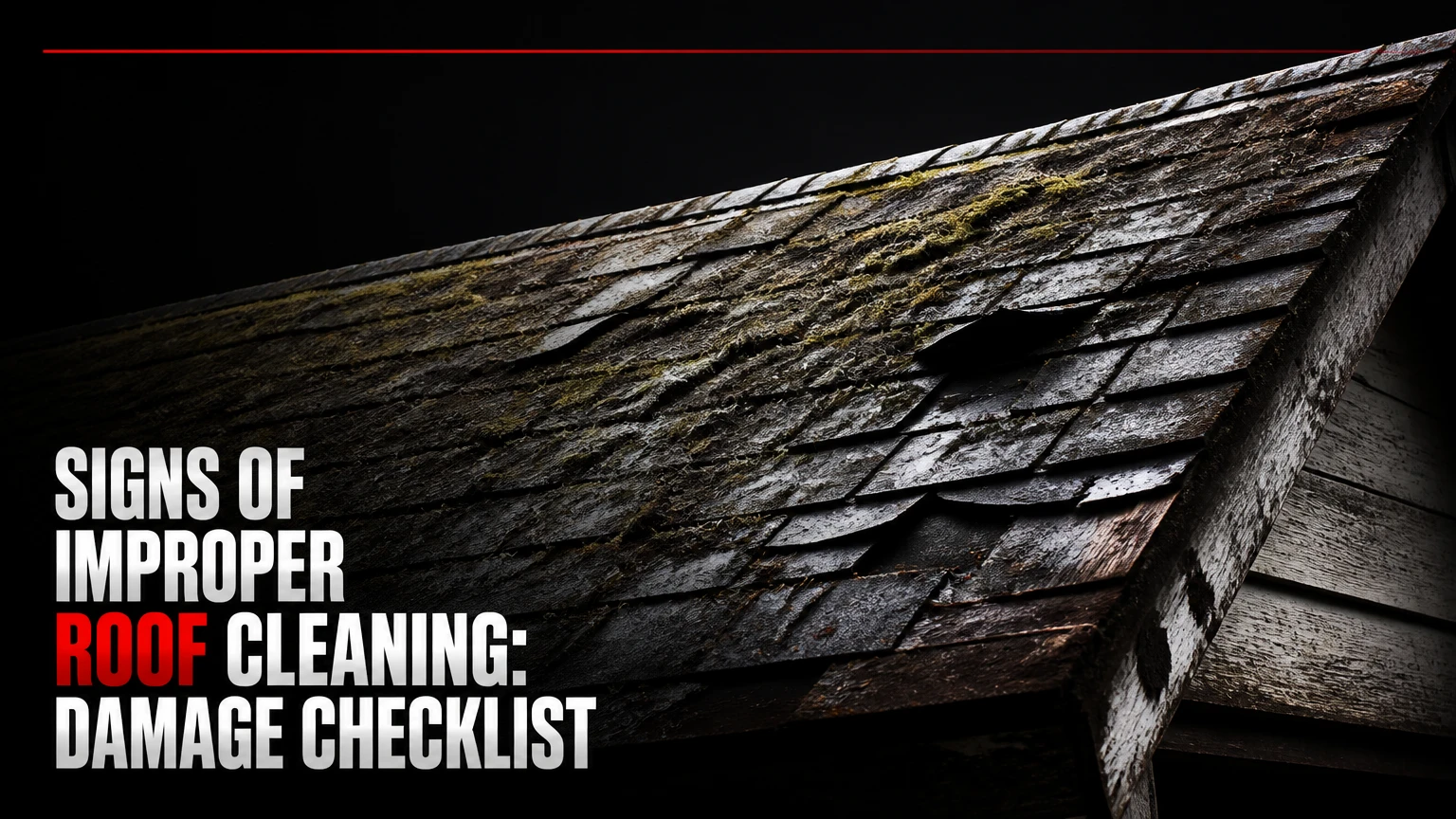
Signs of improper roof cleaning include exposed asphalt, abnormal granules in gutters, broken or displaced roofing materials, bleached patches, corroded metal, dead landscaping, interior leaks, and algae returning within months. The underlying causes are usually excessive pressure, aggressive chemicals, upward water spray, abrasive tools, unsafe foot traffic, or inadequate rinsing.
Key Facts at a Glance
- Asphalt shingles are generally cleaned with low-pressure application and rinsing, not a high-pressure washer.
- A few loose granules are normal, but concentrated piles after cleaning indicate possible surface damage.
- Bleached streaks, brittle tabs, curled edges, and exposed black asphalt require a closer roof inspection.
- Sodium hypochlorite can damage plants and corrode some metals when concentration, dwell time, or runoff is poorly controlled.
- A leak that begins immediately after cleaning requires attic inspection and prompt temporary protection.
- Roof-cleaning cost commonly falls around $0.30-$0.75 per square foot, but material, access, pitch, and remediation change the price.
What Counts as Improper Roof Cleaning?
Improper roof cleaning is any cleaning process that removes or weakens roofing components, drives water beneath protective layers, causes chemical damage, or ignores the roof manufacturer’s care instructions. A roof can look visually clean while losing granules, sealant adhesion, flashing integrity, or wood-fiber strength.
Roof cleaning is not a single technique. Asphalt shingles, cedar shakes, slate, clay tile, concrete tile, and standing-seam metal each tolerate different pressure, chemistry, tools, and walking practices. The correct method also depends on roof age, existing damage, temperature, wind, drainage, and the type of biological growth.
The Asphalt Roofing Manufacturers Association recommends following the shingle manufacturer’s instructions and avoiding practices that damage the granule surface. Manufacturer guidance takes precedence over a generic pressure number because products differ in construction, age, sealant design, and warranty conditions.
Why can a clean roof still be damaged?
A clean appearance does not prove a successful roof treatment. Chlorine can remove the visible color of algae without eliminating moisture conditions, while high pressure can strip granules that protect asphalt from ultraviolet radiation.
The most useful inspection compares three locations: the roof surface, the gutters and downspouts, and the attic. A roof with unusually bare areas, fresh sediment in gutters, and displaced underlayment evidence has a more serious problem than a roof with only temporary cosmetic streaking.
What Are the Main Signs of Improper Roof Cleaning?
The clearest signs are concentrated granule deposits, bald or rough shingle areas, broken roofing units, chemical discoloration, corroded metal, plant injury, water intrusion, and fast biological regrowth. These symptoms should be evaluated by location, timing, roof material, and whether the condition existed before cleaning.
Photograph the roof from the ground before anyone walks on it. Record the cleaning date, weather, products used, equipment settings if available, invoices, worker statements, and the condition of gutters, landscaping, ceilings, and attic insulation.
1. Exposed asphalt or bald shingle areas
Bald shingles show irregular black or dark-brown areas where ceramic-coated mineral granules have been removed. The patches often appear along pressure-washed paths, roof edges, valleys, or places where a stiff brush contacted the surface.
Normal asphalt exposure at a shingle’s factory-cut edge is not the same as a bald field area. Granule loss increases heat absorption and accelerates ultraviolet aging, although a small isolated patch does not automatically require immediate replacement. A roofer should assess the remaining mat, sealant strip, shingle age, and surrounding wear.
2. Unusual granules in gutters and downspouts
Fresh piles of colored mineral granules in gutters after cleaning are a warning sign, especially when deposits are concentrated below recently treated roof sections. Gutter sediment should be compared with older photographs or a neighboring untreated roof plane.
Not every granule in a gutter came from the cleaning. Asphalt roofs naturally shed some granules as they age, and roof traffic, hail, ice, and gutter work can contribute. The timing, quantity, color, and location provide better evidence than a single handful of sediment.
3. Cracked, chipped, or displaced roofing units
Cracked asphalt tabs, fractured clay tiles, broken slate, and displaced concrete tiles can result from foot traffic, scraping, impact, or pressure directed at vulnerable edges. Damage is more likely where workers stood on tile centers, dragged hoses, or used tools beneath overlapping courses.
Slate and clay tile are especially sensitive to point loading. A technician can avoid some breakage by using approved access methods, but a brittle or already deteriorated roof may remain unsafe to walk regardless of technique.
4. Frayed cedar shakes or splintered wood
Cedar shakes damaged by excessive water pressure develop fuzzy fibers, lifted grain, splintering, and localized erosion. A pressure stream can remove the weathered outer layer and expose softer wood beneath it.
Wood roofs require a different decision from asphalt roofs. Cleaning cannot restore split shakes, fungal decay, or lost thickness. A wood-roof contractor should determine whether isolated replacements, preservative treatment, or broader repair is appropriate.
5. Bleached, chalky, or uneven patches
White, yellow, orange, or unnaturally pale streaks may indicate chemical overexposure, uneven application, residue, or pre-existing weathering revealed by cleaning. The appearance alone cannot identify the chemical or prove permanent damage.
Strong oxidizers can lighten organic stains, but they may also affect colored surfaces, nearby coatings, metals, and plants. Record the pattern before rain changes it, then request the product name, safety data sheet, dilution, dwell time, and rinse procedure from the contractor.
6. Rusted fasteners, flashing, or metal valleys
Rust appearing soon after cleaning suggests chemical runoff, residue, damaged coatings, salt exposure, or an existing corrosion process accelerated by wetting. Galvanized steel, aluminum, copper, painted flashing, and fasteners react differently to cleaning chemicals.
Sodium hypochlorite is not automatically unsafe, but uncontrolled concentration and contact time create risk. Acidic products can be particularly harmful to metal and masonry. The correct response is to identify the metal, inspect coating loss, and determine whether corrosion has reached a functional joint or fastener.
7. Dead or scorched landscaping
Brown leaf margins, wilted shrubs, bleached grass, and dead perimeter plants indicate chemical overspray, runoff, or concentrated discharge. Damage can appear within hours, although symptoms may take one or two days when roots absorb contaminated water.
Plants should be pre-wet, protected, and rinsed during and after treatment. If exposure has just occurred, flush leaves and soil with clean water, move containers away from runoff, and retain photographs before removing damaged growth.
8. Water stains or active interior leaks
A ceiling stain, attic drip, wet insulation, or damp roof deck immediately after cleaning is an urgent sign. Upward spray, displaced flashing, broken tiles, damaged pipe boots, and opened shingle laps can all allow water into the assembly.
Stop further cleaning. Photograph the interior and exterior, inspect the attic only where safe, place a container under active drips, and contact a roofing contractor. A tarp is a temporary weather measure, not a repair, and homeowners should not climb onto a wet roof to install one.
9. Algae or moss returning within months
Black streaks returning within six to twelve months may indicate surface bleaching rather than effective treatment, but rapid recurrence can also result from deep moss roots, persistent shade, roof moisture, or nearby tree debris. Regrowth alone does not prove the original cleaning was improper.
A proper treatment may remain visually effective for several years in favorable conditions, while damp, shaded, humid, or heavily wooded locations can require more frequent maintenance. Zinc or copper strips can reduce future growth, but they do not repair granule loss or remove established moss blocks.
How Do Different Cleaning Methods Fail?
Cleaning-method failure depends on roof material, pressure, chemistry, access, and runoff control. Pressure washing is usually unsuitable for asphalt shingles, cedar shakes, slate, and many tile roofs, while low-pressure chemical treatment can still fail when the solution is too strong or poorly rinsed.
Method comparison
| Method | Appropriate materials | Typical operating profile | Common failure signs |
|---|---|---|---|
| Low-pressure chemical wash | Asphalt shingles, some tile, selected slate | Low-flow rinse, controlled dwell time, plant protection | Bleached patches, residue, dead plants |
| High-pressure washing | Concrete, some uncoated metal surfaces | Equipment may exceed 1,500 PSI | Granule loss, leaks, coating damage |
| Manual moss removal | Tile, wood, slate with trained access | Hand tools, low force, targeted removal | Gouges, snapped tabs, displaced units |
| Spray-and-leave cleaner | Light algae on compatible roofs | Slow action over days or weeks | No visible change, persistent stains |
| Dry brushing | Limited non-roof applications | Abrasion without water control | Scuffed coatings, loose granules, scratched metal |
Can pressure washing damage asphalt shingles?
Yes. Pressure washing can dislodge asphalt-shingle granules, remove protective surface material, break sealant bonds, force water beneath laps, and accelerate leaks. A garden hose may be appropriate for final rinsing when the manufacturer permits it, but a pressure washer is not equivalent to a low-pressure roof-cleaning system.
There is no universal “safe pressure” that applies to every shingle. The often-repeated 0-300 PSI limit is a field rule, not a universal manufacturer standard, and pressure at the roof surface changes with nozzle type, distance, flow, angle, and equipment condition. Follow the specific shingle manufacturer’s written instructions.
Which method fits each roof material?
| Roof material | Preferred cleaning approach | Avoid | Inspection concern |
|---|---|---|---|
| Asphalt shingle | Low-pressure compatible treatment and gentle rinse | Pressure washer, stiff brush, aggressive scraping | Granule loss and exposed mat |
| Cedar shake | Specialist assessment, controlled low-pressure or approved treatment | High pressure, forceful brushing | Splintering, rot, lifted fibers |
| Clay or concrete tile | Low-pressure rinse, manual removal by trained worker | Walking on unsupported centers | Cracks, displaced tiles, broken laps |
| Slate | Specialist hand work and controlled rinse | Pressure, casual foot traffic | Cleavage, corner breaks, slipped slates |
| Standing-seam metal | Manufacturer-approved detergent and low-pressure rinse | Abrasive pads, incompatible acids | Coating failure, corrosion, fastener damage |
A roof cleaner who recommends one identical process for every material is overlooking a basic inspection requirement. Tile, slate, and wood roofs often need a roofer with material-specific experience rather than a general exterior-washing crew.
How Much Granule Loss Is Abnormal?
There is no reliable universal weight or volume threshold for abnormal granule loss because roof age, shingle design, storm history, slope, gutter length, and cleaning technique change the result. Concentrated piles directly below cleaned areas are more concerning than scattered, small amounts collected over several seasons.
Use a practical evidence sequence:
- Photograph gutter contents before cleaning them.
- Separate fresh colored granules from leaves, dust, and roofing cement.
- Compare multiple downspouts, including an untreated roof section if available.
- Photograph bald areas from the ground and from a safe inspection position.
- Ask a roofer to assess whether the fiberglass mat or asphalt binder is exposed.
The Insurance Institute for Business & Home Safety identifies granule loss as a roof-aging and weather-damage concern, but gutter granules alone cannot establish a covered insurance loss. Insurance policies generally address sudden, accidental events rather than poor workmanship or normal wear, so the cause and policy language matter.
What Should You Do After a Roof-Cleaning Problem?
After suspected damage, stop the work, preserve evidence, prevent additional water entry, and obtain an independent roof inspection. Do not allow the original cleaner to scrub, repaint, reseal, or discard damaged materials before photographs and written findings exist.
Immediate response by symptom
| Symptom | First action | Professional needed | Typical urgency |
|---|---|---|---|
| Granules in gutters | Photograph and pause gutter cleaning | Roofing contractor | Within 1-7 days |
| Wilted plants | Flush leaves and soil with clean water | Landscaper or chemical specialist if severe | Same day |
| Active ceiling leak | Contain water and protect contents | Emergency roofer | Immediate |
| Broken tiles or slate | Keep people off roof and photograph | Tile or slate roofer | Within 24-72 hours |
| Bleached shingle patches | Request chemical records and roof assessment | Roofing contractor | Within 1-2 weeks |
| Rusted flashing | Photograph joints and check for coating loss | Roofer or sheet-metal contractor | Within 1-2 weeks |
A roof inspection should document shingle condition, flashing, penetrations, valleys, underlayment visibility, attic moisture, ventilation, and gutter sediment. A written report that states location, likely mechanism, and repair recommendation is more useful in a contractor dispute than a general statement that the roof “looks damaged.”
How Much Does Proper Roof Cleaning Cost?
Typical residential roof cleaning costs range from $0.30-$0.75 per square foot, or approximately $600-$1,500 for a 2,000-square-foot roof. Steep pitch, difficult access, heavy moss, multiple roof planes, fragile materials, plant protection, and repair work can move the price outside that range.
| Project condition | Typical price range | Typical duration | Main price driver |
|---|---|---|---|
| 1,500-square-foot asphalt roof, light algae | $450-$1,125 | 2-4 hours | Access and chemical control |
| 2,000-square-foot asphalt roof, moderate growth | $600-$1,500 | 2-5 hours | Roof pitch and treatment time |
| 2,000-square-foot steep roof | $900-$2,000 | 4-8 hours | Safety equipment and labor |
| Heavy moss with manual removal | $1,000-$3,000 | 1-2 days | Hand work and roof repairs |
| Slate, tile, or wood specialist cleaning | $1,200-$3,500 | 4-12 hours | Fragility and access |
A very low quote is not proof of improper work, but a quote below roughly $300 for a typical roof may indicate minimal setup, inadequate plant protection, or rushed application. Ask whether the price includes gutter protection, runoff control, roof inspection, cleanup, and return treatment.
Should Homeowners Clean a Roof Themselves?
Most homeowners should not climb onto a pitched roof or use a pressure washer. A homeowner may apply a compatible, labeled, low-risk treatment from a secure ground or ladder position when the product instructions allow it, but roof access, electrical hazards, fragile materials, and chemical runoff make professional work safer for many properties.
The U.S. Environmental Protection Agency states, “The label is the law.” That rule applies when a pesticide-labeled product is used for algae, moss, or other biological growth. Follow the label for dilution, personal protective equipment, application conditions, runoff controls, storage, and disposal.
Do not use a ladder as a substitute for fall protection on a steep roof. Do not mix bleach with acids, ammonia, or unknown cleaners. Stop work during wind, freezing conditions, lightning, or weather that could carry spray toward people, pets, neighboring property, or waterways.
Which Mistakes Cause the Most Roof Damage?
The most damaging mistakes combine force with a vulnerable roof surface. Experienced roof inspectors pay particular attention to the following practices:
- Spraying upward beneath shingle courses instead of directing water downslope.
- Using a rotating pressure nozzle or narrow fan on asphalt shingles.
- Walking on slate or clay tile centers rather than using approved access methods.
- Scraping moss aggressively when shingles are brittle or bonded to the growth.
- Applying chemical solution to dry plants without pre-wetting and post-rinsing.
- Leaving concentrated cleaner in valleys, gutters, seams, or around metal penetrations.
- Installing zinc or copper strips over heavy moss without first removing the existing mass.
- Treating a roof without checking the manufacturer’s maintenance instructions.
- Assuming a clean appearance means the algae roots, moisture source, or damaged substrate is resolved.
One counterintuitive field observation is that the roof may show its worst cleaning damage in the gutters rather than on the roof. Granules and small fragments collect where they can be counted, while a stripped shingle surface may be difficult to see from the ground.
A second practitioner rule is to inspect the roof before cleaning, not after. Pre-existing blistering, hail marks, brittle edges, failed flashing, and loose tiles can be incorrectly blamed on the cleaner unless dated photographs establish the starting condition.
Can Improper Cleaning Void a Roof Warranty?
Improper cleaning can create a warranty dispute and may void portions of manufacturer coverage when the work violates published maintenance instructions or causes damage. A warranty typically covers defined manufacturing defects, not every failure occurring during the roof’s service life.
Keep the shingle brand, product line, installation date, warranty document, cleaning invoice, chemical records, photographs, and inspection report. Ask the manufacturer or authorized representative which maintenance practices are permitted for that exact product.
A manufacturer warranty does not normally transfer responsibility for workmanship damage to the cleaner. The contractor’s liability insurance, contract language, licensing requirements, and local consumer-protection rules may control the recovery process.
How Can You Tell Whether Damage Was Pre-Existing?
Pre-existing roof damage usually appears in dated inspection photographs, older real-estate records, storm documentation, attic stains, or consistent wear across untreated roof sections. Cleaning-related damage often follows the worker’s path, appears immediately after the service, or clusters beneath spray patterns and access points.
Timing is useful but not conclusive. A cleaning session can reveal an old leak by removing moss that had temporarily blocked water, while a pressure stream can also create a new leak in already weakened flashing.
Compare four evidence points: the invoice date, weather during and after cleaning, photographs before and after, and the location of symptoms relative to the work area. An independent roofer should identify the most probable mechanism rather than promise certainty from appearance alone.
FAQ
Is roof cleaning supposed to remove all granules?
No. Proper roof cleaning should not produce heavy, concentrated piles of granules. Small amounts can occur from normal aging, prior storms, gutter work, or existing deterioration, so the quantity and location must be compared with the roof’s age and pre-cleaning condition.
How quickly can roof damage appear after cleaning?
Chemical discoloration and plant injury may appear within hours, while leaks can begin during the first rainfall or immediately during rinsing. Granule loss may be visible at once, but accelerated aging from a stripped surface develops over months or years.
Is black algae on shingles a structural problem?
Black algae is usually a cosmetic growth during its early stage, but it indicates persistent moisture and shade. Thick moss can lift shingle edges, retain water, and promote decay. Algae returning quickly after treatment may indicate inadequate application or unfavorable roof conditions.
Can roof cleaning repair a leak?
No. Roof cleaning removes biological growth and surface deposits; it does not repair flashing, underlayment, shingles, tiles, fasteners, or roof decking. A leak after cleaning requires a roofing diagnosis, temporary weather protection when necessary, and a permanent repair.
Should gutters be cleaned after roof cleaning?
Yes, but photograph the gutter contents first when damage is suspected. Cleaning removes chemical residue, leaves, and loose material that could block downspouts, while the photographs preserve evidence of unusual granule or roofing-fragment deposits.
Does a low-pressure wash guarantee safe roof cleaning?
No. Low pressure reduces mechanical risk, but chemical concentration, dwell time, runoff, roof condition, walking practices, and rinsing still determine the result. A low-pressure process can damage plants, discolor surfaces, corrode metal, or worsen a pre-existing roof defect.
The Bottom Line
The most reliable signs of improper roof cleaning are exposed asphalt, abnormal gutter granules, fractured roofing units, splintered wood, bleached patches, corrosion, dead landscaping, new leaks, and rapid regrowth. Stop questionable work, document every symptom, protect the interior from water, and obtain an independent inspection before authorizing repairs.
Improper roof cleaning is not defined by an unattractive result alone. It is defined by measurable harm to the roof system, surrounding property, or drainage components. Use the exact shingle or roofing-material instructions, avoid pressure-washing vulnerable surfaces, control chemicals and runoff, and preserve records if the cleaning caused damage.