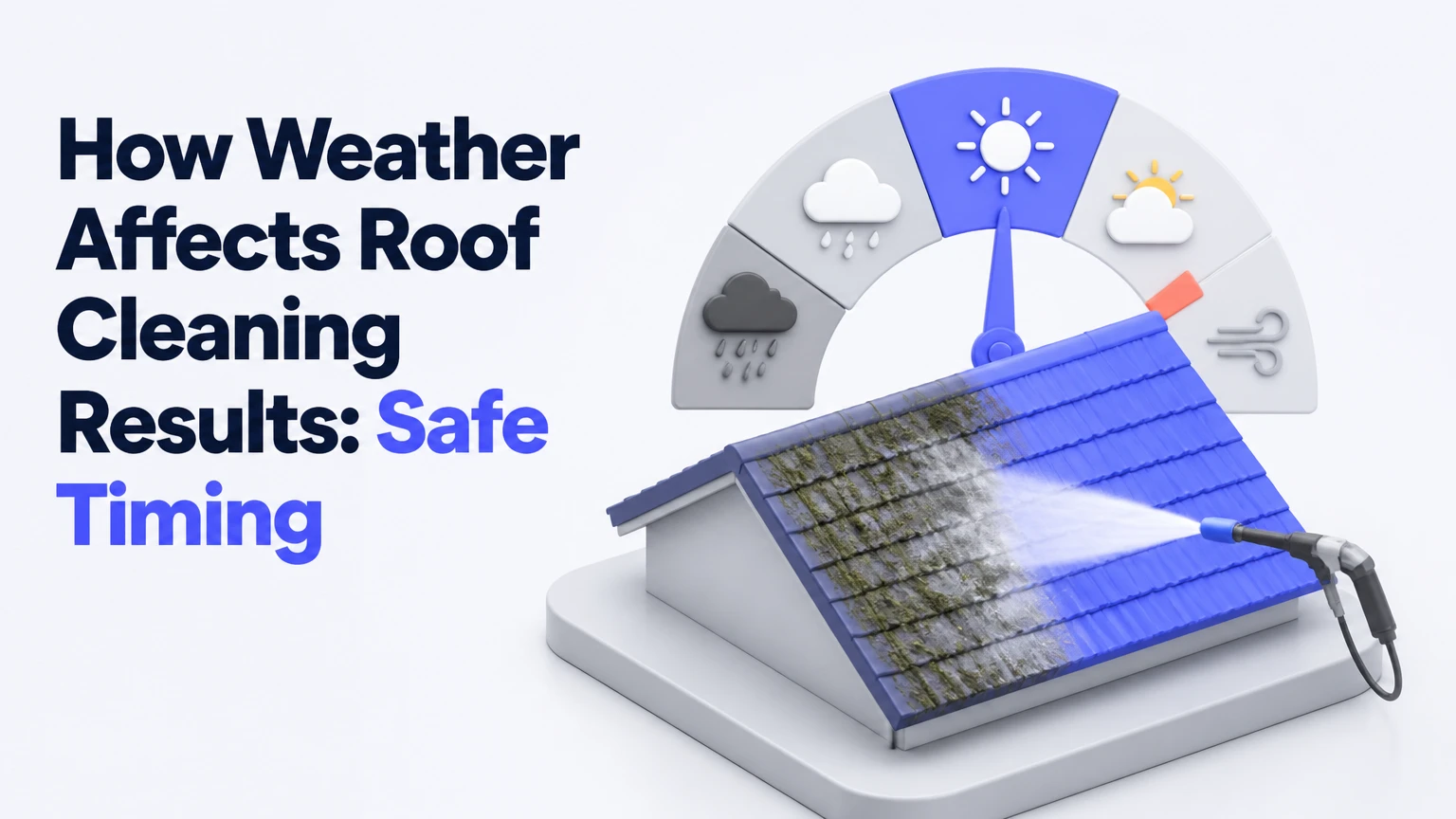
Weather affects roof cleaning results by controlling chemical dwell time, biological breakdown, runoff, surface temperature, and worker safety. Cool, dry, calm conditions usually produce the most consistent treatment, while direct heat, rain, strong wind, frost, and sudden temperature changes can reduce cleaning performance or damage roofing and landscaping.
Key Facts at a Glance
- Roof cleaning chemicals work best when the roof remains wet for the product’s specified dwell time.
- A typical workable air-temperature range is 10°C to 27°C, but the product label and roof material take priority.
- Rain during the dwell period dilutes or removes treatment before algae, moss, or lichen receive an effective dose.
- Wind affects both safety and overspray; 16 km/h is a useful planning threshold, while gusts can require an earlier shutdown.
- Direct sun heats asphalt shingles well above the air temperature and can cause rapid evaporation.
- Visible improvement may take 1-3 weeks after a low-pressure biological treatment, even when active labor lasts only 2-5 hours.
How Weather Changes Roof Cleaning Results
Roof cleaning depends on a controlled chemical reaction followed by safe drainage and drying. Sodium hypochlorite solutions, surfactants, water, and specialty biocides need sufficient contact time on organic growth; weather determines whether the mixture stays in place, evaporates, freezes, or runs into unwanted areas.
A hot roof can dry a treatment before the active ingredient reaches moss roots or lichen attachment points. Rain can dilute the solution and carry it into gutters before the specified dwell period ends. Wind can move spray away from the target and create exposure for plants, vehicles, siding, pets, and workers.
The roof surface matters more than the weather app alone. A south-facing asphalt roof in bright sun may be too hot at an air temperature of 24°C, while a shaded north-facing roof can remain damp after a cool night. Experienced contractors therefore inspect surface condition, dew, cloud movement, wind gusts, and the roof’s material before mixing chemicals.
What does dwell time control?
Dwell time is the period a cleaning solution remains wet and chemically active on the roof. A typical soft-wash treatment may need 15-30 minutes, although heavy lichen, shade, temperature, product concentration, and manufacturer instructions can change that range.
Dwell time is not the same as project duration. A crew may spray for 60 minutes, allow 20 minutes of contact, rinse for 90 minutes, and spend another hour protecting plants and clearing gutters. Leave-on treatments may continue weakening biological growth for days after the crew leaves.
The Environmental Protection Agency states, “The label is the law.” That principle applies to application temperature, dilution, contact time, personal protective equipment, and permitted surfaces. A generic 15-minute rule never overrides the registered product label.
Which Temperatures Work Best?
A typical planning range for roof cleaning is 10°C to 27°C, or 50°F to 80°F, because water-based solutions remain workable without freezing or evaporating too quickly. The best practical condition is often a cool, shaded, dry period near the middle of that range, not simply the warmest available day.
| Condition | Typical effect on treatment | Main roof or safety concern | Preferred action |
|---|---|---|---|
| Below 4°C | Water may freeze; reaction slows sharply | Ice formation and slippery surfaces | Postpone until surfaces remain above freezing |
| 4°C to 9°C | Slower biological response; longer drying | Frost, dew, and extended wetness | Use only if the product label permits it |
| 10°C to 27°C | Stable dwell time and manageable evaporation | Lowest weather-related risk | Preferred operating range |
| 28°C to 32°C | Faster evaporation and hotter shingles | Shortened dwell and granule loss | Work in shade or postpone |
| Above 32°C | Rapid drying and high surface heat | Chemical concentration and heat exposure | Do not apply in direct sun |
Air temperature does not equal shingle temperature. Dark asphalt shingles can become substantially hotter than surrounding air under direct sunlight, so a contractor may spray a shaded roof face first and postpone a sun-exposed face until cloud cover or late afternoon.
Cold weather creates a different failure mode. A solution that remains liquid in a tank may freeze on a roof surface, in a pump, or inside a hose. Water trapped against cracked tile, slate, or flashing can expand as it freezes, increasing the risk of damage.
Is humidity helpful or harmful?
Moderate humidity can slow evaporation and extend wet contact, but high humidity does not compensate for rain, dew, or a saturated roof. A damp surface can also make roof access more dangerous and prevent a technician from determining whether the treatment is evenly distributed.
Humidity becomes especially difficult when overnight dew is heavy. A roof may appear dry from the ground while retaining moisture in moss mats, shingle laps, valleys, and shaded tile. Cleaning should begin only after the surface is dry enough for predictable chemical placement and safe movement.
Can Rain or Humidity Ruin a Treatment?
Rain can ruin a roof-cleaning application when it begins before the product’s required dwell time ends. A light shower may dilute the solution, while heavy rain can wash treatment into gutters and landscaping, leaving insufficient chemical contact on algae, moss, or lichen.
| Rain timing | Likely result | Recommended response | Typical delay |
|---|---|---|---|
| Before application | Wet roof and poor access | Wait for complete surface drying | 2-24 hours |
| Within 0-15 minutes | Major dilution or wash-off | Stop and follow product reapplication guidance | 24-48 hours |
| After 15-30 minutes | Partial reduction, product dependent | Assess coverage before deciding | Same day or next dry window |
| 4-6 hours later | Usually lower disruption for many products | Inspect runoff and finished areas | Often no delay |
| Overnight after treatment | May be acceptable if label allows | Confirm product instructions and drainage | Usually none |
The four-to-six-hour rain-free period is a useful planning minimum for many water-based treatments, not a universal guarantee. Some products specify longer protection, and a forecast showing rain two hours after application is not equivalent to a dry period.
If rain begins mid-job, stop spraying. Do not climb onto a newly slick roof to chase missed areas. Protect exposed plants with clean-water rinsing where appropriate, keep people and pets away from runoff, and flush downspouts only when doing so will not move concentrated solution into a sensitive drainage area.
How should dew and morning moisture affect scheduling?
Dew should be treated as precipitation when it leaves the roof visibly wet. Early starts can work during hot weather only after the roof has dried, so a 6:00 a.m. start is not automatically safer or more effective than a later shaded period.
A moisture meter is rarely necessary for routine residential work, but a visual inspection of valleys, moss colonies, tile joints, and shaded slopes prevents uneven dilution. The roof should be dry enough that the applied mixture remains at its intended concentration rather than combining with surface water.
When Does Wind Make Roof Cleaning Unsafe?
Wind becomes a roof-cleaning problem when it causes spray drift, unstable ladder conditions, poor hose control, or rapid drying. A typical planning threshold is below 16 km/h, or 10 mph, but gust speed and wind direction matter more than a single average number.
| Wind condition | Spray behavior | Worker concern | Decision |
|---|---|---|---|
| 0-8 km/h | Low drift; controlled application | Normal ladder precautions still required | Usually workable |
| 9-16 km/h | Some drift near roof edges | Protect plants and vehicles | Work selectively |
| 17-20 km/h | Fine mist travels downwind | Ladder and chemical exposure risk | Usually postpone spraying |
| Above 20 km/h | Unpredictable overspray | High fall and control risk | Stop chemical application |
| Gusty or shifting wind | Direction changes during passes | Protection plan can fail | Use gusts as the limit |
Wind direction determines where overspray lands. A contractor spraying from the windward side may send hypochlorite mist over a garden, painted siding, air-conditioning equipment, or a neighboring property even when average wind speed appears acceptable.
Lowering pump pressure and moving closer to the roof can reduce drift, but those measures do not make high winds safe. A long extension wand may increase control distance while also increasing hose drag and operator imbalance. Wind is a stop-work condition when the worker cannot keep the stream on the intended surface.
How Do Sunlight and Roof Orientation Matter?
Direct sunlight accelerates evaporation and raises roof-surface temperature, so the same cleaning mixture can remain wet for 25 minutes in shade but dry in several minutes on a hot, exposed slope. South- and west-facing roof planes often require different timing from north-facing or tree-shaded planes.
The common “sun-baking” mistake occurs when a chemical solution dries before the reaction is complete. Dried residue can concentrate active ingredients and salts, increase the chance of plant injury through runoff, and make later rinsing more difficult. Scrubbing a hot asphalt roof to remove residue can also dislodge protective granules.
Overcast conditions are often favorable, but clouds alone do not guarantee success. A passing cloud bank may disappear halfway through application, and a humid summer day may still produce a hot roof. Watch the roof surface rather than relying on the forecast icon.
Should you clean in the morning or afternoon?
Morning is preferable during hot weather only after dew has evaporated and while the roof remains cool. Afternoon can be better in cold or damp climates when morning moisture persists, but late-day work requires enough daylight for rinsing, inspection, and safe ladder removal.
A practical sequencing rule is to start with the roof face that will heat first, then move toward shaded faces if the solution can remain wet. Another approach is to protect and pre-wet landscaping, apply smaller sections, and verify that each section reaches its full dwell time before the next section begins.
How Does Roofing Material Change the Weather Decision?
Roofing material changes how weather affects safety, chemical compatibility, and physical damage. Asphalt shingles are vulnerable to granule loss when hot, while slate and tile can become dangerously slick when wet and may crack under foot traffic or thermal shock.
| Roofing material | Weather sensitivity | Cleaning constraint | Safer practice |
|---|---|---|---|
| Asphalt shingle | Heat softens the surface; granules can loosen | Avoid hot-roof walking and pressure washing | Use low pressure and shaded timing |
| Concrete tile | Porous, heavy, and slippery when wet | Freeze-thaw and broken tiles require care | Inspect for cracks and avoid aggressive pressure |
| Clay tile | Thermal shock and brittleness | Hot tile followed by cold water can crack | Use moderate temperature transitions |
| Natural slate | Brittle, layered, and hazardous when wet | Foot traffic can fracture or dislodge slate | Use specialist access methods |
| Metal roofing | Condensation and rapid heat transfer | Very slick when wet; coatings may be sensitive | Follow coating and detergent instructions |
Roof cleaning is not appropriate for every DIY situation. A steep slate roof, fragile historic tile, active leak, damaged flashing, or roof with no safe access route warrants a qualified roofing or cleaning professional rather than a homeowner experiment.
Pressure washing is especially unsuitable for many asphalt roofs because the force can remove granules and drive water under laps. Weather does not make pressure washing safe; a cool day only reduces heat stress while leaving the mechanical damage risk.
Which Season Is Most Reliable?
Autumn and spring usually provide the best balance of moderate temperatures and manageable evaporation, while summer requires tighter scheduling and winter often creates freezing or access problems. Local climate matters more than the calendar because coastal humidity, desert heat, and northern frost produce different cleaning windows.
| Season | Typical advantage | Typical obstacle | Scheduling approach |
|---|---|---|---|
| Spring | 10°C to 22°C temperatures; post-winter cleanup | Showers, pollen, lingering dew | Choose a 24-48-hour dry forecast |
| Summer | Longer daylight and predictable rain in some regions | 28°C-plus surfaces and rapid drying | Use shade and cooler morning windows |
| Autumn | Cool air and pre-winter debris removal | Leaves, frost, shorter daylight | Clean before repeated leaf fall |
| Winter | Low biological growth activity | Frost, ice, freezing solutions | Postpone unless climate and label permit |
Spring cleaning can remove winter debris before warm temperatures accelerate algae growth, but pollen may settle on wet surfaces and obscure the final appearance. Autumn cleaning works well before winter, provided falling leaves will not immediately cover a freshly treated roof.
Regional timing changes the answer. A humid southeastern USA climate may support algae growth through much of the year, while a cold continental climate may have only a few reliable weeks before frost. Coastal wind and salt exposure also make drift control more important.
What Forecast Should You Check?
A roof-cleaning forecast should cover at least 48 hours and include hourly rain probability, wind speed and gusts, temperature, cloud cover, dew or frost risk, and overnight low temperature. The forecast should be checked again immediately before chemical mixing because localized showers can invalidate a morning decision.
Use the following pre-job check:
- Confirm the roof surface is dry, including shaded valleys and moss colonies.
- Check that the application temperature fits the product label.
- Confirm a rain-free period that exceeds the required dwell time.
- Review wind gusts, not only average wind speed.
- Identify the sun path across each roof face.
- Protect or pre-wet nearby vegetation according to the chemical label.
- Confirm that runoff can be controlled and that downspouts do not discharge onto sensitive planting beds.
- Stop if lightning, hail, freezing precipitation, or unsafe access develops.
Forecast confidence matters. A 30% chance of thunderstorms during a 20-minute dwell period presents more practical risk than a 60% chance of brief rain twelve hours later. The useful question is whether the roof can complete treatment and controlled rinsing before conditions change.
How Long and How Much Does Weather-Compatible Cleaning Take?
Typical active labor takes 2-5 hours for a residential roof, while a leave-on treatment may take 1-3 weeks to produce its full visible biological improvement. Weather can add setup time, section-by-section application, plant protection, drying delays, or a second visit.
| Project factor | Typical range | Weather-related change | Cost implication |
|---|---|---|---|
| Small, accessible roof | 2-3 labor hours | Minimal on cool, calm day | About $400-$700 |
| Medium residential roof | 3-5 labor hours | Extra protection in wind or heat | About $600-$1,200 |
| Large or steep roof | 5-8 labor hours | More sections and access controls | Often above $1,200 |
| Return visit after rain | 1-3 additional hours | Reassessment and reapplication | Product and labor may be added |
| Delayed biological clearance | 1-3 weeks | Slower in cool conditions | Usually no extra charge if treatment worked |
Typical professional pricing ranges from approximately $400-$1,200 in the USA and £350-£950 in the UK, but roof area, pitch, access, growth severity, material, chemical controls, and regional labor rates determine the actual price. Weather surcharges are less common than rescheduling, although a second mobilization can increase the total.
A low quote may exclude gutter clearing, plant protection, steep-roof access, or a return visit. Ask whether the price covers chemical treatment, rinsing, runoff management, and post-treatment inspection.
What Should You Do When Conditions Change?
When a roof dries during application, stop and assess the affected section instead of scraping the residue. A light water mist or a product-approved secondary application may re-wet the surface, but concentrated residue should not be spread blindly across hot shingles or washed toward unprotected landscaping.
When rain starts, stop chemical application and leave the roof safely. Do not add more product while water is actively diluting the first coat, and do not assume rainfall provides a useful rinse because it may create uncontrolled chemical runoff.
When wind gusts rise, lower the wand only if the operator can remain stable and drift remains controlled. Stop spraying when gusts approach 20 km/h, when direction shifts toward sensitive property, or when ladder movement becomes difficult.
Common recovery errors include:
- Scrubbing dried chemical from asphalt shingles, which can remove granules.
- Continuing because only one roof face remains.
- Rinsing concentrated runoff directly into a flower bed.
- Reapplying without checking the label’s re-entry and dilution instructions.
- Walking on wet slate or brittle tile to inspect missed patches.
- Treating a weather disruption as a cosmetic inconvenience rather than a safety event.
The safe recovery is often postponement. Chemical waste is cheaper than a fall, damaged roof covering, or dead landscaping.
Expert Rules That Improve Results
Roof temperature beats air temperature. A 25°C forecast can conceal a much hotter dark roof in direct sun. Shade, cloud cover, and orientation should determine application order.
A longer dry forecast is not always better than a cooler one. A 12°C, calm, overcast day can produce more reliable dwell time than a 26°C day with bright sun, even when both offer six rain-free hours.
Rain-free time must include the treatment’s actual chemistry. If the label requires 30 minutes of wet contact, a forecast gap of 20 minutes is inadequate, regardless of the total dry weather later that day.
The rinse is part of weather planning. Water used to rinse chemicals, gutters, siding, and plants needs a controlled destination. A dry forecast does not eliminate environmental exposure from runoff.
Biological removal is not always immediate. A roof can look darker or patchier after treatment because dead growth releases gradually. Aggressive brushing to force an instant cosmetic result can cause more roof damage than the original growth.
FAQ
Can roof cleaning be done in full sun?
Roof cleaning can be done in full sun only when the product, roof temperature, and crew method allow the solution to remain wet for its required dwell time. Smaller sections, shade, early timing, and careful monitoring can help, but hot asphalt shingles and rapid evaporation make postponement safer.
How many dry days are needed before cleaning a roof?
The roof needs to be dry before application, followed by enough rain-free time for the product’s stated dwell and curing requirements. A practical planning window is at least 4-6 dry hours after treatment, although some labels require longer protection.
Can moss be removed during cold weather?
Moss can be treated in cool weather only when the chemical label permits the temperature and the roof will not freeze during application or dwell. Below approximately 4°C, water-based solutions may freeze or react slowly, while ice increases slip and material damage risks.
Does roof cleaning work better after rain?
Roof cleaning does not generally work better immediately after rain because saturated shingles and moss dilute the treatment and increase slip risk. Wait until the roof has dried, then apply the solution during a calm weather window that protects the full dwell period.
Should gutters be cleaned before or after the roof?
Loose debris is usually cleared before chemical application, while final gutter and downspout inspection occurs after treatment and rinsing. The sequence prevents leaves from blocking drainage and allows the technician to check whether chemical-laden water is pooling or discharging incorrectly.
Can weather cause roof stains to return faster?
Weather can influence how quickly roof staining returns, especially persistent humidity, shade, rainfall, and nearby tree cover. A cleaning treatment removes existing biological growth, but it does not change the moisture and shade conditions that support future algae, moss, or lichen.
The Bottom Line
Weather affects roof cleaning results through evaporation, dilution, freezing, chemical dwell time, runoff, and physical safety. For how weather affects roof cleaning results, the most reliable answer is to choose a dry, calm, moderately cool window, verify the roof surface rather than air temperature alone, and follow the cleaning product label.
A typical target is 10°C to 27°C, wind below 16 km/h, and at least 4-6 rain-free hours after application. Postpone work for wet roofs, high gusts, freezing conditions, lightning, or hot surfaces that cause rapid drying. Correct timing protects the roof, improves biological control, reduces chemical waste, and limits harm to surrounding property.