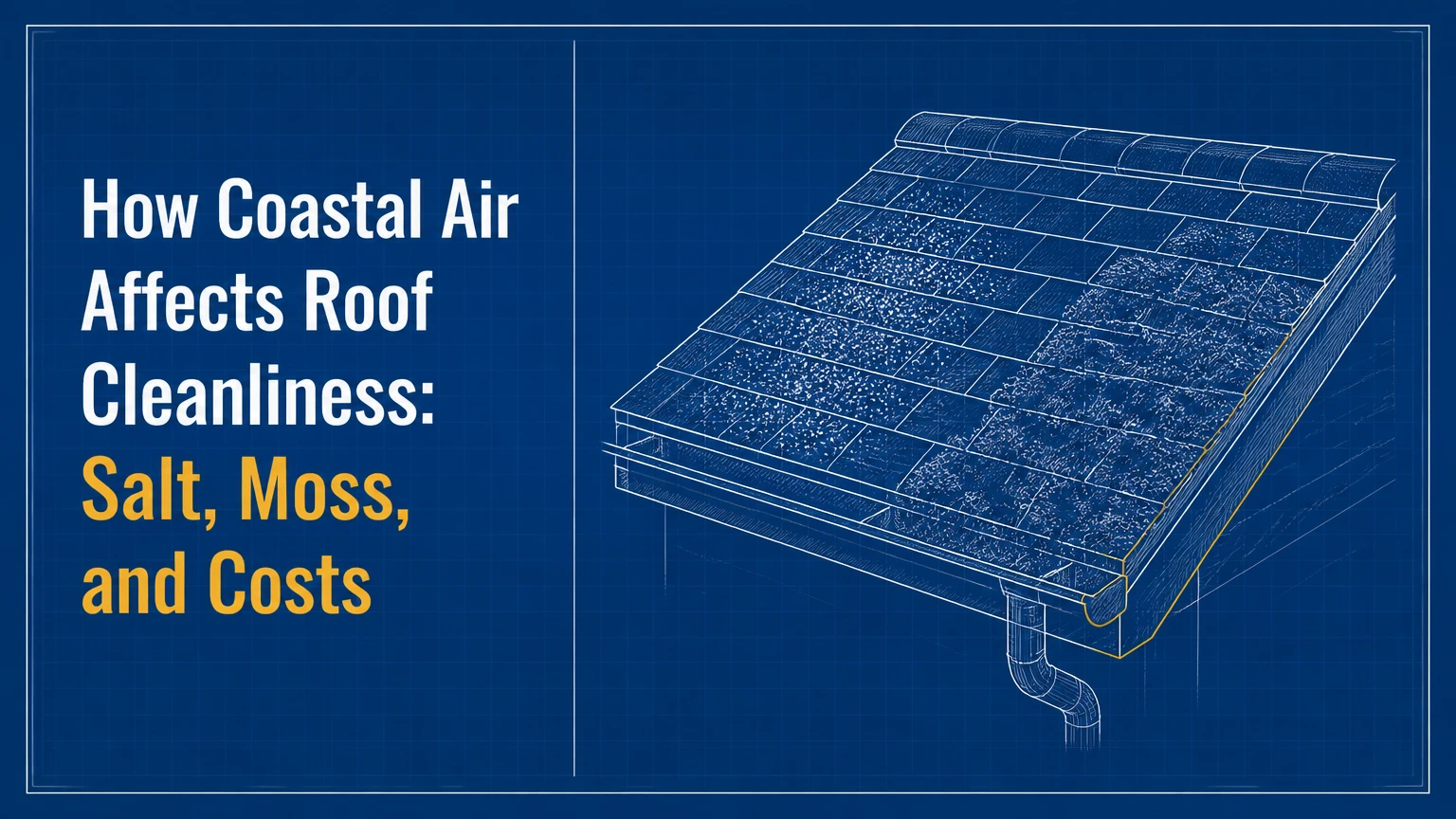
Coastal air affects roof cleanliness by depositing sea-salt particles, moisture, dust, and biological spores onto the roofing surface. Salt residue attracts moisture and holds contamination in roof texture, while shade and poor drying encourage algae, moss, and lichen. The result is faster staining, more frequent cleaning, and increased corrosion or material wear.
Key Facts at a Glance
- Sea-spray salt reaches roofs mainly through windborne marine aerosols, with the heaviest deposition usually closest to the shoreline.
- Salt does not usually create black streaks by itself; cyanobacteria, algae, dirt, and moisture produce the visible discoloration.
- Coastal humidity increases drying time, but no single 75% humidity threshold predicts biological growth on every roof.
- Pressure washing can remove asphalt granules, damage tile surfaces, and force water beneath flashing or roof coverings.
- A coastal roof often needs inspection every 6-12 months and cleaning roughly every 1-3 years, depending on exposure and growth.
- Uncoated steel fasteners, cut metal edges, porous tile, shaded slopes, and clogged gutters are common coastal failure points.
How Coastal Air Affects Roof Cleanliness
Coastal air affects roof cleanliness through four linked processes: marine aerosol deposition, moisture retention, particle adhesion, and biological colonization. Breaking waves create salt-containing droplets, wind carries those droplets inland, and roof surfaces capture them along with dust and organic debris. Porous or textured materials retain the mixture longer than smooth, well-coated surfaces.
The strongest salt exposure normally occurs in the first several kilometres from the shore, but distance alone does not determine risk. A house directly facing prevailing onshore winds, an elevated building, or a roof exposed to sea spray can accumulate more residue than a sheltered building located farther inland.
NOAA describes sea-spray aerosol formation as a result of bubble bursting at the ocean surface. That process explains why coastal contamination is airborne rather than limited to direct splash. Salt-laden air can reach inland properties when wind, terrain, and storm conditions support transport.
What remains on the roof?
Roof contamination usually contains several materials at once:
| Contaminant | Typical source | Visible or damaging effect |
|---|---|---|
| Sodium chloride residue | Sea spray and wind | White film, sticky deposits, accelerated corrosion |
| Fine sand and dust | Beaches, roads, construction | Abrasion, clogged gutters, dirty surface |
| Organic debris | Trees, birds, nearby vegetation | Nutrients for algae, moss, and lichen |
| Cyanobacteria and algae | Airborne spores and existing colonies | Black, green, or brown staining |
| Moss and lichen spores | Vegetation and local air currents | Surface anchoring, moisture retention, tile displacement |
Rain can rinse loose salt from a roof, but ordinary rainfall does not guarantee complete removal. Salt trapped beneath overlapping shingles, inside tile pores, around fasteners, or in gutter seams may remain after the visible surface dries.
Why Does Salt Air Encourage Roof Staining?
Salt air encourages roof staining because sodium chloride deposits increase surface wetting and help retain a damp film between drying cycles. Salt is hygroscopic, meaning it attracts and holds water from humid air, although the effect depends on concentration, temperature, airflow, and the roof’s surface chemistry.
Salt is not food that directly causes Gloeocapsa magma to multiply. The black streak organism, commonly associated with roof algae or cyanobacterial growth, needs moisture, light, nutrients, and a suitable surface. Coastal salt helps create favorable conditions, but shade, tree debris, roof pitch, and ventilation often determine whether staining becomes severe.
A north-facing or shaded roof slope may remain damp long after a sun-exposed slope dries. Two roofs on the same property can therefore show different contamination patterns even though both receive the same marine air.
The practical contamination sequence
Coastal roof fouling usually develops as a variable sequence rather than a fixed calendar:
- Initial deposition: Salt, dust, and organic particles settle into surface texture.
- Damp-film persistence: Humidity, dew, and salt delay complete drying.
- Early microbial film: Algae or cyanobacteria attach to the damp surface.
- Established growth: Moss or lichen gains a foothold where debris and shade persist.
- Material interaction: Corrosion, granule loss, staining, or moisture entry becomes visible.
A roof can skip stages or remain in one stage for years. A steep, sunny, well-ventilated roof may show salt residue without moss. A shaded, low-slope roof can develop moss rapidly even when salt deposition is moderate.
How Quickly Does a Coastal Roof Get Dirty?
A coastal roof can show visible salt or biological staining within weeks to months, while material damage typically develops over longer periods. Typical service intervals range from 12-36 months for cleaning and 6-12 months for inspection, but storm exposure, shade, material age, and roof drainage can shorten those intervals.
The frequently repeated claim that every coastal roof loses 30%-50% of its lifespan is not a reliable universal statistic. Roof service life varies by product warranty, installation quality, ventilation, wind exposure, maintenance, corrosion protection, and local climate. A poorly maintained roof near surf can fail much earlier than a protected roof several kilometres inland, but one fixed percentage cannot describe both.
| Exposure condition | Visible fouling pattern | Typical inspection interval | Likely cleaning interval |
|---|---|---|---|
| Direct ocean exposure, heavy wind | Salt film, algae, corrosion | 6 months | 12-18 months |
| 0.5-3 km from shoreline, open exposure | Staining and gutter deposits | 6-12 months | 12-24 months |
| 3-10 km inland, moderate wind | Intermittent algae and dust | 12 months | 18-36 months |
| Sheltered inland coastal climate | Localized debris and shade growth | 12 months | 24-48 months |
| Shaded roof under trees | Moss, lichen, organic buildup | 6-12 months | 12-24 months |
These are typical planning ranges, not engineering guarantees. A roof with loose granules, rusting fasteners, cracked tiles, or active leaks needs inspection regardless of its last cleaning date.
How Do Roofing Materials React to Coastal Air?
Roofing materials react differently because their pores, coatings, fasteners, edges, and drainage characteristics differ. Asphalt shingles are vulnerable to granule loss and biological staining, metal roofs are vulnerable at scratches and fasteners, and unglazed tiles can absorb contaminated moisture.
| Roofing material | Main coastal vulnerability | Strongest warning sign | Practical response |
|---|---|---|---|
| Asphalt shingles | Granule loss, algae staining, edge curling | Granules collecting in gutters | Low-pressure cleaning and roof-condition inspection |
| Painted steel | Scratches, cut-edge rust, fastener corrosion | Orange staining or bubbling paint | Repair coating failures and replace corroded fasteners |
| Aluminum roofing | Galvanic contact and pitting in damaged areas | White oxidation or dark pits | Isolate dissimilar metals and repair finish |
| Concrete tile | Porosity, salt residue, surface erosion | Flaking or persistent efflorescence | Gentle cleaning and broken-tile replacement |
| Clay tile | Porosity, cracking, brittle surface | Cracks, chips, displaced tiles | Foot-traffic control and targeted repair |
| Slate | Layer separation and metal-flashing corrosion | Rust stains or delamination | Slate specialist inspection |
| Synthetic roofing | Coating weathering and dirt adhesion | Fading, chalking, surface cracks | Manufacturer-approved cleaning only |
Asphalt shingles
Asphalt shingles do not normally lose limestone filler because salt “dissolves” the roof in the simple way suggested by some cleaning claims. The more common risks are ultraviolet exposure, wind abrasion, aging, aggressive cleaning, algae-related moisture, and loss of protective mineral granules.
Granules in gutters are a condition clue. A small amount may reflect normal aging, while repeated heavy deposits combined with bald patches or exposed mat indicate possible replacement planning.
Metal roofing
Salt air corrodes metal most aggressively at damaged coatings, exposed fasteners, seams, cut edges, and locations where dissimilar metals contact one another. Galvanic corrosion requires an electrochemical connection, so saltwater residue acts as an electrolyte that increases risk rather than automatically causing galvanic corrosion on every metal roof.
Marine-grade aluminum, properly coated steel, stainless fasteners, compatible flashing, and isolated dissimilar metals improve durability. A high-quality coating cannot protect a roof indefinitely if scratches remain unsealed.
Concrete and clay tiles
Concrete tile absorbs more water than glazed clay tile, although actual performance varies by product and surface finish. Salt crystallization inside pores can contribute to surface stress when moisture repeatedly enters, evaporates, and leaves crystals behind. Freeze-thaw damage is especially serious in cold coastal climates, but warm coastal areas can still experience efflorescence, staining, and erosion.
Which Coastal Cleaning Method Is Safest?
Low-pressure chemical cleaning followed by controlled rinsing is generally safer for sound asphalt shingles and many tile roofs than high-pressure washing. The correct method depends on roof material, coating condition, biological growth, runoff controls, and the manufacturer’s instructions.
| Method | Typical cost | Typical duration | Best use | Main limitation |
|---|---|---|---|---|
| Low-pressure soft wash | $0.30-$0.80/sq. ft. | 3-6 hours | Algae and light moss on sound roofs | Requires runoff containment |
| Low-pressure freshwater rinse | $100-$400 | 1-3 hours | Loose salt and dust | Does not remove established growth |
| Manual moss removal | $300-$1,200 | 2-8 hours | Localized moss on fragile surfaces | Labor-intensive and incomplete alone |
| Zinc or copper strips | $15-$40/linear ft. installed | 1-4 hours | Residual algae suppression | Does not repair existing damage |
| Protective coating | $1.50-$4.00/sq. ft. | 1-3 days | Compatible porous or metal systems | Can trap moisture if misapplied |
Typical U.S. prices vary by roof pitch, access, region, containment requirements, insurance, and roof size. A 2,000-square-foot roof may cost approximately $600-$1,600 for a professional soft wash, but steep access or extensive vegetation can increase the invoice.
The Asphalt Roofing Manufacturers Association recommends non-abrasive cleaning practices for asphalt shingles and warns against damaging granules. The U.S. Environmental Protection Agency’s pesticide principle, “The label is the law,” also applies when a contractor uses a registered algaecide or moss-control product.
Why is pressure washing risky?
Pressure washing can remove protective granules, fracture brittle tiles, drive water under laps, and damage flashing. It can also spread contaminated runoff into gardens, storm drains, wetlands, or neighboring property.
A chemical soft wash is not automatically safe. Unbuffered chlorine, excessive concentration, prolonged dwell time, and uncontrolled runoff can damage plants, corrode components, and create environmental violations. Contractors should identify the product, dilution, dwell time, rinse plan, and runoff controls before work begins.
Can Zinc or Copper Strips Prevent Coastal Algae?
Zinc and copper strips can reduce new algae growth below the installation line because rainwater carries small amounts of metal ions down the roof. The strips work as a preventive supplement, not as a complete solution for established moss, salt residue, clogged gutters, or damaged shingles.
Copper generally has stronger biological activity, while zinc products are commonly used for roof algae suppression. Neither strip cleans the entire roof during dry weather, and both perform poorly when leaves, ridge design, roof geometry, or low rainfall prevents water from flowing across the treated area.
Install strips according to the roofing and product manufacturer’s instructions. Copper runoff may stain certain surfaces and can harm aquatic organisms at sufficient concentrations, so drainage paths and local environmental rules matter.
Does Roof Coating Help Against Salt Air?
A compatible roof coating can reduce water absorption, slow dirt adhesion, and protect some metal surfaces, but coating cannot correct failed flashing, wet underlayment, active corrosion, or trapped moisture. Coating selection must follow the roofing manufacturer’s specification and account for vapor movement, adhesion, solar exposure, and future repairs.
Hydrophobic coatings are most useful when the substrate is sound, clean, dry, and compatible with the product. Applying a film over damp tile or concealed corrosion can hide defects while allowing deterioration to continue underneath.
For metal roofing, a coating system with documented salt-spray or marine exposure performance is more meaningful than a generic claim that a product is “waterproof.” ASTM B117 salt-spray testing can compare coating resistance under a laboratory protocol, but test performance does not predict an entire installed roof without considering seams, fasteners, impact, and workmanship.
What Maintenance Does a Coastal Roof Need?
Coastal roof maintenance should combine visual inspection, gutter cleaning, freshwater rinsing where appropriate, vegetation control, and prompt repair of coating or flashing defects. The most effective schedule is exposure-based rather than tied to a universal annual cleaning rule.
Use this maintenance sequence:
- Inspect from the ground and attic. Look for black streaks, moss, rust, loose tiles, granule deposits, damp insulation, and daylight around penetrations.
- Clear gutters and downspouts. Remove salt-laden sediment, leaves, and sand before water backs up beneath roof edges.
- Trim vegetation. Keep branches away from the roof and improve sunlight and airflow over shaded slopes.
- Rinse compatible surfaces. Use low-pressure freshwater to remove loose salt, following the roofing manufacturer’s limits.
- Treat biological growth. Use a roof-approved product at its stated dilution and dwell time, with plant and runoff protection.
- Repair small defects. Seal compatible metal coating damage, replace failed fasteners, and replace broken tiles before water enters.
- Record conditions. Photograph each slope and note cleaning dates, products, corrosion locations, and recurring stains.
You will know maintenance is working when new staining takes longer to appear, gutters contain less sediment, fastener corrosion stops progressing, and the roof dries more quickly after rain.
Expert rule of thumb
Recurring black streaks do not automatically mean the cleaning chemical was too weak. Rapid return can indicate shaded moisture, residual growth in porous material, contaminated gutters, nearby trees, or a roof surface already beyond its useful coating life.
How Should Homeowners Handle Common Coastal Roof Problems?
Coastal roof problems require diagnosis before cleaning because the same visible mark can have different causes. White residue may be salt, efflorescence, paint oxidation, or mineral deposits, while dark streaks may be biological growth, soot, or deteriorated coating.
| Symptom | Probable cause | Safe first action | Escalation point |
|---|---|---|---|
| White crust after drying | Salt deposits or efflorescence | Photograph, then test gentle freshwater rinsing | Persistent deposits or tile spalling |
| Black streaks | Cyanobacteria, algae, or dirt | Manufacturer-approved low-pressure treatment | Return within months or granule loss |
| Green fuzzy patches | Moss in damp, shaded areas | Remove debris and arrange gentle treatment | Lifted shingles or displaced tiles |
| Orange marks | Rusting steel, fasteners, or flashing | Inspect coating and metal interfaces | Pitting, holes, or active leaks |
| Loose granules in gutters | Aging, abrasion, or shingle damage | Collect a sample and inspect slopes | Bald patches or exposed mat |
| Cracked or flaking tile | Impact, aging, salt stress, or freeze-thaw | Restrict roof traffic | Replace tiles and inspect underlayment |
Do not scrub asphalt shingles with a stiff brush. Do not walk on brittle clay tile without appropriate training and access equipment. Do not mix chlorine products with acids, ammonia, or other cleaners.
When should cleaning stop?
Cleaning should stop when granule loss increases, tiles move under light contact, metal surfaces reveal deep pitting, underlayment is exposed, or water enters the attic. A clean-looking roof with compromised waterproofing is not a successful cleaning outcome.
The National Roofing Contractors Association recommends qualified roof evaluation when maintenance reveals damaged components. Cleaning cannot restore missing granules, reverse metal perforation, or rebuild deteriorated underlayment.
How Much Does Coastal Roof Maintenance Cost?
Typical coastal roof maintenance costs range from $150 for a basic inspection and rinse to more than $4,000 for large, steep, heavily contaminated, or repair-intensive roofs. The roof’s condition and access usually affect price more than salt exposure alone.
| Service | Typical U.S. price | Typical timing | Main price driver |
|---|---|---|---|
| Roof inspection | $150-$500 | 1-2 hours | Attic access and documentation |
| Gutter cleaning | $150-$500 | 1-3 hours | Height, sand, and vegetation |
| Soft washing | $600-$1,600 | 3-6 hours | Area, pitch, containment |
| Moss and lichen treatment | $400-$1,500 | 3-8 hours | Thickness and manual removal |
| Fastener or flashing repair | $300-$2,000 | 2-8 hours | Corrosion location and material |
| Roof replacement | $12,000-$35,000 typical | 2-7 days | Area, tear-off, material, access |
These figures are typical planning ranges, not quotations. A contractor should separate cleaning, repairs, coating, gutter work, and disposal charges rather than presenting one unexplained package price.
Which Roofing Material Performs Best Near the Ocean?
For new coastal construction, properly specified aluminum, high-quality coated metal, glazed tile, and corrosion-resistant fasteners generally offer better salt-air resistance than basic uncoated steel or highly porous, poorly maintained materials. Installation details often matter as much as the visible roof covering.
| Material system | Salt-air resistance | Typical maintenance need | Important specification |
|---|---|---|---|
| Marine-grade aluminum | High | Annual inspection | Compatible fasteners and flashing |
| 24- or 26-gauge coated steel | Moderate-high | 6-12 month inspection | Marine-rated coating and sealed cut edges |
| Glazed clay tile | High surface resistance | 12-month inspection | Correct underlayment and tile replacement stock |
| Concrete tile | Moderate | 6-12 month inspection | Sound surface, proper drainage |
| Architectural asphalt shingles | Moderate | 6-12 month inspection | Algae resistance and careful cleaning |
| Uncoated galvanized steel | Low-moderate | 6-month inspection | Usually unsuitable for severe direct exposure |
No material is permanently maintenance-free in a marine environment. Stainless or appropriately coated fasteners, corrosion-compatible accessories, properly sealed penetrations, and ventilation prevent small defects from becoming roof-system failures.
What Should Different Property Owners Do?
A homeowner near the beach should inspect twice yearly, rinse compatible surfaces after heavy salt exposure, and arrange professional cleaning when growth becomes established. A landlord should use documented inspections and a scheduled contractor because tenants may report leaks only after concealed damage has developed.
For a budget-conscious homeowner, prioritize gutters, branch trimming, visual inspections, and early treatment of small growth areas. Annual DIY rinsing may be reasonable from ground level, but climbing onto a wet or steep roof introduces fall risk and can damage coverings.
For a rental property owner, schedule inspections every 6-12 months and retain photographs, chemical records, roof age, repair invoices, and runoff procedures. A biannual soft wash is not automatically necessary; use the roof’s exposure and recurrence history to determine frequency.
For a builder, specify marine-compatible metals, corrosion-resistant fasteners, durable underlayment, properly detailed flashing, and a roof finish supported by the manufacturer for the project’s exposure. Design overhangs, drainage, access, and vegetation clearance before construction is complete.
Frequently Asked Questions
Does living one mile from the ocean guarantee salt damage?
No. A one-mile property can experience heavy salt deposition when prevailing winds, elevation, and unobstructed exposure carry marine aerosols directly to the roof. A sheltered property farther inland may receive less salt. Inspect fasteners, cut edges, gutters, and roof coatings instead of using distance as the only risk measure.
Does rain wash salt off a coastal roof?
Rain removes loose surface salt, but it may not remove deposits trapped in pores, overlaps, gutters, and fastener joints. Wind-driven rain can also move salt into seams and concealed interfaces. A controlled freshwater rinse may help on compatible materials, but rinsing cannot reverse corrosion or repair deteriorated roofing.
Can solar panels make coastal roof growth worse?
Solar panels can create shaded, slower-drying areas and restrict cleaning access, which may increase localized algae or moss. Panels do not automatically damage the roof. Keep drainage paths clear, use panel-safe cleaning procedures, and inspect the roof before installation because later repairs beneath panels cost more.
Should homeowners clean a coastal roof before selling?
A roof should be inspected before cosmetic cleaning during a sale. Cleaning can improve appearance, but it may expose granule loss, cracked tiles, rust, or coating failure that buyers and inspectors need to understand. Obtain a written condition report and disclose active leaks or known repairs according to local requirements.
Can coastal algae indicate a roof leak?
Coastal algae usually indicates surface moisture and does not prove a leak. However, persistent growth around valleys, penetrations, chimneys, or damaged flashing deserves inspection because those areas also collect water. An attic inspection after rain can distinguish surface fouling from concealed water entry.
When is roof replacement better than another cleaning?
Replacement is usually more appropriate when cleaning reveals widespread granule loss, exposed asphalt mat, repeated leaks, perforated metal, brittle tiles, failed underlayment, or advanced corrosion. A roof that only has surface algae can often be cleaned. A clean appearance cannot compensate for failed waterproofing.
The Bottom Line
How coastal air affects roof cleanliness depends on salt deposition, humidity, drying speed, roof material, shade, debris, and construction details. Marine aerosols create the conditions for residue, corrosion, algae, moss, and lichen, but coastal distance alone does not predict the outcome.
Inspect coastal roofs every 6-12 months, clean them with material-appropriate low-pressure methods, control runoff, and repair corrosion or water-entry defects promptly. The safest maintenance plan treats visible staining as a condition clue, not as proof that stronger chemicals or higher pressure are needed.