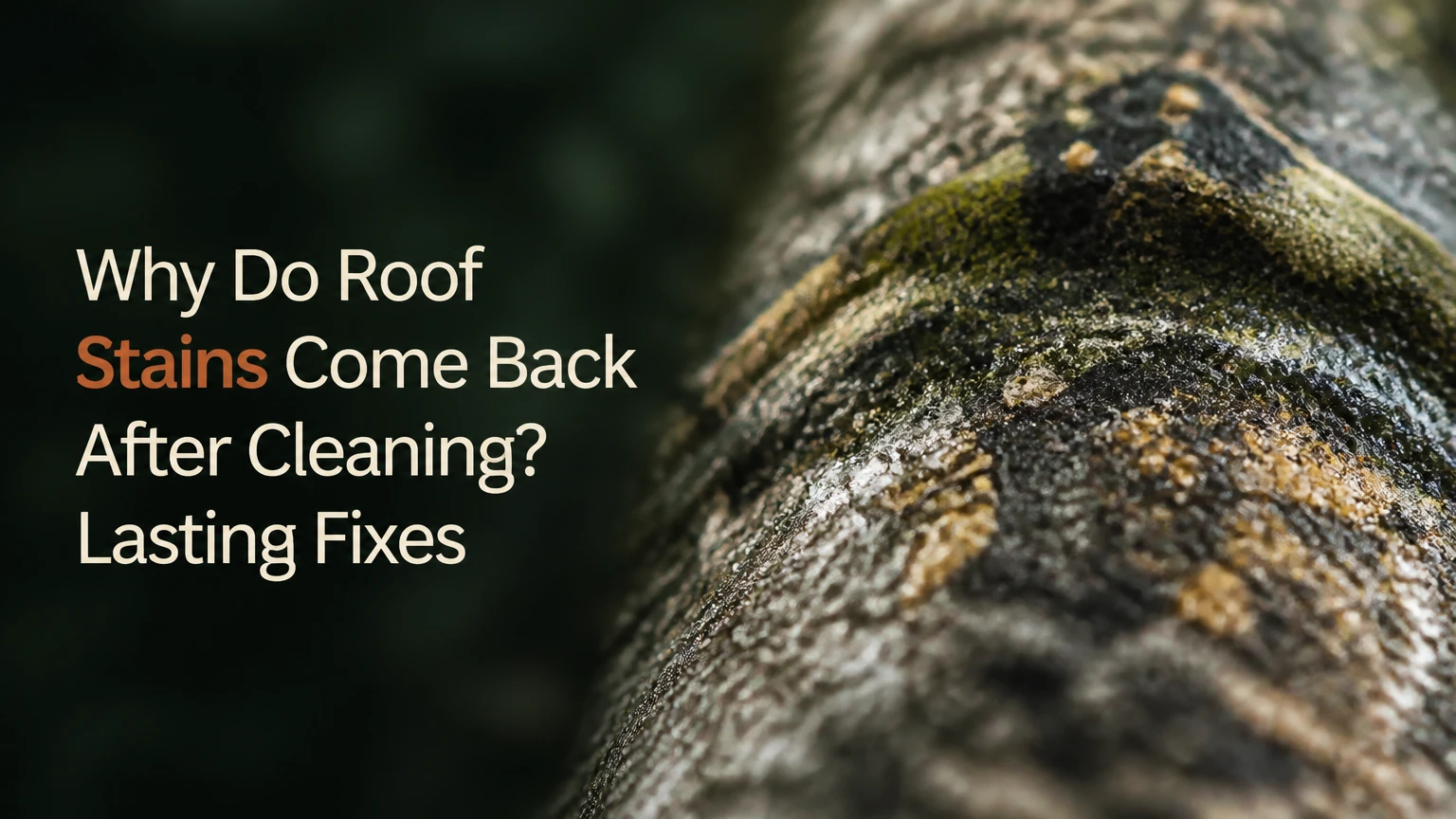
Roof stains come back after cleaning when algae, moss, lichen, or organic debris remains in shingle pores, or when airborne growth reseeds the roof after treatment. Black streaks commonly involve the cyanobacterium Gloeocapsa magma, but recurring discoloration can also result from moisture retention, rust, tannins, soot, or a cleaning method that removed appearance without addressing the cause.
Key Facts at a Glance
- Gloeocapsa magma is a commonly identified cause of black streaks on asphalt shingles, although roof discoloration can have several causes.
- Cyanobacteria do not have true plant roots; “root layer” usually describes cells and biofilm attached to shingle surfaces and pores.
- Pressure washing can remove asphalt-shingle granules and may shorten roof life, even when the roof looks cleaner immediately.
- A properly applied low-pressure treatment can outlast pressure washing, but no cleaning method prevents airborne reseeding permanently.
- Typical professional roof cleaning costs about $300-$1,150, with roof size, pitch, access, material, and contamination severity driving the price.
- Stains returning within 1-3 months suggest incomplete treatment, misdiagnosis, or a persistent moisture source rather than ordinary reseeding alone.
Why Do Roof Stains Come Back After Cleaning?
Roof stains return because the first cleaning often removes dark pigment without eliminating attached biological residue, moisture, or the conditions that support regrowth. Rain, dew, shade, trapped debris, and nearby contaminated roofs then provide the moisture and reseeding needed for visible streaks to develop again.
Black algae creates protective pigments that help shield cells from ultraviolet radiation. On asphalt shingles, the organism can exploit mineral filler, including limestone, while organic debris such as pollen and tree residue adds nutrients and retains moisture. A rinse may make the roof appear clean while microscopic cells remain attached.
The term “root system” needs precision. Algae and cyanobacteria do not develop roots like vascular plants, but biofilm and attached cells can remain in surface irregularities. Moss has rhizoids, and lichen has fungal holdfast structures, so those organisms can anchor more physically than a black algae film.
Reseeding is also normal. Wind, birds, insects, and roof-to-roof contamination can move biological material across a neighborhood. Cleaning one roof cannot sterilize the surrounding environment, which is why prevention reduces recurrence rather than guaranteeing permanent removal.
What does the dark pigment do?
The dark pigment is a survival adaptation, not ordinary soil. Pigmented microbial cells absorb or block some UV exposure, allowing colonies to persist on sunlit roof planes that would otherwise appear too harsh for biological growth.
The visible streak is therefore a late-stage signal. A clear or brown film may exist before the roof develops the familiar black appearance. That distinction explains why a roof can look clean immediately after rinsing and then darken again months later.
What Are the Black Streaks, Moss, and Lichen?
Black streaks usually indicate algae or cyanobacteria, while green mats indicate moss and crusty pale growth often indicates lichen. Mold, mildew, rust, leaf tannins, and chimney soot require different diagnosis because biological roof cleaning will not remove every non-biological stain.
| Contaminant | Typical appearance | Main roof risk | Diagnostic clue |
|---|---|---|---|
| Algae or cyanobacteria | Black, blue-black, or brown vertical streaks | Gradual granule and appearance degradation | Streaks follow water flow on asphalt shingles |
| Moss | Green, thick, spongy mats | Holds water and lifts shingle edges | Growth projects above the shingle surface |
| Lichen | Pale green, gray, yellow, or crusty patches | Holdfasts can dislodge granules | Flat, firmly attached circular or leafy colonies |
| Mold or mildew | Irregular black, green, or brown patches | Indicates persistent moisture; may affect wood nearby | Often concentrated near leaks, shade, or wet debris |
| Rust or tannins | Orange-red streaks or leaf-shaped brown marks | Corrosion or cosmetic staining | Located below metal, chimney areas, or decomposing leaves |
Algae is often less immediately destructive than moss, but “cosmetic only” is too broad. Repeated wetting, surface colonization, and granule loss can accelerate visible aging, particularly on older shingles with already weakened surfacing.
Moss deserves faster attention. Moss holds water against the roof and can lift shingle tabs during freeze-thaw cycles. Lichen can be more difficult than algae because aggressive scraping may remove granules along with the organism.
How Does Incomplete Cleaning Cause Regrowth?
Incomplete cleaning causes regrowth when a treatment reaches the visible coating but fails to contact attached cells, moss bases, lichen holdfasts, or debris in valleys and under overhanging vegetation. High-pressure water can create a deceptive result by removing discoloration faster than it removes the underlying contamination.
The Asphalt Roofing Manufacturers Association advises against pressure washing asphalt shingles. Its maintenance guidance states, “Do not use a pressure washer to clean asphalt shingles.” The concern is physical damage: excessive pressure can dislodge protective granules, force water under laps, and expose the fiberglass or asphalt coating.
Chemical cleaning works differently. A properly selected solution must contact the contamination for sufficient dwell time, while surfactants help the liquid cling to sloped surfaces. The operator must then control runoff, protect plants, and follow the shingle manufacturer’s instructions.
Soft washing is not a magic category. “Low pressure” describes delivery pressure, not chemical strength. An improperly diluted or poorly rinsed solution can damage vegetation, painted surfaces, metal, or roofing materials even when the equipment pressure is low.
How Do Soft-Washing Chemicals Work?
Soft-washing chemicals disinfect and break down organic contamination without relying on abrasive force. Sodium hypochlorite solutions are commonly used by professionals for algae and organic staining, while proprietary biocides and quaternary ammonium compounds may provide residual treatment depending on the product label.
A safe application depends on concentration, dwell time, surface temperature, wind, runoff, and roof material. Direct midday sun can dry a solution before it completes its work, while strong wind can carry droplets onto siding or landscaping. Professional operators normally pre-wet vegetation, control overspray, and rinse plants with clean water.
The dead material may not disappear immediately. Moss and lichen can remain physically attached after treatment and weather away over several weeks or months. Scraping or brushing too aggressively during that period can remove granules.
Which Roof-Cleaning Method Lasts Longest?
For asphalt shingles, low-pressure chemical treatment generally provides the best balance of roof protection and lasting biological control, while pressure washing provides the fastest visual change but the highest physical-damage risk. Results depend on complete coverage, weather, roof age, shade, drainage, and nearby contamination.
| Method | Typical visible result | Typical recurrence window | Main risk |
|---|---|---|---|
| High-pressure washing | Immediate surface stripping | About 6-12 months | Granule loss and shingle damage |
| Low-pressure bleach wash | Rapid algae color reduction | About 1-3 years in favorable conditions | Runoff, overspray, and over-concentration |
| Low-pressure residual biocide | Gradual cleaning plus longer control | About 2-5 years, variable | Delayed cosmetic improvement |
| Manual moss removal | Physical mat reduction | About 6-24 months without moisture control | Granule damage and incomplete removal |
A professional claim of “3-5 years” should be treated as a possible maintenance interval, not a warranty. A shaded roof beneath trees in a humid climate may recur sooner, while a sunny, well-ventilated roof with clean gutters may remain acceptable longer.
Pressure washing is especially unsuitable for asphalt shingles. It may be appropriate for some hard roofing surfaces under controlled conditions, but the material manufacturer, not a generic cleaning rule, determines whether pressure is acceptable.
Is bleach safe for asphalt shingles?
A properly controlled bleach-based roof wash can be compatible with asphalt shingles, but household bleach used casually is not automatically safe. Concentration, application method, contact time, rinsing, and runoff protection determine the outcome.
Tile, painted metal, galvanized metal, copper, wood shakes, and synthetic roofing each have different chemical limits. Sodium hypochlorite can corrode some metals and damage plants, while abrasive methods can scratch coatings or remove surface finishes. Ask the contractor to identify the roof material and product before treatment.
How Long Should Clean Shingles Stay Clean?
A professionally treated asphalt-shingle roof may remain visibly clean for roughly 1-3 years, and some roofs reach 3-5 years when exposure, drainage, and maintenance are favorable. A pressure-washed roof may show recurrence within 6-12 months because pressure removes appearance without providing durable biological control.
| Roof condition | Typical recurrence expectation | Why the interval changes |
|---|---|---|
| Sunny roof, clear gutters, limited trees | 2-5 years | Faster drying and lower debris load |
| Partial shade, moderate humidity | 1-3 years | Longer surface dampness |
| Dense tree canopy, humid climate | 6-24 months | Repeated spores, pollen, and dew |
| Moss or lichen left attached | 3-12 months | Surviving growth expands from existing colonies |
| Stains only after rain | Immediate to 6 months | Runoff, tannins, or wet-surface contrast may be involved |
A cleaning guarantee should specify what “clean” means. Some companies guarantee algae discoloration for a defined period, while others guarantee only workmanship. Neither promise necessarily covers lichen, moss, rust, storm debris, or new contamination.
How Much Does Recurring Roof Cleaning Cost?
Typical professional roof cleaning costs about $300-$1,150 for a residential roof, while reported soft-washing prices commonly fall near $0.30-$0.80 per square foot. Manual moss removal may cost about $0.60-$1.00 per square foot, but local labor, roof access, and protection requirements can move the final quote substantially.
| Project factor | Typical range or value | Cost effect |
|---|---|---|
| Small, accessible asphalt roof | $300-$550 | Lower setup and labor time |
| Larger or steep residential roof | $650-$1,150+ | More equipment, safety, and labor |
| Soft washing | $0.30-$0.80/sq. ft. | Chemical application and plant protection |
| Manual moss removal | $0.60-$1.00/sq. ft. | Slower labor and careful scraping |
| Zinc or copper mitigation strips | About $10-$30 per linear foot installed | Ridge access and metal type affect price |
A low quote may exclude gutter clearing, plant protection, neutralization, steep-slope safety, or a second treatment. Compare written scopes rather than comparing only the advertised square-foot rate.
Roof age changes the financial decision. Cleaning a 20-year-old roof with brittle shingles may expose existing failure, while cleaning a newer roof can preserve appearance and reduce biological loading. A roof inspection should precede treatment when granules are already collecting in gutters, tabs are lifting, or shingles crack when touched.
What Prevents Roof Stains From Returning?
Recurrence prevention combines biological treatment with moisture control, debris removal, and periodic inspection. The most effective maintenance plan clears gutters, improves airflow, limits overhanging vegetation, removes leaf accumulation, and treats early growth before moss or lichen becomes established.
Use this sequence:
- Inspect shingles, flashing, valleys, vents, and gutters before cleaning.
- Identify algae, moss, lichen, rust, tannins, or soot rather than assuming every mark is algae.
- Remove leaves and organic debris without scraping aggressively.
- Trim branches that shade the roof or drop repeated debris, while preserving appropriate tree clearance.
- Correct overflowing gutters, blocked downspouts, and drainage that keeps eaves wet.
- Apply a roof-compatible treatment according to the product label and manufacturer guidance.
- Reinspect after heavy rain and at least twice yearly in humid or heavily wooded locations.
One practitioner rule matters: do not use a copper or zinc strip as a substitute for removing an established moss mat. Metal strips can reduce new growth below the strip as rain carries metal ions downslope, but coverage is uneven and heavy existing contamination remains.
Can Zinc or Copper Stop New Growth?
Zinc or copper strips can suppress new algae and moss growth below the installed metal, but they rarely eliminate established colonies across an entire roof. Strip effectiveness decreases on complex roof geometry, beneath dormers, and wherever rainwater does not flow continuously over the metal.
Installers must avoid incompatible-metal corrosion. Copper runoff can stain certain materials and accelerate galvanic corrosion when it contacts dissimilar metals in the presence of water. Ridge installation also requires sound fastening and compatible flashing details.
Why Do Stains Return in Valleys and Along Edges?
Stains return in valleys and along roof edges because those locations collect water, pollen, leaves, and runoff while drying more slowly than exposed roof planes. Clogged gutters, poor valley drainage, nearby branches, and splashback can create a localized biological incubator even after the main roof plane was cleaned.
A stain that follows a valley may be biological, but it can also be tannin transfer from leaves or sediment from a blocked channel. A dark mark below a chimney may be soot, rust, or flashing corrosion rather than algae.
Check whether the pattern changes after rain. Biological streaks usually develop along water flow and expand gradually; rust often begins below exposed metal, while tannins resemble leaf outlines or concentrated brown runoff.
Do Roof Stains Mean the Roof Leaks?
Roof stains do not automatically mean a roof leaks, because algae, moss, airborne dirt, rust, and tannins can stain intact roofing. A leak becomes more likely when discoloration appears on ceilings, rafters, roof decking, or insulation, or when interior moisture follows rainfall.
An exterior roof stain near a vent, chimney, skylight, or valley deserves closer inspection because those areas contain penetrations and flashing transitions. Cleaning should never conceal an unresolved leak.
Look indoors for water marks, damp insulation, musty odor, peeling paint, or darkened wood. If those signs exist, arrange a roofing inspection before applying chemicals.
What Should You Do When Stains Return?
When stains return, document the recurrence date, photograph the pattern, inspect drainage, and ask the cleaner what organism and treatment were involved. The next remedy depends on timing: rapid recurrence suggests incomplete treatment or moisture, while recurrence after several years may represent normal reseeding.
| Return timing | Likely explanation | Appropriate response |
|---|---|---|
| 1-3 months | Surviving biofilm, moss base, or misdiagnosis | Request inspection and treatment review |
| 6-12 months | Low residual control, shade, or nearby spores | Correct moisture sources and consider maintenance treatment |
| 1-3 years | Normal reseeding in favorable climate | Schedule targeted cleaning and prevention |
| Valleys or eaves only | Debris, blocked drainage, or persistent dampness | Clear channels and inspect gutter flow |
| Around chimney only | Soot, rust, or flashing failure | Clean with material-safe method and inspect flashing |
Do not immediately repeat pressure washing. If the first treatment removed granules, a second aggressive cleaning can worsen the roof while failing to address airborne reseeding.
When Is Cleaning the Wrong Solution?
Cleaning is the wrong solution when shingles are brittle, granules are missing, tabs are lifting, leaks are active, or the discoloration comes from failed flashing and interior moisture. A replacement or repair may be more appropriate than repeated cosmetic treatment.
Cleaning also has limited value on a roof near the end of its service life. Contractors should assess shingle age, exposed mat, fastener condition, flashing, ventilation, and gutter granules before promising an appearance improvement.
How Do Climate and Roof Design Affect Recurrence?
Humid climates, shaded roof planes, low morning temperatures, dense tree cover, and poor ventilation increase the time shingles remain damp. Roof pitch, orientation, valley geometry, and surrounding vegetation then determine where contamination develops first.
A north-facing roof in the Northern Hemisphere often dries more slowly than a south-facing plane, although tree shade can override orientation. Coastal air, frequent rain, and warm temperatures support faster biological cycles, while cold climates can worsen moss damage through freeze-thaw movement.
Treat weather as an operating constraint. A typical application window is above 50°F, or 10°C, with low wind, no immediate rain, and enough overcast time to prevent premature drying. Product labels control the final temperature and weather requirements.
What Safety and Warranty Issues Matter?
Roof cleaning combines fall hazards, chemical exposure, runoff, and possible warranty consequences. Homeowners should avoid climbing wet shingles, mixing cleaning agents, or allowing chemical runoff to enter ponds, storm drains, or neighboring property.
Never mix sodium hypochlorite with acids, ammonia, or other household cleaners. Toxic gases can form. Professionals should use fall protection appropriate to the roof, protect electrical equipment and plants, control overspray, and follow local discharge requirements.
Review the roofing warranty before work begins. Some manufacturers publish approved cleaning methods and prohibit pressure washing, while others distinguish between algae treatment and physical damage. Keep the product name, application record, photographs, and contractor insurance details.
Frequently Asked Questions
Will rain wash away the dead algae?
Rain can gradually remove dead algae, moss residue, and lichen debris, but the process may take weeks or months. Rain does not reliably remove thick moss mats or repair granule loss. If debris remains packed in valleys or gutters, manual removal may be necessary using a roof-safe method.
Can I clean roof stains with vinegar?
Vinegar is unreliable for established roof algae, moss, and lichen, and repeated acidic exposure may affect certain metals or surrounding materials. A roof-compatible product labeled for the specific material provides more predictable results. Never select a chemical solely because it is available in a kitchen cabinet.
Should gutters be cleaned before or after the roof?
Gutters should be cleared before roof treatment and checked again afterward. Pre-cleaning prevents standing water and makes runoff control easier, while a post-treatment check removes loosened debris. Downspouts should discharge away from foundations and sensitive landscaping.
Can algae damage asphalt shingles?
Algae can contribute to surface aging and discoloration, although moss and lichen generally create more direct physical damage. Algae also signals repeated moisture exposure and trapped debris. Granule loss, curling, brittle edges, and exposed asphalt matter more than color alone when evaluating roof condition.
How often should a roof be inspected after cleaning?
Inspect a cleaned roof at least twice yearly, plus after major storms. Humid, wooded, or moss-prone properties may need checks every three to six months. Look first at valleys, eaves, chimney sides, shaded planes, gutters, and areas beneath overhanging branches.
Is recurring staining a reason to replace the roof?
Recurring staining alone is not a reason to replace a roof. Replacement becomes more defensible when staining occurs with leaks, widespread granule loss, brittle shingles, structural deterioration, or an age near the manufacturer’s expected service range. A qualified inspection should separate contamination from underlying roof failure.
The Bottom Line
Why do roof stains come back after cleaning? The usual answer is incomplete biological removal combined with moisture, shade, debris, and new airborne seeding. Identify the contaminant first, avoid pressure washing asphalt shingles, use a material-compatible low-pressure treatment, correct drainage, and judge the result against the roof’s age and climate. Cleaning can control recurring stains, but only maintenance addresses the conditions that bring them back.