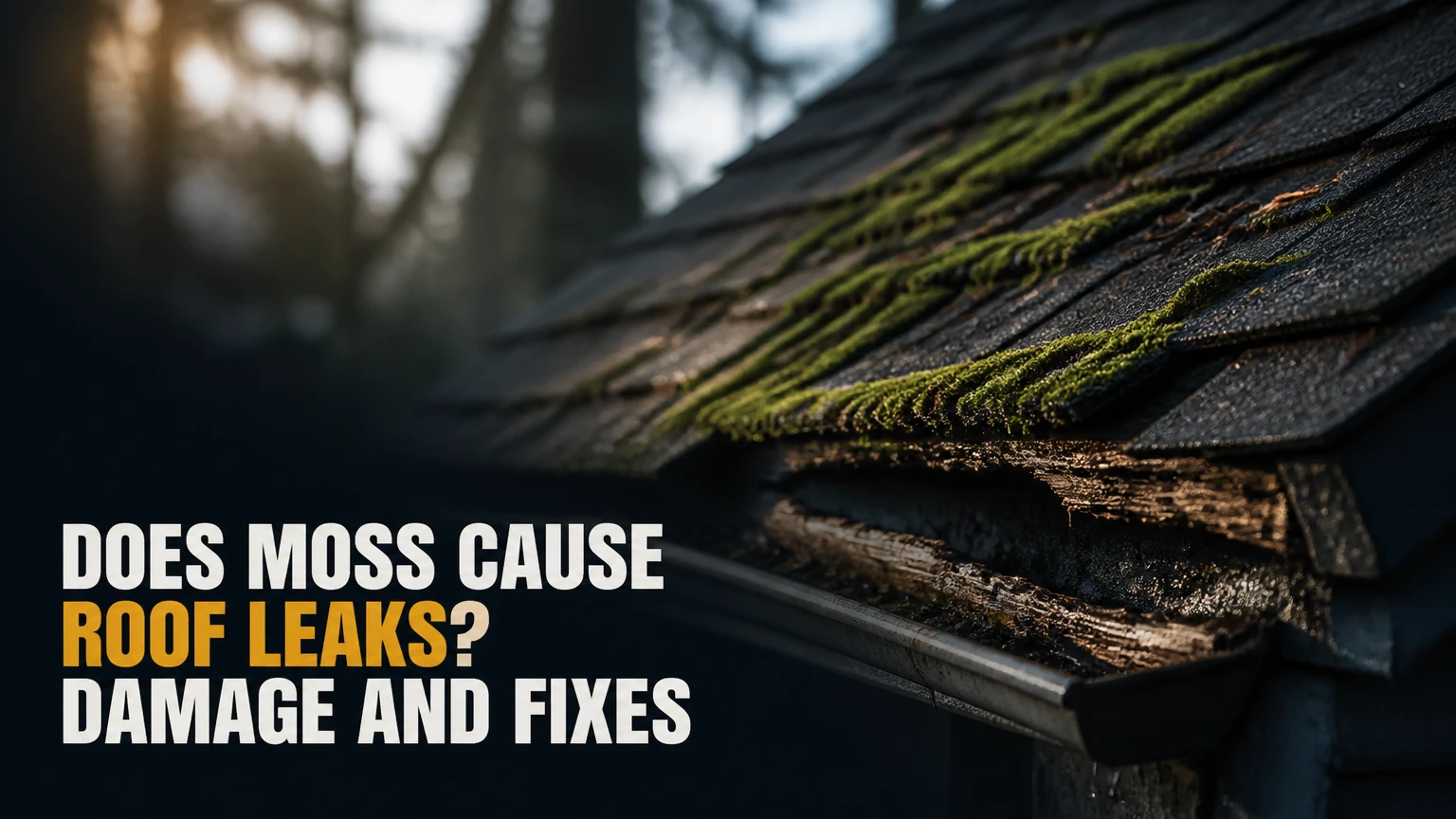
Moss can contribute to roof leaks, but moss does not usually puncture sound roofing by itself. Dense moss retains moisture, traps organic debris, lifts or separates shingle edges, and conceals failed flashing or deteriorated materials, allowing water to reach the underlayment and roof decking.
Key Facts at a Glance
- Roof moss creates leak risk mainly by retaining moisture and displacing roofing materials.
- Moss growth does not prove that moss caused a particular interior water stain.
- Pressure washing can remove asphalt-shingle granules and force water beneath laps.
- Dead moss may remain attached for weeks or months after treatment.
- Copper or zinc strips can slow regrowth, but they cannot repair a leaking roof.
- Typical professional moss treatment costs $0.25-$0.75 per square foot, before repairs.
Does Moss Cause Roof Leaks?
Moss causes or worsens roof leaks when it grows thick enough to hold persistent moisture, lift roofing edges, obstruct drainage, or hide existing defects. A thin patch on a relatively new roof may be cosmetic, while a deep mat on aging asphalt shingles can accelerate deterioration and make water entry more likely.
Roof moss is a nonvascular plant. It absorbs water across its surface and uses rhizoids, small anchoring structures, to attach to rough materials. Rhizoids do not behave like tree roots that drill through intact shingles, so the common statement that moss “eats through” a roof is inaccurate.
The practical danger is the roof environment moss creates. Shade, leaf debris, slow drying, blocked drainage, and repeated freeze-thaw cycles affect the roofing assembly. The National Roofing Contractors Association advises owners to keep roof surfaces clear of debris and to address conditions that retain moisture, because maintenance failures often shorten roof service life.
Can Moss Puncture or Grow Through Shingles?
Moss rarely punctures an intact asphalt shingle directly. Moss can, however, exploit exposed edges, cracked surfaces, open laps, failed seal strips, and deteriorated wood shakes, where existing weaknesses already permit moisture entry.
A moss mat can also lift the lower edge of a shingle. Once the designed overlap changes, wind-driven rain can travel beneath the shingle and reach the underlayment. The more accurate description is mechanical displacement plus prolonged wetting, not root penetration.
How Does Moss Damage Roofing?
Moss damages roofing through four connected mechanisms: moisture retention, material displacement, debris accumulation, and concealment of defects. The resulting damage depends on roof age, material, pitch, climate, ventilation, and the thickness of the growth.
1. Moss Retains Moisture
A thick moss cushion stays wet after rainfall and dries slowly under shade. Constant dampness can soften wood shakes, encourage decay at exposed shingle edges, and keep asphalt roofing cooler and wetter than intended.
Moss does not make a roof permanently saturated in every climate. Sun, wind, low humidity, and adequate slope can dry a roof quickly. Risk rises on north-facing slopes, under tree canopies, and on roofs with poor attic ventilation.
2. Moss Displaces Shingle Edges
Moss grows in the horizontal joints and lower edges of overlapping shingles. As the mat thickens, it can hold edges above the roof plane and prevent asphalt shingles from sealing correctly.
Displaced shingles become vulnerable to wind uplift. They also create channels where rainwater can move sideways or underneath the intended weather barrier. This is a larger concern on low-slope sections, valleys, and roof-to-wall transitions.
3. Moss Traps Leaves and Fine Debris
Organic debris collects inside moss. The mixture can block drainage paths in valleys, behind chimneys, and around skylights, causing water to pond or back up during prolonged rain.
Blocked gutters add a separate risk. Overflowing water can wet fascia boards, soffits, siding, and wall cavities, producing stains that appear to be roof leaks even when the roof covering is intact.
4. Moss Hides Existing Roof Failures
Moss can conceal cracked flashing, missing granules, exposed fasteners, open seams, and deteriorated underlayment. A contractor who removes growth without inspecting the roof may miss the actual leak source.
That distinction matters. Moss presence is evidence of a damp, shaded condition, not forensic proof of causation.
How Long Does Moss Take to Cause Damage?
Moss can begin affecting vulnerable roof components within one or two wet seasons, but a visible leak may take several years to appear. Thick growth on an old or already damaged roof can produce symptoms much sooner, especially after wind-driven rain or freeze-thaw weather.
There is no universal moss-to-leak timetable. Asphalt shingles commonly carry manufacturer warranties of 20-30 years, but warranty duration is not a prediction of leak timing. A 7-year-old roof with failed flashing may leak before a 25-year-old roof with little moss.
| Roof condition | Typical visible moss development | Typical concern |
|---|---|---|
| Sunny, steep asphalt roof | 2-5 years | Low immediate leak risk |
| Shaded asphalt roof with debris | 1-3 years | Edge lifting and granule loss |
| Low-slope roof with thick moss | 1-2 wet seasons | Drainage backup and concealed defects |
| Cedar shakes under trees | 1-3 years | Rot at joints and reduced drying |
| Old roof with existing damage | One heavy rainy season | Rapid leak aggravation |
These are field-based ranges, not guarantees. Local rainfall, latitude, tree cover, roof pitch, and maintenance change the outcome.
How Can You Tell Whether Moss Caused the Leak?
A roofer can assess likely causation by tracing water from the attic upward and comparing the entry point with moss location. Interior stains alone cannot identify moss as the source because water often travels along rafters, sheathing joints, insulation, or electrical penetrations.
Inspect the attic only when conditions are safe. Look for wet insulation, darkened wood, fungal decay, rusted fasteners, daylight around penetrations, and water trails that continue above the stain. A moisture meter can help distinguish an active leak from an old mark.
The strongest evidence is a matching exterior defect. Examples include lifted shingles beneath a moss mat, rotted sheathing beside a blocked valley, or open flashing at a moss-covered chimney. If the only finding is green growth on intact shingles, the roof needs maintenance, but the leak may have another cause.
Moss, Algae, or Lichen?
Moss is soft, raised, and usually green. Algae often appears as flat black or blue-green staining, while lichen forms crusty, leafy patches that attach firmly to roofing.
| Growth type | Typical appearance | Main roof concern | Removal difficulty |
|---|---|---|---|
| Moss | Green, raised cushion | Moisture retention and edge lifting | Moderate |
| Algae | Flat black streaks | Cosmetic staining and surface moisture | Low to moderate |
| Lichen | Crusty gray-green patches | Firm attachment and surface disturbance | High |
| Mold | Dark fuzzy or powdery areas | Moisture warning and indoor air concern | Site-dependent |
A roof can have more than one growth type. Treatment that works on algae may be inadequate for thick moss or lichen.
What Is the Safest Way to Remove Roof Moss?
The safest approach is a low-pressure, roof-material-compatible treatment followed by gentle removal after the growth dies. Avoid walking on fragile shingles, scraping upward under laps, or using a pressure washer.
Before Removing Moss
Check the roof age, material, pitch, weather forecast, nearby plants, and manufacturer cleaning instructions. Do not climb a steep, wet, brittle, or algae-covered roof without professional fall-protection equipment.
A typical homeowner preparation list includes a ground-based pump sprayer, roof-safe cleaner, garden hose, plastic sheeting for sensitive plants, eye protection, gloves, and a way to divert or collect runoff. Never mix bleach with ammonia, acids, or other cleaners.
Step 1: Control Runoff
Pre-wet landscaping with clean water and cover especially sensitive plants. Keep downspouts from discharging concentrated cleaner onto lawns, ponds, or storm drains.
Follow the product label rather than applying a generic bleach ratio. Sodium hypochlorite can damage vegetation, corrode metal, and discolor some roof materials when concentration, dwell time, or rinsing is wrong.
Step 2: Apply a Compatible Treatment
Apply cleaner from a safe position, using low pressure and complete coverage. Overcast, cool conditions reduce premature evaporation, but rain immediately after application can reduce dwell time.
Zinc sulfate, sodium hypochlorite products, and proprietary roof cleaners differ in chemistry and environmental risk. A product suitable for asphalt shingles may stain copper, affect coatings, or damage historic tile.
Step 3: Let the Moss Die
Dead moss often turns brown or yellow and remains attached. Natural weathering may release it over several weeks or months, particularly when the rhizoids have bonded to granules or wood fibers.
Do not force off firmly attached growth. Aggressive removal can pull granules from asphalt shingles or break brittle cedar and clay tiles.
Step 4: Remove Loose Material Downward
After treatment and adequate dwell time, remove loose moss with a soft nylon brush directed from ridge toward eave. Never brush upward beneath shingle courses.
A professional soft-wash contractor may use controlled rinsing and ground-based collection methods. “Soft wash” describes a low-pressure cleaning approach, not a single regulated pressure standard, so ask the contractor for actual pressure, chemical, runoff, and warranty procedures.
Which Moss Treatment Works Best?
No single treatment is best for every roof. Chemical treatment usually produces the least physical wear on asphalt shingles, manual removal suits small accessible patches, and metal strips help control future growth after existing moss is removed.
| Method | Typical material cost | Typical result time | Main limitation |
|---|---|---|---|
| Manual nylon brushing | $10-$40 | Same day | Can remove granules or fibers |
| Labeled roof cleaner | $20-$80 | 1-6 weeks | Runoff and material compatibility |
| Professional soft wash | $500-$1,500 | 1-4 weeks | Requires contractor screening |
| Zinc sulfate treatment | $25-$100 | Several days to weeks | Environmental runoff concerns |
| Copper or zinc strip | $100-$600 installed | Preventive, gradual | Does not remove existing mats |
Copper and zinc strips work only where rainwater can wash ions over the roof surface. Dormers, valleys, tree cover, roof geometry, and heavy debris can leave untreated areas.
Why Is Pressure Washing Risky?
Pressure washing is risky because concentrated water can dislodge asphalt granules, break brittle roofing materials, drive water under laps, and damage flashing or sealant. The Asphalt Roofing Manufacturers Association warns against power washing asphalt shingles because it can shorten roof life and cause surface damage.
A low-pressure rinse is different from blasting a roof with a high-pressure nozzle. The label “soft wash” does not guarantee safe practice. Ask for the equipment pressure at the roof surface and verify that the method follows the shingle manufacturer’s instructions.
How Do Roof Materials Change the Risk?
Asphalt shingles are vulnerable to granule loss and lifted edges, cedar shakes are vulnerable to rot and fiber damage, and tile or slate can crack under foot traffic. Metal roofs resist moss penetration but can still develop blocked drainage, coating damage, and corrosion around fasteners.
| Roof material | Moss-related vulnerability | Safer maintenance approach | Replacement warning sign |
|---|---|---|---|
| Asphalt shingles | Granule loss and lifted laps | Labeled cleaner, low pressure | Bald spots, curling, brittle tabs |
| Cedar shakes | Rot and trapped moisture | Specialist inspection, gentle cleaning | Splitting, soft shakes, deep decay |
| Clay or concrete tile | Cracking and blocked channels | Tile-trained contractor | Broken tiles, failed mortar |
| Slate | Breakage from foot traffic | Slate roofer, localized treatment | Delamination, cracked slate |
| Standing-seam metal | Coating and fastener issues | Manufacturer-approved cleaner | Rust, failed seams, loose fasteners |
Historic roofs need special handling. A generic bleach recipe may discolor clay tile, strip oils from wood, or damage nearby masonry.
How Much Does Moss Removal and Repair Cost?
Typical professional moss treatment costs $0.25-$0.75 per square foot, or about $500-$1,500 for a 2,000-square-foot roof. The final price depends on pitch, access, roof material, growth thickness, plant protection, travel, and whether loose debris must be collected.
| Service or repair | Typical US price range | Typical duration | Main cost driver |
|---|---|---|---|
| Roof inspection | $150-$400 | 45-90 minutes | Roof size and access |
| DIY treatment supplies | $30-$100 | 2-6 hours | Equipment already owned |
| Professional moss treatment | $500-$1,500 | 3-6 hours | Pitch and roof complexity |
| Local shingle repair | $300-$1,200 | 2-6 hours | Flashing and access |
| Sheathing replacement | $1,000-$4,000 | 1-3 days | Rot extent and interior access |
| Full roof replacement | $8,000-$22,000+ | 2-5 days | Area, material, region |
Prices are typical planning ranges for US residential work, not quotes. A steep two-story roof can cost substantially more than a low, simple roof with the same area.
The expensive mistake is paying for cleaning when the roof already needs replacement. If shingles are brittle, curling, widely bald, or near the end of their service life, a cleaning contractor should not be the only professional consulted.
What Should You Do If Moss Has Already Caused Damage?
Stop treating the roof as a cleaning project when you find soft decking, active attic moisture, lifted shingles across a large area, or failed flashing. Arrange a roofing inspection first, because chemical treatment cannot restore structural wood or reseal a failed roof assembly.
Temporary measures can reduce damage while waiting for service. Place a container under an active drip, move valuables, photograph interior and exterior conditions, and avoid puncturing the roof with tarps or improvised fasteners. A temporary roof covering should be installed by someone who understands water shedding and fall protection.
Homeowners insurance commonly excludes gradual wear, neglect, algae, and moss-related deterioration, although policies vary and sudden covered events may receive different treatment. Contact the insurer before extensive work if storm damage may have contributed.
How Can You Prevent Moss From Returning?
Reduce shade and moisture, keep roof drainage open, and install a properly positioned copper or zinc strip when the roof material and local environmental rules permit. Prevention works best after the existing moss and debris have been removed.
Use this maintenance schedule:
- Inspect roof and attic twice yearly, especially after winter.
- Clean gutters at least once or twice per year, depending on tree cover.
- Remove leaves from valleys and roof intersections without scraping shingles.
- Trim branches that shade the roof or drop persistent debris.
- Check flashing around chimneys, skylights, walls, and plumbing vents.
- Reinspect treated areas after the first wet season.
- Replace damaged shingles before installing preventive metal strips.
A metal strip cannot compensate for a leaking valley or a shaded roof covered by leaves. It is a growth-control measure, not a waterproofing system.
Common Mistakes and Their Fixes
- Mistake: Assuming every roof leak comes from moss.
Fix: Trace the leak through the attic and inspect flashing, valleys, vents, and gutters. - Mistake: Pressure washing asphalt shingles.
Fix: Use a compatible chemical treatment and controlled low-pressure method. - Mistake: Scrubbing upward.
Fix: Work from ridge toward eave only after the moss has loosened. - Mistake: Removing dead moss immediately.
Fix: Allow weathering time unless loose material blocks drainage or creates a safety hazard. - Mistake: Applying cleaner without protecting plants.
Fix: Pre-wet vegetation, control downspouts, and follow the product label. - Mistake: Ignoring roof age.
Fix: Obtain a roof-condition assessment before spending money on repeated treatments.
FAQ
Can I leave a small patch of moss on my roof?
A small, thin patch on a new, sound roof may not create an immediate leak, but leaving it allows moisture and debris to accumulate. Photograph the area, check whether shingle edges are lifted, and schedule maintenance before the patch spreads beneath trees or into valleys.
Does roof moss grow faster on north-facing slopes?
North-facing slopes often support faster moss growth because they receive less direct sunlight and dry more slowly. Roof pitch, rainfall, tree cover, ventilation, and debris can outweigh orientation, so a shaded east or west slope may develop the same problem.
Will a new roof stop moss permanently?
A new roof will not stop moss permanently if shade, moisture, and organic debris remain. New asphalt shingles may resist growth better when they contain protective additives, but owners still need gutter cleaning, branch management, and periodic inspection.
Can rain make moss-related leaks worse?
Rain can worsen a moss-related leak by saturating the growth, driving water beneath lifted shingle edges, and filling blocked valleys or gutters. Heavy wind-driven rain can expose flashing defects that moss merely concealed, so the visible timing does not prove moss was the original cause.
Should I remove moss before selling a house?
Removing extensive moss before selling can improve roof inspection results and reveal defects that require disclosure or repair. Do not conceal damaged shingles with cosmetic treatment; obtain dated photographs and a written roofer assessment if the roof is old or leaking.
Does homeowners insurance pay for roof moss removal?
Homeowners insurance usually does not pay for routine moss removal or gradual deterioration, but policy language controls the decision. If a covered storm damaged the roof and moss is incidental, document the timeline and ask the insurer about inspection and claim requirements.
The Bottom Line
Does moss cause roof leaks? Moss can cause or accelerate leaks by retaining moisture, lifting shingle edges, blocking drainage, and hiding failed roofing details, but green growth alone does not establish the leak source. Treat moss as a roof-maintenance warning, inspect the attic and exterior, avoid pressure washing, and repair damaged roofing before applying preventive treatments.