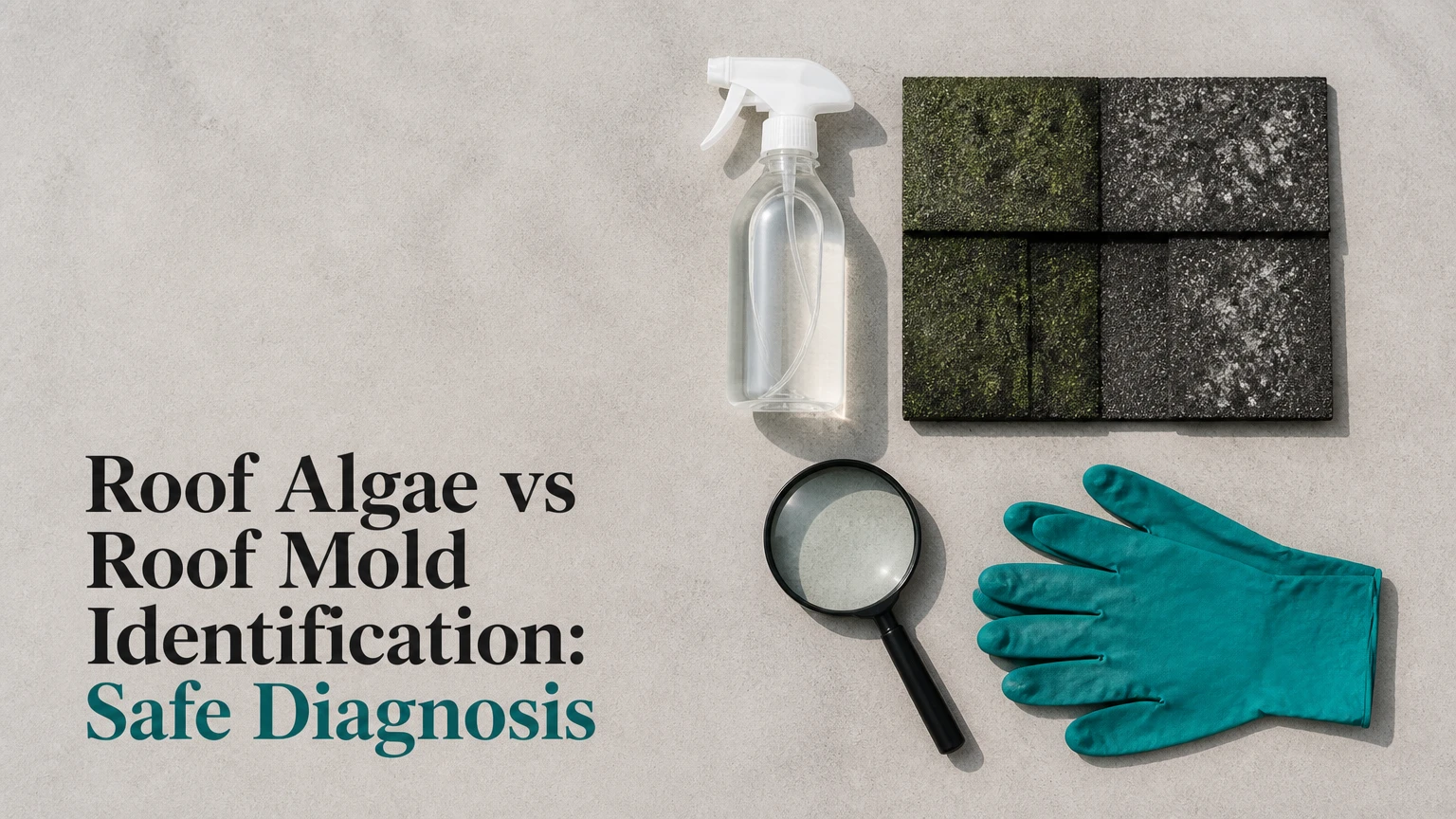
Roof algae vs roof mold identification depends on more than color: algae usually creates flat, broad dark streaks on sun-exposed asphalt shingles, while mold indicates persistent moisture and often appears in concealed, irregular, or three-dimensional patches. Because dirt, moss, lichen, rust, and roof shadow can look similar, confirm the growth pattern and inspect the attic before selecting a treatment.
Key Facts at a Glance
Roof algae commonly appears as blue-green, gray, or black vertical streaks that follow rainwater paths on asphalt shingles.
Roof mold is a moisture indicator, not a diagnosis that can be made reliably from color alone.
Surface algae usually threatens appearance and may retain moisture, while wood decay threatens roof structure.
High-pressure washing can remove asphalt-shingle granules and may shorten roof life.
A musty attic, wet insulation, stained decking, or soft wood requires moisture-source investigation before cleaning.
Typical professional roof cleaning costs about $300-$900; remediation with repairs can exceed $1,500.
What Is the Difference Between Roof Algae and Roof Mold?
Roof algae is usually a photosynthetic cyanobacterium that colonizes damp, mineral-coated shingle surfaces, whereas roof mold is fungal growth associated with organic material and sustained moisture. The two can coexist, but a dark roof mark does not prove that mold is present.
On modern asphalt shingles, the organism commonly discussed is Gloeocapsa magma, although visual inspection cannot establish the species. Asphalt shingles contain mineral granules, and limestone filler in some shingle products can provide nutrients for algae. Rain, shade, humidity, and airborne deposits support colonization.
“Mold” is a broad household term. Fungi that stain surfaces are not automatically the same organisms that cause wood decay. Brown rot and white rot fungi can weaken timber, but a black mark on a shingle does not demonstrate either one. That distinction changes the response: algae may need controlled cleaning, while suspected decay requires moisture correction and a structural inspection.
How do the organisms survive?
Roof algae uses sunlight and intermittent moisture, so it can remain on an exposed shingle roof without a constant leak. A dark protective pigment helps the colony tolerate ultraviolet exposure. Mold requires suitable moisture, a food source, oxygen, and a favorable temperature; concealed roof spaces often provide those conditions.
Algae can grow where rain repeatedly wets the roof but drains normally. Mold growth on roof decking, insulation, rafters, or sheathing usually points to leakage, condensation, blocked ventilation, or humid exhaust entering the attic.
How Can You Identify Roof Algae or Roof Mold?
Roof algae usually looks flat and streaked, while roof mold is more likely to appear as irregular patches with visible texture or a musty indoor odor. These clues are useful for triage, but none proves the diagnosis independently.
| Observation | More consistent with algae | More consistent with mold or moisture damage | Other possible cause |
|---|---|---|---|
| Shape | Vertical streaks, 1-10 inches wide | Irregular patches, 2-24 inches across | Shadow, dirt, soot |
| Surface | Flat, smooth, blue-gray to black | Fuzzy, powdery, velvety, or raised | Lichen, moss |
| Location | Upper shingle surface | Underside, decking, eaves, valleys | Rust near metal flashing |
| Moisture clue | Shade and dew without indoor staining | Leak, condensation, wet insulation | Gutter overflow |
| Odor | Usually no noticeable odor | Musty or earthy attic odor | Wet insulation or decay |
| Physical effect | Possible granule discoloration or retention | Staining, softened wood, swollen materials | Mechanical damage |
Are black roof streaks always algae?
Black roof streaks are often algae on asphalt shingles, but black color alone cannot separate algae from soot, dirt, organic deposits, or aged roof coating. Uniform streaks that run downslope, remain flat, and occur on shaded roof planes strongly favor algae.
A close visual inspection from the ground is safer than climbing. Binoculars or a camera with optical zoom can reveal whether the mark follows shingle courses. Look for granules in the gutters, exposed fiberglass mat, lifted tabs, and missing flashing before anyone applies a cleaner.
Do not scrape a roof sample casually. Disturbing a suspected mold colony can spread spores, and walking on brittle shingles can cause damage unrelated to the original problem.
Can a smell confirm roof mold?
A musty smell in an attic supports a moisture problem, but odor cannot identify a particular mold species or prove that the visible roof mark is mold. Smell is more useful indoors, where it may direct attention toward wet insulation, decking, wall top plates, or bathroom exhaust problems.
The absence of odor does not rule out mold. Cold, dry, or well-ventilated spaces can contain visible staining without a strong smell. Conversely, a strong odor may come from wet cellulose insulation or wood decay rather than mold alone.
Which Roof Conditions Look Like Algae or Mold?
Moss, lichen, dirt, soot, rust, and deteriorated roofing materials can resemble algae or mold. Correct identification matters because cleaning cannot repair missing granules, failed flashing, rotten decking, or a leaking vent boot.
| Look-alike | Typical appearance | Diagnostic clue | Appropriate response |
|---|---|---|---|
| Moss | Green, raised cushions or tufts | Roots lift shingle edges | Remove gently and correct shade or moisture |
| Lichen | Pale gray-green crusts or leaf-like growth | Firm attachment to granules | Use manufacturer-approved treatment |
| Dirt or soot | Uniform brown, gray, or black film | Wipes unevenly; near chimneys or roads | Clean only if roof remains sound |
| Rust staining | Orange, red, or brown vertical marks | Starts below metal fasteners or flashing | Inspect metal and replace failed components |
| Granule loss | Bare, shiny, or speckled areas | Granules collect in gutters | Evaluate roof age and replacement need |
| Wood decay | Darkened, softened, fibrous decking | Probe reveals loss of hardness | Stop cleaning and arrange repair |
Algae commonly covers large areas without changing the shingle profile. Moss lifts edges and traps water. Lichen bonds tightly to the surface and can remove granules when forcibly scraped. These organisms are often grouped together by roof cleaners, but their attachment and damage mechanisms differ.
Does Algae or Mold Damage the Roof Structure?
Surface algae generally causes limited direct structural damage, but persistent moisture, moss growth, granule loss, and an underlying leak can shorten roof service life. Mold on roof decking is more concerning because it signals damp materials, although visible mold alone does not establish that the decking has lost structural strength.
Asphalt shingles can tolerate some surface discoloration without immediate failure. The risk increases when growth holds moisture against the shingle, covers defects, accelerates granule shedding, or hides failed flashing. A roof with heavy streaking may still have sound decking, while a clean-looking roof can contain severe concealed decay.
The decisive inspection targets are wood hardness, moisture content, leak paths, and ventilation. A contractor may use a moisture meter, attic inspection, probe, and photographic documentation. A roof replacement decision should follow the condition of the roofing system, not the word “mold” on a cleaning estimate.
What does mold in the attic mean?
Mold on attic decking usually means the attic has experienced excess moisture from a roof leak, warm indoor air, inadequate ventilation, or an exhaust fan terminating inside the attic. The correct sequence is to find and stop the moisture source, dry the materials, assess damage, and then clean or replace affected components.
Common clues include dark nail tips, frost staining, damp insulation, water marks around valleys, and staining near bathroom fans. Condensation may affect broad areas during cold weather, while a leak often creates localized patterns around penetrations or roof transitions.
Mold remediation cannot compensate for a failed flashing detail. If the source remains active, cleaned surfaces can become stained again within weeks or months.
How Should Roof Algae or Mold Be Removed?
Roof algae removal should use a low-pressure, roof-manufacturer-compatible treatment, while suspected mold involving decking or insulation should begin with moisture investigation and may require professional remediation. No universal bleach ratio, dwell time, or rinse pressure is safe for every roof material, plant setting, or local regulation.
Before you start
| Requirement | Typical value | Why it matters |
|---|---|---|
| Small cleaning project | 2-6 hours | Includes setup, treatment, and rinsing |
| Professional cleaning price | $0.15-$0.40 per square foot | Typical surface-treatment range |
| Basic equipment | Pump sprayer, hose, PPE | Avoids pressure-washer damage |
| Weather window | 24-48 hours without heavy rain | Allows controlled treatment |
| Roof condition | Sound, dry, accessible surface | Damaged shingles require inspection |
| Minimum helpers | 2 people | One person monitors runoff and safety |
Step 1: Confirm the roof material and condition
Read the shingle manufacturer’s care instructions or identify whether the roof is asphalt, metal, tile, slate, or wood. Check for brittle shingles, exposed underlayment, loose tiles, missing caps, and active leaks.
Do not treat a roof with widespread granule loss as a routine cleaning project. The cleaning may expose an already failing surface.
Step 2: Protect people, plants, and drainage
Keep people and pets away from the work zone. Wet down vegetation before treatment, divert or collect concentrated runoff where feasible, and protect ponds, rain barrels, painted siding, and sensitive metals.
Wear eye protection, chemical-resistant gloves, slip-resistant footwear, and clothing appropriate for the product label. Never mix chlorine products with acids, ammonia, or other cleaners because hazardous gases can form.
Step 3: Apply an approved low-pressure treatment
Use the product concentration and application method specified by the roof manufacturer or chemical label. Many contractors use diluted sodium hypochlorite solutions for asphalt algae, but a 50:50 laundry-bleach mixture is not a universal recommendation and can damage plants, coatings, metals, and some roofing materials.
Apply from a stable position without walking on a wet roof. Keep the spray controlled, avoid forcing liquid under shingle laps, and prevent treatment from drying on siding or vegetation.
Step 4: Rinse only when the product requires rinsing
Some treatments require a low-pressure rinse; others are designed to weather away gradually. Use a garden hose or regulated low-pressure system rather than a pressure washer, and follow the label’s dwell period.
The Asphalt Roofing Manufacturers Association warns against pressure washing asphalt shingles because force can dislodge protective granules. You will know the process remained controlled when granules stay in place, shingles are not curled, and runoff does not damage nearby plants or finishes.
Step 5: Inspect the attic and roof after treatment
Check the attic for damp insulation, stained decking, daylight through penetrations, and active dripping. Photograph problem areas and record the date, weather, treatment product, and roof condition.
Cleaning is complete only when the visible growth has been treated and the moisture cause has been addressed. Dead algae can remain as a stain for weeks, so immediate color removal is not a reliable success test.
Which Cleaning Method Is Safest?
Low-pressure chemical treatment is generally safer for asphalt shingles than pressure washing, while non-rinse biocides reduce immediate runoff but may take several months to produce a visibly clean surface. Mechanical brushing is usually the riskiest option because it can remove granules and damage surface coatings.
| Method | Typical result time | Main risk | Best application |
|---|---|---|---|
| Low-pressure treatment | 15-30 minutes active dwell; 1-6 months visual weathering | Chemical runoff or plant injury | Sound asphalt shingles |
| Non-rinse biocide | 3-9 months | Slow appearance change | Light to moderate growth |
| Garden-hose rinse | Same day | Inadequate removal if misapplied | Product-required rinsing |
| Pressure washing | Immediate visual change | Granule loss and water intrusion | Generally unsuitable for asphalt shingles |
| Hand scraping | Immediate removal | Surface and flashing damage | Limited moss removal by trained workers |
Copper or zinc products may inhibit future growth as rain carries metal ions downslope, but strips cannot repair leaks, remove established colonies instantly, or guarantee prevention. Metal runoff can also affect plants, aquatic systems, and adjacent materials.
How Much Does Roof Algae or Mold Treatment Cost?
Typical roof algae cleaning costs about $300-$900 for a residential roof, while mold-related work can cost $600-$2,500 or more when attic remediation, decking replacement, or leak repairs are included. Local labor rates, roof pitch, access, roof size, and contamination extent create larger differences than the algae-versus-mold label alone.
| Work scope | Typical price | Typical time | Cost driver |
|---|---|---|---|
| Small algae treatment | $250-$450 | 2-4 hours | One-story access |
| Average asphalt roof cleaning | $400-$900 | 3-6 hours | Roof size and pitch |
| Mold inspection and moisture tracing | $250-$750 | 2-5 hours | Attic access and testing |
| Localized attic remediation | $600-$1,500 | 4-10 hours | Insulation and containment |
| Decking replacement | $800-$3,000+ | 1-2 days | Sheets, labor, roofing removal |
| Full roof replacement | $8,000-$25,000+ | 1-4 days | Area, material, roof complexity |
These are typical United States planning ranges, not fixed prices. A quote that charges a premium for “mold” but includes no attic inspection, moisture diagnosis, or repair scope deserves scrutiny.
Mold testing is often unnecessary when visible growth and a clear moisture source already exist. Testing becomes more useful when the result affects a disputed insurance claim, an occupancy decision, or an unclear indoor-air complaint.
Which Homeowners Need Professional Help?
A homeowner can consider limited exterior algae treatment only when the roof is low-slope, sound, safely accessible, and the product instructions are understood. Professional help is the better choice for steep roofs, fragile materials, suspected leaks, attic growth, electrical hazards, or any situation requiring walking on wet shingles.
DIY homeowner
DIY work fits a single-story home with a sound asphalt roof, safe ground-based application, mild weather, and no indoor moisture evidence. Do not climb onto wet shingles or improvise chemical concentrations. A roof cleaning contractor is usually cheaper than a fall injury or damaged roofing system.
Property manager
A property manager should document roof planes, drainage, growth recurrence, treatment dates, and attic findings. Recurrence in the same valley or eave often points to shade, gutter overflow, poor drainage, or a ventilation defect rather than an inadequate cleaner.
Home buyer or seller
A buyer should request roof age, previous repairs, attic photographs, invoices, and disclosure records. Surface algae alone is usually a maintenance issue; stained or soft decking, active leaks, and concealed mold can change inspection negotiations and repair allowances.
Insurance claimant
Insurance policies commonly distinguish sudden covered damage from maintenance-related algae, moss, wear, or long-term leakage. Photograph conditions before cleaning and ask the insurer what documentation it requires, but do not assume a “mold” label determines coverage.
What Are the Most Common Diagnostic Mistakes?
The most expensive mistakes are treating color as proof, cleaning without locating moisture, and using pressure to create an instant visual result. Experienced roof inspectors prioritize water entry, material condition, and recurrence patterns over the apparent intensity of a stain.
- Calling every black mark mold: Black algae streaks are common on asphalt shingles. Confirm attic moisture and surface texture before ordering remediation.
- Using a 50:50 bleach mixture automatically: Concentration depends on the product, roof material, weather, runoff controls, and manufacturer instructions.
- Power washing for instant results: Granule loss can appear in gutters after cleaning, exposing asphalt to ultraviolet degradation.
- Scrubbing moss or lichen aggressively: Firm growth can pull away granules and leave attachment damage.
- Ignoring bathroom exhaust ducts: Fans that discharge into attics can create recurring condensation even when the roof has no leak.
- Replacing a roof solely because mold is visible: Determine whether wood is soft, wet, structurally compromised, or merely stained.
A practical rule is simple: surface growth determines the cleaning question; wet or weakened substrate determines the repair question.
How Can Roof Algae and Mold Be Prevented?
Prevention requires water control, sunlight management, clean drainage, and compatible roof treatments. Zinc or copper strips may reduce algae recurrence on asphalt shingles, but they work best alongside functioning gutters, adequate attic ventilation, and prompt flashing repairs.
Trim branches that keep roof planes shaded, clean gutters at least twice yearly, and keep downspouts discharging away from the foundation. Maintain bathroom and kitchen exhaust ducts so they terminate outdoors, not beneath roof sheathing.
Ask a roofer whether algae-resistant shingles with copper-containing granules are appropriate during replacement. Existing strips must be installed without compromising flashing, and dissimilar metals should be evaluated for corrosion risk. No preventive product makes a leaking roof dry.
Roof Algae vs Roof Mold Identification: Which Response Fits?
Roof algae vs roof mold identification should lead to different next actions. Flat, downslope streaks on otherwise sound shingles generally justify a careful maintenance evaluation, while fuzzy or concealed growth paired with damp materials requires moisture tracing and possibly remediation.
Choose surface treatment when the roof is structurally sound, the growth is exterior, and no attic moisture exists. Choose inspection first when the roof has leaks, damaged decking, unusual odor, wet insulation, recurring growth, or visible growth beneath shingles.
The most reliable diagnosis is not a color label. It is the combination of organism appearance, roof material, moisture evidence, and substrate condition.
Frequently Asked Questions
Can roof algae spread into the attic?
Roof algae normally remains on the exterior shingle surface because it needs light and does not colonize dry attic materials in the same way. Growth inside the attic usually indicates mold or another moisture-associated organism, so inspect leaks, condensation, insulation, and ventilation rather than treating the exterior alone.
Does roof mold mean the roof must be replaced?
Roof mold does not automatically require roof replacement. Replacement becomes more likely when inspection finds widespread soft decking, repeated leakage, failed underlayment, severe granule loss, or a roof near the end of its service life. Localized surface or attic contamination may be repairable without replacing the entire roof.
Can rain remove roof algae?
Rain can gradually wash dead algae away after treatment, but ordinary rain rarely removes an established colony completely. Non-rinse treatments may take three to nine months to produce their final appearance, especially on shaded roof planes with slow drying.
Is roof algae dangerous to children or pets?
Exterior roof algae is generally a maintenance concern rather than an indoor health emergency. Chemical treatments create the greater short-term hazard for children, pets, plants, and aquatic environments, so keep them away from runoff and follow the product label during application.
Should I test roof mold before cleaning it?
Testing is not always necessary when visible growth, wet materials, and a clear leak already establish the problem. Testing may help with disputed responsibility, insurance documentation, unusual indoor-air symptoms, or uncertainty about whether a stain is biological. Moisture correction remains necessary regardless of the test result.
Why does roof algae return after cleaning?
Roof algae returns when shade, humidity, slow drainage, gutter overflow, airborne deposits, or untreated adjacent roof areas remain. A clean surface does not change the conditions that support recolonization. Improve drying and drainage, then consider a compatible preventive treatment during maintenance or reroofing.
Title tag: Roof Algae vs Roof Mold Identification: What to Do
Meta description: Separate algae streaks from mold-related moisture, avoid pressure-washer damage, and compare $300-$2,500 treatment paths before you hire or clean.