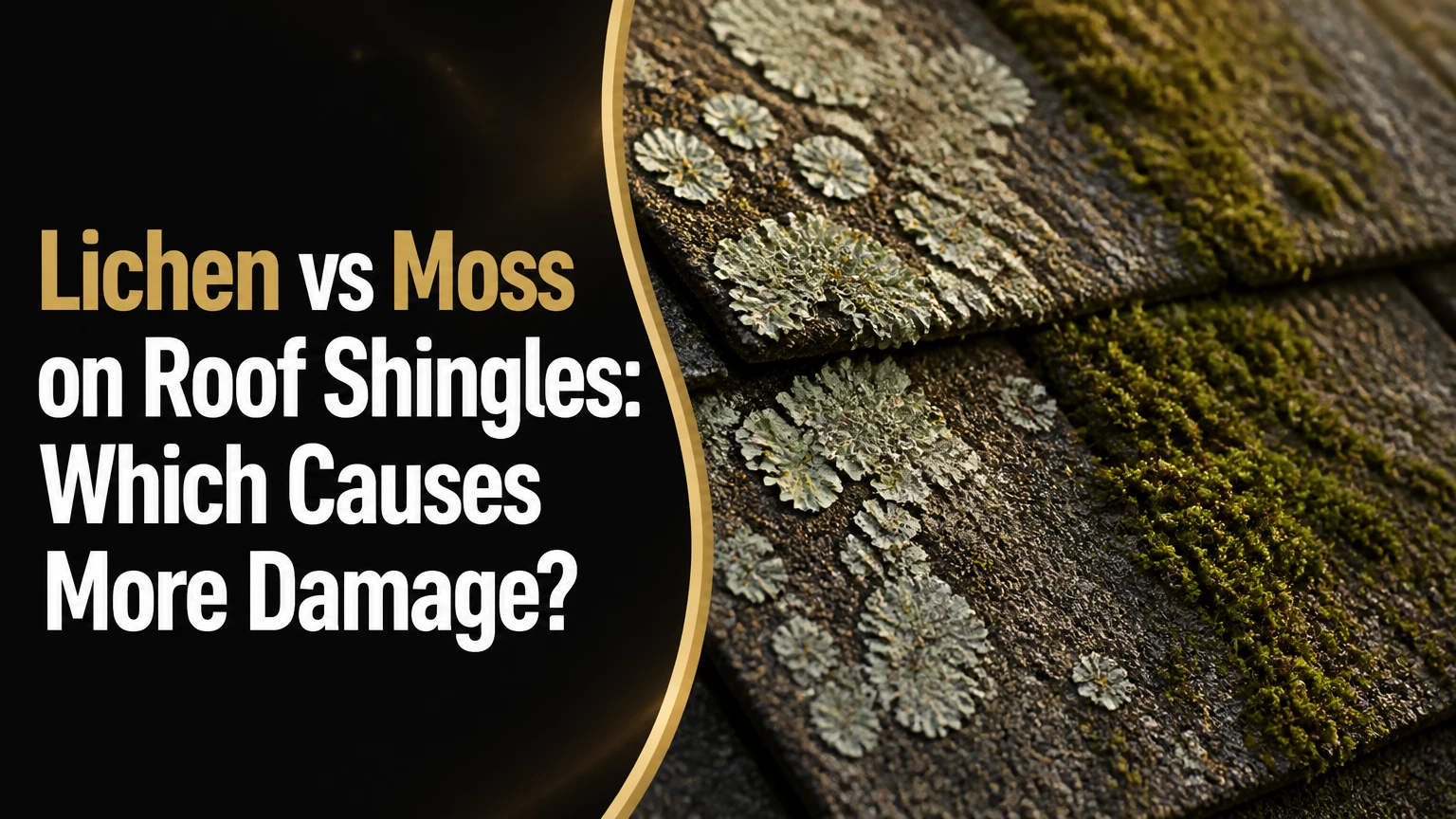
Moss and lichen are different organisms that damage roof shingles in different ways. Moss mainly retains moisture and can lift shingle edges, while lichen attaches tightly to granules and is usually harder to remove without worsening surface loss. Moss is generally easier to treat, but neither growth should be scraped aggressively or pressure-washed.
Key Facts at a Glance
- Moss is a nonvascular plant that uses rhizoids for attachment and absorbs water across its surface.
- Lichen is a partnership between a fungus and an alga or cyanobacterium, forming a body called a thallus.
- Moss creates the greater moisture-retention risk, especially on shaded, low-slope roofs with poor drainage.
- Lichen is usually the greater removal risk because attached growth can pull away asphalt and mineral granules.
- A pressure washer can remove protective granules from asphalt shingles even when biological growth disappears.
- Typical professional roof-growth treatment costs $400-$950, while repairs or replacement cost substantially more.
What Is the Difference Between Moss and Lichen?
Moss is a small plant-like bryophyte, whereas lichen is a composite organism made from a fungus and a photosynthetic partner. Moss commonly appears as a soft green mat with visible stems or leafy shoots; lichen often appears as flat crusts, gray-green patches, leafy lobes, or branching tufts attached directly to the shingle surface.
Moss has no true vascular system, roots, or woody stems. Rhizoids anchor moss, but they do not function like deep plant roots. The plant takes in water and dissolved nutrients across its surface, which explains why a dense mat can remain damp after rainfall.
Lichen has a fungal structure that houses algae or cyanobacteria. The fungal component supplies shape and attachment, while the photosynthetic partner produces carbohydrates. Some lichens also contain compounds that weather mineral surfaces, but the common claim that every lichen chemically fuses to asphalt shingles is too strong. Attachment strength varies by species, substrate, age, and weather exposure.
How Can You Identify Each Organism?
| Feature | Moss | Lichen | Algae |
|---|---|---|---|
| Typical appearance | Soft green mat, 2-50 mm thick | Crust, leafy patch, or branching tuft, 1-10 mm thick | Black, brown, or green discoloration |
| Biological type | Bryophyte plant | Fungus plus alga or cyanobacterium | Usually cyanobacteria or green algae |
| Surface attachment | Rhizoids and mat growth | Fungal holdfasts and surface attachment | Surface film or embedded discoloration |
| Water behavior | Holds moisture in dense mats | Swells and dries with changing humidity | Forms a thin wet film |
| Removal risk | Moderate if dead and loose | High if firmly attached | Usually low physical removal risk |
| Common roof location | Shaded valleys, north slopes, debris lines | Exposed granules, shaded or humid sections | Broad streaks on warm asphalt roofs |
Color alone is unreliable. Green lichen can resemble moss, and old moss can turn brown or gray after treatment. A close visual inspection of texture is more useful: moss feels fibrous and cushion-like, while crustose lichen feels painted or cemented to the granules.
How Do Moss and Lichen Damage Roof Shingles?
Moss damages shingles primarily by holding moisture against the surface and lifting shingle edges as the mat thickens. Lichen damages shingles primarily through persistent attachment, abrasion during removal, and possible chemical weathering of mineral particles. Neither organism automatically proves that the roof deck has rotted.
Moss Damage Mechanism
Dense moss acts as a moisture reservoir. Repeated wetting keeps asphalt shingles damp longer, and the trapped organic material can slow drying after rain, fog, or snow. On roofs with damaged flashing, failed underlayment, or lifted tabs, that moisture can contribute to leaks and wood decay.
Moss can also grow between overlapping shingle courses. As the mat expands, it may push against the lower edge of an upper shingle or lift a tab enough for wind to catch it. In climates with repeated freezing, water expansion can worsen existing cracks and separations.
Roof pitch changes the risk. A steep, sunny roof may dry quickly even with small moss patches, while a shaded 3-in-12 roof can remain wet for much longer. The organism is a warning sign, not a precise measurement of hidden rot.
Lichen Damage Mechanism
Lichen attaches to mineral granules and can be difficult to remove cleanly. When a homeowner scrapes or pulls firmly attached lichen, the removal tool may take granules and portions of the asphalt coating with it. That surface loss exposes the mat and reduces protection from ultraviolet radiation and rainfall.
Some lichen species produce weak organic acids, including compounds that can weather rock and mineral surfaces. Evidence does not support treating every roof lichen patch as a guaranteed source of rapid asphalt dissolution. On asphalt shingles, the practical concern is usually attachment and granule loss rather than a predictable chemical hole in the shingle.
The Insurance Institute for Business & Home Safety recommends regular roof maintenance and inspection because damaged or missing shingles increase vulnerability during severe weather. The organization does not assign a universal “50 percent” lifespan reduction to moss or lichen. A claim that either organism always cuts roof life by up to 50 percent lacks a dependable general source.
Which Is Worse, Moss or Lichen on a Roof?
Moss is worse for moisture retention and lifted shingle edges, while lichen is worse for removal-related granule loss. For most asphalt-shingle roofs, moss requires faster cleanup when it forms a thick mat, but firmly attached lichen requires more restraint because aggressive treatment can cause immediate surface damage.
| Decision factor | Moss | Lichen | Practical winner |
|---|---|---|---|
| Moisture retention | High in mats thicker than 10 mm | Low to moderate | Lichen |
| Edge lifting | Common where growth enters overlaps | Less common as a direct effect | Lichen |
| Removal difficulty | Moderate after approved treatment | High when crustose or firmly attached | Moss |
| Scraping damage risk | Moderate | High | Moss |
| Regrowth conditions | Shade, debris, humidity | Humidity, exposed granules, slow drying | Neither |
| Urgency | High when tabs are lifted or gutters clog | High when granules are already missing | Depends on damage |
| Best first action | Photograph, inspect, treat gently | Photograph, avoid scraping, seek roof-safe advice | Depends on organism |
Which Roof Areas Need Immediate Attention?
Growth deserves prompt inspection when it covers more than a small isolated patch, reaches under shingle tabs, appears beside a chimney or valley, or coincides with interior staining. A roof older than 15-20 years also deserves a replacement-cost discussion before paid cleaning, because cleaning cannot restore brittle asphalt or missing granules.
A small lichen spot on an otherwise intact roof may be monitored. A thick moss band at a shaded eave is more urgent because it can retain water and block drainage. Roof growth beside flashing should never be treated as a cosmetic issue until the flashing and leak path have been checked.
Where Do Moss and Lichen Grow?
Moss favors shade, moisture, organic debris, and slow drainage, while lichen tolerates more direct light and can survive repeated drying. Northern roof slopes often support moss in the Northern Hemisphere, but orientation alone does not predict growth because tree cover, local humidity, pitch, and rainfall matter more.
Polytrichum commune, commonly called haircap moss, can form upright, dense growth in suitable environments. Ceratodon purpureus, often called fire moss, tolerates disturbed and relatively dry urban surfaces. Species identification requires microscopy or a specialist, so homeowners should not select a treatment solely from a common-name match.
Lichen types also differ. Crustose lichen forms a thin crust that can be nearly inseparable from the substrate. Foliose lichen has leaf-like lobes, while fruticose lichen forms branching or hair-like structures. Crustose growth presents the greatest scraping hazard because a tool may remove the roof surface before the organism releases.
What Conditions Cause Regrowth?
| Regrowth condition | Typical threshold or sign | Corrective action | Expected effect |
|---|---|---|---|
| Overhanging branches | Branches shade roof for most daylight hours | Prune through a qualified arborist | Faster drying and less debris |
| Leaf and needle buildup | Debris remains after rainfall | Clear valleys and gutters regularly | Fewer damp organic pockets |
| Low roof pitch | Asphalt roof below about 4-in-12 | Increase inspection frequency | Earlier detection |
| Gutter overflow | Water spills over fascia during rain | Repair slope, hangers, or downspouts | Less edge moisture |
| Persistent humidity | Roof remains damp into afternoon | Improve ventilation and trim shade | Reduced wet time |
| Granule loss | Bare dark patches or exposed mat | Schedule roof inspection | Prevents worsening exposure |
Roof ventilation can help attic moisture control, but ventilation does not dry a shaded exterior surface by itself. Removing the source of shade and debris usually produces a larger improvement than adding an attic fan.
How Should You Remove Moss and Lichen Safely?
The safest roof-growth treatment uses inspection, an approved low-pressure chemical or biocidal product, controlled runoff, and only gentle removal of material that has released naturally. Roof-cleaning products must follow the label and shingle manufacturer’s instructions, because asphalt formulations, coatings, plants, metals, and wastewater rules differ.
Before You Start
| Requirement | Typical value | Why it matters |
|---|---|---|
| DIY time | 3-6 hours, excluding regrowth monitoring | Includes setup, application, cleanup, and gutter clearing |
| Professional treatment | $400-$950 typical | Varies by roof size, pitch, access, and region |
| Weather window | Dry, mild, low-wind day | Prevents runoff and rapid evaporation |
| Basic equipment | Pump sprayer, hose, eye protection, gloves | Controls application without high pressure |
| Roof access | Stable ladder and safe footing | Steep roofs should use professionals |
| Plant protection | Pre-wet and cover sensitive landscaping | Reduces chemical injury |
Do not climb a wet, steep, brittle, or visibly damaged roof. OSHA requires fall protection practices for qualifying residential construction work, and homeowners should treat harnesses, anchors, ladders, and roof edges as serious hazards rather than optional accessories.
Step 1: Inspect and Photograph the Roof
Check shingle tabs, exposed mat, flashing, valleys, ridge vents, gutters, and interior ceilings before applying anything. Photographing the surface creates a useful record if cleaning reveals pre-existing granule loss or if a contractor later recommends replacement.
Success checkpoint: You can identify whether the growth is a surface patch, an under-tab mat, or a symptom near a leak.
Common mistake: Starting treatment before locating fragile or already-failed shingles.
Step 2: Protect Plants and Control Runoff
Wet nearby plants, cover sensitive foliage temporarily, divert downspouts where practical, and remove collected runoff according to the product label and local requirements. Keep children and pets away until the treated area and surrounding ground are safe.
Success checkpoint: No concentrated runoff flows into a pond, storm drain, vegetable bed, or neighboring property.
Common mistake: Assuming dilution makes every roof cleaner harmless to plants or aquatic life.
Step 3: Apply a Roof-Approved Treatment
Use the product’s stated dilution and dwell time. Common professional options include manufacturer-approved sodium hypochlorite formulations, sodium percarbonate products, or other labeled roof biocides; a universal bleach ratio is not safe guidance for every shingle, coating, plant, or jurisdiction.
Apply in manageable sections according to the label. Avoid combining products. The Centers for Disease Control and Prevention states, “Never mix household bleach or any other cleaning products.” Bleach mixed with acids or ammonia can release dangerous gases.
Success checkpoint: The product remains wet for the label’s contact period without pooling beneath shingle tabs.
Common mistake: Increasing concentration to accelerate results, which can damage plants, metals, sealants, and colored shingles.
Step 4: Let Dead Growth Release Naturally
Dead moss often loosens over several days or weeks. A garden hose with low pressure may remove residue when the label permits, but do not force water upward under the shingle courses. Lichen may remain visibly attached after treatment, and that does not justify scraping it away.
Success checkpoint: Loose debris leaves the surface without granule piles appearing in gutters.
Common mistake: Treating a clean-looking roof as proof that the shingles remain undamaged.
Step 5: Clean Gutters and Reinspect
Remove dead organic material from gutters and downspouts after the roof has shed loose growth. Recheck the roof from the ground and attic after the next substantial rainfall.
Success checkpoint: Downspouts flow freely, shingle tabs lie flat, and no new interior staining appears.
Common mistake: Leaving dead moss in gutters, where it can restrict drainage and wet fascia boards.
Which Treatment Works Best for Moss and Lichen?
A labeled soft-wash treatment is usually the best first option for moss, while lichen calls for a slower, less aggressive approach and sometimes professional evaluation. Mechanical scraping is appropriate only for loose dead material, not for firmly attached lichen or brittle asphalt shingles.
| Treatment option | Moss result | Lichen result | Typical cost | Main limitation |
|---|---|---|---|---|
| Labeled sodium hypochlorite cleaner | Fast kill, often 20-60 minutes | Can weaken visible growth over time | $20-$60 DIY supplies | Plant, runoff, and discoloration risk |
| Sodium percarbonate cleaner | Slower biological action | Variable on firmly attached crusts | $25-$80 DIY supplies | Longer dwell and repeat treatment |
| Professional soft wash | Controlled application | Best for high-risk or steep roofs | $400-$950 typical | Does not repair failed shingles |
| Plastic hand tool | Removes loose dead moss | High damage risk on attached lichen | Under $25 | Can strip granules |
| Pressure washer | Immediate visual removal | Immediate surface damage risk | $150-$500 rental or service | Not appropriate for asphalt shingles |
| Zinc or copper strip | Reduces future moss and algae growth | May limit new growth | $200-$500 DIY materials | Does not remove established growth |
A roof cleaner should explain the chemical, dilution, dwell time, runoff controls, insurance coverage, and post-treatment expectations. “Soft wash” describes a pressure approach, not a guarantee that the chemical is roof-compatible.
Are Zinc and Copper Strips Effective?
Zinc and copper strips can reduce new growth below the metal as rainwater carries small amounts of metal ions down the slope. Strips do not repair granule loss, remove established lichen, or protect roof sections blocked by pine needles and debris.
Typical material costs range from $200-$500 for a DIY installation and $800-$1,800 when access and professional labor are included. Lifespan varies widely, commonly about 5-20 years, depending on metal thickness, exposure, fasteners, roof geometry, and corrosion.
Installations require care. Cutting or disturbing shingles can create leaks, and copper runoff may stain or harm sensitive surfaces. Use compatible fasteners and follow the shingle manufacturer’s instructions. A roofer should inspect the ridge detail before any strip is nailed beneath courses.
What Should Homeowners Avoid?
The most damaging roof-cleaning mistake is using high pressure to obtain an immediate cosmetic result. Pressure can remove asphalt granules, break adhesive seals, drive water beneath laps, and shorten the remaining service life even when the growth disappears.
Avoid these failures:
- Scraping live lichen: Stop if the organism does not release easily. Granules coming off with the patch indicate surface damage.
- Using an unapproved chlorine mix: Follow the product label and shingle warranty. Concentration, temperature, dwell time, and runoff determine risk.
- Treating in hot sun: Rapid evaporation can reduce dwell time and create uneven treatment.
- Ignoring existing leaks: Growth removal does not fix flashing, underlayment, decking, or penetrations.
- Blocking gutters during treatment: Debris and runoff can clog downspouts and wet fascia.
- Trimming trees without utility clearance: Hire an arborist when branches approach electrical conductors or large limbs.
One practitioner rule is useful: granules in the gutter after cleaning matter more than a temporarily spotless roof. A few granules can be normal on an aging roof, but concentrated piles after aggressive treatment signal avoidable damage.
How Much Does Roof Moss or Lichen Removal Cost?
Typical professional treatment costs $400-$950 for an accessible residential asphalt roof, while DIY supplies commonly cost $20-$80 before ladder, protective equipment, plant protection, and disposal. Repairs, roof access, steep pitch, multiple stories, and replacement recommendations can raise the total substantially.
| Service or project | Typical price range | Typical timeframe | What changes the price |
|---|---|---|---|
| DIY cleaner and sprayer supplies | $20-$80 | 3-6 hours | Product, PPE, ladder, plant protection |
| Professional soft wash | $400-$950 | 2-5 hours on site | Area, pitch, access, treatment |
| Zinc strip materials | $200-$500 | 2-3 hours installation | Ridge length and metal gauge |
| Professional metal-strip installation | $800-$1,800 | Half to one day | Roof geometry and shingle disturbance |
| Minor shingle repair | $250-$1,000 typical | 1-4 hours | Access, flashing, number of tabs |
| Asphalt roof replacement | $8,000-$25,000 typical | 1-3 days | Area, layers, decking, region |
These figures are broad North American planning ranges, not quotes. A roof inspection should precede cleaning when the roof is older, steep, leaking, heavily granule-worn, or covered by wood shingles.
Which Approach Fits Your Roof?
Homeowner decisions should follow roof material, age, slope, growth thickness, and access rather than organism name alone. Moss on a new, accessible asphalt roof may respond well to careful treatment, while lichen on a 20-year-old roof with bare patches may make replacement more rational than repeated cleaning.
Shaded Asphalt Roof With Thick Moss
Choose professional or label-compliant low-pressure treatment, then correct overhanging branches, debris accumulation, and gutter overflow. Do not pull the mat upward across shingle tabs. Inspect the attic if moss is concentrated around valleys, eaves, or penetrations.
Sunny Asphalt Roof With Crustose Lichen
Avoid scraping and pressure washing. Photograph the area, inspect granule condition, and ask a roofer whether the lichen is attached to intact granules or already exposing the asphalt mat. Treatment may reduce biological activity without producing an immediate bare-looking surface.
Wood Shingles or Shakes
Wood roofing requires a product specifically labeled for wood and a different inspection standard. Chlorine, excessive water, and aggressive brushing can worsen splitting, surface erosion, and fastener corrosion. A wood-roof specialist should assess growth before treatment.
Tile or Metal Roofing
Tile and metal generally tolerate different cleaning methods than asphalt, but coatings, laps, sealants, and fasteners remain vulnerable. Pressure washing can force water into joints or remove coatings, so the material manufacturer’s instructions still control the method.
Low-Slope or Very Steep Roof
Low-slope roofs need drainage and membrane inspection because standing water may be the primary problem. Very steep roofs create fall risks that outweigh DIY savings. In both cases, hire an insured contractor who can document the method and protect the building envelope.
FAQ
Can Moss and Lichen Grow Together on the Same Shingle?
Moss and lichen can occupy the same roof area when humidity, shade, and debris create suitable conditions. Their coexistence does not mean they need identical removal methods. Treat the moss mat gently, and avoid scraping lichen that remains bonded to mineral granules.
Does Roof Moss Mean I Need a New Roof?
Roof moss does not by itself require replacement. Replacement becomes more likely when moss accompanies brittle shingles, widespread granule loss, lifted tabs, exposed mat, recurring leaks, damaged flashing, or a roof near the end of its expected service life.
Will Zinc or Copper Kill Existing Lichen?
Zinc and copper strips mainly reduce new growth below the installation as rain carries metal ions down the roof. They are preventive tools, not reliable removers of established lichen. Existing attached growth still requires a labeled treatment and careful evaluation.
Is Black Streaking the Same as Moss or Lichen?
Black streaking on asphalt shingles is often associated with algae, including cyanobacteria, rather than moss or lichen. Algae usually creates discoloration without the thick moisture-holding structure of moss or the attached crust of lichen. A roof cleaner should identify the growth before choosing treatment.
Can Insurance Cover Roof Damage From Moss?
Home insurance commonly excludes gradual wear, poor maintenance, and biological growth itself, although policy language varies. A sudden covered event, such as wind damage to shingles weakened by prior growth, may be evaluated separately. Photograph conditions and review the policy before filing a claim.
How Often Should a Roof Be Checked After Treatment?
Inspect the roof from the ground and check gutters at least twice yearly, commonly in spring and fall, with an additional check after severe storms. Persistent shade, heavy rainfall, or rapid regrowth may justify a professional inspection every 12-24 months.
The Bottom Line
The practical answer to lichen vs moss on roof shingles is condition-based: moss is the larger moisture and shingle-lifting threat, while lichen is the larger granule-loss and removal hazard. Treat moss before it forms a thick mat, leave firmly attached lichen for a roof-safe assessment, avoid pressure washing, control shade and debris, and replace shingles only when inspection shows damage that cleaning cannot correct.