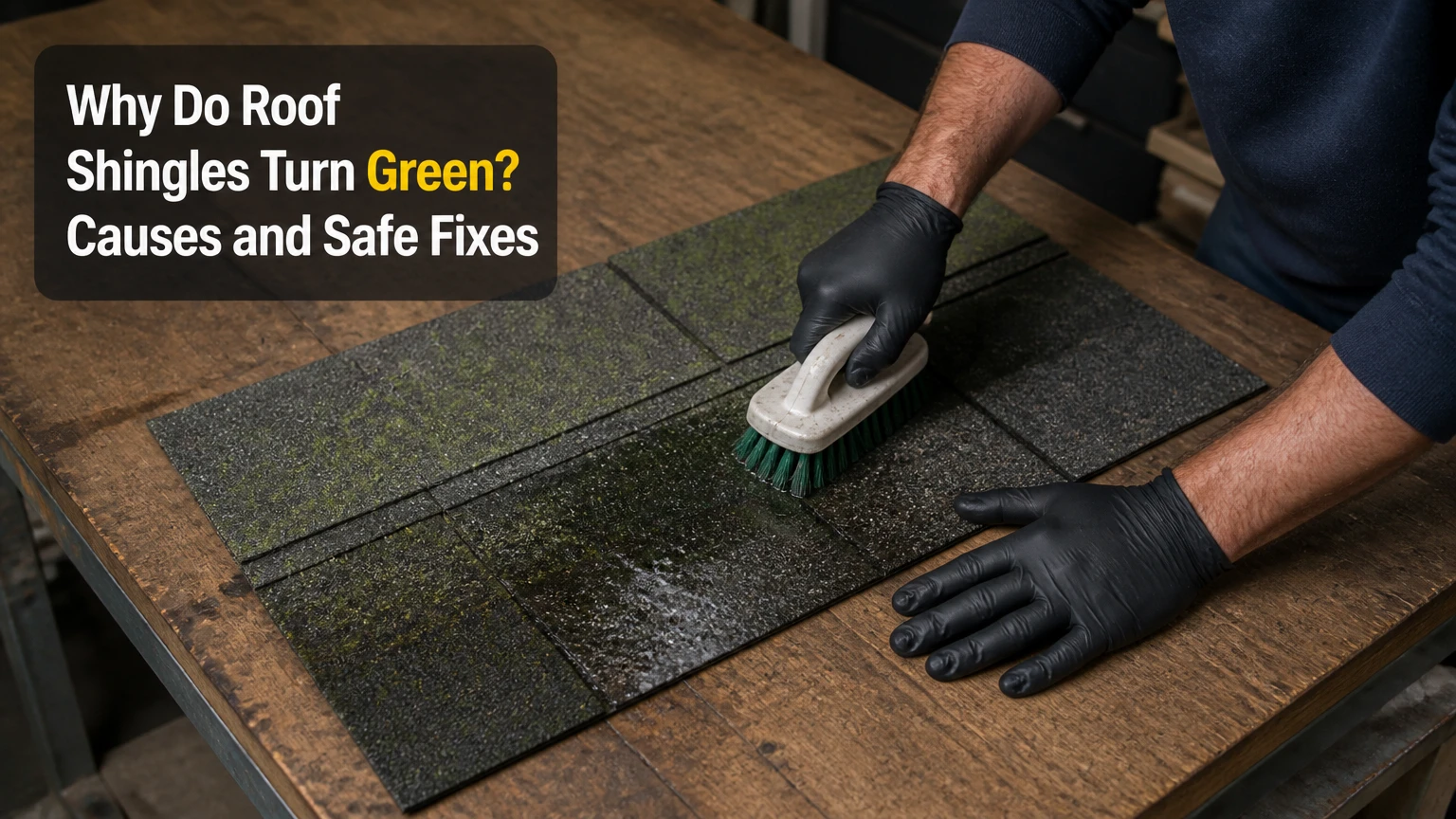
Roof shingles turn green primarily because moisture-loving organisms colonize the surface, especially cyanobacteria that create green or black stains, moss, and lichen. Shade, north-facing slopes, trapped leaves, humid air, poor drainage, and roof leaks increase the time shingles stay damp. Green discoloration can be cosmetic, but moss and lichen may dislodge granules and damage aging shingles.
Key Facts About Green Roof Growth
- Cyanobacteria, historically called blue-green algae, commonly cause flat green, blue-green, or black roof stains.
- Moss is a leafy, water-holding plant that forms raised, fuzzy mats and can lift shingle edges.
- Lichen is a partnership between a fungus and a photosynthetic organism, creating crusty patches attached to granules.
- North-facing and tree-shaded roof sections usually dry more slowly than sun-exposed slopes.
- Asphalt roof cleaning should use low pressure, because high-pressure water can remove protective mineral granules.
- Typical professional roof cleaning costs about $300-$800 for many single-family homes, while repairs cost substantially more.
What Causes Green Roof Shingles?
Green roof shingles result from biological growth combined with repeated moisture retention. Airborne spores and cells settle on the roof, then establish where dew, rain, humidity, organic debris, and shade keep the surface wet long enough for growth.
The most common stain-maker is a cyanobacterium often identified in roofing literature as Gloeocapsa magma. The organism is not technically a true alga, although “roof algae” remains the familiar industry term. Cyanobacteria can use moisture and light to grow across mineral-coated asphalt shingles, producing pigments that appear green, blue-green, brown, or nearly black as colonies age.
Moss and lichen require a different diagnosis. Moss grows upward into a visible plant layer and holds water against the roof. Lichen forms a firm crust or branching growth that grips individual granules. Both organisms become more damaging when they coexist with leaf litter, clogged gutters, defective flashing, or a roof that is already near the end of its service life.
How does the growth process work?
Green roof growth usually follows five stages:
- Deposition: Wind, birds, insects, and nearby vegetation carry microscopic spores or cells onto the roof.
- Moisture retention: Dew, rain, humidity, shade, and debris prevent rapid drying.
- Initial colonization: Cyanobacteria spread as a thin film; moss spores germinate in accumulated dust and organic material.
- Attachment: Moss rhizoids and lichen structures grip the granule surface and nearby debris.
- Expansion: Repeated wetting and drying loosen granules, hold more water, and create additional habitat.
The process is gradual, not automatic. A sunny, clean, well-ventilated roof may receive spores without developing a visible colony because the surface dries too quickly.
How Can You Identify Algae, Moss, or Lichen?
You can usually distinguish the growth by its shape, texture, and location. Flat discoloration usually indicates cyanobacterial staining, while raised or crusty material points toward moss or lichen.
| Growth type | Appearance | Texture and attachment | Typical roof risk |
|---|---|---|---|
| Cyanobacteria | Green, blue-green, brown, or black streaks | Flat film or diffuse stain; no leafy structure | Usually cosmetic at first; persistent moisture can accelerate weathering |
| Moss | Bright green to yellow-green tufts or mats | Soft, raised, and water-holding; rhizoids anchor to debris and granules | Granule loss, lifted edges, blocked drainage, freeze-thaw damage |
| Lichen | Pale green, gray-green, yellow, or orange crusts | Hard, crusty, leafy, or branching patches firmly attached | Localized granule loss and difficult removal |
| Mold or mildew | Gray, brown, white, or black patches | Often powdery or slimy; may occur around leaks | Indicates moisture, but may not be a roof-colonizing organism |
Cyanobacterial streaks often follow the slope because rainwater carries cells and dissolved minerals downward. Moss concentrates in valleys, beneath tree branches, beside chimneys, and near gutters where organic material accumulates. Lichen may appear as isolated circular colonies rather than long, even streaks.
A close visual inspection from the ground is useful, but climbing onto a wet or moss-covered roof creates a fall risk. A roofer can confirm whether discoloration is biological growth, exposed underlayment, damaged sealant, or a leak stain.
Why Do Shade, Humidity, and Roof Orientation Matter?
Shade and humidity matter because organisms need a longer wet period to establish and reproduce. North-facing slopes, roof planes under dense tree canopies, and sections beside taller buildings receive less direct sun and often retain morning dew after sunny areas have dried.
A relative humidity reading above 70% does not automatically cause roof growth. The more useful measure is surface wetness, including how many hours the shingle remains damp after rain or overnight condensation. A shaded roof with poor airflow can stay wet even when the afternoon air feels dry.
Roof conditions that increase moisture retention include:
- Overhanging branches that block sunlight and drop leaves.
- Clogged gutters that overflow onto lower shingle courses.
- A plumbing vent, skylight, or chimney flashing leak.
- A low-slope area where water drains slowly.
- Condensation from an improperly vented attic.
- Coastal or humid climates with frequent overnight moisture.
- Debris lodged behind chimneys, dormers, or roof-mounted equipment.
Tree trimming helps, but trimming alone cannot correct a leaking flashing detail. Localized growth deserves a moisture investigation when the rest of the roof remains clean.
Can Green Growth Damage Asphalt Shingles?
Cyanobacterial staining is usually a cosmetic problem during its early stages. Moss and lichen create greater physical risk because they retain water, attach to granules, and can lift or separate shingle edges as colonies expand.
The Asphalt Roofing Manufacturers Association warns homeowners, “Never power wash an asphalt shingle roof.” High-pressure water can strip ceramic-coated mineral granules from the asphalt mat, expose the binder, and shorten the remaining service life. The damage may not become obvious until accelerated granule loss appears in gutters or bare spots develop across the roof.
Moss does not literally consume an asphalt shingle like a wood-decay fungus consumes timber. Its primary damage mechanism is persistent wetness, root-like attachment, debris accumulation, and mechanical lifting. Lichen can adhere strongly and contribute to localized granule loss, but claims that every lichen colony rapidly dissolves the entire roof are overstated.
How much life can moss remove from a roof?
There is no reliable universal percentage because damage depends on shingle age, climate, slope, organism density, and maintenance history. A typical neglected moss-covered roof can lose meaningful service life, especially when granules, seal strips, and shingle edges are already weathered, but a precise 30%-50% reduction should not be treated as a guaranteed measurement.
Look for repair or replacement evidence rather than relying on a percentage:
- Granules collect heavily in gutters or at downspout outlets.
- Shingle edges curl, lift, crack, or no longer lie flat.
- Fiberglass mat is visible through missing granules.
- Flashing is rusted, open, or separated.
- Water stains appear on attic wood or ceiling finishes.
- The roof is near its expected age and has widespread bare areas.
Which Roofing Materials Are Most Vulnerable?
Asphalt shingles are especially prone to cyanobacterial streaking because their mineral granules and textured surface collect moisture and airborne debris. Tile, metal, wood, and synthetic roofing can also develop biological growth, but cleaning chemistry and physical risks differ.
| Roofing material | Common green growth | Main vulnerability | Safer general approach |
|---|---|---|---|
| Asphalt shingles | Cyanobacteria, moss, lichen | Granule loss and lifted edges | Manufacturer-approved low-pressure treatment |
| Painted metal | Algae, moss at laps, lichen | Coating damage and trapped moisture | Mild cleaner, soft tools, controlled rinsing |
| Concrete or clay tile | Algae, moss, lichen | Cracking and breakage under foot traffic | Walk only on approved areas or use a professional |
| Wood shingles or shakes | Moss, lichen, algae | Rot, splitting, and prolonged wetness | Specialized wood-roof assessment and gentle cleaning |
| Synthetic composite | Algae and moss | Surface staining and slippery access | Product-specific cleaner and low-pressure rinse |
Never transfer an asphalt-shingle bleach recipe to a wood shake roof. Wood roofing may need preservation, ventilation, and rot evaluation rather than simple stain removal. Tile roofs can tolerate some cleaning products but remain vulnerable to cracked tiles and unsafe walking.
How Should Green Roof Growth Be Removed?
Green roof growth should be treated with a roof-compatible cleaner and low-pressure application, followed by natural weathering or a gentle rinse according to the product label. The safest method depends on the roofing material, growth thickness, roof pitch, nearby landscaping, and shingle condition.
Before cleaning, inspect the roof
From the ground or a safe ladder position, identify the material, slope, gutters, downspouts, plants, ponds, and electrical equipment. Do not walk on a steep, wet, icy, or moss-covered roof without fall-protection training and suitable equipment.
A practical preparation checklist includes:
- Read the shingle manufacturer’s maintenance instructions.
- Check weather for at least 24 hours without heavy rain.
- Wet and cover sensitive plants near downspouts.
- Redirect or temporarily disconnect downspouts where runoff can be contained.
- Protect painted siding, metal fixtures, and outdoor furniture.
- Keep children and pets away from treatment and runoff.
- Wear eye protection, gloves, and footwear appropriate to the access area.
Step 1: Remove loose debris without scraping
Use a leaf blower from a safe position or a soft-bristle brush on accessible, low-slope areas. Do not pull rooted moss forcefully, because attached granules can come away with the mat.
You will know this step worked when leaves, twigs, and loose organic material are gone without creating bare streaks. A common mistake is starting with a stiff wire brush, which abrades the shingle surface even before chemical treatment begins.
Step 2: Apply a labeled roof cleaner
Apply a commercial roof-growth product or a properly diluted solution specified for the roofing material. Sodium hypochlorite can work quickly on cyanobacterial staining, while sodium percarbonate products generally act more slowly and may reduce chlorine-related plant damage.
Do not assume that stronger concentration means better cleaning. Chlorine runoff can injure vegetation, corrode metals, discolor siding, and damage aquatic life. Follow the product label rather than copying a 1:3 or 1:1 recipe from an unrelated roof, climate, or shingle manufacturer.
Step 3: Allow dwell time without letting the surface dry
Keep the treatment wet for the label-specified period, commonly about 10-20 minutes for chlorine-based products. Reapply lightly if the surface dries too quickly, but never combine chlorine products with acids, ammonia, or other cleaners.
The treatment is working when green or dark growth loses color and begins to separate naturally. Scrubbing during dwell time can remove granules and does not improve a failing roof.
Step 4: Rinse with low pressure or let rain remove residue
Use a garden hose or low-pressure rinse directed downward, never underneath the shingle laps. Some products are designed to weather away without rinsing, so follow the label and protect landscaping either way.
You will know the rinse is adequate when chemical residue and loose debris no longer remain on the roof or siding. A common mistake is using a pressure washer because the result looks faster; that shortcut can cause permanent granule loss.
Step 5: Correct the moisture source
Clean gutters, remove selected overhanging branches, repair flashing, improve attic ventilation where condensation is present, and correct drainage defects. Cleaning without moisture control often produces a visually clean roof that stains again within one or two seasons.
The job is complete only when the roof dries normally after rain and no active leak or overflow remains. A green patch beside a chimney or valley should trigger inspection, not repeated chemical application.
Which Cleaner and Prevention Method Works Best?
For existing growth, a labeled roof cleaner gives faster and more predictable results than passive metal strips. For recurrence prevention, copper or zinc installed near the ridge can reduce new growth in the runoff path, but strips do not clean an established colony or protect every roof plane.
| Method | Typical result time | Typical cost | Main limitation |
|---|---|---|---|
| Sodium hypochlorite treatment | 10-20 minutes to kill surface growth; 1-3 years before recurrence | $0.20-$0.60 per sq. ft. professionally applied | Runoff can damage plants and corrode metals |
| Sodium percarbonate cleaner | 30 minutes to several hours; 1-2 years typical | $0.40-$0.90 per sq. ft. professionally applied | Slower on dense, established growth |
| Zinc or copper strip | 1-3 wet seasons for prevention benefits | $20-$40 per 10-foot strip, materials only | Usually protects only the runoff path, roughly 10-15 feet |
| Algae-resistant shingles | Protection built into replacement roof; commonly 10-30 years of shingle service | About 10%-15% shingle-material premium | Requires roof replacement and protection declines with weathering |
| Manual soft removal | Same day for loose debris; treatment still needed | $0.15-$0.50 per sq. ft. typical labor component | Aggressive removal can damage granules |
Copper generally has stronger biological activity than zinc, but copper runoff may stain some surfaces and affect aquatic organisms. Metal strips work best when installed below the ridge, under the upper shingle courses, with enough exposed metal for rainwater contact. They do not solve shade, clogged gutters, or a roof leak.
Algae-resistant shingles use copper-containing granules or another manufacturer-specified treatment. Ask for the exact product warranty and whether the feature targets algae staining, moss, or both. Algae resistance does not make a roof immune to organic debris and prolonged wetness.
What Does Professional Roof Cleaning Cost?
Typical professional roof cleaning costs about $300-$800 for a straightforward single-family asphalt roof, while larger, steeper, heavily soiled, or difficult-access roofs can cost $800-$1,500 or more. Local labor rates, roof area, pitch, stories, plant protection, and repair needs create most of the variation.
| Project condition | Typical price range | Typical duration | Likely scope |
|---|---|---|---|
| Small, low-slope asphalt roof | $250-$500 | 2-4 hours | Chemical treatment and light rinse |
| Standard single-family roof | $300-$800 | 3-6 hours | Treatment, runoff control, gutter cleanup |
| Steep or two-story roof | $600-$1,200 | 4-8 hours | Added access and fall-protection labor |
| Heavy moss or lichen | $700-$1,500 | 5-10 hours, sometimes repeat visits | Multiple treatments and careful debris removal |
| Cleaning plus minor repairs | $800-$2,500 | 1-3 days | Treatment, flashing, vent, or shingle repairs |
A typical 2,000-square-foot house may have 2,200-3,000 square feet of actual roof surface because of pitch and overhangs. Contractors should price the roof area, not simply the home’s floor area.
Get a written scope that identifies the chemical, application method, runoff controls, expected recurrence interval, plant protection, warranty exclusions, and whether repairs are included. A low bid that relies on pressure washing can cost more after granule loss or leaks appear.
When Should You Clean, Repair, or Replace?
Clean green growth when the roof is structurally sound, shingles remain flat, granule coverage is consistent, and no leak or widespread aging is present. Repair or replace when biological growth accompanies exposed mat, brittle shingles, recurring leaks, open flashing, or extensive edge lifting.
Use this decision sequence:
- Check age: Asphalt roofs commonly last about 15-30 years, depending on product, ventilation, installation, and climate.
- Check surface condition: Look for bald patches, cracks, curling, and granules in gutters.
- Check water control: Inspect valleys, gutters, flashing, vents, and attic sheathing.
- Check growth depth: Flat staining is less urgent than thick moss or crusted lichen.
- Check distribution: One isolated patch suggests a local moisture source; widespread growth suggests climate or shade exposure.
Cleaning an old roof can improve appearance while leaving the underlying failure unchanged. A roofer should inspect roofs with active leaks, steep slopes, brittle shingles, suspected rot, or growth attached across large areas.
Why Did the Green Growth Return So Quickly?
Green growth that returns within six months usually indicates persistent moisture, incomplete treatment, unsuitable chemistry, or contamination from nearby trees rather than a mysterious new disease. Rapid recurrence warrants checking gutters, shade, roof leaks, runoff paths, and whether the original treatment reached the full colony.
| Symptom after cleaning | Most likely cause | Recommended response |
|---|---|---|
| Stains return in 3-6 months | Heavy shade or incomplete treatment | Inspect moisture sources and repeat with a labeled product |
| Green patch appears in one location | Leak, overflow, or condensation | Check flashing, gutter alignment, valley, and attic |
| Shingles look white or chalky | Excessive cleaner concentration or weathering | Stop treatment and request a roof-condition inspection |
| Moss remains brown but attached | Dead roots and mat were not released naturally | Avoid force; allow weathering or use trained professional |
| Growth spreads below a metal strip | Strip is too short, blocked, or ineffective on that plane | Reposition, extend coverage, and correct shade or debris |
| Granules appear in gutters after cleaning | Abrasion, pressure washing, or advanced shingle failure | Photograph, stop cleaning, and evaluate roof replacement risk |
A residual zinc-based product may slow recurrence, but no treatment compensates for a roof that never dries. The practical rule is simple: fix water retention first, then clean.
Common Mistakes Homeowners Make
Using a pressure washer
Pressure washing can remove granules, force water under laps, damage flashing, and void manufacturer maintenance requirements. Low pressure takes longer but preserves the surface that protects asphalt from ultraviolet exposure.
Scraping attached moss
Aggressive scraping removes moss and shingle granules together. Chemical treatment and natural weathering are safer for sound shingles, while heavily rooted moss on an old roof may justify replacement rather than forceful removal.
Applying bleach without runoff control
Unprotected plants can receive concentrated runoff even when the roof application is careful. Wet vegetation first, cover sensitive plants where appropriate, control downspouts, and rinse affected surfaces with clean water.
Installing metal over a dirty roof
Zinc and copper strips are preventive devices, not instant cleaners. Install them after treatment, and do not expect them to protect shaded roof sections outside the rainwater path.
Ignoring attic moisture
Poor bathroom-fan ventilation can create condensation beneath the roof deck, while exterior growth occurs above. If attic insulation is damp or sheathing has dark water marks, cleaning alone addresses only the visible symptom.
Frequently Asked Questions
Are green roof shingles always a sign of a leak?
Green shingles do not always indicate a leak. Cyanobacteria, moss, and lichen commonly grow because of shade, dew, humidity, and airborne debris. A localized patch beside a chimney, valley, vent, or gutter overflow is more suspicious, especially when attic wood, insulation, or ceilings show water staining.
Can I leave algae stains on asphalt shingles?
You can often leave flat algae stains alone when the roof is young, dry, structurally sound, and free of granule loss or leaks. Staining is mainly cosmetic at first. Cleaning becomes more worthwhile when growth spreads, the roof remains damp, resale appearance matters, or moss and lichen begin forming raised attachments.
Does vinegar kill roof moss?
Vinegar can damage nearby plants and may not provide reliable control on a large, weather-exposed roof. Household vinegar is also acidic, so repeated use can affect metals, coatings, and runoff-sensitive landscaping. A roofing-approved product with label directions is more predictable than an improvised vinegar mixture.
Can rain wash away dead moss?
Rain can gradually loosen dead moss after treatment, but thick mats may remain attached for weeks or months. Do not pull the mat aggressively while it is rooted into shingles. A trained cleaner can remove residual material with controlled, low-abrasion methods after the colony has died.
Do roof algae-resistant shingles prevent moss?
Algae-resistant shingles primarily target algae or cyanobacterial staining, not every form of moss. Copper-containing granules may reduce staining, but shade, leaf debris, poor drainage, and prolonged wetness can still support moss. Roof ventilation, tree management, and gutter maintenance remain necessary.
Should I install zinc or copper strips?
Install a metal strip when the roof is otherwise sound and recurring algae is the main concern, particularly on a shaded slope below a ridge. Copper is generally more biologically active, while zinc often costs less. Neither strip repairs leaks, removes established moss, or protects roof areas outside its runoff path.
The Bottom Line
Why do roof shingles turn green? Moisture-loving cyanobacteria, moss, and lichen colonize surfaces that stay damp because of shade, debris, humidity, poor drainage, or leaks. Flat green or black staining is usually less damaging than raised moss or firmly attached lichen, but every type becomes more persistent when the roof cannot dry.
Start by identifying the organism and checking for a local water source. Use a roof-approved, low-pressure cleaning method, protect landscaping from runoff, and avoid pressure washing or aggressive scraping. Add tree trimming, gutter maintenance, ventilation corrections, or properly installed zinc or copper only after addressing the condition that keeps the shingles wet.