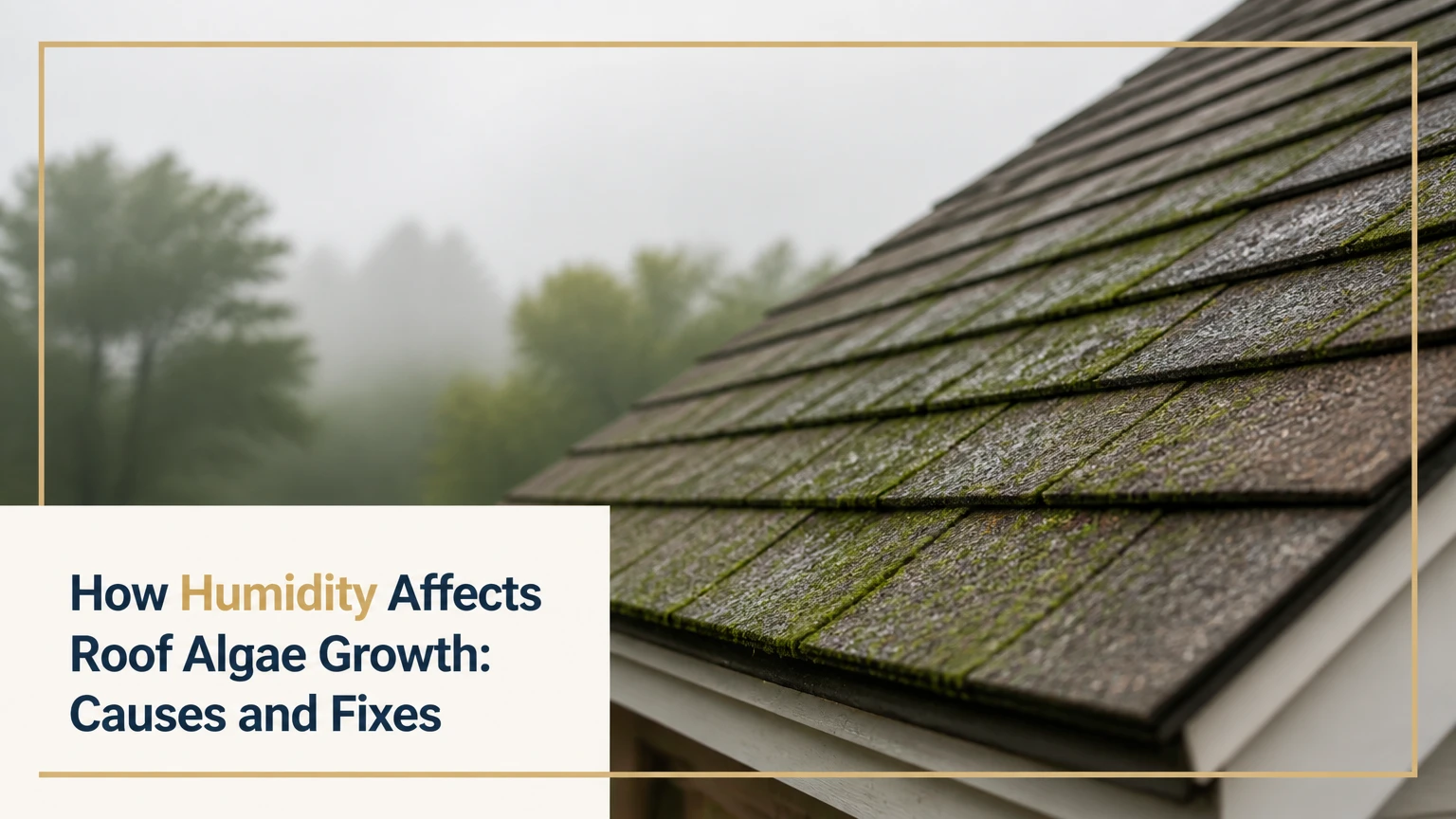
Humidity affects roof algae growth by slowing evaporation and extending the wet periods that airborne cyanobacteria need to establish colonies. The common black-streak organism, often identified as Gloeocapsa magma, grows fastest where humid air combines with shade, dew, poor airflow, and porous mineral surfaces. Relative humidity above 60-70% increases risk, but it is not a universal biological threshold.
Key Facts at a Glance
- Roof algae needs repeated surface moisture, not humidity alone, to colonize asphalt shingles.
- Gloeocapsa magma is a cyanobacterium, although homeowners commonly call the growth roof algae.
- North-facing, shaded, tree-covered, and low-airflow roof slopes usually dry more slowly.
- A 60-70% relative humidity reading indicates increased risk, not a precise point at which algae suddenly activates.
- High-pressure washing can remove asphalt-shingle granules and is not an appropriate routine algae treatment.
- Copper-containing granules, correctly positioned metal strips, and faster roof drying can reduce recurrence without guaranteeing permanent prevention.
How Humidity Affects Roof Algae Growth
Humidity affects roof algae growth through surface moisture retention. When humid air, overnight dew, light rain, and shade keep shingles damp for repeated periods, cyanobacterial cells can remain hydrated long enough to attach, multiply, and produce visible pigment. A roof that reaches 85% outdoor RH for one hour may dry quickly, while a shaded roof at 65% RH can stay damp all morning.
Relative humidity measures how much water vapor air holds compared with the maximum amount possible at that temperature. Cooler nighttime air reaches saturation more easily, so dew often forms on roof surfaces even when a daytime weather app reports moderate humidity. The roof’s actual microclimate therefore matters more than one hourly reading from a backyard sensor.
What organism causes black roof streaks?
Black roof streaks usually come from cyanobacteria associated with Gloeocapsa magma, although laboratory identification is required for certainty. The organism spreads through airborne particles and establishes more readily on asphalt shingles with mineral granules, especially when wind, birds, nearby trees, and roof-to-roof proximity provide repeated spore deposition.
The dark appearance comes from protective pigments and a gelatinous matrix that help the colony tolerate ultraviolet radiation and intermittent drying. The stain is biological, not simply accumulated dirt. Mold and mildew can coexist with roof algae, but they are different organisms and require different diagnostic assumptions.
Is 60% relative humidity a hard threshold?
No. A 60-70% relative-humidity range is a practical risk indicator, not a universal activation threshold for every roof algae colony. Temperature, duration, dew formation, shade, shingle porosity, rainfall, wind, and the organism’s prior establishment all alter the outcome.
A roof can develop algae in a relatively dry climate when nighttime dew repeatedly wets a shaded slope. Conversely, a humid coastal roof can remain relatively clean if strong sun, wind, smooth roofing, and copper-bearing granules shorten the wet period. Treat the RH number as one variable in a moisture balance, not as a switch.
How Does Roof Algae Colonize Shingles?
Roof algae colonizes shingles when airborne cells encounter a damp mineral surface, remain hydrated, and form a protective film that expands during later wetting cycles. The sequence commonly takes months or years, and visible streaking usually appears after the colony has already become established beneath or around surface granules.
The four-stage growth sequence
- Deposition: Airborne cells reach the roof through wind, birds, trees, construction dust, or nearby infested roofs.
- Hydration: Dew, rain, condensation, or persistent humid conditions wet the shingle surface.
- Attachment: Cells collect around mineral granules and irregularities where water remains longer.
- Expansion: The colony produces dark protective material, retains microscopic moisture, and spreads downslope or across adjacent shingle courses.
The process is not identical on every roof. A recently installed roof with algae-resistant granules may resist attachment longer than an older roof with exposed or weathered mineral surfaces.
Does roof algae eat limestone filler?
Roof algae can interact with mineral components in asphalt shingles, but “algae eats the shingles” is an oversimplification. Asphalt shingles contain mineral stabilizers and ceramic-coated granules, and biological films can retain moisture against the surface. Physical weathering, ultraviolet exposure, freeze-thaw cycling, foot traffic, wind, and granule loss usually contribute more broadly to shingle aging than a simple algae feeding process.
The practical consequence remains important: persistent dark growth can conceal granule loss, hold moisture, and make an already weathered roof deteriorate faster. A roof inspection should look for bare spots, exposed fiberglass mat, cracked sealant, lifted tabs, and brittle shingles rather than assuming every black streak means structural damage.
Why Shade and Dew Matter More Than a Weather-App Number
Shade and dew often predict roof algae risk better than daily average humidity because they directly control how long a roof surface stays wet. North-facing slopes, valleys, areas below tree canopies, and roof sections blocked from afternoon sun may remain damp several hours longer than nearby exposed slopes.
Roof orientation changes drying time. In the Northern Hemisphere, north-facing slopes typically receive less direct sun, while east-facing slopes may dry after morning dew and west-facing slopes may dry faster after afternoon exposure. Local trees, neighboring buildings, roof pitch, wind direction, and overhanging branches can override these general patterns.
Roof features that create a humid microclimate
| Roof condition | Typical moisture effect | Likely algae consequence |
|---|---|---|
| Dense tree canopy over a north slope | 3-8 fewer drying hours per sunny day | Persistent black streak risk |
| Roof valley beside blocked gutters | 1-3 days of intermittent dampness after rain | Faster staining and moss transition |
| Low-pitch asphalt roof below 4:12 | Water drains more slowly | Longer surface wetting |
| Open, wind-exposed south slope | 1-4 hours faster daytime drying | Lower colonization probability |
| Coastal roof with salt-laden air | Frequent damp film and salt deposits | Higher maintenance demand |
These values are typical field ranges, not universal measurements. A roof professional should assess the actual slope and drainage conditions.
Can Algae Shorten Roof Life?
Roof algae can shorten service life indirectly by retaining moisture, obscuring damage, and contributing to granule loss on already weathered shingles. Black staining alone does not prove that a roof needs replacement, but thick growth, exposed mat, recurring wetness, and widespread granule loss justify an inspection.
The Asphalt Roofing Manufacturers Association, in its guidance on algae, moss, and lichen prevention, distinguishes cosmetic discoloration from growth that can affect roofing-system performance. ARMA’s cleaning guidance also states, “Do not use a power washer to clean an asphalt shingle roof,” because aggressive water pressure can dislodge protective granules.
Algae usually presents a lower immediate risk than moss. Moss has root-like structures that lift or separate shingle edges, while lichen can anchor tightly to roofing surfaces. Algae mainly creates staining and moisture retention, although heavily colonized or neglected roofs can show associated material deterioration.
What roof damage should you inspect?
| Inspection finding | Meaning | Usual next action |
|---|---|---|
| Flat black or blue-green streaks | Likely algae or cyanobacteria | Plan cleaning if appearance matters |
| Raised green tufts | Moss is present | Remove moisture source and inspect tabs |
| Crusty branching patches | Possible lichen | Use careful professional assessment |
| Bare fiberglass areas | Granule loss and weathering | Obtain roof-age and replacement evaluation |
| Curled or cracked shingle tabs | Thermal or moisture aging | Repair or replace affected sections |
| Soft roof deck near a valley | Possible trapped-water damage | Prompt roofing inspection |
How Should Roof Algae Be Removed?
Roof algae should generally be treated with a manufacturer-compatible, low-pressure cleaning method rather than pressure washing. The appropriate chemical, dilution, dwell time, rinsing method, and runoff controls depend on the roofing material, product label, local rules, nearby plants, and shingle manufacturer.
A professional soft wash usually involves protecting vegetation, applying a low-pressure solution, allowing adequate contact time, and rinsing without blasting the granule surface. Some stains fade gradually after treatment because dead biological material weathers away; immediate aggressive scrubbing is not necessary.
Which cleaning method is safest?
| Method | Typical pressure or process | Asphalt-shingle risk | Best use |
|---|---|---|---|
| Low-pressure chemical wash | Garden-sprayer pressure, often under 100 psi | Lower when label-compliant | Established algae staining |
| Garden-hose rinse | Household water pressure | Low to moderate | Final rinse or light residue |
| Soft-bristle brushing | Hand pressure only | Moderate if granules are scrubbed | Small accessible spots |
| Pressure washer | Often 1,500-3,000 psi | High granule-loss risk | Generally unsuitable for asphalt shingles |
| Roof replacement | Full shingle removal | No cleaning damage, high cost | End-of-life or widespread failure |
Do not copy a bleach recipe onto every roof. Asphalt shingle manufacturers may specify different products, and runoff can injure plants, contaminate ponds, corrode metal, or damage painted surfaces. Anyone working on a roof also faces fall hazards that chemicals do not reduce.
A safe treatment workflow
- Identify the roof material. Confirm whether the surface is asphalt, metal, clay tile, concrete tile, wood, or a synthetic product.
- Check the manufacturer’s instructions. Use the current cleaning guidance and preserve warranty documentation.
- Inspect before cleaning. Mark brittle shingles, loose flashing, skylights, exposed underlayment, and soft deck areas.
- Protect the property. Wet and cover vulnerable vegetation, redirect downspouts when practical, and prevent concentrated runoff from entering water features.
- Apply at low pressure. Keep the nozzle and foot traffic controlled; never use water pressure to strip stains away.
- Allow labeled contact time. Do not let the solution dry on glass, metal, siding, or plants.
- Rinse gently. Move water from the ridge toward the eave and avoid forcing water under shingle laps.
- Reinspect after drying. Look for remaining organic growth, exposed granules, and drainage defects.
You will know the treatment worked when the active growth loses its color and texture, not necessarily when every stain disappears immediately. A common mistake is judging success by same-day whiteness and then repeating a harsh treatment that removes more granules.
Do Zinc or Copper Strips Prevent Recurrence?
Zinc and copper strips can reduce algae recurrence when rainwater contacts the exposed metal and carries dissolved ions downslope. The strips work best on the roof section directly below the ridge, but they do not provide uniform protection across every roof plane and cannot correct shade, clogged gutters, or constant condensation.
Copper generally has stronger algicidal activity than zinc, but both products have installation and runoff limitations. A strip must sit where rainfall reaches it, and the protected distance depends on roof pitch, rainfall pattern, strip length, roof obstructions, and the product design. A single short strip does not protect an entire complex roof.
| Prevention option | Typical useful life | Typical cost range | Main limitation |
|---|---|---|---|
| Zinc strip retrofit | 5-10 years | $2-$5 per linear foot installed | Uneven downhill coverage |
| Copper strip retrofit | 7-15 years | $3-$8 per linear foot installed | Higher cost and runoff concerns |
| Copper granule AR shingles | 10-15 years of intended protection | 10%-15% material premium | Protection declines as granules weather |
| Tree pruning and airflow work | 1-5 years before repeat growth | $150-$1,500 typical project | Does not kill existing colonies |
| Scheduled low-pressure cleaning | 3-5 years, site-dependent | $0.30-$0.75 per square foot | Recurrence remains possible |
Copper and zinc runoff may affect gutters, siding, soil, aquatic environments, and metal components. Local stormwater requirements and product instructions should control placement.
When Are Algae-Resistant Shingles Worthwhile?
Algae-resistant shingles are worthwhile during a reroof, especially on humid, shaded, tree-covered, or repeatedly stained properties. These shingles commonly use copper-containing granules distributed through the shingle surface, which provide a longer-term deterrent than adding a strip after algae appears.
Algae-resistant shingles are not algae-proof. Their performance depends on granule distribution, roof exposure, product warranty language, installation quality, and the local moisture environment. An upgrade usually makes less financial sense when a roof is only a few years from replacement or when the actual problem is a leaking valley.
How roofing material changes the risk
| Roofing material | Typical algae visibility | Humidity sensitivity | Cleaning concern |
|---|---|---|---|
| Asphalt shingles | High, especially black streaks | High on shaded slopes | Granule loss |
| Painted metal | Low to moderate | Surface film more common than embedded growth | Coating scratches |
| Clay tile | Moderate | Joints and porous surfaces retain moisture | Tile breakage |
| Concrete tile | Moderate to high | Porosity increases staining | Surface erosion |
| Cedar shake | Moderate | Moisture supports algae, moss, and fungi | Fiber damage and fire concerns |
| Synthetic slate | Low to moderate | Depends on texture and shade | Manufacturer-specific chemicals |
What Attic Ventilation Can and Cannot Fix
Attic ventilation can reduce interior condensation and protect the roof deck, but it usually does not remove algae growing on the exterior shingle surface. Exterior algae is primarily driven by rain, dew, shade, surface texture, and outdoor drying conditions; attic airflow addresses a different moisture pathway.
Poor attic ventilation becomes relevant when warm indoor air leaks into a cold attic and condenses beneath the roof deck. That condition can cause sheathing mold, wet insulation, corrosion, and premature roof failure. It does not explain every exterior black streak.
A balanced ventilation system needs adequate intake and exhaust, sealed ceiling penetrations, and correctly installed vapor and air controls for the climate. Adding a powered fan without sufficient intake can depressurize the attic and pull more conditioned air from the house.
Why Does Roof Algae Return?
Roof algae returns when treatment removes visible color without changing the moisture and exposure conditions that supported the colony. Recurrence within six months often points to continued shade, nearby biological sources, incomplete treatment, a damp roof section, or a cleaning method that damaged rather than corrected the surface.
Use the following diagnostic sequence:
- Map the recurrence. Growth on one north slope suggests a microclimate; growth on every slope suggests widespread exposure or an aging surface.
- Check drying conditions. Prune branches that touch or closely shade the roof, while preserving safe clearance from shingles and gutters.
- Inspect drainage. Clean gutters and verify that downspouts discharge away from the foundation and lower roof sections.
- Look for water entry. Examine flashing, valleys, plumbing penetrations, skylights, and chimney intersections.
- Review the treatment. Confirm the product, concentration, contact time, and roof-material compatibility.
- Assess roof age. Cleaning cannot reverse granule loss, brittle sealant, curling, or failed flashing.
A counterintuitive practitioner rule is that pruning can outperform repeated cleaning on a shaded slope. Removing the moisture source reduces future wetting cycles, while cleaning alone resets the appearance without changing the biology.
Typical Costs and Timeframes
Professional roof-algae cleaning commonly costs about $0.30-$0.75 per square foot, with a typical small or medium residential job often falling near $375-$600. Steep pitch, difficult access, extensive plant protection, multiple roof levels, and heavy growth can raise the price substantially.
| Project | Typical quantity or rate | Typical duration | Cost range |
|---|---|---|---|
| Small low-pressure algae treatment | 1,000-1,500 square feet | 2-5 hours | $300-$750 |
| Zinc strip installation | 25-100 linear feet | 2-6 hours | $150-$500 |
| Copper strip installation | 25-100 linear feet | 2-6 hours | $250-$800 |
| Tree pruning near roofline | 1-5 trees | 2-8 hours | $150-$1,500 |
| Asphalt reroofing | 1,500-2,500 square feet | 2-4 days | $8,000-$20,000 typical US range |
These are planning ranges, not quotations. Regional labor rates, roof access, permits, disposal, roof pitch, and repair needs can change the final invoice. A contractor who prices cleaning without inspecting the roof may miss damage that cleaning will expose.
Situations That Need Different Advice
Coastal and tropical climates
Coastal humidity increases wetting frequency, but salt deposits and wind-driven rain add separate maintenance problems. Inspect fasteners, metal flashing, sealants, and gutters alongside algae. Copper runoff deserves particular attention near ponds, rain gardens, and sensitive landscaping.
Cold or humid northern climates
Freeze-thaw conditions make retained moisture more consequential. Moss and lichen may cause more physical disruption than algae, especially where snow remains on shaded slopes. Cleaning should be timed for suitable temperatures and should not force water beneath brittle shingles.
New roofs with early staining
Algae on a newer roof does not automatically indicate defective shingles. Nearby trees, contaminated runoff from an upper roof, or an unusually damp exposure can produce early staining. Document the condition, review the shingle warranty, and ask the installer whether the product contains algae-resistant granules before applying chemicals.
Metal and tile roofs
Metal and tile surfaces require material-specific cleaning because coatings, mortar joints, glaze, and fasteners react differently to chemicals and pressure. A method approved for asphalt shingles may discolor painted metal or damage tile surfaces.
Expert Rules That Prevent Expensive Mistakes
- Measure drying, not only humidity. A basic hygrometer records air conditions, but morning roof dampness, shaded hours, and gutter overflow reveal the surface conditions that actually affect colonization.
- Treat roof age and staining separately. Black streaks on a 20-year-old roof deserve a condition inspection; the same streaks on a three-year-old algae-resistant roof call for a moisture-source investigation first.
- Never use pressure to compensate for weak chemistry. If a low-pressure treatment is ineffective, verify identification, concentration, contact time, and weather conditions instead of increasing PSI.
- Do not install a ridge strip over a blocked drainage path. Metal ions cannot protect a lower roof section that receives little rainwater from the strip.
- Do not confuse indoor condensation with exterior algae. Attic mold, wet insulation, and black shingle streaks can coexist, but each requires a separate moisture diagnosis.
FAQ
Does rain cause more roof algae than humidity?
Rain supplies liquid water, while humidity slows evaporation after the roof becomes wet. Repeated light rain followed by cool, cloudy conditions can create more favorable algae conditions than one heavy storm followed by strong sun and wind. The highest risk usually occurs when rain, dew, shade, and high ambient humidity repeatedly overlap.
Can a dehumidifier stop algae on a roof?
A household dehumidifier cannot meaningfully dry an exterior roof surface. Dehumidifiers can reduce indoor moisture and attic condensation when correctly located, but outdoor airflow, solar exposure, roof drainage, and vegetation control determine exterior drying. Use a dehumidifier for an indoor humidity problem, not as a substitute for roof maintenance.
Is roof algae the same as black mold?
Roof algae and black mold are not the same diagnosis. Black streaks on asphalt shingles commonly involve cyanobacteria associated with Gloeocapsa magma, whereas mold is fungal growth that may occur on wood, insulation, siding, or damp organic debris. Color alone cannot identify either organism reliably.
Should I clean roof algae before selling a house?
Cleaning can improve curb appearance when the shingles remain structurally sound, but inspection should come first. A buyer’s inspector may identify granule loss, moss-lifted tabs, leaks, or deteriorated flashing that cosmetic treatment cannot repair. Obtain a documented roof assessment before spending on cleaning.
Can roof algae grow under solar panels?
Roof algae can grow more readily in shaded areas beneath or beside solar panels when airflow and sunlight decrease, although the panel itself may shield the roof from rainfall. Installers should inspect the roof before panel installation and maintain drainage, access, and manufacturer-required clearances during later cleaning.
How often should a humid-climate roof be inspected?
A humid-climate roof should receive a visual inspection at least annually and after severe storms, with additional checks where trees create heavy shade. Inspection frequency should increase for roofs older than 15 years, roofs with recurring growth, and properties with clogged gutters or known attic condensation.
The Bottom Line
How humidity affects roof algae growth depends on how long the roof stays wet, not on relative humidity alone. High RH, dew, shade, low airflow, porous mineral surfaces, and poor drainage create the strongest combination for Gloeocapsa magma and related growth. Low-pressure, material-compatible cleaning addresses existing staining; pruning, drainage repairs, algae-resistant granules, and correctly installed metal strips reduce recurrence. A roof inspection should determine whether the problem is cosmetic algae or evidence of broader shingle, flashing, drainage, or attic-moisture failure.