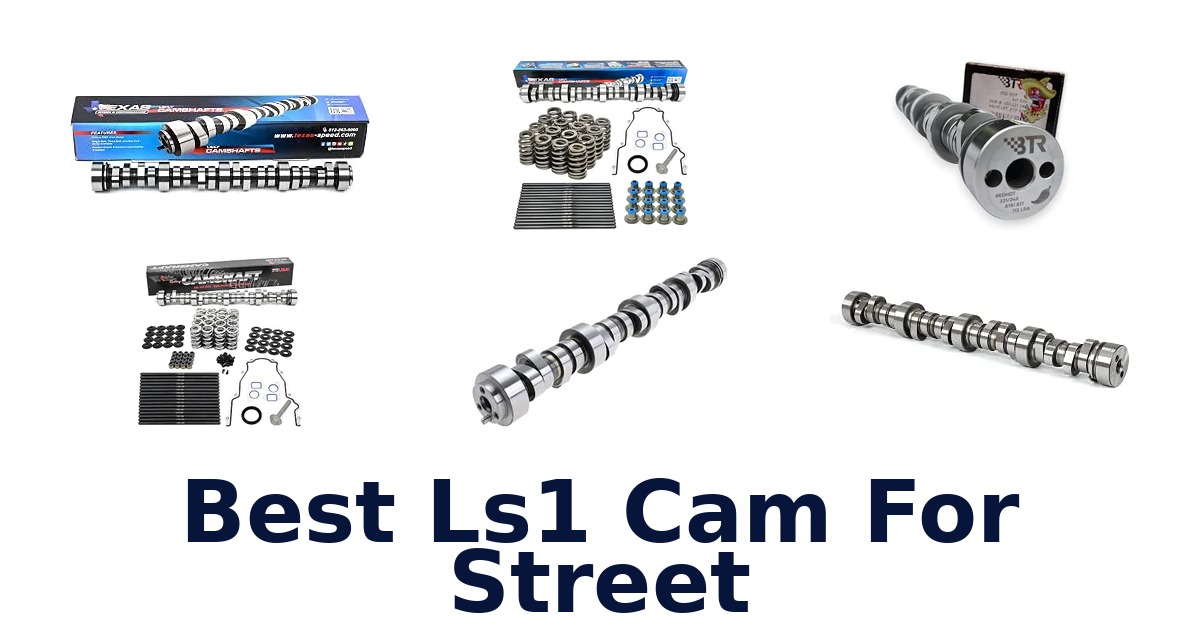
A strong street LS cam balances useful power with a profile suited to your engine setup; the BTR Red Hot is a compelling starting point for naturally aspirated or blower builds. This roundup compares ten LS camshafts, from a 221/24X profile with 113 LSA to an all-out 239/242 Stage 4 grind. The products do not all target the same use: some specify street use, while others focus on drift, turbocharging, or high-RPM performance.
Check each cam’s fitment, required valvetrain parts, and tuning notes against your specific engine before buying. In particular, several listings exclude AFM engines or call for upgraded springs, pushrods, or a suitable converter.
Use the specifications below to narrow the choices to a cam that matches your build rather than choosing by stage number alone.
The BTR Red Hot is the best overall pick here for a street-oriented LS build that is naturally aspirated or supercharged/blown. Its listed 221/24X duration, .619/.617-inch lift, and 113 LSA give buyers a concrete profile to compare, and the listing identifies it for Gen III and Gen IV LS engines. It requires upgraded valve springs and pushrods, which are not included, so confirm your supporting parts and engine compatibility before ordering.
Our Top Picks
 Best Overall
Its 221/24X, .619/.617-inch lift, and 113 LSA profile is listed for naturally aspirated and blower LS setups, covering multiple street-build directions.
View on Amazon Best Drift-Oriented Street Pick
Michigan Motorsports Stage 2 Drift Cam
The 225/229, .629/.600-inch lift, 111 LSA profile targets drift powerbands, and the listing says its lineup spans daily drivers to competition vehicles.
View on Amazon Best Stage 2 Kit
This Stage 2 kit includes an Elgin 1840-P cam, .600-inch springs, and hat seals, offering useful listed components for a street-focused LS upgrade.
View on Amazon- Best Naturally Aspirated Performance BTR Stage 3 NA Cam
- Best Turbo Street Cam BTR Twin Turbo Stage 1
Compare These LS Cam Options by Build and Intended Use
| # | Product | Buy |
|---|---|---|
| 1 | 1. BTR Red Hot CamBest Overall | View on Amazon |
| 2 | 2. Michigan Motorsports Stage 2 Drift CamBest Drift-Oriented Street Pick | View on Amazon |
| 3 | 3. Sloppy Mechanics Stage 2 KitBest Stage 2 Kit | View on Amazon |
| 4 |  4. BTR Stage 3 NA CamBest Naturally Aspirated Performance 4. BTR Stage 3 NA CamBest Naturally Aspirated Performance | View on Amazon |
| 5 |  5. BTR Twin Turbo Stage 1Best Turbo Street Cam 5. BTR Twin Turbo Stage 1Best Turbo Street Cam | View on Amazon |
| 6 |  6. TSP Madd Maxx CamLow-lift LS cam selection 6. TSP Madd Maxx CamLow-lift LS cam selection | View on Amazon |
| 7 |  7. Lskioer Sloppy Stage 3 CamAFM-free LS street builds 7. Lskioer Sloppy Stage 3 CamAFM-free LS street builds | View on Amazon |
| 8 |  8. BuliBoao Sloppy Stage 3 CamTuned 6.0L LS street builds 8. BuliBoao Sloppy Stage 3 CamTuned 6.0L LS street builds | View on Amazon |
| 9 |  9. Lizixny Sloppy Stage 3 CamThree-bolt AFM-free replacements 9. Lizixny Sloppy Stage 3 CamThree-bolt AFM-free replacements | View on Amazon |
| 10 |  10. TSP Magic Stick Stage 4Maximum-effort stock-displacement builds 10. TSP Magic Stick Stage 4Maximum-effort stock-displacement builds | View on Amazon |
Detailed Reviews: Best Ls1 Cam For Street
#1 · Best Overall
1. BTR Red Hot Cam
Best for: NA or blower LS combinations.
Why it ranks #1: Its 221/24X, .619/.617-inch lift, and 113 LSA profile is listed for naturally aspirated and blower LS setups, covering multiple street-build directions.
The BTR Red Hot pairs a 221/24X profile with .619/.617-inch lift and 113 LSA, making its specifications the clearest guide to this camshaft’s character. It is listed for naturally aspirated and blower LS setups across a broad range of Gen III and Gen IV engines, from LS1 through 6.2L applications.
Its listed Gen III/IV coverage includes LS1, LS2, LS6, LS3, L76, L77, LQ4, LQ9, LM7, and 4.8L–6.2L engines, giving builders a substantial stated application range. The 221/24X duration, .619/.617-inch lift, and 113 LSA identify the cam profile. A crucial installation consideration is that upgraded valve springs and pushrods are required but not included, so those parts must be addressed separately when planning the build.
- Listed for naturally aspirated and blower LS setups
- Broad Gen III/IV engine list includes LS1 and LS3
- 221/24X duration and .619/.617-inch lift specified
- Made in USA and designed by Brian Tooley Racing
- Upgraded valve springs and pushrods are required and not included.
Skip it if you want a listing that includes springs and pushrods; BTR Twin Turbo Stage 1 lists both among its included kit components.
This suits an LS owner choosing between naturally aspirated and blower applications who wants the stated Red Hot profile. Plan to source upgraded valve springs and pushrods separately; they are required for the setup and are not included here.
Full product details
| Brand | Dynosty |
|---|---|
| Item Weight | 10 pounds |
| Item model number | REDHOT |
| Manufacturer | BTR Brian Tooley Racing |
| Part Number | BTR REDHOT |
| Model | RED HOT |
| Package Dimensions | 22.32 x 3.74 x 2.91 inches |
Listed on Amazon as: Dynosty Brian Tooley Racing BTR Red Hot LS Cam LS1 LS2 LS3 5.7L 6.0L 6.2L Camshaft
View on Amazon#2 · Best Drift-Oriented Street Pick
2. Michigan Motorsports Stage 2 Drift Cam
Best for: Cathedral-port drift builds.
Why it ranks #2: The 225/229, .629/.600-inch lift, 111 LSA profile targets drift powerbands, and the listing says its lineup spans daily drivers to competition vehicles.
The 225/229 duration and .629/.600-inch lift distinguish this Michigan Motorsports Stage 2 Cathedral Port Drift Camshaft. Its listing frames the grind around drifting, combining a strong powerband with a pronounced idle note, while naming LS1, LS2, LS6 and several 4.8L–6.0L applications.
The 111 LSA and listed lift figures help identify the cam profile for a builder matching a drift-oriented engine combination. The application list includes 4.8L, 5.3L, 5.7L, and 6.0L cathedral-port LS engines, including LS1, LS2, LS6, LM7, LQ4, and LC9. Michigan Motorsports describes the lineup as spanning daily drivers to competition vehicles, but this specific Stage 2 listing emphasizes drifting. Optional spring and pushrod offerings are mentioned, so check the chosen kit contents when planning installation.
- 225/229 duration and .629/.600-inch lift specified
- 111 LSA is listed
- Applications include LS1, LS2, LS6, LM7, LQ4, and LC9
- Drift-focused powerband and idle character are described
- Spring and pushrod options are described as optional, not as included kit contents.
Skip it if you are building a smaller-turbo street setup; BTR Twin Turbo Stage 1 specifically targets 58–66mm twin turbos.
This is aimed at a cathedral-port LS builder prioritizing drift use and the listed powerband and idle character. Confirm which optional spring or pushrod components are part of the selected offering before planning the installation.
Full product details
| Brand | Michigan Motorsports |
|---|---|
| Manufacturer | Michigan Motorsports |
| Part Number | 225/229 LS1 Stage 2 Drift |
Listed on Amazon as: Michigan Motorsports Stage 2 LS1 Drift Cam for Cathedral Port LS 4.8 5.3 5.7 6.0 LS1 LS2 LS6 LM7 LQ4 LC9 Camshaft Kit
View on Amazon#3 · Best Stage 2 Kit
3. Sloppy Mechanics Stage 2 Kit
Best for: LS builds wanting a spring kit.
Why it ranks #3: This Stage 2 kit includes an Elgin 1840-P cam, .600-inch springs, and hat seals, offering useful listed components for a street-focused LS upgrade.
A kit pairing the Elgin 1840-P Sloppy Mechanics Stage 2 cam with .600-inch springs and hat seals is this listing’s defining advantage. The title names 4.8L, 5.3L, 5.7L, 6.0L, and 6.2L engines, plus LS1, LS2, LQ4, LQ9, and L33 applications.
Including the camshaft, .600-inch springs, and hat seals brings several named components together, which can simplify parts planning compared with sourcing those listed pieces separately. The stated engine range covers five LS displacement options from 4.8L to 6.2L, and the title calls out LS1, LS2, LQ4, LQ9, and L33. The supplied details do not provide duration, lift for the cam, or a broader fitment breakdown, so the listing’s named kit contents and engine applications are the supported selection points.
- Elgin 1840-P Sloppy Mechanics Stage 2 cam included
- Kit lists .600-inch springs
- Hat seals are included in the titled kit
- Names 4.8L–6.2L engines and LS1, LS2, LQ4, LQ9, L33
- The supplied listing does not state cam duration or cam lift.
Skip it if you need a cam with published duration and lift figures; BTR Stage 3 NA V2 provides both specifications.
This suits an LS owner whose priority is a Stage 2 cam kit listing the cam, .600-inch springs, and hat seals together. The supplied information does not give cam duration or lift, so those figures cannot guide this choice.
Full product details
| Brand | Michigan Motorsports |
|---|---|
| Item model number | SloppyE-1840-P |
| Manufacturer | Elgin |
| Part Number | SloppyE-1840-P |
| Model | Sloppy Stage 2 |
| Additional Information | Important Information Proposition 65 Warning for California Consumers WARNING: Cancer and Reproductive Harm – www.P65Warnings.ca.gov |
Listed on Amazon as: Sloppy Mechanics Stage 2 LS Camshaft Kit – Fits 4.8L 5.3L 5.7L 6.0L 6.2L LS1 LS2 LQ4 LQ9 L33 Elgin 1840-P Cam (Camshaft, .600" Springs, Hat Seals)
View on Amazon#4 · Best Naturally Aspirated Performance
4. BTR Stage 3 NA Cam
Best for: Naturally aspirated street builds.
Why it ranks #4: The 227/24x, .636-inch lift, 111.5 LSA profile is specified for LS1, LS2, LS6, 5.3L, and 6.0L naturally aspirated applications.
A 227/24x profile with .636-inch lift on both lobes gives the BTR Stage 3 NA V2 its defining specification, aimed at naturally aspirated LS combinations. The listing names LS1, LS2, LS6, 5.3L, and 6.0L engines, with midrange and high-RPM performance and an aggressive exhaust note as its stated goals.
The naturally aspirated application focus makes this a targeted choice for engines running without turbocharging, while the 227/24x duration and .636/.636-inch lift specify its cam profile. BTR describes the grind as supporting midrange pull and high-RPM performance, with a choppy idle and aggressive exhaust note. Its 3-bolt pattern is also stated, and the listed engine range spans LS1, LS2, LS6, 5.3L, and 6.0L combinations; the supplied details do not specify included installation components.
- Naturally aspirated LS application
- Listed for LS1, LS2, LS6, 5.3L, and 6.0L engines
- 227/24x duration and .636/.636-inch lift specified
- 3-bolt pattern and choppy idle are stated
- This is specified for naturally aspirated applications, not turbocharged combinations.
Skip it if you are assembling a twin-turbo street car; the BTR Twin Turbo Stage 1 listing specifically targets smaller turbo combinations.
Choose this for a listed LS naturally aspirated build where the stated high-RPM focus and choppy idle suit the intended street-and-track character. Its NA application is the key boundary; it is not presented as a turbo cam.
Full product details
| Brand | BTR Brian Tooley Racing |
|---|---|
| Item model number | BTR-LS1STAGE3 |
| Manufacturer | BTR Brian Tooley Racing |
| Part Number | BTR 33142122 |
| Model | LS1 Stage 3 Camshaft |
| Additional Information | Important Information Proposition 65 Warning for California Consumers WARNING: Cancer and Reproductive Harm – www.P65Warnings.ca.gov |
Listed on Amazon as: BTR Brian Tooley Racing Stage 3 NA Camshaft V2 | Naturally Aspirated Camshaft for LS1 LS2 LS6 5.3L 6.0L Engines | Aggressive Power & Choppy Idle | BTR Cam Kit
View on Amazon#5 · Best Turbo Street Cam
5. BTR Twin Turbo Stage 1
Best for: Smaller twin-turbo street setups.
Why it ranks #5: Its 218/23x, .618-inch lift, 113 LSA profile is explicitly intended for smaller twin turbos and street miles, with a cam, spring kit, pushrods, and gaskets.
The 113-degree lobe separation and 218/23x profile mark this BTR Twin Turbo Stage 1 as a turbo-oriented option for LS street miles. Its listing specifically calls out smaller 58–66mm turbo pairs and a range of 4.8L through 6.2L LS-based engines, providing a clear starting point for relevant builds.
BTR lists .618-inch lift on both lobes and a 3-bolt pattern alongside the 218/23x duration and 113 LSA. Those specifications identify the cam’s profile and mounting pattern for builders planning an LS-based combination. The stated application covers 1997–2013 engines from 4.8L to 6.2L, including cathedral-port 5.3L and 6.0L heads as well as LS3-headed applications. Its description highlights smaller 58–66mm twin turbos and street use, making that combination its clearest intended fit.
- Twin-turbo-specific Stage 1 grind
- Lists smaller 58–66mm turbo pairs for street use
- Fits listed 1997–2013 LS engines from 4.8L to 6.2L
- Includes cam, spring kit, steel retainers, pushrods, and gaskets
- The stated turbo use centers on smaller 58–66mm twin-turbo setups.
Skip it if you run a naturally aspirated LS setup; BTR Stage 3 NA V2 is explicitly listed for naturally aspirated applications.
This fits a street-focused LS owner planning a smaller twin-turbo combination and wanting the listed kit components together. Its strongest application guidance is for 58–66mm turbo pairs, so other forced-induction plans fall outside that stated target.
Full product details
| Brand | Michigan Motorsports |
|---|---|
| Item model number | BTR-TWINTURBOSTG1 |
| Manufacturer | Brian Tooley Racing |
| Part Number | BTR-TWINTURBOSTG1 |
| Model | Twin Turbo Stage 1 Camshaft |
Listed on Amazon as: BTR Brian Tooley Racing Twin Turbo Stage 1 LS Camshaft -Fits Gen III/IV 4.8L 5.3L 5.7L 6.0L 6.2L LS1 LS3 BTR Cam Kit (Cam, Spring Kit Steel Ret., Pushrods, Gaskets)
View on Amazon#6
6. TSP Madd Maxx Cam
Best for: Low-lift LS cam selection.
Why it ranks #6: The 228/232, .550-inch lift, 110 LSA profile fits listed Gen III/IV LS engines from 4.8L to 6.2L, though street-specific use is not stated.
The Texas Speed TSP Madd Maxx pairs 228/232 duration with .550-inch lift on both lobes and a 110 LSA, giving this listing a clear low-lift profile. It is described for 1997–2013 Gen III/IV LS-based engines from 4.8L through 6.2L, including LS1 applications.
The .550/.550-inch lift is lower than the figures of many other listed cams, while the 228/232 duration and 110 LSA provide additional profile details for comparing build plans. Its stated fitment spans 1997–2013 GM Gen 3/4 LS-based engines, including 4.8L, 5.3L, 5.7L, 6.0L, and 6.2L combinations. A 3-bolt pattern is specified. The listing offers a camshaft or a choice of camshaft kits, so buyers should distinguish the desired kit selection from the base cam listing.
- 228/232 duration is specified
- .550-inch lift on both lobes is listed
- 110 LSA and 3-bolt pattern are stated
- Fits listed 1997–2013 Gen 3/4 LS engines from 4.8L to 6.2L
- The stated fitment ends at 2013 and does not cover later model years.
Skip it if you need stated fitment through 2017; the BuliBoao E1841P lists 1997–2017 LS V8 coverage without AFM.
This suits a 1997–2013 Gen 3/4 LS owner comparing a specified 228/232 low-lift profile. Its stated model-year range and 3-bolt pattern are key boundaries, and the listing distinguishes the cam from optional kit choices.
Full product details
| Brand | Michigan Motorsports |
|---|
Listed on Amazon as: Texas Speed TSP Madd Maxx 228/232 Low Lift LS Camshaft or Choose Your Camshaft Kits 4.8 5.3 5.7 6.0 6.2 LS1 Cam Kit
View on Amazon#7
7. Lskioer Sloppy Stage 3 Cam
Best for: AFM-free LS street builds.
Why it ranks #7: Its .595-inch lift and 296-degree duration provide a defined Stage 3 profile, but listed fitment is limited to 1997–2004 LS engines without AFM.
The .595-inch lift and 296-degree duration define this E-1841-P Sloppy Stage 3 camshaft, giving LS V8 builders a specific performance-oriented replacement profile. Its listed fitment covers 1997–2004 Chevy GM LS V8 engines without Active Fuel Management, making AFM status a central compatibility check before planning an installation.
The camshaft is driven by the crankshaft and controls valve opening and closing, so its profile influences how intake and exhaust gases move through the engine. The stated .595-inch lift and 296-degree duration identify this as a Stage 3-style choice rather than a stock-profile replacement. Fitment is specifically listed for 1997–2004 LS V8 engines without AFM; buyers should plan around that limitation instead of treating the broader title range as universal compatibility.
- .595-inch lift and 296-degree duration are explicitly specified
- Listed for 1997–2004 Chevy GM LS V8 engines
- AFM-free fitment is clearly stated
- Camshaft controls intake and exhaust valve timing
- Not compatible with AFM engines, and stated fitment is limited to 1997–2004.
Skip it if you have an AFM-equipped engine or need stated fitment beyond 1997–2004; BTR Stage 3 NA V2 lists broader LS applications.
This suits an AFM-free 1997–2004 LS V8 owner seeking the listed Stage 3 profile. Treat the year and engine restrictions as firm planning boundaries, and verify the build’s AFM status before choosing this camshaft.
Full product details
| Brand | Lskioer |
|---|---|
| Item Weight | 9.78 pounds |
| Item model number | E-1841-P |
| Manufacturer | Lskioer |
| Part Number | S2.E1841P.H-WYY |
| Model | Camshaft |
| Package Dimensions | 20.75 x 2.75 x 2.62 inches |
Listed on Amazon as: E-1841-P Sloppy Stage 3 Cam Camshaft .595" Lift 296° Duration, Camshaft Replacement Fits For Chevy GM LS LS1 LS V8 1997-2017
View on Amazon#8
8. BuliBoao Sloppy Stage 3 Cam
Best for: Tuned 6.0L LS street builds.
Why it ranks #8: The listing identifies a 3-bolt E1841P cam and explicitly requires upgraded springs and custom tuning; AFM incompatibility narrows fitment.
The E1841P’s .595-inch lift and stated 1997–2017 LS V8 coverage give this BuliBoao Stage 3 camshaft its clearest identifiers. The listing calls out 6.0L LS engines and strokers, while also requiring custom computer tuning and excluding AFM engines—important planning details for street builds.
The listing says stock valve springs cannot be used, so the installation plan must include appropriate non-stock springs rather than treating this as a simple cam-only swap. It also requires custom computer tuning, adding a calibration step to the build workflow. Stated fitment covers Chevy GM LS V8 engines from 1997–2017 without AFM, and the description highlights 6.0L engines and LS strokers. Its three-bolt note provides another specific detail for compatibility planning.
- .595-inch lift is specified
- Stated fitment spans 1997–2017 LS V8 engines without AFM
- 6.0L LS engines and strokers are highlighted
- Three-bolt cam and custom tuning requirements are identified
- Stock valve springs cannot be used, and custom computer tuning is required.
Skip it if you need a naturally aspirated-specific cam listing; BTR Stage 3 NA V2 explicitly identifies that application.
This fits an LS V8 owner planning a 6.0L or stroker build who can arrange suitable springs and custom tuning. The AFM exclusion and non-stock spring requirement are essential boundaries for installation planning.
Full product details
| Brand | BuliBoao |
|---|---|
| Item Weight | 8.8 pounds |
| Item model number | e-1841-p |
| Manufacturer | BuliBoao |
| Part Number | S2.E1841P.H-Tom |
| Model | e-1841-p |
| Package Dimensions | 19.6 x 3.9 x 2.36 inches |
Listed on Amazon as: E1841P Sloppy Stage 3 Camshaft, .595" Engine Camshaft
View on Amazon#9
9. Lizixny Sloppy Stage 3 Cam
Best for: Three-bolt AFM-free replacements.
Why it ranks #9: This E1841P listing gives .595-inch lift and 296-degree duration, but its stated fitment is 1997–2004 LS engines without AFM.
A 3-bolt pattern paired with .595-inch lift and 296-degree duration gives this Lizixny E1841P its concrete identifying details. The listing specifies 1997–2004 Chevy GM LS V8 engines without AFM, helping narrow the intended fit before buyers consider this Sloppy Stage 3 replacement for a street-oriented build.
This camshaft is described as being driven by crankshaft rotation to control valve opening and closing, which in turn governs intake and exhaust gas movement. Its .595-inch lift and 296-degree duration define the listed profile, while the 3-bolt pattern provides a mounting detail for installation planning. The fitment information limits the application to 1997–2004 LS V8 engines without Active Fuel Management; that narrower detail should guide selection over the broader title range.
- .595-inch lift and 296-degree duration are specified
- 3-bolt camshaft pattern is stated
- Fitment names 1997–2004 Chevy GM LS V8 engines
- AFM exclusion is explicitly identified
- AFM-equipped engines are excluded from the stated fitment.
Skip it if you need a listing that includes a spring kit and pushrods; BTR Twin Turbo Stage 1 lists those components.
Consider this for an AFM-free 1997–2004 Chevy GM LS V8 project where the specified 3-bolt layout matches the build. Its stated engine-year range is narrower than the title’s broader years, so use the fitment details as the boundary.
Full product details
| Brand | Lizixny |
|---|---|
| Manufacturer | Lizixny |
| Part Number | S2.E1841P.H-fix |
Listed on Amazon as: E1841P Sloppy Stage 3 Camshaft .595" Lift 296°Duration 3-Bolt Fit for Chevy LS LS1 V8 1997-2017
View on Amazon#10
10. TSP Magic Stick Stage 4
Best for: Maximum-effort stock-displacement builds.
Why it ranks #10: The 239/242, .649/.600-inch lift profile is described as an all-out max-effort cam, and the listing calls for double springs and a 3800-plus stall with an automatic.
A 239/242 profile with .649/.600-inch lift makes the Texas Speed Magic Stick Stage 4 a clearly aggressive option for maximum-effort LS combinations. The listing covers 4.8L–6.2L engines and explicitly requires a high-quality double-spring kit, a major parts-planning consideration before installation.
Texas Speed presents the Magic Stick range for maximum power from stock-displacement engines, and this Stage 4 cam’s 239/242 duration, 111.5 LSA, and 110 ICL provide specific profile details for that goal. Its 3-bolt pattern and listed 4.8L, 5.3L, 5.7L, 6.0L, and 6.2L applications help frame compatibility planning. A high-quality double-spring kit, such as the named PAC .660-inch option, is required. For automatic-equipped customers, the listing also specifies at least a 3800+ stall speed converter with the MS3 camshaft.
- 239/242 duration and .649/.600-inch lift specified
- 111.5 LSA and 110 ICL listed
- 3-bolt camshaft for listed 4.8L–6.2L LS engines
- High-quality double-spring requirement is clearly stated
- Requires a high-quality double-spring kit, which is not listed as included.
Skip it if you need a cam listing that includes a spring kit; BTR Twin Turbo Stage 1 lists a spring kit among its included components.
This is for an LS owner pursuing the stated maximum-effort goal and prepared to plan around the double-spring requirement. Automatic-equipped MS3 applications also need the listed 3800+ stall speed converter consideration.
Full product details
| Brand | Michigan Motorsports |
|---|---|
| Manufacturer | Texas Speed |
| Part Number | 25-TSPMS4 |
Listed on Amazon as: Texas Speed TSP Magic Stick Stage 4 Cam, Specs: 239/242, 649"/.600", 111.5 LSA, 110 ICL Camshaft 4.8 5.3 5.7 6.0 6.2 LS1 LS2
View on AmazonAvoid the cam-and-valvetrain mismatch
A camshaft swap can become a compatibility problem if the supporting valvetrain parts or engine management do not match the chosen profile. The BuliBoao Sloppy Stage 3 listing specifically says stock valve springs cannot be used and custom computer tuning is required; the Lskioer listing also excludes engines with AFM. The BTR Red Hot requires upgraded valve springs and pushrods, which are not included, while the TSP Magic Stick Stage 4 calls for a high-quality double spring kit.
Those notes make it important to treat cam, springs, pushrods, tuning, and engine fitment as one decision rather than assuming a camshaft is a drop-in change. Check the exact engine generation, AFM status, bolt pattern, and existing valvetrain before selecting a listing.
Ask a qualified installer to verify clearances and required components for your particular combination.
Stage numbers do not tell the whole street story
A cam’s stage label alone does not show whether its profile suits your street combination. These listings span distinct purposes: the BTR Twin Turbo Stage 1 is described for smaller twin turbos and street miles, while the BTR Stage 3 NA is positioned for naturally aspirated use and high-RPM performance. The Michigan Motorsports Stage 2 Drift Cam targets drifting, and the TSP Magic Stick Stage 4 is characterized as an all-out max-effort option.
Their listed profiles also differ: the Turbo Stage 1 has 218/23x duration and 113 LSA, compared with the Magic Stick’s 239/242 and 111.5 LSA. Do not treat those numbers as a complete prediction of idle quality or drivability: the supplied listings do not provide a common vehicle, transmission, or dyno comparison.
Choose according to the intended engine setup and confirm the cam’s fitment and supporting-part requirements.
How to Choose an LS1 Street Cam
Match the cam to the engine setup
Start with the engine configuration and whether it is naturally aspirated, boosted, or set up for drifting. The BTR Red Hot is listed for naturally aspirated and blower setups, while the BTR Stage 3 NA is specified for naturally aspirated LS1, LS2, LS6, 5.3L, and 6.0L applications. The BTR Twin Turbo Stage 1 targets smaller twin turbos and street miles.
For a drift-focused build, the Michigan Motorsports Stage 2 Drift Cam is designed around that use and its listing spans daily drivers to competition vehicles. Choose the application-specific option when your setup matches; otherwise, confirm compatibility with the cam manufacturer or a qualified builder before ordering.
Compare duration, lift, and LSA
Compare the listed profile numbers rather than relying on a stage label. The BTR Red Hot lists 221/24X duration, .619/.617-inch lift, and 113 LSA; the BTR Stage 3 NA lists 227/24x, .636-inch lift, and 111.5 LSA. The BTR Twin Turbo Stage 1 has 218/23x, .618-inch lift, and 113 LSA, while the TSP Magic Stick Stage 4 rises to 239/242 and .649/.600-inch lift.
These figures describe different profiles, not a guaranteed street-driving result. Buyers prioritizing an application-specific street setup can start with the Red Hot or Turbo Stage 1; buyers pursuing a max-effort build should study the Stage 4’s supporting requirements.
Which LS cam should I choose for street use?
For a broad naturally aspirated or blower street build, choose the BTR Red Hot Cam: it has a 221/24X, .619/.617-inch lift, 113 LSA profile and is listed for both setups. For a drift-oriented car that may also see daily use, consider the Michigan Motorsports Stage 2 Drift Cam, whose listing spans daily drivers through competition vehicles. If your LS is twin-turbocharged and you plan to drive street miles, the BTR Twin Turbo Stage 1 is specifically described for that use and includes a spring kit, pushrods, and gaskets.
The Sloppy Mechanics Stage 2 Kit suits shoppers seeking a listed cam-and-spring package. Choose the TSP Magic Stick Stage 4 only if its max-effort positioning and substantial spring and converter requirements fit your combination.
Frequently Asked Questions
Will an LS cam swap require a custom tune?
Usually, plan for a tune after an LS cam swap. A cam change can alter how the engine runs, so ask a tuner to account for your exact engine, cam, and supporting parts. The product listings do not specify tuning requirements; confirm the plan with your installer before ordering.
What supporting valvetrain parts should I replace with an LS cam?
Check the cam’s requirements and your engine’s existing parts before choosing springs, pushrods, retainers, or seals. The BTR Red Hot listing says upgraded valve springs and pushrods are required and not included; the Twin Turbo Stage 1 listing includes a spring kit, pushrods, and gaskets. Verify fitment for your combination.
How do I check whether a cam will work with my transmission and converter?
Confirm the cam’s operating demands against your transmission and converter with an installer familiar with your combination. The TSP Magic Stick Stage 4 is positioned as a max-effort choice with substantial spring and converter requirements, so it may not suit every street setup. Verify those requirements before buying.
How can I tell whether a cam kit includes the parts I need?
Read the exact listing and confirm the included components before ordering; kit contents differ. The Sloppy Mechanics Stage 2 listing identifies a cam, .600-inch springs, and hat seals, while the Twin Turbo Stage 1 listing includes a spring kit, pushrods, and gaskets. Ask the seller to clarify any unclear exclusions.
Which option suits a street LS with a specific induction setup?
Match the cam to your induction plan and intended use. The BTR Red Hot is identified for naturally aspirated or supercharged/blown street builds, while the BTR Twin Turbo Stage 1 is described for twin-turbo street miles. Check engine compatibility and required supporting parts before selecting either.
Final Words
For a broad street build, the BTR Red Hot is the strongest starting point in this roundup: its listed profile is specific, and the listing covers Gen III and Gen IV LS engines. Confirm engine fitment, then account for the required upgraded springs and pushrods. Choose the drift, twin-turbo, or packaged-kit options when their stated use better matches your build; reserve the Magic Stick Stage 4 for combinations that meet its demands.