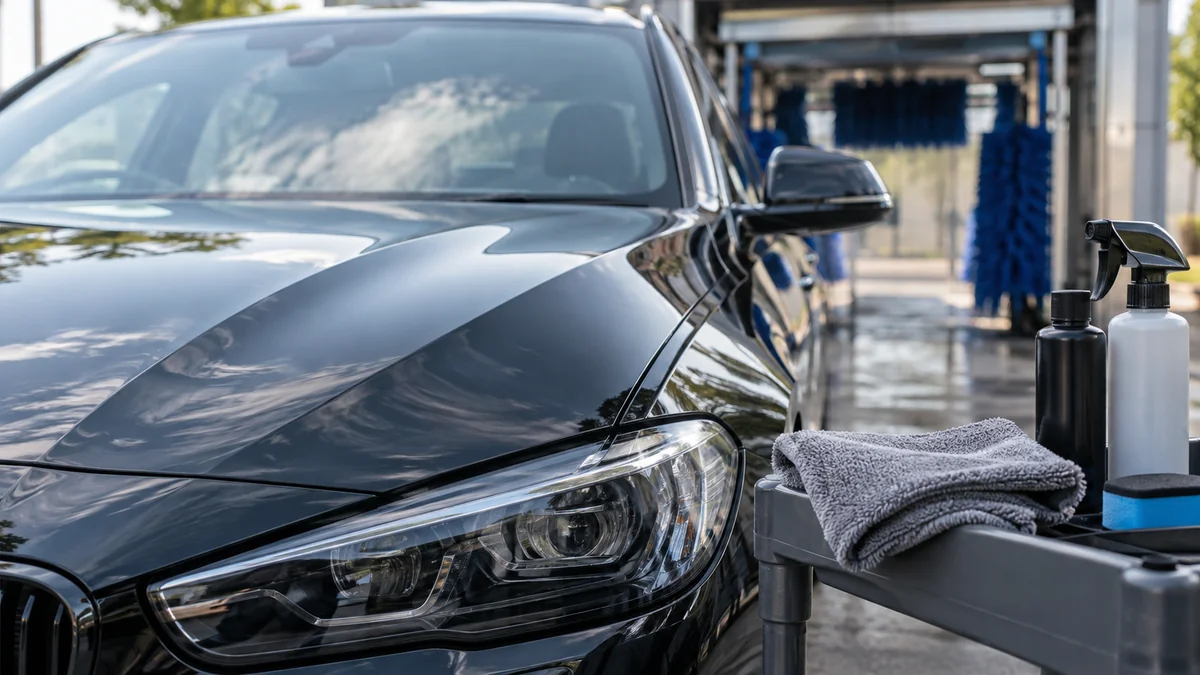
You can use an automatic car wash after ceramic coating, but choose a genuinely touchless wash and follow the coating manufacturer’s cure instructions. Avoid automatic brushes, shared towels, and aggressive add-on chemicals whenever possible. A touchless wash minimizes scratching, although repeated strong detergents, hard-water deposits, and incomplete cleaning can still shorten maintenance intervals.
Key facts
A touchless automatic wash is usually safer for ceramic-coated paint than a brush or cloth tunnel.
A friction wash can create swirl marks even when the ceramic coating remains chemically intact.
The correct post-installation waiting period comes from the coating installer or product manufacturer, not a universal seven-day rule.
Touchless systems can leave bonded traffic film because water and detergent cannot provide mechanical agitation.
Loss of water beading does not automatically prove that the ceramic coating has failed.
Road salt should be removed promptly, even when the only practical option is a touchless wash.
Can You Use an Automatic Car Wash After Ceramic Coating?
Yes, but an automatic car wash is a compromise rather than the ideal maintenance method. A touchless bay is the preferred automatic option because water jets and detergent do not drag contaminated material across the paint. A soft-touch, brush, or cloth tunnel introduces direct contact and therefore a greater risk of marring.
A ceramic coating is a thin, cured protective film bonded to the clear coat. The coating can improve gloss, chemical resistance, and water behavior, but it does not make paint scratch-proof. Dirt still contains mineral particles, road grit, brake dust, and metallic contamination that can abrade paint when a wash material moves across the panel.
The practical distinction is important. A brush tunnel may damage the appearance in one visit through swirls while leaving much of the coating chemically present. A touchless wash usually avoids that immediate contact damage but may use concentrated alkaline or acidic detergents, particularly when the facility must clean heavily soiled vehicles quickly.
What does ceramic coating protect against?
Ceramic coating primarily reduces surface adhesion and improves resistance to ordinary environmental contamination. It does not prevent stone chips, deep scratches, water-spot etching, bird-dropping damage, or every form of chemical attack.
Coating performance also depends on the product. A professional coating, a consumer DIY coating, a ceramic spray sealant, and a dealer-applied “ceramic package” may have very different film thicknesses, durability claims, and maintenance requirements. Ask for the product name and care sheet before treating all coatings as equivalent.
Which Automatic Wash Is Safest?
A touchless automatic wash is generally the safest automatic choice for coated paint, while a brush tunnel is the riskiest. The best overall method remains careful hand washing with clean equipment, because hand washing combines controlled chemistry with controlled, lubricated contact.
| Wash method | Paint contact | Main coating concern | Best use |
|---|---|---|---|
| Touchless automatic | 0 intentional contact | Strong detergent, residue, hard-water spots | Winter salt and quick maintenance |
| Soft-touch tunnel | Cloth or foam contact | Marring, contaminated wash media | Avoid when finish quality matters |
| Brush tunnel | Bristle contact | Scratches, swirls, embedded grit | Avoid on coated or corrected paint |
| Self-serve bay | Owner-controlled contact | Shared brush contamination | Rinse-only or personal equipment |
| Careful home wash | Clean mitt contact | Operator technique and drying | Best routine maintenance |
“Touchless” means the wash media does not physically touch the vehicle. It does not mean the vehicle experiences no risk. Nozzle pressure, detergent concentration, water temperature, dwell time, and final-rinse quality determine the result.
Are soft-touch washes safe for ceramic coatings?
Soft-touch washes are not reliably safe for ceramic-coated vehicles because the material can carry contamination from previous vehicles. Modern closed-cell foam or cloth media may be gentler than old nylon brushes, but gentler contact remains contact.
The risk rises when the vehicle enters visibly muddy, when the tunnel uses shared wash media, or when the exit crew dries vehicles with towels that are not separated and frequently replaced. A coating may reduce friction at the surface, but it cannot neutralize sand trapped in a dirty strip.
Does a touchless wash damage ceramic coating?
A touchless wash can gradually reduce surface performance when repeated exposure to strong detergents removes maintenance products, dries exterior trim, or leaves chemical residue. A single correctly operated touchless wash normally does not destroy a properly cured professional coating.
Automatic wash chemistry is not standardized. One facility may use a moderate detergent and frequent water changes; another may rely on high-pH pre-soak, low-pH wheel cleaner, and a strong rinse to compensate for poor physical agitation. Select the basic wash when the package menu is unclear.
How Long Should You Wait After Installation?
Wait for the exact cure period specified by the coating manufacturer or installer. Seven to fourteen days is a common instruction for some professional systems, but it is not a universal rule; certain coatings permit earlier water exposure while others require a longer period before washing or chemical contact.
Ask four questions at installation:
- When may the vehicle encounter rain?
- When may it receive a normal hand wash?
- When may it enter a touchless or automatic wash?
- Which shampoo and maintenance product are approved?
A cure period is not the same as a maintenance interval. During curing, water, detergent, and drying friction can interfere with the coating’s development. After curing, normal washing cannot usually remove a properly bonded coating in one event, although harsh repeated chemistry can reduce its water behavior and degrade adjacent rubber or plastic.
| Situation | Typical practical guidance | Reason for caution |
|---|---|---|
| Light rain after installation | Follow installer’s product-specific instruction | Water behavior varies by formulation |
| First hand wash | Often 7-14 days, manufacturer dependent | Avoid premature detergent and friction |
| First touchless wash | Use the installer’s stated interval | Chemical exposure can be stronger than rain |
| Bird dropping during cure | Remove promptly with approved method | Organic acids can mark uncured surfaces |
| Severe contamination during cure | Contact installer before washing | Improvised cleaning may void warranty |
If the installer supplied a warranty, follow its wash requirements. Warranty terms may require pH-neutral shampoo, documented maintenance, or periodic inspection.
What Happens During a Touchless Wash?
A touchless automatic wash uses a chemical pre-soak, pressurized water, and a final rinse to remove contamination without brushes. The process usually begins with an underbody rinse, continues through detergent application and dwell time, and ends with spot-reduced water and air drying.
The exact sequence differs by equipment and facility. Typical systems apply pre-soak for approximately 30 seconds to several minutes, then rinse from upper panels downward. Pressure may be high at the nozzle, but pressure alone does not guarantee complete cleaning because bonded traffic film needs agitation.
| Stage | Typical action | Coating-related observation |
|---|---|---|
| Entry rinse | Underbody and lower-panel water spray | Useful for salt and mud |
| Pre-soak | Alkaline or acidic detergent | Repeated extremes may affect trim and toppers |
| Dwell | Chemical remains for roughly 0.5-3 minutes | Never allow detergent to dry |
| High-pressure rinse | Jets remove loosened material | Does not remove every bonded film |
| Spot-free rinse | Reverse-osmosis or softened water | Reduces mineral spotting |
| Air dry | Blowers remove loose water | Does not remove remaining dirt |
A touchless wash cannot safely compensate for every cleaning deficiency with more pressure. Excessive pressure can force water past damaged seals, disturb loose trim, or drive contamination into vulnerable areas, although ordinary commercial equipment is usually designed within operational limits.
What wash package should you select?
Choose the lowest-priced package that includes the basic wash, underbody rinse, and spot-free rinse. Skip brush upgrades, shared towel drying, tire dressing that can sling onto paint, and automatic wax or sealant options unless you specifically want the added product and understand its compatibility.
“Ceramic,” “graphene,” and “triple foam” labels on a wash menu describe the facility’s add-on chemistry, not proof that the product is a professional ceramic coating. Some rinse aids can temporarily improve beading; others can leave a film that changes how the coating looks and behaves.
How Should You Use a Touchless Automatic Wash?
Use a touchless wash by removing loose mud first, selecting basic chemistry, preventing detergent from drying, using the spot-free rinse, and inspecting the vehicle before any towel touches it. The process usually takes 5-10 minutes, but drying and inspection determine whether the result is safe.
Step 1: Confirm the vehicle is cured
Do not use an automatic wash during the coating’s restricted period. Keep the installer’s written instructions in the glove box or vehicle-care app.
Step 2: Select a true touchless bay
Read the signs before entering. A bay with hanging cloth, rotating foam, wheel brushes, or an exit attendant with shared towels is not fully touchless.
Step 3: Select basic wash chemistry
Choose water, detergent, underbody rinse, and spot-free rinse. Avoid premium wax, ceramic foam, tire shine, and sealant upgrades unless the coating manufacturer approves them.
Step 4: Use the underbody cycle in contaminated conditions
Road salt, mud, and winter brine collect beneath rocker panels, wheel wells, suspension components, and subframes. Underbody cleaning is often more valuable than another paint-topper cycle.
Step 5: Let the wash complete without wiping
Do not open the door to wipe mirrors or panels during the cycle. Wet contamination can still scratch when moved across paint.
Step 6: Use the spot-free rinse and air dryer
Allow the machine to complete its final rinse and blower cycle. If water remains, use a clean personal drying towel only when the panel is visibly free from grit.
Step 7: Inspect before touching
Look for traffic film, detergent streaks, mineral spots, and missed lower panels. If the surface remains dirty, do not rub it dry with a towel.
A common practitioner rule is simple: never use a drying towel to solve a washing problem. If dirt remains, rinse again or perform a controlled rinseless wash with clean equipment.
How Often Can You Use a Touchless Wash?
Use a touchless wash whenever contamination requires removal, but avoid treating it as a weekly substitute for proper maintenance if the facility uses aggressive chemistry. For many drivers, one touchless wash every one to four weeks is reasonable, with frequency adjusted for salt, mud, pollen, and driving conditions.
| Driving condition | Practical frequency | Priority |
|---|---|---|
| Dry urban commuting | Every 2-4 weeks | Remove dust and traffic film |
| Snow and road salt | Weekly during salting | Clean underbody and wheel wells |
| Desert dust | Every 1-2 weeks | Prevent abrasive dust accumulation |
| Heavy rain and tree debris | As needed, often weekly | Remove organic contamination |
| Show-car maintenance | Avoid automatic washes | Use controlled hand washing |
A coated vehicle should not be left dirty merely to avoid a touchless wash. Salt and bird droppings can create more harm than a properly selected basic wash. The better long-term plan is to use touchless washing for contamination emergencies and hand washing for routine care.
Does frequent touchless washing shorten coating life?
Frequent touchless washing can shorten the useful life of a coating’s hydrophobic behavior, especially when the facility uses extreme chemistry or the owner never performs decontamination and maintenance. There is no dependable universal lifespan reduction figure because detergent formulas, dilution, frequency, climate, and coating composition vary widely.
Coating appearance can also be masked by traffic film. A surface may bead poorly because contamination has covered the coating, not because the bonded layer has disappeared. Clean the surface with approved chemistry before concluding that the coating has failed.
How Does Touchless Compare With Home Washing?
Careful home washing provides more control than an automatic wash, but poor home technique can create more scratches than a well-operated touchless bay. Clean mitts, frequent rinsing, adequate lubrication, shade, and safe drying matter more than owning a foam cannon.
| Method | Typical cost | Typical duration | Main advantage | Main limitation |
|---|---|---|---|---|
| Touchless automatic | $8-$25 | 5-10 minutes | Fast, no wash-media contact | May leave bonded film |
| Monthly wash plan | $30-$60/month | 5-10 minutes/visit | Convenient frequent rinsing | Encourages unnecessary chemistry |
| Home two-bucket wash | $5-$15 per wash in supplies | 45-90 minutes | Maximum process control | Requires water, space, and skill |
| Rinseless wash | $2-$8 per wash in solution | 30-60 minutes | Low water use | Unsuitable for heavy mud without pre-rinse |
| Professional detail wash | $40-$150 | 1-3 hours | Controlled labor and equipment | Higher recurring cost |
A home wash should use a dedicated automotive shampoo, clean microfiber wash media, separate wheel tools, and drying towels that never contact the ground. Household dish detergent is not a preferred routine product because it may remove maintenance layers and provide poor lubrication.
Can you use a self-serve wash bay?
A self-serve bay can be safer than a friction tunnel if you use only the high-pressure rinse and bring your own mitt, bucket, and drying towel. Never use the facility’s shared foaming brush on coated paint because its contamination history is unknown.
Rinse the vehicle from top to bottom, clean wheels with separate equipment, and avoid holding the nozzle extremely close to seals, badges, damaged paint, or vinyl edges. Self-serve bays are useful for winter underbody rinsing even when they are unsuitable for full contact washing.
What If the Car Still Looks Dirty?
A vehicle that remains dirty after a touchless wash usually has bonded traffic film, oily residue, or contamination that the detergent and water jets did not remove. Do not towel-dry the remaining film because wiping converts a cleaning limitation into a paint-marring risk.
Use one of these recovery methods:
- Rinse again if loose mud or salt remains.
- Perform a rinseless wash with a coating-compatible solution and clean towels.
- Book a professional decontamination wash if the surface feels rough.
- Ask the installer before using iron remover, tar remover, clay, or polishing products.
A clay bar can remove contamination but may leave marring and should not be a routine coating-maintenance tool. Chemical decontamination is often preferable, but product compatibility and dwell time must follow the label.
Why Did Water Beading Stop After Washing?
Water beading can stop temporarily because of detergent residue, rinse-aid film, mineral deposits, traffic film, or a depleted maintenance topper. Actual coating wear is only one possible explanation, and beading alone cannot measure coating thickness or bond strength.
Wash the vehicle with an approved pH-neutral shampoo, rinse thoroughly, and inspect the surface in consistent lighting. If beading returns, the coating was likely masked rather than destroyed. If gloss, slickness, and water behavior remain poor after cleaning, ask the installer to inspect the coating.
| Symptom | Likely cause | Appropriate response |
|---|---|---|
| Beading disappears immediately after wash | Rinse-aid or detergent film | Neutral shampoo wash |
| Cloudy lower panels | Incomplete touchless cleaning | Rinse, then controlled contact wash |
| White mineral rings | Hard-water deposits | Approved water-spot treatment |
| Rough paint | Iron, tar, or bonded contamination | Professional decontamination |
| Persistent dullness | Coating or clear-coat defect | Installer inspection |
Do not apply a random ceramic booster as the first response. A booster can temporarily mask the diagnosis, and incompatible products may create uneven gloss or difficult removal.
What Are the Main Automatic-Wash Mistakes?
The most damaging mistakes are using contaminated brushes, accepting communal towel drying, allowing detergent to dry, and interpreting a premium wash label as coating-safe. These errors matter because they either add physical abrasion or leave chemistry and mineral deposits on the surface.
- Using a brush tunnel: Select touchless equipment instead.
- Accepting shared towel drying: Decline the service and inspect the car after air drying.
- Choosing every add-on: Start with the basic wash and spot-free rinse.
- Washing in direct heat: A hot panel can dry detergent before rinsing.
- Rubbing visible dirt: Rinse until the material is loose.
- Ignoring the underbody: Salt remains in wheel wells and chassis cavities.
- Assuming beading equals coating health: Clean and diagnose before recoating.
- Using household cleaners: Use automotive products with stated surface compatibility.
One counterintuitive point deserves emphasis: a touchless wash that leaves a light film may be safer than a friction wash that leaves a perfectly clean-looking vehicle covered in fresh swirls.
Which Method Fits Your Situation?
The right choice depends on contamination, climate, available equipment, and the value placed on finish quality. A detailing enthusiast should hand wash, a winter driver should prioritize salt removal, and a time-limited driver should use a basic touchless cycle rather than a brush tunnel.
The detailing enthusiast
Use a controlled two-bucket or rinseless wash. Maintain separate wheel tools, wash from the least dirty panels downward, and dry with clean plush microfiber towels.
The winter driver
Use touchless washing whenever salt accumulates, particularly on the underbody and wheel wells. Salt removal is more urgent than preserving perfect hydrophobic behavior between washes.
The apartment resident
Use a touchless facility or a compliant rinseless wash where local rules permit. Keep personal towels and shampoo separate from shared facility equipment.
The leased or older vehicle owner
A basic touchless wash offers a practical balance between cost and paint preservation. Avoid paying monthly for premium chemical packages unless the extra visits and underbody rinsing justify the subscription.
Frequently Asked Questions
Can rain damage a ceramic-coated car before the cure period ends?
Rain exposure may be permitted by some coating systems and restricted by others, so the installer’s written instructions control. Rainwater itself is not equivalent to a detergent wash, but standing water can leave mineral deposits, and contaminated runoff can mark an uncured surface.
Can pressure washing remove ceramic coating?
Normal consumer or commercial pressure washing does not usually remove a properly bonded ceramic coating when used at a sensible distance. High pressure can damage loose trim, seals, decals, and already-defective paint, so avoid concentrating the nozzle on edges or damaged areas.
Can I use a ceramic spray booster after an automatic wash?
Use a ceramic spray booster only when the coating manufacturer approves it and the surface is clean. Applying a booster over traffic film or detergent residue can trap contamination and create uneven appearance rather than restore the underlying coating.
Is a waterless wash safe after a touchless wash?
A waterless wash is appropriate only for light dust and with sufficient lubrication, clean towels, and careful folding technique. Heavy mud, salt, or gritty traffic film requires rinsing first because waterless wiping can drag abrasive particles across the coating.
Does a ceramic coating make automatic brushes safe?
No. Ceramic coating reduces contamination adhesion and can improve lubricity, but it does not make contaminated brushes safe. Physical contact with trapped grit can still mar the coating and the clear coat beneath it.
Should I avoid automatic car washes completely?
Avoid brush and cloth tunnels if preserving a polished finish is a priority. A touchless automatic car wash remains a reasonable practical tool for winter salt, heavy contamination, and drivers without washing access, provided the coating is cured and the basic package is selected.
The Bottom Line
An automatic car wash after ceramic coating is acceptable when the system is genuinely touchless, the coating has completed its manufacturer-specified cure period, and the vehicle needs prompt cleaning. Use the basic wash, underbody rinse, spot-free rinse, and machine air dryer; reject brushes and shared towels.
For the best coating longevity, use touchless washing as a convenience or winter measure and perform routine maintenance with controlled hand or rinseless washing. The safest decision is not based on the word “ceramic” on the wash menu. It is based on contact, chemistry, drying practice, contamination level, and the coating manufacturer’s care instructions.