A water tank for mobile car wash work is a portable reservoir that supplies a pressure washer, hose reel, or low-water cleaning system when a customer’s hookup is unavailable. For most solo detailers, a baffled, opaque polyethylene tank holding 90-100 gallons, paired with a filtered 12V demand pump, provides the best balance of capacity, vehicle payload, reliability, and installation space.
Key Facts at a Glance
- Water weighs 8.34 pounds per US gallon, so a full 100-gallon tank adds approximately 834 pounds, before the tank, pump, fittings, hose, and equipment.
- A professional low-water wash typically consumes 8-15 gallons per vehicle; conventional hose washing can consume 40-100 gallons.
- A 50-gallon tank usually supports 3-5 standard vehicles, while a 100-gallon tank commonly supports 6-9, depending on technique and rinse volume.
- Opaque, UV-stabilized polyethylene limits sunlight exposure and is generally more suitable than a clear tank for outdoor mobile detailing.
- A pressure washer must receive adequate inlet flow. A supply pump can protect the machine from air starvation, but it cannot compensate for an undersized hose, clogged filter, or empty tank.
- A safe installation requires payload verification, low mounting, secure restraint, a vented cap, an accessible shutoff valve, and compliance with local wastewater rules.
What Is a Mobile Car Wash Water Tank?
A mobile car wash water tank is a transportable storage vessel designed to carry clean water in a van, pickup, trailer, or dedicated service vehicle. The tank supplies washing equipment at properties where the operator cannot or does not want to use a customer’s outdoor faucet.
Most commercial tanks use rotationally molded linear polyethylene. The material resists rust, many common detergents, impact, and outdoor exposure, although chemical compatibility still depends on the product stored. A detailing tank should not automatically be treated as a potable-water container unless the manufacturer specifically certifies it for that purpose.
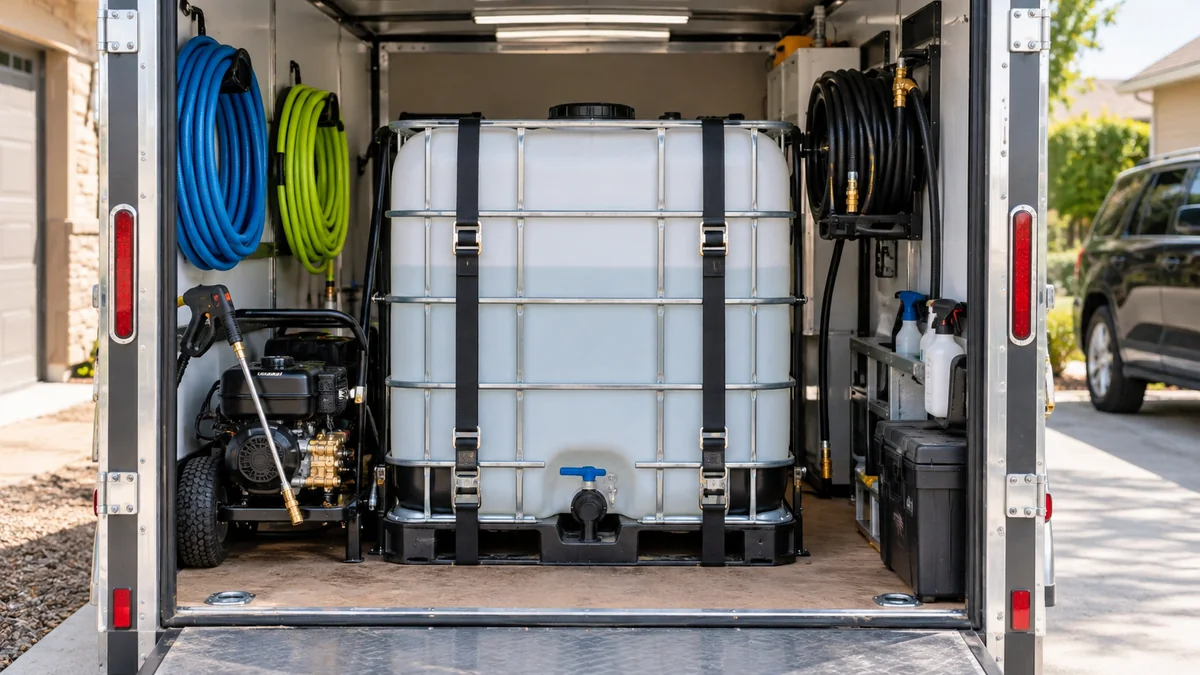
A complete system normally includes a reservoir, a fill opening, a screened vent, a bottom outlet or bulkhead fitting, a shutoff valve, an inlet strainer, non-collapsible supply hose, pump, pressure washer, and tie-down hardware. Baffles or a baffled internal shape reduce water movement during acceleration and braking.
Which Tank Features Matter Most?
Tank opacity, baffles, outlet size, access, and dimensions matter more than a large advertised gallon number. A 100-gallon tank that cannot fit through a van door or safely load the rear axle is a poor choice.
Look for these specifications:
| Feature | Practical target | Why it matters |
|---|---|---|
| Material | UV-stabilized polyethylene | Resists corrosion, impact, and sunlight damage |
| Capacity | 50, 65, 100, or 125 gallons | Matches payload and daily vehicle count |
| Color | Black, dark green, or opaque | Reduces light-driven algae growth |
| Outlet | 1-inch minimum, 1.25-inch preferred for higher flow | Reduces inlet restriction |
| Vent | Screened, breathable cap | Prevents vacuum formation |
| Construction | Internal baffles or transport-rated shape | Limits slosh during braking |
| Restraint | Molded channels or rated straps | Prevents movement in transit |
| Access | Large cleanout opening | Makes inspection and sanitation possible |
A tank with a small garden-hose outlet can work for a low-flow pump, but it may restrict a gasoline pressure washer drawing several gallons per minute. Match the outlet, hose, strainer, and pump inlet as a complete flow path rather than evaluating the tank alone.
How Much Water Does a Mobile Car Wash Need?
A mobile detailing operation generally needs 8-15 gallons per standard vehicle when using a high-efficiency pressure washer, foam prewash, controlled rinsing, and microfiber drying. Larger vehicles, heavy mud, hot weather, and repeated wheel rinsing can raise consumption to 15-25 gallons.
The useful calculation is:
Required tank capacity = vehicles between refills × gallons per vehicle + reserve volume
A 100-gallon tank should not be planned as 100 gallons of working water. Leave space for thermal expansion, movement, sediment, and operational reserve. A practical planning figure is 85-90 usable gallons.
| Tank size | Water weight when full | Typical standard cars | Practical operating range |
|---|---|---|---|
| 35 gallons | 292 pounds | 2-3 vehicles | 28-30 usable gallons |
| 50 gallons | 417 pounds | 3-5 vehicles | 40-45 usable gallons |
| 65 gallons | 542 pounds | 4-6 vehicles | 52-58 usable gallons |
| 100 gallons | 834 pounds | 6-9 vehicles | 85-90 usable gallons |
| 125 gallons | 1,043 pounds | 8-11 vehicles | 105-112 usable gallons |
| 200 gallons | 1,668 pounds | 13-18 vehicles | 170-180 usable gallons |
| 300 gallons | 2,502 pounds | 20-27 vehicles | 255-270 usable gallons |
These yields are typical planning ranges, not guarantees. A heavily soiled SUV can consume more water than two lightly maintained sedans, and a waterless or rinseless service uses a different calculation entirely.
How Do You Calculate Payload Safely?
Calculate the tank’s full water weight, then add the tank, pump, hose reels, pressure washer, generator, chemicals, tools, occupants, and fuel. Compare the result with the vehicle’s payload rating, not merely its towing capacity.
For example, a 100-gallon tank may contribute 834 pounds. Add 100 pounds for the tank and fittings, 150 pounds for a pressure washer and hose reels, 100 pounds for chemicals and tools, and 180 pounds for an operator. The installed load can exceed 1,350 pounds.
The rear axle rating also matters. A tank mounted behind the rear axle creates leverage that can unload the front axle and degrade steering. Place the tank low and as close to the axle line as practical, then verify axle loads with a public scale after installation.
Which Tank Type Fits a Mobile Detailing Rig?
The best tank type depends on vehicle geometry, payload, required daily volume, and whether the installation is permanent. A low-profile baffled polyethylene tank suits most professional vans and pickups, while a bladder is better for occasional use where compact storage matters more than durability.
| Tank type | Typical capacity | Typical price | Best application |
|---|---|---|---|
| Flexible bladder | 30-65 gallons | $100-$300 | Part-time operators and removable setups |
| Horizontal leg tank | 35-100 gallons | $200-$550 | Pickup beds and compact trailers |
| Low-profile tank | 50-150 gallons | $350-$800 | Vans, truck beds, and enclosed trailers |
| Square or PCO tank | 50-200 gallons | $300-$900 | Wall-side mounting and efficient footprint |
| Heavy-duty trailer tank | 200-300 gallons | $700-$1,500 | Fleet, commercial, and multi-operator work |
Low-Profile Polyethylene Tanks
Low-profile tanks use floor space efficiently and keep the center of gravity lower than tall vertical tanks. They are often the most practical choice for a cargo van because their broad footprint reduces tipping and their horizontal form can fit under shelves or benches.
The limitation is width. Measure the narrowest door opening, wheel-well spacing, interior height, and route from the loading door to the mounting position. A tank that fits the cargo area but cannot pass through the rear doors is not a usable purchase.
Bladder Tanks
A flexible bladder weighs little and can be folded or removed when the vehicle has another purpose. The trade-off is lower resistance to abrasion, puncture, sharp objects, and repeated loading. A bladder also requires a cradle or smooth support surface that prevents rubbing during transport.
A bladder is not a good default for daily commercial work in a vehicle carrying tools that can shift. Use it for occasional jobs, temporary capacity, or a controlled trailer installation where the surface and restraints are designed for flexible material.
Square and PCO Tanks
Square tanks use vertical wall space efficiently and can leave a central aisle open in a van. Their taller profile may raise the center of gravity, so the installation needs a rigid base, close wall support, and properly rated restraints.
For a 200-300-gallon tank, a trailer is usually more appropriate than a light-duty van or pickup. Full water weight alone can exceed 2,500 pounds at 300 gallons.
Gravity Feed or Pump: Which Water Delivery System Is Better?
A 12V demand pump is usually the safer choice for a mobile pressure-washing rig because it supplies consistent inlet flow when the tank sits beside or below the pressure washer. Gravity feed costs less and has fewer components, but it requires elevation, large unrestricted plumbing, and careful priming.
| Delivery method | Typical flow | Pressure behavior | Hardware | Best use |
|---|---|---|---|---|
| Gravity feed | 1-4 GPM | Depends on elevation | Tank, valve, hose | Simple low-flow rigs |
| 12V demand pump | 3.3-5.5 GPM | Consistent supply pressure | Pump, wiring, fuse, strainer | Daily detailing |
| Submersible pump | 3-8 GPM | Depends on pump model | Internal pump, cable, control | Temporary or custom systems |
| Diaphragm transfer pump | 5-10 GPM | High flow, separate control | Pump, switch, bypass | Larger commercial rigs |
A pressure washer does not become self-priming merely because water is stored in a tank. The feed line must remain full, the tank vent must breathe, and the pump inlet must receive more water than the pressure washer consumes.
Gravity-Fed Systems
Gravity pressure depends on vertical water height. A tank outlet positioned one meter above the pump produces only modest static pressure, and restrictions in a small hose or dirty strainer can remove much of that available flow.
Gravity systems are attractive for low-cost setups and some electric pressure washers with forgiving inlet requirements. They are less suitable when the tank sits on the same floor as the washer or when the machine has a high flow demand.
12V Demand Pumps
A diaphragm demand pump switches on when pressure falls and stops when the spray gun closes. A common mobile detailing range is 3.3-5.5 gallons per minute, but the pump’s actual performance falls as lift height, hose length, filters, and fittings increase.
Install a fuse near the battery, use wire sized for the pump’s current draw, place a strainer before the pump, and keep the inlet hose short and large enough. A bypass or pressure regulator may be needed if the pump exceeds the washer’s acceptable inlet pressure.
How Do You Install a Water Tank for Mobile Car Wash Work?
Install the tank on a low, rigid, level base, position its mass near the axle line, secure it with rated restraints, and connect a filtered supply line before testing the pressure washer. A careful first installation normally takes 3-6 hours, excluding fabrication or electrical work.
Step 1: Verify Payload and Dimensions
Record the vehicle’s payload rating, front and rear axle ratings, door openings, floor dimensions, and available mounting height. Calculate full tank weight before buying equipment.
Success checkpoint: the filled system remains within payload and axle limits.
Common mistake: sizing from cargo volume while ignoring rear-axle capacity.
Step 2: Position the Tank
Place the tank low, close to the axle line, and slightly forward rather than at the extreme rear. Keep access to the fill cap, cleanout, drain, shutoff, and pump strainer.
Success checkpoint: the tank does not block doors, emergency exits, service panels, or equipment removal.
Common mistake: mounting the tank permanently before checking hose-reel and pressure-washer clearance.
Step 3: Build the Restraint System
Use a rigid platform and rated straps, brackets, or manufacturer-provided channels. Do not rely on friction, adhesive, bungee cords, or a single strap.
Success checkpoint: the tank cannot slide, rotate, or lift when pushed from each side.
Common mistake: securing the tank to thin sheet metal that cannot transfer braking loads.
Step 4: Install the Outlet and Filter
Use the manufacturer’s bulkhead fitting, a full-port shutoff valve, a large-diameter supply hose, and an inlet strainer before the pump. Seal compatible threaded fittings according to the fitting manufacturer’s instructions.
Success checkpoint: water flows freely without collapsing the hose or drawing air around the fitting.
Common mistake: adding multiple small quick-connects that restrict flow.
Step 5: Wire the 12V Pump
Connect the pump through a correctly sized fuse and switch, with protected wiring routed away from standing water, hot exhaust components, and moving parts. Follow the pump maker’s current and wire-size instructions.
Success checkpoint: the pump starts when a downstream outlet opens and stops when pressure stabilizes.
Common mistake: wiring directly to an unprotected battery circuit.
Step 6: Prime and Test the System
Fill the tank with clean water, open the vent, open the outlet valve, and run water through the supply line until air bubbles stop. Test the pressure washer at low load before operating normally.
Success checkpoint: the washer produces steady pressure without pulsing, rattling, or repeated pump cycling.
Common mistake: starting a high-pressure pump while air remains in the inlet line.
What Water Quality Should a Mobile Detailer Use?
Use filtered water for equipment protection and deionized water for a spot-free final rinse. A sediment filter removes particles, a softener reduces hardness minerals, and a DI system removes dissolved ions that otherwise dry as visible spots.
Hard-water performance depends on local mineral content, measured as total dissolved solids, or TDS. A handheld TDS meter can identify whether DI resin is exhausted. A softener does not produce truly spot-free water because it exchanges calcium and magnesium for other ions; DI filtration is the relevant final-rinse technology.
Do not store untreated water for weeks in hot conditions. Water that smells, turns cloudy, or develops visible growth should be drained, cleaned, sanitized with a product appropriate to the tank material, and thoroughly rinsed before customer use. Never mix bleach with acids, ammonia, or detailing chemicals.
What Does a Mobile Wash Tank Cost?
A complete tank system typically costs $250-$1,500 before the pressure washer, depending on capacity, pump, filtration, fittings, restraints, and freight. The tank itself may be inexpensive, but large molded products often incur significant shipping charges.
| System level | Tank and pump budget | Complete added equipment | Typical operator |
|---|---|---|---|
| Removable bladder | $100-$300 | $250-$600 | Weekend detailer |
| 50-65 gallon poly | $250-$650 | $500-$1,000 | Part-time pickup operator |
| 90-125 gallon van system | $450-$1,000 | $900-$1,800 | Full-time solo detailer |
| 200-gallon trailer system | $700-$1,400 | $1,500-$3,000 | Small commercial team |
| 300-gallon commercial system | $1,000-$2,000 | $2,500-$5,000 | Fleet washing operation |
Expect polyethylene tanks to last roughly 8-12 years when protected from impact, excessive heat, incompatible chemicals, and ultraviolet exposure. A heavily used diaphragm pump may require a rebuild or replacement after 18-36 months, depending on duty cycle, water quality, and maintenance.
Local agricultural, irrigation, and industrial suppliers can reduce freight costs. Confirm that the tank is intended for transport, because a stationary agricultural tank may lack the shape, baffles, or restraint provisions required in a moving vehicle.
What Regulations and Alternatives Affect Mobile Washing?
Mobile washing may require wastewater containment or recovery, especially where detergent-laden water could enter a storm drain. Requirements vary by city, county, state, property type, and discharge destination, so operators should check the local sewer authority or environmental agency before taking commercial work.
A water tank does not solve runoff compliance. Use berms, drain covers, wet vacuums, reclaim systems, or approved disposal methods where required. Never assume that biodegradable soap makes storm-drain discharge legal.
Alternatives include customer-supplied water, rinseless washing, waterless cleaning, commercial wash-bay partnerships, and refill points. Customer water reduces payload but creates scheduling and hose-quality dependence. Rinseless methods reduce consumption substantially but are unsuitable for every level of mud, grit, or paint contamination.
Common Problems and How Do You Fix Them?
The Pressure Washer Pulsates
Air in the inlet line, a blocked strainer, a collapsed hose, or inadequate pump flow commonly causes pulsation. Turn off the pressure washer, open the supply line until bubbles stop, clean the strainer, and inspect every connection for leaks.
The Pump Runs but Water Does Not Move
A closed valve, blocked pickup, failed diaphragm, empty tank, or unvented cap can stop delivery. Open the tank vent, confirm the valve position, remove sediment from the strainer, and test flow before reconnecting the pressure washer.
The Water Smells or Looks Cloudy
Stagnation, organic growth, or contamination causes odor and cloudiness. Drain the tank, clean the interior with an appropriate brush and cleaner, rinse repeatedly, and establish a schedule that prevents old water from remaining in heat for extended periods.
The Tank Moves During Braking
Insufficient restraints or a weak mounting surface allows movement. Stop using the vehicle until the tank is secured to a structural base with rated straps or brackets; water movement can amplify the load during sudden braking.
The Pressure Washer Loses Pressure During a Job
The tank may be below the reserve level, the pump may be overheating, or the inlet path may be undersized. Check water level, pump duty cycle, voltage under load, filter condition, hose diameter, and manufacturer inlet-flow requirements.
Which Setup Should You Choose?
Weekend Detailer
Choose a 50-65 gallon tank or 30-65 gallon bladder if the equipment must be removed regularly. A gravity-fed arrangement can work with a low-flow electric pressure washer, but a compact 12V pump offers more reliable operation for a modest additional cost.
Full-Time Solo Detailer
Choose a 90-100 gallon opaque, baffled, low-profile polyethylene tank with a 3.3-5.5 GPM demand pump. This configuration usually supports a full day of compact-car work while keeping payload and refill frequency manageable.
Pickup Truck Operator
Choose a horizontal leg tank that fits between the wheel wells and remains below the bed rails. Verify the truck’s payload with occupants, tools, and fuel included, because a full 100-gallon tank already weighs 834 pounds.
Cargo Van Operator
Choose a low-profile or square tank after measuring the door opening and axle loads. Keep the tank low, protect the driver compartment from unsecured equipment, and leave service access around the pump and electrical components.
Fleet or Trailer Operator
Choose a 200-300 gallon baffled tank on a correctly rated trailer, with electric or gasoline equipment matched to the flow demand. Confirm trailer payload, axle rating, brakes, hitch capacity, tongue weight, and wastewater recovery requirements.
RV, Boat, and Semi-Truck Work
Plan on 15-30 gallons per large vehicle for efficient work, with higher consumption when heavy mud requires extended rinsing. A 200-gallon system may support several large vehicles, but the trailer and water-recovery design become more important than tank capacity alone.
FAQ
Can a mobile car wash tank sit in the rear of a van?
A mobile car wash tank can sit in the rear of a van only when the full water weight, equipment load, axle ratings, and restraint system remain within limits. Mounting the tank at the extreme rear can reduce front-axle load and worsen handling, so the axle line is usually a safer reference position.
Do I need a pump for a pressure washer?
A pump is not always required, but a 12V demand pump is recommended when the tank and pressure washer sit at similar elevations or when the washer needs more inlet flow than gravity can provide. Gravity feed may work for low-flow equipment with a short, large-diameter hose and adequate elevation.
Can I leave water in the tank overnight?
Leaving water overnight is usually acceptable when the tank is clean, shaded, vented, and used regularly. Drain or rotate stored water when temperatures are high or the tank will sit for several days, because stagnant warm water encourages odor, bacterial growth, and sediment accumulation.
Is a 50-gallon tank enough for mobile detailing?
A 50-gallon tank is enough for approximately 3-5 standard cars when the operator uses controlled rinsing and an efficient pressure washer. It may be insufficient for large SUVs, muddy vehicles, or a full schedule without a refill stop, making a 65-100 gallon tank more practical for daily work.
Can I use a clear plastic tank?
A clear plastic tank can store water temporarily, but it is a poor long-term choice for outdoor mobile detailing because light promotes algae growth. Opaque, UV-stabilized polyethylene limits exposure and makes routine maintenance easier, although sanitation and water turnover remain necessary.
What is the best water tank for mobile car wash work?
The best water tank for mobile car wash work is usually a 90-100 gallon, opaque, baffled polyethylene tank with a large outlet, screened vent, secure tie-down channels, and a filtered 12V demand pump. Smaller removable systems suit occasional operators, while 200-300 gallon trailer systems fit fleet work.
The Bottom Line
A water tank for mobile car wash work should be selected from payload, daily water consumption, vehicle dimensions, pressure-washer inlet requirements, and wastewater rules rather than gallon capacity alone. For most full-time solo detailers, a 90-100 gallon baffled polyethylene tank, securely mounted near the axle line and supplied by a filtered 12V demand pump, is the most balanced configuration. Use a 50-65 gallon system for occasional work, and move to a properly rated trailer before carrying 200 gallons or more.