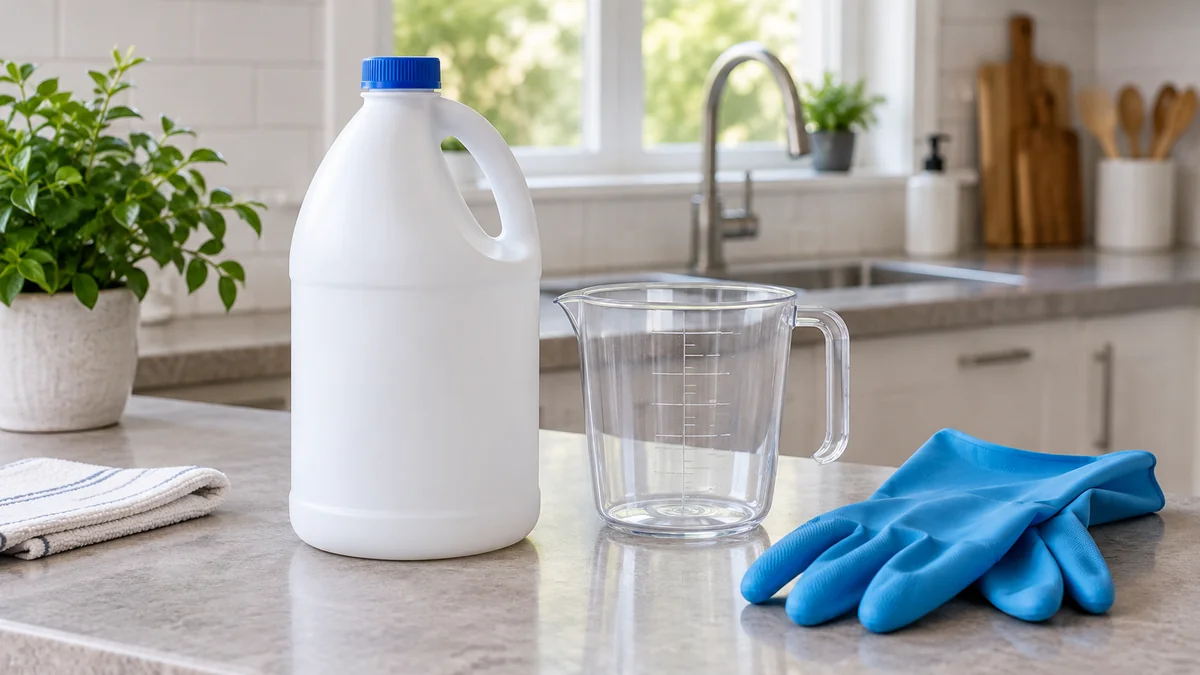
For general hard-surface disinfection, add 20 mL of plain, unscented 5%-6% sodium hypochlorite bleach to 1 liter of cool water to make an approximately 1,000 ppm solution. The exact amount depends on the bleach percentage, product label, surface, and required contact time, so never use the 20 mL rule for food, drinking water, skin, or every contamination scenario.
Key Facts at a Glance
- 5% bleach: Use approximately 20 mL per 1 liter of water for about 1,000 ppm available chlorine.
- 8.25% bleach: Use approximately 12 mL per 1 liter of water for the same nominal strength.
- 3% bleach: Use approximately 33 mL per 1 liter of water for approximately 1,000 ppm.
- Clean visible dirt and grease before applying sodium hypochlorite solution.
- Keep the surface visibly wet for the product label’s contact time, commonly 1-10 minutes.
- Never mix bleach with ammonia, vinegar, acids, alcohol, or other cleaning products.
- Make diluted bleach fresh, because light, heat, air, and time reduce available chlorine.
How Much Bleach Goes Into 1 Liter of Water?
The required bleach volume is approximately 1,000 divided by the bleach concentration percentage when the target is 1,000 ppm. For example, 1,000 divided by 5 equals 200 mL per 10 liters, or approximately 20 mL per liter. The calculation assumes the label percentage represents available sodium hypochlorite and that the dilution is being used for a general hard, nonporous surface.
Dilution Table for Approximately 1,000 ppm
| Bleach concentration | Bleach per 1 L water | Approximate household measure | Typical use |
|---|---|---|---|
| 2% | 50 mL | 3 tablespoons + 1 teaspoon | Weak consumer bleach, label confirmation needed |
| 3% | 33 mL | 2 tablespoons + 1 teaspoon | General surface disinfection |
| 4% | 25 mL | 5 teaspoons | General surface disinfection |
| 5% | 20 mL | 4 teaspoons | Common household bleach |
| 6% | 17 mL | 3 1/2 teaspoons | Common concentrated bleach |
| 7.5% | 13 mL | 2 1/2 teaspoons | Stronger household or institutional bleach |
| 8.25% | 12 mL | 2 1/2 teaspoons, slightly less | Concentrated consumer bleach |
These amounts are practical approximations, not a substitute for the manufacturer’s instructions. A teaspoon is 5 mL, a tablespoon is 15 mL, and a measuring syringe provides better accuracy than kitchen spoons. For regulated workplaces, use a graduated cylinder, dosing system, or chlorine test strips.
Adding 20 mL to 1 liter of water produces slightly more than 1 liter of solution. If exact final volume matters, place the measured bleach in a container and add water until the total volume reaches 1 liter. For ordinary household wiping, the difference is small.
What Does 1,000 ppm Mean?
A 1,000 ppm sodium hypochlorite solution contains approximately 0.1% available chlorine. Public-health agencies commonly use this strength as a general hard-surface disinfectant, but the appropriate concentration depends on the organism, soil load, surface, and product registration.
Sodium hypochlorite forms hypochlorous acid in water. Hypochlorous acid is the principal antimicrobial species that oxidizes cellular components, including proteins and nucleic acids. The solution works less reliably when dirt, blood, food residue, or other organic material consumes available chlorine before the disinfectant reaches microorganisms.
The Centers for Disease Control and Prevention advises following the bleach label and states: “Never mix household bleach with ammonia or any other cleanser.” That warning is a chemical-safety rule, not merely a recommendation about unpleasant odors.
Factors That Reduce Bleach Performance
| Factor | Effect on disinfecting solution | Practical response |
|---|---|---|
| Visible soil | Consumes available chlorine | Clean first with detergent and water |
| Hot water | Accelerates chlorine decomposition | Use cool or room-temperature water |
| Sunlight | Breaks down hypochlorite | Use an opaque, labeled container |
| Old bleach | Contains less available chlorine | Replace degraded product |
| High organic load | Reduces active chlorine quickly | Remove material before disinfection |
| Excessive storage time | Lowers concentration | Prepare only the amount needed |
How Do You Make Bleach Solution Safely?
Prepare a bleach disinfectant in five steps: identify the concentration, clean the surface, measure cool water, add bleach carefully, and maintain wet contact time. The main success factor is not odor; it is the labeled sodium hypochlorite percentage combined with complete wetting for the required duration.
Before You Start
| Requirement | Typical specification |
|---|---|
| Water | 1 liter of cool or room-temperature water |
| Bleach | Plain, unscented sodium hypochlorite with a visible percentage |
| Measuring tool | 5 mL syringe, graduated cup, or measuring cylinder |
| Container | Clean plastic container compatible with bleach |
| Protection | Chemical-resistant gloves and eye protection |
| Ventilation | Open window or operating exhaust fan |
| Batch time | Approximately 3-5 minutes |
Step 1: Check the Bleach Label
Use only a product that identifies sodium hypochlorite and states its concentration. Plain, unscented household bleach is the usual choice. Do not assume that “concentrated,” “professional,” or “regular” indicates a specific percentage.
Avoid splashless bleach unless the manufacturer specifically states that the product is registered and suitable for disinfection. Splashless products may contain thickening ingredients that change how the solution behaves on surfaces. Fragranced products may contain additional ingredients or a different hypochlorite concentration.
You will know this step is complete when the bottle shows a usable percentage and a disinfection direction. The common mistake is calculating from the brand name rather than the active-ingredient label.
Step 2: Clean the Surface First
Remove food, grease, dust, vomit, feces, or blood with detergent and water before applying diluted bleach. Cleaning is separate from disinfection because organic material can shield microorganisms and consume active chlorine.
For a bodily-fluid spill, wear gloves, use absorbent material, place contaminated waste in a sealed bag, and follow the relevant public-health or workplace protocol. The common mistake is applying bleach directly to visible soil and assuming the odor proves that disinfection occurred.
Step 3: Measure Water and Bleach
Measure 1 liter of cool water into a clean container. Add the calculated bleach volume to the water, not water to concentrated bleach, because adding water to a small amount of concentrate can create splashing and localized heat.
For 5% bleach, measure 20 mL. For 8.25% bleach, measure 12 mL. Use a syringe or graduated measure when accuracy matters, especially in childcare, food service, healthcare, or laboratory environments.
You will know the batch is correctly prepared when the concentration, volume, and date are written on the container. The common mistake is using an unmarked bottle that can later be mistaken for drinking water or another cleaner.
Step 4: Apply Enough Solution to Wet the Surface
Apply the diluted bleach with a cloth, wipe, mop, or controlled pour that leaves the entire surface visibly wet. Avoid fine misting because aerosolized droplets can irritate the eyes, skin, and respiratory tract.
Do not use bleach on energized electrical equipment, untreated aluminum, copper, natural stone, or fabrics unless the manufacturer confirms compatibility. Chlorine can corrode metals, discolor textiles, and damage finishes.
You will know application is adequate when no section dries before the required contact time. The common mistake is wiping the solution away immediately after application.
Step 5: Maintain the Label Contact Time
Keep the surface wet for the contact time printed on the bleach product label. Many general disinfecting directions specify 1-10 minutes, while some products require a longer period. If the surface dries early, reapply enough solution to restore wetness.
Contact time begins when the entire surface is wet, not when the cloth first touches it. The common mistake is treating a quick wipe as disinfection when the product requires several minutes of wet exposure.
Which Bleach Strength Is Right for Different Situations?
A 1,000 ppm solution is a general hard-surface option, but food-contact sanitation and heavy bodily-fluid contamination require different instructions. The product label, local health authority, and workplace procedure take priority over a generic ratio.
| Situation | Common target | Example using 5% bleach | Important condition |
|---|---|---|---|
| General hard surface | About 1,000 ppm | 20 mL per 1 L water | Clean first and keep wet |
| Food-contact sanitation | Often 50-200 ppm | 1-4 mL per 1 L water | Follow label and test concentration |
| Bodily-fluid spill | Often 5,000 ppm | 100 mL per 1 L water | Use trained spill procedures |
| Drinking water | Not a household surface dilution | Do not use this table | Follow official potable-water guidance |
| Skin or wounds | Not appropriate | Do not apply | Use medical first-aid guidance |
| Laundry | Product-specific | Follow textile directions | Check color and fiber compatibility |
Food-Contact Surfaces
Food-contact surfaces require a registered sanitizer direction, not automatically the same 1,000 ppm solution used for toilets or door handles. Some authorities and labels specify approximately 50-200 ppm, with a defined contact time and either air-drying or potable-water rinsing.
A stronger solution can leave unacceptable residue or damage equipment. In food service, chlorine test strips are more dependable than measuring by smell. Follow the label’s rinse instruction because requirements differ between products and jurisdictions.
Blood, Vomit, and Fecal Contamination
Heavy bodily-fluid contamination often requires a stronger solution, commonly around 5,000 ppm, but the correct procedure depends on the pathogen risk and local protocol. With 5% bleach, a rough 1:9 mixture uses 100 mL bleach with 900 mL water to produce approximately 1 liter of stronger solution.
Do not improvise this procedure in a healthcare or workplace setting. The Occupational Safety and Health Administration, local health departments, and institutional infection-control policies may require specific disinfectants, personal protective equipment, waste handling, and documentation.
Drinking Water
Household surface-disinfection ratios must not be used to make drinking water safe. Sodium hypochlorite dosing for potable water depends on water clarity, temperature, pH, contact time, chlorine demand, and the product’s suitability for drinking-water treatment.
Use emergency drinking-water instructions from a recognized public-health authority, such as the CDC or a local water utility. Never pour surface disinfectant into a glass or apply it to the mouth, skin, wounds, or food itself.
How Long Does Diluted Bleach Remain Effective?
Diluted bleach is best prepared immediately before use and discarded after the working period. A fresh solution is preferable because sodium hypochlorite loses strength through exposure to light, heat, air, and organic contamination; many public-health instructions recommend replacing diluted solution every 24 hours at most.
Store the original bottle tightly closed in a cool, shaded location. Do not transfer concentrated bleach into an unmarked drink bottle. A date on the original container helps determine whether the product may have lost substantial potency.
A weak smell does not prove that bleach has failed, and a strong smell does not prove that it is effective. Chlorine test strips can verify concentration where measurement matters, but strips must match the expected range and be stored according to their instructions.
What Surfaces Should Not Be Treated With Bleach?
Bleach is effective on many hard, nonporous surfaces, but it is a poor universal cleaner. It can corrode stainless steel when left wet, damage aluminum and copper, discolor fabrics, degrade rubber, and harm electronics or natural stone.
| Surface or material | Bleach suitability | Safer practical approach |
|---|---|---|
| Glazed ceramic toilet | Usually suitable | Follow label contact time and rinse if directed |
| Plastic doorknob | Usually suitable | Test a hidden area and wipe residue |
| Stainless steel | Limited | Use compatible disinfectant and rinse promptly |
| Aluminum or copper | Generally unsuitable | Select a nonchlorine product |
| Upholstery or carpet | Generally unsuitable | Use material-specific cleaning guidance |
| Smartphone or laptop | Do not apply liquid bleach | Use manufacturer-approved electronics cleaner |
| Cutting board | Label-dependent | Use food-contact sanitizer instructions |
| Natural stone | Often unsuitable | Use stone-compatible disinfectant |
The practitioner rule is simple: disinfectant efficacy and material compatibility are separate questions. A solution can kill microorganisms while damaging the surface.
Bleach Compared With Other Disinfectants
Bleach is inexpensive and broad-spectrum, but it demands careful dilution, ventilation, and compatibility checks. Ready-to-use products may be easier for small jobs, while alcohol is useful for some electronics and small hard surfaces but is flammable and evaporates rapidly.
| Disinfectant | Typical active strength | Contact behavior | Main limitation |
|---|---|---|---|
| Diluted sodium hypochlorite | 200-5,000 ppm | Must remain wet | Corrosion, fumes, daily preparation |
| 70% isopropyl alcohol | About 70% | Rapid evaporation | Flammable and poor for large areas |
| Hydrogen peroxide product | Label-specific | Usually 1-10 minutes | Material compatibility varies |
| Quaternary ammonium wipes | Ready-to-use | Often 1-10 minutes | May not cover every organism |
| EPA-registered spray | Label-specific | Product-dependent | Must follow registration directions |
Choose bleach when low cost, broad surface coverage, and readily available chlorine matter. Choose a ready-to-use registered disinfectant when accurate dosing, reduced preparation, or sensitive equipment matters more.
Why Does a Bleach Solution Sometimes Fail?
A bleach solution commonly fails because the product is old, the surface was dirty, the wrong concentration was calculated, or the surface dried before contact time ended. Increasing the amount randomly is not a reliable correction because stronger chlorine can increase damage and exposure without fixing poor application.
| Failure mode | Likely cause | Corrective action |
|---|---|---|
| Surface dries quickly | Too little liquid or hot environment | Reapply to maintain visible wetness |
| No apparent effect | Dirt or grease remained | Clean first, then disinfect |
| Corrosion appears | Metal incompatibility or long exposure | Stop use and choose a compatible product |
| Solution is weak | Old bleach or excess water | Replace bleach and measure accurately |
| Strong fumes | Poor ventilation or chemical mixture | Leave area and seek fresh air |
| Wrong result on food surface | General disinfectant used as sanitizer | Follow food-contact label directions |
Never add vinegar, toilet-bowl cleaner, descaler, ammonia, glass cleaner, or another disinfectant to bleach. Acids can release chlorine gas, while ammonia can produce chloramines. If mixing occurs, leave immediately, avoid breathing the vapors, keep others away, and contact emergency services or poison-control authorities.
Frequently Asked Questions
Can I use 20 mL of bleach in exactly 1 liter of water?
Yes, approximately, if the bleach contains 5%-6% sodium hypochlorite and the target is general hard-surface disinfection. The result is slightly more than 1 liter because the bleach adds volume. For exact final volume, add bleach first and top up with water to 1 liter.
Is 4 teaspoons the same as 20 mL?
Yes. One standard teaspoon is 5 mL, so four teaspoons equal 20 mL. A measuring syringe or graduated cylinder is more accurate than kitchen spoons, particularly when preparing food-service sanitizer or a bodily-fluid cleanup solution.
Can I use hot water to dilute household bleach?
No. Use cool or room-temperature water. Heat accelerates the breakdown of sodium hypochlorite and can increase irritating vapors. Water temperature does not replace the required contact time, so warm water provides no safe shortcut.
Can diluted bleach be kept in a spray bottle?
A diluted solution can degrade in a clear or poorly sealed spray bottle, and fine misting can increase inhalation exposure. Use a labeled, opaque container when practical, apply with a cloth or controlled method, and prepare fresh solution rather than storing it for extended periods.
Does stronger bleach always disinfect better?
No. Stronger chlorine is not automatically safer or more effective for every surface. Excess concentration can corrode metals, damage finishes, increase fumes, and leave residue. The correct concentration is the one specified for the organism, surface, and product label.
What should I do if I do not know my bleach percentage?
Do not guess from the color, smell, or brand name. Check the active-ingredient panel or manufacturer’s technical information. If the concentration cannot be confirmed, use a labeled ready-to-use disinfectant instead of preparing a home dilution.
The Bottom Line
For how much bleach to 1 liter of water for disinfecting, use 20 mL of plain 5%-6% sodium hypochlorite bleach per 1 liter of cool water for an approximately 1,000 ppm general hard-surface solution. Adjust the volume to the bottle’s percentage, clean before disinfecting, keep the surface wet for the label contact time, and never use this general ratio for drinking water, skin, wounds, or food-contact surfaces without product-specific instructions.