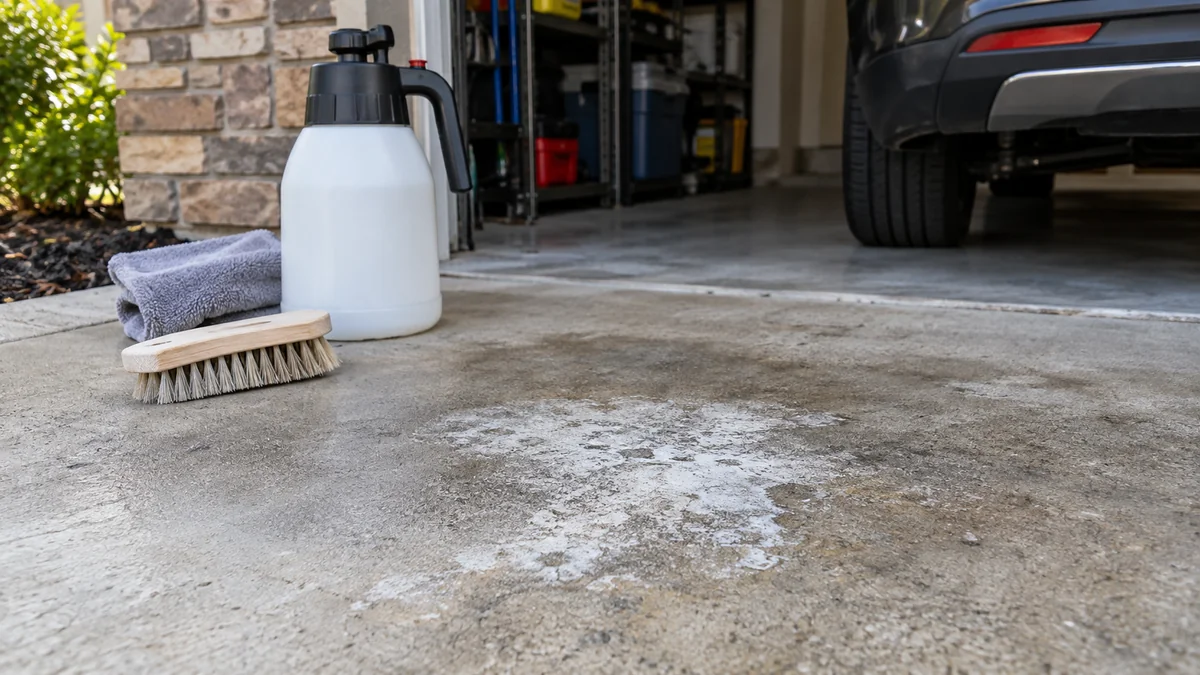
A white battery acid stain on concrete is usually a chemically etched area with calcium-sulfate residue, not an ordinary surface stain. Neutralize any remaining sulfuric acid with a controlled baking-soda solution, collect the runoff, then assess whether the slab needs cleaning, grinding, patching, or only cosmetic blending.
Key Facts at a Glance
Lead-acid battery electrolyte contains sulfuric acid, while lithium-ion batteries usually do not contain liquid sulfuric acid.
White residue can indicate gypsum, cement paste loss, efflorescence, or a separate mineral deposit.
Baking soda neutralizes residual acid, but it cannot rebuild concrete that has already been etched.
Never mix battery acid, baking soda runoff, bleach, ammonia, or muriatic acid in the same container.
A wet-dry vacuum is safer than sweeping dry residue, but collected liquid still requires responsible disposal.
Typical localized repair costs range from $15-$50 for basic DIY supplies to $150-$400 for professional chemical cleaning.
What Is a White Battery Acid Stain on Concrete?
A white battery acid stain on concrete is commonly the visible result of sulfuric acid attacking the cement paste and leaving pale calcium-sulfate minerals behind. The acid can also expose light-colored aggregate, remove an existing sealer, or create a shallow depression that remains after the residue is washed away.
Lead-acid automotive, golf-cart, forklift, and backup-power batteries use an aqueous sulfuric-acid electrolyte. The exact concentration varies by battery design, charge state, temperature, and manufacturer, so a universal “31%-50%” figure should not be treated as a field measurement. The spill should be handled as corrosive regardless of its measured concentration.
White material does not prove that battery acid caused the mark. Concrete efflorescence, dried cleaning chemicals, road salt, alkaline deposits, paint, and mineral scale can look similar. Identification matters because acid treatment will damage sound concrete and may worsen an unrelated deposit.
Battery Acid, Efflorescence, or Paint?
| Appearance or test | Likely material | Useful clue | Safer next action |
|---|---|---|---|
| White powder with a rough, sunken edge | Acid-etched cement paste | Texture is lower than surrounding slab | Neutralize if exposure is possible, then inspect |
| Fluffy crystals that recur after rain | Efflorescence | Deposit returns without a battery nearby | Investigate moisture migration |
| Hard translucent scale | Mineral deposit | Vinegar may react weakly, but acid testing is unnecessary | Use a neutral mineral-deposit cleaner |
| Colored film with a sharp edge | Paint or coating | Film may lift at a corner | Test a neutral coating remover |
| Orange, brown, or black halo | Corrosion or battery additives | Color extends beyond the white center | Clean only after confirming chemical safety |
Do not taste, dry-sweep, or deliberately wet-test an unknown powder. If a battery ruptured, preserve the battery label or photograph it for identification, and keep children, pets, and vehicles away from the area.
Why Does Battery Acid Turn Concrete White?
Sulfuric acid attacks alkaline cement compounds, including calcium hydroxide and other calcium-bearing phases in the hardened cement paste. The reaction can produce soluble salts and calcium sulfate, commonly called gypsum, while the acid removes the paste that binds the surface aggregate.
Concrete is porous rather than glasslike. Liquid can move through capillaries, so a spill may spread farther beneath the visible edge than the surface discoloration suggests. Acid exposure can therefore produce two separate problems: a removable mineral residue and permanent loss of surface material.
The white residue itself is not necessarily an “active toxic compound.” Dry dust may irritate the eyes, skin, and respiratory system, and contaminated residue can contain lead or other battery-related metals. Treat it as hazardous contamination until the source and material are known, but do not claim that every white deposit is carcinogenic.
What Damage Should You Expect?
| Surface condition | Typical visual result | Physical consequence | Appropriate repair |
|---|---|---|---|
| Fresh spill, no visible texture change | Wet dark patch or pale drying edge | Chemical reaction may still be active | Neutralize and rinse under control |
| Light powder, sound concrete | Chalky white film | Mostly superficial residue | Neutral cleaner after neutralization |
| Rough, exposed sand or aggregate | Bleached crater or bald patch | Cement paste has been removed | Grinding, patching, or overlay |
| Coating turned cloudy or peeled | White halo beneath coating | Sealer or paint has failed | Remove failed coating and refinish |
| Deep pitting or cracking | Irregular depression with fractures | More extensive substrate damage | Professional concrete repair assessment |
Acid does not reliably “finish” its work after a fixed number of seconds or exactly 24 hours. Damage depends on acid volume, concentration, contact time, temperature, porosity, and whether the slab is sealed. Permanent etching can begin quickly, but a precise universal time limit is not defensible.
How Do You Safely Remove Battery Acid From Concrete?
Neutralize the spill first, contain the liquid, rinse without spreading it, and inspect the dry surface before selecting a repair. A small outdoor spill typically takes 30-90 minutes of active work plus 8-24 hours of drying; the most important success factor is preventing contaminated runoff from reaching people, drains, soil, or adjacent materials.
Before You Start
| Requirement | Typical specification | Reason |
|---|---|---|
| Gloves | Chemical-resistant nitrile, neoprene, or rubber | Protects hands from corrosive liquid |
| Eye protection | Chemical splash goggles, not ordinary glasses | Prevents liquid entering around lenses |
| Clothing | Long sleeves, long trousers, closed shoes | Limits skin exposure |
| Respiratory control | Avoid dust; use suitable respiratory protection only as labeled | Dry residue can become airborne |
| Neutralizer | Baking soda, approximately 1 cup per gallon of water | Mild alkaline neutralization |
| Applicator | Plastic watering can or sprayer | Avoids corroded metal components |
| Agitation | Stiff nylon brush | Removes residue without steel fragments |
| Recovery | Wet-dry vacuum rated for the material, or absorbent media | Collects contaminated liquid |
| Containment | Plastic sheeting, absorbent socks, or drain covers | Limits migration |
Work outdoors or ventilate an indoor garage. Stop if strong fumes, eye irritation, a large spill, visible battery fragments, or an unknown quantity of liquid is present. A substantial spill, indoor exposure, or contamination near a storm drain warrants advice from the local fire department, hazardous-materials service, or environmental authority.
Step 1: Isolate the Spill
Keep people and pets away, remove nearby metal objects only if doing so is safe, and stop the battery from leaking further. Do not touch battery fragments with bare hands.
Block nearby floor drains with a compatible temporary cover and place absorbent socks around the affected area. Do not create a path toward landscaping, a storm drain, a well, or a neighboring property.
You will know this step worked when: liquid is confined and no fresh runoff is leaving the work zone.
Common mistake: using a hose to push the spill away before neutralization.
Step 2: Apply Baking Soda Gradually
Mix approximately 1 cup of sodium bicarbonate with 1 gallon of water. Apply enough solution to wet the affected area without flooding beyond containment, then add more gradually where fizzing occurs.
Fizzing indicates acid-base reaction, but the absence of bubbles does not prove complete neutralization. Aged, diluted, or dry residue may react weakly. Continue small applications until visible reaction stops, then allow 10-15 minutes for the solution to contact porous residue.
Never add ammonia to battery acid. Ammonia is not a preferred field neutralizer because it can release irritating vapors when misused and complicates chemical disposal. Never mix the area with bleach or other cleaners.
You will know this step worked when: successive small applications produce no visible reaction and the liquid remains contained.
Common mistake: pouring a concentrated mound of dry baking soda onto a large spill, which can obscure the reaction and leave contaminated paste difficult to collect.
Step 3: Collect the Neutralized Liquid
Use a wet-dry vacuum, absorbent pads, or compatible absorbent granules to recover the liquid. Do not dry-sweep powder, and do not assume that neutralized liquid is automatically safe for a storm drain or septic system.
Place collected material in a compatible, labeled container only if the container and local disposal instructions allow it. Contact the local household hazardous-waste program for guidance, particularly when the spill came from a lead-acid battery. Lead contamination changes disposal requirements.
You will know this step worked when: no free liquid remains and the surrounding concrete is not visibly wet beyond the contained area.
Common mistake: rinsing directly into soil because the fizzing has stopped.
Step 4: Rinse With Controlled Water
Rinse with clean water in small amounts while recovering the liquid. A low-pressure hose or watering can is preferable to a pressure washer during the first rinse because high pressure can aerosolize or spread contamination.
Repeat the controlled rinse until the recovered water is visibly clear and no acidic reaction appears on a fresh baking-soda test in the collection area. Do not rely on household pH strips placed directly on rough concrete as a perfect measurement; they can be distorted by dust and uneven moisture.
You will know this step worked when: the surface has no loose residue, runoff is contained, and the recovered water is near neutral according to an appropriate test.
Common mistake: allowing the first rinse to run across a garage threshold or driveway edge.
Step 5: Clean Remaining Discoloration
After neutralization, use a product labeled for concrete and compatible with the slab’s finish. A neutral concrete cleaner is appropriate for general residue; a rust or iron-oxide remover may help with orange-brown staining, but a rust cleaner does not repair acid-etched cement.
Scrub with a nylon brush from the outside toward the center. Work in small sections, follow the product label, and test in an inconspicuous area. Rinse under containment and recover the liquid again.
Allow the slab to dry for 8-24 hours before judging color or texture. Wet concrete often hides the actual boundary of an etched patch.
You will know this step worked when: loose residue is gone and the remaining defect is either a flat color change or a clearly measurable texture change.
Common mistake: using muriatic acid because the surface still looks white.
Step 6: Choose the Restoration Level
Run a straightedge across the area and compare the texture by sight, not by scraping with a finger. If the surface is flat and sound, cosmetic blending may be enough. If the straightedge rocks over a depression or aggregate is exposed, cleaning alone cannot restore the original profile.
A shallow rough patch may accept diamond abrasion followed by a compatible sealer. A deeper crater may require polymer-modified repair mortar or a bonded overlay. Follow the repair product’s minimum thickness, moisture, and curing requirements.
Which Repair Method Fits the Damage?
The best repair method depends on whether the remaining problem is chemical residue, discoloration, coating failure, or missing concrete. Baking soda is the correct first response to residual acidity, but specialized cleaning, grinding, patching, and recoating solve different problems and should not be treated as interchangeable.
| Method | Typical cost | Typical time | Best use | Main limitation |
|---|---|---|---|---|
| Baking soda neutralization | $5-$20 | 30-90 minutes | Fresh or suspected acid residue | Does not replace lost concrete |
| Neutral concrete cleaning | $10-$40 | 1-3 hours | Surface film after neutralization | Limited effect on etching |
| Rust or salt remover | $25-$80 | 2-6 hours | Metal-related discoloration | Product compatibility varies |
| Diamond grinding | $3-$8 per sq. ft. professionally | 1-2 days | Sound but etched surface | Removes surrounding material too |
| Patch or overlay | $50-$400 localized repair | 1-3 days plus cure | Depressions and exposed aggregate | Color matching is difficult |
| Recoating or sealing | $0.75-$4 per sq. ft. | 1-3 days | Clean, dry repaired concrete | Cannot hide active moisture |
Should You Use Muriatic Acid?
Do not use muriatic acid as the default remedy for a battery-acid mark. Hydrochloric acid can dissolve additional cement paste, enlarge the damaged area, release corrosive fumes, and leave a more obvious etched patch.
Acid washing has legitimate uses in controlled concrete preparation, but a battery-acid defect already involves chemical attack. Adding another acid may change texture without matching the original color, and it can create chloride contamination that is undesirable near reinforcement or metal fixtures.
The safer decision rule is simple: neutralize first, use a compatible neutral or specialty cleaner second, and use mechanical removal only when the surface profile actually needs correction.
Is Grinding Better Than Patching?
Grinding is better for a shallow, broad, relatively uniform etch because it can feather the affected area into surrounding concrete. Patching is better for a localized crater when removing enough surrounding slab would create a larger visible repair.
Neither method guarantees invisible color matching. Concrete varies by batch, age, aggregate, sunlight, sealer, and wear. On a decorative or polished floor, a specialist may need to extend grinding across a larger panel and restore it with densifier and compatible coating.
What If the Concrete Is Sealed or Polished?
A sealed or polished concrete floor needs a coating-specific assessment before wet cleaning or abrasion. Battery acid may have damaged only the sealer, or it may have penetrated the film and attacked the concrete beneath it.
Do not apply an untested rust remover to epoxy, polyurethane, acrylic, or decorative acid-stained concrete. Check the coating manufacturer’s chemical-resistance data, test a hidden section, and photograph the surface before treatment.
Polished floors often require professional dust-controlled diamond tooling. A small hand grinder can create a visible low spot, swirl marks, or a sheen difference that is larger than the original battery mark.
How Much Does Repair Cost and How Long Does It Take?
Typical DIY neutralization costs $15-$50, localized professional chemical cleaning costs about $150-$400, and professional grinding commonly costs $3-$8 per square foot. Actual pricing rises with indoor containment, lead contamination, coating removal, deep patching, disposal fees, access problems, and the size of the area requiring color blending.
| Scenario | Typical active labor | Drying or curing | Typical total cost |
|---|---|---|---|
| Fresh driveway spill, neutralization only | 30-90 minutes | 8-24 hours | $15-$50 DIY |
| Old flat discoloration | 2-6 hours | 24-48 hours | $25-$150 DIY |
| Localized professional cleaning | 2-5 hours | 24-48 hours | $150-$400 |
| Small crater with patch repair | 4-8 hours | 24-72 hours | $100-$500 |
| Polished-floor grinding and refinishing | 1-3 days | 24-72 hours | $3-$8 per sq. ft. |
These are typical planning ranges, not guaranteed quotes. Request a written scope that states whether neutralization, runoff recovery, coating removal, patching, sealing, and disposal are included.
What Are the Most Common Mistakes?
Pressure Washing Before Neutralization
High pressure can spread corrosive liquid onto walls, vehicles, skin, landscaping, and eyes. Use containment and gradual neutralization first; pressure washing belongs later, if the surface and runoff plan permit it.
Dry-Sweeping the White Powder
Dry sweeping turns residue into airborne dust and distributes it beyond the original footprint. Dampen and recover the material with appropriate equipment instead.
Using a Wire Brush
Steel bristles can scratch concrete and leave iron particles that later rust. Nylon is the safer default for a localized chemical cleanup.
Pouring Muriatic Acid on the Mark
Muriatic acid can remove more cement paste and increase the visible defect. It is a surface-preparation chemical, not a neutralizer for sulfuric-acid damage.
Ignoring the Battery Type
Lithium-ion battery failures can involve thermal runaway, electrolyte solvents, fire, and toxic smoke rather than a sulfuric-acid spill. Do not use the lead-acid cleanup method for a damaged lithium-ion pack.
Sealing Too Soon
Sealer applied over damp, salty, or chemically contaminated concrete can whiten, blister, or peel. Wait until the substrate is clean and dry, then follow the sealer manufacturer’s moisture limit.
When Should You Hire a Professional?
Hire a professional when the spill is large, indoors, near a drain, associated with a ruptured lead-acid battery, or accompanied by strong fumes, skin exposure, visible metal contamination, or significant pitting. Professional help is also appropriate when a polished floor, decorative coating, structural joint, or reinforced slab must be preserved.
A contractor should explain the chemical identification, containment method, waste route, cleaning product, surface-repair plan, and final sealer. Be cautious of a proposal that promises to remove every mark with one acid wash or guarantees an invisible color match on aged concrete.
For a small exterior spill with no visible crater, a homeowner can often neutralize and clean the area safely with PPE, baking soda, controlled rinsing, and proper disposal. The boundary is not expertise alone. It is the ability to control the chemical and the runoff.
FAQ
Will Baking Soda Remove the White Mark Completely?
Baking soda can neutralize remaining sulfuric acid and loosen some residue, but it cannot restore cement paste removed by corrosion. After drying, a flat pale patch may remain because the acid changed the slab’s color or exposed aggregate. Texture loss requires grinding, patching, or a broader resurfacing treatment.
Can Rain Wash Away Battery Acid on a Driveway?
Rain may dilute and spread battery acid, but it does not make the spill safe or prevent etching. Runoff can reach soil, storm drains, vehicles, and neighboring surfaces. Contain and neutralize the affected area first, then recover contaminated liquid according to local disposal guidance.
How Can I Tell Whether an Old White Patch Is Battery Acid?
Look for a nearby vehicle, golf cart, forklift, or battery location, then compare the patch’s texture with the surrounding slab. A sunken, rough, sharply localized area supports acid damage. Recurring fluffy crystals without a battery exposure suggest efflorescence. Avoid aggressive acid testing because it can create the damage you are trying to diagnose.
Can I Paint Over a Battery-Acid-Damaged Concrete Floor?
Paint can cover a sound, neutralized, clean, and dry surface, but it will not stabilize loose concrete or hide moisture problems permanently. Remove weak material, repair depressions, confirm the coating’s moisture limits, and use a compatible concrete primer. A larger color transition may be less noticeable than a small spot repair.
How Long Should I Wait Before Sealing the Concrete?
Wait at least 24-48 hours after final rinsing for a small outdoor repair, then verify that the slab meets the sealer manufacturer’s moisture requirement. Patch compounds and overlays may need longer curing periods, commonly 24-72 hours or more. Dampness, salts, cool weather, and poor ventilation extend the wait.
Is a White Battery Acid Stain Permanent?
The residue may be removable, but the underlying etch can be permanent without physical restoration. Cleaning can eliminate loose salts and discoloration, while grinding, patching, or resurfacing addresses lost surface material. The most accurate expectation is improved safety and appearance, not guaranteed return to the original concrete color.
The Bottom Line
A white battery acid stain on concrete should be treated first as a corrosive-spill and surface-damage problem, not as an ordinary stain. Isolate the area, neutralize suspected sulfuric acid gradually with baking soda, collect the runoff, clean with a compatible product, and let the slab dry before deciding whether it needs cosmetic blending, grinding, patching, or professional restoration.