To become a pressure washer, learn safe equipment operation, practice on several surfaces, choose employment or self-employment, meet local legal requirements, and assemble equipment suited to your customers. A beginner can reach supervised job readiness in about 30 days, but professional competence requires repeated practice with pressure, water flow, detergents, surface protection, and customer documentation.
Key Facts at a Glance
- Professional pressure washing depends more on usable water flow, surface knowledge, and process control than maximum PSI.
- A typical residential startup costs $2,500-$8,000 before a truck, trailer, advertising, and commercial hot-water equipment.
- General liability insurance commonly starts at $1 million per occurrence, but coverage does not replace safe operating procedures.
- Electric machines suit small residential work; gas machines usually improve productivity on driveways, siding, and larger properties.
- Roof cleaning normally requires soft washing with low pressure and properly controlled detergent, not high-pressure blasting.
- A pressure-washing operator can work as an employee, independent contractor, side-hustler, or full-time business owner.
What Does a Pressure Washer Actually Do?
A pressure washer uses a pump to accelerate water through a small nozzle, creating a concentrated stream that separates dirt from a surface. The machine combines water pressure, water volume, nozzle geometry, distance, temperature, and chemistry; changing any one of those variables changes cleaning speed and damage risk.
PSI, or pounds per square inch, describes pressure force. GPM, or gallons per minute, describes water volume. PSI helps break the bond between contamination and a surface, while GPM rinses loosened material away. Cleaning power is therefore not represented by PSI alone.
A 2,500-PSI machine producing 4 GPM can finish a concrete driveway faster than a 4,000-PSI machine producing 2 GPM, because the higher-flow machine moves more rinsing water across the surface. Professionals often calculate cleaning units as PSI multiplied by GPM, although the result is a comparison aid rather than a complete productivity measurement.
Pressure washing is different from soft washing. Soft washing applies detergent through low-pressure equipment or a downstream injector, allowing chemistry and dwell time to remove algae, organic staining, and microorganisms without forcing water behind siding or into roofing materials.
How Do You Become a Professional Pressure Washer?
Becoming a professional pressure washer requires five stages: learn the equipment, practice surface-specific methods, complete legal setup, buy suitable equipment, and sell a repeatable service. The fastest safe route is usually supervised field experience followed by small, controlled jobs rather than buying a large rig immediately.
Step 1: Learn the Equipment and Safety Rules
Start with the owner’s manual for the exact machine, pump, engine, hose, gun, and nozzle. Learn how to connect the water supply, purge air, start the engine, change nozzles with the trigger released, shut down correctly, and relieve pressure before maintenance.
Wear eye protection, hearing protection around gas machines, gloves suitable for chemicals, long trousers, slip-resistant boots, and clothing that covers exposed skin. High-pressure water can inject fluid through skin and cause deep tissue damage even when the wound looks small. Seek emergency medical care after any suspected injection injury.
Never point the wand at a person, animal, energized electrical equipment, or a window seal. Do not run gasoline equipment indoors, inside a garage with the door open, or near an air intake because carbon monoxide can accumulate rapidly.
Step 2: Practice on Low-Risk Surfaces
Practice first on unpainted concrete, then move to vinyl siding, brick, sealed concrete, painted wood, vehicles, and more delicate materials. Use a wide 25-degree or 40-degree nozzle, begin several feet away, and reduce distance gradually while watching for surface change.
Create test areas that are approximately 2 feet by 2 feet. Record the nozzle, distance, pressure setting, detergent, dwell time, and result. A written log prevents repeating a setting that caused striping, etching, oxidation streaks, or paint failure.
You are ready for paid basic work when you can produce an even result, protect adjacent surfaces, control overspray, explain limitations to a customer, and stop when a surface becomes unsafe to clean.
Step 3: Choose Employment or Self-Employment
Employment with an established contractor is the lowest-risk entry route. You gain access to real surfaces, production timing, chemical handling, ladder procedures, customer communication, and equipment maintenance without immediately carrying the full cost of insurance and lead generation.
A side business offers more control but requires sales, scheduling, bookkeeping, vehicle costs, weather planning, liability management, and customer-service skills. A new operator should avoid presenting limited practice as expertise, particularly for roofs, historic masonry, large commercial sites, and delicate painted surfaces.
| Route | Typical time to first paid work | Typical initial cost | Main advantage | Main limitation |
|---|---|---|---|---|
| Employee technician | 1-4 weeks | $100-$500 | Supervised field training | Lower control over schedule |
| Independent subcontractor | 2-8 weeks | $1,000-$4,000 | Existing contractor leads | Contract and payment risk |
| Weekend side business | 3-8 weeks | $2,500-$6,000 | Flexible local schedule | Limited production hours |
| Full-time company | 1-3 months | $8,000-$30,000 | Higher capacity and revenue potential | Insurance, marketing, and vehicle overhead |
Step 4: Get Training and Certification
Certification is not universally required, but structured training can reduce mistakes and improve credibility. Organizations such as the Power Washers of North America and the Pressure Washing Resource Association provide industry education, while local vocational programs and experienced contractors may provide practical instruction.
Certification does not make an unsafe job safe, guarantee insurance coverage, or authorize work restricted by local law. Verify course content before paying. Useful training should address surface identification, chemical safety, equipment maintenance, estimates, runoff, fall prevention, and customer documentation.
The U.S. Occupational Safety and Health Administration requires employers to control workplace hazards, but a small owner-operated business may face different obligations from an employer with staff. Check federal, state, provincial, and local rules rather than assuming an online certificate satisfies legal requirements.
Step 5: Establish the Business Legally
Choose a business structure with advice from a qualified accountant or attorney. A sole proprietorship is simple to begin, while an LLC may provide administrative separation and a formal operating structure, but an LLC does not automatically prevent personal liability for negligence.
Typical setup tasks include:
- Register the business name where required.
- Obtain a local business license or contractor registration if applicable.
- Open a separate business bank account.
- Register for tax obligations and maintain job records.
- Obtain general liability insurance before customer work.
- Use written estimates, exclusions, payment terms, and damage documentation.
- Confirm wastewater, chemical, noise, and signage rules.
Many operators choose $1 million to $2 million in general liability coverage because commercial customers and property managers often request those limits. Ask the insurer whether roof work, chemical application, subcontractors, vehicles, pollution, and completed operations are covered. A standard policy may exclude a service you assume it includes.
Which Pressure Washer Should a Beginner Buy?
A beginner should buy equipment according to the first service category, water supply, transport method, and realistic workload. A 3,000-PSI gas machine with approximately 2.8-4.0 GPM is a practical starting point for driveways and residential exterior cleaning, while an electric unit is safer for occasional small work.
| Equipment type | Typical specification | Typical price | Best first jobs | Important limitation |
|---|---|---|---|---|
| Electric residential | 1,300-2,300 PSI, 1.1-1.5 GPM | $100-$300 | Cars, bins, small patios | Slow on large concrete |
| Gas residential | 2,500-3,500 PSI, 2.5-4.0 GPM | $300-$1,500 | Siding, driveways, fences | Noise and engine maintenance |
| Commercial cold-water | 3,000-4,000 PSI, 4.0-8.0 GPM | $1,500-$5,000 | Repeated residential jobs | Requires reliable water supply |
| Hot-water skid | 3,000-4,000 PSI, 4.0-5.5 GPM | $2,500-$7,000 or more | Grease, dumpsters, fleets | Fuel, servicing, and transport cost |
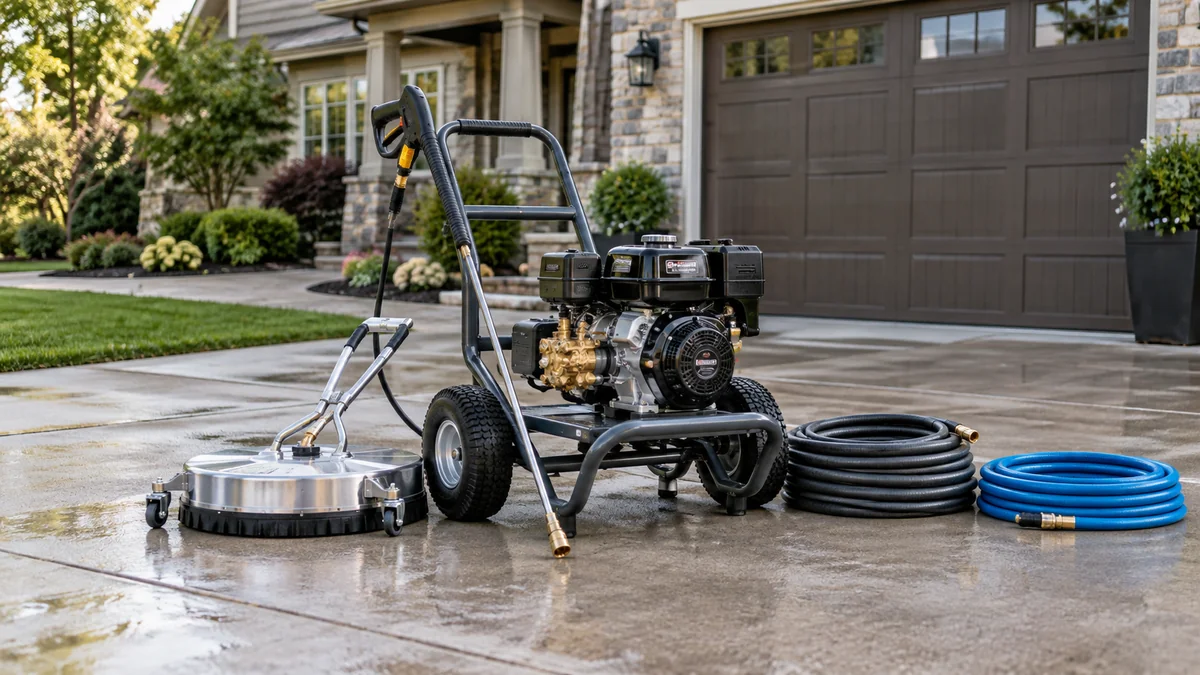
A surface cleaner usually improves concrete results because its rotating arms create a more consistent pattern than a hand wand. Use a cleaner rated for the machine’s flow, and do not assume a large-diameter cleaner will perform well with low GPM.
A professional basic kit normally includes a machine, 50-100 feet of high-pressure hose, garden hose, spare nozzles, an inlet filter, downstream injector, chemical containers, surface cleaner, pump sprayer, hose reel, tarps, cones, and personal protective equipment.
How Much Does It Cost to Start?
A lean residential operation typically costs $2,500-$8,000 before a dedicated trailer or hot-water unit. The total depends on whether you already own a suitable vehicle, whether you buy new equipment, and whether your first work involves concrete, siding, roofs, or commercial grease.
| Startup item | Lean budget | Typical business budget | Higher-capacity budget |
|---|---|---|---|
| Pressure washer and pump | $500 | $1,500 | $5,000 |
| Hoses, reels, and fittings | $250 | $700 | $1,500 |
| Surface cleaner and nozzles | $250 | $600 | $1,200 |
| Chemicals and PPE | $200 | $500 | $1,000 |
| Insurance and registration | $600 | $1,500 | $3,000 |
| Website, signs, and advertising | $300 | $1,200 | $4,000 |
| Trailer or equipment transport | $400 | $2,500 | $8,000 |
Do not buy a 4,000-PSI machine simply because its rating looks professional. Excess pressure can damage wood, mortar joints, paint, window seals, and vehicle finishes, while insufficient flow can make a large surface financially impractical.
How Should You Clean Different Surfaces?
Surface-specific cleaning requires a risk assessment before the wand reaches the material. Identify the substrate, coating, age, existing damage, nearby openings, electrical hazards, and drainage path; then select pressure, nozzle, chemistry, distance, and dwell time.
| Surface | Starting method | Typical pressure approach | Chemical note | Main failure |
|---|---|---|---|---|
| Unpainted concrete | Surface cleaner | 2,500-4,000 PSI | Detergent for oil or organic stains | Etching or striping |
| Vinyl siding | Low-pressure rinse | 500-1,500 PSI at surface | Detergent and controlled rinse | Water behind panels |
| Painted wood | Test area first | 500-1,200 PSI | Mild detergent | Paint removal and raised grain |
| Asphalt shingles | Soft wash only | Low pressure, typically under 500 PSI | Manufacturer-compatible solution | Granule loss and leaks |
| Vehicle paint | Wide fan and low pressure | 1,200-2,000 PSI at distance | Automotive detergent | Clear-coat or trim damage |
| Brick and mortar | Wide fan, moderate pressure | 500-1,500 PSI | Test for efflorescence | Mortar erosion |
Can You Pressure Wash a Roof?
You should not high-pressure wash asphalt shingles. Roof cleaning generally uses low-pressure chemical application, controlled dwell time, gentle rinsing, fall protection, and manufacturer-compatible procedures; some roofs require a specialist or should not be cleaned by a new operator.
Sodium hypochlorite can remove organic growth, but concentration, ventilation, runoff, plant protection, storage, and material compatibility matter. Never mix bleach products with acids, ammonia, or unknown cleaners. Protect landscaping with pre-wetting and post-rinsing, and follow local discharge requirements.
Roof work also adds fall risk, fragile materials, hidden defects, and potential interior water intrusion. A beginner should refer roof customers to an insured specialist until trained in access systems, anchor requirements, chemical control, and roof inspection.
How Do You Price Pressure Washing Jobs?
Price jobs from labor time, water and chemical use, equipment overhead, travel, insurance, taxes, payment fees, and profit, rather than copying a competitor’s square-foot number. Typical residential pricing varies widely by region, access, contamination, surface type, and minimum service charge.
A new operator might use a minimum charge of $150-$250 for small residential work, then estimate larger jobs by measurable surface area and production rate. If a driveway requires 2.5 hours onsite, 45 minutes travel and setup, and $35 in direct costs, a $225 invoice leaves little room for insurance, maintenance, marketing, and taxes.
Use written estimates that specify:
- Surfaces included and excluded
- Approximate square footage or item count
- Water and electricity responsibility
- Stain-removal limitations
- Access, ladder, and weather conditions
- Furniture, vehicles, and plant protection
- Payment timing and cancellation terms
- Before-and-after photographs
Never guarantee complete removal of rust, oil, artillery fungus, oxidation, efflorescence, or old stains. A professional estimate describes the likely result and the conditions that can prevent restoration.
Common Mistakes and How to Fix Them
Using a Zero-Degree Nozzle Too Close
A red 0-degree nozzle concentrates water into a narrow cutting stream. Replace it with a 25-degree or 40-degree nozzle, increase distance, and use overlapping passes; damaged wood, paint, or masonry may require repair rather than additional cleaning.
Ignoring Water Supply
A machine rated at 4 GPM needs a source that can supply approximately 4 GPM continuously. Test a faucet by filling a container for one minute, and use a buffer tank when the source cannot maintain flow.
Letting a Gas Pump Bypass for Too Long
A pressure washer pump can heat stagnant bypass water when the trigger remains released. Shut down during pauses longer than a brief repositioning, or follow the manufacturer’s bypass-time limit; melted seals and damaged unloaders can follow overheating.
Allowing Runoff to Enter Drains
Detergent, oil, sediment, and heavy metals can enter storm drains or waterways. Block or redirect flow where legal, collect wastewater when required, and check municipal environmental rules before commercial work.
Starting Without a Test Patch
A test patch reveals oxidation, loose paint, weak mortar, dye transfer, and chemical reaction before the entire surface is affected. Photograph the test area and obtain customer approval when the result may differ from the expected appearance.
Treating Chemicals as a Substitute for Training
Chemical strength does not compensate for poor surface identification. Measure products, label containers, use appropriate PPE and ventilation, follow the product label, and maintain Safety Data Sheets for workplace chemicals.
How Do You Get Your First Customers?
Start with a narrow service area and one or two controllable services, such as concrete cleaning and low-rise siding. Create a simple service page, a verified business profile where available, clear before-and-after photographs, and an estimate form that records address, surface, access, and contamination.
Ask every customer for permission to photograph results and for a factual review. Contact property managers, real estate agents, landscapers, painters, auto-detailing businesses, and small commercial owners with a specific offer rather than a generic “we clean everything” message.
Track lead source, estimate-to-sale rate, average ticket, labor hours, chemical cost, callbacks, and gross margin. A job that produces attractive photographs but loses money is a marketing expense, not a profitable service.
Troubleshooting Pressure Washer Problems
| Symptom | Likely cause | Correct first action | Escalation point |
|---|---|---|---|
| Low pressure | Clogged nozzle or inlet screen | Clean screen and nozzle | Inspect pump and unloader |
| Pulsing or surging | Air or restricted water | Purge air and open faucet fully | Check hose, filter, and valve |
| Engine stalls on trigger pull | Excessive back pressure | Release trigger, inspect nozzle | Qualified unloader service |
| Pump becomes very hot | Extended bypass operation | Shut down and cool machine | Replace damaged seals if needed |
| Chemical will not draw | Injector mismatch or obstruction | Check injector direction and flow | Replace injector or hose |
Do not adjust an unloader valve by guesswork. Incorrect adjustment can create dangerous pressure, damage the pump, or cause engine problems. Follow the machine’s service instructions or use a qualified repair technician.
Is Pressure Washing a Good Career or Side Business?
Pressure washing can be a viable side business when the operator controls risk, targets services with repeat demand, and tracks production time. It is not passive income, and seasonal weather, equipment breakdowns, insurance costs, customer disputes, and local competition can materially reduce earnings.
Residential concrete and siding are accessible starting categories. Commercial kitchens, dumpster pads, fleet washing, and industrial work may offer recurring revenue but often require hot water, wastewater controls, larger insurance limits, night scheduling, and stronger chemical knowledge.
The strongest early business model is usually narrow and repeatable: serve a defined area, use equipment matched to its water supply, document every job, and refuse work beyond current training.
Frequently Asked Questions
Do You Need a License to Pressure Wash?
License requirements vary by city, county, state, and country. Some jurisdictions require only a general business registration, while others regulate contractors, water discharge, chemical use, signage, or commercial vehicle operation. Contact the local licensing office and environmental authority before advertising paid services.
How Long Does It Take to Learn Pressure Washing?
Basic equipment operation can be learned in several supervised sessions, while reliable surface judgment usually takes weeks or months of varied practice. New operators should begin with low-risk concrete and avoid roofs, historic masonry, high elevations, and delicate finishes until specifically trained.
Can Pressure Washing Damage Concrete?
Pressure washing can damage concrete through excessive pressure, a concentrated nozzle, uneven passes, or aggressive chemicals. Surface cleaner overlap, consistent movement, a suitable nozzle, and a test patch reduce striping and etching, but old or weak concrete may already be vulnerable.
What Is Better, PSI or GPM?
Neither PSI nor GPM is universally better. PSI supplies force for breaking contamination, while GPM carries loosened material away and usually determines production speed. Select a balanced machine for the surface, water source, cleaner attachment, and service category instead of choosing the highest PSI rating.
Can You Start With an Electric Pressure Washer?
You can start with an electric pressure washer for vehicles, bins, furniture, and small patios. Electric units are usually unsuitable for efficient large-driveway or full-time commercial production because their lower GPM extends job time and their cords restrict mobility.
How Do You Handle a Customer’s Existing Damage?
Photograph existing cracks, failed paint, oxidized siding, broken seals, loose mortar, and roof defects before starting. Record the condition in the estimate, explain what cleaning cannot repair, and obtain written approval for any service with a material risk of exposing or worsening pre-existing damage.
The Bottom Line
To become a pressure washer, master safe surface cleaning before expanding into complex services, then combine supervised experience with legal registration, insurance, suitable equipment, written estimates, and disciplined pricing. Start with a manageable service category, test every unfamiliar surface, and let water flow, chemistry, and technique determine the result rather than maximum pressure.