Roof moss is best removed by controlling access, protecting landscaping, gently removing bulk growth, and applying a roof-compatible treatment according to its label. For a sound, low-slope, single-story asphalt-shingle roof, the work typically takes 3-6 hours and costs $25-$150. Steep, fragile, leaking, or multi-story roofs generally require a qualified roofing or soft-wash professional.
Key Facts at a Glance
- Moss holds moisture against roofing materials and can lift shingle edges as it thickens.
- Never use a pressure washer, wire brush, metal rake, or upward scraping motion on asphalt shingles.
- A garden hose provides safer rinsing than a pressure washer, but some labeled treatments should be left to weather away.
- Sodium hypochlorite works quickly but can damage plants, metals, coatings, and aquatic environments.
- Oxygen-bleach and labeled potassium-salt products reduce some runoff risks, but “eco-friendly” does not mean harmless.
- A contractor commonly charges about $250-$900 for a straightforward 1,500-square-foot roof, with pitch, access, and repairs increasing the price.
Why Does Roof Moss Damage Shingles?
Roof moss damages shingles primarily by retaining water and forcing growth beneath shingle edges. Moss does not have true roots, but its rhizoids grip rough surfaces and can work into overlaps, while repeated wetting, freezing, wind, and foot traffic weaken the roof’s water-shedding system.
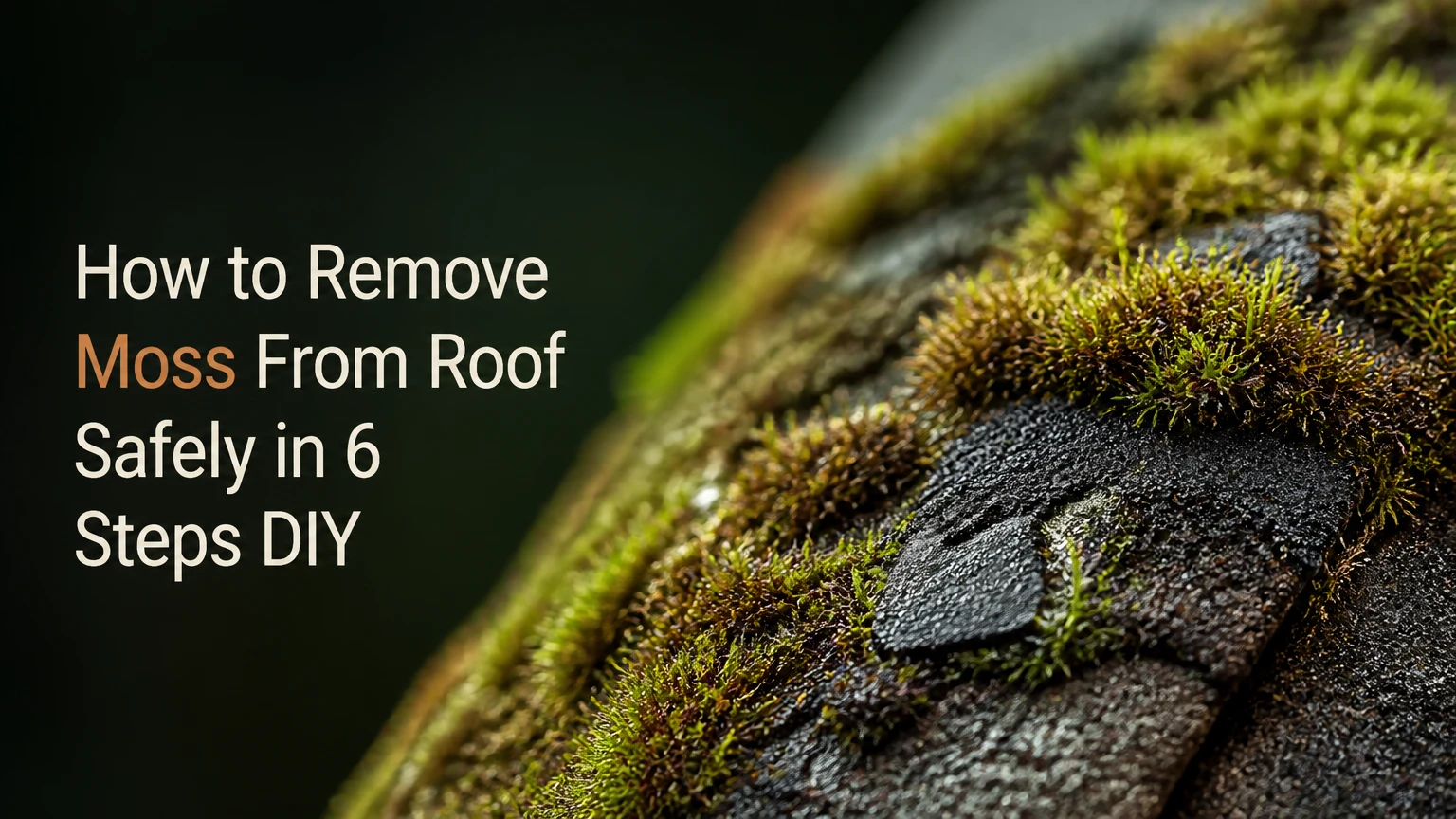
Algae usually produces flat black or brown discoloration. Moss forms raised green cushions or mats, and lichen creates crusty, branching growth attached tightly to the surface. The distinction matters because a dark stain may need a different treatment and may not create the same lifting pressure as a thick moss colony.
The National Roofing Contractors Association recommends following the roofing manufacturer’s maintenance instructions rather than treating every roof with one cleaning formula. GAF and other shingle manufacturers also warn against aggressive cleaning methods because granule loss reduces weathering protection. Moss removal cannot restore missing granules, broken seals, or rotten decking.
What damage should you check before cleaning?
Inspect the roof from the ground first. Look for displaced shingles, exposed underlayment, sagging areas, clogged gutters, bare patches, heavy granule accumulation at downspouts, and water stains in the attic. A roof with active leakage or widespread granule loss needs a roofing assessment before cleaning.
Is Roof Moss Removal Safe to Do Yourself?
Roof moss removal is suitable for a homeowner only when the roof is low enough to reach safely, structurally sound, dry, and accessible without climbing onto a dangerous slope. OSHA identifies falls as a major construction hazard, and a consumer ladder does not substitute for a properly planned fall-protection system.
Do not climb onto a roof that is wet, frosted, brittle, steep, or covered with chemical solution. Avoid walking on slate, clay tile, asbestos-cement sheets, aged wood shakes, or lightweight metal panels unless the material manufacturer specifies a safe access method. A harness is useful only when attached to an approved anchor capable of supporting the system; tying one to a gutter or vent is unsafe.
Hire a contractor when the roof is above one story, difficult to reach, steeper than a comfortable walking slope, visibly damaged, or too old to tolerate cleaning. Ask for proof of liability insurance, workers’ compensation coverage, roof-cleaning experience, and a written description of chemical concentration, runoff control, and rinsing practice.
Before You Start
| Requirement | Typical specification | Why it matters |
|---|---|---|
| Active work time | 3-6 hours for light or moderate moss | Includes setup, brushing, treatment, and cleanup |
| DIY cost | $25-$150 | Covers tools, treatment, tarps, and replacement supplies |
| Weather | Dry, calm, overcast, 45-85°F | Reduces slipping, drift, and rapid evaporation |
| Roof condition | Sound, low-slope, single-story | Limits access and breakage risk |
| PPE | Gloves, eye protection, non-slip footwear | Reduces chemical and fall exposure |
| Water supply | Garden hose with adjustable nozzle | Provides controlled low-pressure rinsing |
| Ground protection | 2-4 tarps plus clean water | Limits moss and chemical contact with plants |
Before applying any product, read the current label and Safety Data Sheet. Never mix bleach with ammonia, acids, vinegar, toilet cleaner, or other household products. Product labels control dilution, dwell time, required PPE, disposal, and whether rinsing is allowed.
How Do You Remove Moss From Roof Shingles?
Remove roof moss in six controlled steps: assess access, protect the ground, remove loose debris, reduce the moss mechanically, apply a compatible treatment, and complete a gentle rinse or weathering process. The most important success factor is avoiding force that removes shingle granules or lifts overlapping edges.
Step 1: Assess the Roof and Choose a Dry Day
Inspect the roof from a ladder or the ground, not by stepping onto questionable shingles. Select a calm, dry, overcast day after checking that no rain is expected during the product’s required dwell period.
Confirm the roof material, age, slope, and condition. Asphalt shingles can tolerate only gentle cleaning. Wood shakes may require a specialized cleaner and a preservation assessment. Metal roofing needs a coating-compatible product, while tile and slate often require a specialist familiar with breakage and point loading.
You’ll know this step worked when: you can identify the roof material, treatment label, drainage path, and a safe work position without improvising access.
Common mistake: starting because the moss looks bad while ignoring a loose ladder, wet surface, or roof leak.
Step 2: Protect Plants, Walls, Gutters, and Drains
Wet grass, shrubs, flower beds, and siding with clean water before treatment. Cover delicate plants loosely with breathable plastic or tarps, but remove covers promptly after application so heat does not build up beneath them.
Place tarps below the eaves to catch moss clumps. Do not block downspouts if rain could occur, and use temporary downspout extensions or collection methods to keep chemical runoff away from ponds, storm drains, vegetable gardens, and neighboring property.
A ground helper should watch runoff and keep clean water available. Constantly flooding a roof is unnecessary, but rinsing siding, gutters, and plants after accidental contact reduces residue concentration.
You’ll know this step worked when: runoff has a planned path and no treated water can enter a pond, storm drain, or uncovered garden.
Common mistake: covering plants without wetting them first, then leaving plastic in place during warm weather.
Step 3: Remove Leaves and Loose Moss From the Ground or a Safe Position
Use a leaf blower from a stable ladder position or the ground to remove leaves, pine needles, and loose debris. Direct material toward the eaves only when gutters and ground protection are ready.
For accessible areas, use a soft nylon brush or a dull plastic scraper. Work downward, parallel to the shingle slope, so the tool does not catch the lower edge of an overlapping shingle. Lift and remove loosened clumps by hand rather than dragging them across the surface.
Do not use a wire brush, metal rake, garden hoe, putty knife, or abrasive pad. Do not pull moss upward from the eaves toward the ridge. Those actions can tear asphalt edges, disturb adhesive strips, and remove protective granules.
You’ll know this step worked when: thick clumps are gone, the shingle surface remains intact, and no concentrated pile remains inside the gutter.
Common mistake: trying to remove every green mark mechanically. Residual staining and fine holdfasts are the treatment’s job.
Step 4: Apply a Roof-Compatible Moss Treatment
Choose a commercially labeled roof treatment based on the roof material, runoff conditions, and desired speed. Mix only the quantity and concentration printed on the label. A homemade bleach recipe can be cheaper, but its strength varies and its runoff can injure plants, corrode metals, and violate local discharge rules.
Apply from the ridge downward only if the label permits roof application and the operator can remain off treated, slippery areas. Saturate the remaining moss without creating uncontrolled runoff. Observe the printed dwell time, which may range from about 10 minutes to several hours for a cleaner, or days to weeks for some leave-on biocides.
Sodium hypochlorite can produce rapid visual knockdown, but chlorine bleach is not automatically safe for asphalt shingles, aluminum gutters, painted surfaces, pets, or plants. Oxygen bleach based on sodium percarbonate is often less corrosive, although it may require more brushing and can still irritate skin and aquatic life. Zinc or copper salts may kill moss gradually and require strict runoff control.
You’ll know this step worked when: the moss changes color or loses firmness within the label’s stated response period, without visible shingle discoloration or uncontrolled runoff.
Common mistake: increasing concentration or adding dish detergent to make the product “cling.” Unapproved additives can change chemical behavior and invalidate label directions.
Step 5: Rinse Only as the Label Directs
Use a garden hose with a fan or shower setting, not a pressure washer. Keep the nozzle away from shingle laps, flashing joints, ridge vents, and exposed underlayment, and direct water downward toward the eaves.
Some products require rinsing after a stated dwell time. Other leave-on treatments are designed to kill moss gradually, after which rain and natural weathering remove the residue. Rinsing a leave-on product too early can reduce effectiveness and send more concentrated chemicals into the drainage system.
Rinse gutters, siding, and plants with clean water after treatment. Collect and dispose of moss according to local rules, and never sweep concentrated chemical residue into a storm drain.
You’ll know this step worked when: no loose chemical foam or moss remains on walls and plants, and water exits the gutters without backing up.
Common mistake: using a pressure washer because the moss detaches quickly. Fast removal can conceal permanent granule and seal damage.
Step 6: Clear Gutters and Inspect the Roof and Attic
Remove moss clumps from gutters and downspouts after the roof surface is clean. Confirm that downspouts discharge away from the foundation and that no debris remains beneath flashing, valleys, or roof-to-wall transitions.
From the ground, photograph previously affected areas for comparison. Inside the attic, check for damp insulation, dark sheathing, daylight, musty odors, or active drips after the next rainfall. Cleaning does not repair a lifted shingle or failed flashing.
You’ll know this step worked when: drainage is clear, the roof has no newly displaced shingles, and the attic remains dry after rain.
Common mistake: assuming a clean-looking roof is watertight. Moss often exposes defects that were present before treatment.
Which Roof Moss Treatment Works Best?
The best treatment depends on roof material, runoff sensitivity, and whether the homeowner needs rapid knockdown or gradual weathering. A labeled roof biocide is generally more controllable than an improvised mixture, while gentle physical removal is necessary for thick mats but should not be used as the only method on fragile shingles.
| Method | Typical response | Main advantage | Main risk or limitation |
|---|---|---|---|
| Sodium hypochlorite solution | 10-30 minutes | Rapid biological kill | Plant injury, corrosion, fumes, runoff |
| Sodium percarbonate | 30 minutes to several hours | Lower chlorine odor and corrosion risk | More brushing and slower stain removal |
| Potassium-salt biocide | 1-4 weeks | Gradual leave-on treatment | Aquatic toxicity and label-dependent runoff |
| Zinc or copper sulfate | 1-6 weeks | Effective supplemental treatment | Metal runoff, plant injury, incomplete control |
| Manual nylon brushing | Immediate bulk reduction | No chemical discharge | Fall risk and possible granule loss |
| Pressure washing | Immediate visible removal | Fast appearance change | Granule loss, leaks, warranty concerns |
When is bleach appropriate?
Bleach is appropriate only when the roof product label permits its use, the operator can control runoff, and nearby metal, plants, pets, and water bodies are protected. Bleach is a poor choice for uncontrolled drainage, sensitive landscaping, corroded gutters, painted surfaces, or anyone unable to use chemical PPE.
Do not infer safety from dilution alone. A weaker solution can still damage vegetation, and a stronger solution may discolor or degrade roofing components. Commercial products often include surfactants and instructions that differ from household bleach.
Are zinc and copper strips a permanent solution?
Zinc or copper strips can suppress new moss growth below the metal strip, but they are not a permanent cure and cannot remove established mats. Rain dissolves small quantities of metal and carries ions down the roof, so effectiveness decreases on roof sections that receive little rainfall.
Metal strips also require correct placement near the ridge, secure fastening, and compatibility with the roofing material. Copper runoff can harm aquatic organisms, and some metals may stain light-colored siding or roofing. Replace severely moss-damaged shingles rather than relying on strips to compensate for structural defects.
How Do Methods Compare by Roof Material?
Roof-material compatibility determines the acceptable cleaning pressure, chemical choice, and access method. Asphalt shingles tolerate low-pressure treatment and gentle nylon brushing, while slate, wood shakes, tile, and coated metal require product-specific procedures that a generic bleach recipe may damage.
| Roof material | Safer general approach | Avoid | Professional trigger |
|---|---|---|---|
| Asphalt shingles | Labeled soft wash, downward nylon brushing | Pressure washing, metal tools | Granule loss, lifted tabs, roof older than about 20 years |
| Wood shakes | Manufacturer-approved cleaner, limited brushing | Chlorine-heavy formulas, aggressive scraping | Splitting, rot, historic or cedar roof |
| Painted metal | Low-pressure labeled cleaner, soft brush | Abrasives, incompatible solvents | Chalking, peeling coating, concealed fasteners |
| Clay or concrete tile | Ground-based treatment, careful access | Walking on unsupported tiles | Cracked tiles, steep slope, fragile underlayment |
| Slate | Specialist inspection and treatment | Routine ladder or roof walking | Any broken slate or loose flashing |
| EPDM or membrane | Membrane-approved cleaner | Petroleum solvents, harsh oxidizers | Ponding water, open seams, punctures |
Can you clean moss from a wood or metal roof?
You can clean some wood and metal roofs, but the procedure must follow the material manufacturer’s instructions. Wood shakes absorb chemicals and can split under scraping, while metal roofs may lose protective coatings or develop corrosion at cut edges and fasteners.
A contractor should inspect wood rot, zincalume or galvanized coatings, concealed fasteners, seam conditions, and drainage before treatment. “Low pressure” describes water force, not chemical compatibility, so a gentle application can still cause damage if the chemistry is wrong.
What Does Professional Roof Moss Removal Cost?
Professional roof moss removal typically costs $250-$900 for a straightforward 1,500-square-foot asphalt roof, while larger, steeper, heavily affected, or repair-intensive roofs can exceed $1,000. Typical DIY material costs range from $25-$150, excluding fall-protection equipment, ladder rental, repairs, or disposal.
| Job condition | Typical DIY cost | Typical professional cost | Typical active time |
|---|---|---|---|
| Light moss, 1,000 sq. ft. | $25-$75 | $200-$450 | 2-4 hours |
| Moderate moss, 1,500 sq. ft. | $50-$150 | $250-$900 | 3-6 hours |
| Heavy moss with gutter clearing | $75-$200 | $500-$1,200 | 5-8 hours |
| Steep or two-story roof | Not recommended | $700-$1,800+ | 4-8 hours |
| Moss plus shingle repair | $150-$500 materials | $800-$3,000+ | 1-3 days |
Prices vary by region, roof pitch, access, treatment, travel, insurance, and whether repairs are included. Published consumer cost guides such as Angi and HomeGuide list roof-cleaning prices across broad national ranges, so a written local quote is more useful than a single national average.
Request an itemized estimate that separates cleaning, biocide, gutter work, roof repairs, plant protection, and warranty terms. A very low quote may omit runoff protection or rely on high-pressure washing.
What Are the Most Common Roof Moss Removal Mistakes?
The most damaging mistakes are pressure washing, upward scraping, chemical overconcentration, uncontrolled runoff, and walking on an unsuitable roof. Each mistake can convert a cosmetic cleaning job into a shingle replacement, siding repair, plant-loss, or water-intrusion claim.
| Mistake | Likely consequence | Corrective action |
|---|---|---|
| Pressure washing asphalt shingles | Granule loss and lifted edges | Stop immediately; inspect for bare areas |
| Wire brushing or metal scraping | Scratches and broken shingle surfaces | Switch to soft nylon tools |
| Scraping upward | Lifted laps and disturbed adhesive | Work downward or use treatment only |
| Mixing bleach with acids or ammonia | Toxic gas or chemical reaction | Stop, leave area, and contact emergency services if exposed |
| Ignoring runoff | Plant injury and water contamination | Divert flow, dilute surfaces, follow label disposal |
| Walking on treated moss | Slips and shingle breakage | Wait for treatment response or use a contractor |
| Cleaning a leaking roof first | Hidden defects remain | Inspect and repair before treatment |
If pressure washing has already removed granules, photograph the surface and inspect gutters for unusual granule deposits. A roofer can determine whether the loss is localized or widespread. If a chemical contacts plants, flush foliage and soil with clean water immediately unless the product label gives different emergency instructions.
How Can You Prevent Moss From Returning?
Reduce shade and moisture, keep roof drainage open, and install correctly positioned zinc or copper strips when compatible with the roof and local runoff requirements. Prevention works best when it addresses the roof environment rather than relying on repeated aggressive cleaning.
Trim branches that shade the roof while preserving safe clearance from shingles. Clean gutters at least twice yearly, especially after leaf fall, and correct overflowing valleys or blocked downspouts. Keep leaves from accumulating in roof valleys, where a thin organic layer can remain damp for days.
Metal strips work only where rainwater can flow across the treated roof plane. They do not protect roof sections separated by dormers, valleys, ridges, or obstructions. Check the fasteners and surrounding sealant periodically, because loose metal can become a leak source.
How often should a roof be checked for moss?
Check a moss-prone roof twice each year and after long wet periods. Pacific Northwest climates, heavily shaded properties, and roofs beneath conifers may need seasonal observation, while sunny, well-ventilated roofs may need less frequent treatment.
Treat small regrowth before it forms a thick mat. Early ground-based treatment usually creates less runoff and requires less mechanical disturbance than removing mature moss after several wet seasons.
When Should You Replace the Roof Instead of Cleaning It?
Roof replacement deserves consideration when moss removal reveals widespread granule loss, brittle shingles, repeated leaks, exposed underlayment, rotten decking, or shingles near the end of their service life. Cleaning cannot restore asphalt, wood fibers, flashing, sealant, or structural sheathing.
Typical asphalt shingles last roughly 15-30 years depending on product quality, climate, ventilation, installation, and maintenance. Age alone does not mandate replacement, but an older roof with heavy moss and multiple defects may cost more to clean and repair than its remaining service life justifies.
Ask a roofer to inspect the roof after loose moss has been removed but before aggressive treatment. A roof report should identify shingle condition, flashing, valleys, penetrations, ventilation, decking, and attic moisture rather than merely recommending a chemical wash.
FAQ
Will vinegar kill moss on a roof?
Vinegar can damage or kill some surface vegetation, but it is not a preferred roof-moss treatment because household acidity, contact time, runoff, and material compatibility vary. Vinegar can affect metals, plants, sealants, and aquatic environments, and it may not penetrate a thick moss mat. Use a labeled roof product instead.
Can I remove roof moss without chemicals?
You can remove loose moss manually, but thick growth usually needs a follow-up treatment to reduce remaining holdfasts and slow regrowth. Use a soft nylon brush from a safe position, move downward, and stop when the surface begins shedding granules. Chemical-free work does not remove the fall risk.
Does roof moss mean I need a new roof?
Roof moss does not automatically mean a roof needs replacement. Moss is a reason to inspect the roof for lifted shingles, granule loss, leaks, and rot; replacement becomes more likely when those defects are widespread or the roof is near the end of its expected service life.
Can I use a pressure washer on a metal roof?
A pressure washer can damage coatings, force water beneath seams, and affect fasteners even when the metal itself is strong. Some manufacturers permit controlled low-pressure cleaning, but the approved pressure, nozzle distance, and detergent depend on the coating. Follow the metal-roof manufacturer’s instructions or hire a specialist.
How long does roof moss treatment take to work?
Rapid oxidizing cleaners may change moss within 10-30 minutes, while leave-on potassium, zinc, or copper products may take one to six weeks to kill and weather away growth. The product label determines whether rinsing is required. Dead moss may remain attached until rain, wind, or careful later removal releases it.
What should I do if moss keeps returning?
Find the moisture source before applying another treatment. Inspect shade, tree debris, clogged gutters, poor ventilation, roof valleys, and persistent condensation, then improve drainage and airflow. A correctly installed zinc or copper strip can suppress regrowth on some roof planes, but it cannot correct leaks or ponding water.
The Bottom Line
The safest answer to how to remove moss from roof surfaces is gentle, label-directed cleaning combined with strict fall and runoff control. Protect the landscaping, remove bulk moss downward with non-abrasive tools, avoid pressure washing, and inspect for leaks or granule loss afterward. For steep, fragile, old, leaking, or multi-story roofs, professional removal is the safer and often less expensive decision.