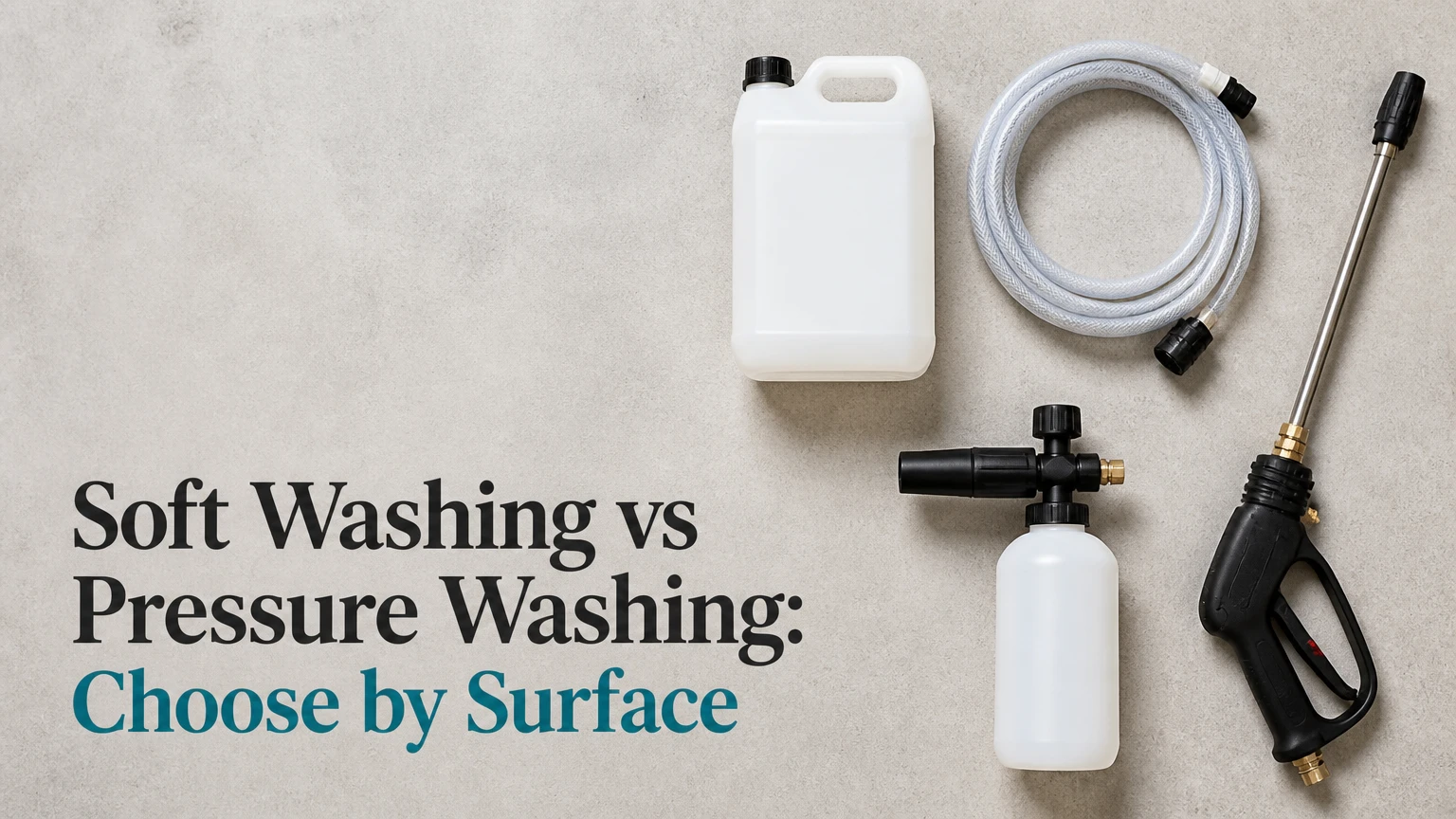
Soft washing uses low-pressure water with a cleaning solution to remove and kill organic growth, while pressure washing uses higher-pressure water to remove bonded dirt mechanically. Soft washing is generally the safer choice for roofs, siding, stucco, and delicate finishes; pressure washing is usually better for sound concrete, heavy mud, and some industrial grime.
Key Facts at a Glance
- Soft washing commonly applies chemical solution at approximately 100-500 PSI, but the exact pressure depends on the equipment and surface.
- Pressure washing commonly operates from approximately 1,500-4,000 PSI, although professional operators adjust pressure, flow, nozzle, and distance together.
- Soft washing treats algae, mold, mildew, and lichen at the source; pressure washing can remove visible growth without reliably killing remaining spores.
- Concrete tolerates more mechanical force than asphalt shingles, vinyl siding, painted wood, or EIFS stucco.
- Power washing usually means pressure washing with heated water; soft washing and power washing are not interchangeable terms.
- A contractor’s surface assessment, runoff control, and technique matter more than a machine’s maximum PSI rating.
Soft Washing vs Pressure Washing: What Is the Core Difference?
Soft washing relies primarily on chemical action, dwell time, and controlled rinsing. Pressure washing relies primarily on water velocity and impact force. Both methods can include detergents, and neither method is automatically safe or unsafe without considering the substrate, contamination, nozzle, temperature, flow rate, and operator technique.
Soft-wash systems often use a diaphragm pump, 12-volt pump, or pressure-washer downstream injector to apply a diluted sodium hypochlorite solution with surfactant. The solution loosens organic contamination and destroys biological growth, after which the operator rinses with low-impact water.
Pressure washers use an electric motor or gasoline engine to drive a pump. The pump sends water through a restrictive nozzle, creating a concentrated stream that breaks the bond between soil and the surface. A wide fan nozzle spreads force over a larger area, while a narrow nozzle concentrates it.
The common PSI boundary is useful as a rough description, not a universal technical standard. A 500 PSI soft-wash application can damage a weak coating, while a 1,500 PSI rinse may be appropriate for certain sound concrete surfaces. The operator’s actual impact depends on pressure, gallons per minute, spray angle, nozzle orifice, standoff distance, and dwell time.
Comparison of Technical Characteristics
| Characteristic | Soft washing | Pressure washing | Power washing |
|---|---|---|---|
| Typical application pressure | 100-500 PSI | 1,500-4,000 PSI | 1,500-4,000 PSI |
| Typical water flow | 4-10 GPM | 2-5 GPM | 2-5 GPM |
| Water temperature | 50-90°F ambient | 50-90°F ambient | 140-200°F |
| Main cleaning action | Chemical decomposition | Water impact | Heat plus water impact |
| Typical dwell time | 5-20 minutes | 0-5 minutes | 0-5 minutes |
| Main contaminants | Algae, mold, mildew, lichen | Mud, soil, loose paint | Grease, oil, gum, wax |
| Typical equipment | Diaphragm pump or injector | Plunger pump and nozzle | Heated pressure washer |
How Each Cleaning Method Works
Soft washing works by applying a controlled chemical solution, allowing enough contact time, and rinsing without forcing water behind the building envelope. Pressure washing works by transferring kinetic energy through a nozzle, with the operator controlling the result through distance, angle, flow, and passes.
How Does Soft Washing Remove Organic Growth?
Soft washing applies a diluted sanitizer, commonly sodium hypochlorite, to biological deposits. Surfactants help the solution cling to vertical or sloped surfaces, while dwell time allows the active ingredient to penetrate porous growth and loosen discoloration.
A typical residential house-wash mix is weaker than a roof-treatment mix, and the correct concentration varies with the organism, material, temperature, sunlight, and product strength. Operators should follow product labels rather than copy an internet ratio. Sodium hypochlorite can corrode metals, discolor fabrics, injure plants, and irritate skin or lungs.
The usual sequence is:
- Inspect the surface, plants, drainage, fixtures, and nearby materials.
- Close windows, protect outdoor furniture, and move vehicles.
- Pre-wet vegetation with clean water.
- Apply the solution evenly, usually from the bottom upward to control streaking.
- Maintain wet contact for approximately 5-20 minutes.
- Prevent drying by reapplying water or solution in hot, windy conditions.
- Rinse the surface and surrounding vegetation thoroughly.
- Manage runoff and neutralize or dilute residues where local rules require it.
The surface is clean when organic staining has lifted or visibly lightened and no chemical residue remains. A dark shadow can persist on severely weathered materials even after biological contamination is dead.
How Does Pressure Washing Remove Dirt?
Pressure washing removes contamination by directing water through a nozzle at high velocity. The operator uses a broader nozzle and greater distance for fragile surfaces, then increases mechanical action only when the substrate can tolerate it.
A 0-degree nozzle creates a narrow, highly concentrated jet that can permanently scar concrete, cut wood fibers, damage mortar, or remove paint. A 25-degree or 40-degree fan nozzle distributes force more safely, while a surface cleaner keeps two rotating jets at a consistent height over flat concrete.
A competent process normally includes:
- Inspect cracks, joints, coatings, mortar, windows, vents, and electrical fixtures.
- Remove loose stones and objects that could become projectiles.
- Select a nozzle appropriate to the substrate.
- Test an inconspicuous area at the lowest effective pressure.
- Pre-treat oil, algae, or grease when detergent improves removal.
- Keep the wand moving with overlapping passes.
- Maintain a consistent angle and distance.
- Rinse from the highest area toward the approved drainage point.
The strongest machine setting is rarely the best setting. Excessive pressure can remove the surface layer that the operator intended to clean.
Which Method Fits Each Surface?
Soft washing generally fits delicate, coated, porous, or elevated surfaces, while pressure washing generally fits sound, horizontal, durable surfaces. Mixed projects often need both methods, such as soft washing a house exterior and pressure washing its concrete walkway.
| Surface or project | Preferred method | Typical operating range | Main reason |
|---|---|---|---|
| Asphalt shingles | Soft washing | 50-300 PSI | Removes algae without stripping granules |
| Vinyl siding | Soft washing | 100-500 PSI | Limits water intrusion behind laps |
| Aluminum siding | Soft washing | 100-500 PSI | Reduces denting and coating damage |
| Stucco or EIFS | Soft washing | 100-400 PSI | Protects textured and insulated finishes |
| Painted wood siding | Low-pressure cleaning | 100-500 PSI | Limits paint failure and fiber damage |
| Composite decking | Low-pressure cleaning | 300-800 PSI | Removes soil without gouging boards |
| Sound concrete driveway | Pressure washing | 1,500-3,500 PSI | Removes embedded soil and tire marks |
| Brick and pavers | Controlled pressure washing | 800-2,000 PSI | Balances cleaning with joint protection |
| Greasy dumpster pad | Hot pressure washing | 2,000-4,000 PSI | Heat and detergent dissolve oily residue |
| Heavy equipment | Hot pressure washing | 2,000-4,000 PSI | Removes grease, mud, and hydraulic residue |
Is Soft Washing Better for Roofs?
Soft washing is usually the appropriate method for asphalt-shingle roofs because high-pressure water can dislodge granules, shorten shingle life, and drive water under laps or flashing. Roof cleaning still requires fall protection, controlled runoff, and a solution compatible with the roofing manufacturer’s requirements.
Tile, slate, and metal roofs also need material-specific assessment. A low-pressure chemical application can be suitable, but fragile tiles, failed coatings, oxidized metal, and exposed fasteners may require a roofing specialist rather than a general cleaner.
Never treat a roof as a flat driveway. Walking damage, ladder placement, chemical runoff, and wet-surface falls create risks that a ground-level pressure-washing project does not.
Can You Pressure Wash Vinyl Siding?
Pressure washing vinyl siding is possible at low settings, but direct high-pressure spraying can force water behind siding panels and damage vents, seals, insulation, or electrical components. Soft washing with a controlled rinse is usually more forgiving for an entire house exterior.
Spray downward rather than upward into the overlap, keep the wand away from seams and openings, and use low pressure near windows. A soft brush and detergent may be safer than increasing pressure when oxidation or chalking is present.
Should You Soft Wash Concrete?
Soft washing alone is usually insufficient for heavily embedded concrete soil, tire marks, and grease because chemical treatment does not provide the mechanical agitation needed to flush hard-packed particles from the pores. A detergent pre-treatment followed by controlled pressure washing usually produces a better result.
Organic stains on concrete can benefit from a sanitizer before pressure cleaning. This combined process reduces the temptation to compensate for poor pre-treatment with excessive PSI.
Which Method Causes Less Surface Damage?
Soft washing usually creates less mechanical damage, but chemical misuse can cause plant injury, corrosion, discoloration, and runoff problems. Pressure washing creates more impact risk, especially when an operator uses a narrow nozzle, excessive pressure, or an unsuitable angle.
Surface-Damage Risk by Material
| Material | Main soft-wash risk | Main pressure-wash risk | Safer control |
|---|---|---|---|
| Asphalt shingles | Chemical runoff or granule discoloration | Granule loss and leaks | Low-pressure application and roof-safe procedure |
| Vinyl siding | Bleaching plants or dried residue | Water behind laps and cracks | Downward rinse below 500 PSI |
| Painted wood | Coating discoloration | Peeling paint and gouging | Test patch and gentle rinse |
| Concrete | Residual chemical streaks | Etching and striping | Detergent plus wide fan or surface cleaner |
| Aluminum | Oxidation marks or corrosion | Dents and finish removal | Weak solution, short dwell, thorough rinse |
| Stucco or EIFS | Staining or trapped residue | Cracking and water intrusion | Low-impact cleaning by an experienced operator |
An important practitioner rule is that pressure at the pump is not pressure at the surface. Hose length, nozzle size, distance, and spray angle change the force that reaches the material. Asking only for the machine’s PSI does not establish whether a contractor will clean safely.
Another counterintuitive point is that lower pressure does not eliminate risk. A strong chemical solution applied to hot metal, landscaping, or a painted surface can cause more damage than a carefully controlled rinse.
How Much Does Each Method Cost?
Typical residential soft-washing prices range from $300-$800 for a 2,000-square-foot house, while pressure washing commonly costs $200-$500 for a comparable driveway or flatwork project. Local labor rates, access, height, staining severity, water recovery, chemical handling, and minimum service charges can move the final quote substantially.
| Project type | Typical area or scope | Soft-washing price | Pressure or power-washing price |
|---|---|---|---|
| One-story house exterior | 1,500-2,000 sq. ft. | $250-$600 | $200-$450 |
| Two-story house exterior | 2,000-3,000 sq. ft. | $400-$900 | $300-$700 |
| Asphalt-shingle roof | 1,500-2,500 sq. ft. | $350-$900 | Usually not recommended |
| Four-car driveway | 600-900 sq. ft. | $150-$350 | $200-$500 |
| Composite deck | 250-500 sq. ft. | $150-$400 | $200-$500 |
| Greasy commercial pad | 500-1,000 sq. ft. | $250-$700 | $400-$1,200 hot-water service |
These are typical planning ranges, not published national price guarantees. A quote should state whether it includes plant protection, gutter brightening, windows, detergent, wastewater controls, access equipment, and post-service inspection.
Soft washing may cost more on a house because it includes chemical handling, plant protection, dwell time, ladder or lift access, and extensive rinsing. Pressure washing can cost more when concrete requires stain treatment, hot water, surface-cleaner passes, or recovery of contaminated wastewater.
How Professionals Soft Wash a House
Professional house soft washing commonly takes 1.5-3 hours for a standard two-story home, excluding major preparation, difficult access, and severe oxidation. The highest-risk parts are chemical containment, protecting vegetation, preventing solution from drying, and controlling runoff.
Before Application
The operator should identify sensitive plants, open windows, outdoor air-conditioning equipment, unsealed wood, oxidized siding, delicate decorations, and nearby ponds. Plastic sheeting can trap chemical runoff or heat plants if used incorrectly, so protection must be combined with continuous rinsing and sensible ventilation.
The operator pre-wets plants, wets down adjacent surfaces, confirms that windows and doors are closed, and disconnects or protects vulnerable low-voltage fixtures. Sodium hypochlorite must never be mixed with ammonia, acids, or other incompatible cleaners. The U.S. Centers for Disease Control and Prevention warns, “Never mix household bleach with ammonia or any other cleaner.”
During Application
Application should proceed in manageable sections. The solution must remain wet for its intended dwell period, and the operator should reduce the section size when sun or wind accelerates drying.
The spray pattern should cover the contamination without forcing fluid into soffit vents, window seals, or siding joints. A low-pressure rinse then removes dead growth, loosened dirt, surfactant, and chemical residue from top to bottom.
After Application
Plants receive a second clean-water rinse, and metal fixtures, glass, painted trim, and adjacent decks receive close inspection. The operator should document any pre-existing oxidation, failed caulk, cracked siding, loose shingles, or deteriorated paint because cleaning can reveal defects that were previously hidden by grime.
A professional should explain where runoff goes. Municipal storm drains often discharge to waterways without treatment, and local regulations may restrict contaminated wastewater from entering them.
How Professionals Pressure Wash Concrete
A four-car driveway commonly takes 2-4 hours, depending on surface area, staining, water supply, machine flow, and whether the operator uses a surface cleaner. Concrete cleaning succeeds when the operator combines pre-treatment, consistent passes, and adequate rinsing instead of relying on a pinpoint jet.
Concrete Procedure
- Sweep loose gravel, leaves, and debris from the slab.
- Pre-treat oil, rust, algae, or tire marks with a compatible product.
- Allow detergent to dwell for approximately 5-15 minutes without drying.
- Use a surface cleaner on sound, level concrete.
- Make overlapping passes at a consistent walking speed.
- Edge-clean carefully with a fan nozzle rather than a zero-degree tip.
- Rinse joints, drains, walls, and landscaping.
- Inspect for striping, missed edges, exposed aggregate, or unstable joints.
Concrete that appears clean while wet may show uneven shading after it dries. The operator should avoid stopping the surface cleaner in one place because concentrated jets can create circular marks or etching.
Pressure washing is not a repair for spalling, cracked slabs, oil-soaked concrete, or failed sealers. Cleaning can improve appearance, but it cannot restore missing cement paste or reverse structural deterioration.
When Neither Method Is the Right Choice
Some surfaces need specialized cleaning rather than ordinary soft washing or pressure washing. Sandblasting, soda blasting, steam cleaning, hand scrubbing, dry ice blasting, roof treatment by a roofing contractor, or coating removal may be more appropriate.
| Condition | Better alternative | Typical reason |
|---|---|---|
| Historic masonry | Conservation cleaning | Protects soft mortar and aged brick |
| Lead-based paint risk | Licensed paint abatement | Controls hazardous paint debris |
| Delicate artwork or signage | Hand cleaning | Prevents pigment and coating loss |
| Oil inside porous concrete | Poultice or specialty degreaser | Draws contamination from pores |
| Mold inside wall cavities | Moisture investigation | Exterior washing cannot fix hidden moisture |
| Rust on finished metal | Chemical restoration | Abrasion can remove the protective coating |
Pressure washing cannot remove every stain, and soft washing cannot correct every discoloration. Efflorescence, oxidation, rust, tannin bleed, soot, and failed coatings each require diagnosis before treatment.
A useful limitation is that neither cleaning method fixes the cause of recurring growth. Overhanging branches, blocked gutters, poor drainage, insufficient sunlight, and persistent leaks can make a newly cleaned surface become stained again within months.
Common Failure Modes and Repairs
Most exterior-cleaning failures result from incorrect surface diagnosis, excessive dwell or pressure, poor rinse control, or inadequate documentation. The appropriate response is to stop the process, identify the material and contaminant, and avoid escalating force blindly.
| Failure mode | Likely cause | Immediate response |
|---|---|---|
| Brown or bleached leaves | Chemical overspray or insufficient rinsing | Flush plants with clean water and follow product guidance |
| White haze on siding | Solution dried on a hot surface | Re-wet promptly and rinse before residue hardens |
| Stripes on concrete | Uneven wand speed or overlapping error | Reclean the full section with consistent passes |
| Wood splintering | High pressure or close nozzle distance | Stop, allow drying, then sand or repair damaged fibers |
| Water behind siding | Upward spray into laps or vents | Stop spraying, inspect interior and wall cavities |
| Rust marks on fixtures | Chemical contact with metal | Rinse immediately and use a compatible neutralizer |
| Algae returns quickly | Moisture or shade source remains | Correct drainage, vegetation, or roof moisture problem |
Never use a 0-degree nozzle to erase a visible stripe on concrete. The narrow stream may remove the stripe while creating a permanent etched line that becomes more obvious after drying.
Do not neutralize sodium hypochlorite by improvising acid mixtures. Chemical neutralization requires product-specific instructions, protective equipment, and appropriate disposal practices.
Which Should You Choose?
Choose soft washing for roofs, siding, stucco, EIFS, painted surfaces, and biological growth. Choose pressure washing for sound concrete, durable pavers, heavy mud, and selected industrial surfaces where mechanical removal is appropriate.
Homeowner With Roof or Siding Stains
A homeowner with black streaks on asphalt shingles should request a low-pressure roof treatment, not a conventional roof pressure wash. Ask for the proposed chemical, plant-protection procedure, rinse method, insurance coverage, and confirmation that the contractor will not walk unnecessarily on fragile roofing.
Homeowner Cleaning a Driveway
A homeowner cleaning sound concrete can use a pressure washer with a surface cleaner, detergent, eye protection, waterproof footwear, and a test area. An electric machine below approximately 2,000 PSI may handle light residential dirt, but flow rate and attachment quality strongly affect completion time.
Owner of a Painted Wood Deck
Painted wood needs a low-pressure approach and a test patch. If the goal is to remove failing paint before refinishing, controlled pressure may be useful, but the operator should expect additional scraping, sanding, drying, and coating preparation.
Commercial Property Manager
Commercial sites often need both methods. Hot-water pressure washing suits greasy dumpster pads, loading areas, and equipment, while low-pressure chemical cleaning suits building facades, roofs, and exterior cladding.
DIY Cleaner Unsure of the Material
Stop when the substrate is unknown, deteriorated, historic, or elevated. A professional assessment usually costs less than replacing damaged siding, repairing a leaking wall, or restoring etched concrete.
How to Choose a Qualified Contractor
A qualified contractor should describe the substrate, contaminant, cleaning method, pressure range at the surface, chemical controls, access plan, and wastewater procedure before starting. A machine specification alone is not evidence of competence.
Ask these questions:
- Will you test a small inconspicuous area?
- What pressure and nozzle will you use on each material?
- How will you protect and rinse plants?
- How will you prevent chemical solution from drying?
- Does the quote include gutters, trim, windows, and cleanup?
- Are you insured for roof, ladder, lift, and chemical work?
- How will you handle runoff near storm drains or ponds?
- What damage or pre-existing defects will you document?
Be cautious when a contractor promises that one pressure setting cleans every surface. Be equally cautious when a contractor presents soft washing as harmless regardless of chemical concentration, weather, landscaping, or runoff.
Frequently Asked Questions
Does soft washing kill mold and mildew?
Soft washing can kill or chemically deactivate much of the exposed biological growth when the solution, dwell time, and rinse are appropriate for the material. Soft washing does not remove hidden mold inside walls, correct chronic moisture, or guarantee that spores will not return when shade, leaks, and humidity remain.
Is power washing different from pressure washing?
Power washing generally refers to pressure washing that uses heated water, often approximately 140-200°F. Pressure washing usually uses ambient-temperature water. Industry terminology varies, so a contractor should specify water temperature, pressure, flow rate, detergent, and surface method rather than relying on the label alone.
How often should a house be soft washed?
Many homes need exterior treatment every 1-3 years, but climate, shade, roof exposure, nearby trees, humidity, and drainage determine the interval. A shaded, damp north-facing wall may need cleaning sooner than a sunny wall, while correcting moisture sources can extend the interval.
What PSI is safe for a wood deck?
A typical starting range is approximately 500-1,000 PSI with a wide fan nozzle and a controlled distance, but wood species, age, moisture, finish, and grain condition matter more than a single PSI number. Test first, keep the spray moving, and avoid spraying directly into the grain at close range.
Can soft washing remove oil from a driveway?
Soft washing alone is usually a poor choice for deeply embedded driveway oil. A concrete-safe degreaser, dwell time, agitation, absorbent treatment, and controlled pressure rinse are more suitable, although old petroleum contamination may remain visible after cleaning.
Is DIY exterior cleaning worth it?
DIY cleaning can be reasonable for a ground-level concrete walkway or small patio when the material is sound and the operator understands the equipment. Roofs, two-story siding, stucco, chemical applications, electrical fixtures, and contaminated runoff create enough risk to justify a qualified professional.
The Bottom Line
Soft washing and pressure washing solve different contamination problems. Soft washing is the better default for roofs, siding, stucco, painted finishes, and algae or mildew because chemical action reduces the need for damaging force. Pressure washing is the better choice for sound concrete, heavy soil, and selected industrial grime where controlled impact can remove contamination efficiently.
The best exterior-cleaning plan may combine both methods. Use the least aggressive process that can remove the specific contaminant, verify the substrate first, protect plants and building openings, and judge a contractor by technique and controls rather than maximum PSI. When choosing between soft washing vs pressure washing, choose by surface, contaminant, risk, and runoff plan.