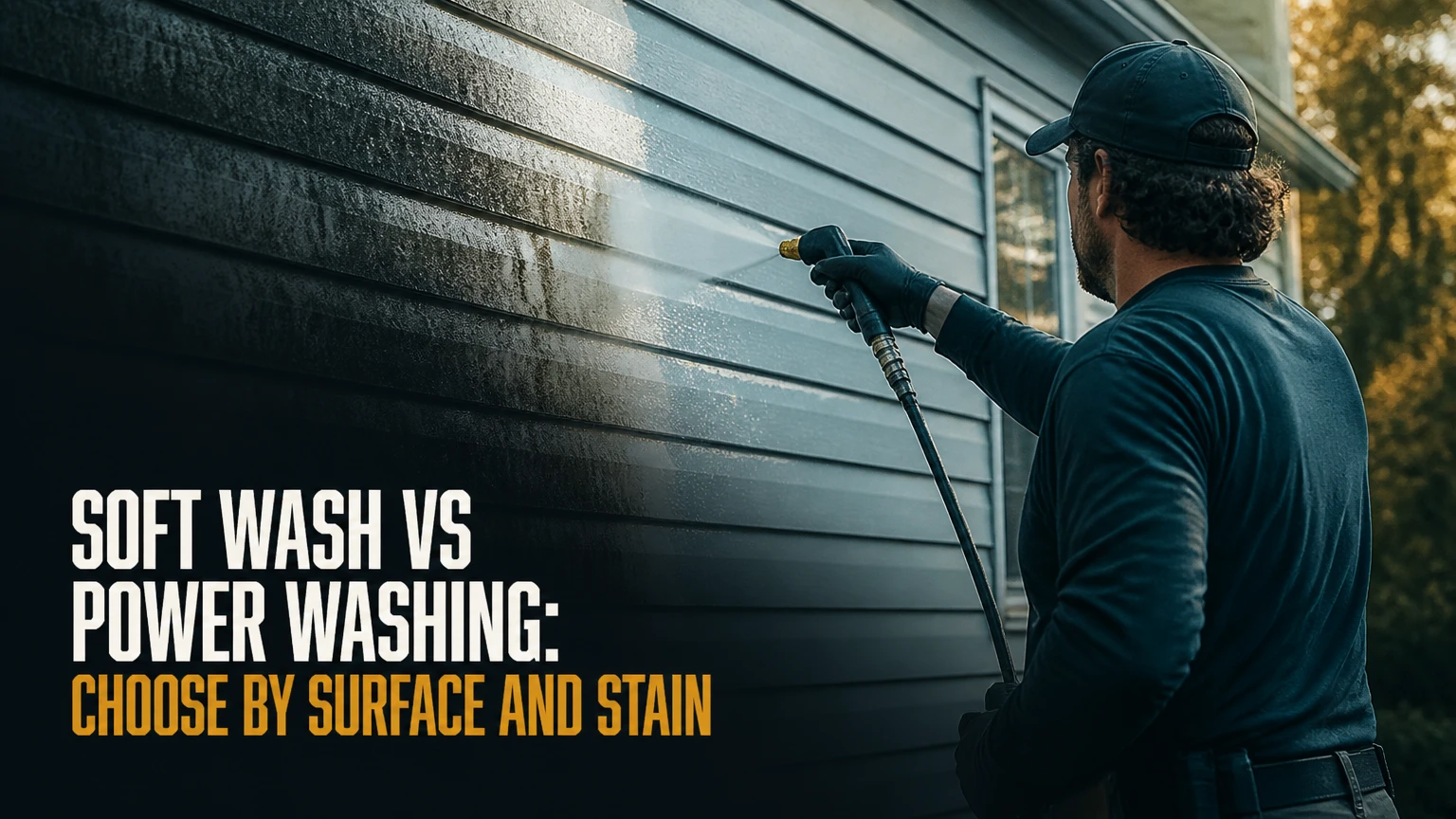
Soft wash vs power washing is primarily a choice between chemical treatment and mechanical force. Soft washing uses a cleaning solution at relatively low pressure to kill algae, mold, mildew, and similar organic growth, while power washing uses pressurized water, usually heated, to remove embedded soil, grease, and hard-surface residue. The correct method depends on the substrate, contaminant, surface condition, and required finish.
Key Facts at a Glance
- Soft washing is generally the safer first choice for asphalt shingles, vinyl siding, painted surfaces, stucco, and delicate coatings.
- Power washing is better suited to sound concrete, asphalt, heavy equipment, masonry, and petroleum-based contamination.
- Power washing does not inherently mean hot water in everyday contractor usage, although technically power washing commonly refers to heated pressure washing.
- PSI alone does not determine cleaning power. Water volume, temperature, nozzle angle, distance, chemical action, and operator technique also matter.
- Sodium hypochlorite can kill organic growth, but overspray, runoff, concentration, and drying can damage plants, metals, finishes, and people.
- A professional may combine both methods, such as chemically treating a driveway before hot-water surface cleaning.
What Is the Difference Between Soft Washing and Power Washing?
The central difference is the source of cleaning energy. Soft washing relies mainly on a chemical solution and controlled dwell time, whereas power washing relies mainly on water impact, flow, and often heat.
The terms are not perfectly standardized across the cleaning industry. A contractor may call any high-pressure service “power washing,” even when the machine uses cold water. In technical equipment language, pressure washing describes pressurized water, and power washing usually describes pressurized heated water. Ask the provider for pressure, flow, temperature, chemical process, and surface-specific safeguards rather than relying on the label alone.
| Attribute | Soft washing | Power washing |
|---|---|---|
| Main cleaning mechanism | Chemical oxidation and surfactant action | Water impact, flow, and heat |
| Typical pressure at surface | 60-500 PSI | 1,500-4,000 PSI |
| Typical flow rate | 2-5 gallons per minute | 3-8 gallons per minute |
| Water temperature | Ambient to warm | Approximately 120-200°F when heated |
| Best contaminant match | Algae, mold, mildew, lichen, moss | Grease, oil, gum, soil, tire marks |
| Typical surface risk | Chemical or runoff damage | Erosion, gouging, paint loss, water intrusion |
These ranges are typical operating figures, not universal specifications. A roof-cleaning system can operate at far below 100 PSI, and a contractor can clean concrete with lower pressure when a surface cleaner, detergent, or hot water supplies the missing cleaning action.
How Does Soft Washing Work?
Soft washing applies a cleaning agent, usually a diluted sodium hypochlorite solution with water and a surfactant, at low pressure. The solution wets the growth, remains on the surface for a controlled dwell period, breaks down organic contamination, and is then rinsed away with low-impact water.
Soft washing removes the living or decomposing component of algae, mildew, mold, and lichen instead of merely abrading the visible layer. Surfactant improves cling and coverage, particularly on vertical siding, but it does not replace correct chemical concentration or adequate dwell time.
A professional usually protects windows, plants, outdoor furniture, electrical components, and nearby vehicles before application. The operator keeps the surface wet, adjusts the solution to the material and growth severity, and rinses before the solution dries. The U.S. Environmental Protection Agency advises, “Never mix bleach with ammonia or other cleaners,” because incompatible mixtures can release hazardous gases.
What Chemicals Are Used in Soft Washing?
Sodium hypochlorite is the common active ingredient for organic growth, but the final concentration reaching the surface varies by equipment, product strength, dilution, and contamination. Typical house-washing solutions may reach about 0.5%-2% available chlorine at the surface, while heavily affected roofs may require a stronger professionally controlled mixture.
Soft washing is not a single universal recipe. A trained operator may use a neutral detergent, a manufacturer-approved roof treatment, an alkaline cleaner, or a specialty product when bleach could damage a coating or metal component. Never combine sodium hypochlorite with acids, ammonia, or unapproved detergents.
How Does Power Washing Work?
Power washing uses a pump to deliver pressurized water through a restricted nozzle, and a burner may heat the water to improve removal of grease, oil, gum, and industrial soil. Pressure supplies impact, flow carries loosened debris away, and heat reduces the viscosity of many petroleum-based contaminants.
A 15-degree nozzle concentrates force more aggressively than a 25-degree nozzle, while a 0-degree nozzle produces a narrow, high-risk jet that can scar concrete, cut wood, or damage skin. Surface cleaners distribute spray through rotating arms and reduce striping on large flat areas.
Hot water is valuable for commercial concrete, restaurant pads, dumpster areas, automotive fluids, and machinery. Cold-water pressure cleaning can still remove ordinary dirt and is often sufficient for residential driveways, fences, and some masonry.
Why Is PSI Not Enough to Compare Machines?
PSI measures pressure, but cleaning performance also depends on gallons per minute, nozzle orifice, temperature, detergent, distance, and time. A 4,000-PSI machine with low flow may clean less efficiently than a 3,000-PSI machine delivering substantially more water.
A useful practical concept is cleaning-unit output, calculated as PSI multiplied by GPM. A 3,000-PSI, 4-GPM machine produces 12,000 cleaning units, while a 2,000-PSI, 8-GPM machine produces 16,000. The calculation is not a complete performance test, but it explains why flow and recovery speed matter.
Which Method Fits Each Surface?
Soft washing fits surfaces that can be damaged by concentrated water impact, while power washing fits sound, hard substrates that can tolerate controlled mechanical cleaning. Contaminant type remains equally important: organic growth responds to chemistry, while oil and gum usually require agitation, detergent, heat, or all three.
| Surface or material | Preferred method | Typical operating approach | Main warning |
|---|---|---|---|
| Asphalt shingles | Soft washing | Low-pressure roof solution, controlled dwell, gentle rinse | Do not dislodge granules with high pressure |
| Vinyl siding | Soft washing | Detergent application, low-pressure rinse | Avoid forcing water behind laps and vents |
| Painted wood siding | Soft washing or low-pressure cleaning | Test a hidden area, use mild solution | Oxidized paint can streak or chalk |
| Sound concrete driveway | Power washing | 2,000-3,500 PSI, surface cleaner, optional detergent | Cracks and weak concrete can spall |
| Oil-stained concrete | Hot power washing | Degreaser, hot water, recovery or runoff controls | One pass rarely removes deep oil |
| Brick masonry | Low-pressure cleaning | Detergent and controlled rinse | High pressure can erode mortar |
| Stucco or EIFS | Soft washing | Low-pressure application and rinse | Water can enter cracks and wall assemblies |
| Wood deck | Low-pressure cleaning | Approximately 500-1,200 PSI, wide fan, grain-aligned passes | High pressure raises wood fibers |
| Metal roof | Low-pressure cleaning | Compatible cleaner and thorough rinse | Avoid chemical contact with sensitive finishes |
| Graffiti | Power washing or specialty removal | Tested solvent, hot water, containment | Abrasive force may enlarge the damaged area |
Roof material requires special attention. Asphalt shingles, cedar shakes, clay tiles, concrete tiles, and metal panels have different coatings, drainage behavior, and manufacturer restrictions. A roof contractor should follow the roofing manufacturer’s cleaning guidance and avoid claiming that one chemical or pressure setting fits every roof.
Is Soft Washing Better for Roofs?
Soft washing is usually better for asphalt shingle roofs because high-pressure water can remove protective granules, open laps, and shorten shingle life. Low-pressure chemical treatment targets the algae and lichen that create black streaks, but a roof with cracked, brittle, or missing shingles still requires repair assessment before cleaning.
Soft washing does not repair roof damage. It also cannot reverse granule loss, replace failed flashing, or correct trapped moisture. A competent inspection records existing defects before treatment so cleaning damage is not confused with pre-existing deterioration.
Should You Power Wash a Deck?
You can clean a structurally sound deck with low-pressure washing, but ordinary high-pressure power washing is a poor choice for most wood decking. A broad fan, adequate distance, and pressure commonly kept near 500-1,200 PSI for softer wood reduce raised grain and gouging.
Hardwoods may tolerate somewhat higher settings, but the operator should test a hidden section first. Soft washing can remove organic growth from wood with less mechanical damage, although the solution must be compatible with the stain, paint, fasteners, and surrounding landscaping.
Which Method Removes Different Stains?
Organic growth calls for a biocidal or oxidizing treatment, while petroleum, mineral, and mechanical stains usually need a detergent, solvent, heat, agitation, or surface abrasion. Choosing by stain chemistry prevents the common mistake of using pressure to solve a problem that pressure cannot chemically dissolve.
| Stain or contaminant | Effective first treatment | Likely equipment | Expected result |
|---|---|---|---|
| Green algae on siding | Diluted sodium hypochlorite | Soft-wash pump and rinse | Growth killed and color removed |
| Black roof streaks | Roof-safe organic-growth treatment | Low-pressure application system | Streaks fade after treatment |
| Fresh motor oil | Concrete degreaser | Hot-water pressure washer | Surface oil lifts; deep shadow may remain |
| Tire marks | Detergent and hot-water cleaning | Surface cleaner or rotary tool | Rubber residue breaks down |
| Rust | Acid-compatible specialty cleaner | Low-pressure sprayer and rinse | Rust lightens; etching may remain |
| Efflorescence | Masonry-safe acidic treatment | Low-pressure application | Mineral salts dissolve if masonry is sound |
| Chewing gum | Heat and focused mechanical removal | Hot-water machine and scraper | Gum softens and releases |
| Embedded dirt | Detergent plus surface cleaning | Pressure washer and rotary surface cleaner | Uniform soil removal |
A chemical treatment should not be selected solely because a surface looks dirty. Test for oxidation, fragile coatings, old repairs, and color transfer before applying a strong solution.
What Is the Correct Cleaning Process?
The correct process begins with an inspection, followed by protection, testing, cleaning, and a final review. A typical residential exterior project takes 2-5 hours, but roof complexity, water access, staining, plant density, and runoff controls can extend the work.
Soft-Washing Process
- Inspect the material and growth. Identify roof type, paint oxidation, cracked stucco, open joints, electrical fixtures, and drainage paths.
- Protect vegetation and property. Saturate plants with clean water, cover sensitive items, close windows, and move furniture and vehicles.
- Test the solution. Apply a small amount in an inconspicuous area and check color, coating stability, and dwell response.
- Apply from a controlled position. Use a broad spray and avoid forcing solution behind siding, soffits, flashing, and vents.
- Maintain dwell time. Allow approximately 5-20 minutes when conditions permit, keeping the surface wet and adjusting for sunlight, wind, and temperature.
- Rinse thoroughly. Rinse from the top downward with enough water to remove dead growth and residue without driving water into openings.
- Rinse plants and inspect. Flush landscaping again, check windows and metal, and identify areas needing a second controlled application.
You will know the treatment worked when organic discoloration loses its green or black appearance and the surface rinses clean without streaks. A common mistake is allowing the solution to dry, which increases spotting, plant stress, and finish damage.
Power-Washing Process
- Inspect the substrate. Locate cracks, spalling, loose mortar, failing paint, soft wood, and previous repairs.
- Remove loose debris. Sweep dirt and collect objects that could become projectiles.
- Apply detergent when appropriate. Pre-treat oil, grease, tire marks, or heavy soil rather than increasing pressure immediately.
- Select a suitable nozzle. Start with a wider fan, maintain distance, and reserve narrow tips for controlled spot work.
- Clean in uniform passes. Keep the wand moving, overlap each pass, and use a surface cleaner on broad concrete.
- Control water and runoff. Prevent contaminated water from entering storm drains where local rules prohibit discharge.
- Rinse and review. Remove detergent, check for striping, and allow the surface to dry before judging oil or efflorescence removal.
You will know the process worked when the cleaned area has consistent color without wand marks, exposed aggregate, raised fibers, or damaged joints. A common mistake is moving too quickly with a surface cleaner, which leaves circular or striped patterns.
Which Method Is Safer?
Soft washing generally creates less pressure-related damage, but it is not risk-free. Power washing creates greater mechanical and water-intrusion risk, while soft washing creates chemical, runoff, vegetation, respiratory, and finish-compatibility risks.
| Risk category | Soft washing | Power washing | Control measure |
|---|---|---|---|
| Plant damage | High when overspray dries | Moderate from physical debris | Pre-wet, shield, and post-rinse vegetation |
| Surface gouging | Low | High with narrow or close spray | Use broad fan and test pressure |
| Paint or coating damage | Moderate from chemistry | High from impact or oxidation removal | Test hidden area before full cleaning |
| Water intrusion | Moderate at openings | High near vents and joints | Spray away from openings |
| Worker injury | Chemical exposure | Injection, slip, electrical, noise | PPE, ground control, equipment inspection |
| Stormwater contamination | Moderate | Moderate to high with oil or detergent | Block, collect, or redirect runoff |
Power-washing injuries can include lacerations, injection wounds, falls, electrical shock, and eye injuries. Soft-wash risks include chemical burns, inhalation exposure, hypochlorite damage, and incompatible chemical reactions. PPE, labels, ventilation, and local disposal requirements apply to both methods.
An important practitioner rule is to protect the building before protecting the appearance. Water forced behind siding or into soffit vents can create concealed moisture problems even when the visible surface looks clean.
How Much Do Soft Washing and Power Washing Cost?
Typical residential exterior cleaning costs about $300-$800 per project, although local labor rates, access, height, surface area, stain severity, and minimum service charges can move the total substantially. Soft-washed roof cleaning often falls near $0.30-$0.60 per square foot, while driveway power washing commonly falls near $0.20-$0.40 per square foot.
| Project | Typical price range | Typical duration | Main price drivers |
|---|---|---|---|
| Small driveway | $100-$250 | 1-2 hours | Oil, edges, minimum charge |
| Two-car driveway | $150-$350 | 1.5-3 hours | Square footage and staining |
| House siding wash | $250-$700 | 2-4 hours | Height, oxidation, access |
| Asphalt shingle roof | $300-$900 | 2-5 hours | Roof pitch, growth, plant protection |
| Deck cleaning | $150-$500 | 2-4 hours | Wood condition and size |
| Commercial concrete | $150-$300 per hour | 3-8 hours | Hot water, recovery, traffic control |
DIY equipment can cost approximately $150-$500 for a consumer pressure washer, $30-$100 for detergents and accessories, and more for pumps, hoses, PPE, plant protection, and specialty chemicals. Hiring a professional is often more economical for roofs, high elevations, chemical handling, contaminated runoff, or surfaces with expensive failure consequences.
A low quote may omit pre-treatment, plant protection, runoff control, insurance, or post-rinse work. Request a written scope that identifies the method, pressure or chemical approach, areas excluded, surface risks, and cleanup responsibilities.
What Commonly Goes Wrong?
Most cleaning failures result from mismatched force, chemistry, surface condition, or weather. The visible symptom often points to the process failure.
- Streaky siding: The solution dried, coverage was uneven, or oxidation reacted with the cleaner. Re-wet, test a milder treatment, and rinse smaller sections before they dry.
- Striped concrete: A wand or surface cleaner moved too quickly or at inconsistent height. Re-clean with overlapping, uniform passes after testing a small area.
- Returning algae: Pressure removed visible growth without killing the biological material. Use a compatible soft-wash treatment and improve drainage or shade conditions where possible.
- White masonry haze: Efflorescence or detergent residue remains after rinsing. Identify the deposit before choosing an acid, because acid can damage mortar and some stone.
- Dead plants: Overspray or runoff reached leaves, roots, or soil at excessive concentration. Flush plants immediately and use physical shielding during future work.
- Peeling paint: Pressure removed weak coating, or chemical exposure loosened an already failing finish. Cleaning cannot substitute for paint preparation and adhesion testing.
- Wood fuzzing: The nozzle was too close, too narrow, or too powerful. Sand raised fibers after drying and reduce pressure and distance on subsequent cleaning.
A counterintuitive truth is that a cleaner-looking surface can reveal more defects. Removing algae may expose cracked caulk, failed paint, missing granules, or deteriorated mortar that was already present.
Which Should You Choose?
Choose soft washing for organic growth and vulnerable exterior materials, and choose power washing for sound hard surfaces with embedded soil, grease, gum, or tire residue. When both contamination types appear, professionals often pre-treat chemically and then use controlled pressure or hot water.
For a Homeowner Cleaning Roofs and Siding
Use soft washing, preferably through a qualified contractor for roofs and multi-story elevations. Do not climb a wet roof, spray beneath siding laps, or improvise a chemical mixture from household products.
For a Homeowner Cleaning a Driveway
Use a pressure washer with a surface cleaner and a broad fan, beginning below 3,000 PSI if the concrete is residential and sound. Pre-treat oil rather than expecting pressure alone to erase a stain that has penetrated the slab.
For a Property Manager
Schedule soft washing for recurring algae on siding, stucco, and roofs, then use power or hot-water cleaning for loading zones, dumpster pads, parking decks, and concrete walkways. Coordinate work with tenant access, stormwater rules, and manufacturer warranties.
For a Commercial Cleaning Contractor
A dual setup provides the most flexibility: a hot-water machine around 5.5-8 GPM for grease and hard surfaces, plus a dedicated chemical application system for roofs and building envelopes. Chemical storage, PPE, runoff recovery, insurance, and employee training matter as much as machine specifications.
FAQ
Is soft washing the same as pressure washing?
No. Soft washing is a low-pressure chemical cleaning process, while pressure washing uses pressurized water as the primary cleaning force. A contractor may use a pressure washer to apply soft-wash chemicals, so the equipment name does not always identify the actual method. Ask how the surface will be treated and rinsed.
Does soft washing last longer than power washing?
Soft washing often keeps algae and mildew from returning sooner because the treatment addresses organic growth rather than removing only its visible surface. Duration still depends on shade, humidity, nearby trees, drainage, and the material. No cleaning method permanently prevents biological regrowth.
Can soft washing remove oil from concrete?
Soft washing alone is generally ineffective against deeply embedded oil because sodium hypochlorite targets organic growth, not petroleum residue. Oil removal usually requires a concrete degreaser, agitation, hot water, absorbent treatment, or multiple applications. A dark shadow may remain after the surface oil has been removed.
How often should a house be soft washed?
Many homes need soft washing every 1-3 years, but the interval varies with climate, shade, tree cover, humidity, and roof orientation. North-facing or heavily shaded elevations may show growth sooner than sunny walls. Inspect annually rather than scheduling automatically when the surface remains clean.
Can power washing damage concrete?
Yes. Excessive pressure, a narrow nozzle, close distance, or cleaning weak concrete can cause surface etching, exposed aggregate, spalling, and visible striping. Concrete that is cracked or already deteriorating should be tested first. A surface cleaner and moderate pressure usually produce a more uniform result than a close-held wand.
Should a surface be sealed after cleaning?
Sealing may help compatible concrete, masonry, wood, or pavers, but the surface must be clean, dry, structurally sound, and suitable for the selected sealer. Sealers do not repair cracks or eliminate oil contamination. Follow the sealer manufacturer’s moisture, temperature, and cure-time requirements.
The Bottom Line
Soft wash vs power washing is not a contest with one universal winner. Soft washing is the better choice for roofs, siding, stucco, and organic growth because chemical action reduces pressure-related damage. Power washing is the better choice for sound concrete, asphalt, machinery, grease, oil, gum, and heavy soil. Select the method by surface and contaminant, verify the contractor’s pressure and chemical controls, and treat plant protection and runoff management as part of the cleaning job rather than optional extras.