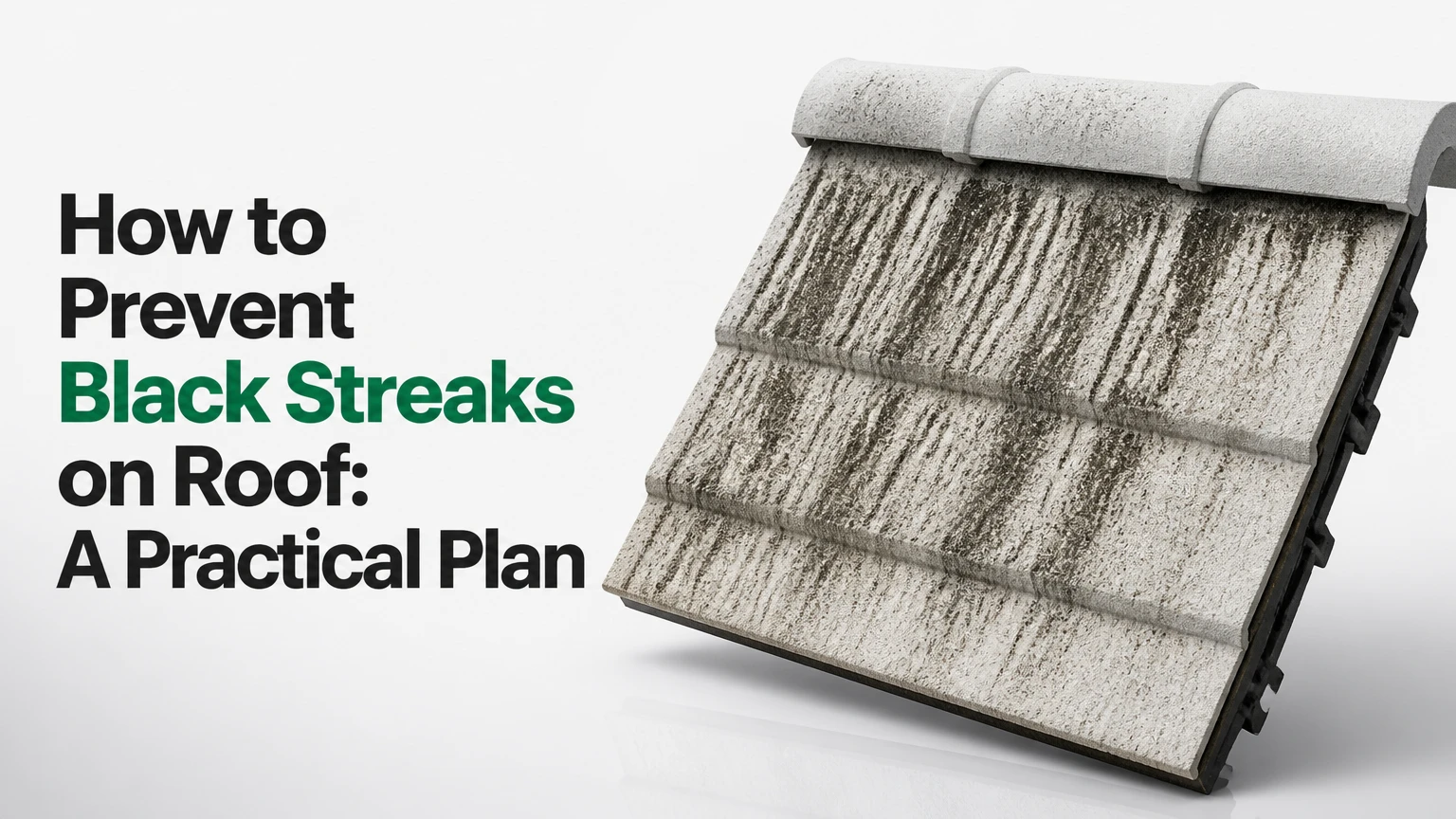
To prevent black streaks on a roof, control the cyanobacteria commonly associated with Gloeocapsa magma, reduce shade and moisture, and choose algae-resistant shingles or a compatible zinc or copper retrofit. Clean existing growth with a labeled low-pressure treatment first, then maintain gutters, trim branches, and inspect the roof annually.
Key Facts at a Glance
- Black streaks on asphalt shingles are commonly associated with the cyanobacterium Gloeocapsa magma, although appearance alone cannot confirm the organism.
- Algae-resistant shingles use copper-containing granules to suppress new growth across the shingle surface.
- Zinc or copper strips work only when rainwater reaches exposed metal and flows over the protected roof plane.
- Pressure washing can dislodge ceramic granules and shorten shingle service life.
- Tree shade, wet debris, poor airflow, and north-facing roof slopes increase the chance of recurring streaks.
- Existing algae must be removed or neutralized before a prevention measure can work reliably.
What Causes Black Roof Streaks?
Black roof streaks on asphalt shingles are usually colonies of blue-green algae, technically cyanobacteria, that spread down the roof in water-flow paths. Gloeocapsa magma is the organism most often associated with these stains in roofing discussions, but a laboratory diagnosis is rarely performed on residential roofs.
The organism can use mineral filler, including limestone, present in many asphalt shingles. As the colony grows, dark pigments help shield it from ultraviolet radiation. Rain then creates vertical tracks, which explains why streaks often appear below laps, valleys, penetrations, or other places where water follows a consistent route.
Black staining is different from every dark roof discoloration. Moss forms raised green or brown cushions, lichen creates crusty gray-green patches, and rust usually begins around exposed fasteners, flashing, or metal components. Dirt often washes away unevenly after rainfall. A roof inspection should identify the stain before anyone applies a chemical treatment.
Are Black Streaks Algae, Mold, or Moss?
Black streaks are more likely to be algae than mold or moss when they appear as flat, vertical discoloration on otherwise intact asphalt shingles. Mold and mildew can occur on roofing materials, but the classic long black tracks on asphalt shingles are commonly attributed to cyanobacterial growth.
The distinction affects treatment. Moss has a physical root-like attachment and may lift shingle edges, while algae generally stains the surface without creating thick vegetation. Lichen combines fungal and photosynthetic organisms and can adhere strongly to granules. Rust requires correction of a metal or fastener problem rather than repeated biological treatment.
Do not scrape or brush aggressively to confirm the diagnosis. A nylon brush can remove granules, and walking on brittle shingles can create damage that was not present before cleaning.
How Does Algae Damage Asphalt Shingles?
Algae damage asphalt shingles gradually by colonizing the granule surface, retaining dampness, and contributing to surface aging. The main immediate problem is cosmetic staining, but persistent moisture and granule loss can reduce the roof’s resistance to ultraviolet exposure and weather.
The dark pigment itself does not automatically mean the roof is failing. A 5-year-old roof with light streaking may have substantial remaining service life, while a 20-year-old roof with the same appearance may already have brittle edges, exposed mat, or widespread granule loss. Roof age, ventilation, shingle condition, slope, and drainage matter more than stain color alone.
The often-repeated claim that algae always removes 3-10 years from a roof’s life is not a universal engineering measurement. Actual loss varies by climate, shingle quality, moisture exposure, and maintenance. Treat the claim as a possible risk range, not a guaranteed deduction from the manufacturer’s rated life.
Which Roof Conditions Encourage Recurring Streaks?
Shade and repeated dampness encourage recurring algae growth because roof surfaces dry slowly under overhanging trees, on north-facing slopes, and in humid climates. Leaf litter, pine needles, clogged gutters, and poor attic ventilation add moisture or restrict drying.
Roof pitch also changes the result. A low-slope roof can hold water and debris longer, while a steep roof usually sheds rain faster but may be more hazardous to access. Long roof planes can exceed the effective downslope reach of a metal-strip treatment, particularly when the strip is narrow or heavily oxidized.
| Condition | Typical effect | Practical response |
|---|---|---|
| North-facing slope | 4-8 hours less direct sun than a south-facing slope in many layouts | Prioritize shade reduction and inspection |
| Overhanging branches | Leaves, sap, and slower drying | Trim branches away from the roof plane |
| Clogged gutters | Water backs up at eaves and roof edges | Clean gutters at least twice yearly |
| Low roof slope | Longer surface wetness after rain | Inspect laps, valleys, and drainage paths |
| Roof plane over 15 feet | Reduced metal-ion concentration downslope | Do not rely on one short strip alone |
| Humid coastal or subtropical climate | Faster biological recolonization | Schedule more frequent inspections |
How to Prevent Black Streaks on Roof
The most reliable prevention plan combines surface cleaning, moisture reduction, and a roof-specific protective measure. Existing streaks should be treated first, environmental conditions should be corrected second, and the final product choice should match roof age, shingle warranty, slope length, and nearby metals.
Before You Start
| Requirement | Typical specification |
|---|---|
| Inspection time | 30-60 minutes from ground level |
| Treatment time | 2-4 hours, excluding drying |
| Difficulty | Moderate for ground work, high for roof access |
| DIY material cost | $30-$150 for basic treatment and maintenance |
| Professional cleaning | Typically $300-$800, depending on roof size and access |
| Basic equipment | Garden sprayer, hose, eye protection, gloves, ladder stabilizer |
| Prerequisite | Confirm shingle condition and read the manufacturer’s cleaning instructions |
Avoid roof access when shingles are wet, steep, brittle, visibly damaged, or contaminated with moss. A professional roofer or roof-cleaning contractor is the safer choice when fall protection, chemical handling, or ladder placement is uncertain.
Step 1: Confirm the Stain and Inspect the Roof
Inspect the roof from the ground with binoculars, then check the attic for daylight, wet insulation, or roof-deck staining. Look for missing granules, curled tabs, exposed underlayment, lifted flashing, damaged pipe boots, and blocked valleys.
You will know the inspection is useful when the treatment decision accounts for both biological growth and roof condition. A common mistake is cleaning a roof that actually needs flashing repair or replacement.
If granules collect heavily in downspouts, the shingles may be deteriorating independently of the algae. Cleaning will not restore lost granules.
Step 2: Remove Debris and Reduce Shade
Clear leaves and pine needles from valleys, gutters, and roof-to-wall intersections using ground-based tools where possible. Prune branches so they do not rub against the shingles or form a persistent canopy over the roof.
A practical target is at least 3-6 feet of clearance from the roof plane, subject to local tree-care requirements and property constraints. More clearance improves airflow and sunlight, but tree removal is not always necessary.
You will know this step worked when the roof remains free of damp organic piles after rain. A common mistake is pruning branches while leaving clogged gutters, which preserves the moisture problem at the eaves.
Step 3: Treat Existing Algae With a Low-Pressure Method
Apply a roof-safe algae treatment according to its product label and the shingle manufacturer’s instructions. Common professional treatments use diluted sodium hypochlorite with a surfactant, while non-bleach products may use other labeled biocides or slow-acting chemistry.
Do not assume a 50:50 bleach-and-water mixture is appropriate for every roof. Concentration, contact time, roof age, plant sensitivity, local discharge rules, and product formulation change the safe procedure. Professionals commonly protect vegetation by wetting plants before treatment, controlling runoff, and rinsing exposed landscaping afterward.
Use a pump sprayer or low-pressure application system. Allow the labeled dwell time, often 10-20 minutes, then rinse gently with a garden hose when the instructions require rinsing.
You will know treatment worked when the dark colony lightens or releases without granule loss. A common mistake is scrubbing until the stain disappears, which can remove the protective surface faster than the algae did.
Step 4: Install a Compatible Zinc or Copper Strip
Install an exposed metal strip near the ridge so rainfall can dissolve small amounts of zinc or copper and carry ions down the slope. The strip must sit in the water path, remain exposed to rain, and be secured without creating leaks.
Typical retrofit strips are 2-3 inches wide, with about 1 inch or more exposed after installation. The upper edge is placed under the ridge-cap material, and fasteners must be sealed with compatible roofing products. Follow the strip manufacturer’s dimensions and the roofing manufacturer’s warranty requirements.
Copper generally provides stronger and longer-lasting algae suppression than zinc, but copper runoff can stain some light-colored materials and may corrode or damage incompatible downstream metals. Zinc usually costs less and is often easier to match with aluminum drainage systems, although compatibility still requires confirmation.
You will know installation is functional when rain contacts the exposed strip and flows continuously over the shingle field. A common mistake is hiding the entire strip beneath ridge caps, leaving no metal available for rain activation.
Step 5: Maintain Dry, Unobstructed Roof Drainage
Inspect the roof, gutters, and nearby trees at least twice each year, with an additional inspection after major storms. Remove debris before it forms wet pockets, check for displaced ridge materials, and verify that downspouts discharge away from the foundation.
Prevention is a maintenance system rather than a one-time chemical application. A treatment may suppress algae for 1-3 years, but heavy shade, humid weather, and dirty roof planes can shorten that interval.
You will know the system is working when new streaks do not appear below recurring water paths and the roof dries promptly after rainfall. A common mistake is waiting until the entire roof is black before repeating maintenance.
Which Prevention Method Fits Your Roof?
Algae-resistant replacement shingles provide the longest built-in protection, while a compatible metal strip is usually the most practical retrofit for a sound existing roof. Soft washing removes established growth but requires repetition, and environmental controls reduce the cause without independently guaranteeing a streak-free roof.
| Method | Typical upfront cost | Typical effective interval | Best use |
|---|---|---|---|
| Algae-resistant shingles | $5,000-$15,000 installed for many homes | 10-30 years, warranty dependent | Roof replacement |
| Zinc strip retrofit | $150-$500 installed | 5-10 years | Budget retrofit on compatible systems |
| Copper strip retrofit | $300-$900 installed | 10-20 years | Longer slopes and stronger suppression |
| Professional soft wash | $300-$800 per treatment | 1-3 years | Existing stains on serviceable shingles |
| Tree and debris maintenance | $0-$700 annually | Ongoing with repeat care | Shaded or tree-covered properties |
Costs are typical U.S. residential ranges, not quotes. Roof size, pitch, access, regional labor rates, material compatibility, and permit requirements can change the total substantially.
Are Algae-Resistant Shingles Worth It?
Algae-resistant shingles are worth considering when the roof is already near replacement age or when recurring cleaning costs approach the price premium for upgraded shingles. These products place copper-containing granules in the shingle surface, where moisture releases ions that suppress algae near the granules.
The protection is not identical across brands or product lines. Ask for the exact product name, algae-resistance warranty term, transferability, exclusions, and required maintenance. A “limited lifetime” shingle warranty does not mean algae stains are covered for the full physical life of the roof.
The limitation is timing. Replacing a structurally sound 8-year-old roof solely because of streaks is rarely economical. Cleaning, shade reduction, and a compatible strip usually make more sense until the roof approaches replacement.
Is Copper Better Than Zinc for Roof Algae?
Copper is generally the stronger long-term metal-strip option, while zinc is usually the lower-cost retrofit. Neither metal is a universal solution because ion concentration declines downslope, oxidation can reduce exposed surface, and roof geometry can interrupt rainwater coverage.
| Decision factor | Zinc | Copper |
|---|---|---|
| Typical material price | $10-$20 per 10-foot strip | $25-$50 per 10-foot strip |
| Typical service interval | 5-10 years | 10-20 years |
| Relative ion activity | Moderate | Higher |
| Appearance | Silver-gray | Bright copper, then darkens or greens |
| Main concern | Shorter life and deformation in thin stock | Runoff staining and galvanic incompatibility |
| Best application | Affordable retrofit on compatible drainage | Long-term retrofit with verified compatibility |
Never place copper upstream of aluminum gutters, coated steel, or other vulnerable metals without professional compatibility review. Dissimilar-metal contact or contaminated runoff can accelerate corrosion.
Do Metal Strips Protect the Entire Roof?
Metal strips protect only the roof areas that receive sufficient ion-bearing runoff. A ridge strip may work well on a short, unobstructed slope, but it can leave streaks below the middle or lower section of a long roof plane.
Roof valleys, dormers, ridge intersections, and changes in slope divide water paths. A strip installed on one ridge may not protect an adjacent plane if rainwater does not cross between them. Intermediate strips can improve coverage, but adding them requires careful flashing and warranty review.
A common practitioner rule is to assess every distinct water path rather than measure the roof as one rectangle. Roofs with slopes exceeding roughly 15 feet deserve special attention because the treatment effect can weaken before water reaches the eave.
What Are the Main Cleaning and Installation Mistakes?
The most damaging mistake is pressure washing asphalt shingles. The Asphalt Roofing Manufacturers Association advises homeowners not to use a pressure washer on asphalt shingles because high-pressure water can remove granules and damage the roof surface.
Other failures occur when homeowners install a metal strip without exposing it to rain, use incompatible fasteners, or apply an untested chemical concentration. Chemical runoff can injure plants, contaminate drainage, and damage painted surfaces.
| Mistake | Result | Correction |
|---|---|---|
| Pressure washing | Granule loss and possible water intrusion | Use a labeled low-pressure treatment |
| Scrubbing black stains | Abraded shingle surface | Let chemistry loosen growth |
| No vegetation protection | Burned leaves and damaged lawn | Wet, cover, control runoff, and rinse |
| Copper above aluminum | Galvanic corrosion risk | Verify metals before installation |
| Strip fully concealed | Little or no ion release | Leave manufacturer-specified exposure |
| One strip on a long or divided roof | Streaks below untreated areas | Map water paths and add approved coverage |
| Cleaning a failing roof | Hidden leaks or brittleness remain | Repair or replace before treatment |
Chemical cleaners also have limits. Bleach can discolor siding, damage plants, and corrode some metals when misapplied. Non-bleach products may be gentler but slower, less predictable, or unsuitable for heavy growth. Product labels and shingle manufacturers take priority over generic internet recipes.
Why Do Streaks Return Below a Metal Strip?
Streaks return below a metal strip when the strip is oxidized, too narrow, poorly exposed, incorrectly positioned, or unable to deliver ions across the entire water path. Reappearance can also indicate that the original colony was not adequately treated before installation.
Check whether rain actually contacts the exposed metal. Inspect for ridge-cap overlap, leaves, sealant, paint, or oxidation that blocks the active surface. Then compare the streak location with the roof’s drainage pattern.
Do not scrub copper or zinc aggressively with a steel brush. Remove loose debris with a nonmetallic brush only if the product manufacturer permits it, and replace the strip when its exposed area has significantly deteriorated. A secondary strip may help on long slopes, but it should be installed like roof flashing, not simply nailed across the shingle field.
What Should You Do in Different Situations?
A sound roof with new streaks usually needs cleaning plus environmental control, not replacement. An aging roof with widespread granule loss should be evaluated for replacement, because algae treatment cannot reverse structural deterioration.
For a Budget Retrofit
Use a professional or label-compliant low-pressure treatment, then install zinc if the roof’s drainage metals are compatible. Trim shade-producing branches and clean gutters twice each year. Typical total spending is $200-$900, depending on whether labor is hired.
For a Roof Near Replacement
Do not invest heavily in multiple chemical treatments or complex strip layouts. Specify algae-resistant shingles during replacement, request the written algae-resistance warranty, and confirm that the selected ventilation, flashing, and ridge materials are compatible.
For a Shaded, Humid Property
Prioritize airflow, branch clearance, debris removal, and shorter inspection intervals. A single ridge strip may underperform when the roof has multiple dormers, long slopes, or persistent shade. Professional cleaning may need to recur every 1-2 years.
For a Low-Chemical Approach
Use shade reduction, debris control, algae-resistant shingles at replacement, and a manufacturer-approved non-bleach treatment. “Eco-friendly” does not mean harmless: verify aquatic-toxicity warnings, plant precautions, runoff directions, and required protective equipment.
What Does a Practical Maintenance Schedule Look Like?
A practical roof-algae schedule includes a spring inspection, an autumn debris cleaning, and an inspection after severe weather. Properties with dense trees, heavy humidity, or recurring streaks may need quarterly visual checks.
| Timing | Task | Inspection target |
|---|---|---|
| Early spring | Clean gutters and valleys | Wet debris and winter damage |
| Late summer | Check shaded slopes | New algae tracks and moss |
| Autumn | Remove leaves and needles | Blocked drainage paths |
| After major storms | Ground-level roof review | Missing shingles and exposed flashing |
| Every 1-3 years | Reassess treatment need | Recolonization and chemical wear |
| At replacement | Choose AR shingles | Warranty and granule specification |
Photograph the roof from the same locations each season. Consistent images reveal whether streaks are spreading, fading, or returning in a new water path.
FAQ
Can black streaks shorten the life of a roof?
Black algae streaks can contribute to premature surface aging, particularly when moisture, shade, heat, and granule loss occur together. The exact service-life reduction cannot be predicted from staining alone. Inspect shingle flexibility, granule coverage, flashing, attic ventilation, and roof age before deciding whether cleaning or replacement is appropriate.
How often should a roof receive algae treatment?
Many residential roofs need treatment every 1-3 years, but the interval depends on humidity, shade, roof orientation, shingle condition, and treatment chemistry. A heavily shaded roof may recolonize sooner than a sunny roof. Reapply only when inspection shows new growth and the product label permits repeat use.
Can rain alone remove black roof streaks?
Rain rarely removes established algae because the colony adheres to the granule surface and produces protective pigmentation. Rain can spread the discoloration vertically and may wash loose debris away, but it does not reliably neutralize the organism. Low-pressure, manufacturer-compatible treatment is usually required for established streaks.
Should I replace a roof because of black streaks?
Black streaks alone do not justify replacing a serviceable roof. Replacement becomes more reasonable when staining accompanies widespread granule loss, brittle or curling shingles, active leaks, damaged flashing, or a roof near the end of its expected service interval. An inspection should separate cosmetic growth from structural failure.
Will gutter guards prevent roof algae?
Gutter guards can reduce leaf accumulation and overflow, but gutter guards do not prevent algae on the shingle surface. Roof algae grows primarily in response to moisture, shade, and surface conditions. Guards help only when clogged gutters are contributing to wet eaves or debris buildup, and they still require periodic inspection and cleaning.
Is roof algae dangerous to people?
Typical roof algae is mainly a roofing and appearance concern, not a direct household health hazard. Cleaning creates the greater safety risk because falls, chemical exposure, slippery shingles, and runoff can injure people or damage landscaping. Keep occupants and pets away from treatment areas and use a qualified contractor when roof access is hazardous.
The Bottom Line
To prevent black streaks on roof shingles, clean existing algae with a low-pressure, label-compliant treatment, reduce shade and debris, maintain drainage, and select a compatible zinc or copper strip when the roof is suitable for retrofit. Choose algae-resistant shingles at replacement rather than replacing a sound roof solely for cosmetic staining. Inspect every water path, protect plants and metals, and never pressure wash asphalt shingles.