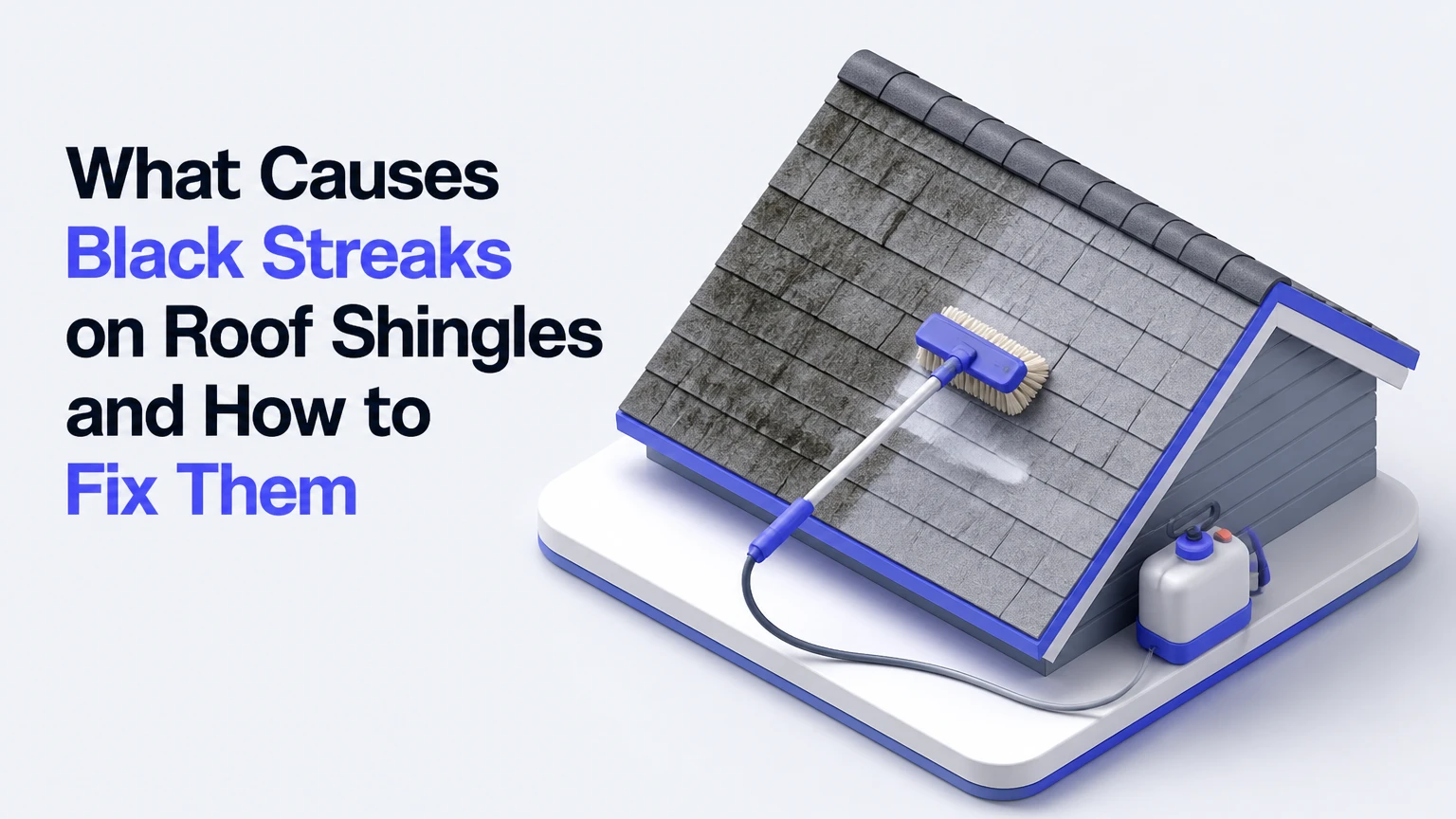
The primary cause of black streaks on asphalt roof shingles is usually Gloeocapsa magma, a windborne cyanobacterium commonly called blue-green algae. Moisture, shade, warm temperatures, and limestone-filled shingle granules help colonies establish, while dark biological pigments and rainwater create the familiar vertical marks.
Key Facts at a Glance
- Gloeocapsa magma is the usual cause of broad, vertical black or blue-black streaks on asphalt shingles.
- The organism is a cyanobacterium, although roofing contractors and homeowners commonly call it algae.
- North-facing, shaded, humid roof sections usually show growth before sunny, well-ventilated slopes.
- Black streaks are initially cosmetic, but persistent biological growth can retain moisture and contribute to granule loss.
- Pressure washing and stiff brushing can remove protective mineral granules from asphalt shingles.
- Typical professional roof cleaning costs range from $0.30 to $0.75 per square foot, with roof access and plant protection affecting the final price.
What Causes Black Streaks on Roof Shingles?
Gloeocapsa magma causes most black streaks on asphalt roof shingles. The cyanobacterium arrives on wind, settles on damp mineral granules, and produces dark pigments that become visible as rain carries residue down the roof slope.
The streaks are biological staining rather than ordinary dirt. Modern asphalt shingles contain ceramic-coated mineral granules, commonly including crushed limestone, embedded in an asphalt mat. Calcium carbonate from limestone can support microbial colonization, although describing limestone as the organism’s sole “food” source simplifies a more complex surface ecosystem involving moisture, dust, organic deposits, and airborne nutrients.
Roof age influences risk, but age alone does not cause streaking. A shaded eight-year-old roof can stain before a sunny fifteen-year-old roof, especially where tree cover slows drying. Conversely, algae may remain difficult to see for one or two seasons before colonies produce enough pigment to form obvious lines.
A dark roof can also make streaks appear less dramatic than they are. Light gray, tan, and weathered brown shingles usually reveal the contrast sooner.
Is the Black Material Algae, Cyanobacteria, or Mold?
The common roofing term is algae, but Gloeocapsa magma is classified as a cyanobacterium rather than a true eukaryotic alga. Mold, mildew, moss, and lichen are different organisms with different surface behaviors and treatment needs.
Cyanobacteria form a thin film or colony across the shingle surface. Moss creates raised, green cushions and traps water, while lichen forms crusty patches that attach tightly to mineral granules. Mold and mildew more often appear where organic debris, persistent dampness, or poor ventilation creates a suitable substrate.
The label matters because treatment differs. A chemical treatment that suppresses algae may not remove entrenched moss roots or lichen attachment, and mechanical scraping can damage shingles faster than the stain itself.
How Does Gloeocapsa magma Create Vertical Streaks?
Gloeocapsa magma creates vertical streaks through a sequence of settlement, colony growth, pigment production, and rainwater movement. The dark appearance comes from protective cellular pigments and accumulated residue, not from the organism’s original blue-green color alone.
The Biological Process
- Airborne cells settle. Wind carries microscopic cells and fragments onto roof surfaces, often concentrating them where dust and organic debris accumulate.
- Moisture enables growth. Dew, rain, humidity, and slow drying give colonies repeated periods of surface moisture.
- The colony anchors. Irregular mineral granules provide microscopic texture where biological films can persist.
- Pigments darken the colony. Cyanobacteria produce protective compounds that reduce damage from sunlight and ultraviolet exposure.
- Runoff elongates the mark. Rainwater moves downhill, carrying pigmented material and dead cellular residue into narrow vertical paths.
The ridge is not always the point of origin. Streaks can begin below valleys, roof penetrations, tree branches, or areas where wet leaves remain on shingles. A visible line therefore indicates water movement and colony distribution, not a defect at the ridge cap.
Which Roof Conditions Encourage Streaks?
| Roof condition | Typical effect | Visible pattern | Inspection clue |
|---|---|---|---|
| North-facing slope | Dries slowly | Broad gray-black bands | Shade remains after noon |
| Overhanging trees | Adds shade and debris | Irregular streak clusters | Leaves sit in valleys |
| High humidity | Extends wet periods | Repeated darkening after rain | Dew remains in the morning |
| Low roof pitch | Slows runoff | Longer, wider streaks | Gutters receive heavy granule sediment |
| Open sunny slope | Dries rapidly | Fewer colonies | Streaks limited to debris zones |
Sunlight does not prevent algae permanently. A sunny slope can still stain when the roof has poor ventilation, frequent dew, nearby vegetation, or contaminated runoff from an upper roof plane.
Can Black Streaks Damage Asphalt Shingles?
Black streaks are usually cosmetic at first, but long-term biological growth can worsen shingle aging under favorable conditions. The stain alone does not prove that a roof leaks, has rotten decking, or needs replacement.
Dark colonies can increase solar absorption, while surface films and trapped debris may slow drying. Those effects can add stress to already weathered shingles, but a universal claim that algae shortens roof life by exactly 20% is not established for every roof, climate, or shingle formulation.
A roofing inspection should focus on measurable damage:
- Missing, cracked, curled, or brittle shingles
- Exposed fiberglass mat or asphalt
- Excessive granules in gutters and downspouts
- Rusted or lifted flashing
- Soft decking or attic water stains
- Repeated leaks around penetrations
- Moss lifting shingle edges
The National Roofing Contractors Association treats roof cleaning as a maintenance activity that must preserve the roofing system, not merely improve appearance. Cleaning cannot restore lost granules, repair failed flashing, or reverse advanced thermal aging.
When Do Streaks Indicate a Larger Problem?
Streaks deserve closer inspection when they occur with moss, lichen, standing water, interior staining, or major granule loss. A single flat stain on otherwise intact shingles usually supports cleaning or monitoring; lifted edges and damp wood require roofing work.
A practical rule is to inspect the roof surface and attic together. If the roof is more than approximately 15-20 years old and already shows cracking or widespread granule loss, compare cleaning costs with remaining service life before paying for cosmetic treatment.
How Can You Tell Algae From Moss, Lichen, Soot, or Rust?
Broad, flat, downhill black bands usually indicate cyanobacterial staining, while raised growth, localized deposits, or orange discoloration point to different causes. Diagnosis should precede chemical application because the wrong treatment can damage shingles without solving the source.
| Appearance and location | Likely cause | Surface behavior | Recommended response |
|---|---|---|---|
| Flat black or gray vertical bands | Gloeocapsa magma | Film follows runoff | Low-pressure biological treatment |
| Green tufts or thick cushions | Moss | Lifts edges and retains water | Professional removal and moisture control |
| Crusty gray-green patches | Lichen | Bonds tightly to granules | Gentle biocide, no scraping |
| Black spots near vents or chimneys | Soot or exhaust | Localized, often greasy | Check exhaust termination and clean siding |
| Orange or red-brown marks | Rust or iron deposits | Often below metal flashing | Inspect metal source and drainage |
| Dark streaks beneath gutters | Dirty runoff | Follows gutter overflow | Clear gutters and check downspouts |
Could the Streaks Be Soot From a Chimney?
Soot is more likely when black residue appears around a chimney, furnace vent, plumbing vent, or exhaust termination rather than across an entire roof plane. Soot may feel powdery or greasy and often marks nearby siding, flashing, or the vent cap.
A furnace or appliance exhaust problem requires prompt attention because combustion gases can present a safety hazard. Do not treat localized residue as algae until the venting system has been checked.
Could the Streaks Be a Roof Defect?
A roof defect usually produces a localized wet area, exposed underlayment, displaced shingle, or recurring interior stain rather than evenly spaced biological bands. Water can still follow a defect and spread algae below it, so staining does not rule out flashing or drainage failure.
Inspect valleys, pipe boots, skylights, wall intersections, and gutters. A professional should investigate any roof section with soft decking, active leaks, or damaged flashing before cleaning.
What Is the Safest Way to Remove Black Streaks?
The safest common method for asphalt shingles is a manufacturer-compatible, low-pressure chemical treatment applied from secure access, followed by controlled rinsing or natural weathering. The treatment must protect plants, painted surfaces, metal, pets, and gutters from runoff.
Should You Pressure Wash Roof Shingles?
You should not pressure wash asphalt shingles. High-pressure water can dislodge ceramic-coated granules, open weak shingle edges, force water beneath laps, and accelerate UV damage after the roof appears clean.
The Asphalt Roofing Manufacturers Association, or ARMA, has repeatedly advised against power washing asphalt shingles because the force can damage the roofing surface. A low-pressure application is different from using a pressure washer at close range, even when the operator claims to use a reduced setting.
Step 1: Check the Roof and Product Instructions
Confirm the roof covering, approximate age, pitch, access conditions, and manufacturer cleaning instructions. Do not walk on brittle, steep, wet, or heavily granulated shingles without appropriate fall protection.
Select a product labeled for asphalt roofing or obtain a written recommendation from the shingle manufacturer. Household detergents are not interchangeable with roof-cleaning products, and mixing bleach with acids, ammonia, or other cleaners can release toxic gases.
Step 2: Protect the Property
Pre-wet plants, cover sensitive landscaping where practical, divert concentrated runoff, and keep children and pets away from the work area. Chemical exposure can burn foliage, discolor siding, corrode unfinished metals, and damage painted surfaces.
Close windows and protect rain barrels. Disconnect or redirect downspouts when runoff would flow directly into a pond, vegetable garden, or storm drain, subject to local rules.
Step 3: Apply at Low Pressure
Apply the approved solution evenly without scraping or forcing water beneath shingle courses. Follow the product label for concentration and dwell time, because bleach strength, temperature, stain severity, and roof material change the correct application.
A typical professional treatment takes 2-5 hours, including setup and plant protection. Some products require no rinse and rely on rain, while others require a gentle garden-hose rinse. The label controls.
Step 4: Rinse and Inspect
Rinse according to the product directions, moving runoff away from plants and painted surfaces. Do not expect every dark mark to disappear immediately; dead biological pigment can fade over several weeks after the colony is killed.
You will know the treatment worked when the surface loses its active green or blue-black film, new growth stops, and the streaks gradually lighten. Remaining discoloration does not necessarily mean the treatment failed.
| Cleaning approach | Typical pressure or action | Typical time | Main risk |
|---|---|---|---|
| Chemical soft wash | Low pressure, product-labeled | 2-5 hours | Plant or metal damage |
| Garden-hose rinse | Household hose pressure | 30-90 minutes | Runoff contamination |
| Pressure washing | Often 1,000-3,000 PSI | 1-3 hours | Granule loss and leaks |
| Wire brushing | Direct abrasive contact | 1-4 hours | Shingle-surface removal |
| Natural weathering after treatment | No added pressure | 2-12 weeks | Residual staining |
The pressure-washing and wire-brushing options are included as unsafe comparisons, not recommendations.
How Much Does Roof Streak Removal Cost?
Typical professional asphalt-shingle cleaning costs range from $0.30 to $0.75 per square foot, or roughly $450-$1,125 for a 1,500-square-foot roof before unusual access, heavy moss, regional labor, or extensive landscaping protection.
Contractors may calculate by roof area rather than the home’s floor area. A two-story house with 1,500 square feet of living space can have substantially more than 1,500 square feet of roof surface.
| Service or remedy | Typical material or installed cost | Typical duration | Best use |
|---|---|---|---|
| Professional soft wash | $0.30-$0.75 per sq. ft. | 2-5 hours | Existing algae staining |
| Zinc strip materials | $30-$60 per 50-foot roll | 1-3 hours | Small ridge prevention project |
| Professional metal-strip installation | $200-$400 | 2-5 hours | Safer ridge access |
| Asphalt roof replacement | $4.50-$8.00 per sq. ft. installed | 1-3 days | Old or damaged roof |
| Roof inspection | $150-$400 typical range | 45-90 minutes | Uncertain damage or leaks |
These are typical planning ranges, not guaranteed local prices. Roof pitch, height, insurance, chemical containment, travel, and regional wages can change the estimate.
Do Zinc or Copper Strips Prevent Black Streaks?
Zinc and copper strips can reduce new algae growth when installed near the ridge, because rainwater dissolves small quantities of metal ions and carries them down the shingle surface. Metal strips do not reliably remove established streaks or repair roof damage.
Copper generally has stronger algae-inhibiting activity, while zinc is often less expensive. Both require exposed metal below the ridge cap and enough rainfall to distribute ions across the roof. Dormer roofs, valleys, wide roof planes, and complex layouts may remain partly untreated.
Avoid installing metal in a way that compromises ridge-cap ventilation, fasteners, flashing, or the shingle manufacturer’s warranty. Copper runoff can stain light-colored siding, masonry, and some metals.
| Prevention option | Coverage limitation | Typical service life | Main drawback |
|---|---|---|---|
| Zinc strip | Rain path below ridge | 5-15 years | Weaker coverage on wide planes |
| Copper strip | Rain path below ridge | 5-15 years | Higher cost and runoff staining |
| Algae-resistant shingles | Granules across new roof | Shingle warranty term | Requires roof replacement |
| Tree trimming | Shaded roof sections | 2-5 years before regrowth | May need permits or arborist |
| Gutter maintenance | Debris and overflow zones | Seasonal | Does not kill existing colonies |
Are Algae-Resistant Shingles Worth the Cost?
Algae-resistant shingles are worthwhile when a roof already needs replacement, especially in humid regions with repeated staining. These shingles typically use copper-containing granules or another algae-inhibiting technology distributed through the shingle surface.
Replacing an otherwise sound roof solely to remove black streaks is rarely economical. Ask for the exact algae-resistance warranty, exclusions, required installation details, and whether the warranty covers appearance, product replacement, labor, or only prorated material.
What Prevents Black Streaks From Returning?
The most effective prevention combines faster drying, less organic debris, controlled runoff, and algae-resistant materials at the next replacement. No single measure guarantees a streak-free roof in a humid, shaded environment.
Use the following maintenance plan:
- Trim branches that touch or heavily shade the roof, while preserving safe tree structure.
- Remove leaf piles from valleys and behind chimneys with nonabrasive methods.
- Clean gutters and confirm that downspouts discharge away from the foundation.
- Keep attic ventilation and insulation within the roofing manufacturer’s requirements.
- Inspect shaded slopes each spring and after long wet periods.
- Install compatible zinc or copper strips when access and warranty conditions permit.
- Choose algae-resistant shingles during the next legitimate replacement.
A counterintuitive point is that gutter cleaning alone rarely prevents algae. Streaks form on the shingle surface, while gutters mainly control concentrated water and debris at the roof edge.
What Mistakes Make Roof Streaks Worse?
The most damaging cleaning mistakes are excessive pressure, abrasive contact, incompatible chemicals, and uncontrolled runoff. Each mistake can create repair costs that exceed the price of professional cleaning.
- Pressure washing: Removes mineral granules and can drive water beneath laps. Recovery requires inspection, not another cleaning pass.
- Wire brushing: Scrapes the weathering surface and leaves exposed areas vulnerable to ultraviolet degradation.
- Walking on fragile shingles: Breaks aged or cold shingles and can dislodge granules around foot traffic.
- Overconcentrated bleach: Burns plants, corrodes metal, and may discolor siding. Follow the product label.
- Ignoring runoff: Sends treatment chemicals into gardens, ponds, or storm drains.
- Cleaning before diagnosing: Treats soot, rust, or a leak as algae and leaves the actual source unresolved.
Professional roof cleaners should explain access, pressure, chemical concentration, dwell time, runoff control, insurance, and warranty compatibility before starting. A low price that excludes plant protection may not be the lower total cost.
When Should You Hire a Professional?
Hire a professional when the roof is steep, two or more stories high, wet, fragile, heavily moss-covered, or difficult to access safely. Professional help is also appropriate when chemical handling, runoff control, or diagnosis is uncertain.
A homeowner may reasonably handle observation from the ground, gutter cleaning from safe access, branch management through a qualified arborist, and product research. Roof walking and chemical application are different risk categories.
Request evidence of general liability insurance and ask whether the company uses low-pressure methods specifically approved or tolerated by the shingle manufacturer. Avoid companies that promise instant restoration through aggressive pressure.
Which Situation Needs Immediate Attention?
| Situation | Urgency | Reason | Next action |
|---|---|---|---|
| Flat black streaks, no leaks | Low | Usually cosmetic algae | Schedule inspection or gentle cleaning |
| Moss lifting shingle edges | Medium-high | Moisture and wind damage risk | Arrange roofing evaluation |
| Active ceiling or attic leak | High | Water intrusion is occurring | Temporary protection and roofer |
| Heavy granules in gutters | Medium-high | Surface aging or shingle failure | Inspect roof and attic |
| Soot at combustion vent | High | Possible venting issue | Check appliance and vent system |
| Lichen across old shingles | Medium | Tight biological attachment | Use specialist treatment |
FAQ
Do Black Roof Streaks Mean I Need a New Roof?
Black streaks alone do not mean an asphalt roof needs replacement. Replacement becomes more likely when staining appears with widespread granule loss, brittle or curling shingles, exposed mat, failed flashing, leaks, or a roof near the end of its expected service period. A roof inspection separates cosmetic growth from functional failure.
Can Rain Remove Black Algae Streaks?
Rain can spread and gradually fade loose residue, but ordinary rainfall rarely removes an established Gloeocapsa magma colony. Rain also carries pigment downhill, which explains why streaks lengthen after wet weather. A compatible low-pressure treatment addresses the biological growth, while remaining discoloration may fade over several weeks.
Will Bleach Damage Asphalt Shingles?
Bleach can damage plants, metal, paint, and some roofing components when it is too concentrated, left in place too long, or rinsed poorly. It does not automatically damage asphalt shingles when a manufacturer-compatible product and label directions control the application. Never mix bleach with ammonia or acidic cleaners.
Do Black Streaks Affect Home Insurance?
Black algae staining is usually treated as maintenance or cosmetic deterioration rather than a covered sudden loss. Insurance policies differ, and an insurer may separately evaluate leaks, storm damage, or neglected maintenance. Photograph the roof condition and review the policy before assuming cleaning or replacement is reimbursable.
Can Tree Shade Alone Cause Roof Streaks?
Tree shade alone does not create cyanobacteria, but shade increases the moisture-retention period that allows airborne colonies to grow. Overhanging branches also deposit leaves, pollen, and dust, creating a better surface for biological films. Trimming branches improves drying but does not remove established streaks without treatment.
The Bottom Line
The most common answer to what causes black streaks on roof shingles is Gloeocapsa magma, a cyanobacterium that colonizes damp, mineral-coated asphalt shingles and leaves dark pigment in downhill rain paths. Shade, humidity, debris, slow drying, and roof orientation increase the risk.
Flat black streaks are usually cosmetic initially, but moss, lichen, leaks, loose shingles, and heavy granule loss change the diagnosis. Use low-pressure, manufacturer-compatible cleaning rather than pressure washing or abrasive brushing, then improve drying and consider zinc, copper, or algae-resistant shingles for long-term prevention.