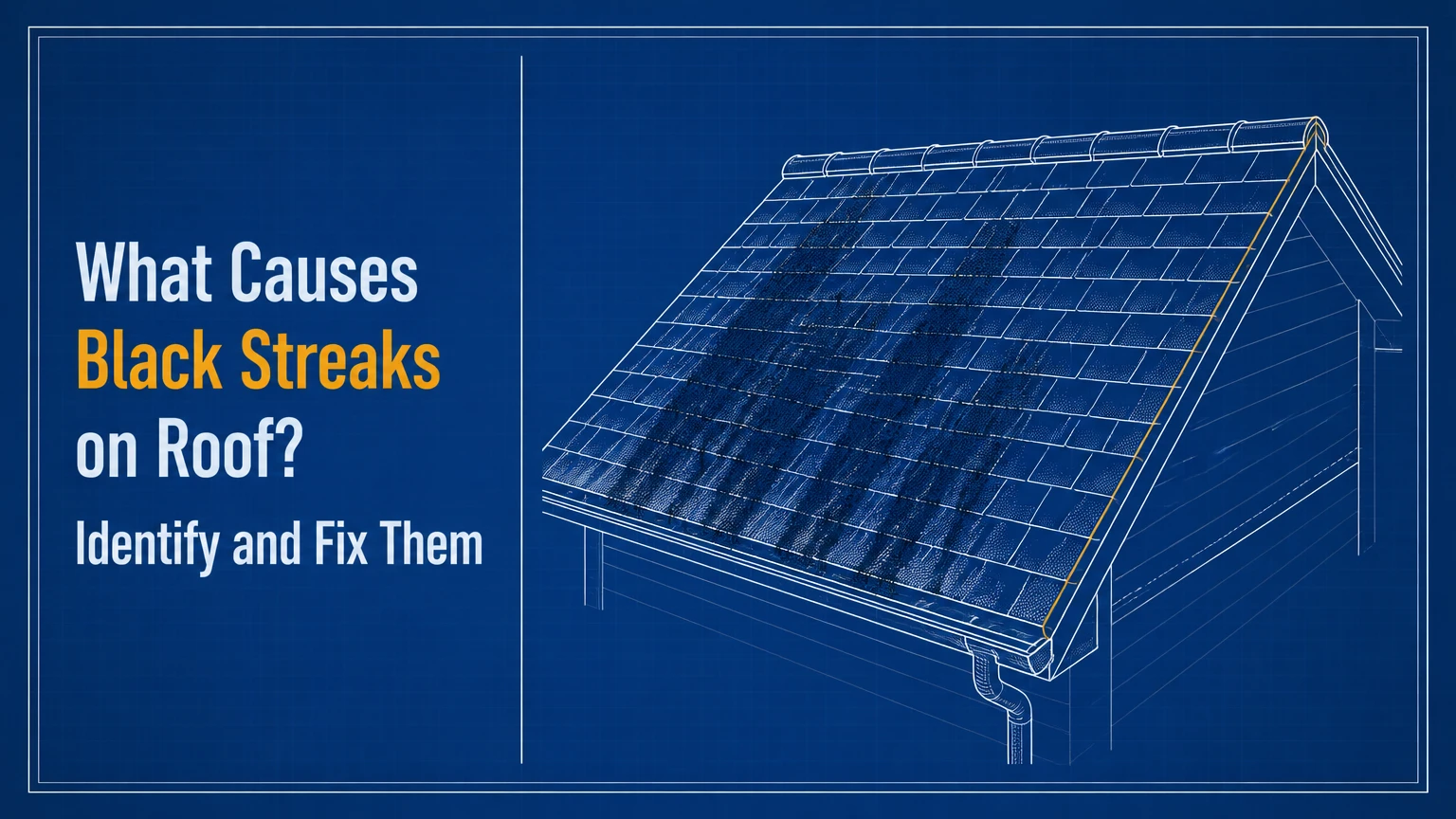
Black streaks on a roof are usually caused by the cyanobacterium Gloeocapsa magma, which colonizes moisture-retaining asphalt shingles and produces a dark, UV-resistant pigment. The streaks are generally algae-related staining rather than black mold. Soot, rust, moss, lichens, and runoff can create similar marks, so appearance and location determine the correct diagnosis.
Key Facts at a Glance
- Gloeocapsa magma is the usual cause of smooth, vertical black streaks on asphalt shingles.
- Roof algae spread fastest where shade, humidity, debris, and slow drying keep shingles damp.
- Black staining alone usually indicates a cosmetic and surface-maintenance problem, not an immediate roof leak.
- Moss and lichens present greater physical damage risk than a thin film of cyanobacterial staining.
- Pressure washing asphalt shingles can remove mineral granules and shorten roof life.
- Typical professional roof cleaning costs $300-$800 and may keep visible algae controlled for 3-5 years.
What Causes Black Streaks on Roof?
The most common cause is Gloeocapsa magma, a photosynthetic cyanobacterium carried to roofs by wind, birds, dust, and rain. Asphalt shingles provide a rough, mineral-rich surface where the organism can persist, especially when tree shade, humidity, and roof debris reduce drying time.
The dark appearance comes from protective pigments and cellular material within established colonies. Rainwater then travels downslope, carrying loosened material into narrow vertical paths. That process explains why a roof can develop long black lines even when the original growth began in small, scattered spots.
The organism’s name appears frequently in roofing literature, although cyanobacterial classification and naming have changed across scientific and industry sources. The practical diagnosis remains the same: smooth black or blue-black streaking on asphalt shingles usually indicates biological surface growth.
Why do black stains run vertically?
Vertical streaks form because gravity channels rainwater over established colonies. Water follows shingle courses and microscopic surface grooves, so staining often begins near the ridge and becomes more pronounced toward the eaves. Areas below roof penetrations, valleys, and lower shingle courses may look darker because they receive concentrated runoff.
A clean, sharply bounded line can reveal a metal strip or flashing detail above it. Zinc and copper release ions that inhibit many forms of algae and moss, so roof sections below those metals may remain visibly cleaner.
Are Black Roof Streaks Mold or Mildew?
Black roof streaks are usually cyanobacteria, not indoor-type black mold or mildew. Mold and mildew are fungi, while Gloeocapsa magma is a photosynthetic bacterium that grows on exterior mineral surfaces and does not indicate that mold has entered the attic or living space.
The distinction matters because homeowners often assume that every black biological stain requires mold remediation. A roof stain normally calls for exterior roof assessment and appropriate cleaning, not indoor air testing or a mold contractor. Mold becomes a separate concern when persistent moisture has affected roof decking, insulation, drywall, or framing.
What does Gloeocapsa magma need to grow?
Gloeocapsa magma needs moisture, light, minerals, and time. Shingle granules and limestone filler create a textured mineral surface, while dust, pollen, leaf fragments, and bird droppings supply additional residues that retain water.
The common explanation that the bacterium “eats” limestone is too simple. Roofing sources associate the organism with calcium carbonate-rich shingles, but homeowners should not interpret that claim as proof that a visible stain rapidly dissolves the roof. The immediate mechanism is colony attachment and discoloration; physical shingle damage becomes more important when moss, lichens, trapped debris, or repeated aggressive cleaning are present.
Why Do Shade and Moisture Matter?
Shade and moisture determine where roof algae can establish most easily. North-facing slopes, roof areas under dense tree canopy, sections beside taller buildings, and low-slope surfaces often dry more slowly than fully exposed south- or west-facing slopes.
Roof orientation is not a guarantee. A shaded roof in a dry climate may stay clean, while a sunny roof beside sprinklers, humid landscaping, or a dirty gutter can stain quickly. The decisive condition is repeated wetting followed by insufficient drying.
Which roof conditions encourage staining?
| Roof condition | Typical effect | Diagnostic clue |
|---|---|---|
| Dense tree canopy | Adds shade, pollen, and leaf debris | Stains concentrate below branches |
| North-facing slope | Receives less direct sun in many regions | Dark growth remains damp after rain |
| Clogged gutter | Holds water and organic debris | Staining intensifies near eaves |
| Low roof pitch | Slows runoff and drying | Broad patches replace narrow lines |
| Irrigation overspray | Repeatedly wets shingles | Growth follows sprinkler coverage |
| Coastal or humid climate | Raises surface moisture duration | Algae appears on younger roofs |
Trees do not directly create the cyanobacterium. Trees increase the conditions that help it survive, and branches can abrade shingles or block gutters. Trimming branches to improve airflow often slows recurrence more effectively than cleaning alone.
What Type of Roof Stain Is Present?
Smooth black streaks on asphalt shingles usually indicate cyanobacteria, but texture, color, and location can separate algae from moss, lichens, soot, and rust. The table below provides a practical first diagnosis, although a roofer should inspect uncertain or extensive staining from a safe position.
| Stain or growth | Appearance and location | Main risk | Appropriate response |
|---|---|---|---|
| Cyanobacteria | Matte black or blue-black vertical lines | Usually cosmetic; prolonged buildup can retain moisture | Low-pressure biological treatment |
| Moss | Green raised cushions or tufts | Lifts shingle edges and traps water | Gentle removal and roof inspection |
| Lichens | Gray, white, orange, or green crusts | Root-like structures can bond to granules | Professional treatment; avoid scraping |
| Soot or exhaust | Uniform gray-black film near vents or chimneys | Indicates combustion or airflow deposits | Inspect appliance, flue, and vent termination |
| Rust | Orange, red-brown, or yellow streaks below metal | Signals corroding flashing or fasteners | Repair or replace affected metal |
| Leaf tannin | Brown or black irregular patches below debris | Usually low structural risk | Remove debris and improve drainage |
| Wildfire residue | Ash-gray to black film across several surfaces | May contaminate gutters and HVAC systems | Document, rinse appropriately, and assess residue |
Soot usually follows airflow rather than the roof’s wettest areas. Rust follows metal. Algae follows moisture and runoff. Those location patterns are often more useful than color alone.
Can chimney soot look like roof algae?
Chimney soot can resemble algae when a vent or masonry chimney discharges combustion products onto the roof. Soot typically forms a concentrated film or fan-shaped deposit downwind of the outlet, while biological streaks appear across multiple shingle courses and often occur on shaded slopes.
A furnace, boiler, fireplace, or generator vent that deposits soot deserves inspection. Roof cleaning will not solve a venting defect, and disturbed combustion residue may point to incomplete combustion or poor termination design.
Can Black Streaks Damage a Roof?
Black cyanobacterial staining alone usually does not mean that a roof is failing. Damage risk rises when growth is combined with moss, lichens, standing debris, blocked drainage, granule loss, cracked or curled shingles, exposed fasteners, or water entering the roof assembly.
The Asphalt Roofing Manufacturers Association advises against power washing asphalt shingles because mechanical force can dislodge granules and damage the shingle surface. That recommendation addresses a larger risk than the stain itself: an attempted cosmetic repair can create accelerated ultraviolet aging and leak paths.
How much roof life can staining remove?
No reliable universal percentage applies to every stained roof. A thin algae film on a 5-year-old, well-ventilated roof may have little measurable effect, while moss on an aging roof can lift shingle edges and accelerate failure. Claims that all algae reduces roof life by 30%-50% should therefore be treated skeptically unless supported by a specific inspection or study.
Look for actual damage:
- Missing or loose mineral granules in gutters
- Shingles that curl, crack, blister, or remain lifted
- Exposed asphalt or fiberglass mat
- Soft roof decking visible from the attic
- Water marks, damp insulation, or active leaks
- Moss growing beneath shingle edges
- Corroded flashing around chimneys, walls, and valleys
A stain is a maintenance clue. It is not a replacement diagnosis.
How Should Black Streaks Be Cleaned?
Black roof streaks should be treated with a manufacturer-compatible, low-pressure cleaning method rather than blasted away. The usual process is to protect landscaping, apply a suitable biological cleaner, allow the solution to work for the specified dwell time, and rinse without forcing water beneath shingles.
What should you do before cleaning?
Confirm the roof material, age, pitch, weather forecast, and warranty requirements first. Asphalt shingles with brittle edges, widespread granule loss, or active leaks should receive a roofing inspection before anyone walks on them.
Prepare these controls:
- Keep people and pets away from runoff.
- Pre-wet plants and cover sensitive vegetation.
- Divert downspouts away from ponds, gardens, and storm drains where required.
- Use fall protection and avoid roof access when wet.
- Follow the cleaner label and the shingle manufacturer’s instructions.
- Test a small inconspicuous area for discoloration or granule loss.
Sodium hypochlorite can kill biological growth quickly, but runoff can burn foliage and corrode some metals. Hydrogen peroxide or oxygen-based products may reduce those hazards, although they can require longer dwell times or repeated applications.
Which cleaning method is safest?
For asphalt shingles, professional low-pressure soft washing is generally the safest effective method when the operator controls chemical concentration, runoff, access, and rinsing. A garden hose or label-approved spray may suit minor staining on a low-risk, accessible roof, but roof work remains hazardous even when the application equipment is simple.
| Method | Typical pressure or process | Typical cost | Main limitation |
|---|---|---|---|
| Professional soft wash | Low pressure, commonly below 100 psi at the roof surface | $300-$800 | Chemical runoff needs plant protection |
| Peroxide-based cleaner | Low-pressure application, longer dwell time | $250-$700 | May need repeat treatment |
| Garden-hose product | Hose-end application, label-controlled dilution | $30-$100 materials | Coverage and runoff are difficult to control |
| Manual moss removal | Hand tools, no aggressive scraping | $400-$1,000 | Slow and unsafe on steep roofs |
| Pressure washing | Often 1,000-3,000+ psi equipment | $250-$800 | Granule loss and water intrusion risk |
| Roof replacement | Remove and install new roofing | $8,000-$25,000 typical home range | Excessive for staining alone |
Pressure-washing prices and cleaning prices can overlap, but equal cost does not mean equal risk. The surface condition, roof pitch, access, region, and treatment area change the estimate.
Why is pressure washing a poor choice?
Pressure washing can strip mineral granules, break adhesive bonds, lift shingle tabs, force water under laps, and damage flashing or ridge vents. The roof may look clean immediately, but exposed asphalt ages faster and loose granules can clog gutters.
Pressure washing can be appropriate for some non-shingle surfaces when the manufacturer permits it, such as certain concrete areas or heavily soiled metal components. Asphalt shingles are the important exception.
How Much Does Professional Roof Cleaning Cost?
Professional roof cleaning typically costs $300-$800 for a residential asphalt-shingle roof, with many contractors quoting approximately $0.20-$0.50 per square foot. Steep pitch, difficult access, extensive moss, landscaping protection, regional labor rates, and multi-story setup can push the price above that range.
| Project condition | Typical price range | Typical duration | Likely service |
|---|---|---|---|
| Small, accessible algae stain | $250-$450 | 1-2 hours | Low-pressure treatment |
| Average 1,500-2,500-square-foot roof | $300-$800 | 2-4 hours | Soft wash and cleanup |
| Heavy moss or lichen | $600-$1,500 | 4-8 hours | Treatment plus careful removal |
| Steep or difficult-access roof | $700-$1,800 | 3-8 hours | Specialized access and protection |
| Cleaning with gutter service | $450-$1,000 | 3-5 hours | Roof treatment and drainage work |
These are typical planning figures, not guaranteed market prices. A written estimate should identify the roof material, chemical or cleaner type, pressure range, plant-protection measures, runoff handling, and any warranty.
Treatment does not permanently sterilize a roof. A clean roof may remain visibly improved for 3-5 years, but dense canopy, humid weather, and persistent debris can shorten that interval. A contractor promising permanent algae removal without addressing moisture and shade is overstating the result.
How Can Recurring Streaks Be Prevented?
Recurring roof streaks are best prevented by reducing moisture retention and adding algae-resistant materials during replacement. Trim branches away from the roof, clean gutters, remove leaf accumulation, correct irrigation overspray, and consider zinc or copper protection where compatible with the roofing system.
Do zinc and copper strips work?
Zinc and copper strips can inhibit algae and moss below the metal as rainwater carries small amounts of metal ions down the roof. Strips do not clean existing stains, do not protect the entire roof equally, and may lose effectiveness as they weather or become blocked by debris.
A roofing professional should install the metal near the ridge without compromising underlayment, fasteners, ridge ventilation, or manufacturer requirements. Metal strips commonly last many years, but a claim of 20-plus years of equal biological protection is not a universal guarantee.
When replacing asphalt shingles, select an algae-resistant product with embedded copper-containing granules if available in the local market. Such shingles can delay visible streaking, but they are not immune to algae under severe moisture exposure.
Which prevention measures have the greatest effect?
| Prevention measure | Typical effort | Expected benefit | Important limitation |
|---|---|---|---|
| Gutter cleaning twice yearly | 1-2 hours per visit | Reduces wet debris near eaves | Does not remove overhead shade |
| Branch trimming | $150-$800 typical service | Improves sun and airflow | Trees may regrow over the roof |
| Zinc or copper strip | $200-$800 installed | Suppresses downstream growth | Does not clean existing stains |
| Algae-resistant shingles | Added material cost at replacement | Delays new colonization | Requires reroofing |
| Irrigation adjustment | 30-60 minutes | Stops repeated wetting | Wind can still carry spray |
| Debris removal after storms | 15-45 minutes | Reduces moisture pockets | Roof access may be unsafe |
The highest-value intervention is often simple: keep organic debris from remaining on the roof. A clean gutter cannot compensate for branches that continually shed wet leaves onto shingles.
Why Do Black Streaks Come Back?
Black streaks return when treatment removes visible pigment but does not reduce the conditions supporting recolonization. Fast recurrence, especially within 12 months, commonly indicates heavy shade, persistent moisture, incomplete treatment, untreated nearby slopes, or a cleaner applied without adequate coverage or dwell time.
What do recurring patterns reveal?
- Return within one year: inspect canopy, gutters, irrigation, and treatment coverage.
- Stains only below a vent: investigate soot, exhaust residue, or condensate.
- A clean V-shape below metal: check for zinc or copper flashing above it.
- Growth at the eaves: inspect gutter overflow and roof-edge ventilation.
- Growth under branches: remove debris and improve air movement.
- Staining on one roof plane only: compare orientation, shade, pitch, and runoff.
- Black patches with raised green growth: diagnose moss rather than simple algae.
A roof inspection should include the attic when staining accompanies musty odors, ceiling marks, wet insulation, or unexplained humidity. Exterior discoloration does not prove a leak, but it can identify areas where water remains available long enough to expose drainage defects.
Does Roof Material Change the Diagnosis?
Roof material changes both the likely contaminant and the safe cleaning method. Asphalt shingles commonly develop Gloeocapsa magma streaks, while clay tile, concrete tile, wood shakes, and metal roofing have different surface textures, coatings, drainage details, and manufacturer restrictions.
| Roof material | Common dark surface cause | Main cleaning concern | Inspection priority |
|---|---|---|---|
| Asphalt shingles | Cyanobacteria, moss, lichen | Granule loss and lifted tabs | Granules, flashing, ventilation |
| Concrete tile | Algae, lichen, dirt in pores | Breakage and coating damage | Cracked tiles and underlayment |
| Clay tile | Algae, soot, lichen | Fragile tiles and foot traffic | Broken tiles and mortar details |
| Wood shakes | Algae, moss, mildew, weathering | Splitting and trapped moisture | Rot, gaps, and ventilation |
| Standing-seam metal | Dirt, oxidation, soot, biological film | Coating scratches and incompatible chemicals | Rust, fasteners, seams |
| Membrane roofing | Dirt, biological film, ponding | Punctures and chemical compatibility | Seams, drains, and standing water |
A cleaner approved for asphalt shingles may damage painted metal, natural stone, vegetation, or sealants. The roof material should be identified before selecting a product.
When Should Stained Shingles Be Replaced?
Stained shingles should be replaced only when inspection finds age-related deterioration, storm damage, widespread granule loss, failed flashing, or roof-system leakage. Cosmetic black streaks on otherwise flexible, intact shingles usually call for cleaning and prevention rather than a reroof.
Replacement becomes more reasonable when several conditions overlap:
- The roof is near or beyond its expected service period.
- Shingle edges are curled, brittle, cracked, or missing.
- Granules collect heavily in gutters.
- Leaks occur in multiple areas.
- Moss has lifted numerous shingle courses.
- Flashing and underlayment have widespread defects.
- A storm or fire has damaged the roof surface.
Insurance generally covers sudden, named perils such as wind or hail, not gradual algae staining or deferred maintenance. A policy and local claims requirements determine coverage, so photographs should document both the staining and any separate storm damage before cleaning.
Common Mistakes Homeowners Make
Scrubbing until the roof looks new
Aggressive brushing can remove granules and tear lichen-bonded shingle surfaces. Biological growth often dies before it disappears, so visual improvement may take days or weeks after treatment rather than occurring during scrubbing.
Treating without protecting plants
Bleach-based solutions can injure leaves, grass, shrubs, and aquatic life. Pre-wetting, covering sensitive plants, controlling runoff, and post-rinsing with clean water are practical safeguards, but label directions and local discharge rules still govern the work.
Walking on brittle shingles
Foot traffic can crack aged asphalt, dislodge granules, and bend shingle tabs. A roof that appears visually sound from the ground may be unsafe to walk on, particularly during cold weather or after prolonged ultraviolet exposure.
Ignoring the attic
Roof staining and interior moisture are separate findings that can coexist. Inspect the attic for daylight, damp decking, rusted fasteners, compressed insulation, and water tracks when exterior stains accompany indoor symptoms.
Installing metal without checking compatibility
Copper runoff can stain some adjacent materials, and improperly fastened strips can create penetrations or interfere with ridge-cap installation. The strip must be integrated with the roof system rather than simply nailed over the shingles.
Frequently Asked Questions
Are black roof streaks dangerous to people?
Black roof streaks caused by cyanobacteria are generally an exterior maintenance issue, not evidence of a dangerous indoor mold colony. The main household risks come from unsafe roof access, chemical exposure, runoff, and unaddressed leaks. People with respiratory sensitivity should avoid chemical application areas and follow the product label.
Can rain remove black algae from shingles?
Rain rarely removes established roof algae because colonies attach to the shingle surface and produce protective material. Heavy rain may loosen dead pigment or spread it downslope, making streaks appear longer. Rain can help distribute ions from zinc or copper strips, but it does not replace a controlled cleaning treatment.
Can I clean roof algae with vinegar?
Vinegar is not a dependable primary treatment for established roof algae, and concentrated acetic acid can affect plants, metals, sealants, and nearby surfaces. A product labeled for the specific roof material provides clearer dilution, contact, and safety instructions. Never combine vinegar with chlorine-based products.
Do black streaks mean the roof needs replacing?
Black streaks alone do not mean that a roof needs replacement. Replacement depends on shingle age, brittleness, granule loss, leaks, flashing failure, storm damage, and the extent of moss or lichen attachment. A roof inspection can separate a cleanable surface condition from system-wide deterioration.
How often should roof algae be treated?
Many professionally cleaned roofs remain visibly improved for approximately 3-5 years, but recurrence depends on shade, humidity, debris, pitch, and ventilation. Inspect the roof annually from the ground or a safe vantage point, clean gutters at least twice yearly where leaf fall is heavy, and address moisture sources before repeating treatment.
The Bottom Line
The usual answer to what causes black streaks on roof is Gloeocapsa magma, a cyanobacterium that colonizes damp, mineral-rich asphalt shingles and leaves dark vertical pigment trails. Soot, rust, moss, lichens, leaf tannins, and wildfire residue can look similar, so color and location should guide diagnosis.
Black staining is not automatically a structural emergency, but moss, lichen, granule loss, curled shingles, clogged drainage, and leaks require prompt attention. Use a roof-compatible low-pressure treatment, avoid pressure washing asphalt shingles, protect landscaping, and reduce shade, debris, and repeated wetting to slow recurrence.