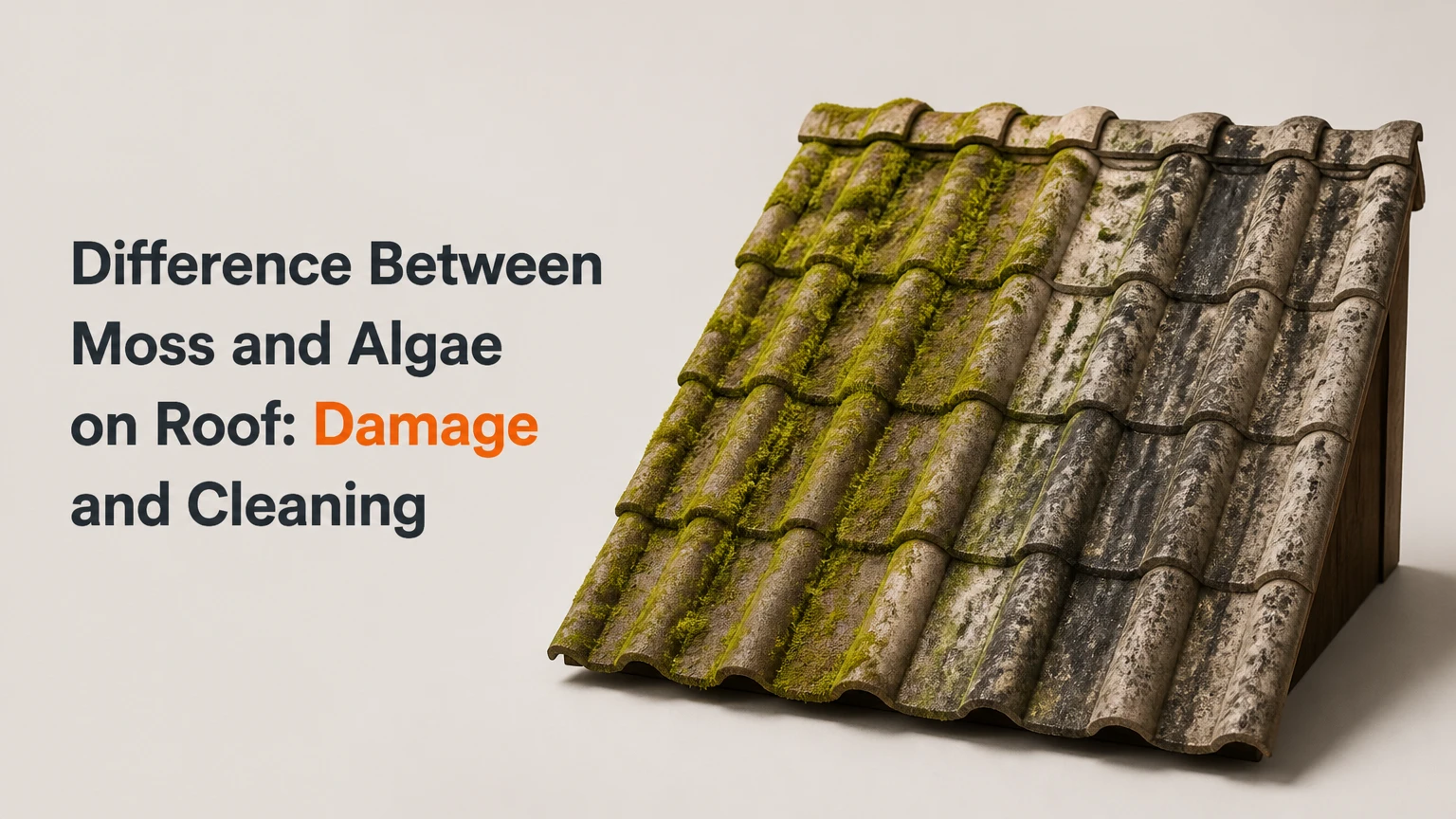
The difference between moss and algae on roof surfaces is appearance, biology, and risk: algae forms mostly flat black or blue-green staining, while moss forms raised, water-retaining green growth. Algae is usually a gradual shingle-aging and appearance concern; established moss can lift shingle edges, retain water, and contribute to leaks or roof-deck damage.
Key Facts at a Glance
- Roof algae usually appears as flat black streaks, dark smudges, or blue-green discoloration on sun-exposed asphalt shingles.
- Roof moss forms three-dimensional green cushions or mats and is most common on shaded, damp slopes with accumulated debris.
- Gloeocapsa magma is commonly associated with black staining on asphalt roofs and is more accurately described as a cyanobacterium than ordinary green algae.
- Moss presents the greater immediate physical risk because its growth and moisture retention can lift shingle edges.
- High-pressure washing can remove asphalt granules and damage shingle seals, so asphalt roofs generally require label-compliant low-pressure treatment.
- A typical professional roof cleaning costs about $450-$1,050 for a 1,500-square-foot roof, but pitch, access, material, and growth severity change the price.
What Is the Difference Between Moss and Algae on Roof?
Roof algae is a thin, surface-level photosynthetic organism or colony that produces dark discoloration, whereas roof moss is a nonvascular bryophyte that grows as a thicker, leafy mat. Algae spreads across damp roof surfaces without roots; moss uses rhizoids for attachment and retains substantially more water within its structure.
The common black-roof-streak organism is often identified as Gloeocapsa magma. Taxonomy varies in consumer literature, but Gloeocapsa is generally treated as a cyanobacterium, sometimes called blue-green algae. Airborne cells, fragments, and moisture move the organism between roofs. Calling the material “spores” is understandable shorthand, but it is not a complete biological description.
Moss belongs to the Bryophyta group. Rhizoids anchor moss to dirt, shingle texture, and small surface irregularities, but they are not vascular roots that penetrate deeply into sound roofing materials. The serious problem comes from the combination of attachment, trapped moisture, organic debris, and shingle movement.
How do you identify each growth?
Algae lies flat against the roof and creates color changes; moss rises above the surface and casts visible shadows. A close inspection from the ground, binoculars, or a safely accessible eave can usually distinguish them without anyone climbing onto the roof.
- Algae: black streaks, charcoal stains, dark green films, or relatively uniform discoloration.
- Moss: fuzzy green tufts, cushions, mats, and growth concentrated along shingle laps or shaded edges.
- Lichen: pale gray, yellow, or green crusts with small leaflike structures; lichen can be harder to remove than algae.
- Mold: irregular dark patches, often associated with persistent moisture, but not necessarily raised like moss.
- Dirt: brown or gray deposits that may rinse away without a biological treatment.
- Rust: orange or reddish staining below metal fasteners, flashing, or corroding components.
Do not diagnose solely by color. A roof can contain algae, moss, lichen, and dirt at the same time, and each responds differently to cleaning.
How Do Algae and Moss Interact With Roofing?
Algae mainly changes the shingle surface and appearance, while moss creates a moisture-management and shingle-lifting problem. Both organisms favor damp conditions, but moss needs a deeper layer of debris and shade to establish substantial growth.
What does algae do to asphalt shingles?
Algae produces a dark surface coating that can retain some moisture and reduce the roof’s visual reflectivity, but the common claim that it actively consumes limestone filler is too broad. Asphalt shingles contain mineral stabilizers and surfacing granules, and biological growth, weathering, runoff, and physical wear can all contribute to gradual granule loss.
Black streaks can make a roof look older without indicating an active leak. In warm climates, dark staining may increase solar heat absorption, although the effect on whole-home cooling costs depends on insulation, attic ventilation, roof orientation, roof color, and local weather. Algae-resistant shingles use copper- or zinc-containing granules to inhibit streak formation, not to make the roof immune to every organism.
The Asphalt Roofing Manufacturers Association, in its guidance on algae and moss, advises owners to avoid damaging cleaning methods and to follow the shingle manufacturer’s instructions. That advice matters because a visually clean roof with stripped granules has suffered a more permanent injury than a roof with untreated staining.
How does moss damage a roof?
Moss damages roofing by holding water against shingle surfaces and growing into overlaps, edges, and irregularities. As moss thickens, its wet mass can lift shingle tabs, interrupt drainage, weaken the asphalt seal, and expose underlayment or roof decking to wind-driven rain.
Moss is most destructive on roofs with several contributing conditions:
- Dense tree shade that slows drying.
- Leaf litter or soil trapped in shingle courses.
- Low-slope areas where water drains slowly.
- Broken, curled, or already-unsealed shingles.
- Repeated freezing and thawing in cold climates.
Moss does not automatically mean the roof deck is rotten. It does mean the roof deserves inspection, especially where shingles are visibly displaced, soft, cracked, or darkened underneath. If ceiling staining, attic dampness, or daylight through the roof deck is present, cleaning is not a substitute for leak repair.
Moss Versus Algae: Which Is More Dangerous?
Moss is usually more dangerous to roof function, while algae is usually more damaging to appearance and long-term surface condition. The correct priority is not to ignore algae, but to remove established moss sooner because lifted shingles can permit water entry during the next wind-driven rain.
| Condition | Typical appearance | Immediate roof effect | Recommended response |
|---|---|---|---|
| Light algae | Thin black streaks | Primarily cosmetic staining | Schedule gentle treatment during routine maintenance |
| Heavy algae | Broad dark film | Possible added heat absorption and surface weathering | Clean according to shingle instructions |
| Early moss | Small green tufts at laps | Localized moisture retention | Remove debris and treat before mat formation |
| Established moss | Thick green mats, raised edges | Shingle displacement and drainage interference | Arrange professional assessment and controlled removal |
| Lichen | Gray or pale crusts | Strong attachment and localized weathering | Use a compatible biocide; avoid forceful scraping |
| Growth with leaks | Any growth plus interior staining | Active water-entry risk | Repair the roof system before cosmetic cleaning |
Does algae mean the roof needs replacement?
Algae staining alone rarely proves that an asphalt roof needs replacement. Replacement becomes a consideration when staining is accompanied by widespread granule loss, exposed fiberglass mat, repeated leaks, brittle or curling shingles, failed flashing, or an age near the material’s expected service range.
A roof inspection should distinguish cosmetic staining from functional failure. Asphalt shingles can retain adequate weather protection despite black streaks, while a relatively clean roof can still have hidden flashing or underlayment defects.
What Is the Safest Removal Process?
The safest general process for asphalt shingles is a manufacturer-compatible, low-pressure chemical treatment followed by gentle rinsing and controlled removal of dead growth. Total work commonly takes 2-5 hours for an average accessible roof, but thick moss may remain visibly attached for 2-6 weeks as rainfall loosens it.
Before you start
| Requirement | Typical figure | Practical limit |
|---|---|---|
| Small roof treatment | 2-3 hours | Accessible, low-pitch roof |
| Average professional treatment | 2-5 hours | About 1,500-2,000 square feet |
| DIY chemical material | $25-$100 | Product label controls dilution |
| Professional cleaning | $450-$1,050 | Typical 1,500-square-foot asphalt roof |
| Minimum equipment | 1 sprayer, hose, PPE | No pressure washer on asphalt shingles |
Do not climb a steep, wet, brittle, slate, or visibly damaged roof. A roof-cleaning contractor should carry liability insurance, explain runoff controls, and identify the roof material before applying any chemical.
Step 1: Inspect and protect the site
Identify roof material, pitch, gutters, nearby plants, outdoor furniture, windows, painted metal, and water collection points. Wet vegetation thoroughly before treatment, cover sensitive plants when the product label permits covering, and plan runoff so concentrated solution does not pool on lawns or enter ponds.
Photograph damaged shingles before work. Cleaning can expose pre-existing defects, and photographs help separate cleaning damage from existing deterioration.
Step 2: Remove loose debris without lifting shingles
Clear leaves, pine needles, and loose organic material with a soft roof rake or gentle hand method from a safe position. Moss removal should proceed downward along the shingle slope, never upward underneath tabs.
Do not use wire brushes, metal scrapers, or forceful prying. The asphalt sealant bond can tear when a tool catches a tab, particularly in cold weather when shingles are less flexible.
Step 3: Apply a compatible treatment
Use a product specifically labeled for the roof material and target organism. Sodium hypochlorite solutions often act quickly on algae and moss, while quaternary ammonium or other registered biocides may work more slowly and leave less immediate whitening.
Never assume a generic 50/50 bleach mixture is safe. Concentration, roof age, temperature, runoff, nearby metals, and the product label determine whether a solution can damage vegetation, gutters, paint, or shingles.
Step 4: Respect dwell time and weather
Allow the solution to remain wet for the label-specified period, commonly 10-30 minutes for professional formulations. Avoid hot, sunny, windy conditions that dry the treatment prematurely, and do not apply before rain unless the label specifically permits it.
A second application may be safer than a stronger mixture. The objective is biological control, not instant removal by force.
Step 5: Rinse with controlled low pressure
Rinse with a garden hose or a professional low-pressure system that does not dislodge shingle granules. Direct water downward and keep spray away from laps, flashing joints, ridge vents, and damaged areas.
You will know the process worked when the living green color fades, surface debris releases without aggressive brushing, and no unusual quantity of granules appears in the gutters. Dead moss may not disappear immediately.
Step 6: Check the roof and drainage system
Inspect gutters for excessive granules, clumps of dead moss, blocked outlets, and displaced shingle pieces. Check the attic and ceilings after the next significant rainfall if moss had lifted shingle edges.
Cleaning does not repair lifted tabs, rotten decking, failed flashing, or missing underlayment. Those defects require roofing work.
How Do Treatment Options Compare?
Chemical treatment is generally the least abrasive removal method, while zinc or copper provides longer-term prevention but cannot repair an already damaged roof. The best option depends on roof material, organism, runoff sensitivity, recurrence rate, and whether the roof remains under warranty.
| Treatment option | Typical action time | Typical material cost | Main limitation |
|---|---|---|---|
| Sodium hypochlorite blend | 10-30 minutes | $15-$60 per treatment | Can harm plants, metals, and finishes |
| Registered non-bleach biocide | Several hours to weeks | $25-$100 per treatment | Slower cosmetic improvement |
| Zinc strip | Rain-activated over time | $30-$60 per 50-foot roll | Limited by debris, roof geometry, and runoff |
| Copper strip | Rain-activated over time | $50-$150 per 50-foot roll | Higher cost and possible metal runoff concerns |
| Manual soft brushing | Immediate for loose material | $20-$100 in tools | Can damage tabs if done aggressively |
| Professional soft wash | 2-5 hours | $0.30-$0.70 per square foot | Requires contractor access and runoff controls |
Do zinc and copper strips prevent roof growth?
Zinc and copper strips can reduce recurring algae and moss on roof areas reached by rainwater carrying dissolved metal ions. They work best when installed near the ridge, kept continuous across the affected slope, and used with debris control, but they do not sterilize shaded roof sections or remove existing growth.
Metal strips have important limitations. Dormers, valleys, ridge interruptions, heavy leaf cover, and roof sections below broad obstructions can prevent treated rainwater from reaching the entire surface. Installation also involves fasteners, sealants, and penetrations that must be compatible with the roof system.
Do not install copper above aluminum gutters or sensitive metal components without checking compatibility. Runoff can accelerate corrosion in some assemblies. A strip is a prevention aid, not a replacement for cleaning, ventilation, tree management, or roof repair.
What Does Roof Cleaning Cost and How Long Does It Last?
Typical professional roof cleaning costs about $0.30-$0.70 per square foot, or approximately $450-$1,050 for a 1,500-square-foot roof. Moss, steep pitch, difficult access, multiple roof levels, tile, slate, and extensive plant protection can move the quote well beyond that range.
| Project factor | Typical effect on price | Typical time effect | Why it matters |
|---|---|---|---|
| Light algae on simple asphalt roof | Base rate | 2-3 hours | Chemical treatment needs little manual work |
| Heavy moss on asphalt roof | Plus 25%-75% | 3-6 hours | Loose growth and inspection require more labor |
| Steep or multi-level roof | Plus 20%-60% | Add 1-3 hours | Safety equipment and access increase labor |
| Concrete tile roof | Plus 20%-50% | 3-6 hours | Tiles require careful foot placement |
| Slate or cedar roof | Custom quotation | 4+ hours | Material-specific methods and specialist skill |
| Dense landscaping | Plus $50-$250 | Add 30-90 minutes | Plant protection and runoff control take time |
Typical cleaning lasts 1-3 years where shade, humidity, and debris remain unchanged. Zinc or copper prevention may extend the interval, but no strip can overcome a roof that stays wet beneath overhanging branches.
Price comparisons should include chemical type, runoff protection, gutter cleaning, inspection, warranty language, and whether the contractor guarantees removal or only treatment. A low quote that uses high pressure can create a more expensive roof repair.
How Does Roofing Material Change the Decision?
Asphalt shingles generally tolerate properly controlled low-pressure treatment, while slate, cedar, tile, and coated metal require material-specific methods. A chemical safe for asphalt may stain, corrode, dry, or weaken another roof covering.
| Roof material | Common growth pattern | Safer general approach | Avoid |
|---|---|---|---|
| Asphalt shingle | Algae streaks and moss at shaded laps | Label-compliant low-pressure treatment | High-pressure washing and metal scraping |
| Concrete tile | Moss in porous surfaces and overlaps | Tile-compatible biocide, careful access | Walking on unsupported tile edges |
| Clay tile | Algae or moss in shaded joints | Manufacturer-approved cleaner | Acidic or highly corrosive chemicals |
| Cedar shake | Moss, algae, lichen, and moisture decay | Specialist inspection and gentle treatment | Aggressive pressure and excessive chlorine |
| Slate | Moss at laps and valleys | Slate roofer assessment | Walking directly on slate |
| Painted metal | Surface algae in damp areas | Mild compatible cleaner and soft rinse | Chlorides that corrode coatings and fasteners |
A roof-cleaning contractor should know the covering manufacturer’s maintenance instructions. Roofing materials differ in porosity, coating chemistry, thermal movement, and acceptable foot traffic.
Which Roof Growth Approach Fits Your Situation?
Homeowners should choose treatment based on risk, not color alone. Flat algae staining on sound asphalt shingles can usually wait for planned maintenance, while moss that lifts tabs, blocks drainage, or accompanies leaks deserves prompt professional attention.
For a budget-conscious homeowner
Use ground-based inspection, remove nearby debris, trim branches, and obtain two written quotes before attempting treatment. DIY work is reasonable only on a low, accessible roof where the product label permits homeowner application and no climbing hazard exists.
A garden sprayer, hose, gloves, eye protection, and plant protection may cost roughly $25-$100. Never substitute a stronger chemical mixture for professional equipment or experience.
For a steep or fragile roof
Hire a contractor experienced with the specific covering. Steep asphalt roofs, slate, cedar, and brittle older shingles create fall and breakage risks that outweigh the apparent savings from DIY cleaning.
Ask whether the contractor will inspect flashing, document granule loss, protect vegetation, and avoid pressure washing. A treatment-only quote is incomplete if moss has already displaced shingles.
For a recently installed roof
Check the warranty before cleaning. Algae-resistant shingles may include a limited anti-streak warranty, but warranty terms can exclude improper cleaning, physical damage, chemicals, or installation defects.
The manufacturer’s maintenance document controls. Keep invoices, product names, photographs, and contractor insurance records.
For a roof that regrows within six months
Look for a moisture source rather than simply repeating chemical treatment. Overhanging branches, clogged gutters, leaf accumulation, poor drainage, north-facing slopes, and nearby tree canopy can keep the roof wet long enough for rapid recolonization.
Trim branches where appropriate, clean gutters, improve drainage, and assess attic ventilation. Branch trimming should respect local tree regulations and should not create new roof abrasion.
What Mistakes Cause the Most Roof Damage?
The most expensive roof-cleaning mistakes are pressure washing, aggressive scraping, unapproved chemical mixtures, and treating a leak as a cosmetic problem. Each mistake can remove granules, break shingle seals, corrode metal, or delay necessary repair.
- Pressure washing asphalt shingles: High-pressure water can strip granules and force water beneath laps. Recovery requires documenting damage and having a roofer assess exposed mat and seals.
- Scraping upward: Upward tools catch shingle tabs and can break the seal. Brush downward only, and stop when growth is firmly attached.
- Using wire brushes: Wire can cut the surface and expose reinforcement. Replace wire tools with soft nylon methods or chemical treatment.
- Applying concentrated bleach in hot sun: Rapid drying increases plant and material damage. Rinse according to the product label and never allow runoff to pool.
- Ignoring gutters: Dead moss and granules can block outlets after cleaning. Clear and test downspouts before the next storm.
- Cleaning over active leaks: Chemicals do not restore flashing or underlayment. Repair water entry first or arrange inspection immediately.
One useful practitioner rule is to treat roof cleaning as a controlled chemical and drainage operation, not as exterior pressure washing. The roof surface is a weather barrier, not a driveway.
Frequently Asked Questions
Can roof algae turn into moss?
Roof algae does not transform into moss because algae and moss are different organisms. Algae can create a damp, dirty surface where moss later establishes, especially when shade and organic debris remain, so both may appear on the same roof without one changing into the other.
Is black staining on every roof caused by algae?
Black roof staining is often algae, but dirt, mold, soot, lichen, and shingle discoloration can look similar. A streak that follows runoff paths suggests algae, while irregular patches near chimneys, vents, or metal components may indicate another source that needs inspection before treatment.
Can rain remove roof moss naturally?
Rain can loosen dead moss after treatment, but rain alone rarely removes an established moss mat. Moss may remain attached for 2-6 weeks after treatment, and pulling it away prematurely can lift shingles, disturb sealant, or expose weak areas.
Will roof moss grow under solar panels?
Roof moss can grow beneath or around solar panels when panels create shade and restrict drying. Solar equipment should not be removed or sprayed casually; coordinate roof cleaning with the solar installer and use procedures that protect wiring, mounts, and warranty coverage.
Should I clean algae before selling my house?
Cleaning algae can improve curb appeal, but sellers should disclose known leaks, damaged shingles, or prior roof work according to local law. Cosmetic cleaning cannot substitute for a roof inspection, and aggressive cleaning may create visible granule loss that complicates the sale.
Does attic ventilation stop moss and algae?
Attic ventilation does not directly kill roof algae or moss because growth occurs on the exterior surface. Adequate ventilation can reduce some heat and moisture problems inside the roof assembly, while shade, debris, surface drainage, and rainfall exposure usually control exterior biological growth more strongly.
The Bottom Line
The difference between moss and algae on roof surfaces determines urgency: flat algae staining is usually a planned-maintenance issue, while thick moss can lift shingles and contribute to water entry. Identify the growth, confirm the roofing material, avoid pressure washing, and use a compatible low-pressure treatment with runoff protection. For recurring growth, address shade and debris before adding zinc or copper prevention.