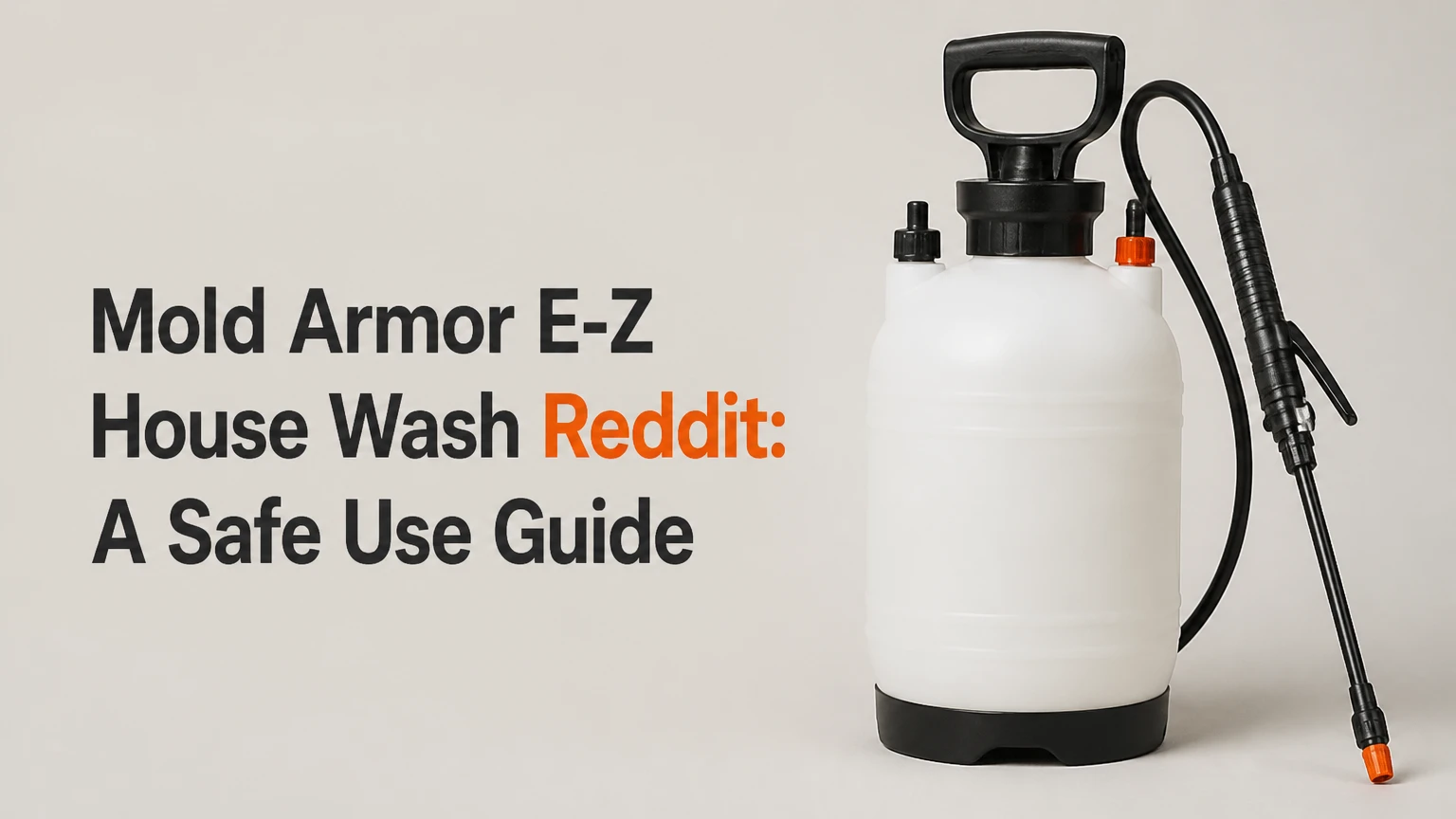
Mold Armor E-Z House Wash is a bleach-based exterior cleaner that Reddit homeowners commonly discuss for removing algae, mildew, mold, and grime from siding without high-pressure washing. The product can work well on compatible, weatherproof surfaces, but its real value depends on coverage, runoff control, shade, and following the current package label rather than copying an unverified Reddit dilution hack.
Key Facts at a Glance
- Mold Armor E-Z House Wash uses an oxidizing chlorine chemistry, commonly identified by the manufacturer’s safety documentation as sodium hypochlorite.
- The 64-ounce hose-end product is designed for garden-hose application; a hose-end sprayer generally uses much lower impact than a pressure washer.
- The advertised coverage can reach approximately 4,500 square feet, while practical coverage may fall to 1,500-2,000 square feet when growth is heavy or application is generous.
- A typical dwell target is about 5-10 minutes, and the solution must not dry on siding, glass, metal, plants, or painted surfaces.
- Pre-wetting vegetation, wearing eye and skin protection, and rinsing thoroughly are more important than producing thick foam.
- Reddit posts are useful for identifying practical complaints, especially fast product consumption, but they do not establish a universal dilution, safety profile, or performance guarantee.
What Is Mold Armor E-Z House Wash?
Mold Armor E-Z House Wash is an exterior surface cleaner sold in hose-end and concentrate formats for brick, concrete, trim, and siding. Its active cleaning system relies on an oxidizer that breaks down organic discoloration, while surfactants help the liquid spread and remain on vertical surfaces long enough to react.
The phrase “just bleach” is partly accurate and partly incomplete. Sodium hypochlorite supplies the principal oxidation action, but the finished product can also contain surfactants, stabilizers, fragrance components, dyes, or other formulation ingredients. The exact concentration may differ by product version and market, so a Reddit claim that every bottle contains 5.25% sodium hypochlorite should not replace the current label or Safety Data Sheet.
Reddit’s favorable reports usually describe green algae and surface mildew on vinyl siding. Those results make sense because chlorine oxidation is fast on exposed organic growth. Reddit’s less favorable reports commonly involve poor coverage, strong odor, plant damage, or dark marks that were not biological growth at all.
Is Mold Armor E-Z House Wash “Soft Washing”?
Mold Armor E-Z House Wash can be part of a low-pressure soft-wash process, but the bottle itself does not define a complete soft-washing system. Soft washing means applying an appropriate cleaning solution at low impact, allowing chemical dwell, and rinsing without forcing water behind siding, seals, or flashing.
A garden hose still produces enough pressure to damage fragile paint, force water into openings, or spread contaminated runoff if the user holds the stream too close. Conversely, a pressure washer operated with a downstream injector can also apply a chemical at low pressure. The operating pressure, nozzle distance, substrate condition, and rinse technique determine the risk.
How Does the Cleaner Remove Mold and Algae?
Sodium hypochlorite oxidizes exposed organic pigments and cellular material, while surfactants lower water’s surface tension so the solution spreads across and clings to a wall. The chemical reaction removes or lightens growth; water pressure mainly carries the loosened residue away.
The process is not identical for every stain. Green algae often responds quickly because it sits near the surface. Mildew may need a longer dwell or a second application. Lichen has a tougher structure and can leave attachment residue even after the living material is killed. Rust, artillery-spore marks, tannin, soot, and permanent paint discoloration require different chemistry.
The product’s foam is a delivery feature, not a laboratory measure of strength. A thick layer can improve contact on vertical siding, but a thin, evenly wet film can outperform foam that dries in sunlight.
The Mold Armor product instructions and safety documents should control the method. A useful manufacturer instruction is “Do not allow product to dry,” because dried chlorine cleaner is harder to rinse and more likely to leave residue or affect sensitive finishes.
Which Product Format and Equipment Fit the Job?
The 64-ounce hose-end bottle is usually the simplest choice for a small or average siding project. Concentrate is more economical for larger areas only when the user has a compatible sprayer and follows the specified mixing instructions; concentrate should not automatically be poured into a hose-end bottle or applied full-strength.
| Product or setup | Typical use | Application method | Main limitation |
|---|---|---|---|
| 64-ounce hose-end E-Z House Wash | 500-2,000 square feet of moderately dirty siding | Garden hose and built-in selector | Coverage varies sharply with spray rate |
| 1-gallon house-wash concentrate | Larger masonry or siding projects | Label-specified pump, downstream, or dilution system | Requires accurate dilution and chemical-resistant equipment |
| Pressure-washer concentrate | Low-pressure downstream cleaning | Pressure washer injector at low impact | High-pressure rinsing can damage siding |
| Pump sprayer with approved dilution | Small spot treatments and controlled edges | Manual low-pressure spray | Limited reach and slower application |
| Plain garden hose rinse | Final removal of cleaner | Wide spray pattern from a distance | Does not replace chemical dwell |
A pressure washer is not required for the standard hose-end product. Reddit users are right to favor low-impact cleaning on vinyl siding, where forcing water upward or behind overlapping panels can create moisture problems. The safest choice is often a controlled garden-hose rinse, not the highest available pressure.
How Much Area Does One Bottle Really Cover?
The advertised 64-ounce coverage may approach 4,500 square feet under favorable conditions, but a practical homeowner range is often 1,500-3,000 square feet. Heavy growth, porous masonry, low water pressure, long hose runs, wind, and repeated passes can reduce that figure substantially.
| Condition | Typical coverage from 64 ounces | Approximate product cost at $12-$17 | Why coverage changes |
|---|---|---|---|
| Light algae on smooth vinyl | 3,000-4,500 sq. ft. | $0.27-$0.57 per 100 sq. ft. | Thin, even film and quick rinse |
| Moderate mildew on vinyl or aluminum | 2,000-3,000 sq. ft. | $0.40-$0.85 per 100 sq. ft. | More solution needed for uniform wetting |
| Heavy organic growth on siding | 1,500-2,000 sq. ft. | $0.60-$1.13 per 100 sq. ft. | Slow application and repeat treatment |
| Brick or concrete | 800-1,800 sq. ft. | $0.67-$2.13 per 100 sq. ft. | Porosity absorbs liquid and increases dwell demand |
| Spot treatment with a pump sprayer | 300-1,000 sq. ft. | $1.20-$5.67 per 100 sq. ft. | Deliberate application limits overspray |
Retail prices change by store and pack size. Measure the actual wall area, then divide the purchase price by the square footage cleaned. That calculation is more useful than relying on the bottle’s maximum claim.
How Do You Apply Mold Armor E-Z House Wash Safely?
Apply Mold Armor E-Z House Wash to a cool, shaded, weatherproof surface, keep surrounding materials wet, allow a short monitored dwell, and rinse completely before the solution dries. A typical small-house side takes 15-30 minutes to apply and rinse, excluding setup and plant protection.
Before You Start
| Requirement | Practical target |
|---|---|
| Weather | Overcast or shaded conditions, approximately 50-85°F |
| Working time | 15-30 minutes per standard side |
| PPE | Chemical-resistant gloves, safety glasses, long sleeves, closed shoes |
| Materials | Garden hose, product, clean-water supply, plastic sheeting, soft brush |
| Plant preparation | Thorough pre-wetting and a second rinse after cleaning |
| Surface test | Hidden 1-square-foot patch checked after drying |
| Access | Extension wand or low-pressure reach tool instead of unstable ladder work |
Step 1: Inspect and Protect the Area
Remove outdoor cushions, toys, flags, and fabric items before opening the bottle. Close windows and doors, cover delicate electrical components, and inspect caulk, loose siding, failed paint, and unsealed wood.
Saturate grass, shrubs, flowers, and nearby soil with clean water. Moveable pots should leave the spray zone. Wet vegetation reduces immediate absorption, but it does not make chlorine harmless.
You will know the area is prepared when no fabric or sensitive object remains beneath the wall and every plant within likely overspray range is visibly wet. The common mistake is protecting only the plants directly beneath the wall while ignoring windborne spray.
Step 2: Test the Surface and Product Pattern
Apply the product to a hidden patch according to the package directions. Wait through the specified dwell and rinse, then inspect the dry surface for color loss, haze, chalking, or altered gloss.
Test the spray pattern on an empty section or cardboard before targeting windows and trim. Keep the selector in the off position while connecting the hose, then open the spigot fully if the package mechanism requires strong flow.
You will know the setup works when the product wets the wall evenly and the hose-end selector changes cleanly between application and rinse. Do not compensate for a weak siphon by guessing at concentrate ratios.
Step 3: Apply Cleaner From Bottom to Top
Start at the bottom and work upward in manageable sections. Bottom-up application keeps the lower wall from drying beneath cleaner flowing from an untreated upper section, which reduces visible overlap lines on some surfaces.
Use enough solution to wet the surface without creating uncontrolled streams. Keep the spray away from open vents, window seals, door hardware, roof edges, and unprotected electrical fixtures. For a second story, use an extension wand or manufacturer-approved reach attachment rather than leaning a ladder into wet chemical runoff.
You will know application is even when the wall remains uniformly wet, with no dry islands or heavy curtains of liquid. A common error is spraying a large sunlit wall at once and discovering that the top has dried before the rinse begins.
Step 4: Monitor Dwell Without Letting It Dry
Allow approximately 5-10 minutes of contact time unless the current label specifies another interval. The correct endpoint is a visibly wet surface with softened or fading growth, not a rigid “exactly ten minutes” rule that ignores temperature, wind, shade, and substrate.
Mist a section lightly with clean water if it begins to dry. Do not add more chemical to a drying wall without considering runoff and concentration at the surface.
You will know dwell is adequate when green discoloration has faded and loose residue begins to release during rinsing. The common mistake is leaving chlorine cleaner unattended because foam remains visible, even though the film underneath has dried.
Step 5: Rinse From Top to Bottom
Switch to clean water and rinse from the top down using a broad, low-impact pattern. Keep the nozzle far enough away to avoid driving water behind vinyl laps, window trim, siding seams, or damaged mortar.
Rinse until no foam, odor-heavy runoff, or visible residue remains. Then rinse plants, grass, soil, windows, and nearby hardscape again with clean water.
You will know rinsing is complete when the wall has no slippery film, streaking, or foam and runoff is visibly diluted. The common mistake is rinsing the wall while forgetting the sill, foundation planting, and downspout discharge area.
Which Surfaces Can It Clean, and Which Should You Avoid?
Mold Armor E-Z House Wash is most defensible on compatible, weatherproof vinyl, aluminum, brick, concrete, and exterior trim after a patch test. Unsealed wood, roofs, delicate coatings, corroded metal, and surfaces that cannot be thoroughly rinsed require a different method or professional assessment.
| Surface | General suitability | Main risk | Recommended approach |
|---|---|---|---|
| Vinyl siding | Usually suitable | Water intrusion and streaks | Low-pressure application, controlled rinse |
| Aluminum siding | Often suitable after testing | Oxidation, chalking, color change | Test hidden area and avoid hot sun |
| Brick and concrete | Usually suitable | Porosity, mortar discoloration | Use approved dilution and longer rinse |
| Painted trim | Conditional | Gloss loss or paint bleaching | Patch test, short dwell, immediate rinse |
| Stucco | Conditional | Uneven absorption and soft finish | Confirm coating compatibility first |
| Unsealed wood | Poor default choice | Fiber damage and uneven bleaching | Use wood-specific cleaner or specialist |
| Asphalt roofing | Do not assume suitability | Granule loss and runoff damage | Use a roof-labeled method |
| Glass and natural stone | Conditional | Etching, haze, sealant damage | Protect, avoid contact, rinse immediately |
Black spots do not prove that a surface needs stronger bleach. On masonry, dark marks can be iron staining, soot, lichen attachment, or embedded dirt. Increasing chemical strength can damage the substrate while leaving the actual stain unchanged.
How Do You Protect Plants, Metal, Glass, and Clothing?
Chlorine-based house wash can injure foliage, discolor fabric, corrode susceptible metals, and irritate eyes and skin. Protection requires physical control of spray and runoff, not merely pre-wetting a few leaves.
Use gloves and eye protection, avoid breathing spray mist, and work with ventilation around windows and doors. Keep the product away from acids, ammonia, toilet cleaners, vinegar, and other chemicals because mixing incompatible cleaners can release hazardous gases.
Rinse metal fixtures, window glass, painted doors, and vegetation promptly if overspray occurs. If a person receives eye exposure, flush with clean water for at least 15 minutes and follow the product SDS or local medical guidance. Skin exposure requires immediate rinsing and removal of contaminated clothing.
A practitioner rule of thumb is to begin plant protection before assembling the sprayer. Once chemical application starts, users tend to rush and overlook leaves beneath ledges or runoff collecting beside foundation beds.
How Does Mold Armor Compare With Alternatives?
Mold Armor is a strong convenience choice for fast organic-growth removal on compatible siding, while oxygen bleach is gentler in odor and 30 Seconds Outdoor Cleaner offers another ready-to-use category with its own label instructions. No alternative eliminates the need for a patch test and plant protection.
| Cleaner category | Primary chemistry | Typical dwell | Odor and plant concern | Best fit |
|---|---|---|---|---|
| Mold Armor E-Z House Wash | Chlorine oxidizer with surfactants | 5-10 minutes | Strong odor, foliage injury if misused | Fast algae and mildew removal |
| 30 Seconds Outdoor Cleaner | Product-specific oxidizing formula | Label-dependent | Can still affect plants and finishes | Ready-to-use outdoor spot cleaning |
| Oxygen bleach | Sodium percarbonate-based oxidizer | 10-30 minutes or longer | Lower chlorine odor, slower action | Users prioritizing reduced chlorine smell |
| Mild detergent | Surfactant cleaning | 5-15 minutes | Lower biological kill, low odor | Dirt and routine maintenance |
| Professional soft wash | Technician-selected chemistry | Site-dependent | Controlled by trained operator | Tall, delicate, or extensive properties |
The comparison depends on the stain. Chlorine often wins on speed for green growth, oxygen bleach can suit users who accept slower action, and detergent is appropriate when the discoloration is ordinary dirt rather than living growth.
Is Mold Armor Better Than a Pressure Washer?
Mold Armor with low-pressure rinsing is usually safer than a high-pressure stream for vinyl siding, especially when panels are loose, aged, or improperly sealed. A pressure washer may clean faster mechanically, but it can scar surfaces, strip paint, break seals, and inject water behind siding.
A pressure washer still has a legitimate role when used with the correct low-pressure chemical application and a broad rinse pattern. The machine is not automatically unsafe; the dangerous combination is excessive pressure, close distance, narrow nozzle selection, and upward spraying.
What Does Reddit Get Right and Wrong?
Reddit users correctly identify convenience, low-impact application, strong odor, plant sensitivity, and unexpectedly fast bottle consumption as the main practical trade-offs. Reddit users are less reliable when recommending unverified pool-chlorine substitutions, full-strength concentrate use, or a universal dwell time for every surface.
The most useful Reddit-style observation is economic: a 64-ounce bottle may disappear before a visibly average house is finished. That outcome usually reflects porous masonry, heavy growth, a wide spray pattern, low siphon efficiency, or repeated passes rather than a defective product.
The least safe recurring shortcut is refilling a specialty hose-end bottle with pool chlorine and water. That practice can create an uncontrolled concentration, damage the sprayer, invalidate label directions, and expose the user to splash or gas hazards. Buy a product intended for the chosen sprayer and use its stated dilution.
Should You Clean a Roof With It?
Do not use Mold Armor E-Z House Wash on a roof unless the current product label explicitly permits that roofing material. Roof cleaning adds risks that siding cleaning does not, including granule loss, concentrated runoff, slippery footing, gutter corrosion, and plant exposure over a large drainage area.
Roof algae may require a roof-specific treatment applied from safe access without walking on shingles. The product’s suitability for siding, brick, concrete, or trim does not transfer automatically to asphalt shingles, membrane roofing, metal roofing, or tile.
Why Is the Bottle Not Siphoning?
A hose-end Mold Armor bottle may fail to siphon when water pressure is insufficient, the hose is kinked, the selector is not fully engaged, the pickup path is blocked, or the sprayer is being used with an incompatible connection. Fully open the spigot, straighten the hose, verify the selector position, and check the instructions before changing equipment.
Long, narrow, or restrictive hoses can reduce flow enough to affect a venturi-style pickup system. A partially closed spigot, backflow device, damaged washer, or clogged nozzle can produce the same symptom.
Do not shake the bottle, drill the cap, remove internal parts, or pour concentrate into the container to force performance. If the clean setting still produces only water after basic checks, use a compatible chemical-resistant pump sprayer and the label’s specified dilution, or replace the defective attachment.
Why Did Green Growth Disappear but Black Marks Remain?
Black marks remaining after algae removal usually indicate a different stain, deeper lichen residue, substrate discoloration, or a second biological layer rather than proof that the first application failed. Inspect the mark after the surface dries and avoid immediately escalating chemical strength.
A second label-compliant treatment may help with persistent organic growth. A soft-bristled brush can loosen residue on durable masonry, but aggressive brushing can spread spores, remove paint, or roughen mortar. Rust, soot, artillery-spore staining, and tannin need targeted products designed for those materials.
If the mark follows mortar joints, appears beneath metal fasteners, or remains unchanged after a controlled test patch, chemical house wash is probably the wrong solution. Photograph the area dry and compare it with an untreated patch before deciding.
Is Mold Armor E-Z House Wash Worth Buying?
Mold Armor E-Z House Wash is worth buying for a homeowner cleaning moderate algae or mildew on compatible exterior siding who values a quick garden-hose application and accepts chlorine odor and plant-protection work. It is a poor fit for unsealed wood, uncertain roof materials, delicate coatings, or properties where runoff cannot be controlled.
| User situation | Recommended choice | Reason | Avoid when |
|---|---|---|---|
| One-story vinyl siding, light algae | 64-ounce hose-end bottle | Simple setup and low-impact rinse | Surface is chalking or damaged |
| Two-story vinyl siding | Hose-end product with extension wand | Reaches higher areas without ladder pressure | Wind makes overspray uncontrollable |
| Large brick facade | Approved concentrate system | Better purchasing efficiency for area | User cannot measure dilution |
| Sensitive garden beside wall | Oxygen bleach or professional service | Lower chlorine exposure preference | Fast kill is the only priority |
| Roof or unsealed wood | Material-specific cleaner | Chemistry matches substrate | Product label does not name the surface |
The purchase decision should use measured wall area, not the maximum printed coverage. Buy one bottle for a small test section first when surface compatibility, growth type, or runoff risk is uncertain.
FAQ
Will Mold Armor E-Z House Wash kill mold inside a house?
Mold Armor E-Z House Wash is an exterior cleaner, not an indoor mold-remediation system. Indoor mold requires moisture correction, containment, ventilation, and a material-appropriate cleaning or removal method; chlorine house wash can create fumes and damage porous indoor finishes.
Can I leave Mold Armor on siding overnight?
No. Mold Armor E-Z House Wash should not be left on siding overnight or allowed to dry. A short, monitored dwell of roughly 5-10 minutes is typical when consistent with the current label, followed by a thorough top-down rinse.
Does Mold Armor remove black mold permanently?
Mold Armor can kill or lighten exposed organic growth, but it cannot permanently prevent recurrence when siding remains damp, shaded, dirty, or affected by leaking gutters. Persistent black discoloration may also be rust, soot, lichen, or substrate staining rather than mold.
How often should a house be cleaned with Mold Armor?
Many homes need exterior washing every 1-3 years, but the interval depends on shade, humidity, trees, drainage, and siding orientation. Clean when growth returns, then correct gutter leaks, overhanging vegetation, and persistent dampness to extend the interval.
Can Mold Armor damage vinyl siding?
Mold Armor can damage or discolor vinyl siding when the surface is hot, the solution dries, the product is misapplied, or the siding is already weathered. Use a hidden patch test, low-impact rinse, controlled dwell, and the current label directions.
What should I do if bleach runoff reaches plants?
Immediately rinse affected leaves and surrounding soil with abundant clean water. Remove heavily contaminated foliage if necessary, continue monitoring for yellowing or browning, and prevent further runoff by wetting plants, redirecting discharge, and using smaller application sections.
The Bottom Line
Mold Armor E-Z House Wash Reddit discussions are most useful when they describe real application trade-offs: fast organic-growth removal, strong chlorine odor, plant sensitivity, low-pressure convenience, and lower-than-advertised practical coverage. Mold Armor E-Z House Wash is a reasonable siding cleaner when the substrate is compatible and the user controls dwell, spray, and runoff.
Do not treat Reddit dilution hacks, an assumed 5.25% concentration, or the printed 4,500-square-foot maximum as universal operating facts. Test first, follow the current product label and SDS, protect vegetation, keep the cleaner wet only for the specified dwell, and rinse every affected surface thoroughly.