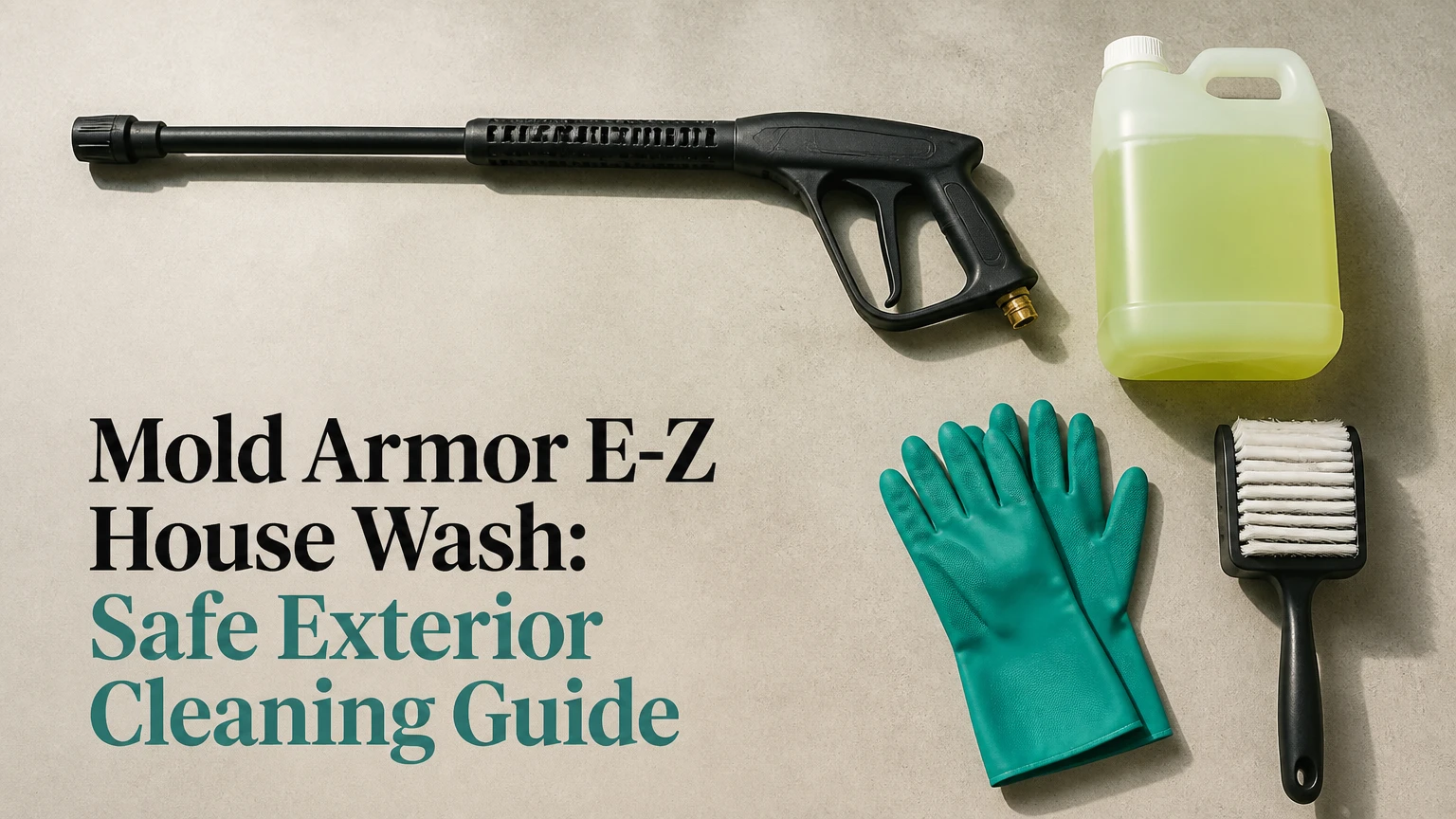
Mold Armor E-Z House Wash is a bleach-based exterior cleaner from W.M. Barr & Company for removing mold, mildew, algae, dirt, and grime from compatible siding, brick, concrete, and trim. The hose-end bottle is the simplest option for many homes: wet vegetation, apply foam, keep the surface wet for about 10 minutes, then rinse thoroughly.
Key Facts
- Mold Armor E-Z House Wash uses sodium hypochlorite, surfactants, and foaming agents to treat organic staining and lift surface soil.
- The usual working sequence is vegetation pre-wetting, bottom-up application, approximately 10 minutes of dwell time, and top-down rinsing.
- The 64-ounce hose-end product is typically marketed for up to 4,500 square feet, but porous or heavily stained surfaces reduce practical coverage.
- Ready-to-spray, refill, and pressure-washer products are different variants; never assume their dilution or application directions are interchangeable.
- Bleach can damage plants, fabrics, unfinished metals, and some coatings, so a test area and controlled runoff are essential.
- Mold Armor E-Z House Wash is an exterior surface cleaner, not a structural mold-remediation treatment or a universal roof-cleaning product.
What Is Mold Armor E-Z House Wash?
Mold Armor E-Z House Wash is a sodium-hypochlorite exterior wash that combines an oxidizing active ingredient with surfactants designed to cling to vertical surfaces. The product line includes a 64-ounce hose-end sprayer, gallon house-wash concentrate, and a separate siding and house pressure-washer concentrate.
The product is intended to remove visible organic discoloration from building exteriors without routine hand scrubbing. Sodium hypochlorite oxidizes biological staining, while surfactants help loosen and suspend dirt so water can carry it away. The foam improves contact on siding, but foam alone does not guarantee that deeply embedded growth has been eliminated.
The manufacturer’s product pages identify applications including brick, concrete, trim, and siding. Current packaging remains the controlling source for surfaces, dilution, warnings, and first-aid instructions because formulations, labels, and regional products can change.
What Mold Armor E-Z House Wash Is Not
Mold Armor E-Z House Wash is not a substitute for repairing leaks, replacing rotten wood, correcting failed caulk, or removing water-damaged drywall. Exterior discoloration can return when gutters overflow, sprinkler heads wet walls, or shaded surfaces remain damp.
The cleaner is also not automatically suitable for asphalt shingles, copper roofs, aluminum, galvanized metal, natural stone, or delicate painted finishes. A house wash and a roof-treatment product may use related chemistry but have different labels and application controls. EPA guidance summarizes the compliance principle clearly: “The label is the law.”
How Does the Formula Work?
Sodium hypochlorite oxidizes mold, mildew, and algae staining, while surfactants reduce surface tension and help suspend loosened soil for rinsing. Foaming agents slow runoff on vertical walls, extending wet contact, but the treatment only works predictably when the surface remains wet and the solution is rinsed before drying.
Sodium Hypochlorite Treats Organic Staining
Sodium hypochlorite is the active biological and stain-oxidizing component associated with household bleach. It can lighten green algae, mildew films, and some black organic discoloration, although old stains may leave a shadow after the visible growth has died.
A pale surface after washing does not prove that every organism or moisture problem has been removed. Porous masonry can retain pigment, and textured siding can shelter growth in joints and recesses.
Surfactants Lift Dirt
Surfactants help water spread across siding instead of forming isolated droplets. They also loosen oily dust, pollen residue, and particulate soil that sodium hypochlorite does not chemically dissolve.
The resulting residue must be rinsed away. Leaving surfactant film on a wall can create streaks, haze, or a chalky appearance that resembles coating damage.
Foam Extends Contact
Foam clings longer than a thin stream on a vertical surface. That added contact time is useful on siding, but foam is not a measurement of chemical strength and more foam is not always better.
Direct sun, wind, hot siding, and low humidity accelerate evaporation. On such days, divide the wall into small sections and keep each section visibly wet until rinsing.
Which Product Variant Should You Use?
Choose the 64-ounce hose-end sprayer for a typical one- or two-story home when you want low setup complexity. Choose a labeled gallon concentrate only when the container specifically supports your sprayer or pressure-washer method, because ready-to-spray and concentrated formulas can have different directions.
| Product option | Typical tool | Published or typical coverage | Best fit |
|---|---|---|---|
| 64-ounce E-Z House Wash hose-end bottle | Garden hose | Up to 4,500 sq. ft. | One- or two-story siding and masonry |
| 1-gallon E-Z House Wash concentrate | Pump sprayer, sponge, or refill method stated on label | Up to 4,500 sq. ft. on listed packaging | Larger projects or targeted treatment |
| 1-gallon E-Z Siding and House Pressure Washer Concentrate | Compatible downstream injector or soap system | Varies by injector and machine | Large exterior areas with existing equipment |
| Soft-wash professional cleaner | Dedicated proportioner and low-pressure equipment | Varies by final mix and surface | Large, high, delicate, or heavily contaminated properties |
Coverage figures are maximum product claims, not guaranteed field yield. Rough concrete, deeply profiled siding, heavy growth, overspray, and repeated passes consume more solution than smooth vinyl.
Which Exterior Surfaces Are Suitable?
Mold Armor E-Z House Wash is commonly positioned for vinyl siding, brick, concrete, and exterior trim, but the correct decision depends on the current product label and the coating condition. Test an inconspicuous area first, allow it to dry, and inspect for color change, whitening, corrosion, or loss of gloss.
| Surface | Typical suitability | Main risk | Practical control |
|---|---|---|---|
| Vinyl siding | Usually suitable when label-listed | Oxidation, streaking, water behind panels | Low-pressure application and thorough rinse |
| Brick and concrete | Usually suitable when label-listed | Mortar discoloration and porous residue | Saturate evenly and rinse joints carefully |
| Painted wood | Conditional | Paint fading, fiber swelling, peeling | Test first and use the lowest effective exposure |
| Stucco | Conditional | Pigment loss and water intrusion | Avoid aggressive pressure and inspect cracks |
| Aluminum siding | Conditional | Oxidation and chalking | Test for color change before full application |
| Glass and windows | Avoid chemical drying | Cloudy or mineral-like film | Keep wet and rinse immediately |
| Plants and lawn | Not a target surface | Leaf scorch and discoloration | Pre-wet, shield, and flush with clean water |
How Do You Apply the Hose-End Bottle?
Apply Mold Armor E-Z House Wash in seven controlled stages: prepare the area, wet vegetation, connect the hose, foam the wall from bottom to top, maintain roughly 10 minutes of wet contact, rinse from top to bottom, and flush the surroundings again. A typical single-story facade takes 30-45 minutes.
Before You Start
| Requirement | Typical value | Why it matters |
|---|---|---|
| Project time | 30-45 minutes per small facade | Includes setup and rinsing |
| Dwell time | About 10 minutes | Prevents premature rinsing or drying |
| Water supply | Fully open outdoor spigot | Hose-end siphons need adequate flow |
| Working distance | About 10-15 feet | Reduces concentrated overspray |
| Product quantity | One 64-ounce bottle for up to 4,500 sq. ft. claimed coverage | Actual yield varies by soil and surface |
| Protective equipment | Eye protection, gloves, long sleeves, closed shoes | Reduces bleach-contact exposure |
Wear clothing that can tolerate bleach spotting. Remove or cover outdoor cushions, flags, toys, untreated wood furniture, and metal decorations before spraying.
Step 1: Protect Plants and Nearby Property
Thoroughly wet grass, shrubs, flowers, and soil beside the wall with clean water before opening the cleaner. Cover sensitive plants when practical, redirect downspouts, and keep runoff away from ponds, storm drains, and neighboring property.
Success checkpoint: leaves and soil are visibly saturated before chemical application.
Common mistake: wetting only the top leaves while dry soil and lower foliage remain exposed.
Step 2: Connect the Hose Correctly
Turn the bottle dial to OFF, attach a standard 5/8-inch garden hose securely, and open the outdoor spigot fully. Inspect the connection for leaks before selecting CLEAN.
Success checkpoint: the hose connection remains tight and the sprayer produces a consistent stream.
Common mistake: partially opening the spigot, which can reduce flow through the siphoning valve.
Step 3: Apply Foam From Bottom to Top
Select CLEAN and spray a manageable wall section from approximately 10-15 feet away, moving from the bottom upward. The lower edge receives fresh solution rather than dirty runoff from untreated upper siding, which reduces vertical cleaning lines.
Use controlled passes rather than holding the nozzle on one spot. Avoid forcing spray into window seals, vents, electrical fixtures, soffit openings, and siding laps.
Success checkpoint: the wall is evenly coated with wet foam and no dry stripes appear.
Common mistake: starting at the roofline and allowing contaminated solution to run down dry siding.
Step 4: Maintain About 10 Minutes of Wet Contact
Allow the cleaner to work for approximately 10 minutes, but do not let the solution dry on siding, glass, trim, or painted surfaces. Mist the section lightly with clean water when sunlight or wind begins removing the wet film.
Success checkpoint: organic discoloration has visibly lightened and the foam remains damp.
Common mistake: treating the entire house at once, then discovering that the first wall dried before rinsing.
Step 5: Rinse From Top to Bottom
Return the dial to RINSE, or use the product’s stated rinse setting, and wash the wall from the highest treated area downward. Use normal hose pressure whenever possible; high pressure can drive water behind vinyl panels, damage mortar, strip paint, and force water into openings.
Rinse windows, trim, corners, and horizontal ledges separately. Continue until no foam or slippery residue remains.
Success checkpoint: runoff is clear of visible foam and the surface has an even appearance.
Common mistake: rinsing only the broad face while leaving chemical residue on window frames and lower trim.
Step 6: Flush Vegetation and Runoff Paths
Turn the bottle to OFF, disconnect or store the product, and wash plants, lawn, soil, walkways, and nearby objects with clean water. A second flush reduces residue concentration on leaves and prevents dried cleaner from remaining on hardscape.
Success checkpoint: no foam remains on vegetation, windowsills, or ground surfaces.
Common mistake: assuming rain will provide an adequate post-wash rinse.
Step 7: Inspect After Drying
Allow the wall to dry naturally and inspect it in indirect light. Remaining dark marks may indicate embedded pigment, oxidation, protected growth, or an unrelated coating defect rather than insufficient rinsing.
Repeat only when the label permits another application. Do not escalate to pressure without identifying the cause of the remaining mark.
How Do the Hose-End and Pressure-Washer Methods Compare?
The hose-end bottle is usually the safer choice for routine residential cleaning because it minimizes equipment and pressure. A pressure-washer system rinses large areas faster, but its water force creates greater risk around siding joints, windows, caulk, vents, and deteriorated coatings.
| Decision factor | Hose-end bottle | Pressure-washer concentrate |
|---|---|---|
| Setup time | 2-5 minutes | 10-20 minutes, including injector setup |
| Chemical application pressure | Garden-hose flow | Low-pressure soap setting |
| Rinse speed | Moderate | Faster on large walls |
| Equipment cost | Existing hose, typically $12-$18 product price | Existing washer plus typically $15-$30 concentrate |
| Siding intrusion risk | Lower | Higher if a narrow or high-pressure tip is used |
| Water dependence | Outdoor spigot flow | Machine gallons per minute and injector compatibility |
| Best project size | Small to medium residential facade | Large facade or multiple buildings |
A pressure washer should apply chemical through a low-pressure soap nozzle, not a high-pressure tip. Use a wide rinse pattern and maintain distance from siding, especially around lower edges, seams, and damaged panels.
How Much Time, Product, and Money Should You Plan?
A small single-story facade typically requires 30-45 minutes and one 64-ounce bottle when the surface has moderate staining. Retail pricing commonly falls around $12-$18 for the hose-end bottle and $15-$30 for a gallon concentrate, but local availability, package size, and seasonal pricing change the total.
| Project condition | Product planning | Typical active work time | Likely complication |
|---|---|---|---|
| 1,000 sq. ft. smooth vinyl facade | 1 hose-end bottle | 30-45 minutes | Window and plant protection |
| 2,500 sq. ft. mixed siding and trim | 1 bottle, possibly a second pass | 45-75 minutes | Uneven absorption and runoff |
| 4,500 sq. ft. maximum claimed area | At least 1 bottle, with reserve advisable | 1-2 hours | Coverage loss from heavy growth |
| Large masonry or two-story property | Concentrate or professional system | 2-4 hours | Access, porous surfaces, and rinsing |
The 4,500-square-foot figure should not be treated as a guarantee for every house. Count walls, gables, dormers, porches, and heavily stained sections, then buy reserve product if returning to the store would interrupt the project.
What Problems Occur During Application?
Most failed applications result from insufficient water flow, dried chemical, uneven coverage, poor rinsing, or substrate damage rather than weak chemistry. Diagnose the failure before applying a stronger solution or increasing pressure.
| Symptom | Probable cause | Corrective action | Do not do this |
|---|---|---|---|
| Bottle does not siphon | Low flow, kinked hose, blocked inlet, faulty connection | Open spigot fully, straighten hose, inspect adapter | Do not shake or puncture the bottle |
| White haze after drying | Dried soap, oxidation, or mineral residue | Rewet and rinse with clean water; test oxidation | Do not scrub aggressively before testing |
| Green spots remain | Dense growth, shaded recess, insufficient coverage | Reapply only as label permits and use a soft brush | Do not jump immediately to high pressure |
| Plants yellow or wilt | Concentrated overspray or runoff | Flush repeatedly with clean water | Do not add fertilizer or another chemical |
| Paint looks lighter | Oxidation or bleach sensitivity | Stop, rinse, and compare with an untreated area | Do not continue full-wall application |
| Streaks appear | Top-down chemical application or incomplete rinse | Rewash a small section evenly | Do not let a stronger mix dry |
Why Is the Hose-End Bottle Not Drawing Cleaner?
A hose-end sprayer needs adequate water flow to create the suction that pulls product from the container. A fully open spigot, unobstructed 5/8-inch hose, clean adapter, and adequate household pressure solve many siphoning problems, but a defective venturi valve requires product replacement.
Water pressure around 40 psi is often cited by retailers and user instructions as a practical threshold for some hose-end sprayers, not a universal specification for every Mold Armor package. Check the current label and sprayer instructions rather than treating 40 psi as a guaranteed manufacturer requirement.
Why Does White Residue Remain?
White residue usually comes from dried surfactant, hard-water minerals, or oxidized siding rather than mold. Rewet a small area and rinse it with clean water; if the haze remains after drying, compare it with an unwashed section to identify pre-existing oxidation.
Oxidized aluminum and vinyl can release a chalky film when rubbed. A cleaner cannot restore faded pigment, and repeated chemical exposure may make the appearance more noticeable.
Why Do Black Stains Remain?
Black staining can remain because pigment has penetrated porous material, growth is sheltered inside texture, or the mark is atmospheric soil rather than biological growth. A second label-permitted treatment with gentle agitation may help, but a persistent mark calls for substrate diagnosis instead of unlimited reapplication.
If staining returns quickly, inspect roof drainage, tree shade, sprinkler overspray, failed flashing, and wall moisture. Cleaning treats the appearance; it does not remove the moisture source.
What Are Safer Alternatives and Chemical Rules?
A non-bleach exterior cleaner, oxygen-based cleaner, or professional low-pressure wash may be preferable for delicate paint, sensitive landscaping, or surfaces where chlorine staining is unacceptable. Alternatives trade biological bleaching speed for lower corrosion, plant, or color risk, so select according to the substrate rather than the darkest stain.
| Alternative | Typical use | Main advantage | Main limitation |
|---|---|---|---|
| Oxygen-based exterior cleaner | Painted surfaces and light organic soil | Lower chlorine exposure | Often slower on heavy algae |
| Neutral siding detergent | Dirt and pollen on maintained siding | Low surface aggressiveness | Limited effect on established mildew |
| Low-pressure professional wash | Tall, delicate, or heavily stained homes | Controlled proportioning and access | Higher labor cost |
| Soft-bristle brush and water | Small isolated patches | Precise treatment | More labor and ladder exposure |
Do not make a substitute by casually mixing pool chlorine, laundry detergent, acids, ammonia, or other household products. Chemical compatibility, final concentration, surfactant behavior, and label legality cannot be inferred from an online recipe.
If a concentrate label permits dilution, measure it accurately in a dedicated container and use only the stated ratio. Never mix bleach products with acids or ammonia because hazardous gases can form.
When Should You Hire a Professional?
Hire a professional when the work requires roof access, ladder use above a safe working height, extensive containment near ponds, heavy contamination, deteriorated siding, or treatment of a large multi-story property. Professional soft-wash operators can proportion chemicals, control overspray, and collect or redirect runoff more reliably.
Exterior house washing is also a poor DIY project when the building has lead-based paint concerns, friable coatings, extensive water damage, or electrical components that cannot be protected. A cleaner should not be used to conceal structural mold caused by persistent moisture.
Frequently Asked Questions
Can Mold Armor E-Z House Wash Be Used on a Roof?
Do not use the house-wash product on a roof unless the current label specifically lists that roof material and application. Asphalt shingles, metal roofing, copper, tile, and roof coatings have different chemical and runoff risks, and high-pressure rinsing can remove granules or damage seams.
Does Mold Armor E-Z House Wash Kill Mold Permanently?
Mold Armor E-Z House Wash can treat visible organic staining, but it cannot guarantee permanent prevention. Mold and algae return when moisture, shade, airborne spores, clogged gutters, or sprinkler overspray remain, so correcting the moisture source matters as much as the wash.
Can the Cleaner Be Used Around Pets?
Keep pets away during application and until treated surfaces and surrounding areas have been thoroughly rinsed and dried. Follow the current label for reentry, storage, first aid, and accidental exposure instructions, and prevent pets from drinking runoff or walking through wet solution.
Can You Use a Brush With the Product?
Use a soft brush only when the label permits agitation and only after the solution has had appropriate contact time. A stiff brush can scratch vinyl, remove loose paint, damage mortar, or spread contaminated residue across adjacent surfaces.
Does Rain Replace the Final Rinse?
Rain is not a reliable substitute for a controlled rinse. Rainfall may leave cleaner in window tracks, trim joints, plant foliage, and low spots, while a deliberate freshwater rinse lets you verify that foam and residue have been removed.
How Soon Can You Wash the House Again?
Repeat washing only when the product label allows it and the surface has been evaluated after drying. A second pass may address sheltered growth, but repeated bleach exposure can accelerate coating fade, metal corrosion, plant injury, and surface oxidation.
The Bottom Line
Mold Armor E-Z House Wash is a practical bleach-based exterior cleaner for compatible siding, brick, concrete, and trim when applied according to the current label. For most homeowners, the hose-end bottle offers the simplest process: pre-wet plants, apply from bottom to top, keep the surface wet for about 10 minutes, rinse from top to bottom, and flush the surrounding area.
Choose the pressure-washer concentrate only when the product, injector, and surface are compatible and you can apply chemical at low pressure. Mold Armor E-Z House Wash can improve exterior appearance, but accurate surface selection, runoff control, and moisture-source correction determine whether the result remains safe and durable.