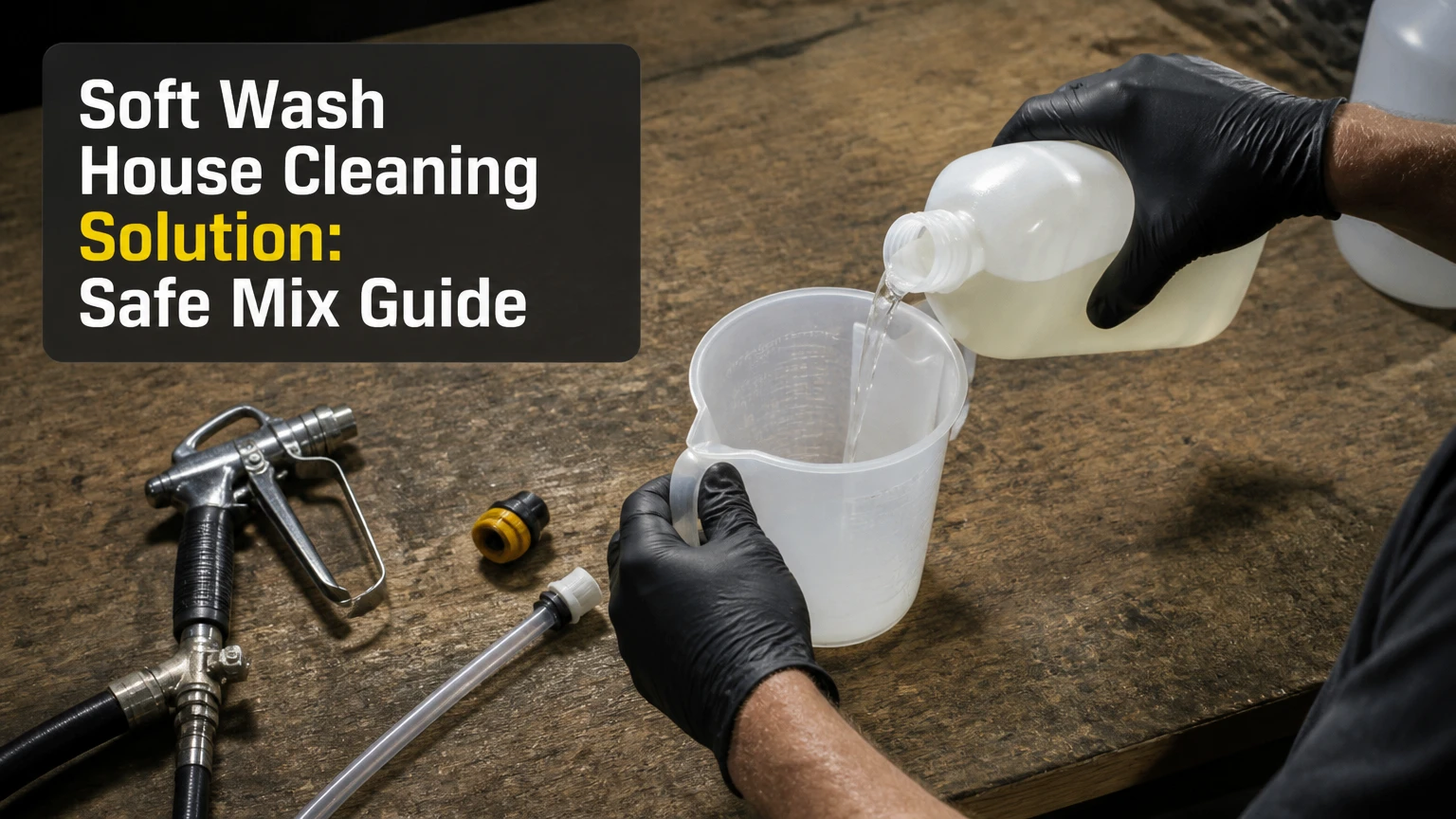
A soft wash house cleaning solution combines a registered exterior-cleaning biocide, water, and a compatible surfactant, then applies the mixture at low pressure to remove algae, mildew, mold, and lichen without relying on force. For most siding, a final sodium hypochlorite concentration of about 0.5%-1.5% is typical, but the correct strength depends on the material, growth, product label, and runoff risk.
Key Facts at a Glance
- Sodium hypochlorite is the fastest common soft-wash biocide for organic staining, but it can damage plants, metals, coatings, and fabrics when mishandled.
- A siding wash commonly reaches the wall at approximately 0.5%-1.5% available chlorine, while roofs may require stronger professional formulations.
- Surfactants improve wetting and cling; they do not replace the biocide or make an unsafe mixture safe.
- Soft washing uses chemical dwell time and low-impact rinsing, while pressure washing uses water impact as the primary cleaning mechanism.
- Never mix bleach or sodium hypochlorite with acids, ammonia, vinegar, toilet cleaners, or other incompatible chemicals.
- A small, reachable siding project may be suitable for a trained DIY homeowner; roofs, multi-story work, and concentrated chemical handling usually warrant a professional.
What Is a Soft Wash House Cleaning Solution?
A soft wash house cleaning solution is a diluted exterior cleaner designed to kill or loosen biological growth before a low-pressure rinse. The mixture normally contains water, a biocide such as sodium hypochlorite, and a bleach-stable surfactant. Some systems use quaternary ammonium compounds instead of chlorine-based chemistry.
Soft washing is appropriate for organic discoloration on vinyl siding, painted cladding, fiber-cement siding, stucco, masonry, and many asphalt-shingle roofs when the material manufacturer permits chemical cleaning. The method is not a universal repair system. It cannot restore failing paint, replace missing mortar, repair rotten wood, or remove every oil, rust, or hard-water deposit.
Pressure also requires clarification. “Low pressure” does not mean a fixed universal number, and a garden hose is not automatically safer. Professional systems may apply solution at roughly 40-150 PSI, while some equipment operates higher depending on flow, nozzle, distance, and surface. The safe outcome depends on impact, spray pattern, operator control, and the substrate.
Why does soft washing work?
Soft washing works because a suitable biocide disrupts living organic growth, and dwell time allows the solution to contact porous areas that a brief water blast may leave untreated. Rinsing then removes dead material and dissolved soil with considerably less mechanical impact than conventional power washing.
The result depends on the type of stain. Green algae, mildew, mold, and many black roof streaks respond to biological treatment. Rust, artillery fungus, artillery-spore marks, efflorescence, and grease require different chemistry or mechanical methods. Treating every stain with stronger bleach creates risk without solving the underlying problem.
What Ingredients Belong in the Mix?
A practical soft-wash formula has three functional components: an approved sanitizer, clean water, and a compatible surfactant. Additives such as plant rinsing agents or specialty stain removers belong in separate stages unless the product manufacturer expressly permits combination.
| Ingredient or system | Primary function | Typical limitation or risk |
|---|---|---|
| Sodium hypochlorite, 5%-12.5% stock | Oxidizes organic growth and removes biological discoloration | Corrosive, plant damaging, strength declines with heat and sunlight |
| Quaternary ammonium compound, such as DDAC | Slower biological control with less bleaching | Requires label-compliant use and longer contact time |
| Bleach-stable surfactant | Improves wetting, cling, and dwell time | Excess foam can obscure coverage and complicate rinsing |
| Fresh water | Dilutes concentrate and carries solution to the surface | Hard or mineral-rich water may leave deposits |
| Sodium thiosulfate product | Helps neutralize residual chlorine during remediation | Does not replace pre-wetting, rinsing, or runoff control |
| Oxalic acid or specialty rust remover | Addresses rust or tannin staining in a separate treatment | Acid and hypochlorite can release chlorine gas if combined |
Is sodium hypochlorite the best cleaner?
Sodium hypochlorite is usually the most predictable fast-acting option for exterior organic growth, but it is not automatically the best choice for every material or property. A lower-impact quaternary ammonium product may fit a wood project, odor-sensitive site, or maintenance program when the slower response and label directions are acceptable.
Commercial sodium hypochlorite is often sold at approximately 10%-12.5% available chlorine, although concentration varies by supplier, age, storage, and temperature. A container stored outdoors in summer may be materially weaker than its printed strength. Professionals should verify the product label and account for degradation rather than treating the nominal percentage as exact.
The U.S. Environmental Protection Agency requires antimicrobial pesticide products to carry approved labels that specify uses, application directions, and safety requirements. The label controls when a product is used as a biocide. A homemade mixture is not automatically legal or appropriate because a recipe appears online.
What does surfactant actually do?
A surfactant reduces surface tension so the solution wets textured or vertical surfaces more evenly and remains in contact longer. A surfactant cannot compensate for weak chemical, poor coverage, wind, excessive runoff, or an incorrect stain diagnosis.
Use a product identified as compatible with sodium hypochlorite. Ordinary dish detergent can create excessive foam, leave residue, interfere with rinsing, or behave unpredictably in a concentrated chemical system. Product-specific instructions take priority over generic recipes.
What Strength Should You Use on Each Surface?
The correct final strength is the concentration that reaches the surface, not the percentage printed on the stock container. Typical professional starting ranges appear below, but an inconspicuous test patch, the material manufacturer, and the chemical label should determine the final decision.
| Surface | Typical final SH range | Approximate 12.5% SH to water ratio* | Typical dwell |
|---|---|---|---|
| Lightly soiled vinyl siding | 0.5%-1.0% | 1:12 to 1:25 | 5-10 minutes |
| Moderately soiled vinyl or aluminum | 1.0%-1.5% | 1:7 to 1:12 | 5-10 minutes |
| Painted wood or fiber cement | 0.5%-1.5% | 1:7 to 1:25 | 3-8 minutes |
| Stucco or EIFS | 1.0%-2.0% | 1:5 to 1:12 | 5-10 minutes |
| Asphalt shingles | Often 2.0%-5.0% | 1:1.5 to 1:5 | Label and professional control |
*Ratios are approximate starting points and ignore surfactant volume, stock degradation, application loss, and measurement error. Roof chemistry requires particular caution.
A simple dilution calculation is:
Stock volume = desired final concentration × total batch volume ÷ stock concentration
For example, 1 gallon of 12.5% stock theoretically produces about 10 gallons of a 1.25% solution before accounting for additives. A homeowner should measure with chemical-resistant tools, avoid guessing by container size, and never transfer chemicals into unmarked bottles.
Why are online mix ratios inconsistent?
Online ratios differ because operators use different stock strengths, pumps, water volumes, growth severity, climates, and definitions of “mix.” Some describe the concentration in the tank; others describe the concentration delivered at the nozzle. Those values are not interchangeable.
A proportioning system may draw separate chemical and water streams, while a pump sprayer uses a pre-mixed batch. The same “1:10” instruction can produce different results if the source chemical is 5% instead of 12.5%. Treat every ratio as incomplete until the stock percentage and final application strength are stated.
How Do You Apply the Solution Safely?
Apply a soft wash house cleaning solution in controlled sections, protect nearby materials, prevent drying, and rinse with high volume at low impact. A typical one-story siding wash takes 1.5-3 hours, excluding setup, with the greatest risk occurring around plants, windows, electrical components, and runoff paths.
Before you start
| Requirement | Typical specification |
|---|---|
| Project size | 500-2,000 square feet of reachable siding |
| Working time | 2-4 hours including protection and rinsing |
| Water supply | Stable supply capable of sustained rinsing |
| Application tool | Pump sprayer, downstream injector, or chemical-rated soft-wash pump |
| Protective equipment | Chemical-resistant gloves, eye protection, long sleeves, closed footwear |
| Test area | 1-2 square feet in an inconspicuous location |
| Weather | Low wind, moderate temperature, no imminent rain |
Read the Safety Data Sheet and product label first. Keep children, pets, and bystanders away. Do not work near overhead electrical lines, unstable ladders, or surfaces that cannot be identified.
Step 1: Inspect and isolate the property
Identify siding type, failed caulk, open vents, oxidized paint, delicate plants, outdoor outlets, cameras, lighting, and water-sensitive openings. Repair or disclose pre-existing defects before cleaning because low-pressure water can still enter damaged assemblies.
Step 2: Test the surface and solution
Apply the weakest reasonable mixture to a hidden patch and observe color, coating, runoff, and cleaning response. Wait for the test area to dry before judging apparent fading, especially on painted wood, oxidized aluminum, and older vinyl.
You know the test passed when the substrate remains uniform and the biological film lightens without coating transfer or discoloration. The common mistake is testing only whether the stain disappears, while ignoring delayed paint or plant damage.
Step 3: Pre-wet and protect vegetation
Drench grass, shrubs, flowerbeds, and soil with clean water before chemical application. Move portable items, close windows, cover sensitive fixtures, and route downspouts away from concentrated discharge where practical.
Pre-wetting reduces absorption by foliage, but it does not make bleach runoff harmless. Sensitive plants may still suffer from droplets, drift, or contaminated soil. Avoid spraying in wind, and do not rely on plastic covers alone because trapped chemical vapor and runoff can damage leaves.
Step 4: Apply a controlled section
Work in manageable sections, usually 100-300 square feet, so the solution remains wet during dwell. Apply enough product for uniform coverage without flooding seams, vents, windows, or landscaping.
The common bottom-to-top rule is not universal. Applying from the bottom upward can reduce dirty drip marks on some siding, but it may increase chemical exposure at the lower edge. On many homes, the safer sequence is to control runoff, maintain wet edges, and rinse top to bottom after coverage. Follow the equipment and chemical manufacturer’s directions.
Step 5: Maintain dwell without drying
Allow approximately 3-10 minutes for ordinary siding, monitoring the surface continuously. Re-wet with a light application if the solution begins to dry, because evaporation increases local concentration and can produce streaking or coating damage.
You know the chemistry is working when organic discoloration fades or releases with minimal rinsing. Do not extend dwell indefinitely to compensate for a weak or degraded product. Fresh solution, complete coverage, and accurate concentration usually outperform excessive dwell.
Step 6: Rinse from top to bottom
Rinse windows, frames, siding, trim, plants, fixtures, and horizontal ledges with abundant clean water. Use a broad fan pattern and enough distance to avoid forcing water behind siding or under roof materials.
The surface is adequately rinsed when no foam, odor, visible residue, or chemical sheen remains. A final visual inspection matters more than a single pass. Windows often need multiple rinses because surfactant and oxidized soil can collect on the glass edge.
Step 7: Neutralize and inspect
Re-water vegetation and hardscape after rinsing. A labeled sodium thiosulfate product may help neutralize residual chlorine during a controlled cleanup, but it does not reverse tissue that has already been chemically injured.
Inspect for missed growth, damaged screens, yellowed foliage, oxidation, and runoff accumulation. Record the product, dilution, weather, dwell time, and affected areas so a future maintenance wash can use a safer starting point.
Which Application System Is Appropriate?
A pump sprayer is adequate for small, ground-level spot work, while a dedicated chemical-resistant pump gives professionals better reach and concentration control. Downstream injectors are convenient but often deliver weaker mixtures than a dedicated soft-wash pump.
| Delivery method | Typical pressure or reach | Best use | Main limitation |
|---|---|---|---|
| Pump-up sprayer | 20-60 PSI, 8-12 feet | Small one-story spot treatment | Slow, uneven coverage, operator exposure |
| Downstream injector | 500-1,500 PSI system pressure, 20-30 feet | Light siding maintenance | Limited chemical draw and concentration |
| 12-volt diaphragm pump | 40-100 PSI, 30-60 feet | Professional siding and roof work | Requires chemical-rated components |
| Proportioner manifold | 40-100 PSI, 30-60 feet | Repeatable blend-on-demand application | Higher equipment cost and training requirement |
A pressure washer can be part of a soft-wash setup, but its pump pressure does not define the pressure at the surface. A large nozzle, long hose, and proper standoff distance can reduce impact. Conversely, a narrow nozzle held close can damage siding even when the machine is marketed for soft washing.
Soft Washing Versus Pressure Washing: Which Is Better?
Soft washing is generally better for biological growth on siding, painted surfaces, and roofs because chemistry reduces the need for impact. Pressure washing is generally better for hard, non-painted surfaces such as concrete when removing embedded soil, tire marks, or some surface deposits.
| Decision factor | Soft washing | Pressure washing |
|---|---|---|
| Primary action | Biocide and dwell time | Water impact and agitation |
| Typical surface risk | Chemical or runoff damage | Etching, gouging, water intrusion |
| Best target | Mold, algae, mildew, lichen | Concrete soil, pavers, hard masonry |
| Typical siding pressure | 40-150 PSI at surface | Often excessive if used directly |
| Organic regrowth | Usually slower after treatment | May return sooner if roots remain |
| Main operator skill | Chemical control and rinsing | Pressure, distance, and nozzle control |
Neither method is automatically safe. Soft washing can brown landscaping or fade coatings; pressure washing can strip paint, damage mortar, and force water behind cladding. The correct method follows the substrate and stain, not the equipment already sitting in a garage.
What Does Professional Soft Washing Cost?
Typical professional house washing costs about $250-$1,200 for many residential properties, with roof cleaning priced separately in many markets. A final quote changes with access, height, growth severity, surface type, water availability, plant protection, and local labor rates.
| Project | Typical duration | Typical professional price | Common cost driver |
|---|---|---|---|
| Small one-story siding wash | 1.5-2.5 hours | $250-$450 | Minimum service charge |
| 1,500-2,500 square-foot home | 2-4 hours | $450-$850 | Height and plant density |
| Large or multi-story home | 3-6 hours | $650-$1,200+ | Reach, access, and setup |
| Asphalt-shingle roof | 3-6 hours | $300-$1,000+ | Roof pitch and containment |
| DIY ground-level wash | 2-5 hours | $50-$200 | Sprayer, chemical, PPE, and water |
Published consumer cost guides such as Angi and HomeAdvisor commonly report broad exterior-cleaning ranges rather than a single national soft-wash price. Those figures are useful for budgeting, but they are not chemical-performance data and should not be treated as a guaranteed quote.
What Can Go Wrong?
The most common failures involve incorrect diagnosis, drying solution, incomplete rinsing, or uncontrolled runoff. Stronger chemistry is not a universal fix because surface damage can occur before a resistant stain responds.
| Symptom | Likely cause | Corrective action |
|---|---|---|
| Brown wood discoloration | Tannin or iron reaction | Rinse, then use a separately labeled specialty treatment |
| White or pale siding streaks | Dried or excessive SH | Rinse immediately and assess coating damage |
| Green growth remains | Weak, degraded, or incomplete coverage | Reassess stock strength and test a modest reapplication |
| Plants wilt or turn brown | Drift, runoff, or insufficient rinsing | Flush foliage and soil with clean water |
| Rust remains | Non-biological stain | Use a compatible rust remover separately |
| Dirty lower siding band | Uncontrolled runoff or uneven dwell | Improve section size, wet edges, and rinse control |
Oxalic acid must remain physically separate from sodium hypochlorite. The same rule applies to vinegar, muriatic acid, toilet-bowl cleaners, ammonia, and many other household products. The Centers for Disease Control and Prevention warns that mixing bleach with certain cleaners can release toxic gases; chlorine odor is not a reliable indicator of safe exposure.
When should you stop a DIY project?
Stop when the work requires a ladder on a steep roof, chemical spray above electrical equipment, containment of roof runoff near sensitive landscaping, or treatment of unknown or failing materials. A homeowner should also stop after an unsuccessful test patch, visible coating loss, chemical exposure, or uncontrolled wind drift.
Roof work adds fall exposure and concentrated runoff. A professional should provide insurance information, identify the proposed chemical, explain plant protection, and state how runoff and final rinsing will be managed. A low price that omits protection can cost more than the cleaning itself.
What Are Safer Alternatives to Chlorine?
Quaternary ammonium products, hydrogen-peroxide-based cleaners, and manufacturer-approved specialty products can reduce bleaching or odor in selected situations, but slower action and different application rules are trade-offs. Mechanical brushing with a mild detergent may suit light dirt on a small, durable surface.
No alternative is automatically plant-safe or environmentally harmless. Read the label, protect drainage routes, and test compatibility with paint, sealants, roofing granules, metals, and glass. For heavy black algae or mature lichen, a mild alternative may require repeated treatments rather than one aggressive application.
Frequently Asked Questions
Can I use household bleach for soft washing?
Household bleach may contain fragrances, thickeners, or additives that are unsuitable for exterior equipment and controlled application. Professional sodium hypochlorite is typically more predictable, but every product must be used according to its label, concentration, storage requirements, and intended application.
How long should a soft wash remain on siding?
A typical siding dwell time is 3-10 minutes, provided the surface stays wet and the product label permits that contact period. Sun, wind, temperature, porosity, and growth severity change the timing. Rinse before drying rather than extending dwell to force a faster result.
Will soft washing remove black streaks from roof shingles?
Soft washing can remove many organic black streaks associated with roof algae, including stains commonly linked with Gloeocapsa species. Roof cleaning requires controlled application, careful foot-traffic avoidance, gutter and runoff planning, and compliance with shingle manufacturer guidance. Do not climb or spray a roof without suitable training and fall protection.
Can soft washing damage windows?
Soft-wash chemicals can damage window screens, oxidized frames, seals, films, and some coatings if they dry or remain unrinsed. Keep application controlled around glazing, rinse glass and frames repeatedly, and follow the window manufacturer’s care instructions.
How often should a house be soft washed?
Many homes need cleaning every 1-3 years, but shade, humidity, tree cover, orientation, and local climate can shorten or extend that interval. Inspect for returning biological growth rather than following a rigid calendar. Better drainage and reduced shade can also slow recurrence.
Does soft washing kill mold inside walls?
Exterior soft washing treats accessible surface growth and staining; it does not remediate mold inside wall cavities, insulation, crawlspaces, or HVAC systems. Persistent indoor odor, moisture damage, or concealed growth requires moisture correction and an indoor environmental assessment.
The Bottom Line
The safest soft wash house cleaning solution is the weakest labeled mixture that removes the identified growth without drying, damaging the substrate, or contaminating landscaping. For many siding projects, that means a carefully tested final sodium hypochlorite strength near 0.5%-1.5%, a compatible surfactant, controlled low-impact application, and thorough rinsing. Concentrated roof work, elevated access, uncertain materials, and sensitive runoff conditions justify hiring a trained professional.