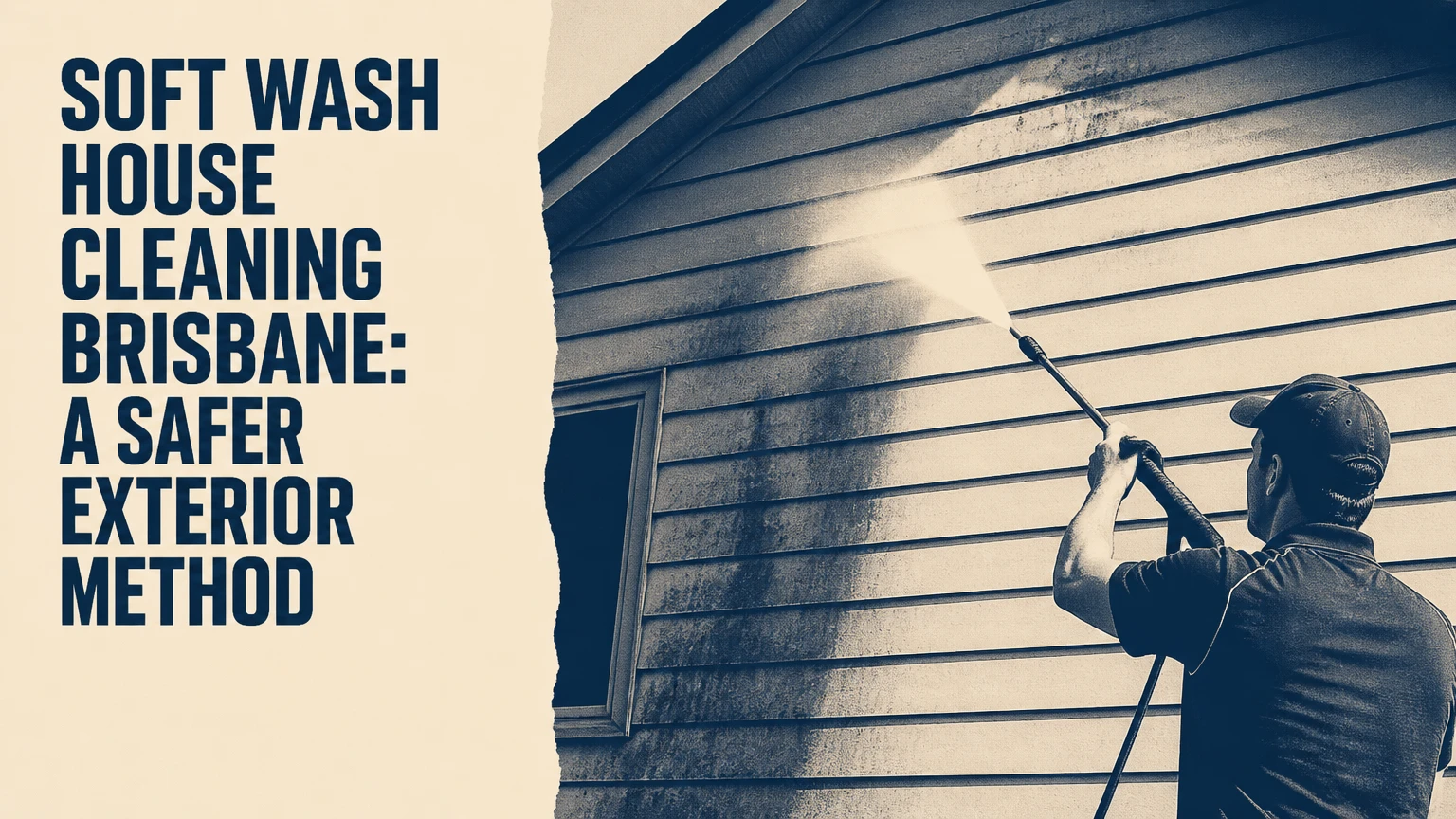
Soft wash house cleaning Brisbane services use low-pressure water and a carefully selected cleaning solution to remove mould, algae, lichen, mildew, and surface dirt from home exteriors. The solution does most of the biological cleaning, while a gentle high-volume rinse removes residue without the impact of conventional pressure blasting.
Key Facts at a Glance
- Professional soft washing commonly uses pressures below 500 PSI, although the exact pressure depends on the pump, nozzle, distance, and surface.
- Sodium hypochlorite is often the primary biocidal ingredient, while surfactants improve cling and coverage.
- A typical Brisbane house wash costs about $400-$1,250, depending on size, access, height, and surface condition.
- A standard single-storey wash takes approximately 2-3 hours; complex double-storey work commonly takes 4-6 hours.
- Pre-wetting, covering vulnerable assets, and post-rinsing plants are essential controls against chemical damage.
- Soft washing removes organic growth effectively, but oil, rust, mineral scale, and failing paint require separate treatment or repair.
What Is Soft Wash House Cleaning in Brisbane?
Soft wash house cleaning in Brisbane is an exterior maintenance method that combines a low-impact water application with a biocidal or detergent-based solution. Unlike high-pressure cleaning, the method is designed to kill and loosen biological growth rather than scrape it from the surface with force.
The term “soft wash” does not identify one universally fixed pressure. Many contractors work below 500 PSI, and some delicate applications use garden-hose-level pressure or a dedicated low-pressure pump. The practical safety result depends on nozzle type, spray distance, flow volume, chemical strength, substrate condition, and operator control.
Brisbane’s humid subtropical conditions create favourable growth conditions on shaded walls, eaves, tile roofs, fences, and north-facing or tree-covered elevations. Homes near bushland, creeks, the Brisbane River, or the bayside may accumulate organic debris and salt faster than exposed inland properties.
Soft washing is therefore a maintenance treatment, not simply a cosmetic rinse. It can improve appearance and reduce biological regrowth, but it cannot repair cracked render, failed sealant, loose paint, roof leaks, or deteriorated cladding.
How Does the Soft Washing Process Work?
Soft washing works through contact time and chemical breakdown. The technician applies a material-appropriate solution, allows it to work while keeping the surface wet, then rinses from the top down using controlled water volume and low impact.
The sequence matters because the main risks are not limited to the spray itself. Poor inspection can force water behind cladding, inadequate plant protection can scorch foliage, and dried solution can leave residue on glass, paint, or metal. Professional work treats the building envelope and surrounding property as part of one system.
The Seven-Step Professional Sequence
- Inspect and map the property. Identify render, brick, painted timber, vinyl or fibre-cement cladding, roofing, sealants, windows, vents, electrical fittings, and existing damage. Check for loose coatings, open joints, cracked surfaces, and paths where water could enter.
- Prepare the site. Close windows, secure doors, move outdoor furniture, protect electrical fixtures, and identify rainwater tanks, ponds, air-conditioning units, solar equipment, and delicate plants.
- Pre-wet vulnerable vegetation. Fresh water dilutes incidental overspray. Plants under eaves, beside walls, and beneath downpipes need particular attention because they receive concentrated runoff.
- Mix the solution for the substrate. Sodium hypochlorite strength, surfactant quantity, and contact time should be adjusted to the material and organic load. The product label and Safety Data Sheet should control handling.
- Apply from the bottom upward. A bottom-up application helps keep the working face uniformly wet and reduces uneven drying on porous or absorbent walls. The spray should remain broad and controlled.
- Monitor dwell time. A typical contact window is 5-15 minutes, but sunlight, wind, temperature, porosity, and contamination change the required time. Never allow the solution to dry on the surface.
- Rinse from the top downward. Use fresh water to remove dead growth and chemical residue, giving windows, frames, vents, door hardware, and ledges additional rinsing where runoff collects. Re-wet plants and soil after the wash.
A skilled operator changes the process when conditions change. A dark wall in full sun may need smaller working sections, more frequent misting, or a lower-strength mix than a shaded brick elevation with heavy mould.
Which Chemicals and Equipment Are Used?
Soft washing commonly uses sodium hypochlorite, surfactants, and clean water, although the exact formulation varies by surface and product label. Quaternary ammonium compounds may be used for selected post-treatment applications, but they are not interchangeable with every bleach-based system.
| Component | Primary function | Typical control point | Main risk |
|---|---|---|---|
| Sodium hypochlorite | Kills mould, algae, mildew, and lichen | Label-directed concentration | Plant injury, fading, corrosion |
| Surfactant | Improves cling and wetting | Small measured addition | Residue or incompatible finish |
| Clean water | Carries, dilutes, and rinses solution | Adequate flow for full rinse | Water ingress if misdirected |
| Quaternary ammonium product | Selected residual biocidal treatment | Product-specific dwell time | Material or environmental incompatibility |
A downstream injector uses a pressure-washer pump to draw chemical into the water stream after the pump. A dedicated 12V or air-diaphragm pump carries the solution independently and can offer more consistent chemical delivery at low pressure. Neither setup is automatically safer; nozzle selection, concentration, distance, and operator technique determine the result.
Brisbane contractors should carry chemical labels and Safety Data Sheets, use chemical-resistant gloves and eye protection, and prevent incompatible products from mixing. Sodium hypochlorite must not be combined with acids, ammonia, or acidic descalers because dangerous gases or reactions can result.
Which Brisbane Surfaces Are Suitable?
Soft washing is usually suitable for painted weatherboard, acrylic render, fibre-cement cladding, vinyl siding, roof tiles, Colorbond roofing, brickwork, gutters, eaves, and fences when the substrate is sound. The method must be adjusted for porous, chalking, cracked, oxidised, or previously repaired materials.
| Surface | Preferred method | Typical pressure approach | Inspection priority |
|---|---|---|---|
| Acrylic render | Chemical wash and gentle rinse | Below 500 PSI, often lower | Cracks, hollow areas, failed coating |
| Painted timber weatherboard | Controlled soft wash | Garden-hose-level to low pressure | Open laps, peeling paint, rot |
| Face brick | Soft wash with targeted rinse | Below 500 PSI | Mortar condition and efflorescence |
| Colorbond roof | Low-pressure chemical treatment | Low pressure only | Rust, exposed fasteners, paint failure |
| Concrete or terracotta tiles | Soft wash, no aggressive blasting | Low pressure | Broken tiles, lichen, roof access |
| Driveway concrete | Pressure or surface cleaning | Often higher pressure | Oil, tyre marks, mineral deposits |
Render and Weatherboard
Modern acrylic render can lose its texture or protective coating under aggressive pressure. Painted weatherboard can also admit water through laps, joints, vents, and deteriorated paint when the operator sprays upward or too closely.
Soft washing does not make defective cladding waterproof. If a wall has movement cracks, blown render, rotten timber, or failed flashing, cleaning should follow a repair assessment rather than conceal the defect.
Roofs, Gutters, and Eaves
Roof soft washing is appropriate for organic staining on many Colorbond and tiled roofs, but roof access creates a separate fall hazard. Wet tiles become slippery, and chemical solution increases that risk. A contractor should assess roof pitch, fragile tiles, skylights, solar panels, access points, and safe ground-based alternatives.
Gutters and eaves often need manual debris removal before washing. Soft wash chemicals can kill growth on gutter edges, but they do not replace clearing blocked downpipes or repairing leaking joints.
Solar Panels and Rainwater Tanks
Solar panels require a manufacturer-compatible cleaning approach, with attention to seals, frames, electrical equipment, and runoff. Rainwater tanks need isolation or diversion when roof chemicals could enter the collection system. Ask the contractor how downpipes will be managed before work begins.
How Much Does Soft Wash House Cleaning Cost in Brisbane?
Typical Brisbane soft wash pricing ranges from $400-$750 for a small single-storey house and $650-$1,250 for a medium double-storey home. Roofs, difficult access, heavy lichen, coastal salt, fragile surfaces, plant protection, and gutter work can move the quote above these ranges.
| Service | Typical Brisbane price | Typical duration | Main price variable |
|---|---|---|---|
| Small single-storey house wash | $400-$750 | 2-3 hours | Wall area and access |
| Medium double-storey house wash | $650-$1,250 | 4-6 hours | Height and setup |
| Colorbond roof soft wash | $650-$900+ | 3-5 hours | Pitch and roof condition |
| Terracotta or concrete tile roof | $850-$1,100+ | 4-7 hours | Fragility and lichen load |
| Gutters and eaves add-on | $300-$400 | 1-2 hours | Debris volume and height |
These are typical service-planning ranges, not fixed Brisbane tariffs. A $450 quote may exclude windows, gutters, heavy staining, access equipment, or plant protection, while a $900 quote may include those controls and a larger wall area.
What Changes the Quote?
Contractors normally price the following variables:
- Total wall and roof area rather than only bedroom count.
- Number of storeys, roof pitch, ladders, scaffolding, and restricted side access.
- Surface type, especially porous render, aged timber, delicate tiles, or chalking paint.
- Mould, algae, lichen, bird waste, soot, salt, and accumulated leaf debris.
- Distance between the water source, chemical equipment, and work area.
- Protection requirements for gardens, ponds, pets, solar equipment, and rainwater systems.
- Additional cleaning for glass, screens, gutters, fences, paths, or concrete.
Request a written quote that identifies the areas included, chemical approach, plant protection, rinse procedure, exclusions, insurance, and whether a return visit is charged.
How Long Does a Brisbane House Wash Take?
A typical single-storey Brisbane house wash takes 2-3 hours, while a double-storey or heavily contaminated property commonly takes 4-6 hours. The active spraying is only part of the job because inspection, setup, protection, dwell monitoring, rinsing, and cleanup determine the total duration.
| Property condition | Typical crew setup | Working time | Scheduling note |
|---|---|---|---|
| Small brick home, light growth | 2 technicians | 2-3 hours | Clear access required |
| Single-storey rendered home | 2 technicians | 3-4 hours | Short work sections in sun |
| Double-storey weatherboard | 2-3 technicians | 4-6 hours | Height and rinse control |
| Mould-heavy coastal home | 2-3 technicians | 4-6 hours | Extra protection and treatment |
| Tiled roof with lichen | 2 technicians | 4-7 hours | Weather and roof safety control |
Rain, strong wind, extreme heat, and intense direct sun can make a scheduled wash unsuitable. A dry, mild day with low wind is generally easier to control than a hot, gusty afternoon.
Soft Washing Versus Pressure Washing: Which Is Better?
Soft washing is generally the better choice for mouldy, painted, rendered, timber, or roof surfaces because chemical action reduces the need for impact. Pressure washing is often better for sound concrete, some unpainted masonry, and hardscape contamination such as embedded dirt or tyre marks.
| Decision factor | Soft washing | High-pressure cleaning |
|---|---|---|
| Main cleaning action | Biocidal chemical contact | Mechanical water impact |
| Common pressure range | Below 500 PSI | About 2,500-4,000 PSI |
| Best surface examples | Render, paint, timber, roofs | Sound concrete and hard paving |
| Organic regrowth control | Kills surface organisms | May remove visible growth only |
| Damage risk | Chemical and runoff risks | Erosion, stripping, water ingress |
| Typical water pattern | Low-pressure application and rinse | Continuous high-impact spray |
Pressure is not the only variable. A careless operator can damage a surface with a low-pressure chemical system, while an experienced technician can safely clean sound concrete with pressure equipment. The correct choice follows the substrate and contaminant, not the equipment label.
Soft washing is not the best standalone solution for oil, rust, calcium deposits, hard-water scale, chewing gum, or deeply embedded vehicle stains. Those contaminants may need alkaline degreasers, rust treatment, controlled abrasion, specialty detergents, or professional surface restoration.
How Often Should Brisbane Homes Be Soft Washed?
Most Brisbane homes benefit from inspection every 12 months and cleaning approximately every 12-24 months, depending on shade, vegetation, surface porosity, rainfall, and coastal exposure. A shaded wall under dense trees may need treatment sooner than a sun-exposed brick wall.
Use these maintenance signals:
- Green film returns within 6-12 months.
- Black mould appears beneath eaves or around windows.
- Roof lichen thickens or retains moisture.
- North-facing or shaded elevations remain damp after rainfall.
- Bayside salt and algae accumulate on exposed walls.
- Leaves and organic debris remain in gutters.
Early maintenance usually requires less chemical strength and less dwell time than severe growth removal. Cleaning before thick lichen develops can also reduce the need for roof access and manual agitation.
What Are the Main Risks and Edge Cases?
Soft washing reduces impact damage, but it introduces chemical, runoff, access, and compatibility risks. A responsible contractor identifies those risks before mixing any solution rather than treating protection as an afterthought.
Plants, Pets, and Outdoor Assets
Pre-wet plants, shield delicate foliage, remove pets from the work zone, and rinse vegetation after the application. Concentrated runoff can injure leaves even when incidental overspray appears minor.
Protect or isolate outdoor electrical outlets, door hardware, cameras, air-conditioning coils, ponds, fish tanks, untreated timber, and oxidised metal. Do not assume every waterproof enclosure tolerates chemical exposure.
Failing Paint and Lead Paint
Soft washing cannot stabilise peeling paint. Water and chemicals can expose loose flakes, while older painted homes may contain lead-based coatings. If paint is chalking, blistering, or flaking, arrange a coating assessment and use lead-safe containment practices before cleaning.
Asbestos-Containing Materials
Older fibre-cement sheets may contain asbestos. Avoid high-impact cleaning, uncontrolled disturbance, and dry brushing. If asbestos is suspected, obtain advice from a licensed asbestos professional before any exterior wash.
Water Ingress
Open joints, cracked render, failed window seals, blocked weep holes, and damaged flashing can allow water behind the facade. Spraying upward beneath weatherboard laps or vents is a common operator error. Cleaning should stop when the substrate cannot safely receive water.
What Common Soft Washing Mistakes Cause Damage?
The most damaging mistakes are letting solution dry, using excessive concentration, neglecting vegetation, and treating every substrate identically. Correcting those errors requires stopping the application early, rinsing thoroughly, and assessing the affected material rather than simply applying more product.
| Mistake | Visible symptom | Immediate response | Prevention |
|---|---|---|---|
| Solution dries on glass | White haze or spotting | Re-wet and rinse immediately | Work smaller sections |
| Plants are not pre-wet | Leaf scorch or wilt | Flood foliage and soil with fresh water | Pre-rinse and post-rinse |
| Mix is too strong | Fading or chalky coating | Stop and rinse thoroughly | Follow label and test area |
| Spray is directed upward | Damp interiors or leaks | Stop, inspect, ventilate | Spray with controlled angle |
| Metal is poorly protected | Rust or discolouration | Rinse hardware and dry | Cover, isolate, rinse |
| Heavy lichen is blasted | Surface gouging or tile damage | Stop pressure escalation | Use repeat chemical treatment |
A brown stain that remains after biological growth is removed may be rust, tannin, soot, or mineral staining. Increasing pressure often damages the substrate without solving the underlying chemistry.
Can You Soft Wash a House Yourself?
DIY soft washing is possible on accessible ground-level areas, but professional treatment is safer for roofs, double-storey walls, concentrated chemicals, fragile cladding, and properties with extensive gardens. A homeowner should never climb a wet roof carrying chemical equipment without suitable fall protection and training.
For limited DIY work, use a labelled consumer exterior-cleaning product, follow its dilution and contact-time instructions, wear gloves, eye protection, long sleeves, and suitable footwear, and keep children and pets away. Do not mix household cleaners, spray in windy conditions, or use a respirator unless its cartridge and fit are appropriate for the product.
Avoid DIY treatment when the property has suspected asbestos, lead paint, rainwater collection, fish ponds, solar equipment, internal leaks, high roof access, or dense sensitive landscaping. The cost of a professional wash is usually lower than repainting scorched foliage, replacing corroded fittings, or repairing water intrusion.
How Should You Choose a Brisbane Soft Wash Contractor?
Choose a contractor who explains the substrate-specific method, chemical controls, asset protection, rinse plan, and exclusions before quoting. Equipment photos and a low price cannot establish competence.
Ask these questions:
- What surfaces will you clean, and what pressure will you use?
- How will you protect plants, ponds, rainwater tanks, solar panels, and electrical fixtures?
- What product will you use, and can I review its label or Safety Data Sheet?
- How will you prevent solution from drying in Brisbane heat?
- Will you rinse windows, frames, screens, soil, and vegetation?
- What happens if mould remains after the first treatment?
- Does the quote include gutters, eaves, fences, paths, and external glass?
- Are you insured for property damage and chemical overspray?
- How will you handle suspected asbestos, lead paint, or failing render?
- Will you document pre-existing cracks, leaks, or coating failure?
A practitioner rule is to compare the protection plan before comparing the chemical brand. The cleaning agent matters, but uncontrolled runoff and poor spray direction create more avoidable damage than a modest difference between reputable products.
Brisbane Soft Wash Scheduling by Situation
Different Brisbane properties require different planning. A bayside home, shaded character house, and modern rendered build should not receive the same quote or treatment plan.
| Situation | Main problem | Preferred timing | Special control |
|---|---|---|---|
| Wynnum or Manly home | Salt and coastal algae | Dry, low-wind weather | Extra metal and window rinsing |
| Inner-city character home | Timber, old paint, shade | Mild daylight conditions | Coating and lead-paint inspection |
| Bushland-edge property | Spores, leaves, dense growth | After debris removal | Plant and runoff protection |
| Modern rendered home | Coating damage risk | Overcast or mild day | Low impact and test patch |
| Rainwater-tank property | Chemical entry risk | Planned downpipe isolation | Divert or isolate collection |
Do not schedule immediately before forecast rain if runoff could enter tanks, ponds, or neighbours’ garden beds. Also avoid high-wind conditions because chemical drift becomes harder to control around windows, plants, and adjoining properties.
Frequently Asked Questions
Does soft washing remove black mould permanently?
Soft washing kills and removes much of the visible biological growth, but it does not permanently prevent mould. Brisbane shade, moisture, spores, leaking gutters, poor ventilation, and nearby vegetation can cause regrowth. Correcting persistent dampness and scheduling inspection every 12 months usually extends the clean period more effectively than using a stronger chemical mix.
Will soft washing remove green algae from a Colorbond roof?
Soft washing can remove green algae from a sound Colorbond roof when the coating, fasteners, and drainage details are in reasonable condition. The contractor should avoid aggressive pressure, protect painted metal, rinse thoroughly, and inspect rust or coating failure first. Soft washing cannot repair corrosion, holes, failed sealant, or loose roof sheets.
Can soft washing damage windows?
Soft washing can spot or haze windows if solution dries, runoff is left on glass, or frames receive inadequate rinsing. Professional operators keep glass wet, use controlled application, rinse frames and tracks repeatedly, and complete a final inspection. Mineral deposits, damaged seals, and pre-existing glass defects require separate identification.
Is soft washing safe around a vegetable garden?
Soft washing is not automatically safe around edible plants. Covering or relocating produce, preventing chemical contact, pre-wetting nearby foliage, controlling runoff, and thoroughly rinsing the area are necessary precautions. Ask the contractor how the product label addresses edible crops, and do not allow contaminated runoff to enter garden beds.
Can soft washing clean a driveway?
Soft washing can remove algae and organic film from a driveway, but pressure or specialty treatment may be more effective for oil, tyre marks, rust, and deeply embedded dirt. A contractor should identify the stain before choosing a method. Combining chemical pretreatment with controlled surface cleaning often produces a better result than either method alone.
What should I do if mould returns quickly?
Rapid regrowth usually indicates continuing moisture, shade, blocked gutters, leaking downpipes, dense foliage, or a porous surface rather than inadequate pressure. Inspect the source, repair drainage or ventilation problems, and request a targeted treatment plan. Repeatedly increasing chemical strength can fade coatings and damage vegetation without fixing the moisture condition.
The Bottom Line
Soft wash house cleaning Brisbane homeowners commission is best understood as controlled biological treatment, not low-cost pressure washing with a different name. The method suits mouldy render, painted weatherboard, roofs, eaves, gutters, brick, and other vulnerable surfaces when inspection, chemical handling, dwell time, plant protection, and rinsing are properly managed.
Typical house-wash pricing is $400-$1,250, with most jobs taking 2-6 hours. Compare contractors by substrate knowledge, protection procedures, written inclusions, insurance, and runoff control. The correct soft wash removes organic growth while preserving the building materials that high-impact cleaning can damage.