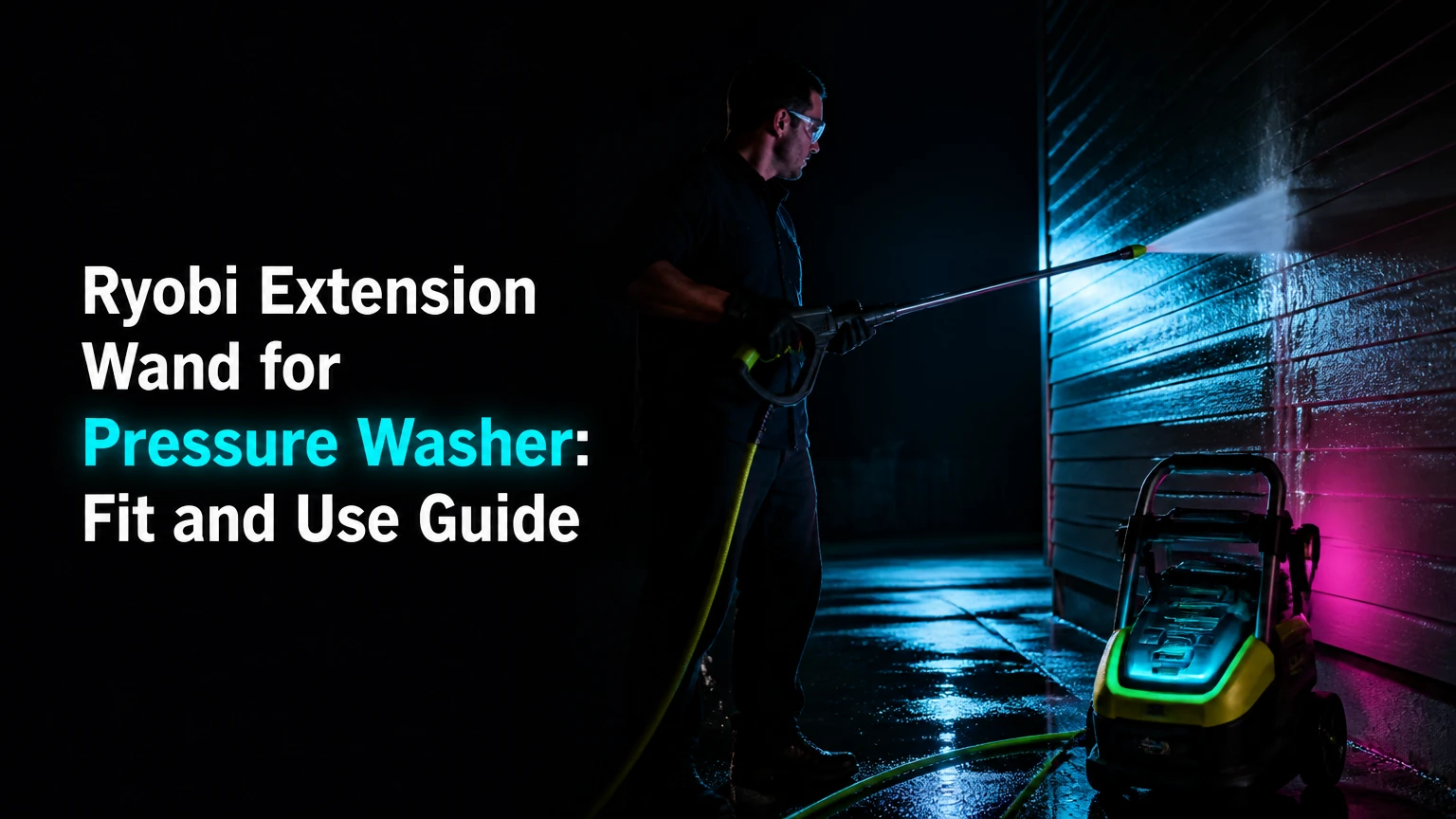
A Ryobi extension wand for pressure washer equipment adds reach between the spray gun and cleaning surface, reducing ladder use for siding, eaves, and gutters. The correct choice depends on pressure rating, connector type, machine platform, reach, and nozzle compatibility. Ryobi’s RY31EP26 suits many full-size washers, while EZClean wands belong to a lower-pressure power-cleaner system.
Key Facts at a Glance
- The Ryobi RY31EP26 telescoping pole is listed for pressure washers up to 4,200 PSI and provides approximately 18 feet of working reach with the operator included.
- Ryobi EZClean extension wands are designed for Ryobi EZClean power cleaners, not automatically for full-size electric or gas pressure washers.
- A 1/4-inch quick-connect nozzle does not prove that the wand fits the spray gun. The hose-side inlet may use an M22 thread, a proprietary fitting, or another connector.
- Long poles increase leverage and operator fatigue even when the pump pressure remains unchanged.
- A wider 25-degree or 40-degree nozzle is generally easier to control at height than a 0-degree pinpoint nozzle.
- Maximum PSI is a compatibility ceiling, not a recommended setting for vinyl siding, painted trim, windows, or soft materials.
What Is a Ryobi Extension Wand for Pressure Washer Equipment?
A Ryobi extension wand is a rigid, sectional, or telescoping lance that carries pressurized water farther than the factory spray gun. A full-size model connects to the washer’s high-pressure hose at its base, routes water through an internal tube, and accepts a spray tip at the outlet.
The accessory changes reach, not pump capacity. A 2,000-PSI washer does not become a 4,200-PSI washer after adding an RY31EP26, and a longer wand does not automatically increase cleaning power. The nozzle still determines spray angle and orifice size, while the pump determines available pressure and flow.
The phrase “Ryobi extension wand” covers two materially different product families. Full-size pressure-washer poles are built for higher pressure and use a trigger handle or base control. EZClean accessories are lighter attachments for Ryobi portable power cleaners, which operate at much lower pressure and flow.
How does the water path work?
Water travels from the supply connection into the pump, through the high-pressure hose, into the extension wand’s base inlet, along the internal fluid tube, and out through the quick-connect nozzle. Every restriction, kink, damaged seal, or undersized orifice can reduce flow at the tip.
Longer tubing usually creates some additional friction, but the practical control problem is often leverage rather than dramatic pressure loss. A pole held 15 feet from the operator produces a large turning force when the nozzle reacts against siding or when wind pushes the tube.
The pressure washer pump, hose, wand, and nozzle must operate within the lowest component rating. Ryobi’s RY31EP26 product listing and Home Depot listing identify the model as suitable for machines up to 4,200 PSI, but that rating does not make every nozzle or connector safe at that pressure.
Which Ryobi Wand Fits Your Washer and Cleaning Job?
The best Ryobi wand depends first on the machine platform, then on reach and surface. Choose the RY31EP26 for a full-size pressure washer and second-story work, a sectional lance for rigid medium-range control, or an EZClean pole for a compatible portable power cleaner.
| Wand category | Typical system | Reach or length | Pressure context | Best application |
|---|---|---|---|---|
| RY31EP26 telescoping pole | Full-size gas, electric, or compatible cordless washer | 5-foot collapsed length, approximately 16.5-foot pole, 18-foot working reach | Up to 4,200 PSI listed maximum | Second-story siding, eaves, gutters |
| Stainless sectional wand | Full-size pressure washer | 17-inch sections, commonly 2-6 sections | Common aftermarket ratings from 2,000-4,500 PSI | Vehicles, brick, walkways, undercarriages |
| Ryobi RY3112EP EZClean pole | Ryobi EZClean power cleaner | 42 inches | EZClean system, commonly 320-600 PSI depending on tool | Vehicle roofs, boats, low-clearance surfaces |
| EZClean short extension | Ryobi EZClean power cleaner | Approximately 12 inches | EZClean system rating | Small reach increases and close work |
Full-size telescoping pole
The RY31EP26 is the strongest match for homeowners washing elevated exterior surfaces with a standard pressure washer. Its base trigger lets the operator control water without reaching toward the nozzle, and the supplied brush can help with low-pressure agitation when the surface and tool configuration permit it.
The trade-off is handling. A long pole becomes tiring because the operator must resist nozzle recoil and the pole’s own weight at a distance from the body. A shoulder strap or body support can reduce arm loading, but it does not eliminate the need for two-handed control in wind.
The manufacturer and retailers may describe the product as an 18-foot extension pole. That figure generally represents working reach, not 18 feet of rigid material. Verify collapsed length, extended length, brush inclusion, and current stock before purchase because retailer descriptions and pricing can change.
Sectional metal wand
Sectional wands connect multiple short stainless-steel or brass sections to create a rigid lance. They take longer to assemble than a telescoping pole, but they often flex less at moderate reach and pack into a smaller storage footprint when separated.
Sectional products are especially useful for wheel wells, patios, masonry, and vehicle roofs where the operator wants precise control rather than maximum height. Their fittings vary widely, so an apparently universal 1/4-inch nozzle end does not confirm compatibility with a Ryobi spray gun.
EZClean extension wand
The Ryobi RY3112EP is an EZClean accessory, identified by Ryobi for its portable power-cleaner platform. EZClean equipment prioritizes portability and low operating force, making it useful for cars, boats, outdoor furniture, and light rinsing rather than high-pressure masonry restoration.
An EZClean wand should not be attached to a full-size pressure washer unless the manufacturer explicitly provides a compatible connection and pressure rating. The lower-pressure fluid path, trigger, seals, and structural components may not tolerate a conventional washer pump.
What Specifications Matter Before You Buy?
Check five specifications before ordering: machine platform, hose-side fitting, maximum PSI, flow requirement, and physical reach. The nozzle-end connection is usually easier to standardize than the base connection, so the hose and trigger interface deserves the closest inspection.
| Specification | What to verify | Practical threshold or example | Why it matters |
|---|---|---|---|
| Machine platform | Full-size washer or EZClean cleaner | RY31EP26 versus RY3112EP | Prevents incompatible pressure exposure |
| Maximum pressure | Wand rating above washer output | 4,200 PSI listed for RY31EP26 | Establishes a safe equipment ceiling |
| Hose-side fitting | M22-14, M22-15, 3/8-inch, or proprietary fitting | Match the existing hose exactly | Prevents leaks and forced adapters |
| Nozzle connection | 1/4-inch quick-connect or proprietary tip | Standard 1/4-inch QC is common | Determines available spray tips |
| Flow rate | Required gallons per minute | Match washer output, often 1.2-2.5 GPM for home units | Avoids restricted or unstable spray |
| Reach | Pole length plus operator height | Approximately 18-foot working reach | Determines whether ladders are actually avoidable |
| Weight | Dry pole weight plus water and nozzle | RY31EP26 is commonly listed near 9.5 pounds dry | Predicts fatigue and control difficulty |
Are M22 fittings interchangeable?
M22-14 and M22-15 fittings are not the same internal configuration. The numbers commonly identify different insert or nipple dimensions, and an incorrect pairing can leak even when the thread appears to start correctly.
Inspect the existing hose end, washer model manual, and replacement accessory instructions. Do not force an adapter onto plastic threads, and do not assume a listing that says “fits Ryobi” covers every Ryobi pressure washer generation.
The 1/4-inch quick-connect specification normally describes the spray-tip socket. It says little about the hose inlet, trigger body, or internal pressure rating. A complete fit check must cover both ends.
How Do You Install a Ryobi Extension Wand Safely?
Install the wand in seven controlled steps, with the motor off and line pressure released before every connection change. A typical first setup takes 10-20 minutes, including nozzle selection and leak inspection, while a later setup usually takes 3-7 minutes.
Before you start
| Requirement | Typical value |
|---|---|
| Setup time | 10-20 minutes initially |
| Difficulty | Moderate, no specialized tools |
| Required equipment | Pressure washer, high-pressure hose, compatible wand, nozzle |
| Useful supplies | Silicone O-ring grease, clean cloth, replacement seals |
| Minimum condition | Stable footing, water supply, eye protection |
| Recommended nozzles | 25-degree, 40-degree, or manufacturer-approved brush |
Step 1: Shut down and release pressure
Turn off the motor, close the water supply, and squeeze the original spray-gun trigger until no pressure remains. Disconnect the washer from power when the manufacturer’s procedure requires it.
You will know the line is safe when the trigger produces no pressurized burst. The common mistake is loosening a fitting while trapped pressure remains, which can eject a seal or spray debris toward the operator.
Step 2: Identify the hose connection
Remove the factory wand or lance from the trigger gun according to the washer manual. Compare the exposed outlet or hose connector with the extension pole’s base inlet before applying force.
The correct connection starts smoothly and seats without cross-threading. A common mistake is confusing the quick-connect nozzle socket with the M22 hose fitting.
Step 3: Inspect and lubricate seals
Clean grit from threads, couplers, and O-rings, then apply a thin film of silicone grease to exposed rubber seals. Silicone grease helps installation and reduces seal tearing; petroleum grease can damage some elastomers.
A successful seal has no cut, flattening, or missing section. Replace damaged O-rings rather than tightening the fitting harder, because excessive torque can crack plastic components.
Step 4: Route the internal hose
For a telescoping model, feed or uncoil the internal high-pressure hose through the pole sections as directed by the product instructions. Keep the hose free from sharp bends before locking the sections.
The hose should move without pinching when the pole extends. A kink inside the frame can produce weak spray, pulsing, or premature hose wear even when the pump is functioning normally.
Step 5: Connect the high-pressure hose
Attach the washer hose to the base trigger inlet and tighten it by hand, followed by only the tool-assisted tightening specified by the manufacturer. Open the water supply before starting the motor if the washer manual requires pump priming.
Water should flow without a leak at low or unpressurized supply conditions. Starting a pump without adequate water can damage the pump head.
Step 6: Set the pole length
Extend each telescoping section only to its marked limit, then clamp every lock firmly. Keep the pole shorter when washing close surfaces because extra length increases leverage and reduces nozzle precision.
A correctly locked pole remains rigid during a gentle test movement. Never extend beyond a red line or safety mark, and never use a visibly cracked section.
Step 7: Install and test the nozzle
Pull back the 1/4-inch quick-connect sleeve, insert the nozzle fully, and release the sleeve. Start with a 40-degree tip at low distance, then adjust distance and angle before moving to a narrower spray.
The nozzle is secure when the collar returns completely and the tip cannot pull out by hand. Test on an inconspicuous area first, particularly on vinyl, painted wood, stucco, or aged mortar.
Which Nozzle and Pressure Setting Should You Use?
Use a 25-degree or 40-degree nozzle for most extended-pole rinsing, beginning at low pressure and a greater stand-off distance. A 0-degree nozzle concentrates impact, increases recoil, and can damage siding, mortar, paint, window seals, or roofing materials.
| Surface | Starting nozzle | Typical starting distance | Operating guidance |
|---|---|---|---|
| Vinyl siding | 40-degree white tip | 24-36 inches | Spray downward, avoid forcing water behind laps |
| Painted trim | 40-degree white tip | 30-48 inches | Reduce pressure and test adhesion |
| Brick and concrete | 25-degree green tip | 18-30 inches | Avoid eroding soft mortar joints |
| Vehicle paint | 40-degree white tip | 24-36 inches | Use detergent separately and avoid damaged clear coat |
| Gutters and eaves | 25-40 degrees | 18-30 inches | Control runoff and inspect the nozzle path |
| Heavy spot deposits | 15-degree yellow tip | 12-24 inches | Use briefly, never on fragile coatings |
The color convention above follows common pressure-washer nozzle systems, but manufacturers can vary. Read the tip markings and the washer manual rather than relying on color alone.
Which Wand Fits Each Cleaning Job?
The RY31EP26 is the practical choice for elevated siding and eaves, while a shorter sectional lance is usually easier for vehicles, patios, and masonry. EZClean accessories fit light-duty portable cleaning where low weight matters more than impact force.
| Cleaning job | Preferred accessory | Typical working height or distance | Main reason |
|---|---|---|---|
| One-story siding | Standard gun or 17-42-inch wand | 6-12 feet | Better control than a fully extended pole |
| Second-story siding | RY31EP26 telescoping pole | Up to approximately 18 feet | Reduces ladder use |
| Gutter exterior | RY31EP26 with wide nozzle or brush | 10-18 feet | Reaches fascia and outer gutter face |
| Vehicle roof | EZClean 42-inch pole or short sectional wand | 3-7 feet | Limits bending and keeps control |
| Brick patio | Sectional steel wand | 1-8 feet | Rigid, precise handling |
| Boat hull | EZClean extension | 2-8 feet | Lightweight and lower impact |
| Roof cleaning | Dedicated soft-wash pole | 8-25 feet | Avoids concentrated high-pressure damage |
A pressure washer extension pole is not a universal roof-cleaning tool. Asphalt shingles, flashing, ridge vents, and sealants can suffer damage from concentrated high-pressure spray, so a low-pressure chemical application system is often safer.
What Does a Ryobi Extension Wand Cost?
Typical retail pricing ranges from $15-$20 for short EZClean extensions, $30-$50 for basic sectional kits, and $105-$169 for an RY31EP26 telescoping pole. Actual prices vary by retailer, promotions, region, included brush, and whether the product is new or factory reconditioned.
| Accessory or related cost | Typical price range | Typical replacement interval | Cost issue |
|---|---|---|---|
| EZClean short extension | $15-$20 | 1-5 years | Platform-specific |
| EZClean 42-inch pole | $25-$60 | 1-5 years | Lower pressure, limited compatibility |
| Sectional steel kit | $30-$50 | 2-8 years | Fittings and seals vary |
| RY31EP26 telescoping pole | $105-$169 | 2-7 years | Storage and lock wear matter |
| O-ring or seal kit | $5-$20 | As needed | Cheaper than replacing a wand |
| Adapter or coupler | $10-$30 | As needed | Wrong adapter can create leaks |
Treat price as secondary to pressure and fitting compatibility. A $20 adapter does not rescue a wand whose trigger or internal tube is rated below the washer’s output.
Why Does Soap Stop Drawing Through a Long Wand?
Long extension wands often reduce or eliminate detergent pickup because downstream injectors need low backpressure and adequate flow to create suction. A longer hose path, narrow nozzle, or restrictive wand can raise backpressure beyond the injector’s operating range.
Apply detergent with a dedicated foam cannon, pump sprayer, or compatible low-pressure soap attachment close to the surface. Allow the chemical dwell time specified on its label, then rinse with the extension pole.
Never leave detergent in the pump or wand after use. Flush with clean water, because dried surfactant can obstruct the injector, nozzle orifice, check valve, and internal tube.
What Are the Main Safety Limits?
Keep both feet on stable ground, use eye protection, and avoid operating a fully extended pole in strong wind. The wand can rotate or swing when the nozzle strikes a surface, and water can enter siding joints, soffit vents, electrical fixtures, or window seals.
Use a harness or shoulder strap only as a support aid, not as a substitute for two-handed control. Stop when fatigue changes the pole angle or causes the nozzle to drift across a fragile surface.
Avoid these high-risk practices:
- Do not use a 0-degree nozzle on an elevated pole unless the manufacturer and surface specifically allow it.
- Do not point the wand toward people, pets, vehicles, or overhead power lines.
- Do not work from a ladder while holding a long, pressurized pole.
- Do not exceed the smallest PSI rating among the washer, hose, wand, trigger, nozzle, and adapter.
- Do not spray directly upward beneath siding, soffits, roof edges, or gutter joints.
- Do not use a cracked telescoping section or a lock that will not close fully.
The most important practitioner rule is simple: lower pressure and greater distance usually produce a safer first test than maximum pressure and a narrow tip.
How Do You Troubleshoot Leaks, Vibration, and Weak Spray?
Diagnose a malfunction from the water source toward the nozzle: supply, pump, hose, base fitting, internal tube, coupler, and tip. This order isolates common causes faster than repeatedly changing nozzles.
| Symptom | Likely cause | Corrective action | Confirmation |
|---|---|---|---|
| Water leaks at connector | Cut O-ring or mismatched fitting | Release pressure, replace seal, verify fitting | Dry connection after 60 seconds |
| Weak spray at tip | Clogged nozzle or kinked tube | Remove debris, straighten internal hose | Stable fan pattern |
| Pulsing spray | Air in line or restricted supply | Purge air, open supply fully, inspect inlet | Even flow from trigger |
| Pole vibrates | Narrow nozzle, high pressure, wind | Use wider tip, shorten pole, reduce pressure | Controlled sweep |
| Trigger leaks | Worn seal or cracked trigger body | Replace approved seal or trigger assembly | No seepage under pressure |
| No detergent pickup | Excessive backpressure | Use foam cannon or lower-pressure injector setup | Visible chemical draw |
Always turn off the washer and release pressure before clearing a nozzle. A small piece of grit can alter the spray pattern, but probing a pressurized tip is unsafe.
When Is Another Accessory Better?
Choose a dedicated gutter-cleaner attachment when the goal is to remove debris from inside a gutter while standing below it. Choose a soft-wash pole for roofs and delicate coatings, and choose a surface cleaner for flat concrete where a wand creates striping.
A telescoping wand is a poor substitute for a surface cleaner on large driveways. The rotating bar of a surface cleaner distributes spray more evenly and usually completes a 500-square-foot area with fewer visible passes.
A ladder may still be necessary for inspection, repair, or manual gutter debris removal, but a pressure washer pole can reduce the need to climb for rinsing. It cannot reveal loose flashing, rotten fascia, blocked downspouts, or damaged seals from ground level.
Which Ryobi Extension Wand Should You Choose?
Choose the RY31EP26 when a compatible full-size pressure washer must reach second-story siding, eaves, or exterior gutters. Choose a sectional steel wand for rigid control at moderate height, and choose the RY3112EP EZClean pole only when the power cleaner platform matches.
Homeowner washing siding
The RY31EP26 is the strongest match for a homeowner cleaning two-story vinyl siding from the ground. Use a 40-degree tip, work from the lower section upward for detergent only when the chemical system supports it, and rinse from the top downward.
Skip full extension when a shorter setting reaches the surface. Shorter length reduces fatigue and improves spray accuracy.
Vehicle owner or detailer
An EZClean 42-inch extension is appropriate for vehicle roofs, boats, and outdoor furniture when the tool is already part of the EZClean system. Its lower pressure reduces handling strain and can be more appropriate for sensitive finishes.
Skip it if the goal is high-impact concrete or masonry cleaning. The power-cleaner platform does not replace a full-size pressure washer.
Contractor or frequent masonry cleaner
A sectional metal wand offers predictable rigidity and simpler section replacement for repeated brick, patio, and walkway work. Confirm the supplier’s PSI and GPM ratings, then match the connector to the specific Ryobi hose or gun.
Skip low-cost unbranded kits when thread quality, seal availability, or pressure documentation is unclear. A cheap fitting failure can create downtime and a dangerous uncontrolled hose.
FAQ
Will a Ryobi extension wand fit any pressure washer?
No. Compatibility depends on the hose-side fitting, pressure rating, flow requirement, and trigger connection. Some aftermarket wands use M22-14 or M22-15 fittings, while others use 3/8-inch or proprietary couplers. Verify the exact washer model and accessory instructions before purchase.
Can I use the RY31EP26 with a cordless Ryobi washer?
The RY31EP26 is marketed for many gas, electric, and cordless pressure washers up to its listed rating, but cordless models differ in hose fittings, flow, and operating pressure. Confirm the specific tool manual and connector before attaching the pole.
How far can the Ryobi telescoping pole reach?
The RY31EP26 is commonly described as an 18-foot working-reach pole, with approximately 16.5 feet of extended pole length and a shorter collapsed length near 5 feet. Actual cleaning height depends on operator height, spray angle, footing, and whether the pole can be fully controlled.
Can an extension wand clean roof shingles?
A high-pressure extension wand is generally unsuitable for directly cleaning asphalt shingles because concentrated water can lift granules, damage sealant, or force water beneath roofing components. A low-pressure soft-wash pole and roof-compatible chemical process are usually safer.
Why does my pressure washer lose pressure with the wand attached?
Common causes include a clogged nozzle, kinked internal hose, mismatched fitting, damaged O-ring, insufficient water supply, or a wand whose flow path restricts the pump. Remove the nozzle first, verify normal hose flow, then inspect each connection toward the tip.
How should I store a telescoping pressure-washer pole?
Flush clean water through the wand, remove the nozzle, drain residual water, wipe the sections dry, and store the pole collapsed in a protected location. Keep locks free of grit and replace seals before the next job if they show flattening, cuts, or brittleness.
The Bottom Line
A Ryobi extension wand for pressure washer equipment is primarily a reach and access accessory, not a pressure upgrade. Select the RY31EP26 for compatible full-size machines and elevated exterior cleaning, a sectional wand for rigid medium-range work, or an EZClean extension for the matching low-pressure platform. Verify fittings, ratings, nozzle choice, and surface limits before operating.