The best foam cannon soap for house washing is JOMAPS House Wash for homeowners who need strong cling and compatibility with exterior cleaning workflows, while Simple Green House and Siding Cleaner is the safer mild-maintenance choice. Heavy algae and mildew usually require a labeled sodium-hypochlorite system, not thicker foam or ordinary car shampoo.
Key Facts at a Glance
- JOMAPS House Wash is the strongest general-purpose pick when cling, siding maintenance, and professional-style application matter.
- Simple Green House and Siding Cleaner suits light dirt, pollen, soot, and routine cleaning where a milder retail formula is preferred.
- 30 SECONDS Outdoor Cleaner is better for targeted organic staining than for producing dense, shaving-cream-like foam.
- Bleach-stable surfactants improve wetting and dwell, but concentrated sodium hypochlorite should generally be applied through a downstream injector or dedicated soft-wash system.
- Foam thickness does not prove that a detergent kills algae, mildew, or mold.
- Typical homeowner chemical cost ranges from about $10 to $40 per wash, depending on product concentration, wall area, and dilution.
Which Foam Cannon Soap Is Best for House Washing?
JOMAPS House Wash is the best overall choice for a homeowner who specifically wants a house-washing detergent that clings in a foam cannon and supports low-pressure exterior cleaning. Simple Green House and Siding Cleaner is the better mild-use option, while a bleach-compatible professional surfactant is more effective for established green algae when used with the correct soft-wash equipment.
The selection depends on the contaminant. Dust, pollen, and gray atmospheric film respond to detergent and rinsing. Black streaks, green algae, and mildew require an oxidizing or biocidal treatment that a neutral foaming soap may not provide.
Our Top Picks
| Rank and product | Best for | Typical price range | Main strength | Main limitation |
|---|---|---|---|---|
| 1. JOMAPS House Wash | General house washing | $25-$45 per gallon | Cling and exterior-cleaning focus | Availability and label directions vary |
| 2. Simple Green House and Siding Cleaner | Light residential maintenance | $15-$30 per gallon | Mild retail handling | Limited performance on heavy growth |
| 3. 30 SECONDS Outdoor Cleaner | Spot treatment and organic stains | $15-$35 per gallon | Fast visible treatment | Foam behavior is not its main purpose |
| 4. Southeast Softwash surfactant | Professional soft-wash setups | $25-$45 per gallon | Bleach-compatible wetting support | Requires chemical discipline and suitable equipment |
| 5. A labeled oxygenated house cleaner | Wood, painted surfaces, and mild grime | $15-$35 per gallon | Avoids chlorine odor | Slower or weaker on mature algae |
Product formulations, packaging, and directions can change. Treat the current manufacturer label and safety data sheet as the controlling source, especially for dilution, siding compatibility, plant exposure, and chemical mixing.
How Does a Foam Cannon Clean a House?
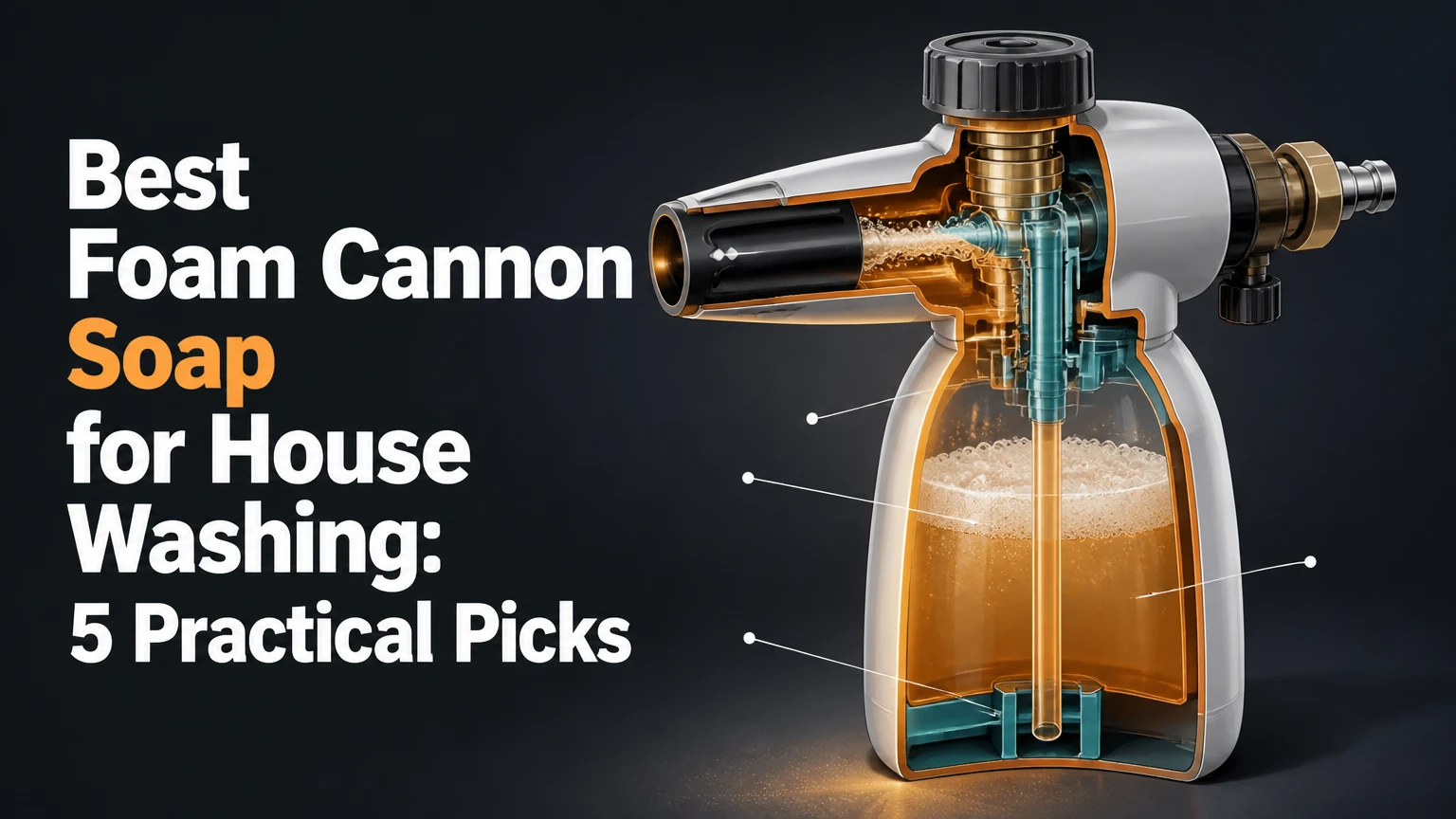
A foam cannon combines pressurized water, detergent, and air through a venturi injector, but the surfactant performs the important wetting and soil-lifting work. The cannon draws concentrate from its bottle, meters it into the water stream, aerates the mixture through an internal orifice and mesh, and spreads the resulting foam across the wall.
Surfactants lower water’s surface tension, helping the solution wet textured siding, mortar joints, and small surface irregularities. Foam can slow drainage on a vertical wall, extending contact time, but foam volume is an equipment result rather than a direct measure of disinfecting or stain-removal strength.
A typical consumer foam cannon works best with roughly 1.5-2.0 gallons per minute and enough inlet pressure to create suction. A low-flow electric pressure washer may produce watery foam even when the detergent is effective. A clogged pickup tube, incorrect orifice, hard-water scale, or overly diluted concentrate can create the same symptom.
Foam Cannon Versus Downstream Injector
A foam cannon is useful for visible coverage and controlled detergent placement, while a downstream injector is usually more efficient for applying a large-volume house-wash solution. The injector draws chemical after the pump, allowing the operator to rinse and apply at lower pressure without placing aggressive chemistry through the pump or hose.
| Method | Typical chemical draw | Best use | Equipment concern |
|---|---|---|---|
| Consumer foam cannon | 1:4-1:10 bottle mix, label dependent | Small homes and visible foam coverage | Requires adequate flow and pressure |
| Downstream injector | Often 10%-20% draw, model dependent | Whole-house soft washing | Requires correct injector and hose setup |
| Pump sprayer | Manual or battery-powered | Spot treatment and delicate areas | Limited reach and application speed |
| Dedicated soft-wash pump | Product-specific proportioning | Professional organic-growth removal | Requires training, PPE, and runoff control |
The best approach is not always the method that creates the thickest blanket. For a two-story home with extensive algae, a correctly proportioned low-pressure treatment generally offers better chemical delivery than repeatedly applying weak foam.
What Should You Look for in House-Wash Soap?
The best house-wash detergent has a clear exterior-use label, a dilution range, material compatibility information, and a stated role such as detergent cleaning, organic-growth treatment, or bleach-compatible surfactant. Buyers should evaluate cleaning chemistry before foam density, because a highly aerated neutral soap can leave established algae alive.
Check these attributes before purchase:
- Target soil: Dust and pollen need detergency; algae and mildew need an appropriate biocidal or oxidizing treatment.
- Surface compatibility: Vinyl, painted wood, stucco, brick, mortar, composite trim, and oxidized aluminum tolerate different chemistry and pressure.
- Chemical compatibility: Never assume a product is stable with sodium hypochlorite. The label must say so.
- Application method: Some concentrates are designed for garden sprayers, downstream injectors, or direct application rather than foam cannons.
- Dilution: Confirm whether the ratio refers to the bottle mixture, injector draw, or final wall concentration.
- Rinse requirements: Residue, surfactant film, and mineral deposits become more likely on hot or porous surfaces.
- Safety documentation: A safety data sheet should identify hazards, first aid, storage, and incompatible chemicals.
Does More Foam Mean Better Cleaning?
More foam does not necessarily mean better house washing. Foam depends on water hardness, nozzle design, air intake, orifice size, pressure, temperature, and detergent concentration, whereas organic-growth removal depends mainly on active chemistry, contact time, coverage, and rinsing.
This distinction matters when comparing car shampoo with an exterior cleaner. A car shampoo may produce impressive foam but lack the oxidizer or biocide needed for green algae. Conversely, a low-foaming house detergent can clean effectively if the solution wets the surface and remains active for the required dwell period.
Five Best Foam Cannon Soap Options
The five options below cover different cleaning situations rather than pretending one chemical is ideal for every house. Product names identify practical categories, but users must confirm the current label before mixing or applying any concentrate.
1. JOMAPS House Wash: Best Overall
JOMAPS House Wash is the best overall option for homeowners who prioritize exterior-cleaning performance, cling, and compatibility with a foam-based workflow. The product is better suited to house washing than automotive shampoo because its intended context is siding and exterior soil rather than clear-coated vehicle paint.
Typical use involves a concentrated product diluted according to the label and applied over a cool, wet surface. The operator should test an inconspicuous area first, especially on oxidized aluminum, older paint, porous masonry, or surfaces with chalking.
JOMAPS is a sensible choice for vinyl siding with pollen, road film, light mildew, and general weathering. It is not a substitute for a properly proportioned soft-wash treatment when dark biological staining has penetrated textured masonry or returned quickly after cleaning.
Choose this if: You want one dedicated house-wash concentrate for routine siding maintenance and foam-cannon application.
Skip it if: Your main problem is severe algae and you lack a separate, labeled organic-growth treatment.
2. Simple Green House and Siding Cleaner: Best Mild Retail Choice
Simple Green House and Siding Cleaner is the best mild retail choice for light dirt, pollen, soot, and seasonal exterior maintenance. Its broad availability and straightforward consumer positioning make it appropriate for homeowners who do not want to handle concentrated bleach or professional soft-wash chemistry.
The formula can be useful on vinyl, painted surfaces, and other labeled exterior materials when applied at the manufacturer’s dilution. Pre-wetting vegetation remains necessary because “mild” does not mean harmless to every plant, finish, fishpond, or soil environment.
Simple Green is not the strongest option for mature black mildew or thick green algae. A homeowner may see a cleaner-looking wall after detergent action while living growth remains embedded in porous surfaces. Repeated staining within weeks indicates a chemistry or moisture problem rather than a need for more foam.
Choose this if: The house has ordinary dust, pollen, soot, and light surface grime.
Skip it if: Established organic growth is the dominant contaminant.
3. 30 SECONDS Outdoor Cleaner: Best for Targeted Organic Stains
30 SECONDS Outdoor Cleaner is best for targeted treatment of outdoor organic staining when the user values a retail product and visible results over maximum foam density. The product family includes formulations intended for exterior organic stains, so the exact package directions determine application, dwell, surface restrictions, and required rinsing.
This type of cleaner may work well on localized siding, walkways, trim, and other manageable sections. It is less compelling as a dedicated foam-cannon soap because outdoor stain removers are often designed around direct or sprayer application rather than thick aerated cling.
Avoid allowing the solution to dry, and protect nearby plants with pre-wetting, physical shielding, and post-rinsing. “Plant-safe” claims should be read narrowly: a product can be safer when used as directed while still damaging foliage at concentrated strength or under hot, dry conditions.
Choose this if: You need retail access and targeted treatment for visible outdoor growth.
Skip it if: Dense foam and large-scale whole-house application are your primary requirements.
4. Southeast Softwash Surfactant: Best for Professional Soft-Wash Chemistry
Southeast Softwash surfactant is best for experienced users who already operate a compatible soft-wash or downstream-injection system and need a wetting agent for an approved sodium-hypochlorite process. The surfactant’s role is to improve coverage, cling, and dwell; sodium hypochlorite supplies the main oxidation of organic growth.
This category requires more discipline than a ready-to-use retail cleaner. Sodium hypochlorite concentration changes with storage age, temperature, and source strength, so a fixed recipe cannot guarantee the same wall concentration. Operators need chemical-resistant gloves and eye protection, controlled runoff, plant protection, and a clear understanding of the equipment manufacturer’s limits.
A professional surfactant is not automatically the best foam-cannon product. Some are intended for downstream injection or soft-wash pumps, and forcing aggressive chlorine chemistry through an unsuitable foam cannon can damage seals, metals, and internal components.
Choose this if: You understand soft-wash chemistry and have compatible low-pressure equipment.
Skip it if: You are unfamiliar with sodium hypochlorite handling or cannot control runoff.
5. Labeled Oxygenated House Cleaner: Best for Mild Chemistry and Painted Wood
A labeled oxygenated house cleaner is best for painted wood, delicate-looking finishes, and homeowners who want to avoid chlorine odor during mild-to-moderate cleaning. Oxygenated formulas can address dirt and some organic discoloration without the same chlorine-handling requirements as hypochlorite systems.
The trade-off is slower or less complete performance on heavy algae, mildew, and black streaks. Wood also creates a separate risk: excessive water pressure can scar grain, drive water behind boards, or remove failing paint even when the detergent itself is compatible.
Apply to a small test area, keep the surface wet, and use low pressure at a suitable distance. A product’s biodegradable or oxygenated positioning does not eliminate runoff concerns or guarantee safety for every plant species.
Choose this if: Painted wood or mild grime makes a lower-odor process attractive.
Skip it if: The surface has deep organic staining that requires rapid biocidal action.
How Should You Wash a House With a Foam Cannon?
A foam-cannon house wash normally takes 45-120 minutes for a small one-story home, excluding setup and difficult rinsing. The success factors are correct chemical selection, a wet surface, controlled dwell, and complete rinsing, not maximum pressure.
Before You Start
| Requirement | Typical value | Why it matters |
|---|---|---|
| Work time | 45-120 minutes | Varies with wall area and rinsing |
| Detergent | 0.5-2 gallons concentrate | Depends on coverage and product strength |
| Water supply | 1.5-2.0 GPM minimum for many cannons | Supports consistent foam and rinsing |
| Dwell time | 3-5 minutes typical | Prevents premature rinsing without drying |
| PPE | Chemical gloves, eye protection, closed shoes | Reduces splash and mist exposure |
| Tools | Foam cannon, pressure washer, garden hose, soft brush | Supports application and spot agitation |
Step 1: Inspect and Protect the Property
Wet plants, shrubs, grass, and nearby soil with fresh water before chemical application. Cover outdoor outlets, cameras, doorbell equipment, unsealed speakers, and sensitive electronics, while keeping electrical connections away from standing water.
Close windows and doors. Remove fragile decorations and check for loose caulk, failing paint, cracked mortar, and open vents. A detergent cannot repair those defects.
Success checkpoint: No open window, exposed outlet, pond, or delicate plant sits directly below the spray area.
Common mistake: Starting chemical application before identifying where runoff will travel.
Step 2: Test the Surface and Mix the Product
Read the product label, then mix only the quantity needed for the working session. A listed 1:4 ratio usually means one part concentrate to four parts water in the bottle, but an injector ratio may describe chemical draw instead; these measurements are not interchangeable.
Test a shaded, inconspicuous section for color change, chalking, residue, and reaction with adjacent trim. Never mix sodium hypochlorite with acids, ammonia, or unknown detergents. Use only a surfactant explicitly labeled for that chemical system.
Success checkpoint: The test area shows no bleaching, softening, unusual residue, or color transfer after rinsing.
Common mistake: Increasing concentrate because the foam looks thin without checking the cannon’s orifice and water flow.
Step 3: Apply Foam From Bottom to Top
Set the cannon to a wide fan and apply from the bottom upward in manageable sections. Bottom-up application keeps detergent from immediately running over dry, dirty areas and makes coverage easier to see, especially on siding with horizontal laps.
Keep the nozzle far enough away to avoid forcing water behind siding or into trim. For many homes, 2-4 feet is a practical starting distance, but surface texture, pressure, and nozzle pattern determine the safe distance.
Success checkpoint: The wall is evenly wet, with no dry lanes or concentrated drips.
Common mistake: Using a narrow high-pressure stream that damages caulk, paint, wood fibers, or mortar.
Step 4: Maintain a Wet Dwell
Allow approximately 3-5 minutes of dwell for many detergent applications, extending or shortening the interval according to the label, temperature, shade, and soil. Work in small sections when sunlight, wind, or hot siding could dry the solution before rinsing.
Reapply a light mist if the wall begins to dry. Do not let chlorine-containing or alkaline cleaner dry on glass, painted trim, siding, or masonry.
Success checkpoint: Dirt softens and the solution remains visibly wet without hardened residue.
Common mistake: Applying the entire house before rinsing, then discovering the first wall has dried.
Step 5: Rinse From Top to Bottom
Rinse from the highest clean edge downward, using a broad spray and moderate pressure. Start farther away from the surface, then move closer only if necessary, because excessive pressure can drive water behind laps and damage weathered finishes.
Flush gutters, window ledges, corners, and horizontal trim where detergent collects. Rinse windows until no film or spotting remains.
Success checkpoint: Water sheets or beads without visible detergent trails, and runoff no longer carries foam.
Common mistake: Rinsing only the center of the wall while leaving concentrated solution under trim and behind fixtures.
Step 6: Flush Landscaping and Inspect
Spray fresh water over plants, grass, soil, and hardscape after completing the rinse. Walk around the house from multiple angles and inspect shaded areas, lower siding, soffits, and corners before packing away equipment.
A second application may be appropriate for remaining organic staining, but repeated detergent-only passes will not solve growth that requires a different active chemistry.
Success checkpoint: No residue, streaking, plant wilt, or missed growth is visible after the surface dries.
Common mistake: Judging the result while the wall is still wet, when streaks and surviving growth are harder to see.
What Are the Costs and Coverage?
Typical homeowner chemical cost is $10-$40 per wash, although a gallon of concentrate may cover approximately 2,000-4,000 square feet depending on dilution, surface porosity, equipment draw, and soil load. Retail ready-to-use products often cost more per treated square foot than concentrated professional surfactants.
| Product category | Typical container price | Typical treated area | Approximate chemical cost per wash |
|---|---|---|---|
| Mild retail house cleaner | $15-$30 per gallon | 2,000-3,000 sq. ft. | $15-$30 |
| Targeted outdoor cleaner | $15-$35 per gallon | 1,000-3,000 sq. ft. | $15-$35 |
| Professional surfactant | $25-$45 per gallon | 3,000-6,000 sq. ft. | $10-$30 |
| Oxygenated cleaner | $15-$35 per gallon | 1,500-3,000 sq. ft. | $15-$35 |
Coverage estimates are typical planning values, not guarantees. Porous stucco, rough brick, heavy oxidation, wind, and repeated passes can double consumption.
What Are the Common Foam Cannon Problems?
Watery foam usually results from inadequate flow, excessive dilution, an incorrect orifice, low detergent draw, or water hardness rather than defective soap. Check the pressure washer’s actual flow, the cannon adjustment, and the pickup tube before adding concentrate.
| Symptom | Likely cause | Corrective action |
|---|---|---|
| Watery foam | Low flow or diluted mix | Check GPM, reduce dilution within label limits |
| No soap draw | Loose or cracked tube | Reseat or replace pickup tube |
| Sputtering cannon | Clogged mesh or inlet screen | Rinse and clean the head |
| Foam stops after minutes | Blocked filter or empty bottle | Clean filter and inspect bottle level |
| Streaks after drying | Dried detergent or incomplete rinse | Re-wet, rewash lightly, rinse thoroughly |
| Growth remains | Wrong chemistry or inadequate dwell | Use a labeled organic-growth treatment |
Soak removable cannon parts in warm water according to the equipment manufacturer’s instructions. Vinegar can help with mineral scale on compatible parts, but do not expose unknown metals, seals, or chemical residues to an acid without confirming compatibility.
Can You Put Bleach in a Foam Cannon?
Homeowners should not put concentrated sodium hypochlorite into a consumer foam cannon unless the cannon manufacturer and chemical label explicitly approve that use. Bleach can attack metals, seals, and internal components, while poor proportioning can create plant damage, surface damage, and uncontrolled runoff.
A downstream injector or dedicated soft-wash pump is normally the more appropriate delivery method for a bleach-based house wash. The operator can apply the solution at low pressure while keeping concentrated oxidizer away from the pressure washer pump.
Never combine bleach with acids, ammonia, or products containing unknown ingredients. If accidental mixing creates fumes, leave the area immediately and contact emergency services or poison-control resources.
What Should You Use on Each Siding Type?
Vinyl siding generally tolerates a labeled house detergent and low-pressure rinse, while painted wood, stucco, brick, and aluminum require more careful testing. Siding type changes the risk of water intrusion, staining, oxidation, and residue, so one universal pressure setting is unsafe.
| Siding or wall material | Starting approach | Typical dwell | Main risk |
|---|---|---|---|
| Vinyl siding | Mild detergent, low-pressure rinse | 3-5 minutes | Water behind laps |
| Painted wood | Oxygenated or labeled mild cleaner | 2-5 minutes | Grain damage and paint loss |
| Stucco | Broad low-pressure application | 3-5 minutes | Erosion and trapped moisture |
| Brick and mortar | Compatible detergent, gentle rinse | 3-8 minutes | Mortar erosion and residue |
| Aluminum siding | Test for oxidation first | 2-4 minutes | Chalky streaks and color change |
Do not use a narrow high-pressure nozzle on wood, stucco, or deteriorated mortar. If siding remains dirty after a safe detergent wash, physical agitation with a soft brush may be safer than increasing pressure.
What Are the Best Alternatives to Foam Cannon Soap?
The best alternative depends on the soil and equipment. A downstream-injected house wash is usually better for large walls, a pump sprayer is more controlled for spot treatment, and a soft brush with mild detergent is appropriate when foam equipment cannot maintain consistent draw.
Car wash soap is acceptable for loose dust on a small exterior section, but it is a poor choice for established algae or mildew because its formula targets automotive soil and finish lubrication rather than exterior biological growth. Dish soap can strip protective finishes, increase runoff, and leave residue, so it should not be the default house-wash chemical.
Professional service becomes the safer alternative when the house is tall, the roof or electrical equipment is nearby, runoff enters a pond, or chlorine chemistry is required but unfamiliar. Equipment access does not equal chemical competence.
FAQ
Is foam cannon soap safe for vinyl siding?
A foam cannon soap labeled for vinyl siding is generally suitable when diluted and rinsed according to its instructions. Vinyl can still suffer from water intrusion, streaking, or oxidation-related discoloration, so test an inconspicuous section and use broad low-pressure spray rather than a concentrated jet.
How long should house-wash soap sit?
A typical detergent dwell time is 3-5 minutes, but hot sun, wind, shade, product chemistry, and surface temperature change the safe interval. Keep the solution wet throughout the dwell period. Rinse immediately if the detergent begins drying, even when the label allows a longer contact time.
Can a foam cannon remove black mold?
A foam cannon can distribute cleaning chemistry over black mold, but foam alone does not guarantee removal or kill the underlying growth. Established organic staining often needs a labeled oxidizing or biocidal treatment, controlled dwell, and complete rinsing. Porous materials may retain discoloration after the organism is inactive.
Is plant-safe house-wash soap completely harmless to plants?
No house-wash soap should be treated as completely harmless to every plant. Pre-wet foliage, avoid direct spray, control runoff, and rinse vegetation afterward. Concentration, heat, wind, plant species, and exposure time determine injury risk, even when a product is biodegradable or marketed as environmentally preferable.
How do I make foam cannon soap thicker?
Check water flow, cannon orifice size, pickup-tube blockage, adjustment settings, and dilution before increasing chemical strength. Many electric pressure washers cannot create dense foam because their flow is too low. Thicker foam may improve cling, but it does not automatically improve algae removal or detergent performance.
When should I hire a professional house washer?
Hire a professional when the work requires concentrated sodium hypochlorite, involves a two-story or fragile exterior, threatens a pond or sensitive landscaping, or includes failing paint, damaged mortar, or difficult electrical equipment. A professional should explain chemical concentration, runoff control, surface testing, and plant protection before starting.
The Bottom Line
The best foam cannon soap for house washing is JOMAPS House Wash for general foam-based exterior cleaning, Simple Green House and Siding Cleaner for mild maintenance, and a labeled professional surfactant paired with suitable soft-wash chemistry for severe algae or mildew. Choose by soil type, siding material, equipment, and chemical safety rather than foam thickness alone.