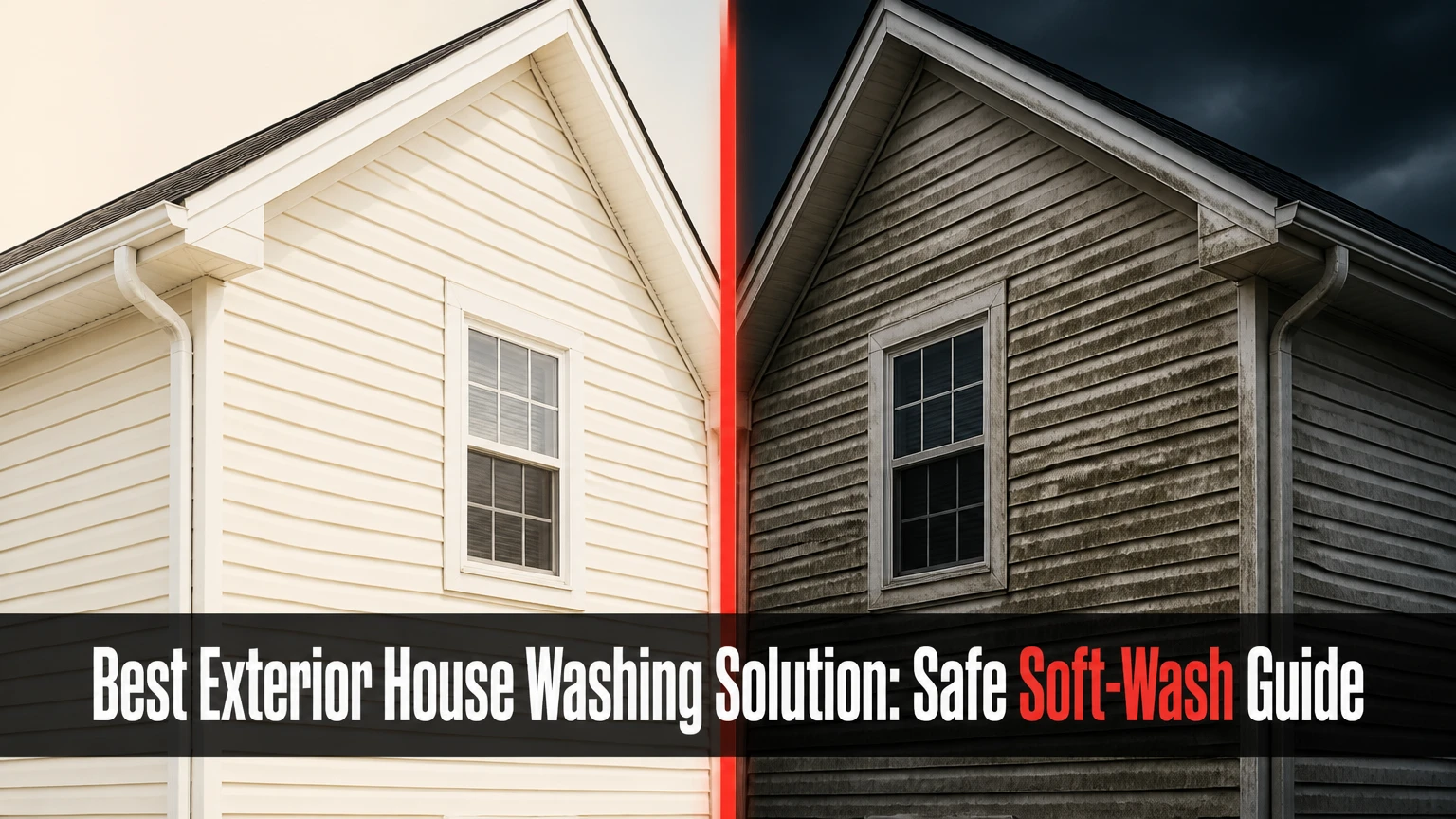
The best exterior house washing solution for most painted siding, vinyl, stucco, and masonry is a properly diluted soft-wash detergent that targets organic growth, usually sodium hypochlorite with water and a compatible surfactant. Soft washing uses chemical cleaning and low application pressure, while high pressure is reserved mainly for durable surfaces such as concrete after testing.
Key Facts at a Glance
- Sodium hypochlorite soft washing is usually the fastest treatment for algae, mildew, mold staining, and lichen on residential siding.
- A soft wash should use low application pressure, typically below 300 PSI, but the exact pressure depends on the equipment and substrate.
- The supplied 5-gallon mix examples are mathematically inconsistent: 1 gallon of 12.5% sodium hypochlorite plus 4 gallons of water produces about 2.5% active solution before surfactant.
- High-pressure cleaning is useful for concrete and some brick, but it can force water behind siding and damage paint, wood, mortar, and window seals.
- Sodium percarbonate is a lower-chlorine alternative, but it generally needs more dwell time, agitation, and rinsing.
- Never mix sodium hypochlorite with acids, ammonia, or unapproved cleaners; the CDC states, “Never mix household bleach or any disinfectants with other cleaners or disinfectants.”
What Is the Best Exterior House Washing Solution?
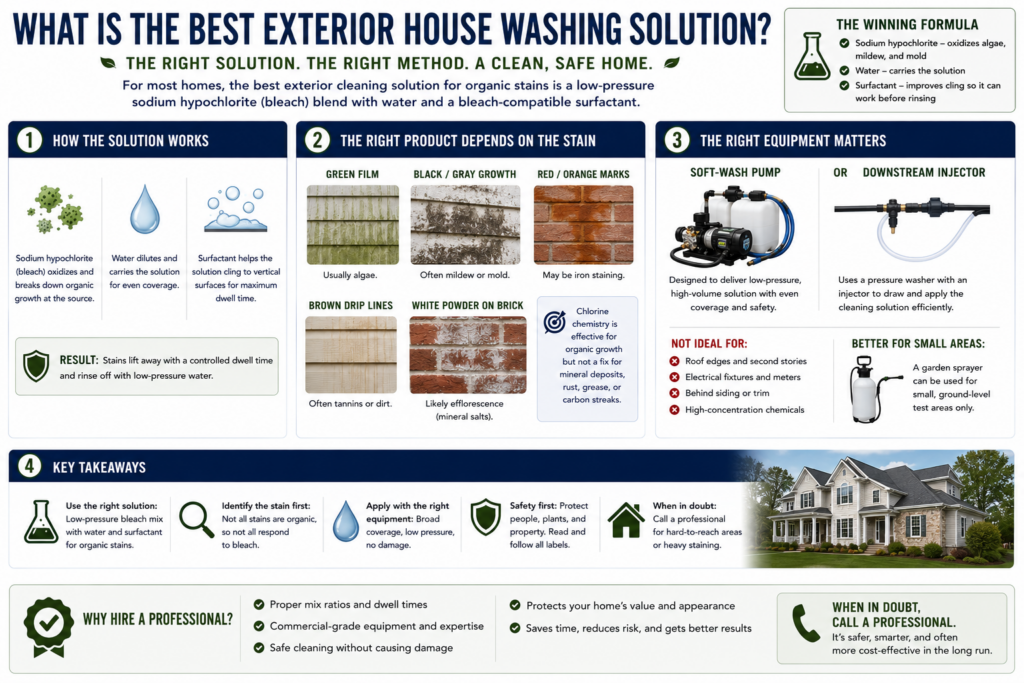
For organic discoloration on a typical home, the best exterior house washing solution is a low-pressure sodium hypochlorite formulation with water and a bleach-compatible surfactant. Sodium hypochlorite oxidizes biological growth, water carries the product, and surfactant improves cling on vertical surfaces so the solution can work before rinsing.
The right product depends on the stain. Green film usually indicates algae, while fuzzy black or gray growth often includes mildew or mold. Red-orange marks may be iron, brown drip lines can be tannins or dirt, and white powder on brick may be efflorescence. Chlorine chemistry is efficient against organic growth but is not a universal answer for mineral deposits, rust, grease, or carbonized gutter striping.
Professional cleaners normally apply house-wash chemistry through a dedicated soft-wash pump or a pressure-washer downstream injector. The equipment should deliver broad coverage without forcing water behind cladding. A garden sprayer can handle small, ground-level test areas, but roof edges, second stories, electrical fixtures, and concentrated chemicals increase the risk beyond ordinary household cleaning.
How Does Soft Washing Work?
Soft washing removes exterior staining through chemical reaction and controlled rinsing rather than abrasion. Sodium hypochlorite damages the cells of algae, mildew, mold, and lichen, while surfactant holds the solution against the surface and low-pressure water removes the loosened residue.
The phrase “biological oxidation” describes the organic-growth component, not every stain found on a house. Oxidation does not dissolve all rust, cement haze, oil, or embedded carbon. A reliable operator identifies the contaminant before selecting a stronger chemical, because increasing chlorine strength will not solve a non-organic stain and may increase surface risk.
Dwell time is also conditional. A shaded vinyl wall may need 5-10 minutes, while cool masonry with heavy growth may need longer. Sun, wind, surface temperature, porosity, and product label directions change the usable window. The solution should remain wet, but it should not be allowed to dry on siding, glass, painted trim, or plants.
Which Solution Is Best for Each Exterior Material?
The best cleaner changes with the substrate, coating, and stain. Vinyl generally tolerates a properly diluted organic-growth cleaner, painted wood demands a conservative test and rapid rinse, and concrete can accept stronger cleaning methods than window trim or EIFS.
| Exterior material | Preferred first treatment | Typical dwell or action | Main risk |
|---|---|---|---|
| Vinyl siding | Diluted SH house wash | 5-10 minutes | Oxidized chalk, dried chemical film |
| Painted wood | Mild labeled detergent, spot-tested SH if appropriate | 3-8 minutes | Paint lifting, grain damage, moisture intrusion |
| Stucco or EIFS | Low-pressure labeled cleaner | 5-12 minutes | Water intrusion, coating erosion |
| Brick veneer | Mild soft wash, then gentle rinse | 5-15 minutes | Mortar erosion, efflorescence |
| Concrete | Surface cleaner, alkaline detergent, or SH for organic growth | 5-20 minutes | Etching, wand marks, runoff |
| Natural stone | Stone-safe neutral cleaner | Label-directed | Acid damage, sealer failure |
Vinyl siding
Vinyl siding usually responds well to a low-pressure detergent containing sodium hypochlorite when algae or mildew is the problem. Keep the spray below the lower edge of panels and rinse downward so water does not enter laps, weep holes, or wall penetrations.
Older vinyl may have chalked pigment. A strong cleaner can expose uneven color rather than restore it. Test a hidden section, inspect after drying, and avoid assuming that a clean-looking wet panel will have uniform color when dry.
Painted wood
Painted wood is less forgiving than vinyl. Use the lowest effective chemical strength, keep dwell time short, and rinse before the coating softens or the wood absorbs excessive water. Peeling paint, open joints, rotten trim, and failed caulk should be repaired before washing.
A pressure washer can abrade wood fibers even when the operator is several feet away. A soft brush and low-pressure application are safer for localized dirt, provided scrubbing does not spread failing paint.
Stucco, EIFS, brick, and concrete
Stucco and EIFS need controlled water volume and pressure because cracks, penetrations, and failed sealants can route water behind the finish. Brick tolerates more moisture than painted wood, but high pressure can erode mortar and enlarge existing defects.
Concrete is the main exception to the “low pressure everywhere” rule. A surface cleaner can use substantially higher pressure on sound concrete, but pressure should be reduced near joints, decorative coatings, garage thresholds, and adjacent siding.
How Strong Should a Soft-Wash Solution Be?
There is no safe universal soft-wash ratio because product strength, downstream dilution, surface condition, weather, and label directions vary. A professional may select roughly 0.5%-1.5% available sodium hypochlorite at the surface for common siding, but the final concentration should be calculated and verified rather than guessed.
The arithmetic matters. If 12.5% sodium hypochlorite is diluted with four equal parts water, the result is approximately 2.5% active sodium hypochlorite before equipment dilution, not 0.5%-1.0%. A 1:10 downstream injector can then reduce that concentration substantially, but actual injector draw varies with hose length, nozzle, water flow, and chemical viscosity.
| Starting SH strength | SH volume | Water volume | Approximate pre-application strength |
|---|---|---|---|
| 12.5% | 1 gallon | 4 gallons | 2.5% |
| 12.5% | 1 gallon | 9 gallons | 1.25% |
| 10.0% | 1 gallon | 9 gallons | 1.0% |
| 5.0% | 1 gallon | 4 gallons | 1.0% |
These figures use a simple dilution calculation and exclude surfactant volume. They are not instructions to mix a particular batch. Read the safety data sheet and product label, wear chemical-resistant gloves and eye protection, control runoff, and use a commercial house-wash product when possible. Never combine sodium hypochlorite with acids, ammonia, solvents, or an unapproved detergent.
Practitioner rule: start weaker, test an inconspicuous area, and make a second controlled application rather than beginning with a concentration that can damage coatings or vegetation.
What Equipment and Preparation Are Required?
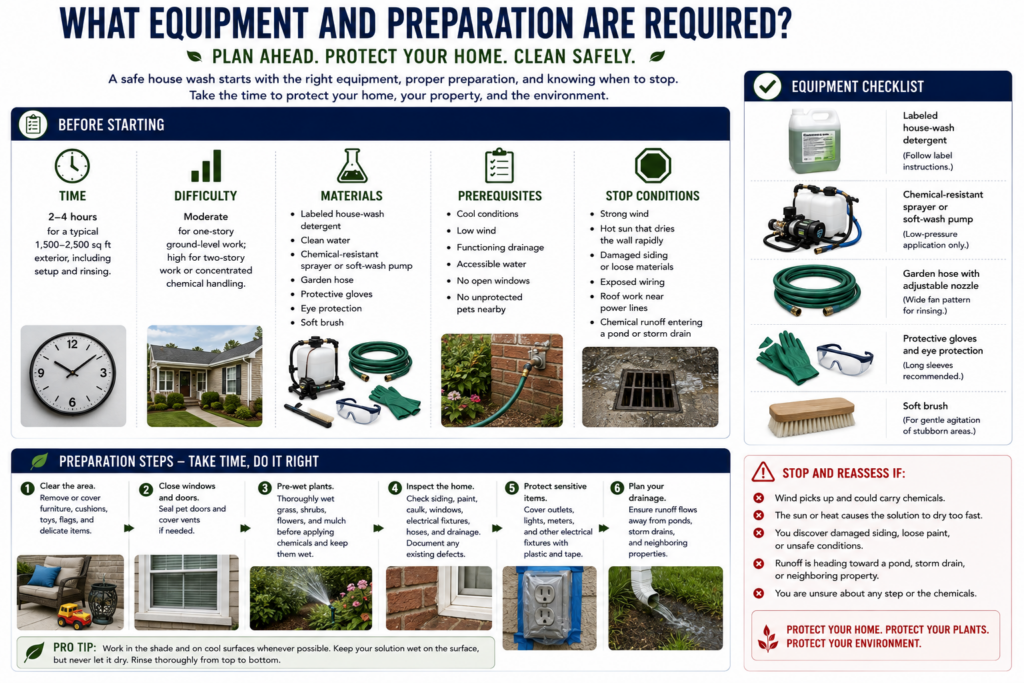
A safe house wash requires chemical-resistant containers, a calibrated application method, a low-pressure rinse setup, eye and skin protection, and a way to protect or continuously wet nearby vegetation. The minimum practical preparation also includes closing windows, checking hose bibs and electrical fixtures, and documenting pre-existing coating defects.
Before starting
- Time: 2-4 hours for a typical 1,500-2,500-square-foot exterior, including setup and rinsing.
- Difficulty: Moderate for one-story ground-level work; high for two-story work or concentrated chemical handling.
- Materials: Labeled house-wash detergent, clean water, chemical-resistant sprayer or soft-wash pump, garden hose, protective gloves, eye protection, and a soft brush.
- Prerequisites: Cool conditions, low wind, functioning drainage, accessible water, and no open windows or unprotected pets nearby.
- Stop conditions: Strong wind, hot sun that dries the wall rapidly, damaged siding, exposed wiring, roof work near power lines, or chemical runoff entering a pond or storm drain.
Cover or remove outdoor cushions, toys, flags, and delicate metal objects. Pre-wet plants thoroughly, moveable pots, and soil near the wall. Pre-wetting reduces immediate absorption, but it does not make chlorine harmless, so overspray control remains necessary.
How Should You Apply the Solution?
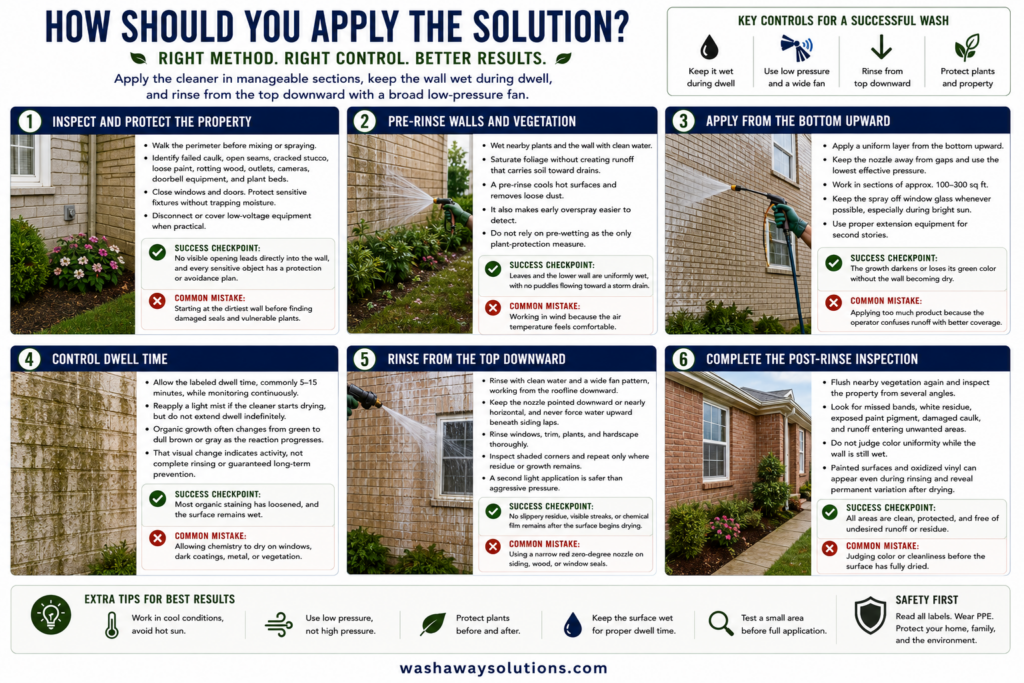
Apply the cleaner in manageable sections, keep the wall wet during dwell, and rinse from the top downward with a broad low-pressure fan. The most important control is preventing the chemical from drying on glass, painted trim, metal, landscaping, or hot siding.
Step 1: Inspect and protect the property
Walk the perimeter before mixing or spraying. Identify failed caulk, open siding seams, cracked stucco, loose paint, rotting wood, exterior outlets, cameras, doorbell equipment, and plant beds.
Close windows and doors. Protect sensitive fixtures according to their manufacturer instructions, but do not seal electrical equipment in a way that traps moisture. Disconnect or cover low-voltage garden equipment when practical.
Success checkpoint: no visible opening leads directly into the wall, and every sensitive object has a protection or avoidance plan.
Common mistake: starting at the dirtiest wall before finding damaged seals and vulnerable plants.
Step 2: Pre-rinse walls and vegetation
Wet nearby plants and the wall with clean water. Use enough water to saturate foliage without creating runoff that carries soil toward drains.
A pre-rinse cools hot surfaces and removes loose dust. It also makes early overspray easier to detect. Do not rely on pre-wetting as the only plant-protection measure.
Success checkpoint: leaves and the lower wall are uniformly wet, with no puddles flowing toward a storm drain.
Common mistake: working in wind because the air temperature feels comfortable.
Step 3: Apply from the bottom upward
Apply a uniform layer from the bottom upward, keeping the nozzle away from gaps and using the lowest effective pressure. Bottom-up application reduces the chance that dirty runoff creates irregular clean bands on dry lower sections.
Work in sections of approximately 100-300 square feet. Keep the spray off window glass whenever possible, especially during bright sun. For second-story walls, use appropriate extension equipment rather than climbing unstable ladders while handling chemicals.
Success checkpoint: the growth darkens or loses its green color without the wall becoming dry.
Common mistake: applying too much product because the operator confuses runoff with better coverage.
Step 4: Control dwell time
Allow the labeled dwell time, commonly 5-15 minutes, while monitoring the surface continuously. Reapply a light mist if the cleaner starts drying, but do not extend dwell indefinitely to compensate for weak coverage or an unsuitable product.
Organic growth often changes from green to dull brown or gray as the reaction progresses. That visual change indicates activity, not complete rinsing or guaranteed long-term prevention.
Success checkpoint: most organic staining has loosened, and the surface remains wet.
Common mistake: allowing chemistry to dry on windows, dark coatings, metal, or vegetation.
Step 5: Rinse from the top downward
Rinse with clean water and a wide fan pattern, working from the roofline downward. Keep the nozzle pointed downward or nearly horizontal, and never force water upward beneath siding laps.
Rinse windows, trim, plants, and hardscape thoroughly. Inspect shaded corners and repeat only where residue or growth remains. A second light application is safer than aggressive pressure.
Success checkpoint: no slippery residue, visible streaks, or chemical film remains after the surface begins drying.
Common mistake: using a narrow red zero-degree nozzle on siding, wood, or window seals.
Step 6: Complete the post-rinse inspection
Flush nearby vegetation again and inspect the property from several angles. Look for missed bands, white residue, exposed paint pigment, damaged caulk, and runoff entering unwanted areas.
Do not judge color uniformity while the wall is still wet. Painted surfaces and oxidized vinyl can appear even during rinsing and reveal permanent variation after drying.
Soft Wash Versus Pressure Washing
Soft washing is usually the better choice for organic growth on house siding, while pressure washing is usually better for sound concrete and selected masonry. The deciding variables are substrate strength, stain type, water-entry risk, and whether abrasion is needed.
| Criterion | Soft washing | High-pressure washing | Oxygenated cleaning |
|---|---|---|---|
| Main action | Chemical oxidation | Mechanical impact | Oxidation plus agitation |
| Typical house-wall pressure | Below 300 PSI | Often 1,000-2,500 PSI | Low pressure |
| Best stain type | Algae, mildew, mold | Dirt, loose buildup, concrete grime | Light organic growth |
| Typical labor | 1.5-3 hours professional | 1.5-3 hours professional | 3-6 hours with brushing |
| Surface risk | Chemical and runoff damage | Etching, paint loss, water entry | Scrubbing or residue |
| Typical longevity | About 6-24 months | About 3-12 months | About 3-12 months |
| Best setting | Siding and coated walls | Driveways and sound concrete | Sensitive or chlorine-avoidance jobs |
Pressure is not inherently wrong. The error is applying concrete-cleaning pressure to a fragile wall assembly. High pressure can strip oxidation-softened paint, cut wood fibers, drive water behind vinyl, and damage mortar joints.
The “red tip trap” deserves special attention. A zero-degree nozzle concentrates force into a tiny impact point and has no legitimate role on ordinary residential siding. Even a wider nozzle can cause damage when held too close or aimed upward.
Winner for painted siding and organic growth: soft washing, applied with controlled chemistry and low pressure.
What Are the Best Alternatives to Chlorine?
Sodium percarbonate, hydrogen-peroxide-based products, neutral detergents, alkaline degreasers, and specialty acids are useful alternatives when chlorine is unsuitable. Each alternative addresses a narrower problem and generally requires more physical work or stricter material compatibility.
| Cleaner type | Best use | Typical contact time | Limitation |
|---|---|---|---|
| Sodium percarbonate | Light algae and organic soil | 10-20 minutes | Usually needs brushing |
| Hydrogen peroxide product | Small sensitive-area treatment | Label-directed | Higher product cost |
| Neutral detergent | Dust and general dirt | 5-15 minutes | Weak against established growth |
| Alkaline degreaser | Oil, soot, and grease | 5-15 minutes | Can harm coatings or plants |
| Oxalic or other acid cleaner | Rust and mineral deposits | Label-directed | Etches stone and irritates skin |
Oxygenated cleaners can suit households that want to minimize chlorine use, but “plant safe” is not an automatic property of every oxygen product. Concentration, pH, runoff volume, and the specific plant determine risk.
Acid cleaners belong in a separate category. Oxalic acid may help with iron staining, but it does not replace a biological-growth treatment and should never be mixed with sodium hypochlorite. Use stone-specific guidance and neutralization instructions from the product manufacturer.
What Can Go Wrong During House Washing?
Most house-washing failures come from incorrect stain diagnosis, excessive pressure, dried chemistry, uncontrolled runoff, or an inaccurate dilution assumption. Recovery depends on the failure, and some coating damage cannot be reversed by another cleaning pass.
- White or cloudy residue: Re-wet and rinse promptly. Dried surfactant or mineral residue may need a manufacturer-approved cleaner and soft brushing.
- Dark horizontal gutter lines: Carbon-based tiger striping may need a dedicated gutter cleaner and manual agitation; chlorine alone may not remove it.
- Rust-colored marks: Identify iron or tannin staining before using a rust remover. Do not increase SH strength expecting rust to disappear.
- Efflorescence on brick: White salts require moisture-source control and masonry-appropriate cleaning, not repeated chlorine applications.
- Paint loss or fuzzy wood: Stop pressure washing. The surface needs drying, coating assessment, and possibly sanding or repainting.
- Plant browning: Rinse immediately with clean water, stop the source, and monitor affected foliage. Severely damaged leaves may not recover.
- Streaks after drying: Re-rinse the affected section and inspect for oxidation, uneven paint, or a missed rinse rather than increasing pressure.
Practitioner rule: a failed first pass is usually a diagnosis problem, not a reason to use more pressure or stronger chemicals.
How Much Does Exterior House Washing Cost?
Professional exterior house washing typically costs about $150-$350 for a small one-story home and $350-$700 for a larger or two-story property in the United States, before unusual access, heavy growth, or bundled services. Local labor rates, access, surface area, and plant-protection requirements create substantial variation.
| Project | Typical professional price | Typical duration | Main cost driver |
|---|---|---|---|
| One-story siding | $150-$350 | 1-2 hours | Linear wall area |
| Two-story siding | $350-$700 | 2-4 hours | Height and access |
| Large or three-story home | $700-$1,400+ | 4-8 hours | Lift, setup, and labor |
| Driveway add-on | $100-$300 | 1-2 hours | Concrete area and stains |
| Roof cleaning add-on | $450-$900 | 2-5 hours | Roof pitch and safety |
| DIY ground-level wash | $40-$150 | 3-6 hours | Equipment and product |
These are typical planning ranges, not a universal price list. Homewyse and Angi publish cost estimates that vary by location and project assumptions, while local quotes can change with travel, insurance, water access, and containment requirements.
Request an itemized quote. It should identify the surfaces included, chemical method, protection of plants and windows, rinse responsibility, access equipment, and whether the contractor will stop when pre-existing defects make washing unsafe.
Should You DIY or Hire a Professional?
DIY house washing is reasonable for a small, one-story, ground-level area with mild dirt and a labeled consumer product. Hiring a professional is the safer choice for two-story walls, concentrated sodium hypochlorite, roofs, extensive mold, delicate coatings, or any property with difficult runoff control.
A qualified contractor should carry general liability insurance and explain the cleaning method in plain terms. Ask what pressure reaches the wall, how chemical strength is selected, how plants are protected, and what happens if the coating or caulk fails during inspection.
Avoid a contractor who promises that one concentration works for every surface. Also avoid a provider who describes a high-pressure red nozzle as appropriate for vinyl or painted wood. A careful operator tests a small area, photographs existing defects, and gives chemistry time to work instead of compensating with force.
How Often Should a House Exterior Be Washed?
Most homes need exterior washing every 12-24 months, but shaded, humid, tree-covered, or coastal properties may need annual service. A dry, sunny home with limited biological growth may remain presentable for two or three years.
Cleaning frequency depends on the return of the contaminant, not a fixed calendar. North-facing walls, dense landscaping, roof runoff, and poor drainage create damp conditions where algae and mildew return quickly. Trimming vegetation away from walls and correcting leaking gutters can extend the clean appearance more effectively than stronger chemicals.
A maintenance wash should be lighter than a neglected restoration wash. Early surface film usually requires less dwell time, less runoff, and less risk to coatings.
FAQ
Is bleach safe for vinyl siding?
Diluted sodium hypochlorite can be compatible with vinyl siding when the product label permits it, the area is pre-tested, the solution does not dry, and the wall receives a complete rinse. Undiluted bleach, prolonged dwell, hot sun, and uncontrolled overspray can discolor surfaces or damage nearby plants and metals.
Can I use dish soap in a house-wash mix?
Do not add dish soap to sodium hypochlorite unless the manufacturer specifically confirms compatibility. Dish detergents contain varying surfactants, fragrances, solvents, and additives that can degrade chlorine, leave residue, or create hazardous reactions when combined with other cleaners. Use a labeled bleach-stable house-wash surfactant instead.
What is the best solution for black mold on a house?
For black or dark organic growth on compatible exterior surfaces, a labeled sodium hypochlorite house-wash product is often the most efficient treatment. A dark stain may instead be carbon, rust, or embedded dirt, so test a small area and identify the contaminant before increasing chemical strength.
Can soft washing remove stains from a driveway?
Soft washing can remove algae and some organic discoloration from a driveway, but pressure washing with a surface cleaner is usually more efficient for embedded dirt, tire marks, and many oil residues on sound concrete. Use lower pressure near cracks, joints, coatings, garage doors, and adjacent landscaping.
Does rain ruin a house-washing treatment?
Light rain after a complete rinse usually does not ruin a house-washing treatment. Rain during the dwell period can dilute the solution and shorten contact time, while heavy rain can spread runoff beyond the controlled work area. Pause when weather prevents the wall from staying wet but contained.
What should I clean before painting the exterior?
Clean the exterior before painting so loose dirt, mildew, chalk, and failing material do not interfere with adhesion. Allow the substrate to dry fully, repair damaged wood or masonry, remove loose paint, and follow the coating manufacturer’s preparation requirements before applying primer or finish paint.
The Bottom Line
The best exterior house washing solution for most residential siding is a properly selected, label-directed soft-wash detergent that combines controlled chemistry with low-pressure application and thorough rinsing. Sodium hypochlorite is efficient for algae, mildew, mold, and lichen, while oxygenated products, degreasers, rust removers, and pressure cleaning belong to specific stain and substrate situations.
Choose chemistry by contaminant and material. Protect plants, glass, electrical fixtures, coatings, and drainage before application. If the work involves height, concentrated chemicals, damaged cladding, or uncertain stains, a qualified professional is usually worth the cost because correct diagnosis prevents the damage that stronger pressure cannot repair.