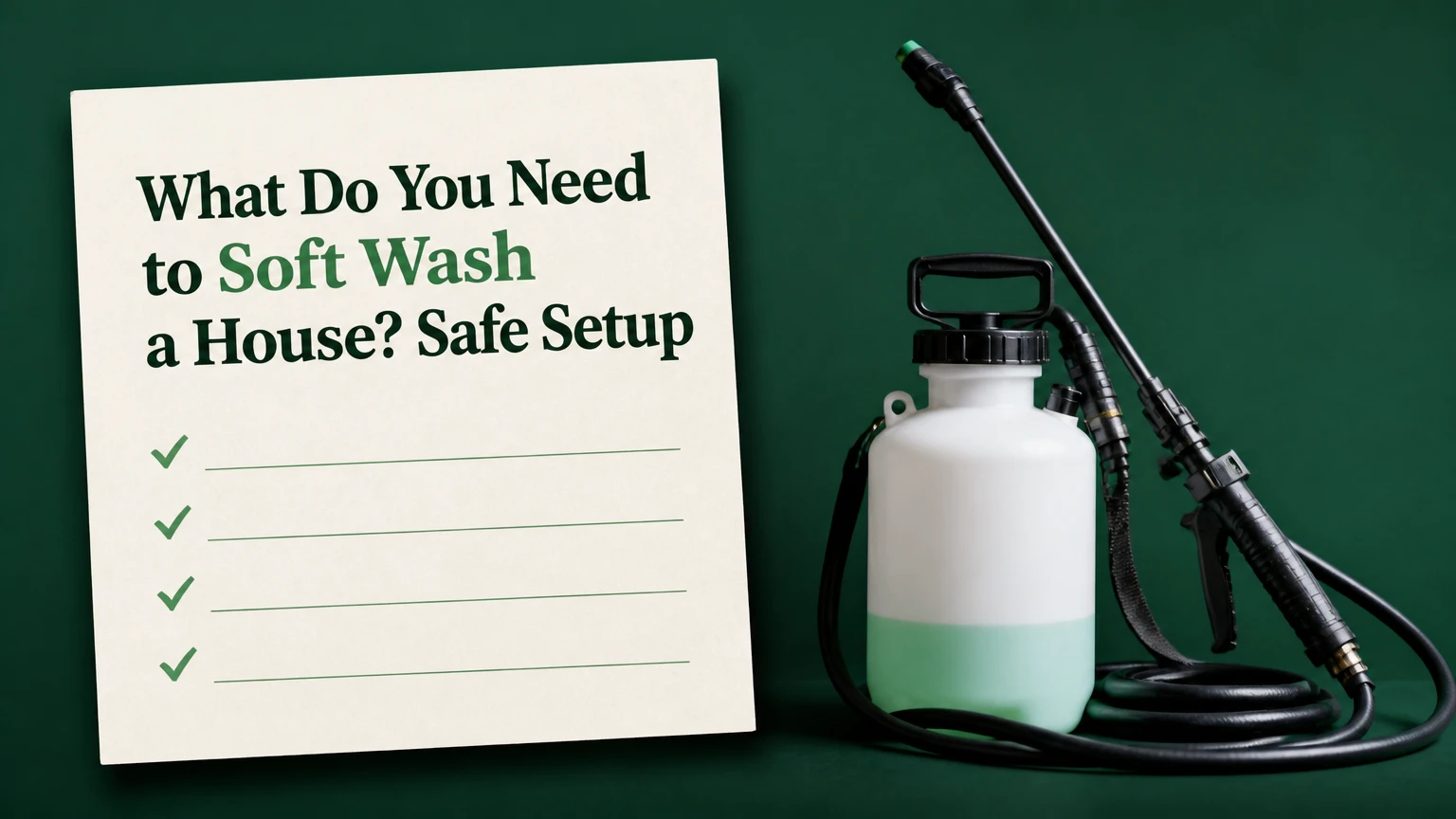
To soft wash a house, you need a low-pressure diaphragm pump, chemical-resistant hose, wide-orifice nozzle, sodium hypochlorite solution, surfactant, clean water, protective equipment, and plant-protection supplies. A practical system delivers about 40-100 PSI and 4-6 GPM. The correct chemical strength depends on the siding, contamination, weather, and surface condition.
At a Glance
- A soft-wash system uses chemical cleaning and low pressure, not high-pressure blasting.
- A 12-volt, 24-volt, or gas-powered diaphragm pump typically produces the needed 40-100 PSI range.
- A typical house-wash mix contains about 1%-3% sodium hypochlorite at the surface.
- Sodium hypochlorite must never contact acids, ammonia, or incompatible cleaners.
- Plants, windows, fixtures, and neighboring property require continuous protection.
- Oxidized siding, rust, and artillery fungus need different treatment from ordinary algae or mildew.
How Does Soft Washing Differ From Pressure Washing?
Soft washing removes organic growth with a cleaning solution and uses low pressure to rinse the surface. Pressure washing relies primarily on mechanical force, which can remove surface dirt quickly but may damage paint, screens, siding, mortar, or seals when used improperly.
| Factor | Soft washing | Pressure washing | Practical result |
|---|---|---|---|
| Typical working pressure | 40-100 PSI | 1,000-3,000 PSI | Soft washing reduces impact |
| Main cleaning action | Chemical treatment | Water force | Soft washing targets organic growth |
| Risk to screens | Lower with correct technique | Higher at close range | Keep pressure away from screens |
| Organic regrowth | Often slower | May return sooner | Chemical treatment reaches growth roots |
| Best use | Algae, mildew, mold | Hard, durable surfaces | Match the method to the material |
The phrase “soft wash” does not mean “chemical-only” or “risk-free.” A poorly controlled sodium hypochlorite application can discolor plants, corrode metals, or damage coatings even when pump pressure is low. The method works because the chemical performs most of the cleaning, allowing the operator to rinse with less force.
What Pump and Pressure Are Right for House Washing?
A dedicated diaphragm pump rated for chemicals is the right pump for house washing. The usual operating range is 40-100 PSI, with 150 PSI treated as an upper limit rather than a target.
| Pump option | Typical output | Suitable use | Limitation |
|---|---|---|---|
| 12-volt diaphragm pump | 3-5 GPM, 40-100 PSI | Small homes and spot cleaning | Battery capacity limits long jobs |
| 24-volt diaphragm pump | 4-6 GPM, 40-100 PSI | Larger residential work | Requires compatible power supply |
| Gas-powered diaphragm pump | 5-10 GPM, 40-150 PSI | Two-story homes and frequent work | Noise, fuel, and maintenance |
| Garden sprayer | Below 1 GPM | Small patches and testing | Usually cannot reach upper walls |
A flow rate of 4-6 GPM helps a stream reach upper siding without increasing pressure. A standard pressure-washer pump is usually unsuitable because the machine can deliver far more force than window screens, paint, or siding joints can tolerate. Use a pressure gauge when possible, and reduce output if the stream damages caulk, coatings, or fragile surfaces.
Which Hose, Nozzle, and Accessories Are Needed?
A house-washing setup needs 150-200 feet of 1/2-inch or 5/8-inch chemical-resistant hose, wide-orifice shooter tips, an inline filter, a proportioner or injection system, and secure fittings. The hose must tolerate sodium hypochlorite because ordinary garden hose can deteriorate.
| Component | Recommended specification | Purpose |
|---|---|---|
| Chemical hose | 1/2 or 5/8 inch inner diameter | Carries cleaning solution |
| Hose length | 150-200 feet | Reaches upper walls and distant areas |
| Straight shooter tip | 0040 or similar | Projects a narrow stream |
| Fan tip | 2540 or similar | Spreads solution across siding |
| Pump filter | Manufacturer-compatible size | Protects pump from debris |
| Pressure gauge | 0-200 PSI scale | Confirms operating pressure |
Use the widest effective spray pattern that reaches the surface. A narrow stream can concentrate chemical on one spot, while an excessively wide fan may fail to reach the second story. Keep connections secured, inspect hose wear before use, and flush the system with clean water after the job.
What Chemicals Are Used in a House-Washing Solution?
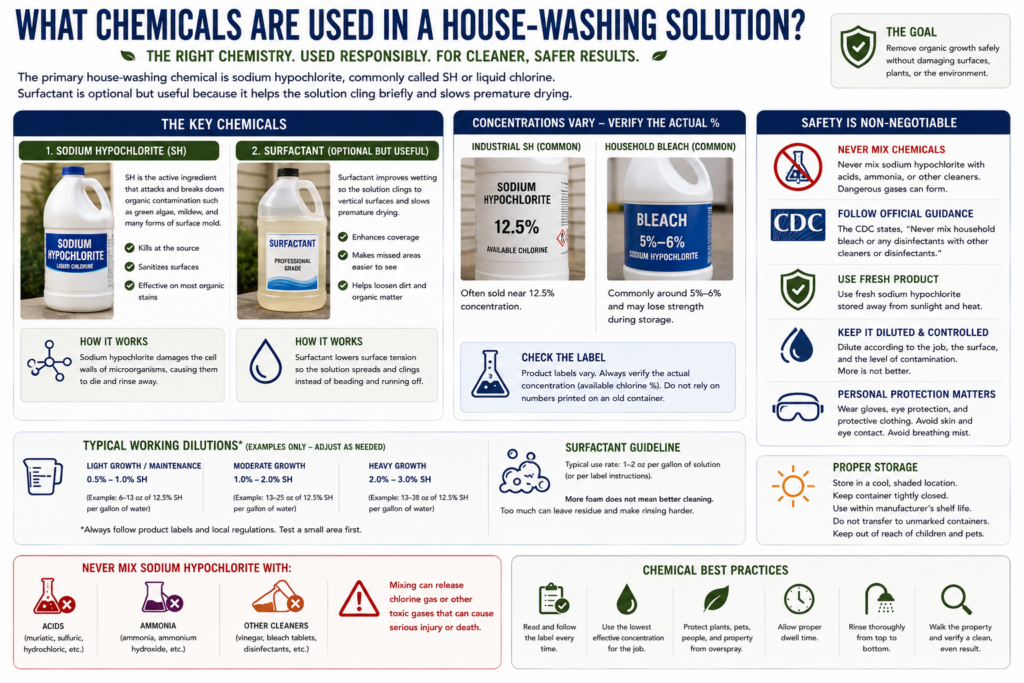
The primary house-washing chemical is sodium hypochlorite, commonly called SH or liquid chlorine. Surfactant is optional but useful because surfactant helps the solution cling briefly and slows premature drying.
Sodium hypochlorite attacks organic contamination such as green algae, mildew, and many forms of surface mold. Surfactant improves wetting and can make missed areas easier to identify, but more foam does not mean better cleaning. Excess surfactant can leave residue and make rinsing harder.
Use fresh sodium hypochlorite stored away from sunlight and heat. Industrial SH is often sold near 12.5% concentration, while household bleach is commonly around 5%-6% and may lose strength during storage. Product labels vary, so verify the actual concentration instead of assuming the number printed on an old container.
Never mix sodium hypochlorite with acids, ammonia, or other cleaners. The CDC states, “Never mix household bleach or any disinfectants with other cleaners or disinfectants,” because dangerous gases can form.
How Do You Dilute Sodium Hypochlorite Safely?
Dilute sodium hypochlorite by calculating the desired final strength, measuring the water and chemical separately, and testing a small inconspicuous area first. A simple dilution formula is: starting concentration × chemical volume = target concentration × final volume.
For example, a 3% solution made from 12.5% sodium hypochlorite requires approximately 24 gallons of 12.5% SH in a 100-gallon final batch. A 50-gallon batch at 3% requires about 12 gallons of 12.5% SH, with water added to reach the final 50-gallon volume. A small amount of surfactant may then be added according to the product label.
| Surface or condition | Typical surface SH | Typical dwell time |
|---|---|---|
| Light vinyl algae | 0.5%-1.0% | 5-8 minutes |
| Moderate vinyl growth | 1.0%-1.5% | Up to 10 minutes |
| Painted wood or Hardie | 1.0%-1.5% | 5-8 minutes |
| Stucco, Dryvit, or EIFS | 2.0%-3.0% | Up to 15 minutes |
| Brick or masonry growth | 2.0%-3.0% | Up to 15 minutes |
These figures are typical practitioner ranges, not universal label instructions. Temperature, sunlight, age of contamination, and chemical freshness can change the result. Stronger is not automatically better.
How Much Solution Does a House Usually Require?
A typical one-story house may use 10-30 gallons of mixed solution, while a larger two-story house may use 25-60 gallons. Actual consumption depends on wall area, porosity, contamination, spray technique, and the amount of rinsing water.
| Project size | Mixed solution range | Concentrated 12.5% SH at 2% final strength |
|---|---|---|
| Small one-story home | 10-20 gallons | 1.6-3.2 gallons |
| Average one-story home | 20-35 gallons | 3.2-5.6 gallons |
| Large two-story home | 35-60 gallons | 5.6-9.6 gallons |
| Heavy stucco or masonry job | 45-80 gallons | 7.2-12.8 gallons |
The table assumes a 2% final SH strength for estimating chemical volume. A 3% final strength uses 50% more concentrate than the 2% examples. Buy only the amount needed for the project because sodium hypochlorite degrades over time, especially in warm storage.
What Is the Correct Soft-Washing Process?
The correct process is inspection, preparation, controlled application, dwell-time management, and low-pressure rinsing. The operator should clean one manageable section at a time rather than applying chemical to the entire house and hoping it remains wet.
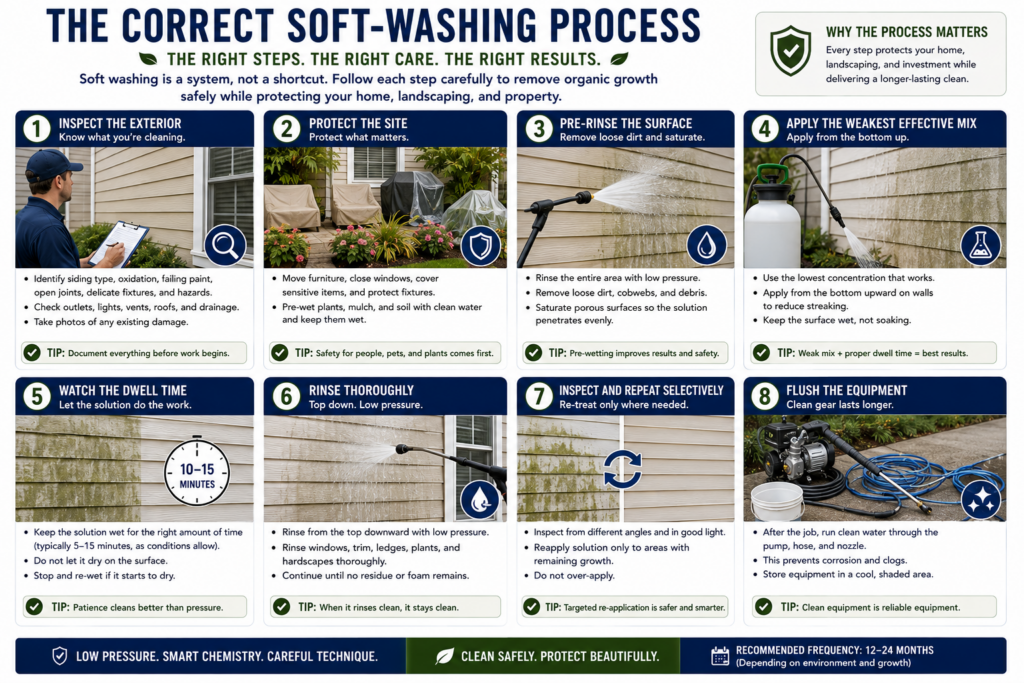
The most common professional mistake is allowing chemical to dry. Shade, moderate temperatures, and controlled sections make the process safer and more consistent.
How Long Should the Cleaner Stay on the Surface?
The cleaner should usually remain wet for 5-15 minutes, depending on the material and contamination. Vinyl often needs 5-10 minutes, while stucco and brick may need as much as 15 minutes when the surface has been pre-wetted.
| Condition | Typical dwell range | Required response |
|---|---|---|
| Light algae in shade | 3-5 minutes | Rinse after visible release |
| Moderate vinyl growth | 5-10 minutes | Keep surface wet |
| Painted wood or Hardie | 5-8 minutes | Rinse before drying |
| Stucco or EIFS | 10-15 minutes | Maintain saturation |
| Hot, sunny, windy weather | 2-6 minutes | Use smaller sections |
Dwell time is not a race to the longest number. If solution dries, rinse immediately and reduce the section size or chemical strength. Delicate paint, dark-colored siding, and hot surfaces require shorter exposure and more frequent inspection.
How Do You Protect Plants, Windows, and Nearby Property?
Protect plants with clean-water pre-rinsing, continuous watering during application, and a final rinse after chemical runoff passes. Cover or move sensitive outdoor items, and keep windows closed so solution cannot enter the building.
| Property | Protection method | Timing |
|---|---|---|
| Shrubs and grass | Saturate with clean water | Before, during, and after |
| Delicate plants | Rinse plus temporary cover | Before chemical application |
| Windows | Close, wet frames, rinse promptly | Before and after each section |
| Unpainted metals | Cover or keep continuously wet | During chemical application |
| Outdoor lights | Cover and avoid direct spray | Before application |
| Neighboring property | Notify, shield, and monitor runoff | Before starting |
A ground person should monitor plants and runoff when the job involves concentrated SH or extensive landscaping. Wind is a stop condition when spray can drift onto people, vehicles, neighboring plants, or open windows. Clean water dilutes runoff, but water protection does not excuse careless chemical application.
Can Every Type of Siding Be Soft Washed?
Most sound vinyl, fiber-cement, brick, and properly finished stucco can be soft washed, but no surface should receive a standard mix without inspection and a test patch. Painted wood, oxidized metal, old coatings, and damaged EIFS require more conservative treatment.
| Surface | Usually suitable? | Main adjustment |
|---|---|---|
| Vinyl siding | Yes, if sound | Use about 1.0%-1.5% SH |
| Fiber cement | Usually | Protect failing paint and joints |
| Painted wood | With caution | Use weaker mix and short dwell |
| Stucco or EIFS | Usually | Pre-wet and rinse deeply |
| Brick masonry | Usually | Saturate porous areas first |
| Oxidized metal | Not with standard mix | Use restoration cleaning |
| Unsealed wood | High caution | Test compatibility first |
Soft washing removes biological growth, not every kind of stain. Mineral deposits, oxidation, rust, artillery fungus, and failing paint need separate decisions. The surprise for many homeowners is that a cleaner surface can reveal pre-existing coating damage that was hidden beneath algae.
When Should You Avoid Soft Washing?
Avoid or postpone soft washing when wind can carry chemicals, electrical equipment is exposed, siding is severely deteriorated, or the operator cannot control runoff. Soft washing is also inappropriate when the cleaning objective involves rust, oxidation, or a coating failure that SH will not correct.
Stop the work if plants show stress, chemical dries on the wall, a window leaks, or a fixture begins discoloring. Do not spray near open windows, unprotected HVAC intakes, people, pets, or vehicles. Avoid hot, windy conditions because evaporation and drift become harder to control.
Homeowners should hire a trained professional for steep access, extensive second-story work, fragile historic finishes, large EIFS surfaces, or chemical restoration. A ladder, pump, and bleach container do not provide the same control as a complete system and a practiced operator.
What Should You Do About Oxidation, Rust, or Artillery Fungus?
Oxidation, rust, and artillery fungus require separate treatments because sodium hypochlorite is designed for organic growth, not every exterior stain. Test the suspected problem before applying a stronger house-washing mixture.
- Oxidation: Rub a dry, inconspicuous area with a finger. If chalk transfers to the finger, standard SH cleaning may leave white runs or uneven marks. Use a compatible restoration cleaner and gentle agitation instead.
- Rust: Treat irrigation or metal rust only after SH has been completely rinsed away. Use a product labeled for the specific surface, and follow the label’s acid safety requirements.
- Gutter tiger striping: Use a dedicated gutter cleaner rather than expecting house-wash SH to dissolve inorganic runoff.
- Artillery fungus: The black, tar-like spots often remain attached after treatment. Carefully remove spots with a plastic scraper or use a specialist method that will not scratch siding.
Never apply acid to a surface that still carries sodium hypochlorite. Chlorine gas can form.
Is DIY Soft Washing Cheaper Than Hiring a Professional?
DIY soft washing is cheaper for repeated small projects when the homeowner already owns compatible equipment, but hiring a professional is often more economical for a single large or high-risk house. A basic DIY setup may cost about $250-$700, while a more capable gas-powered system can exceed $1,000.
| Approach | Typical equipment or service cost | Best fit | Main risk |
|---|---|---|---|
| Pump sprayer method | $30-$120 | Small, reachable areas | Low reach and uneven coverage |
| Electric DIY setup | $250-$700 | One-story homes | Limited flow or battery runtime |
| Gas soft-wash system | $1,000-$3,000 | Frequent or large projects | Higher cost and maintenance |
| Professional house wash | $250-$800 typical range | One-time residential cleaning | Price varies by size and access |
These are typical U.S. practitioner ranges, not fixed market prices. Chemical cost is only one part of the project. Insurance, ladders, plant protection, replacement hose, wastewater control, and time can make professional service the better choice for a two-story or fragile home.
How Often Should a House Be Soft Washed?
A house commonly needs soft washing every 12-24 months, but shade, humidity, tree cover, and local climate can shorten or extend that interval. North-facing walls and surfaces beneath dense vegetation usually regrow algae sooner than sunny, dry elevations.
| Exposure or condition | Typical cleaning interval |
|---|---|
| Sunny, dry siding | 18-36 months |
| Average residential exterior | 12-24 months |
| Shaded north-facing wall | 6-18 months |
| Damp, tree-covered property | 6-12 months |
| Clean masonry in dry climate | 24-36 months |
Soft washing often lasts longer than pressure washing because the treatment addresses organic growth instead of merely removing visible discoloration. The result still depends on moisture, spores, surface porosity, and nearby vegetation. A maintenance rinse or early spot treatment can reduce the need for aggressive cleaning later.
What Mistakes Cause Damage During Soft Washing?
The most damaging mistakes are using excessive pressure, applying an untested chemical strength, allowing solution to dry, neglecting plants, and mixing incompatible products. Each mistake creates a different failure mode.
| Mistake | Likely damage | Prevention |
|---|---|---|
| Using a pressure-washer tip | Stripped paint or damaged seals | Use a low-pressure diaphragm system |
| Applying strong SH to old paint | Fading, oxidation, or peeling | Test first and start weaker |
| Letting solution dry | Streaks or surface discoloration | Work in small sections |
| Ignoring wind direction | Drift onto plants or vehicles | Pause in unsafe wind |
| Skipping the final rinse | Residue and corrosion | Rinse walls, fixtures, and plants |
| Mixing SH and acid | Toxic chlorine gas | Flush completely between chemicals |
Professional operators do not judge success by chemical strength alone. They control exposure, keep surfaces wet, protect surrounding property, and inspect the result before moving to the next section.
The Bottom Line
To soft wash a house, use a chemical-resistant diaphragm pump, 40-100 PSI output, 4-6 GPM flow, suitable hose and nozzles, sodium hypochlorite, surfactant, and complete site-protection equipment. Match the final SH strength to the siding, beginning with the weakest effective mixture. Protect plants continuously, and avoid standard soft washing on oxidized, rust-stained, or severely damaged surfaces because those conditions require separate treatment.