Soft washing typically lasts 1-3 years, although a professionally treated roof may remain visibly clean for 2-5 years in favorable conditions. Shade, humidity, rainfall, nearby trees, surface porosity, drainage, and the quality of the biocidal treatment determine when algae, mold, mildew, or moss returns.
Key Facts at a Glance
- Soft washing usually lasts 1-3 years on residential exterior surfaces.
- Roof soft washing commonly lasts 2-5 years, but heavy shade and overhanging trees can shorten that period.
- Siding commonly stays clean for 1-2 years, while shaded north-facing walls often regrow first.
- Wood decks and fences usually last 1-3 years when the wood is cleaned and then sealed or stained.
- Concrete and brick commonly last 1-2 years because porous, horizontal surfaces retain water and organic debris.
- A soft wash is not a permanent barrier. It kills or removes existing biological growth, but it does not eliminate moisture, shade, spores, or falling debris.
What Does Soft Washing Do?
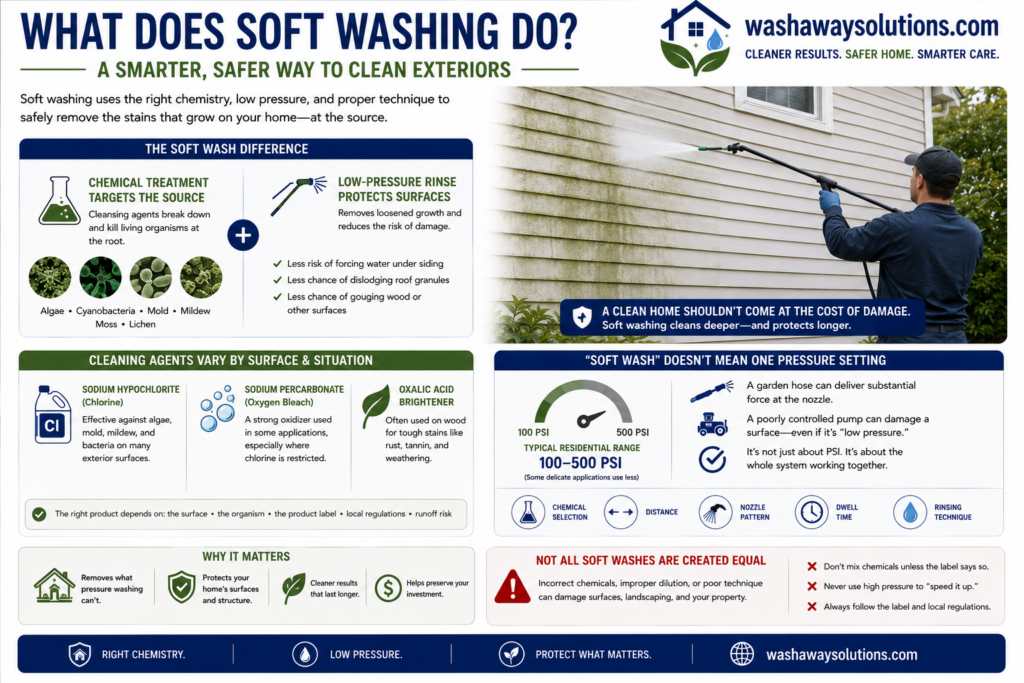
Soft washing is an exterior-cleaning method that combines a low-pressure spray with a chemical treatment designed to remove living organic growth. The solution targets algae, cyanobacteria, mold, mildew, moss, and lichen, while the low-pressure rinse reduces the chance of forcing water beneath siding, dislodging roof granules, or gouging wood.
The cleaning agent varies by material and local regulation. Professional systems may use diluted sodium hypochlorite with surfactants, while some wood-cleaning applications use sodium percarbonate, a detergent, or an oxalic-acid brightener. The correct product depends on the substrate, the organism, the product label, and the runoff risk.
The term “soft wash” does not identify one universal pressure setting. Many residential systems operate around 100-500 PSI, and some delicate applications use less. A garden hose can deliver substantial force at the nozzle, while a poorly controlled pump can damage a surface despite being marketed as low pressure. Chemical selection, distance, nozzle pattern, dwell time, and rinsing technique matter as much as the gauge reading.
How does soft washing preserve cleanliness?
Soft washing lasts longer than water-only cleaning because a properly selected treatment addresses biological contamination rather than merely removing its visible film. Algae and mildew can remain in surface texture after mechanical washing, allowing discoloration to reappear when moisture and temperature become favorable.
A typical application follows this sequence:
- Inspect the substrate, stains, roof drainage, windows, vents, and vulnerable landscaping.
- Pre-wet plants and soil with clean water.
- Cover or shield electrical fixtures, outdoor furniture, vehicles, and sensitive finishes.
- Apply a surface-appropriate cleaning solution at low pressure.
- Allow controlled dwell time, commonly 5-20 minutes, without letting the solution dry.
- Rinse from the cleanest direction using low to moderate pressure.
- Inspect the surface, then rinse vegetation and hardscape again.
The solution must remain wet long enough to work, but longer dwell is not automatically better. Sun, wind, temperature, concentration, and substrate absorbency change the required contact time.
What Determines How Long the Result Lasts?
Climate and moisture exposure usually have more influence than the cleaning date. A shaded, damp wall beneath trees can regrow within months, while a sun-exposed roof with good airflow may remain clean for several years after the same treatment.
The most important variables are:
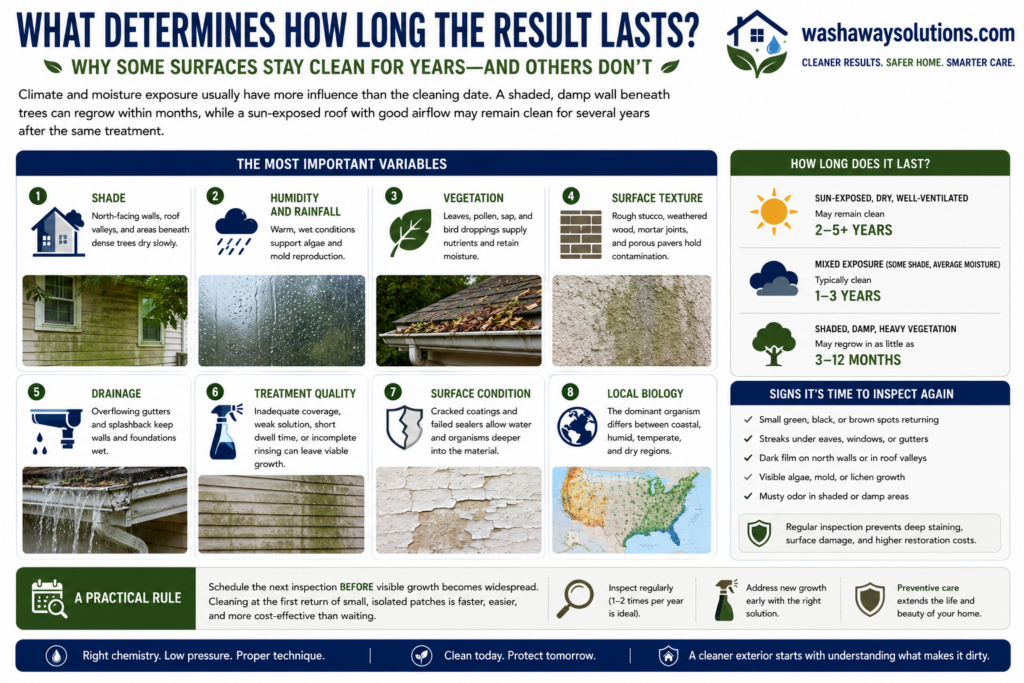
A practical rule is to schedule the next inspection before visible growth becomes widespread. Cleaning at the first return of small isolated patches usually costs less and requires less chemical exposure than waiting for a dense infestation.
How much does shade shorten soft-wash results?
Shade can shorten a typical cleaning interval from several years to roughly 6-18 months, especially on damp siding, masonry, and roof sections beneath trees. Shade does not guarantee rapid regrowth, but it combines low ultraviolet exposure with slower evaporation, which creates better conditions for algae, moss, and mildew.
Tree trimming, gutter repair, improved downspout discharge, and better airflow can extend the result more effectively than applying a stronger chemical mixture. Increasing concentration without fixing persistent moisture often creates added plant and material risk without solving the cause.
How Long Does Soft Washing Last on Different Surfaces?
Soft washing lasts different lengths of time because each substrate retains different amounts of water, nutrients, and spores. Roofs often remain clean longer than concrete because roof surfaces receive more airflow and sunlight, whereas horizontal masonry collects soil and stays damp after rain.
| Surface | Typical visible-clean interval | Main regrowth drivers | Maintenance trigger |
|---|---|---|---|
| Asphalt shingle roof | 2-5 years | Shade, tree debris, damp roof valleys | Dark streaks or moss patches |
| Vinyl siding | 1-2 years | North-facing exposure, pollen, poor drainage | Green film or gray mildew |
| Stucco or rendered wall | 1-2 years | Porosity, cracks, irrigation overspray | Discoloration in texture or joints |
| Wood deck or fence | 1-3 years | Moisture, weathering, failed stain | Gray fibers, mildew, peeling finish |
| Concrete driveway | 1-2 years | Vehicle moisture, soil, porous finish | Black spotting or slippery film |
| Brick and pavers | 1-2 years | Damp joints, moss, leaf litter | Moss in joints or persistent darkening |
These are typical practitioner ranges, not warranties. A roof in a dry, sunny climate may exceed five years, while a shaded coastal roof may show staining again within a year. Similarly, sealing wood or masonry can reduce water absorption, but a sealer does not replace cleaning or correct defective drainage.
How long does roof soft washing last?
Roof soft washing commonly lasts 2-5 years on asphalt shingles, with shorter intervals where tree cover, humidity, and roof shading are severe. Roof cleaning removes biological staining and moss from the surface, but it does not repair brittle shingles, replace missing granules, or reverse age-related deterioration.
Dark streaks on asphalt shingles are often associated with cyanobacteria, including organisms commonly identified as Gloeocapsa magma. Moss presents a different problem because its structures can lift shingle edges and retain water. Dead moss may detach gradually after treatment rather than disappearing during the rinse.
Cleaning can improve appearance and reduce moisture retention, but claims that one soft wash adds a guaranteed ten years to roof life are not technically defensible. Remaining roof life depends on shingle age, granule loss, ventilation, storm damage, flashing, installation quality, and manufacturer requirements. The cleaning contractor should document pre-existing defects before work begins.
How long does soft washing last on siding?
Soft washing generally keeps siding visibly clean for 1-2 years, although sunny, dry walls can last longer and shaded walls can show growth in 6-12 months. Vinyl, fiber-cement, painted wood, and stucco each require different pressure, chemical tolerance, and rinsing controls.
Siding streaks often return first beneath eaves, around hose bibs, beside downspouts, or where sprinklers wet the wall. A contractor who treats only the stained panel without addressing gutter overflow or irrigation overspray may produce a short-lived cosmetic result.
Aluminum siding deserves particular care because strong oxidizing solutions or prolonged dwell can alter the finish. Painted surfaces can chalk, and stucco can hold solution in its texture. The operator should test an inconspicuous area, keep the mixture wet, and rinse thoroughly.
How long does soft washing last on wood?
Wood cleaning typically lasts 1-3 years, but the finish determines whether the surface remains attractive for the full interval. A deck or fence that is washed and left unsealed may gray and absorb moisture again within months, even when biological growth has been removed.
Wood is not a single uniform material. Pressure-treated pine, cedar, redwood, painted boards, and composite decking respond differently to cleaners and water. Sodium percarbonate is often selected for organic dirt and mildew on wood, while oxalic acid may brighten certain weathered surfaces. Product labels and manufacturer instructions control the choice.
The most durable sequence is cleaning, complete drying, light preparation where needed, then application of a compatible stain or sealer. Sealing cannot make structurally unsound boards safe, and it should not trap moisture inside damp timber.
How long does soft washing last on concrete and brick?
Soft washing on concrete, brick, and pavers commonly lasts 1-2 years, because porous horizontal materials collect soil, leaves, tire residue, and standing water. Masonry in a shaded walkway can require annual inspection even when a sunny wall remains clean.
Concrete may need a separate oil, rust, or efflorescence treatment because a biocide does not remove every stain type. Brick mortar can be vulnerable to aggressive pressure and prolonged chemical exposure. Pavers may also have polymeric joint sand that requires careful rinsing.
Improved slope, cleaned gutters, regular sweeping, and a compatible sealer can extend the clean appearance. Sealer selection must account for vapor transmission, freeze-thaw conditions, and the manufacturer’s maintenance instructions.
Which Lasts Longer, Soft Washing or Pressure Washing?
Soft washing generally lasts longer for algae, mildew, mold, and moss because chemical treatment can kill biological contamination, whereas pressure washing may remove only the visible layer. Pressure washing remains useful for hard, stable surfaces and nonbiological dirt, but excessive pressure can damage delicate materials.
| Decision factor | Soft washing | Pressure washing |
|---|---|---|
| Typical operating force | 100-500 PSI, application-dependent | 1,500-4,000 PSI, equipment-dependent |
| Biological stain interval | 1-3 years typically | 3-12 months when no biocide is used |
| Best roof approach | Low-pressure treatment and rinse | Generally unsuitable for asphalt shingles |
| Wood risk | Lower when correctly applied | Gouging, fuzzing, and finish removal |
| Concrete cleaning | Useful for organic growth | Strong for embedded dirt and surface grime |
| Main failure mode | Chemical overspray or residue | Surface damage or water intrusion |
The “up to four times longer” claim sometimes used in soft-wash marketing is not a universal measured result. Longevity varies by climate, organism, application, and substrate, so a contractor should not present that multiplier as a guarantee.
Soft washing is also not automatically safer. A chemical solution can damage plants, metals, coatings, pets, and waterways if it is misapplied. Pressure washing can be appropriate when the surface is sound and the operator controls distance and force.
What should be used for roofs, siding, and driveways?
Use a low-pressure chemical process for asphalt shingles, vinyl siding, stucco, painted surfaces, and organic staining on wood. Use controlled pressure for durable concrete or masonry when the primary contamination is mud, soil, loose debris, or embedded grit rather than living growth.
Many jobs need both methods. For example, a driveway may receive a biological pre-treatment followed by surface cleaning, while siding may require chemical application and a gentle rinse only. The correct choice follows the material and contamination, not the equipment a contractor happens to own.
How Is a Soft-Washing Job Performed Safely?
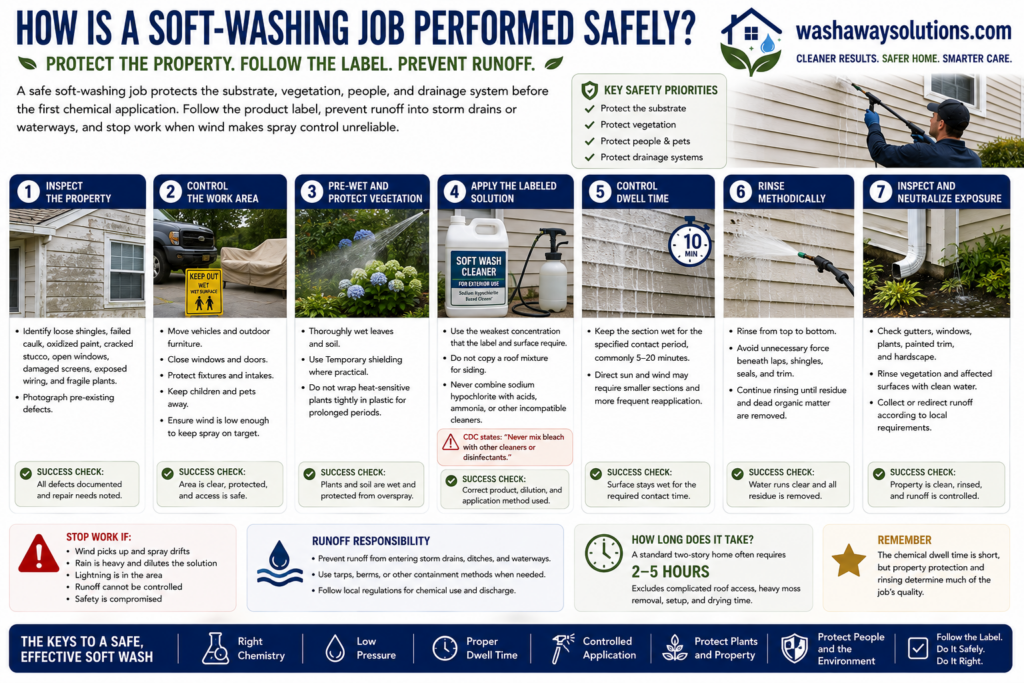
A safe soft-washing job protects the substrate, vegetation, people, and drainage system before the first chemical application. The operator should follow the product label, prevent runoff into storm drains or waterways, and stop work when wind makes spray control unreliable.
Step 1: Inspect the property
Identify loose shingles, failed caulk, oxidized paint, cracked stucco, open windows, damaged screens, exposed wiring, and fragile plants. Photograph pre-existing defects so cleaning damage is not confused with prior deterioration.
Step 2: Control the work area
Move vehicles and outdoor furniture, close windows, protect fixtures, and keep children and pets away. Wind should be low enough to keep spray on the intended surface.
Step 3: Pre-wet and protect vegetation
Thoroughly wet leaves and soil before application. Use temporary shielding where practical, but do not wrap heat-sensitive plants tightly in plastic for prolonged periods.
Step 4: Apply the labeled solution
Use the weakest concentration that the product label and surface require. Do not copy a roof mixture for siding, and never combine sodium hypochlorite with acids, ammonia, or other incompatible cleaners.
The Centers for Disease Control and Prevention states, “Never mix bleach with other cleaners or disinfectants.” That rule applies to household and professional cleaning work.
Step 5: Control dwell time
Keep the section wet for the specified contact period, commonly 5-20 minutes. Direct sun and wind may require smaller sections and more frequent reapplication.
Step 6: Rinse methodically
Rinse from top to bottom while avoiding unnecessary force beneath laps, shingles, seals, and trim. Continue until residue and dead organic matter are removed.
Step 7: Inspect and neutralize exposure
Check gutters, windows, plants, painted trim, and hardscape. Rinse vegetation and affected surfaces with clean water, and collect or redirect runoff according to local requirements.
A standard two-story home often requires 2-5 hours, excluding complicated roof access, heavy moss removal, setup, and drying time. The chemical dwell time is short, but property protection and rinsing determine much of the job’s quality.
What Does Soft Washing Typically Cost?
Typical residential soft-washing prices range from $150-$350 for a driveway, $250-$500 for a deck or fence, $300-$600 for siding, and $400-$800 for a roof. Local labor rates, access, square footage, height, stain severity, travel, plant protection, and wastewater controls can move the quote substantially.
| Project | Typical price range | Typical labor time | Main price variables |
|---|---|---|---|
| Driveway and walk | $150-$350 | 1-3 hours | Oil stains, size, joints, access |
| Deck or fence | $250-$500 | 2-5 hours | Linear footage, stain, drying, sealing |
| House siding | $300-$600 | 2-5 hours | Stories, windows, stucco texture |
| Asphalt roof | $400-$800 | 3-6 hours | Pitch, size, access, moss density |
| Multi-surface property | $700-$1,500+ | 5-10 hours | Combined scope, runoff, restoration |
A low quote may exclude plant protection, gutter cleaning, sealing, or a second treatment pass. Ask whether the price includes setup, chemical application, rinse, cleanup, and documentation of pre-existing damage.
When Should a Property Be Soft Washed Again?
Most properties should be inspected every 6-12 months and cleaned again when biological growth returns, rather than following a rigid annual timetable. A preventive treatment interval of 18-24 months often suits moderately affected homes, while damp, shaded properties may need attention every year.
Schedule an inspection when:
- Green or black growth appears across more than isolated spots.
- Moss begins lifting roof shingle edges or filling masonry joints.
- Gutters overflow onto siding.
- Sprinklers repeatedly wet walls or walkways.
- A deck finish begins peeling or absorbing water unevenly.
- The previous cleaning lasted less than six months.
Cleaning too frequently can expose plants, metals, coatings, and sealers to unnecessary chemicals. Cleaning too late allows roots, moisture, and staining to penetrate deeper.
Why Did Growth Return After Soft Washing?
Growth returning in under six months usually indicates persistent moisture, incomplete treatment, contamination from nearby vegetation, or a surface condition that retains organic matter. A weak solution or insufficient dwell time is possible, but early regrowth does not prove that concentration was the problem.
Use this diagnostic table before requesting a stronger treatment.
| Symptom | Likely cause | Corrective action |
|---|---|---|
| Green film under eaves | Shade and slow drying | Improve airflow, inspect gutters, retreat locally |
| Black roof streaks after 8 months | Tree cover or residual staining | Remove debris, inspect valleys, treat affected areas |
| Brown plant leaves | Overspray or poor rinsing | Flood foliage and soil with clean water, assess damage |
| White siding residue | Solution dried before rinse | Re-wet and rinse according to product guidance |
| Moss returns in joints | Moisture trapped in porous masonry | Improve drainage, remove debris, consider compatible sealer |
| Stains remain immediately | Wrong cleaner or inadequate coverage | Identify stain type and request a controlled second pass |
A second treatment should not automatically use a stronger mix. The operator should first identify whether the stain is biological, mineral, oily, metallic, or coating-related, because the wrong chemistry can damage a clean surface without removing the actual contaminant.
Is Soft Washing Safe for Plants, Roofs, and People?
Soft washing can be safe when the operator matches the chemistry to the material, controls overspray, protects vegetation, and follows the product label. It is not risk-free, and sodium hypochlorite solutions can injure foliage, corrode metals, irritate skin and eyes, and harm aquatic life through uncontrolled runoff.
Professional safeguards include:
- Safety goggles, chemical-resistant gloves, protective clothing, and appropriate respiratory controls.
- Clean-water pre-wetting and post-rinsing of plants.
- Low-wind application and careful nozzle control.
- Separate storage and labeling of chemicals.
- No mixing of bleach with acids, ammonia, or unknown products.
- Protection of copper, aluminum, painted metals, and delicate finishes.
- Rinsing windows, screens, fixtures, and hardscape after treatment.
A soft wash is not suitable for repairing leaks, replacing roof materials, removing hazardous mold inside a building, or correcting structural rot. Exterior cleaning improves surface condition and appearance, but it cannot substitute for roofing, siding, drainage, or moisture remediation.
Should You Hire a Contractor or Do It Yourself?
DIY soft washing may suit a ground-level, small, accessible surface when the homeowner uses a labeled consumer product exactly as directed. Roofs, multi-story walls, strong concentrates, difficult runoff, fragile landscaping, and electrical hazards are better handled by an insured professional.
Before hiring, ask for:
- The proposed product and its label-approved use.
- The expected pressure and application method for each surface.
- A plant, window, vehicle, and runoff protection plan.
- Proof of general liability and workers’ compensation coverage.
- Photos or references for the same material, not merely similar-looking work.
- A written scope stating whether sealing, gutter work, and stain removal are included.
- A statement of what the contractor will do if growth returns quickly.
Care, custody, and control coverage may matter when a contractor is working around customer property, but insurance terminology varies by jurisdiction. Ask the insurer or contractor to explain exclusions rather than relying on a certificate alone.
Frequently Asked Questions
Does rain ruin a soft-washing treatment?
Rain immediately after application can dilute or remove the solution before the required dwell time, reducing treatment effectiveness. Once the surface has received adequate contact time and has been rinsed, ordinary rain usually does not undo the cleaning. Contractors should check the product label and forecast before starting.
Can soft washing remove moss permanently?
Soft washing can kill and remove existing moss, but it cannot prevent permanent recurrence. Moss returns when moisture, shade, debris, and porous surfaces remain favorable. Roof maintenance, tree management, gutter cleaning, and improved sunlight can extend the interval, while persistent roof defects require a roofer’s assessment.
Does soft washing damage asphalt shingles?
Correctly performed low-pressure roof cleaning is less mechanically aggressive than high-pressure washing, which can strip granules or lift shingles. Chemical exposure still requires control. The operator should follow the shingle manufacturer’s guidance, avoid unnecessary walking, protect metal components, and document existing granule loss.
Can soft washing remove rust or oil stains?
Soft washing chemicals designed for algae and mildew do not reliably remove rust, grease, or oil. Rust usually needs an appropriate acidic or specialty treatment, while oil may require a degreaser and agitation. Combining incompatible cleaners can create hazardous reactions or damage concrete, coatings, plants, and metals.
How soon can plants recover from chemical overspray?
Minor exposure may produce temporary browning, while concentrated or repeated exposure can kill leaves or damage roots. Immediately rinsing foliage and flooding nearby soil with clean water can reduce exposure, but recovery depends on plant species, dose, weather, and whether growing points were affected.
Does sealing make soft-washing results last longer?
A compatible sealer can reduce water absorption on suitable wood, concrete, or masonry and may extend the clean appearance. Sealing does not stop airborne spores, eliminate shade, or correct drainage. The surface must be clean and sufficiently dry, and the sealer must be compatible with freeze-thaw, vapor movement, and the substrate.
The Bottom Line
Soft washing usually lasts 1-3 years, with roofs often reaching 2-5 years and shaded, damp surfaces needing treatment sooner. The best predictor is not the advertised chemical strength; it is the combination of biological treatment, surface-specific technique, sunlight, airflow, drainage, vegetation, and post-cleaning maintenance. Schedule an inspection when growth first returns, and choose the method that protects the material rather than simply using the highest pressure.