Soft washing a house typically takes 2-5 hours for a standard 2,000-square-foot home, including site preparation, plant protection, chemical dwell time, rinsing, and cleanup. A small, accessible one-story house may take 1.5-2.5 hours, while a large, heavily soiled, or multi-story property can require 4-7 hours.
Key Facts at a Glance
- A 2,000-square-foot single-story home usually takes 2-4 hours for a professional soft wash.
- A full service includes inspection, plant protection, solution application, dwell time, rinsing, and final cleanup.
- Dwell time commonly takes 10-20 minutes per treatment area, but shade, temperature, and organic growth can extend the process.
- Vinyl siding often cleans faster than porous stucco, painted wood, or heavily textured masonry.
- A two-person crew may finish sooner than one technician without reducing the required chemical contact or rinsing time.
- Soft washing uses low-pressure application and cleaning chemicals, while pressure washing relies primarily on mechanical water force.
How Long Does It Take to Soft Wash a House?
The most useful estimate for a typical house is 2-5 hours from arrival to departure, not 2-5 hours of continuous spraying. Application itself may take less than an hour, but technicians also need time to inspect the property, cover or move vulnerable items, pre-wet vegetation, allow the solution to work, rinse thoroughly, and check for missed areas.
A typical 2,000-square-foot vinyl-sided home with clear access may take about 2-3 hours. The same home with dense shrubs, three sides of difficult access, extensive algae, or two stories may take 3-5 hours. These ranges describe ordinary residential house washing, not roof cleaning, gutter brightening, driveway cleaning, window detailing, or exterior repairs.
The largest timing variable is usually surface condition combined with access, rather than square footage alone. A compact home surrounded by mature landscaping can take longer than a larger home with open walls and a wide driveway.
Typical Residential Soft Wash Time
| Property situation | Typical service time | Main reason for variation |
|---|---|---|
| Small one-story home, under 1,500 sq. ft. | 1.5-2.5 hours | Short hose runs and simple access |
| Standard home, 1,500-2,500 sq. ft. | 2-4 hours | Moderate wall area and setup |
| Large home, 2,500-4,000 sq. ft. | 3.5-6 hours | More elevations and rinse volume |
| Two-story home, 2,000-3,500 sq. ft. | 3-5.5 hours | Height, hose routing, and ladder avoidance |
| Heavy algae or mold growth | Add 30-90 minutes | Reapplication and slower rinsing |
| Dense landscaping or restricted access | Add 30-120 minutes | Protection, repositioning, and detailed rinsing |
What Is Included in the Soft Washing Time?
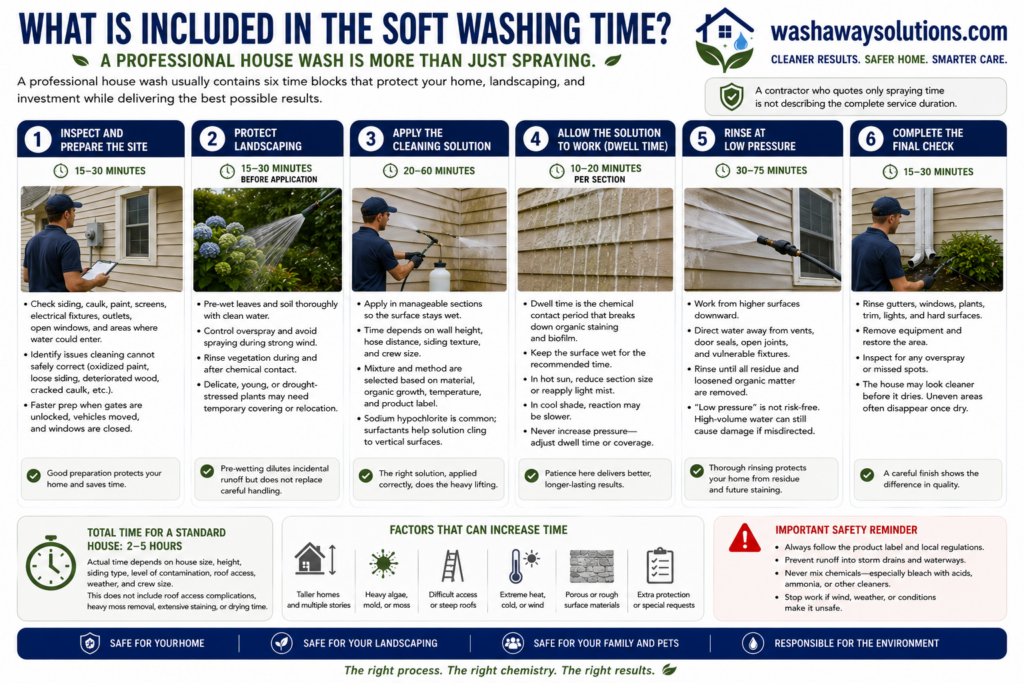
A professional house wash usually contains six time blocks: inspection, preparation, chemical application, dwell time, rinsing, and final cleanup. A contractor who quotes only spraying time is not describing the complete service duration.
Step 1: Inspect and Prepare the Site
A technician normally spends 15-30 minutes checking siding condition, electrical fixtures, outdoor outlets, open windows, fragile decorations, irrigation equipment, and areas where water could enter. Technicians may also identify oxidized paint, cracked caulk, loose siding, damaged screens, or deteriorated wood that cleaning cannot safely correct.
Furniture, toys, grills, and small decorations should be moved away from the walls before the crew arrives. Preparation is faster when gates are unlocked, vehicles are moved, and windows remain closed.
Step 2: Protect Landscaping
Plant protection commonly takes 15-30 minutes before application, with additional rinsing during and after the wash. Technicians pre-wet leaves and soil with clean water, control overspray, avoid spraying during strong wind, and rinse vegetation after chemical contact.
Pre-wetting reduces the concentration of incidental runoff on plant surfaces, but it does not make careless chemical handling safe. Delicate flowers, young plants, and drought-stressed landscaping may need temporary covering or relocation.
Step 3: Apply the Cleaning Solution
Chemical application often takes 20-60 minutes, depending on wall height, hose distance, siding texture, and crew size. The solution is generally applied in manageable sections so the surface remains wet during the working period.
Professional operators select the mixture and application method according to the material, organic growth, temperature, and product label. Sodium hypochlorite is common in exterior cleaning, while surfactants help the solution cling to vertical siding instead of immediately running off.
Step 4: Allow the Solution to Work
Dwell time usually lasts 10-20 minutes per section. Dwell time is the chemical contact period that allows organic staining and biofilm to break down before rinsing.
Hot sun can dry a solution too quickly, while cool shade can slow its reaction. A technician may keep a section wet, reduce the working area, or apply a second light treatment rather than increasing pressure.
Step 5: Rinse at Low Pressure
Rinsing often takes 30-75 minutes for a standard house. The technician works from higher surfaces downward while directing water away from vents, door seals, open joints, and vulnerable fixtures.
The phrase “low pressure” does not mean “no risk.” A high-volume stream aimed at a damaged seal can still force water into a wall cavity, and a strong chemical mixture can discolor finishes even when the spray pressure is low.
Step 6: Complete the Final Check
Final rinsing, equipment removal, plant inspection, and cleanup normally take 15-30 minutes. A careful crew checks windows, doors, hose paths, plants, exterior lights, and any areas that received overspray.
The house may look cleaner before every surface is dry. Dark streaks, wet shadowing, and residual moisture can make a completed wash appear uneven for several hours.
Which Factors Change the Cleaning Time?
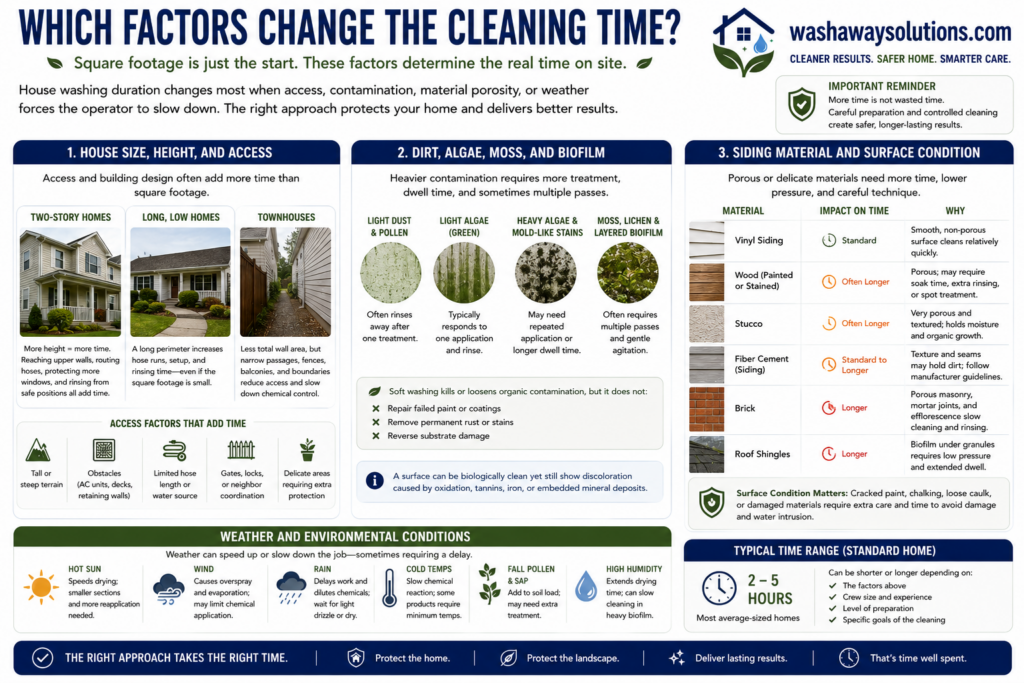
House washing duration changes most when access, contamination, material porosity, or weather forces the operator to slow down. Square footage provides a starting point, but wall height and preparation often determine the final labor time.
House Size, Height, and Access
A two-story home takes longer because technicians must reach upper walls, route hoses around the building, protect more windows, and rinse from safe positions. A long, low ranch house can also take longer than its floor area suggests because its exterior perimeter is large.
Townhouses create a different access problem. Shared walls reduce the cleaning area, but narrow side passages, balconies, fences, and neighboring property boundaries can make chemical control more difficult.
Dirt, Algae, Moss, and Biofilm
Light dust and pollen may rinse away after one treatment. Thick green algae, black mold-like spotting, lichen, moss, and layered biofilm may require repeated application, longer dwell time, or gentle brushing on limited areas.
Soft washing kills or loosens organic contamination; it does not repair failed paint, remove permanent rust, or reverse substrate damage. A surface can be biologically clean while still showing discoloration caused by oxidation, tannins, iron, or embedded mineral deposits.
Siding Material and Surface Condition
Porous materials absorb more solution and water, which can lengthen application and rinse times. Fragile or deteriorated materials also require slower work because the operator must avoid lifting paint, entering cracks, or saturating the wall assembly.
| Exterior material | Typical time for a 2,000 sq. ft. home | Important timing or safety issue |
|---|---|---|
| Vinyl siding | 2-3.5 hours | Fast coverage, but oxidation needs gentle handling |
| Painted wood | 2.5-4.5 hours | Loose paint and open joints require slower rinsing |
| Stucco or Dryvit | 3-5 hours | Porosity and texture increase dwell and rinse work |
| Brick masonry | 2.5-4.5 hours | Mortar condition determines rinse pressure and pace |
| Fiber cement | 2.5-4 hours | Lap joints and aged paint need controlled rinsing |
| Mixed exterior materials | 3-6 hours | Multiple methods and chemical strengths may be required |
Weather and Water Conditions
Mild, overcast conditions are often easier for soft washing because the solution stays wet longer and technicians can control dwell time. Wind can delay the job by increasing overspray risk, while rain can dilute the cleaning solution before it works.
A typical operator may postpone work when sustained wind makes plant protection unreliable, temperatures approach freezing, or rain is likely during application. Water supply matters too. Low flow from a private well or a distant spigot can lengthen rinsing substantially.
How Does Soft Washing Compare With Pressure Washing Time?
Soft washing and pressure washing can take similar total time on a house, but they spend that time differently. Soft washing generally uses more preparation and chemical dwell time, while pressure washing may require more surface-by-surface mechanical passes and carries greater risk on delicate siding.
| Cleaning method | Typical pressure | Best use | Typical house-wash time |
|---|---|---|---|
| Soft washing | Under 500 PSI at the surface | Algae, mildew, mold, pollen, and organic film | 2-5 hours |
| Low-pressure detergent wash | 300-800 PSI, equipment-dependent | Light dirt on sound siding | 1.5-4 hours |
| Conventional pressure washing | 1,500-3,000 PSI | Concrete, some masonry, and hard deposits | 2-5 hours |
| Hand detailing | Minimal mechanical pressure | Delicate trim and small spot areas | 2-8 hours |
Soft washing is usually the safer choice for vinyl siding, painted wood, stucco, and asphalt roofing when performed with appropriate chemicals and controlled rinsing. Pressure washing is more suitable for many concrete surfaces, although detergent and surface-specific pressure remain important.
Pressure does not determine whether a service is professional. Equipment, nozzle distance, water volume, chemical control, substrate knowledge, and runoff management matter more than a single PSI number.
How Much Does House Soft Washing Cost?
Typical residential soft washing costs about $250-$600 for many small to average homes, while large, multi-story, or heavily contaminated properties commonly cost $600-$1,000 or more. Local labor rates, access, water conditions, regional demand, and the included services can move the price outside those ranges.
The quoted price should state whether the service includes siding only or also includes soffits, fascia, exterior gutters, porch ceilings, detached structures, windows, and concrete. Roof cleaning is usually priced separately because roof access, runoff control, and plant protection requirements differ.
| Home or service scope | Typical duration | Typical price range |
|---|---|---|
| Small home, under 1,500 sq. ft. | 1.5-2.5 hours | $250-$400 |
| Average home, 1,500-2,500 sq. ft. | 2-4 hours | $350-$600 |
| Large home, 2,500-4,000 sq. ft. | 4-7 hours | $600-$1,000+ |
| Heavy stucco or Dryvit cleaning | Add 1-2 hours | Add 20%-40% |
| House plus detached garage | Add 30-90 minutes | Add $75-$250 |
| Front elevation only | 45-90 minutes | $150-$300 |
These are typical planning figures, not universal market prices. A very low quote may exclude preparation, plant rinsing, or difficult elevations, while a higher quote may include trim, gutters, screens, or a larger crew.
Can You Soft Wash a House Yourself?
A homeowner can soft wash a small, accessible house, but chemical exposure, runoff, ladder use, electrical hazards, and siding damage make professional work safer for tall or complex properties. DIY timing is often 4-8 hours, because a homeowner has less equipment, less experience with application rates, and more setup time.
A basic DIY job requires a low-pressure application method, garden hose access, appropriate personal protective equipment, clean water for plant rinsing, warning signage where needed, and a product used exactly according to its label. Never mix cleaning chemicals unless the manufacturer explicitly permits the combination.
The Centers for Disease Control and Prevention states, “Never mix bleach with ammonia or any other cleaner.” That warning matters because incompatible chemicals can produce dangerous gases. Keep people and pets away from wet treatment areas until surfaces have been rinsed and the product label permits re-entry.
DIY work is a poor choice when the house exceeds safe ladder height, the roof must be accessed, the siding is damaged, the landscaping is valuable, or runoff could reach a pond, storm drain, or neighboring property.
What Should a Professional Soft Wash Quote Include?
A reliable quote should identify the surfaces, treatment method, estimated crew time, chemical handling approach, and completion standard. The quote should also state exclusions, because “house wash” can mean siding only or a much broader exterior cleaning package.
Check for these details:
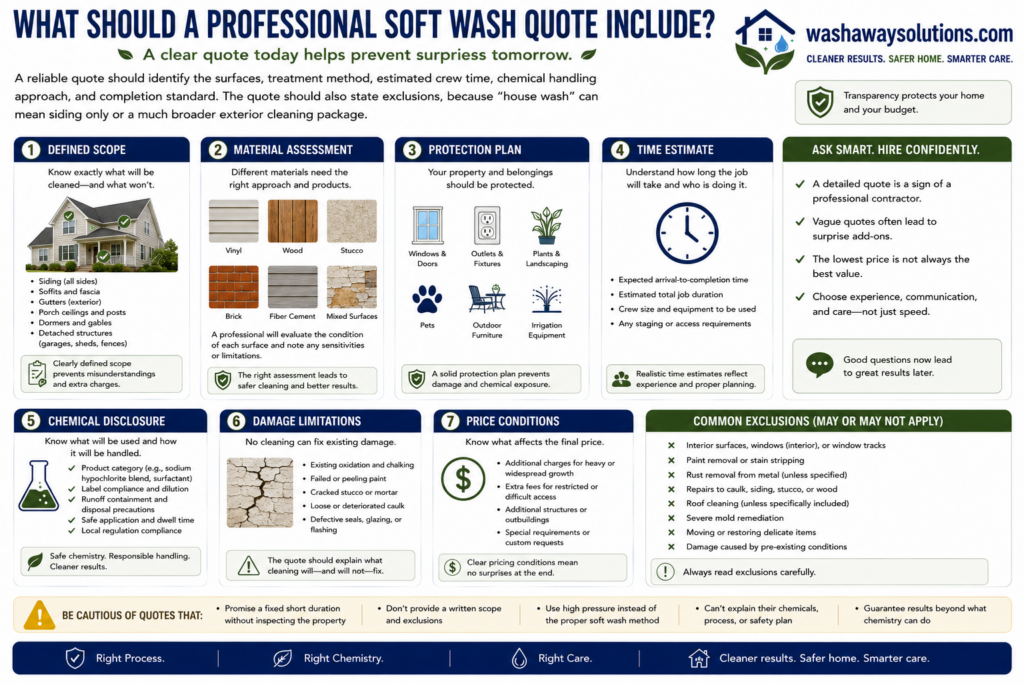
A contractor who promises a fixed short duration without inspecting the property may be estimating from floor area alone. That approach misses the variables that create most delays.
Is Soft Washing Safe for Every House?
Soft washing is not automatically safe for every house or every chemical mixture. The method is appropriate for many exterior materials when the operator matches pressure, concentration, dwell time, and rinse volume to the substrate, but deteriorated paint, open seams, failed caulk, and fragile landscaping require special controls.
Soft washing is generally appropriate for sound vinyl, many painted wood surfaces, stucco, fiber cement, brick, and asphalt shingles. The operator should test an inconspicuous area first, especially when dark paint, oxidized vinyl, aged coatings, or unusual manufactured siding is present.
Soft washing is not a cure for structural moisture problems. If water enters behind siding, algae returns rapidly, or interior staining appears, the cause may be failed flashing, roof leakage, condensation, or damaged sheathing rather than inadequate cleaning.
What Are the Most Common Soft Washing Mistakes?
The most common failures are incomplete plant protection, excessive chemical strength, premature rinsing, excessive pressure, and spraying through openings. Each mistake can increase the job time because correction requires a second rinse, spot treatment, surface repair, or plant recovery.
Skipping Plant Pre-Wetting
Dry leaves can receive a stronger chemical exposure from accidental droplets and runoff. Saturate nearby vegetation with clean water before treatment, rinse during the work when necessary, and complete a final rinse after application.
Using Pressure to Compensate for Weak Chemistry
Increasing pressure may remove visible growth while damaging paint, wood fibers, mortar, or seals. The better correction is to reassess the surface, apply a suitable labeled solution, allow adequate dwell time, and rinse with controlled volume.
Allowing the Solution to Dry
A drying solution can leave uneven marks or discoloration, particularly on dark coatings and hot south-facing walls. Work in smaller sections, monitor the surface continuously, and rinse or re-wet before the solution dries.
Rinsing Too Quickly
A fast rinse can leave organic staining behind and force the operator to repeat the application. The surface should show a clear reduction in biological growth before final rinsing, but dwell time must remain within the product directions.
Spraying Into Openings
Open windows, damaged vents, door gaps, and unsealed light fixtures can allow water or chemicals inside. Close and check openings before application, then use a controlled rinse angle around vulnerable details.
How Long Does a Soft-Washed House Stay Clean?
A soft-washed exterior commonly remains visibly clean for one to three years, but climate, shade, humidity, tree cover, surface porosity, and roof drainage determine the actual interval. Organic growth returns sooner on shaded north-facing walls and surfaces that remain damp.
Soft washing removes or kills biological contamination more effectively than water-only blasting, but no exterior treatment prevents new spores, pollen, dust, or algae from arriving. Trim overhanging branches, correct overflowing gutters, improve drainage, and address persistent moisture to extend the result.
A maintenance wash every 12-24 months may be reasonable in humid, shaded regions. Dry, sunny homes with good drainage may need less frequent cleaning.
What Happens After the Soft Wash?
A completed soft wash should leave siding visibly cleaner, with organic staining reduced and no uncontrolled chemical residue on plants, windows, or adjacent surfaces. Some porous masonry, oxidized coatings, and deeply embedded stains may continue to lighten over several days as remaining residue weathers.
Inspect the property after surfaces dry. Look for missed growth under eaves, streaking caused by uneven application, damaged paint revealed by cleaning, and plant stress. Report concerns promptly, because a same-day correction is easier than a delayed return after rain and additional drying cycles.
The cleaning process does not replace caulking, painting, siding repair, gutter repair, roof maintenance, or mold remediation inside the building. Those problems need separate evaluation.
Frequently Asked Questions
Does soft washing take longer than power washing?
Soft washing can take longer than basic pressure washing when plant protection, chemical dwell time, and careful rinsing are included. For an average home, both methods often fall within a 2-5-hour total window, but pressure washing may be faster on open concrete and slower or unsafe on delicate siding.
Can a soft wash be completed in one day?
Most ordinary residential house washes can be completed in one day. A standard 2,000-square-foot home usually requires 2-5 hours, while a large estate, severe growth, multiple structures, poor water flow, or weather interruption may require most of a day or a return visit.
Should windows be cleaned before or after soft washing?
Exterior windows are usually cleaned after the house wash, because rinsing can leave mineral spots or chemical residue on glass. A contractor should protect window seals during washing, then perform dedicated window cleaning separately if the service includes streak-free glass rather than a basic rinse.
How often should a house be soft washed?
Many homes need soft washing every 12-24 months, while shaded or humid properties may need annual service. Inspect north-facing walls, areas beneath trees, and surfaces near overflowing gutters each spring to determine whether new algae, mildew, or biofilm has returned.
Does soft washing remove black stains from siding?
Soft washing can remove many black stains caused by mildew, algae, or atmospheric biofilm, but it may not remove oxidation, rust, tannin marks, soot, or permanent coating discoloration. A small test area helps identify whether the stain is biological before the full house is treated.
The Bottom Line
For the query how long does it take to soft wash a house, plan on 2-5 hours for a typical 2,000-square-foot home, including preparation, plant protection, chemical dwell time, rinsing, and cleanup. Allow 1.5-2.5 hours for a small accessible house and 4-7 hours for a large, heavily soiled, multi-story, or difficult-to-access property. The most accurate estimate comes from siding material, contamination level, landscaping, height, water supply, weather, and the exact services included.