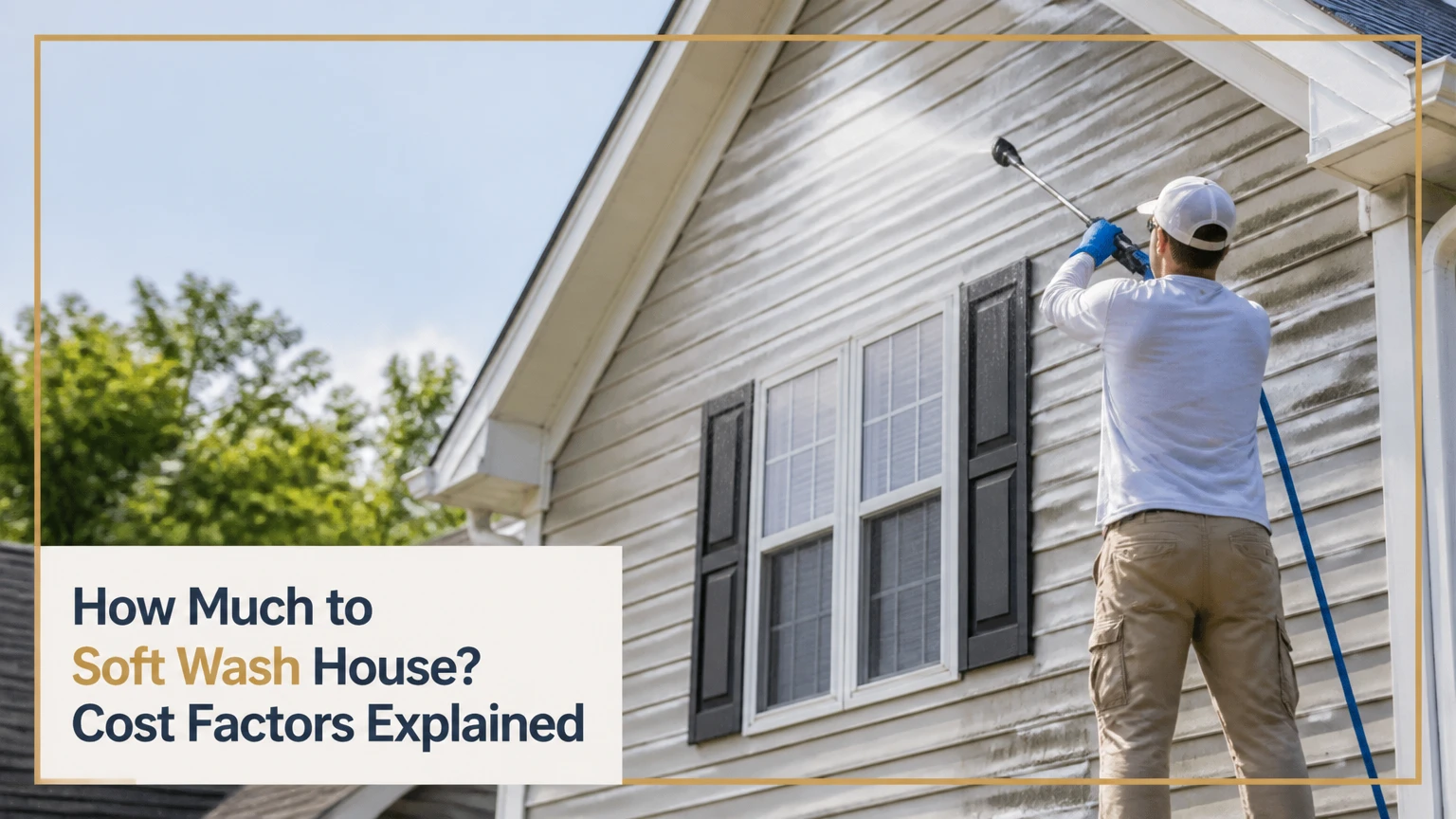
Professional house soft washing typically costs $300-$800, with a standard 2,000-square-foot home often priced at $450-$600 in a mid-range market. The final quote depends on measured wall area, siding material, stories, organic growth, water access, layout, and the contractor’s minimum service charge.
At a Glance
- A professional soft wash usually costs $300-$800 for an entire house.
- A 2,000-square-foot home commonly costs $450-$600 in a mid-range market.
- Most insured contractors charge a $300-$400 minimum, even for small homes.
- Porous siding, severe growth, extra stories, and poor water access increase the price.
- A standard house wash usually excludes roofs, inside gutters, windows, driveways, and patios.
- Professional soft washing commonly lasts one to three years, depending on shade and climate.
How Do Contractors Calculate the House-Washing Price?
Contractors calculate a house-washing price from service area, labor time, chemical use, access difficulty, and the company’s minimum trip charge. Some companies use the home’s footprint square footage, while others estimate exterior wall surface area, so two apparently similar quotes may use different pricing models.
| Pricing method | Typical basis | Common effect on quote |
|---|---|---|
| Footprint pricing | $0.15-$0.60+ per square foot | Faster estimate, less layout precision |
| Wall-area pricing | $0.20-$0.80+ per square foot | Better for tall or complex homes |
| Hourly pricing | $75-$150 per labor hour | Useful for unusual properties |
| Minimum charge | $300-$400 per visit | Applies to small homes and short jobs |
A reliable quote should state the measurement method, included surfaces, chemical treatment, plant protection, rinsing, and any access surcharge. The roof footprint is not the same as the washable wall area, particularly on a two-story home with dormers, porches, bump-outs, and enclosed additions.
The surprising rule is that square footage is only a starting point. A compact 2,000-square-foot home with clear access may cost less than a sprawling 1,600-square-foot ranch surrounded by dense landscaping.
How Much Does Soft Washing Cost by Home Size?
Typical professional soft-washing prices range from $300 for a small home to more than $1,200 for an estate-sized property. The following figures represent broad practitioner ranges, not a guaranteed national price list.
| Home type | Approximate size | Crowded market | Mid-range market | Rare-service market |
|---|---|---|---|---|
| Small ranch | Under 1,500 sq. ft. | $150-$250 minimum | $300-$450 | About $600 |
| Average home | 1,500-2,500 sq. ft. | $250-$375 | $450-$750 | $900-$1,200 |
| Large home | 2,500-3,500 sq. ft. | $375-$525 | $750-$1,050 | About $1,500 |
| Estate home | 4,000+ sq. ft. | $600+ | $1,200+ | $2,100+ |
Crowded markets can produce lower advertised rates because multiple cleaning companies compete for routine work. Mid-range markets more often support full-service crews with insured vehicles, commercial pumps, chemical storage, and trained technicians.
A $200 quote is not automatically a bargain. If the contractor has a $300 minimum, the lower figure may exclude trim, plant protection, setup, or a return visit. Ask for the complete job price before comparing numbers.
What Raises the Price Beyond Square Footage?
The main cost increases come from height, porous siding, severe organic growth, difficult access, water limitations, and unusually extensive landscaping. These conditions add labor, chemical use, setup time, or rinsing requirements.
| Cost factor | Typical added cost | Why it matters |
|---|---|---|
| Additional story | $50-$100 per story | Increases reach and rinse time |
| Heavy moss or lichen | $100-$250 | May require multiple treatments |
| Porous siding | 20%-50% higher | Needs more solution and dwell time |
| No usable spigot | $100-$300+ | Requires hauled buffer water |
| Dense landscaping | $50-$150+ | Adds plant protection and rinsing |
| Difficult access | $50-$200+ | Requires longer hoses or ladders |
Regional chemical prices and local labor rates also matter. A coastal town with high insurance costs may charge more than an inland market with many competing operators.
Weather can affect scheduling without changing the base price. Very cold conditions, strong wind, or heavy rain can make chemical application unsafe or ineffective. A responsible contractor may postpone the work rather than apply a weak solution during poor conditions.
Why Can a Large Ranch Cost More Than a Two-Story Home?
A large single-story ranch can cost more than a two-story home with the same floor area because the ranch usually has more exterior perimeter, longer hose runs, and more landscaping to protect. The roofline and wall arrangement can also create extra trim, corners, porches, and low sections that require careful work.
| Two homes with 2,500 sq. ft. | Typical labor pattern | Likely pricing effect |
|---|---|---|
| Compact two-story home | Smaller footprint, less walking | $750-$950 |
| Wide single-story ranch | More perimeter and hose movement | $850-$1,100 |
| Ranch with dense beds | Extra plant protection | $950-$1,250 |
The contractor’s clock matters more than the home’s advertised living area. A sprawling ranch may take four to six labor hours, while a compact two-story home may take three to four hours with the same equipment.
Homeowners should provide photos of every elevation, not only the front façade. Side additions, screened porches, detached garages, and narrow rear access frequently explain a quote that appears high by square-footage standards.
How Much Extra Does a Second or Third Story Cost?
An additional story typically adds $50-$100 per level, although difficult three-story access can raise the total by $150-$300 or more. The surcharge covers longer hose placement, higher-reach equipment, ladder work, slower application, and extra rinsing.
| Home height | Typical access condition | Common surcharge |
|---|---|---|
| One story | Ground-level wand access | $0 |
| Two stories | Extension reach or booster pump | $50-$100 |
| Three stories | High-reach tools and complex rinsing | $150-$300 |
| Steep or obstructed elevation | Lift, ladder, or special access | $200-$500+ |
Height alone does not determine the final amount. A two-story home on level ground may cost less than a one-story house built into a steep slope, because the technician may need additional equipment and safety controls.
A written quote should identify whether the story fee applies to the entire house or only inaccessible elevations. That distinction prevents a broad surcharge when only one rear wall requires high-reach work.
Which Siding Materials Cost More to Soft Wash?
Stucco, brick, wood, and dry-dash render generally cost more to soft wash than smooth vinyl because porous surfaces retain moisture and chemical solution longer. A typical surcharge is 20%-50%, while stucco work in a mid-range market may reach $0.40-$0.50 per square foot.
| Siding material | Typical treatment difficulty | Relative price |
|---|---|---|
| Smooth vinyl | Low absorption, easy rinse | $0.20-$0.35/sq. ft. |
| Painted fiber cement | Moderate, inspect finish | $0.25-$0.40/sq. ft. |
| Brick | Porous mortar and texture | $0.30-$0.50/sq. ft. |
| Stucco or render | High absorption | $0.40-$0.50/sq. ft. |
| Older wood siding | Finish-sensitive and absorbent | $0.35-$0.60/sq. ft. |
Siding condition matters as much as siding type. Oxidized vinyl can release chalky pigment during cleaning, while failing paint may lift under repeated rinsing. A technician should test an inconspicuous section before treating a visibly deteriorated finish.
Soft washing is low pressure, not zero risk. Water can still enter damaged caulk joints, loose trim, cracked stucco, or open vents if the technician sprays carelessly.
What Does a Standard Soft-Wash Quote Include?
A standard house-wash quote usually includes exterior siding, trim, soffits, fascia, and gutter faces, plus chemical application, dwell time, rinsing, and basic plant protection. A standard quote usually excludes roof cleaning, the inside of gutters, window screens, windows, driveways, patios, and other horizontal concrete.
| Usually included | Usually priced separately |
|---|---|
| Exterior siding walls | Roof cleaning |
| Trim and shutters | Inside-gutter cleaning |
| Soffits and fascia | Window glass and screens |
| Gutter faces | Driveway and patio concrete |
| Pre-wet and final plant rinse | Rust, oil, and artillery-fungus removal |
Quote language varies, so homeowners should not rely on the phrase “whole-house wash” alone. Some providers include only siding, while others include exterior trim and gutter faces.
Ask whether the price includes moving hoses around gates, treating detached structures, rinsing outdoor furniture, and cleaning areas behind downspouts. Each omitted surface can create a change order after work begins.
How Long Does Professional House Washing Take?
Professional house washing usually takes 2-5 hours for an average home, including setup, chemical application, dwell time, rinsing, and cleanup. A small, accessible vinyl-sided home may take 1.5-2.5 hours, while a large or heavily landscaped property can require a full day.
| Property condition | Typical duration |
|---|---|
| Small, accessible vinyl home | 1.5-2.5 hours |
| Average 2,000 sq. ft. home | 2-5 hours |
| Two-story home with moderate growth | 3-6 hours |
| Large ranch with dense landscaping | 4-8 hours |
| Severe growth or delicate siding | 5-8+ hours |
The chemical dwell period is often 5-15 minutes, but the technician may work in sections so the solution does not dry on the siding. Plant protection can add 20-45 minutes before spraying and another 15-30 minutes afterward.
A very fast job is not always better. If a crew arrives, sprays, and leaves within 30 minutes, the process may omit adequate dwell time, rinsing, or plant protection.
Will Soft-Wash Chemicals Harm Plants or Pets?
Professional soft-wash chemicals should not harm plants or pets when technicians control runoff, follow label directions, and rinse thoroughly. The primary protection sequence is pre-wetting vegetation, covering sensitive items, applying solution in manageable sections, continuously rinsing, and completing a final deep rinse.
Sodium hypochlorite, commonly mixed with a foaming surfactant, can damage leaves when concentrated solution dries on them. Technicians should remove or protect toys, pet bowls, outdoor fabrics, and delicate metal fixtures before application.
| Protection step | Typical timing |
|---|---|
| Pre-wet grass and plants | 10-20 minutes |
| Cover or move sensitive items | Before chemical application |
| Rinse during application | Every treated section |
| Final landscape rinse | 15-30 minutes |
| Pet re-entry | After surfaces and vegetation are rinsed |
Homeowners should keep pets indoors during treatment and until the work area is rinsed. Plant stress can still occur with heat, drought, tender new growth, or repeated chemical exposure.
A contractor who refuses to explain chemical dilution, runoff control, or plant protection deserves caution. The lowest price becomes expensive if shrubs, flowers, or painted surfaces require replacement.
Can You Soft Wash a House Yourself?
Yes, a homeowner can soft wash a house, but DIY work becomes unsafe when the job requires ladders, concentrated sodium hypochlorite, roof access, or high-reach equipment. A garden-hose attachment may lack the reach and control needed for upper walls, while a backpack sprayer creates chemical-handling and fall risks.
A safer DIY project is a small, ground-level vinyl section with mild growth, nearby water, eye protection, chemical-resistant gloves, and a product label that specifies dilution. Never mix sodium hypochlorite with acids, ammonia, or other cleaners.
| DIY condition | Practical verdict |
|---|---|
| One-story vinyl, light algae | Possible with strict precautions |
| Two-story exterior | Usually hire a professional |
| Stucco or painted wood | Use a trained technician |
| Roof or ladder work | Avoid DIY treatment |
| Dense landscaping nearby | Professional protection is safer |
Weak solution may fail to kill growth, while an overly strong mixture can bleach finishes and injure plants. Pressure from improvised equipment can also force water behind siding.
Professional equipment is only part of the advantage. Experienced technicians understand dwell time, surface testing, runoff, and when to stop.
Is Pressure Washing Cheaper or Better?
Pressure washing is not automatically cheaper or better than soft washing. Soft washing uses low pressure and chemistry to kill organic growth, while pressure washing relies more heavily on mechanical force and is usually better suited to durable horizontal surfaces such as concrete.
| Method | Typical pressure approach | Best use | Main risk |
|---|---|---|---|
| Soft washing | Low pressure, often under 1,000 PSI | Siding, stucco, delicate surfaces | Chemical or runoff damage |
| Pressure washing | Often 1,500-3,000+ PSI | Concrete and durable masonry | Etching, striping, water intrusion |
| Manual cleaning | Hand tools and mild detergent | Small stains and fragile details | Slow labor and uneven results |
Soft washing may cost $300-$800 for a house, while adding driveway or patio pressure washing can add $100-$300 or more. The two services are often combined, but they should remain separate line items.
Pressure washing can remove surface dirt quickly without killing embedded algae roots. Soft washing generally provides longer biological control, although shaded, humid elevations may develop new growth within one year.
How Often Should a House Be Soft Washed?
Most houses need soft washing every one to three years, but humid, shaded, coastal, and heavily wooded properties may need annual treatment. Sunny homes in dry climates can sometimes remain presentable for three years or longer.
| Property environment | Typical interval |
|---|---|
| Dry, sunny climate | 2-3 years |
| Mixed climate with partial shade | 1.5-2.5 years |
| Humid or coastal climate | 1-2 years |
| Heavily wooded north-facing walls | About 1 year |
| Persistent moisture or poor drainage | 6-12 months |
Algae often returns first on north-facing walls, under eaves, behind trees, and near leaking gutters. A maintenance wash before heavy buildup may cost less than severe-growth treatment because the crew needs fewer chemical passes.
Annual cleaning is not automatically necessary. Inspect the shaded elevations each spring and schedule service when green film, black streaks, or moss becomes established rather than waiting for thick growth.
Can Soft Washing Remove Artillery Fungus and Black Spots?
Soft washing can kill mold, algae, moss, and lichen, but soft washing usually cannot dissolve artillery fungus spots. Artillery fungus produces hard black spore masses that may remain attached after chemical treatment, requiring careful hand removal or a specialized surface-treatment process.
| Stain or growth | Soft-wash result | Likely additional work |
|---|---|---|
| Green algae | Usually removes it | Standard rinse |
| Mold film | Usually kills and removes it | Extra dwell time if heavy |
| Moss or lichen | Kills growth, may leave residue | Gentle follow-up removal |
| Artillery fungus | Often remains | Hand scraping or specialty treatment |
| Oxidation marks | Does not reverse finish damage | Siding restoration or replacement |
Black spots are not all the same. Gloeocapsa magma, often associated with roof streaking, responds differently from artillery fungus on siding.
The homeowner should photograph stubborn spots before requesting a quote. A contractor who promises that one chemical application will erase every black mark may be selling an unrealistic result.
How Should You Compare Soft-Wash Quotes?
Compare soft-wash quotes by total scope, measurement method, insurance, chemical process, plant protection, access assumptions, and warranty terms rather than by headline price alone. A useful quote identifies the exact surfaces, final price, exclusions, and conditions that could trigger additional charges.
| Quote item | Strong quote language | Warning sign |
|---|---|---|
| Total price | Fixed price, $450-$600 example | “Starting at” only |
| Service area | Siding, trim, soffits listed | “Whole house” with no detail |
| Chemicals | Product class and safe handling | No process explanation |
| Plant protection | Pre-wet, rinse, final rinse | “Plants are your responsibility” |
| Insurance | Certificate available | Verbal assurance only |
| Extra charges | Stories and water fees stated | Surprise fees after arrival |
Ask for before-and-after photos of comparable siding. Verify that the company carries liability insurance and workers’ compensation where applicable.
A quote that is 40% below local competitors may reflect fewer included surfaces, minimal rinsing, uninsured labor, or a weak process. A high quote may be reasonable when it includes delicate stucco, water hauling, or extensive landscaping protection.
When Should You Postpone or Reject Soft Washing?
Postpone soft washing during freezing temperatures, strong wind, severe storms, or conditions that prevent safe chemical control. Reject or revise the job when siding is severely deteriorated, water access is inadequate, runoff cannot be controlled, or the contractor cannot explain the treatment method.
| Condition | Recommended action |
|---|---|
| Forecast near freezing | Reschedule |
| Strong wind toward plants | Reschedule or protect more thoroughly |
| Cracked stucco or loose siding | Repair before washing |
| No working outdoor spigot | Confirm water-hauling plan |
| Uncontained stormwater runoff | Do not proceed |
| Contractor skips inspection | Seek another quote |
Soft washing does not repair failed paint, open joints, rotten wood, or broken gutters. Chemical treatment can expose those defects without correcting them.
A low-yield well may not supply enough water for rinsing, and some operators will decline the work rather than risk incomplete neutralization. Ask about water requirements before booking, especially for rural properties.
The Bottom Line
Professional house soft washing usually costs $300-$800, while a typical 2,000-square-foot home often lands at $450-$600. Extra stories, porous siding, severe growth, dense landscaping, difficult access, and limited water can raise the quote substantially. Soft washing commonly lasts one to three years, but shaded and humid properties may need annual maintenance.