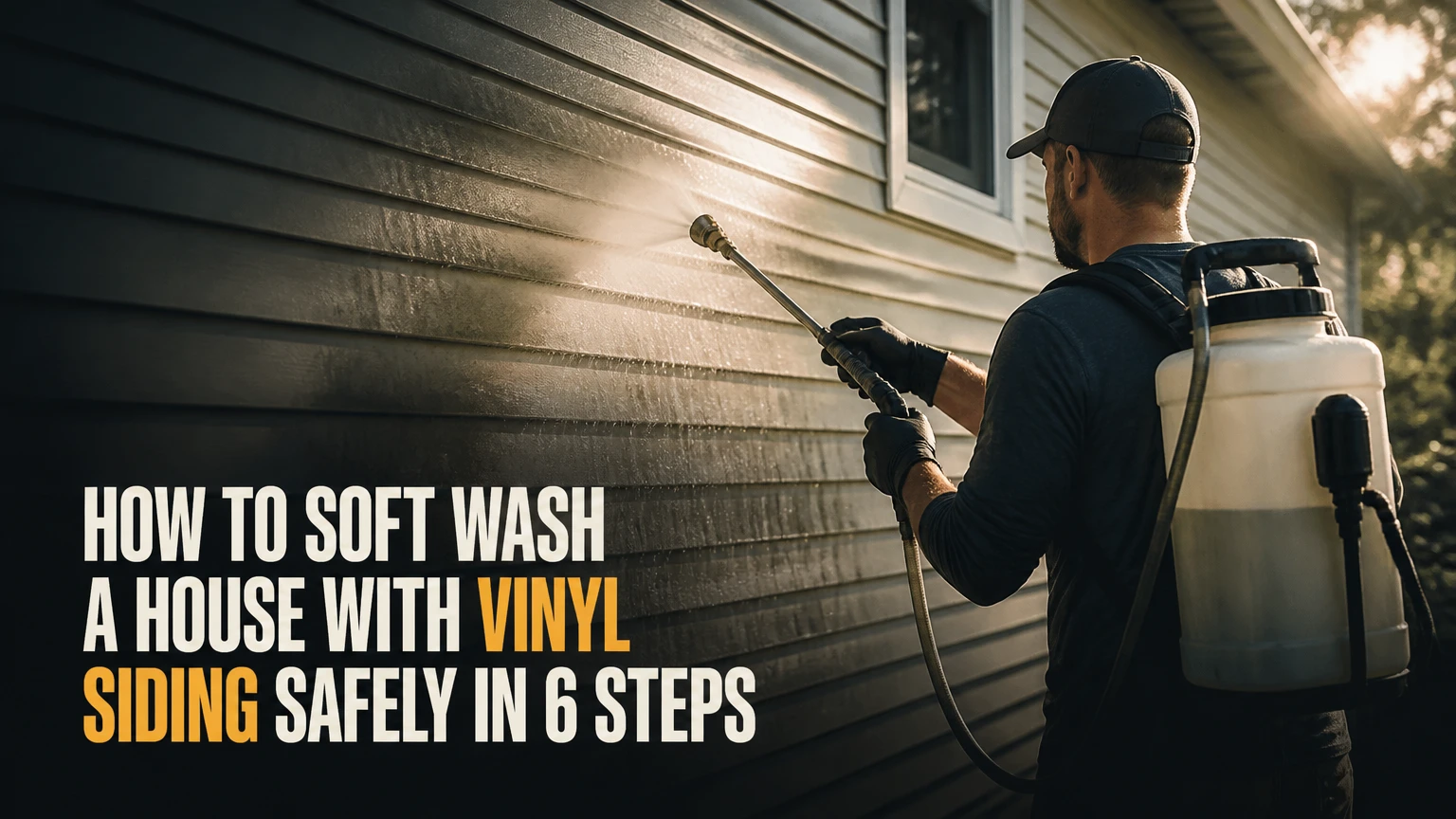
Soft washing a house with vinyl siding requires applying a diluted cleaning solution at low impact, allowing it to dissolve and kill organic growth, then rinsing from top to bottom without driving water behind the panels. The safest process takes about 2-4 hours for a typical home and depends more on chemical control, plant protection, and rinse technique than on maximum pressure.
Key Facts at a Glance
- Use a low-impact spray, commonly about 60-300 PSI, and follow the siding manufacturer’s pressure limits.
- A typical working strength is 0.5-1.5% sodium hypochlorite, depending on algae, mildew, and surface soil.
- Apply cleaning solution from the bottom upward, then rinse clean water from the top downward.
- Keep the solution wet for approximately 10-15 minutes; never allow bleach solution to dry on vinyl.
- Pre-wet plants, rinse them during the job, and flush them again after the house wash.
- Never combine sodium hypochlorite with ammonia, acids, vinegar, or other cleaners.
What Is Soft Washing Vinyl Siding?
Soft washing vinyl siding combines low-pressure water with a detergent-based chemical solution that loosens dirt and neutralizes algae, mold, mildew, and other organic deposits. The chemistry performs most of the cleaning, so the operator does not need a forceful jet that can lift siding edges, damage brittle panels, or push water behind the cladding.
Vinyl siding is weather-resistant, but it is not immune to damage. High pressure can mark the surface, crack aged panels, force water through overlaps and weep holes, or loosen caulk around windows and penetrations. Soft washing reduces those mechanical risks, although chemical overspray and careless rinsing create their own hazards.
The Vinyl Siding Institute recommends following the siding manufacturer’s care instructions and testing a small, inconspicuous area before broad application. That matters because insulated vinyl, painted vinyl, old panels, trim, and adjacent materials may respond differently to the same cleaner.
How Does the Cleaning Process Work?
Sodium hypochlorite oxidizes organic staining, while water carries away loosened soil and surfactant helps the solution remain in contact with vertical panels. Dwell time is the chemical reaction period, not idle time: the siding must remain visibly wet while the solution works.
Soft washing is not a guarantee against damage. It is a controlled method whose outcome depends on concentration, temperature, wind, spray impact, dwell time, and rinsing.
What Do You Need Before Starting?
A typical DIY vinyl-siding wash needs a low-pressure sprayer, a garden hose, a clean-water supply, measured sodium hypochlorite, compatible surfactant, PPE, and materials for protecting electrical fixtures and landscaping. Budget approximately $50-$150 for basic supplies, excluding a pump or pressure washer already owned.
Before-You-Start Checklist
| Requirement | Typical specification | Why it matters |
|---|---|---|
| Work time | 2-4 hours | Includes setup, application, dwell, rinse, and cleanup |
| Weather | Low wind, overcast or mild sun | Reduces drift and premature drying |
| Working pressure | About 60-300 PSI | Limits impact on vinyl and joints |
| Cleaning solution | 0.5-1.5% SH on siding | Matches light to heavy organic growth |
| Dwell period | 10-15 minutes | Allows chemical action before rinsing |
| DIY budget | $50-$150 | Covers PPE, hose tools, chemicals, and sprayer |
| Water supply | Continuous garden-hose flow | Prevents incomplete rinsing and plant exposure |
Required equipment includes chemical-resistant gloves, splash goggles, long sleeves, closed footwear, a low-pressure pump sprayer or soft-wash system, a wide fan tip, a garden hose with an adjustable nozzle, plastic sheeting, painter’s tape, and a measuring container dedicated to chemical use.
Respiratory protection requires special care. A disposable dust mask does not protect against bleach vapor or mist. OSHA chemical-safety principles favor ventilation, exposure control, and a properly selected and fitted respirator when the product label or risk assessment requires one. Do not improvise cartridge selection.
Which Cleaning Solution Is Safe for Vinyl?
A diluted sodium hypochlorite solution with water and a compatible surfactant is the common professional house-wash chemistry for organic growth on vinyl. The correct strength depends on the actual concentration of the bleach, the severity of growth, the siding condition, and the product label.
Household bleach and pool or industrial sodium hypochlorite are not interchangeable by volume. A 1:4 mixture of 6% bleach and water produces approximately 1.2% sodium hypochlorite before accounting for application dilution, while the same ratio using 12.5% product produces approximately 2.5%, which may be unnecessarily aggressive for ordinary vinyl siding.
Approximate Working Mixes
The following examples use 12.5% sodium hypochlorite and calculate the approximate concentration in the mixed batch. They are starting points, not universal instructions. Product age, temperature, storage, and downstream-injector dilution can change the result.
| Growth condition | Approximate target SH | 12.5% SH per water | Surfactant per 5 gallons |
|---|---|---|---|
| Dust and light discoloration | 0.5% | 1 gallon to 24 gallons | 2-3 fluid ounces |
| Light green algae | 0.75-1.0% | 1 gallon to 11.5-16 gallons | 3-5 fluid ounces |
| Established green growth | 1.0-1.25% | 1 gallon to 9-11.5 gallons | 4-6 fluid ounces |
| Heavy mildew staining | 1.5% | 1 gallon to about 7.3 gallons | 6-8 fluid ounces |
| Very heavy growth | 1.5-2.0% | Confirm with product label or contractor | Label direction |
Do not add more bleach because a stain remains after one pass. First check whether the surface stayed wet, the sprayer delivered enough solution, or the deposit is dirt, oxidation, rust, or paint failure rather than living growth.
Never mix bleach with ammonia, acids, vinegar, toilet cleaner, or acidic detergents. The Centers for Disease Control and Prevention warns that mixing bleach with other cleaners can release dangerous gases. Add surfactant only when the product is labeled as compatible with sodium hypochlorite; some soaps reduce stability or damage plants more readily.
How to Soft Wash a House With Vinyl Siding
The six-step method is: inspect and prepare, protect plants and openings, mix the solution, apply from bottom to top, allow controlled dwell, and rinse from top to bottom. Divide the house into sections small enough to keep wet, particularly on warm, sunny, or windy days.
Step 1: Inspect the Siding and Surroundings
Walk around the house and identify loose panels, cracked vinyl, failed caulk, open soffit vents, damaged window screens, exterior outlets, and areas where water could enter. Photograph existing damage so cleaning is not blamed for a pre-existing defect.
Check the siding manufacturer’s instructions when available. Vinyl siding with chalky oxidation, severe brittleness, unusual coatings, or unknown age deserves a test patch before full cleaning. Do not soft wash surfaces that visibly shed color or coating until the finish is evaluated.
Success checkpoint: The siding is intact, access is stable, and vulnerable openings or defects are recorded.
Common mistake: Starting at the tallest wall before discovering a loose panel or damaged flashing.
Step 2: Protect Plants, Openings, and People
Move patio furniture, toys, grills, and pet bowls away from the work area. Close all windows and doors. Turn off or cover exterior outlets, doorbell housings, cameras, light fixtures, and HVAC intakes with suitable plastic protection, while avoiding anything that traps heat around an operating electrical device.
Saturate grass, shrubs, flower beds, and tree leaves with clean water before applying chemicals. Arrange a second hose or an assistant to keep nearby vegetation wet during application and rinsing. Wet soil dilutes runoff, but it does not make concentrated overspray harmless.
Keep children, pets, and bystanders away from the downwind side. Do not work when wind carries mist toward a neighbor’s vehicle, pond, vegetable garden, or open window.
Success checkpoint: Plants are wet, openings are closed, and no unprotected person or animal can enter the runoff area.
Common mistake: Covering plants with plastic and leaving them exposed to trapped chemical droplets. Wetting and rinsing are usually safer than relying on a cover alone.
Step 3: Mix and Test the Cleaning Solution
Read the sodium hypochlorite and surfactant labels before measuring. Add clean water to a compatible tank first, then add the measured hypochlorite slowly and add surfactant last if the product directions permit it. Avoid splashing, use a dedicated container, and label the batch.
Mix only the amount needed for the work period. Sodium hypochlorite loses strength in heat, sunlight, and long storage, so do not keep an unidentified leftover batch in a drink container or unmarked tank.
Apply the weakest solution likely to work on a hidden area. Wait through the intended dwell period, rinse, and inspect both the siding and nearby trim. A surface that turns chalky, changes color, or shows streaking requires stopping and reassessing.
Success checkpoint: The test patch removes organic growth without discoloring vinyl, trim, glass seals, painted surfaces, or plants.
Common mistake: Treating a recipe based on 12.5% product as if it applies to 6% household bleach.
Step 4: Apply the Solution From Bottom to Top
Use a wide fan pattern and keep the wand far enough away that the spray does not deform the panel or force liquid into overlaps. Apply to one manageable section, beginning at the bottom and moving upward until the surface is evenly wet.
Bottom-up application reduces streaking because fresh solution runs over already wetted siding rather than drying into vertical lines on a dry panel. Use lower output around windows, doors, vents, painted trim, and utility penetrations.
Do not spray directly into soffit vents, window weep holes, siding seams, or gaps. A pump sprayer can handle small single-story areas, while a dedicated low-pressure system gives better reach and more consistent coverage on a larger home.
Success checkpoint: The section has an even wet film, with no dry strips, forceful impact marks, or visible chemical mist leaving the property.
Common mistake: Applying from the roofline downward and creating bleach streaks on dry siding below.
Step 5: Maintain a 10-15-Minute Wet Dwell
Allow the solution to work for approximately 10-15 minutes while watching the surface continuously. The correct endpoint is usually fading or release of the organic deposit, not a fixed clock, and hot siding may require shorter sections or a light water mist to prevent drying.
Never let sodium hypochlorite dry on vinyl, glass, painted trim, metal fixtures, or landscaping. If a section begins to dry, lightly re-wet it with the cleaning solution or clean water according to the situation, then rinse promptly.
A longer dwell does not automatically produce a cleaner result. Extended exposure can increase residue, plant injury, discoloration, and corrosion without improving deposits that are actually oxidation or embedded dirt.
Success checkpoint: Algae and mildew have visibly lightened, the surface remains wet, and no white haze or drying edge has formed.
Common mistake: Applying the entire house before rinsing the first wall.
Step 6: Rinse From Top to Bottom
Use clean water and a broad spray to rinse the highest cleaned area first, working downward so residue does not run onto a finished section. Keep the nozzle level with the panels or pointed slightly downward, never sharply upward beneath the overlapping edges.
Rinse window frames, trim, gutters, downspouts, and ground-level siding carefully. Continue wetting nearby plants during the rinse, then flush them and the surrounding soil with clean water after the house is complete.
Inspect from several angles. Soap film, white salt residue, green shadows, and dry streaks indicate incomplete rinsing or uneven application. Do not increase pressure to remove residue until you have tried additional low-impact water.
Success checkpoint: Water runs clear, the siding has no slippery film or white haze, and no chemical odor or visible residue remains on adjacent surfaces.
Common mistake: Rinsing upward to reach the underside of panels and forcing water into the wall assembly.
Which Equipment and Method Should You Use?
A pump sprayer is adequate for localized, single-story cleaning, a downstream injector is convenient but heavily dilutes the chemical, and a dedicated soft-wash pump provides consistent reach and strength for larger homes. Equipment choice should follow house height, water access, solution control, and operator experience.
| Delivery method | Typical reach | Chemical control | Typical use | Main limitation |
|---|---|---|---|---|
| Hand pump sprayer | 6-12 feet | Low to moderate | Small accent wall | Slow coverage and arm fatigue |
| Garden-hose sprayer | 8-15 feet | Low | Light dirt on one story | Inconsistent dilution |
| Downstream injector | 15-30 feet | Moderate to low | One- or two-story DIY work | Chemical dilution reduces strength |
| 12-volt soft-wash pump | 20-40 feet | High | Full residential exterior | Equipment and chemical exposure cost |
| Air-diaphragm or gas pump | 30-60 feet | High | Commercial or tall structures | Noise, maintenance, and training |
A pressure washer can function as a low-pressure delivery platform when equipped with a suitable injector and wide fan tip, but its pump does not make high-pressure spraying safe. Set the system for low-impact application and verify performance on a test patch.
For a two-story home, ground-based equipment may not reach every gable safely. Do not climb an unstable ladder while holding a pressurized wand or chemical sprayer. Hire a contractor when access requires roof walking, difficult ladder work, traffic control, or chemical drift management.
Soft Washing or Pressure Washing: Which Is Better?
Soft washing is generally the better choice for algae, mold, mildew, and fragile or aged vinyl because chemical action removes the source of organic staining with less mechanical force. Low-pressure cleaning is not always faster, and pressure washing can be useful for unpainted masonry, concrete, and hard nonporous surfaces when the substrate and technique support it.
| Criterion | Soft washing | High-pressure washing |
|---|---|---|
| Typical application pressure | 60-300 PSI | Often 1,000-3,000 PSI |
| Organic growth removal | Chemical treatment kills or loosens growth | Surface force may remove visible staining |
| Water intrusion risk | Lower with correct downward spray | Higher at seams, vents, and overlaps |
| Vinyl suitability | Preferred for aged or heavily soiled panels | Limited to manufacturer-approved technique |
| Main hazard | Chemical drift and plant injury | Surface damage and hidden moisture |
| Best substrate | Vinyl, stucco, painted surfaces with approval | Concrete, some masonry, durable hardscape |
| Repeat-cleaning effect | Often longer-lasting on organic growth | May leave viable spores behind |
| Operator priority | Concentration, dwell, runoff control | Pressure, distance, angle, nozzle choice |
No cleaning method has zero risk. Soft washing can corrode metal, damage plants, discolor fabrics, and harm aquatic life if the operator ignores runoff. Pressure washing can clean loose surface dirt quickly, but a clean-looking panel may still contain viable organic growth after the water evaporates.
What Problems Occur During a Vinyl Siding Wash?
Most failures come from dried solution, excessive concentration, upward rinsing, poor plant protection, or misidentifying the stain. Recovery usually starts with stopping chemical application, flushing the affected area with clean water, and avoiding a stronger second treatment.
| Failure mode | Likely cause | Immediate recovery | Prevention |
|---|---|---|---|
| White haze or salt marks | Solution dried on siding | Rinse repeatedly with clean water | Work in smaller sections |
| Brown or curled leaves | Concentrated overspray | Flush foliage and soil thoroughly | Pre-wet and continuously rinse plants |
| Green streaks remain | Uneven application or short dwell | Re-treat only after surface dries and test | Use overlapping fan passes |
| Water behind panels | Upward spray angle | Stop and allow cavity to drain | Keep nozzle level or downward |
| Sticky film | Incomplete final rinse | Perform a low-impact second rinse | Check ground runoff for soap |
| Color change or chalking | Oxidation, aged finish, or strong mix | Stop, rinse, and document condition | Test an inconspicuous patch first |
How Do You Handle Heavy Black Mildew?
Heavy black mildew may need a controlled 1.0-1.5% working strength and a second application, but increasing chemical concentration is not a substitute for adequate wet dwell and coverage. Black marks can also represent embedded staining, oxidation, or failed paint, which a house wash will not reverse.
Treat a small area first. If the organic material does not lighten after correct application and rinsing, stop instead of repeatedly increasing the bleach level. A professional can distinguish biological growth from substrate or coating failure and can protect adjacent roofing, metal, and landscaping more effectively.
What If the Siding Is Old or Brittle?
Old or brittle vinyl should receive a low-pressure test wash with extra attention to panel movement, seams, and trim. Soft washing reduces impact but cannot restore plastic that has become brittle from ultraviolet exposure, freezing, or long-term weathering.
Do not use a ladder to press a wand close to a fragile wall. A weak panel can crack from contact, vibration, or thermal movement even when spray pressure is low.
What If the Day Is Hot, Sunny, or Windy?
Choose a shaded wall, shorten the work section, and rinse before the chemical film dries. Strong wind is a reason to postpone the job, because a low-pressure mist can travel farther than a visible stream and damage plants, vehicles, stained wood, or neighboring property.
A cool, overcast morning with low wind usually provides more working time than a hot afternoon. Weather does not remove the need for pre-wetting and post-rinsing.
How Much Does It Cost and How Long Does It Take?
A typical DIY vinyl-siding wash costs $50-$150 when the homeowner already has a hose and uses a pump sprayer, while professional service commonly costs about $300-$600 for an average 2,000-square-foot home. Height, access, regional labor, heavy growth, landscaping, water availability, and detached structures can move the final price substantially.
| Home situation | DIY time | Professional time | Typical professional price |
|---|---|---|---|
| One-story, 1,000-1,500 square feet | 1.5-3 hours | 1-2 hours | $200-$400 |
| Two-story, about 2,000 square feet | 2-4 hours | 2-3 hours | $300-$600 |
| Heavy growth and dense landscaping | 3-5 hours | 3-4 hours | $450-$800 |
| Tall or difficult-access exterior | 4+ hours | 3-6 hours | $600-$1,200+ |
These are typical planning ranges, not guaranteed quotes. Request confirmation that the contractor uses low-pressure application, protects vegetation, controls runoff, and includes a complete rinse rather than simply spraying a strong chemical and leaving.
How Often Should Vinyl Siding Be Soft Washed?
Most homes need cleaning every 1-3 years, although shaded, humid, tree-covered, or poorly ventilated walls may need attention sooner. South-facing walls may dry faster, while north-facing walls and areas beneath roof drainage commonly retain moisture and grow algae more quickly.
Reduce recurrence by repairing overflowing gutters, correcting downspout discharge, trimming vegetation away from the wall, and improving airflow around shaded elevations. Cleaning removes growth, but it does not correct the moisture conditions that support regrowth.
When Should You Hire a Professional?
Hire a professional when the house exceeds safe ladder reach, has extensive mold or mildew, contains delicate landscaping, has unknown siding coatings, or requires chemical application near ponds, wells, public walkways, or neighboring property. Professional equipment improves reach and consistency, but training and runoff controls matter more than owning a large pump.
DIY soft washing is a poor choice when you cannot identify the chemical concentration, cannot supply continuous rinse water, cannot keep people away from runoff, or cannot safely reach the upper siding. Saving a service fee is not worthwhile if a plant bed, window seal, or wall cavity is damaged.
FAQ
Can I Soft Wash Vinyl Siding With a Garden Hose?
A garden hose can rinse vinyl siding and may apply a mild cleaner through a hose-end sprayer, but it usually provides limited reach and inconsistent chemical dilution. For light, single-story dirt, that approach may work. For established algae or mildew, a measured low-pressure pump sprayer gives better coverage and more predictable dwell.
Is Bleach Safe for Vinyl Siding?
Diluted sodium hypochlorite is commonly used on vinyl siding to control organic growth, but bleach is safe only when the concentration, contact time, overspray, and rinse are controlled. Test first, follow the product and siding instructions, protect plants and metals, and never mix bleach with ammonia, acids, or other cleaners.
Can Soft Washing Remove Black Streaks From Vinyl?
Soft washing can remove black streaks caused by algae or mildew when the solution reaches the growth and remains wet long enough to work. It will not repair oxidation, remove all embedded pollution, or restore failed paint. A test patch distinguishes removable biological staining from permanent surface deterioration.
Should I Use Dish Soap in a House-Wash Mix?
Use dish soap only if its manufacturer permits the intended application and it is compatible with sodium hypochlorite. A purpose-made, bleach-compatible surfactant usually provides more predictable cling and stability. Never use a product containing ammonia or mix soap and bleach without checking compatibility and label directions.
Will Soft Washing Damage Windows?
Soft washing can damage window seals, screens, frames, or coatings if concentrated solution dries on them or enters through an open opening. Keep windows closed, reduce spray around frames, rinse glass and trim promptly, and inspect seals before beginning. Never direct a forceful stream into weep holes or gaps.
Does Soft Washing Prevent Algae Permanently?
Soft washing does not prevent algae permanently because shaded, damp siding can support new growth after cleaning. Typical recurrence ranges from one to three years, depending on moisture and sunlight. Gutter repairs, vegetation trimming, improved airflow, and prompt cleaning of small areas can extend the interval.
The Bottom Line
Soft washing a house with vinyl siding is the preferred approach for organic growth when the operator uses a measured solution, low-impact spray, bottom-up application, controlled 10-15-minute dwell, and thorough top-down rinsing. Protect plants and openings before mixing chemicals, test aged siding first, and choose professional service when height, runoff, or chemical control exceeds your equipment and experience.