Soft wash for house siding is a low-impact cleaning process that combines controlled water flow with a detergent and biocidal solution to remove algae, mildew, mold, and dirt. The method protects delicate cladding by using chemical dwell time instead of high-pressure impact, but safe results depend on siding type, solution strength, runoff control, and thorough rinsing.
Key Facts at a Glance
- Soft washing removes biological growth chemically, while pressure washing removes soil mainly through water impact.
- A typical residential siding wash takes 2-4 hours for a professional crew, including setup and rinsing.
- Low pressure does not automatically mean safe cleaning; nozzle angle, flow rate, chemical strength, and water intrusion also matter.
- Sodium hypochlorite is common for algae and mildew, but the working concentration must match the surface and product label.
- Vinyl siding usually tolerates a properly controlled house wash, while oxidized aluminum, old wood, EIFS, and damaged cladding require testing or specialist care.
- Professional house-washing prices commonly fall between $300 and $700 for an average home, although access, height, region, and contamination change the quote.
What Is Soft Washing for House Siding?
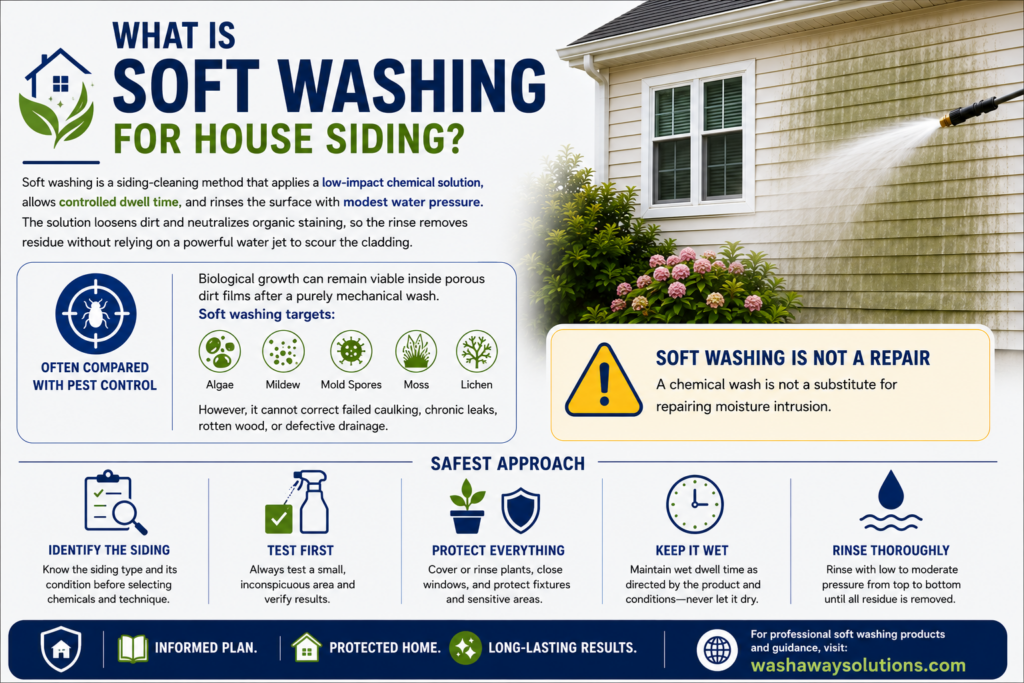
Soft washing is a siding-cleaning method that applies a low-impact chemical solution, allows controlled dwell time, and rinses the surface with modest water pressure. The solution loosens dirt and neutralizes organic staining, so the rinse removes residue without relying on a powerful water jet to scour the cladding.
The process is often compared with pest control because biological growth can remain viable inside porous dirt films after a purely mechanical wash. Soft washing targets algae, mildew, mold spores, moss, and lichen, although it cannot correct failed caulking, chronic leaks, rotten wood, or defective drainage.
The method is safest when the operator identifies the siding, tests a small inconspicuous area, protects plants and fixtures, and keeps the solution wet during dwell time. A chemical wash is not a substitute for repairing moisture intrusion.
What Does Soft Washing Remove?
| Contamination | Typical appearance | Soft-wash result | Additional action |
|---|---|---|---|
| Green algae | Green film or vertical streaks | Usually removed after one controlled treatment | Correct shade and moisture sources |
| Black mildew | Gray-black spots or bands | Often lightened or removed chemically | Re-treat persistent porous areas |
| Moss | Raised green clumps | Surface growth can be killed | Remove heavy mats manually after treatment |
| Lichen | Crusty pale patches | Chemical treatment weakens growth | Allow weathering or use specialist restoration |
| Oxidation | White chalk on aluminum or paint | Not reliably removed | Use oxidation-restoration methods |
| Rust staining | Orange or brown marks | Chlorine may not remove it | Use a compatible rust remover |
Algae and mildew are the easiest targets because they form surface films. Rust, oxidation, tannin bleed, artillery fungus, and paint failure require different chemistry, and applying a stronger house-wash mixture can worsen them.
How Does Soft Wash for House Siding Work?
Soft washing works through four linked actions: solution application, surfactant adhesion, chemical dwell, and low-impact rinsing. A typical treatment uses a diluted cleaning agent with a surfactant that reduces surface tension, holds the solution on vertical siding, and gives the active ingredient time to affect organic growth.
Application generally begins at the lower section and progresses upward, which helps prevent dirty runs from drying into uneven stripes. Rinsing then proceeds from the top downward, using broad flow rather than a narrow jet. The operator should keep water directed downward or perpendicular to lap siding, never forcefully upward beneath panels.
The frequently quoted 40-100 PSI range is a practical description of some soft-wash applications, not a universal safety standard. Pump pressure, nozzle restriction, hose length, elevation, flow rate, and distance from the wall all change the force reaching the siding. The visible spray pattern and technique matter as much as the gauge reading.
How Long Should the Solution Dwell?
Most residential siding treatments dwell for approximately 5-15 minutes, with shorter times in hot sun and longer times in shade when the product label permits. The correct checkpoint is visible response, such as fading green growth, rather than an arbitrary timer.
Never allow a chlorine-containing solution to dry into a concentrated residue. Divide the wall into manageable sections, work in shade where possible, and mist a drying section with clean water or compatible solution according to the product instructions. Always perform a test panel first.
Is Soft Washing Safe for Every Siding Material?
Soft washing is generally appropriate for sound vinyl siding, but no method is automatically safe for every cladding material. Fiber cement, wood, aluminum, stucco, EIFS, painted panels, and aged siding differ in porosity, coating stability, oxidation risk, and tolerance for moisture.
The U.S. Environmental Protection Agency states, “The best way to control mold growth is to control moisture.” That principle matters here: a clean wall can develop new growth quickly if roof runoff, leaking gutters, irrigation spray, or shaded dampness remains unresolved.
| Siding material | Main risk | Typical approach | Stop condition |
|---|---|---|---|
| Vinyl | Water behind laps or damaged panels | Mild detergent or labeled biocide, low-impact rinse | Panels flex, crack, or admit water |
| Fiber cement | Porous edges and coating damage | Test panel, moderate solution, thorough rinse | Paint lifts or fibers become exposed |
| Wood or cedar | Fiber bleaching and raised grain | Mildest compatible cleaner, controlled dwell | Grain raises or coating changes |
| Aluminum | Oxidation and chalking | Very small test area, rapid rinse | Chalk transfers heavily or color changes |
| Stucco | Water absorption and soft surface erosion | Specialist low-impact application | Surface abrades or stays saturated |
| EIFS or Dryvit | Moisture behind the finish system | Follow manufacturer guidance, use specialist | Cracks, open joints, or concealed damage |
| Painted siding | Paint loss and color change | Confirm coating condition before treatment | Paint flakes, powders, or softens |
Which Siding Needs the Most Caution?
Old aluminum siding, painted wood, damaged fiber cement, stucco, and EIFS need the most caution because cleaning can expose pre-existing coating or moisture problems. A professional should document oxidation, open joints, failed sealant, loose panels, and cracked render before applying chemicals.
Manufacturers may specify different cleaners and dilution limits. The label for the selected product and the siding manufacturer’s maintenance instructions take priority over generic recipes found online.
Which Chemicals Clean House Siding?
Siding soft washing commonly uses water, a detergent or surfactant, and an EPA-registered or label-approved antimicrobial product where applicable. Sodium hypochlorite is widely used by contractors for organic growth, but it is not a universal siding cleaner and should never be mixed with acids, ammonia, or other incompatible products.
A household laundry bleach bottle is not interchangeable with pool-grade sodium hypochlorite. Concentration, additives, age, storage temperature, and dilution accuracy differ. Professionals normally use test strips, proportioning equipment, product labels, and a material-specific batch rather than relying on a guessed recipe.
| Solution component | Function | Typical use | Main control |
|---|---|---|---|
| Clean water | Dilution and rinsing | All siding types | Prevent contaminated runoff |
| Sodium hypochlorite | Biological growth treatment | Algae, mildew, mold | Match label and test-panel strength |
| Surfactant | Improves wetting and cling | Vertical walls | Avoid excessive foaming near windows |
| Mild detergent | Dirt and soil removal | Routine maintenance | Use a siding-compatible formula |
| Oxalic or specialty brightener | Wood or stain restoration | Selected restoration work | Never mix with chlorine products |
| Rust remover | Iron staining | Localized orange marks | Keep away from incompatible metals |
Because product concentrations vary, publishing one “correct” recipe for every home is unsafe. A typical professional may use a weaker mixture on sound vinyl and a different product or process on painted wood, but the exact percentage should come from the product label, training, test results, and local regulations.
What Equipment Is Needed for Siding Soft Washing?
A homeowner can complete a small, low-risk wash with a garden hose, a compatible low-pressure applicator, a soft brush, protective coverings, and a reliable rinse supply. Professional crews commonly use a downstream injector or a dedicated chemical-resistant pump because those systems provide better reach, flow control, and repeatability.
| System | Typical output | Best fit | Limitation |
|---|---|---|---|
| Garden hose applicator | 2-5 GPM, low hose pressure | One-story vinyl maintenance | Limited height and chemical control |
| Downstream injector | 2.5-5.5 GPM, variable draw | Existing pressure-washer users | Dilution changes with hose and nozzle setup |
| 12-volt diaphragm pump | 4-7 GPM, approximately 40-70 PSI | Residential contractors | Battery capacity and chemical compatibility |
| Air-diaphragm system | 5-10+ GPM, application-specific pressure | High-volume professional work | Higher purchase and maintenance cost |
| Soft brush and hand sprayer | Manual application | Small stain or detail work | Slow on large elevations |
A narrow turbo nozzle, rotary nozzle, or close-range pressure-washer tip is usually unsuitable for siding. Wide fan spray, adequate distance, and downward movement reduce the chance of forcing water behind laps or stripping a coating.
Electrical outlets, doorbells, cameras, light fixtures, vents, windows, and open doors need protection. Covering a fixture is not permission to saturate it; the operator must still control spray direction and runoff.
How Do You Soft Wash House Siding?
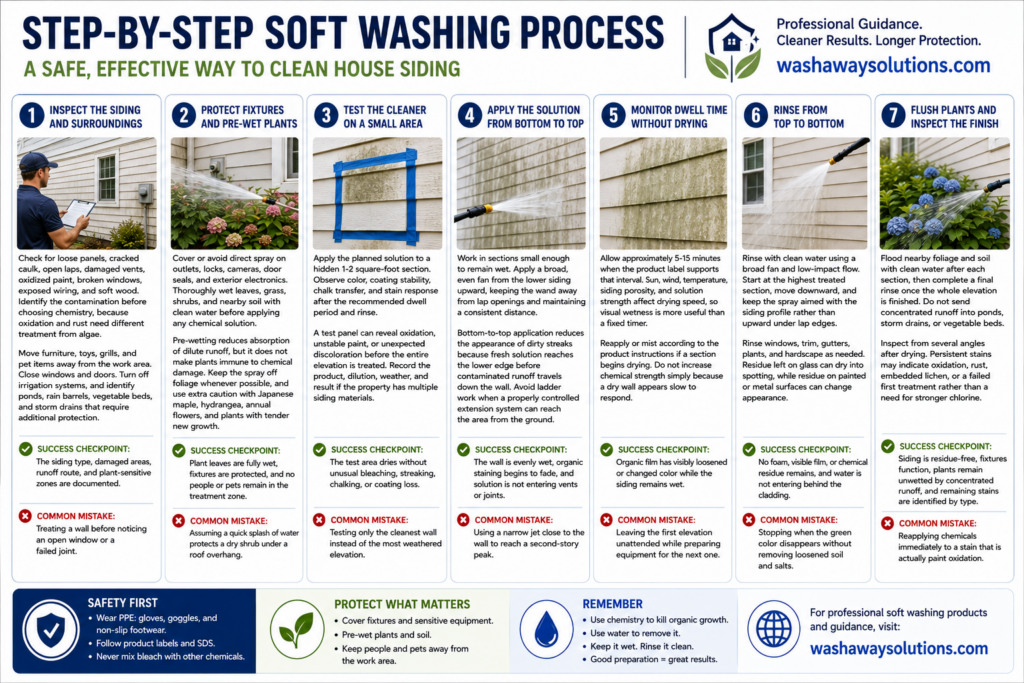
A complete siding wash normally follows seven stages: inspection, preparation, test application, controlled treatment, dwell monitoring, low-impact rinsing, and final inspection.
A professional two-person crew typically needs 2-4 hours for an average home, while a homeowner may need most of a day because setup and ladder avoidance take longer.
Before You Start
| Requirement | Typical amount or range | Practical standard |
|---|---|---|
| Project time | 2-4 hours professional | Add time for steep access and heavy growth |
| DIY budget | $50-$200 | Includes applicator, cleaner, covers, and PPE |
| Professional cost | $300-$700 | Typical average-home range |
| Water supply | 40-60 PSI household supply | Confirm flow before starting |
| Test area | 1-2 square feet | Choose an inconspicuous location |
| Plant protection | 10-15 minutes per section | Pre-wet and rinse thoroughly |
| PPE | Gloves, eye protection, suitable clothing | Follow the product safety label |
Step 1: Inspect the Siding and Surroundings
Check for loose panels, cracked caulk, open laps, damaged vents, oxidized paint, broken windows, exposed wiring, and soft wood. Identify the contamination before choosing chemistry, because oxidation and rust need different treatment from algae.
Move furniture, toys, grills, and pet items away from the work area. Close windows and doors. Turn off irrigation systems, and identify ponds, rain barrels, vegetable beds, and storm drains that require additional protection.
Success checkpoint: The siding type, damaged areas, runoff route, and plant-sensitive zones are documented.
Common mistake: Treating a wall before noticing an open window or a failed joint.
Step 2: Protect Fixtures and Pre-Wet Plants
Cover or avoid direct spray on outlets, locks, cameras, door seals, and exterior electronics. Thoroughly wet leaves, grass, shrubs, and nearby soil with clean water before applying any chemical solution.
Pre-wetting reduces absorption of dilute runoff, but it does not make plants immune to chemical damage. Keep the spray off foliage whenever possible, and use extra caution with Japanese maple, hydrangea, annual flowers, and plants with tender new growth.
Success checkpoint: Plant leaves are fully wet, fixtures are protected, and no people or pets remain in the treatment zone.
Common mistake: Assuming a quick splash of water protects a dry shrub under a roof overhang.
Step 3: Test the Cleaner on a Small Area
Apply the planned solution to a hidden 1-2 square-foot section. Observe color, coating stability, chalk transfer, and stain response after the recommended dwell period and rinse.
A test panel can reveal oxidation, unstable paint, or unexpected discoloration before the entire elevation is treated. Record the product, dilution, weather, and result if the property has multiple siding materials.
Success checkpoint: The test area dries without unusual bleaching, streaking, chalking, or coating loss.
Common mistake: Testing only the cleanest wall instead of the most weathered elevation.
Step 4: Apply the Solution from Bottom to Top
Work in sections small enough to remain wet. Apply a broad, even fan from the lower siding upward, keeping the wand away from lap openings and maintaining a consistent distance.
Bottom-to-top application reduces the appearance of dirty streaks because fresh solution reaches the lower edge before contaminated runoff travels down the wall. Avoid ladder work when a properly controlled extension system can reach the area from the ground.
Success checkpoint: The wall is evenly wet, organic staining begins to fade, and solution is not entering vents or joints.
Common mistake: Using a narrow jet close to the wall to reach a second-story peak.
Step 5: Monitor Dwell Time Without Letting the Wall Dry
Allow approximately 5-15 minutes when the product label supports that interval. Sun, wind, temperature, siding porosity, and solution strength affect drying speed, so visual wetness is more useful than a fixed timer.
Reapply or mist according to the product instructions if a section begins drying. Do not increase chemical strength simply because a dry wall appears slow to respond.
Success checkpoint: Organic film has visibly loosened or changed color while the siding remains wet.
Common mistake: Leaving the first elevation unattended while preparing equipment for the next one.
Step 6: Rinse from Top to Bottom
Rinse with clean water using a broad fan and low-impact flow. Start at the highest treated section, move downward, and keep the spray aimed with the siding profile rather than upward under lap edges.
Rinse windows, trim, gutters, plants, and hardscape as needed. Residue left on glass can dry into spotting, while residue on painted or metal surfaces can change appearance.
Success checkpoint: No foam, visible film, or chemical residue remains, and water is not entering behind the cladding.
Common mistake: Stopping when the green color disappears without removing loosened soil and salts.
Step 7: Flush Plants and Inspect the Finished Wall
Flood nearby foliage and soil with clean water after each section, then complete a final rinse once the whole elevation is finished. Do not send concentrated runoff into ponds, storm drains, or vegetable beds.
Inspect from several angles after drying. Persistent stains may indicate oxidation, rust, embedded lichen, or a failed first treatment rather than a need for stronger chlorine.
Success checkpoint: Siding is residue-free, fixtures function, plants remain unwetted by concentrated runoff, and remaining stains are identified by type.
Common mistake: Reapplying chemicals immediately to a stain that is actually paint oxidation.
Soft Washing Versus Pressure Washing: Which Is Better?
Soft washing is usually the better choice for organic growth on sound siding because it reduces impact and treats the biological film. Pressure washing is better suited to hard, non-porous materials such as concrete when the surface can tolerate mechanical force and water intrusion is not a concern.
| Decision factor | Soft washing | Pressure washing |
|---|---|---|
| Main cleaning action | Chemical treatment and low-impact rinse | Water impact and surface friction |
| Typical wall application | Approximately 40-100 PSI at the surface, depending on setup | Commonly 1,500-4,000 PSI at the machine |
| Best target | Algae, mildew, mold, delicate cladding | Concrete, masonry, pavers, heavy soil |
| Siding risk | Chemical, runoff, and moisture-management risk | Stripping, gouging, and water-intrusion risk |
| Biological persistence | Treatment can affect remaining organic film | Surface growth may remain viable |
| Preferred nozzle | Wide fan, long-range application | Surface-specific tip and controlled distance |
| Main limitation | Does not repair oxidation or damaged siding | Can damage laps, paint, seals, and soft materials |
The lower-risk method is not always the lowest-cost method. Soft washing requires chemical handling, plant protection, and careful rinsing, while a pressure washer may be faster on a small, hard surface.
Is a Garden Hose Enough?
A garden hose can be enough for a one-story vinyl exterior with light staining and good access. A hose-end applicator may lack the reach, chemical consistency, and rinse flow required for tall homes, heavy growth, porous siding, or complicated landscaping.
Homeowners should not compensate for limited reach by climbing an unstable ladder or switching to a narrow high-pressure nozzle. Hiring a trained operator is safer when the wall cannot be reached from the ground.
How Much Does Siding Soft Washing Cost?
Professional siding soft washing typically costs $300-$700 for an average home, with many contractors pricing by wall area, linear footage, access, or the total scope of house washing. A small one-story home may cost less, while a large or multi-story property with heavy growth, delicate materials, or difficult landscaping costs more.
| Pricing factor | Typical effect | Example |
|---|---|---|
| Home size | Raises labor and chemical volume | 1,200 square feet costs less than 3,000 |
| Wall height | Adds setup and reach requirements | Two-story access increases labor |
| Siding condition | Requires testing or restoration | Oxidized aluminum needs separate work |
| Vegetation | Increases protection and rinsing | Dense shrubs slow production |
| Contamination | Extends dwell and repeat treatment | Heavy lichen needs additional labor |
| Region and insurance | Changes operating overhead | Urban markets may quote higher rates |
A typical professional wall-cleaning rate is approximately $0.15-$0.40 per square foot of wall surface, but contractors calculate areas differently. Ask whether the quote includes trim, gutters, plant protection, windows, chemical treatment, and post-rinse work.
A DIY project may cost $50-$200 for an applicator, compatible cleaner, hose fittings, gloves, eye protection, plastic sheeting, and replacement plants if protection fails. Chemical savings are rarely worth sacrificing safe handling or runoff control.
What Problems Can Occur After Soft Washing?
The most common post-wash problems are chalky siding, streaks, plant injury, window residue, and recurring biological growth. Each problem points to a different failure, so increasing chemical strength is often the wrong correction.
| Symptom | Likely cause | Correct response |
|---|---|---|
| White haze on aluminum | Existing oxidation disturbed | Use oxidation restoration, not stronger biocide |
| Green growth remains | Weak coverage, short dwell, or porous surface | Reassess contamination and repeat only when appropriate |
| Brown leaf spots | Chemical overspray or concentrated runoff | Rinse foliage and soil immediately |
| White window film | Dried residue or mineral deposits | Rinse, then use a compatible glass cleaner |
| Dark lines under laps | Dirty runoff or incomplete rinse | Re-rinse downward and inspect joints |
| Growth returns quickly | Persistent shade, leaks, or irrigation | Correct moisture conditions and improve drainage |
| Paint flakes | Failed coating or incompatible cleaning | Stop work and arrange coating assessment |
The EPA’s moisture-control principle explains recurring mildew better than the idea that one cleaning should last forever. A north-facing wall under trees may need attention sooner than a sunny, ventilated elevation.
When Should You Hire a Professional?
Hire a professional when the building is more than one story, the siding is oxidized or painted, the exterior includes EIFS or stucco, electrical fixtures are exposed, or runoff could reach a pond or sensitive planting bed. Professional work is also appropriate when the property has extensive lichen, lead-painted surfaces, or uncertain siding composition.
Ask for the following before accepting a quote:
- The contractor’s proposed method and expected surface pressure.
- The cleaning product names and safety data sheets.
- A description of plant, window, fixture, and runoff protection.
- A test-area procedure for painted, wood, aluminum, or aged siding.
- Proof of liability insurance covering chemical overspray.
- A written statement separating house washing from oxidation or stain restoration.
- A clear explanation of what the price includes.
A reliable contractor will not promise that every stain disappears in one pass. They will identify the stain, explain the likely result, and stop when the siding or coating becomes the limiting factor.
How Often Should You Soft Wash House Siding?
Most homes need exterior siding cleaning every 12-24 months, but the correct interval depends on climate, shade, humidity, tree cover, irrigation, and drainage. A shaded wall beside a leaking gutter may need cleaning sooner, while a dry, sunny elevation may remain presentable longer.
Inspect siding each spring and autumn for green film, black spotting, dampness, failed sealant, overflowing gutters, and vegetation touching the wall. Cleaning after correcting the moisture source produces a more durable result than repeating the same treatment.
Soft washing is maintenance, not waterproofing. It cannot replace gutter cleaning, roof repairs, grading corrections, or ventilation improvements.
Frequently Asked Questions
Can You Soft Wash Siding in Direct Sun?
Yes, but direct sun increases drying speed and can create uneven results or concentrated residue. Work in smaller sections, begin on shaded elevations, monitor wetness continuously, and follow the product label. Avoid the hottest part of the day when air temperature, wind, and wall temperature make controlled dwell difficult.
Will Soft Washing Remove Black Streaks From Vinyl Siding?
Soft washing will often remove black biological streaks from vinyl siding when the streaks are algae or mildew. Streaks caused by oxidation, asphalt transfer, rust, or deteriorated sealant need different treatment. A test area confirms whether the mark responds before the full wall is cleaned.
Can Soft Washing Damage Windows?
Soft washing can damage window seals, screens, coatings, or surrounding finishes if the solution dries on them or enters through gaps. Keep windows closed, avoid direct application into frame channels, rinse glass and trim thoroughly, and use extra care around older wood windows and failed glazing.
Is Household Bleach Safe for House Siding?
Household bleach is not automatically safe or unsafe because its concentration and additives vary. Laundry bleach is commonly weaker than commercial sodium hypochlorite and may contain thickeners or fragrances. Use only a product compatible with the siding and follow its label, never mix bleach with acids or ammonia.
Can Soft Washing Remove Oxidation From Aluminum Siding?
Soft washing does not reliably remove oxidation from aluminum siding. Oxidation appears as chalky residue that can remain after biological staining disappears, and aggressive cleaning may worsen the coating. Restoration normally requires a separate compatible cleaner, controlled agitation, and a test area.
What Should You Do if Plants Are Hit by Cleaner?
Immediately rinse plant leaves, stems, and surrounding soil with large amounts of clean water. Remove contaminated mulch from concentrated runoff zones if practical, then monitor foliage for several days. Do not apply another chemical to neutralize the first one unless a qualified professional provides product-specific instructions.
The Bottom Line
Soft wash for house siding is the preferred cleaning approach for algae, mildew, and mold on many sound exterior surfaces because chemical action reduces the need for damaging water impact. The safest result comes from identifying the siding, testing the solution, protecting plants and fixtures, preventing dry time, rinsing downward, and correcting the moisture source that caused the growth.
Pressure alone is not the measure of a safe wash. Material condition, spray angle, chemical control, dwell time, runoff management, and final rinsing determine whether the home is cleaned or damaged. Hire a qualified professional for tall, porous, oxidized, painted, or structurally compromised siding.