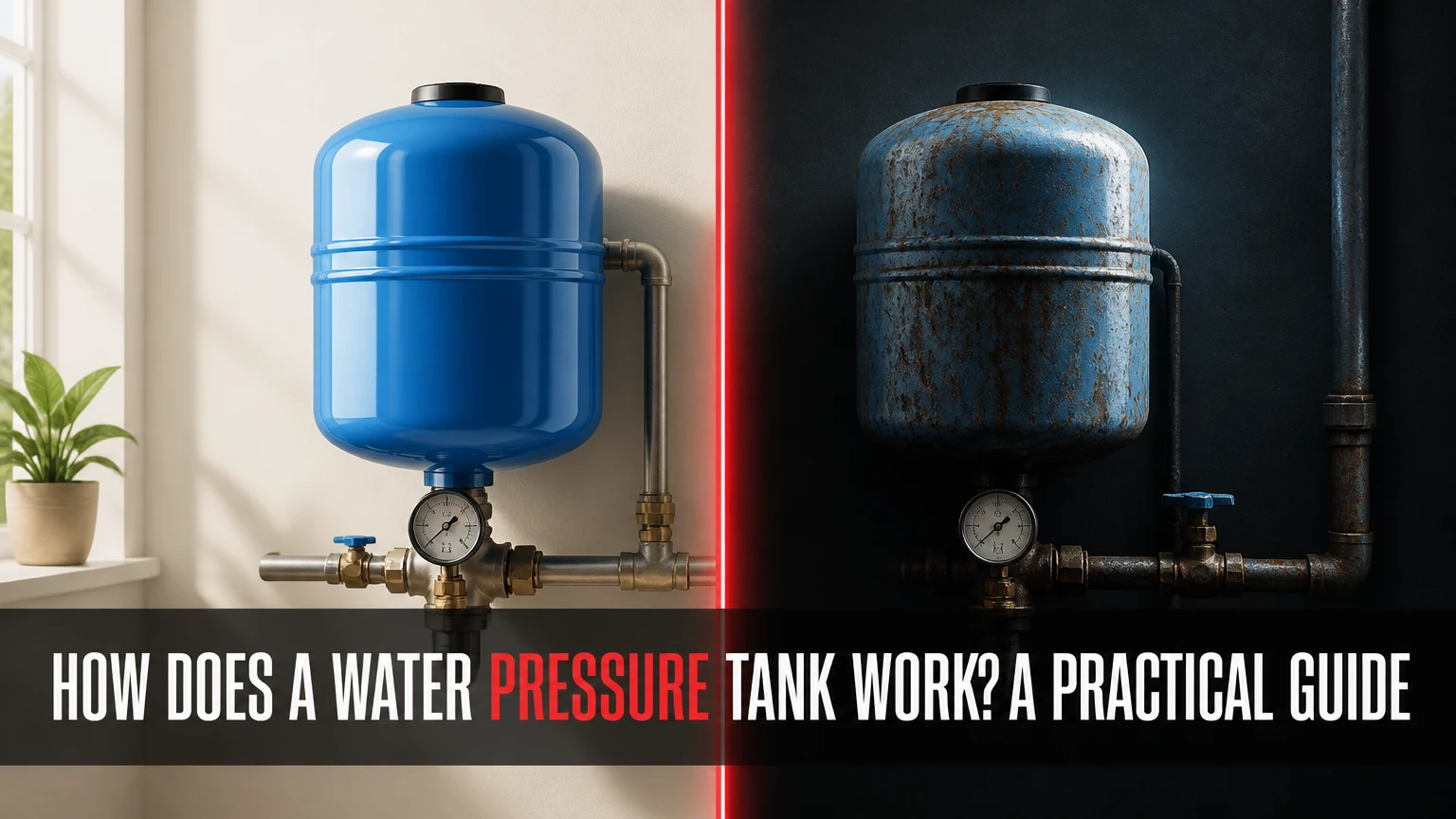
A water pressure tank stores water under pressure by separating or compressing water and air inside a sealed vessel. When a faucet opens, compressed air pushes water into the plumbing while the pump remains off; when pressure falls to the cut-in setting, the pump refills the tank until the cut-out setting stops it.
Key facts at a glance
- A well pressure tank reduces pump short-cycling by supplying stored water between pump cycles.
- A standard 30/50 PSI pressure switch starts the pump at 30 PSI and stops it at 50 PSI.
- A captive-air tank normally needs an empty-tank pre-charge 2 PSI below the pressure switch cut-in point.
- Tank size describes total vessel volume, while drawdown describes usable water delivered before the pump restarts.
- A ruptured bladder, lost air charge, blocked pressure-switch tube, or leaking plumbing can produce similar symptoms.
- A pressure tank is different from a water-heater expansion tank, even though both contain compressed air.
What Is a Water Pressure Tank?
A water pressure tank is a pressure vessel that combines a water reserve with a compressed-air cushion. In a private-well system, the tank works with the pump, pressure switch, check valve, pressure gauge, relief valve, and household distribution piping.
The tank has two jobs. First, it provides drawdown water without requiring the pump to run for every toilet flush or faucet opening. Second, it gives the pump a longer operating cycle, which limits heat buildup and electrical wear caused by frequent starts.
A water pressure tank does not create pressure by itself. The well pump supplies pressure, while the compressed air stores energy and discharges water when a fixture opens. The pressure switch controls the pump, not the tank.
What happens inside the tank?
In a captive-air tank, a rubber bladder or diaphragm separates water from air. Water entering the tank compresses the trapped air, and compressed air pushes water back out through the tank outlet. In an air-over-water tank, water and air share the vessel, so dissolved air gradually escapes and the air cushion must be replenished.
Boyle’s law describes the operating principle: at a stable temperature, reducing the volume available to a trapped gas increases its pressure. Water is effectively incompressible in this application, so the air cushion provides nearly all of the useful compression.
How Does a Water Pressure Tank Work?
A water pressure tank operates through a repeating six-stage cycle: idle, pressure drop, pump start, tank filling, pump stop, and drawdown. A conventional 30/50 PSI system repeats the cycle between 30 PSI cut-in and 50 PSI cut-out, although actual settings depend on the pressure switch and installation.
The six-stage operating cycle
- Idle condition: The tank contains pressurized water and compressed air. The pump is off because system pressure is above the cut-in point.
- Fixture opens: A faucet, shower, toilet, or irrigation zone consumes water. Compressed air pushes drawdown water into the distribution piping.
- Pressure falls: The gauge moves downward as tank water leaves. The pump remains off until pressure reaches the cut-in setting.
- Pump starts: At 30 PSI in a 30/50 system, the pressure-switch contacts close and energize the well pump.
- Tank refills: The pump sends water into the tank, reducing the air volume and raising system pressure.
- Pump stops: At 50 PSI, the pressure switch opens the circuit. The pump stops, and the system returns to idle.
The pump may run while a faucet remains open. In that case, the tank and pump share the demand: the tank supplies part of the flow, and the pump supplies the remainder. The pressure gauge should rise toward cut-out after demand ends.
Why does the tank prevent short-cycling?
The tank prevents short-cycling by supplying water during small demands that would otherwise start the pump repeatedly. A pump that starts several times in a few minutes experiences more motor and relay stress than a pump that runs through a longer, uninterrupted cycle.
The exact minimum run time depends on the pump manufacturer, motor design, installation, and cooling conditions. A common residential design target is approximately 60 seconds of runtime per cycle, but a manufacturer’s specification takes priority.
Which Types of Pressure Tanks Are Available?
The main residential options are bladder tanks, diaphragm tanks, and air-over-water tanks. Captive-air tanks usually require less routine air management, while air-over-water tanks can offer a durable shell but demand more maintenance.
| Tank type | Water-air separation | Typical service issue | Common application |
|---|---|---|---|
| Bladder tank | Replaceable rubber bladder | Bladder rupture or loss of pre-charge | Residential wells and booster systems |
| Diaphragm tank | Fixed flexible diaphragm | Diaphragm fatigue or rupture | Compact residential pressure systems |
| Galvanized tank | No membrane | Waterlogging and corrosion | Older wells and heavy-duty installations |
| Fiberglass tank | Replaceable bladder or liner | Membrane wear, low external corrosion | Corrosive or damp environments |
Bladder versus diaphragm tanks
A bladder tank holds water inside a flexible rubber container, with compressed air surrounding the bladder. Many designs permit bladder replacement, although labor, parts availability, and vessel condition determine whether repair is economical.
A diaphragm tank divides the vessel with a fixed membrane. The diaphragm does not usually function as a separately replaceable part, so a failed membrane commonly means replacing the entire tank.
The practical difference is less important than correct sizing, pre-charge, and water quality. A properly sized diaphragm tank can outperform a poorly maintained bladder tank.
Are air-over-water tanks still useful?
Air-over-water tanks remain useful where a heavy steel vessel, large air volume, or existing system design justifies regular maintenance. Water absorbs air over time, causing the vessel to become waterlogged and reducing drawdown.
An air-volume-control valve, snifter valve, bleeder valve, or compressor may restore the air cushion, depending on the system. These components require inspection because a failed air-control device can make a sound tank appear defective.
What Do 30/50 and 40/60 PSI Mean?
A pressure-switch rating describes two control points, not the tank’s maximum safe pressure. A 30/50 PSI switch starts the pump at 30 PSI and stops it at 50 PSI; a 40/60 PSI switch starts at 40 PSI and stops at 60 PSI.
| Pressure-switch setting | Pump starts at | Pump stops at | Empty-tank pre-charge |
|---|---|---|---|
| 20/40 PSI | 20 PSI | 40 PSI | 18 PSI |
| 30/50 PSI | 30 PSI | 50 PSI | 28 PSI |
| 40/60 PSI | 40 PSI | 60 PSI | 38 PSI |
| 50/70 PSI | 50 PSI | 70 PSI | 48 PSI |
A higher setting can improve shower pressure, but only when the pump, tank, piping, fixtures, filters, and elevation can support it. Every 2.31 feet of vertical elevation consumes approximately 1 PSI, before friction losses are added.
How should pressure-tank pre-charge be set?
Set the air pre-charge to 2 PSI below the pressure-switch cut-in pressure, with the tank completely depressurized on the water side. For a 30/50 switch, the target is 28 PSI; for a 40/60 switch, the target is 38 PSI.
Use this procedure:
- Turn off electrical power to the well pump.
- Open a nearby faucet and drain the tank until the water gauge reads 0 PSI.
- Check air pressure at the Schrader valve with a calibrated tire-pressure gauge.
- Add or release air until the reading is 2 PSI below cut-in.
- Close the faucet, restore power, and verify the pump starts and stops normally.
Water must be drained before measurement. Checking pre-charge while the tank remains pressurized produces a misleading reading and can lead to overinflation.
How Large Should a Water Pressure Tank Be?
Tank selection should be based on required drawdown, pump flow, pressure-switch settings, and minimum pump runtime. Total tank volume is not the amount of water available to the house.
The sizing relationship is:
Required drawdown = pump flow in gallons per minute × desired minimum runtime in minutes
For example, a 10 GPM pump with a 60-second minimum runtime needs at least 10 gallons of drawdown. The manufacturer’s drawdown chart then identifies the physical tank size that supplies those 10 gallons at the selected pressure range.
| Nominal tank volume | Typical 30/50 drawdown | Typical 40/60 drawdown | Practical residential use |
|---|---|---|---|
| 20 gallons | 6-7 gallons | 5-6 gallons | Low-demand cabin or small home |
| 44 gallons | 14-16 gallons | 12-14 gallons | Moderate two-bathroom home |
| 86 gallons | 27-30 gallons | 24-27 gallons | Larger home or higher-flow pump |
| 119 gallons | 38-42 gallons | 34-38 gallons | Large demand or irrigation buffer |
The values above are typical ranges, not universal specifications. Brand, membrane geometry, pre-charge, pressure range, and usable drawdown tables change the result.
Why can a large tank still provide little water?
A tank can lose most of its drawdown when the air charge is wrong, the bladder ruptures, or the vessel is waterlogged. A nominal 44-gallon tank does not deliver 44 gallons between pump cycles because the air cushion occupies much of the vessel and the pressure range is limited.
Oversizing is usually safer than undersizing when space and budget permit, but a very large tank cannot compensate for an undersized pump, poor well yield, blocked piping, or inadequate recovery.
What Is the Difference Between a Pressure Tank and an Expansion Tank?
A well pressure tank supplies drawdown water and controls pump cycling. A thermal expansion tank absorbs pressure growth in a closed domestic hot-water system as heated water expands; it is not a substitute for a well tank.
| Feature | Well pressure tank | Water-heater expansion tank | Booster-system accumulator |
|---|---|---|---|
| Primary equipment | Well or booster pump | Water heater | Variable-speed or booster pump |
| Main function | Store drawdown water | Absorb thermal expansion | Reduce rapid pressure changes |
| Control range | Commonly 30/50 or 40/60 PSI | System pressure, often 50-80 PSI | Manufacturer-specific |
| Water volume role | Regularly delivered to fixtures | Normally remains reserve volume | Small buffering reserve |
| Typical location | Near pressure switch and pump line | Cold inlet near water heater | Near booster pump |
Confusing these vessels can cause poor pump control and an incorrectly protected water heater. The connection point and manufacturer rating should always match the intended use.
Which Tank Type Fits Different Properties?
A steel captive-air tank is usually the economical choice for a conventional suburban well. A fiberglass bladder tank suits corrosive water or damp locations, while a constant-pressure variable-frequency-drive system fits properties that need steadier pressure across changing demand.
| Property condition | Suitable configuration | Reason | Limitation |
|---|---|---|---|
| One to two bathrooms | 44-gallon bladder tank | Provides moderate drawdown | Requires adequate installation space |
| Acidic or iron-rich water | Fiberglass bladder tank | Resists external and internal shell corrosion | Higher purchase price |
| Irrigation and household demand | Large tank or VFD system | Supports longer pump cycles | Requires pump-system design |
| Low-yield well | Properly sized tank with flow control | Buffers limited well recovery | Cannot increase aquifer yield |
| Multi-story house | 40/60 system if equipment permits | Adds pressure at upper fixtures | Elevation consumes pressure |
A variable-frequency-drive system changes pump speed to match demand and often uses a smaller buffer tank. It can deliver steadier pressure, but the controller introduces electronic complexity and may require surge protection, compatible motors, and specialized service.
How Much Do Pressure Tanks Cost?
A replacement pressure tank typically costs about $200-$1,200 for residential sizes, while professional installation commonly adds $300-$800. Actual pricing depends on tank volume, material, access, valves, electrical work, freight, local labor, and whether corroded piping must be rebuilt.
| Replacement scope | Typical equipment cost | Typical labor cost | Approximate total |
|---|---|---|---|
| 20-30 gallon steel tank | $200-$400 | $300-$600 | $500-$1,000 |
| 44-86 gallon steel tank | $350-$800 | $400-$800 | $750-$1,600 |
| 86-119 gallon fiberglass tank | $600-$1,200 | $500-$900 | $1,100-$2,100 |
| Tank, switch, gauge, valves | $250-$1,000 | $500-$1,000 | $750-$2,000 |
These are typical planning ranges rather than quotes. A replacement estimate should identify the tank’s drawdown, pressure rating, connection size, pressure-switch setting, and included safety components.
How Long Does a Pressure Tank Last?
A captive-air steel tank commonly lasts 5-10 years, while fiberglass vessels may last 10-15 years and galvanized tanks can last 15-20 years when air-control components and corrosion conditions are managed. The membrane, not only the shell, determines useful life in many residential tanks.
Inspect the tank annually for corrosion, leakage, unstable pressure, and abnormal pump cycling. A tank in a humid basement may fail externally before its membrane wears out, while corrosive well water can attack metal internally.
When should the tank be replaced?
Replace the tank when the bladder is ruptured, the shell is leaking, corrosion has reduced wall integrity, or the tank cannot maintain its specified pre-charge. A failed Schrader valve or pressure gauge is often a smaller repair, but a tank with water escaping from its air valve has a failed internal bladder.
Do not weld, drill, or modify a pressurized vessel. Pressure tanks require a correctly rated relief valve, and electrical isolation is necessary before servicing the pressure switch or pump wiring.
Why Is the Pump Short-Cycling?
Pump short-cycling means the pump starts and stops repeatedly during a small or steady demand. The most common causes are lost pre-charge, a ruptured bladder, an undersized tank, a leaking check valve, a running toilet, or a pressure-switch fault.
| Symptom | Likely cause | Safe first check | Likely remedy |
|---|---|---|---|
| Pump starts every few seconds | Waterlogged tank | Depressurized pre-charge test | Restore charge or replace tank |
| Water sprays from Schrader valve | Ruptured bladder | Press valve briefly with power off | Replace tank or bladder if supported |
| Pressure falls with all fixtures closed | Plumbing or check-valve leak | Watch gauge for 10 minutes | Repair leak or check valve |
| Pump never reaches cut-out | Weak pump, leak, low well level | Observe gauge during demand | Test pump flow and well recovery |
| Gauge fluctuates violently | Blocked switch nipple | Inspect pressure-switch port | Clean or replace restricted fitting |
A hollow sound near the upper tank does not prove the tank is healthy. Tapping is only a rough screening method; pressure testing with the water side empty gives a more reliable diagnosis.
Why is water pressure low at the faucet?
Low faucet pressure can result from insufficient pump output, a clogged filter, blocked plumbing, an incorrect pressure-switch setting, excessive elevation, or a damaged pressure tank. A normal tank gauge does not prove that water can pass through the house piping.
Check pressure at the tank gauge and at a downstream hose connection. If the tank gauge reaches 50 or 60 PSI but a fixture has weak flow, inspect filters, aerators, shutoff valves, pressure-reducing valves, and sediment in the service line.
Why does the pressure gauge fluctuate?
A fluctuating gauge often indicates a restricted pressure-switch nipple, pump-flow problem, leaking check valve, or unstable air charge. Sediment can block the small passage that communicates system pressure to the switch, causing delayed or erratic pump control.
Turn off power before removing a pressure switch. Drain pressure, clean or replace the nipple, inspect the gauge, and verify that the switch operates at its marked cut-in and cut-out values.
What Mistakes Reduce Tank Performance?
Four practitioner rules prevent most avoidable failures:
- Never set pre-charge with water pressure present. The reading will be higher than the true empty-tank value.
- Do not size by household occupancy alone. Match drawdown to pump flow and minimum runtime.
- Do not raise cut-out pressure casually. The pump must reach the new pressure, and every foot of elevation reduces available fixture pressure.
- Do not treat a pressure tank as water storage for outages. A 44-gallon vessel may supply only about 14-16 gallons of usable drawdown at common settings.
A pressure relief valve must be installed according to the tank and system design. The relief setting must remain below the lowest rated component, and local plumbing and electrical requirements may specify the installation details.
The Bottom Line
A water pressure tank uses compressed air to push stored water through a plumbing system while the pump remains off. The pressure switch starts the pump at cut-in and stops it at cut-out, while the tank’s drawdown determines how much water is available during each cycle.
For a typical private well, match the tank to pump flow, target runtime, pressure-switch range, and available space. Set pre-charge 2 PSI below cut-in with the tank empty, investigate short-cycling promptly, and choose fiberglass, galvanized, or variable-speed equipment only when water quality, demand, or pressure requirements justify the added cost.
Frequently Asked Questions
Can a water pressure tank increase my well’s water pressure?
A water pressure tank cannot increase the pump’s maximum pressure or the well’s available flow. Raising the pressure-switch setting may increase the system’s pressure range only when the pump can reach that setting and the piping, fixtures, relief valve, and tank are rated for it.
What pressure should be in a well tank when empty?
The air pre-charge should normally be 2 PSI below the pressure-switch cut-in setting when the water side is fully drained. That means 28 PSI for a 30/50 switch and 38 PSI for a 40/60 switch, unless the tank manufacturer specifies another value.
Can a pressure tank freeze?
A pressure tank can freeze when installed in an unheated space exposed to sustained temperatures below 32°F. Freezing water can damage the tank connection, piping, bladder, pressure gauge, and pump components, so seasonal properties need insulation, heat, or winterization.
Does a bigger pressure tank improve shower pressure?
A bigger tank usually improves runtime and reduces pump starts, but it does not automatically improve shower pressure. Shower pressure depends on pump capacity, pressure-switch settings, elevation, pipe friction, filters, valves, and the fixture’s flow restrictor.
How often should a pressure tank be checked?
Check a residential pressure tank at least annually and whenever pump cycling changes. Inspect the shell, gauge, relief valve, fittings, and pressure-switch operation; test pre-charge only after disconnecting power and draining the tank safely. A professional should handle electrical faults and damaged pressure vessels.