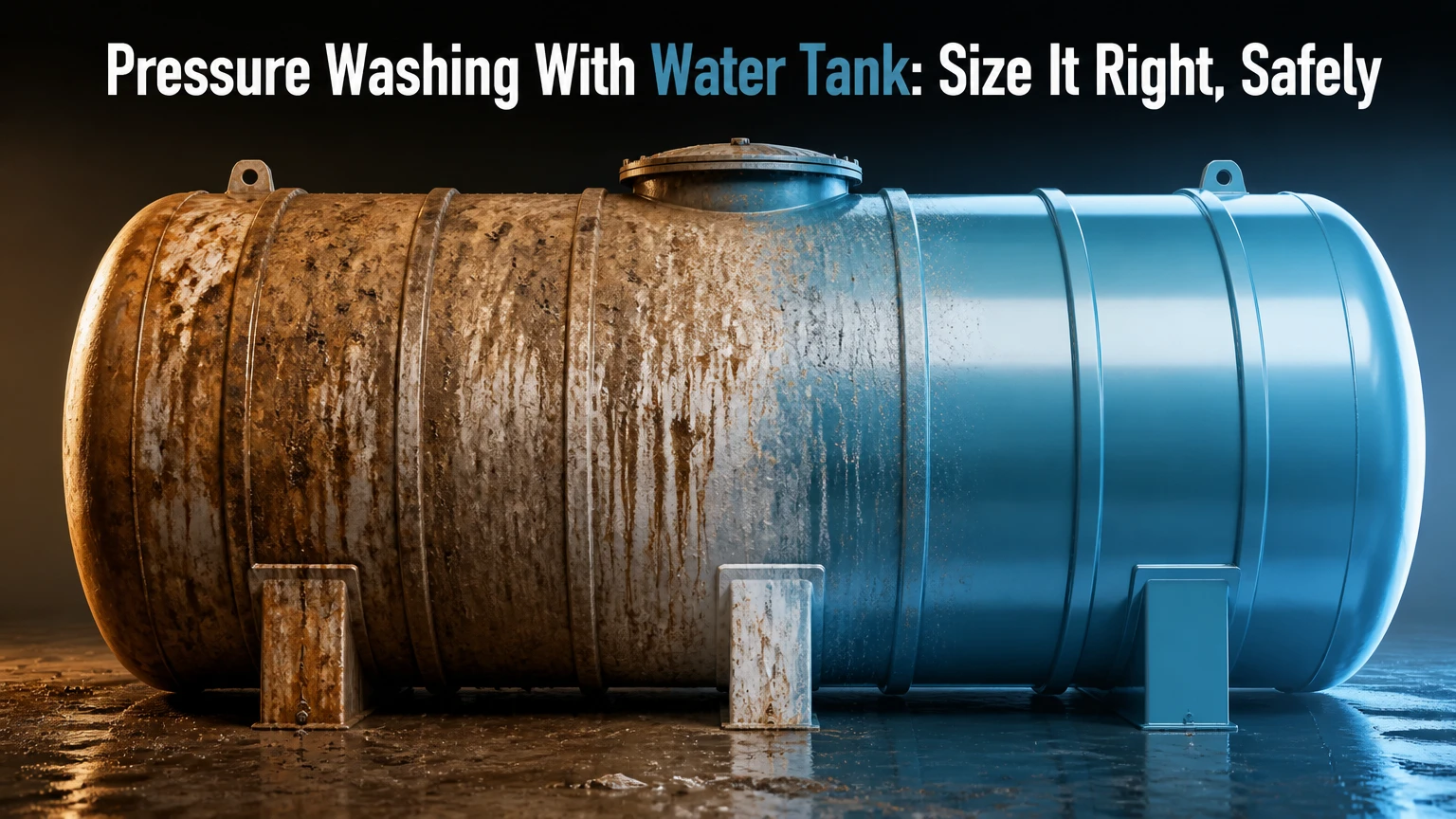
Pressure washing with water tank equipment uses a dedicated storage tank to supply a pressure washer when a tap, well, or municipal connection cannot provide the pump’s required flow. The reliable design matches tank capacity, inlet plumbing, pump requirements, vehicle payload, and wastewater controls, rather than connecting any pressure washer to any tank.
Key Facts at a Glance
- A 4 GPM pressure washer consumes 240 gallons, or about 909 liters, per hour while spraying continuously.
- A full 500-liter tank weighs approximately 500 kilograms before adding the machine, fuel, hose, frame, and operator.
- Gravity feed works only when the tank, hose, filter, and valve can deliver the pump’s required inlet flow without air entering the line.
- A non-collapsible suction hose, a full-flow valve, and a clean inlet filter protect the pump from starvation.
- A pressure washer unloader normally recirculates water through the pump head; a return-to-tank loop requires equipment designed and plumbed for that arrangement.
- The correct tank size depends on actual spray time, not the pressure washer’s advertised maximum pressure.
What Is Pressure Washing With Water Tank Equipment?
A tank-fed pressure washer draws water from a storage reservoir instead of taking its entire supply directly from a hose bib. The reservoir is often called a buffer tank because a slow tap can refill it while the pressure washer temporarily consumes water faster than the tap supplies it.
The arrangement is useful for mobile detailers, rural properties, construction sites, farms, commercial buildings, and locations without a dependable outdoor faucet. It does not create more water. It creates stored supply and separates the pump from short-term fluctuations in the source connection.
A tank is unnecessary when a tap consistently supplies more water than the machine consumes. For example, a 4 GPM machine needs at least 4 GPM at the pump inlet during active spraying, plus a margin for restrictions. A tap delivering 2 GPM cannot sustain that rate without a reservoir.
What does a buffer tank actually solve?
A buffer tank solves inadequate source flow, intermittent supply, and mobile access problems. It does not solve an undersized pump, blocked filtration, insufficient electrical power, unsafe vehicle loading, or illegal wastewater discharge.
The tank should be treated as part of a hydraulic system. Tank outlet size, hose length, elevation, filter condition, valve opening, water temperature, and pump inlet design all affect whether the pump receives enough water.
How Does a Tank-Fed Pressure Washer Work?
A tank-fed pressure washer follows this path: source water enters the tank, stored water travels through a low-pressure feed line, the pressure washer pump pressurizes that water, and the high-pressure hose delivers it through the gun and nozzle. The pump must receive water continuously, with minimal restriction and no trapped air.
The supply tank usually has a fill connection, screened vent, low-level outlet, drain, and a broad outlet fitting. A shutoff valve and inlet filter sit between the tank and pump. The pressure washer then sends water through its normal high-pressure circuit.
When the trigger closes, the unloader reduces pump loading by redirecting flow. Many machines recirculate water through the pump or a bypass line, not automatically back into the storage tank. A tank-return line is useful only when the pump, unloader, plumbing, and tank are rated for it.
Gravity feed or auxiliary feed pump?
Gravity feed is preferable when the tank outlet is above or nearly level with the pressure washer inlet and the machine manufacturer permits a standing-water supply. An auxiliary feed pump is appropriate when the tank sits below the pump, the hose run is long, the inlet route has several restrictions, or the pressure washer requires positive inlet pressure.
A 12-volt diaphragm pump is not automatically suitable. Its rated flow must exceed the washer’s consumption, and its pressure, duty cycle, pulsation, electrical draw, and bypass behavior must match the inlet circuit. Some high-flow machines need a centrifugal booster or a manufacturer-approved supply pump instead.
Does a pressure washer suck water from a tank?
Some pressure washers can draw from a tank, but the statement is model-specific. Commercial triplex plunger pumps commonly tolerate gravity-fed or low-pressure supplies when installed correctly; many consumer axial-pump machines require pressurized inlet water and may fail to prime from a free-standing tank.
Read the pressure washer manual before choosing the plumbing. The pump type alone does not establish safe suction lift, allowable inlet pressure, maximum temperature, or priming procedure.
Which Water Tank Type Fits the Job?
Horizontal leg tanks usually fit vehicle beds and trailers because their low profile reduces the center of gravity. IBC totes provide economical high capacity, but their square footprint, steel cage, and high full weight demand careful restraint and payload calculations. Vertical tanks save floor space in stationary installations but are less convenient in moving vehicles.
| Tank type | Typical capacity | Typical footprint | Best application | Main limitation |
|---|---|---|---|---|
| Horizontal leg tank | 200-500 L | 120 x 75 cm at 300 L | Van, pickup, detailing trailer | Limited capacity above 500 L |
| IBC tote | 600-1,000 L | 120 x 100 cm | Stationary or heavy trailer rig | 600-1,000 kg water load |
| Vertical polyethylene tank | 300-2,500 L | 75-150 cm diameter | Workshop or fixed site | Tall center of gravity |
| Low-profile baffled tank | 200-800 L | 100-220 cm length | Mobile commercial washing | Higher purchase price |
Polyethylene tanks intended for potable or agricultural storage are not automatically suitable for every detergent, solvent, or hot-water application. Check chemical compatibility, UV exposure rating, wall support, and maximum operating temperature.
How large should a pressure-washing tank be?
Choose tank capacity from planned spray minutes, pump flow, refill rate, and reserve. The basic calculation is:
Required tank volume = pressure-washer flow × spray time
For a machine using 4 GPM for 30 minutes, the theoretical requirement is 120 gallons, or approximately 454 liters. Add a reserve of 10-20% because operators cannot use every liter without risking air entering the outlet.
| Pressure washer flow | Consumption per hour | Theoretical 30-minute volume | Practical tank with 15% reserve |
|---|---|---|---|
| 2.5 GPM, 9.5 LPM | 150 gal, 568 L | 75 gal, 284 L | 86 gal, 325 L |
| 4.0 GPM, 15.1 LPM | 240 gal, 908 L | 120 gal, 454 L | 138 gal, 522 L |
| 5.5 GPM, 20.8 LPM | 330 gal, 1,249 L | 165 gal, 624 L | 190 gal, 719 L |
| 8.0 GPM, 30.3 LPM | 480 gal, 1,817 L | 240 gal, 908 L | 276 gal, 1,044 L |
Actual cleaning rarely uses continuous trigger time. A detailer may spray for 12-20 minutes during a 30-minute vehicle wash, while a surface cleaner can approach continuous consumption across a large open slab.
What Pump and Inlet Plumbing Are Required?
A commercial triplex plunger pump is generally the safer choice for a tank-fed pressure washer because many models accept low-pressure or gravity-fed supply. Consumer axial pumps often have tighter inlet requirements, so a booster pump may be necessary or the machine may be unsuitable for tank use.
The inlet line must remain open internally under suction. Use reinforced, non-collapsible hose rated for the intended flow and temperature, with a short route and few sharp bends. A common commercial arrangement uses a 1-inch inlet line for moderate-flow equipment, but the pump manufacturer’s specification controls.
The claim that the feed hose must always be twice the pump inlet diameter is too broad. Larger hose can reduce friction, but fittings, filters, valves, elevation, and hose length determine the actual restriction.
| Pressure washer flow | Common feed hose range | Typical filter size | Approximate gravity-head target |
|---|---|---|---|
| 2.5 GPM | 3/4-1 inch | 50-80 mesh | 0.3-0.6 m above inlet |
| 4.0 GPM | 1 inch | 50-80 mesh | 0.5-1.0 m above inlet |
| 5.5 GPM | 1-1.25 inches | 30-60 mesh | 0.8-1.2 m above inlet |
| 8.0 GPM | 1.25-1.5 inches | 30-60 mesh | 1.0-1.5 m above inlet |
The filter should be installed where it can be inspected and cleaned without draining the entire tank. A coarse tank screen prevents large debris, while a serviceable inlet filter catches finer particles before they reach the pump.
What does the bypass line need to do?
The bypass line must keep the pump from building pressure against a closed trigger. Many unloaders return water to the pump inlet or a dedicated low-pressure loop. A return-to-tank configuration can reduce heat buildup, but only when the tank connection prevents restriction and the components are rated for the flow.
Do not assume a tank-return line cools every machine. A poorly sized return hose, blocked filter, closed valve, or undersized tank fitting can still overheat the bypass circuit. Follow the pressure washer and unloader instructions, and avoid leaving a machine in bypass for extended periods.
How Do You Set Up a Pressure Washer From a Tank?
A correct setup takes roughly 20-45 minutes for a first installation and 5-10 minutes for a routine start. The decisive factor is water delivery at the pump inlet, not the tank’s nominal capacity.
Before you start
| Requirement | Typical specification |
|---|---|
| Tank volume | 200-500 L for mobile detailing, 500-1,000 L for commercial work |
| Feed hose | 1-1.5 inch reinforced, non-collapsible hose |
| Inlet filter | 30-80 mesh, serviceable housing |
| Water reserve | 10-20% above calculated spray volume |
| Vehicle check | Payload, axle rating, tie-down points, center of gravity |
| Safety equipment | Eye protection, hearing protection, gloves, spill kit |
Step 1: Inspect the tank and feed line
Place the tank on a level, structurally supported surface and inspect the outlet, valve, filter bowl, hose clamps, and fittings. Remove leaves, sediment, algae, and loose plastic from the tank.
You will know the system is ready when the outlet valve moves fully and the hose has no kink or soft section that can collapse. A common mistake is using an ordinary garden hose on the suction side because its outside diameter appears large enough.
Step 2: Fill the tank and verify vehicle capacity
Fill only to the level allowed by the tank and vehicle installation. Water weighs approximately 1 kilogram per liter, or 8.34 pounds per US gallon, so a 500-liter load weighs about 500 kilograms before equipment and passengers.
You will know the loading plan is sound when the combined payload remains below the vehicle’s rated limit and the tank is restrained against forward, rearward, and lateral movement. A full 1,000-liter IBC tote can exceed the practical payload of many half-ton pickups.
Step 3: Open the supply valve and prime the pump
Open the tank valve fully, then allow water to reach the pressure washer before starting the engine or motor. On machines that require manual priming, disconnect the high-pressure hose or follow the manual’s specified priming port, then run low-pressure water until air bubbles stop.
You will know priming is complete when water flows steadily without sputtering. Starting a pump with air in the head can cause vibration, pressure fluctuation, and inadequate lubrication.
Step 4: Connect the high-pressure circuit
Attach the high-pressure hose, gun, lance, and nozzle while the engine is off and the supply is stable. Select the nozzle by cleaning task, not by color alone, because color conventions vary by manufacturer.
You will know the connection is secure when couplers lock completely and there are no low-pressure leaks. Never repair a damaged high-pressure hose with tape or a generic clamp.
Step 5: Start the machine with the trigger open
Start the engine or motor according to the manufacturer’s procedure, then pull the trigger immediately to discharge trapped air and stabilize the pump. Keep the nozzle pointed toward a safe, prepared surface.
You will know the pump is receiving enough water when the spray is continuous, the engine does not surge, and pressure remains stable. Pulsation at this stage usually indicates air, a restricted filter, an incompletely opened valve, or insufficient inlet flow.
Step 6: Wash while monitoring consumption
Use overlapping passes and avoid holding the trigger open when repositioning. Monitor the tank level, inlet filter, engine temperature, pump sound, and pressure throughout the job.
You will know the system is healthy when pressure remains consistent and the pump does not grow unusually hot in bypass. Stop before the water level reaches the outlet pickup or before air enters the line.
Step 7: Shut down in the correct order
Release the trigger, switch off the engine or motor, close the water supply valve, and squeeze the trigger briefly to relieve trapped high-pressure water. Drain or isolate the system if freezing temperatures are expected.
You will know shutdown is complete when the high-pressure line has no residual pressure and the pump is not exposed to stagnant contaminated water. Do not close the tank valve while the machine is still operating.
How Much Does a Tank-Fed System Cost?
A basic DIY arrangement typically costs $300-$800, a dependable mobile commercial rig commonly costs $2,500-$7,000, and a hot-water trailer with high-flow equipment can exceed $10,000. Prices vary with pump brand, burner, reels, tank material, trailer fabrication, filtration, and water-recovery equipment.
| System level | Tank and machine | Typical total cost | Typical setup time | Suitable workload |
|---|---|---|---|---|
| DIY low-flow | 200 L tank, 2.5 GPM washer | $300-$800 | 1-2 days | 1-3 cars per fill |
| Mobile detailer | 300-500 L leg tank, 4 GPM washer | $2,500-$7,000 | 1-3 days | 3-6 cars per fill |
| Property cleaner | 500-1,000 L tank, 5.5 GPM washer | $5,000-$12,000 | 2-5 days | Concrete, siding, equipment |
| Industrial trailer | 1,000 L tank, 5.5-8 GPM hot-water washer | $10,000-$30,000+ | 1-4 weeks | Large commercial surfaces |
The cheapest tank is rarely the cheapest system after adding a booster pump, heavy hose, fittings, mounting, filtration, and repairs. Budget also for periodic filter replacement, pump oil where applicable, hose replacement, winterization, and lawful wastewater collection.
How Long Will the Water Last?
A 500-liter tank feeding a 4 GPM machine lasts approximately 33 minutes of uninterrupted spraying when no water enters the tank. The calculation is 500 liters divided by 15.1 liters per minute, which equals about 33.1 minutes.
If a tap refills at 2 GPM while the washer consumes 4 GPM, the tank loses water at a net rate of 2 GPM. A 500-liter tank therefore provides approximately 66 minutes from full to empty under continuous spraying, assuming the refill rate remains stable.
| Tank capacity | Machine flow | No-refill spray time | Refill at 2 GPM |
|---|---|---|---|
| 200 L | 2.5 GPM | 21 minutes | 42 minutes |
| 300 L | 4.0 GPM | 20 minutes | 40 minutes |
| 500 L | 4.0 GPM | 33 minutes | 66 minutes |
| 1,000 L | 8.0 GPM | 33 minutes | 66 minutes |
These are theoretical figures. A 15% reserve, trigger cycling, inlet geometry, and refill interruptions reduce usable time. If the refill rate equals or exceeds machine consumption, the tank can remain full during spraying, provided the inlet and overflow arrangement are safe.
Tank Versus Direct Tap: Which Setup Is Better?
A direct tap is the better option when the source supplies the required flow, the property allows hose access, and vehicle mobility is unnecessary. A tank is better when source flow is inadequate, the work location has no reliable connection, or water must be transported to the job.
| Decision factor | Direct tap connection | Tank-fed buffer system | Best choice |
|---|---|---|---|
| Initial equipment cost | $0-$150 for hose and fittings | $300-$30,000+ | Direct tap |
| Continuous supply | Limited by 1-8 GPM source flow | 200-1,000 L stored supply | Depends on source |
| Vehicle payload | 5-20 kg of hose | 200-1,100 kg of water | Direct tap |
| Mobility | 15-50 m hose reach | 0-300 km transport range | Tank |
| Setup time | 2-10 minutes | 5-45 minutes | Direct tap |
| Rural suitability | Requires pressurized source | Works with hauled water | Tank |
| Pump protection | Pressure can fall unexpectedly | Stable supply if correctly sized | Correctly designed system |
A tank does not automatically protect a pump. A blocked inlet filter or collapsed hose can starve a tank-fed pump more severely than a well-sized tap connection.
Which Setup Fits Each Cleaning Situation?
Mobile car detailing
A 200-400 liter baffled or leg tank paired with a 2.5-4 GPM machine usually offers a practical balance. A 300-liter tank contains approximately 79 US gallons, which provides about 20 minutes of continuous spraying at 4 GPM before reserve.
A smaller tank reduces payload and improves maneuverability. It is not suitable for several hours of unrestricted pressure washing without a refill plan.
House washing and rural property work
A 300-500 liter tank fits light house washing when the operator uses downstream chemical application and low-pressure rinsing. A 4 GPM machine consumes the stored water quickly if the operator uses a pressure nozzle continuously.
Rural users should test the source refill rate before purchasing. A slow well pump may refill the tank at less than 2 GPM, making a larger tank useful but not eliminating the need for conservation.
Commercial concrete cleaning
Concrete cleaning with a surface cleaner consumes water continuously. A 5.5 GPM machine uses approximately 1,249 liters per hour, while an 8 GPM machine uses approximately 1,817 liters per hour.
A 1,000-liter tank provides only about 33 minutes of theoretical spraying at 8 GPM. Commercial operators therefore need a refill source, multiple tanks, a water-recovery plan, or a work schedule built around short operating intervals.
What Are the Most Common Failure Modes?
Pressure drops during washing
A pressure drop usually indicates pump starvation, a blocked filter, a partially closed valve, a collapsing hose, inadequate tank elevation, or an auxiliary pump that cannot maintain flow. Check the system from the tank toward the pump rather than immediately adjusting the unloader.
Stop the machine, clean the filter, open the valve, inspect the hose, and prime again. If the problem returns with a clean supply line, compare measured inlet flow with the machine specification.
Pulsation and vibration
Pulsation usually means air is entering the pump inlet or the pump is receiving insufficient water. Low tank level, a loose clamp, cracked hose, vortexing at the outlet, and a restricted filter can all produce the same symptom.
Do not continue spraying while the pump pulses severely. Persistent cavitation can damage valves, plungers, seals, and bearings.
Water leaking beneath the pump
Water beneath the pump can indicate worn seals, a cracked manifold, a loose fitting, freezing damage, or overheating from prolonged bypass. A leak is not proof that the bypass water became too hot, so inspect the source before ordering seals.
Turn off the machine, relieve pressure, and identify whether the leak occurs at the inlet, outlet, drain, crankcase, or pump head. Repair parts must match the pump model.
Tank contamination
Algae, sediment, rust, and biofilm can block filters and damage pump components. Keep the tank covered, use clean water, drain it between long storage periods, and inspect the interior on a scheduled basis.
Do not add disinfectants or cleaning chemicals unless the tank manufacturer confirms material compatibility and the residue will not damage the pump or surface being washed.
What Mistakes Should Operators Avoid?
- Using a collapsible garden hose on the inlet. Replace it with reinforced suction-rated hose sized for the flow.
- Starting with an empty or unprimed pump. Fill the supply line and purge air before engaging the engine.
- Assuming every axial pump accepts tank water. Check the manual for inlet pressure, suction lift, and priming requirements.
- Ignoring payload limits. Calculate water weight, equipment weight, passengers, fuel, and tools together.
- Leaving the trigger closed in bypass. Follow the manual’s maximum bypass time and shut down during pauses.
- Running hot water through an incompatible tank. Confirm tank, hose, filter, and seal temperature ratings.
- Discharging dirty runoff into a storm drain. Local environmental authorities commonly restrict detergents, oil, mud, and wastewater entering storm systems.
A practitioner rule of thumb is to design for 10-20% more inlet capacity than the pump’s stated consumption. That margin accommodates filter loading, hose friction, and imperfect field conditions.
What Are the Alternatives to a Water Tank?
A larger tap or dedicated standpipe is the simplest alternative when the property can provide adequate flow. A refillable intermediate tank at the site can reduce vehicle payload while preserving a buffer for a high-flow washer.
For lightly soiled vehicles, a low-water or rinseless cleaning method can reduce consumption, but it does not replace pressure washing for heavy mud, concrete oxidation, grease, or deep surface contamination. Water hauling is another option, although transport costs and legal disposal obligations remain.
The least expensive alternative is often a smaller pressure washer whose flow matches the available source. Reducing flow from 4 GPM to 2.5 GPM extends a 500-liter tank’s theoretical spray time from about 33 minutes to approximately 53 minutes, although cleaning productivity also changes.
FAQ
Can I use an IBC tote with a pressure washer?
An IBC tote can supply a pressure washer when the pump accepts a standing-water supply and the tote has a suitable full-flow outlet, reinforced feed hose, shutoff valve, and filter. A full 1,000-liter tote weighs about 1,000 kilograms, so stationary placement or an appropriately rated trailer is essential.
Does a pressure washer need a pump between the tank and machine?
A booster pump is needed when the pressure washer requires positive inlet pressure, the tank sits below the pump, or the gravity system cannot maintain the manufacturer’s specified flow. A correctly elevated tank with a short, large feed line may work without a booster on compatible commercial equipment.
Can I put the water tank lower than the pressure washer?
A lower tank can work only if the pressure washer and supply pump are designed for that arrangement. Otherwise, the inlet line may not prime, air can enter through fittings, and the pump can cavitate. An auxiliary pump must provide the required flow without exceeding the washer’s inlet-pressure limit.
Is a 200-liter tank enough for mobile detailing?
A 200-liter tank is enough for short mobile detailing jobs using a 2.5-3 GPM machine and controlled trigger time. At 4 GPM, the theoretical continuous spray time is approximately 13 minutes, so a refill source or water-efficient workflow becomes necessary for multiple vehicles.
How do I stop a tank-fed pressure washer from pulsing?
Stop the pressure washer and check the tank level, outlet valve, inlet filter, hose condition, clamps, and pump priming. Remove trapped air and confirm that measured supply flow exceeds machine consumption. Continuing to operate during severe pulsation can damage pump valves and seals.
Can pressure-washer chemicals go into the storage tank?
Do not place detergent, bleach, degreaser, or solvent in the storage tank unless the tank and pump manufacturers approve that chemical path. Use a downstream injector, dedicated chemical tank, or manufacturer-approved dosing system to control concentration and reduce tank contamination.
The Bottom Line
Pressure washing with water tank equipment is the right solution when stored water must bridge the gap between the job’s required flow and the available source. Select the tank from spray-time calculations, use pump-compatible inlet plumbing, protect the vehicle from excessive water weight, and confirm local wastewater requirements before starting work.