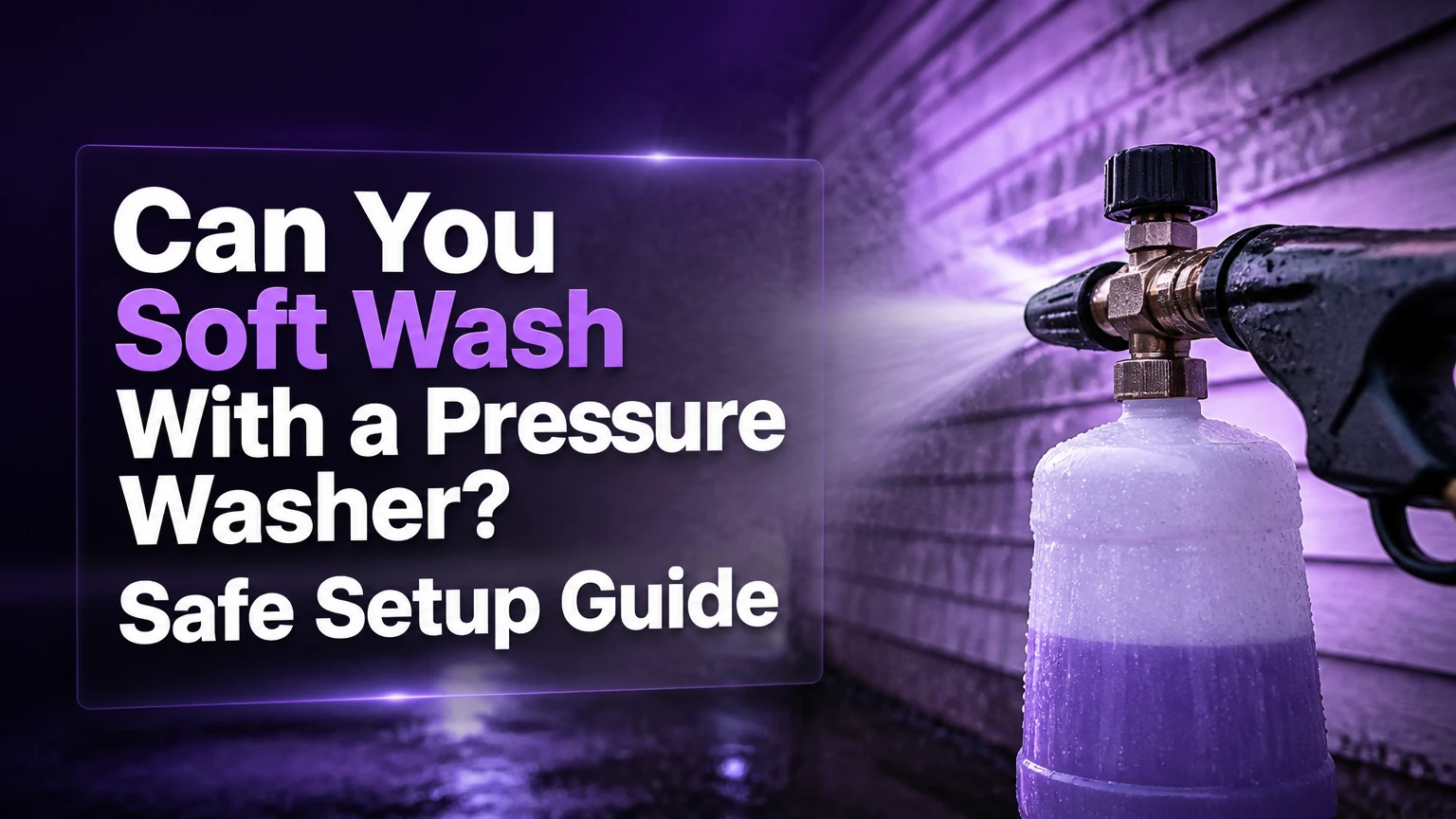
Yes, you can soft wash with a pressure washer when the machine delivers a diluted cleaning solution through a downstream injector or external chemical nozzle, followed by a low-impact rinse. The pressure washer supplies water and application reach; the detergent or sodium-hypochlorite solution performs most of the biological cleaning. A pressure washer alone does not automatically become a soft-wash system.
Key Facts at a Glance
- Soft washing uses chemical action and controlled water delivery, rather than high-impact spray force, to remove organic growth.
- A downstream injector introduces chemicals after the pressure washer pump, reducing chemical exposure to pump components.
- Pressure-washer nozzle colors are not universal, so the equipment manufacturer’s orifice and pressure chart overrides color alone.
- Typical house-wash solution strength is about 0.5%-1.5% available sodium hypochlorite on the surface, but product labels and material guidance control the final mix.
- Roof cleaning requires lower-impact application, careful runoff management, and a material-specific method; walking on or pressure-rinsing asphalt shingles can cause damage.
- Never mix sodium hypochlorite with acids, ammonia, or other cleaners, and never allow a chemical solution to dry on glass, painted surfaces, or vegetation.
Can You Soft Wash With a Pressure Washer?
A pressure washer can support soft washing if its chemical system and nozzle produce a low-impact spray suitable for the surface. The method is appropriate for many vinyl-sided walls, some painted exteriors, masonry, and selected roof-cleaning applications, but the pressure washer’s maximum PSI rating is not the same as the pressure reaching the surface.
A typical residential pressure washer rated at 2,000-3,000 PSI can still be used for chemical application through a wide-orifice soap nozzle or an external injector. The delivered pressure depends on the nozzle orifice, water flow, hose length, injector restriction, spray distance, and the machine’s unloader setting.
Soft washing is therefore a process, not a pressure-washer setting. The operator applies an appropriate solution, allows controlled dwell time, and rinses without using a narrow, high-impact jet.
How Does Soft Washing Work With a Pressure Washer?
Soft washing works by transferring the main cleaning task from mechanical impact to chemical reaction and dwell time. The pressure washer moves water through a hose, an injector introduces the cleaning solution, and a wide spray pattern distributes that solution over the target surface.
What does the pressure washer actually do?
The pressure washer performs three practical jobs:
- It supplies water flow, commonly measured in gallons per minute.
- It creates enough pressure to operate a downstream injector or external chemical nozzle.
- It carries the solution to the surface through a wand, lance, or shooter tip.
The pump does not determine the safe pressure by itself. A 3,000-PSI machine can produce a relatively gentle application when paired with an appropriate nozzle and distance, while an incorrectly selected tip can damage siding even on a smaller machine.
Why does the chemical do most of the cleaning?
Sodium hypochlorite oxidizes and kills many algae, mold, mildew, and lichen organisms when the concentration, contact time, and surface compatibility are appropriate. Surfactants improve wetting and cling, while water rinses away dead growth and loosened soil.
The chemistry does not remove every contaminant. Oil, tire marks, rust, efflorescence, and compacted mineral deposits often require different products or controlled mechanical cleaning. Soft washing is strongest against biological staining, not every type of exterior soil.
Which Pressure-Washer Equipment Can Soft Wash?
A downstream injector is the simplest pressure-washer conversion for low-level house washing, while an X-Jet or dedicated soft-wash pump provides better chemical reach or stronger solution delivery. Equipment choice depends mainly on water flow, height, chemical volume, and the surface being cleaned.
| Equipment option | Typical working range | Chemical path | Best-fit situation |
|---|---|---|---|
| Downstream injector | 2.5-8 GPM machine flow; roughly 10%-20% draw under favorable conditions | After the pump | Ground-level siding and routine house washing |
| X-Jet-style external nozzle | Reach commonly 20-40 feet from ground level, depending on model and water supply | Chemical is pulled at the wand | Higher walls, adjustable proportioning, reduced injector dependence |
| Dedicated 12V soft-wash pump | Commonly 40-100 PSI operating pressure; model limits vary | Separate tank and diaphragm pump | Roofs, large properties, precise chemical application |
| Low-pressure pump sprayer | Hand-pump or battery-powered delivery | Separate container | Small patches, plants, spot treatment, and test areas |
How does a downstream injector work?
A downstream injector uses a venturi effect to draw chemical solution into the water stream after the pump outlet. The injector generally draws only when the system has adequate flow and low enough backpressure, which is why a soap nozzle or wide-orifice tip is normally required.
Downstream injection protects the pump from routine exposure to sodium hypochlorite because the solution enters after the pump. Protection is not absolute: chemical residue remains in hoses, fittings, and the gun, so flush the system with clean water after use.
Injector dilution varies widely. A stated 1:10 ratio is not a guarantee because actual draw changes with machine GPM, nozzle size, hose length, injector model, elevation, and water temperature. Test the output with a measured container instead of assuming the label ratio applies to your setup.
Is an X-Jet better than a downstream injector?
An X-Jet can be better for high walls or situations where a pressure washer’s downstream injector cannot pull a strong enough solution. The external nozzle draws from a chemical container at the wand, avoiding some long-hose dilution and allowing proportioning tips on compatible models.
An X-Jet also increases operator exposure to overspray because the solution can travel farther. Use a test patch, control wind, protect adjacent surfaces, and follow the product label. An X-Jet is an application tool, not permission to use concentrated chemical indiscriminately.
When is a dedicated soft-wash pump the better choice?
A dedicated diaphragm-pump system is generally better for roofs, larger commercial buildings, and jobs requiring predictable chemical strength at low pressure. The separate pump can apply solution without forcing corrosive chemistry through a pressure washer and can operate at far lower pressure than many pressure-washer configurations.
The trade-off is cost and maintenance. A separate tank, chemical-resistant hose, pump, proportioner, and fittings often cost several hundred dollars before a professional trailer or remote valve system is added.
What PSI and GPM Should You Use?
Use the lowest pressure that applies and rinses the solution effectively, rather than choosing a target number from the pressure washer’s nameplate. Typical low-impact chemical application may be below 300 PSI at the surface, but safe pressure varies by nozzle, distance, material, and equipment configuration.
| Task or surface | Typical application approach | Typical rinse range | Main limitation |
|---|---|---|---|
| Vinyl siding | Wide fan, downstreamed solution, 12-24 inches away | 100-300 PSI at surface | Oxidized siding can streak or show chalking |
| Stucco or EIFS | Low-impact fan and controlled dwell | Under about 300 PSI at surface | Avoid forcing water behind cracks and joints |
| Painted wood | Test patch, low-impact application, gentle rinse | Often 100-500 PSI at surface | Paint failure and soft wood require special care |
| Asphalt shingles | Low-pressure chemical application from a safe position | Minimal or no pressure rinse where appropriate | Walking, pressure rinsing, and runoff can damage roofing |
| Concrete driveway | Chemical pretreatment plus surface cleaning | Often 1,000-3,000 PSI, material dependent | Biological stains may need chemistry and agitation |
GPM affects productivity and injector performance. A 2.3-GPM electric machine may draw chemicals weakly, while a 5.5-GPM professional washer can rinse faster and operate a high-draw injector more consistently. More GPM does not make a high-pressure tip safe for fragile materials.
What Chemicals Should You Use?
Use a product labeled for the surface and contamination, then calculate the final concentration from the product’s stated strength. Sodium hypochlorite is common for organic growth, but household bleach, pool chlorine, and commercial solution have different concentrations and may contain additives unsuitable for exterior cleaning.
| Surface or contamination | Typical on-surface range or approach | Typical dwell time | Important control |
|---|---|---|---|
| Vinyl siding with algae | 0.5%-1.5% sodium hypochlorite | 5-15 minutes | Keep wet and rinse windows promptly |
| Painted exterior | Start below 1% and test | 5-10 minutes | Check paint, oxidation, and warranty guidance |
| Stucco or masonry growth | About 1%-2%, material dependent | 5-15 minutes | Avoid forcing solution into cracks |
| Asphalt shingles | Often about 1%-3%, product and roof dependent | 10-20 minutes | Follow roofing and chemical guidance; avoid pressure |
| Heavy lichen or moss | Multiple controlled applications may be safer than stronger mix | 15-30 minutes | Do not escalate concentration without testing |
These are typical practitioner ranges, not universal recipes. A 12.5% sodium-hypochlorite product diluted 1:10 is approximately 1.25% before accounting for injector dilution; a downstream injector can reduce the final wall concentration much further. Measure source and downstream output separately.
Do not add dish soap casually. Some household detergents contain fragrances, solvents, or additives that increase runoff, harm plants, or leave residue. A purpose-made exterior-cleaning surfactant is easier to evaluate through its Safety Data Sheet and label.
How Do You Soft Wash a House With a Pressure Washer?
A typical 2,000-square-foot house takes a homeowner about 1.5-3 hours, including setup, plant protection, application, dwell, rinsing, and cleanup. The process has seven practical stages, and the main success factor is controlling chemical strength and keeping the solution wet without allowing runoff or overspray to damage nearby materials.
Before You Start
| Requirement | Typical homeowner provision |
|---|---|
| Time | 1.5-3 hours for a 2,000-square-foot house |
| Difficulty | Moderate; higher for roofs, ladders, and chemical handling |
| Equipment | 2.3-4 GPM washer, injector or external nozzle, 50-100 feet of hose |
| Protective gear | Chemical-resistant gloves, eye protection, long sleeves, footwear |
| Materials | Labeled cleaner, measuring container, plant-rinse hose, absorbent materials |
| Weather | Low wind, no imminent rain, surface temperature within label limits |
| Test area | One inconspicuous patch, observed through drying |
Step 1: Inspect and Protect the Area
Disconnect or shield outdoor electrical equipment according to the manufacturer’s instructions, close windows, remove loose items, and identify oxidized paint, failed caulk, cracked stucco, open vents, and delicate plants.
Pre-wet vegetation with clean water before applying cleaner. Covering plants with plastic can trap heat and chemical vapor, so use it only for a short, supervised period when the product directions permit. Plan where runoff will travel before opening the chemical valve.
You will know the preparation worked when windows are closed, outlets and fixtures are protected, and no runoff path leads directly into a storm drain or sensitive garden.
Common mistake: Starting at the highest wall without checking wind direction. Overspray can reach neighboring property, vehicles, stained glass, or dry vegetation.
Step 2: Select and Test the Delivery System
Connect the downstream injector after the pump, install the correct siphon filter, and place the tube into a measured chemical container. Select the manufacturer-designated low-pressure or soap nozzle, then verify that the injector actually draws.
Apply a small test patch at the planned distance. Observe the surface for color change, paint lifting, runoff, and reaction speed before mixing enough solution for the entire property.
You will know the system works when the solution reaches the surface evenly and the test patch cleans without discoloration or excessive runoff.
Common mistake: Trusting nozzle color alone. A black soap tip often indicates low pressure, but color conventions differ by brand; orifice size and spray behavior matter more.
Step 3: Apply the Solution From the Bottom Up
Apply the cleaning solution in manageable sections, usually 100-300 square feet at a time, starting at the bottom and moving upward. The lower edge is already wet with solution, so upward application reduces dirty streaks caused by uncontrolled runoff from unclean upper sections.
Keep the spray moving. Use approximately 12-24 inches of distance for a controlled fan unless the nozzle manufacturer specifies another distance, and never aim directly into siding seams, window seals, vents, or roof penetrations.
You will know the application is even when the surface has a consistent wet sheen without concentrated curtains of liquid.
Common mistake: Applying from the top down because the rinse will move downward. That sequence allows dirty chemical runoff to cross dry, uncleaned surfaces and leave tracks.
Step 4: Control Dwell Time
Allow the solution to work for approximately 5-15 minutes on ordinary siding, adjusting for temperature, sun, wind, contamination, and the product label. Keep the surface wet by working smaller sections or applying a light second pass.
Do not allow sodium hypochlorite solution to dry on glass, aluminum, painted trim, or plants. If a section begins drying, lightly re-wet it with solution or clean water as appropriate instead of increasing concentration immediately.
You will know dwell time is adequate when organic staining has visibly lightened and the surface can be rinsed without force.
Common mistake: Treating a fixed 10-minute dwell time as mandatory. Hot sun and wind may reduce safe dwell time, while shaded heavy growth may need a second application.
Step 5: Rinse From the Top Down
Switch to a low-impact rinse configuration and rinse upper sections downward, using enough flow to remove dead growth and residue. Keep the nozzle moving and avoid holding the spray against window seals, soffits, vents, and painted edges.
Rinse windows, frames, gutters, plants, and hardscape separately. Clean water should continue over vegetation after the wall appears clean, particularly where overspray or runoff contacted leaves.
You will know the rinse is complete when no visible foam, chemical film, loose organic residue, or active runoff remains.
Common mistake: Reaching for a red zero-degree or yellow 15-degree tip to remove a stubborn spot. Spot-clean the contamination with a compatible method instead of concentrating force on a fragile surface.
Step 6: Check Details and Repeat Selectively
Inspect shaded walls, under eaves, corners, downspouts, and areas behind utility lines. A second chemical application on isolated biological staining is usually safer than a closer, more forceful spray.
Do not chase uniform color on weathered or oxidized siding by increasing pressure. Oxidation, paint failure, and permanent staining may remain after cleaning and require restoration or repainting.
Step 7: Flush and Document the Setup
Run clean water through the injector, hose, gun, and wand for the period specified by the equipment and chemical manufacturers. Remove and rinse the siphon filter, inspect seals, and store chemicals in their original labeled containers.
Record the source concentration, dilution, weather, dwell time, and surface response. A simple log prevents repeating an overly strong mix on the next visit.
Is Soft Washing Better Than Pressure Washing?
Soft washing is generally safer for fragile, painted, porous, or roof surfaces with biological growth, while conventional pressure washing is more effective for hard surfaces with embedded soil, oil, and loose debris. Neither method is universally superior because the correct choice depends on material strength and contaminant type.
| Decision factor | Soft washing with pressure-washer support | Conventional pressure washing | Preferred method |
|---|---|---|---|
| Main cleaning force | Chemical action at low impact | Water impact and agitation | Soft wash for algae; pressure for hard soil |
| Typical surface pressure | Often under 300 PSI at surface | About 1,000-4,000 PSI | Low pressure for siding and roofs |
| Vinyl siding | Organic growth and light dirt | Can force water behind panels | Soft washing |
| Concrete driveway | Pretreatment plus rinse | Surface cleaner and high flow | Combined method |
| Asphalt shingles | Low-pressure chemical application | Can dislodge granules | Soft washing |
| Oil and tire marks | Limited without specialty degreaser | Stronger mechanical removal | Pressure washing plus degreaser |
| Main risk | Chemical runoff and vegetation damage | Gouging, stripping, and water intrusion | Depends on controls |
Which method should you use for common surfaces?
| Surface | Recommended first method | Avoid | Reason |
|---|---|---|---|
| Vinyl siding | Low-impact chemical wash | Narrow high-pressure jet | Prevents water intrusion and surface damage |
| Asphalt shingles | Professional low-pressure roof cleaning | Pressure-washer roof rinsing | Protects granules and reduces fall risk |
| Concrete | Detergent pretreatment and surface cleaner | Wand-only close spraying | Improves uniformity and reduces striping |
| Painted wood | Test patch and controlled low-pressure wash | High pressure near joints | Paint and wood can fail under impact |
| Brick masonry | Low-pressure cleaning with material test | Aggressive pressure on old mortar | Mortar erosion may be irreversible |
| Vehicle paint | Automotive detergent and suitable wash system | Strong bleach mix or close high pressure | Protects clear coat, trim, and seals |
Can You Soft Wash a Roof With a Pressure Washer?
A pressure washer can sometimes deliver roof-cleaning solution, but using the pressure washer to rinse asphalt shingles is generally a poor practice. Roof cleaning combines chemical exposure, fall hazards, runoff control, and manufacturer warranty concerns, so a ground-operated low-pressure pump is usually the safer professional setup.
Never infer that a roof is suitable for cleaning because its shingles look dirty. Asphalt granules, flashing, skylights, sealants, gutters, and nearby landscaping all respond differently to water and chemicals. Clay tile, slate, cedar, and synthetic roofing require separate material-specific procedures.
A homeowner should avoid climbing a steep or wet roof. A professional can often apply solution from the ground with a dedicated pump, then allow weather and normal rainfall to remove dead growth when the roof manufacturer’s guidance permits.
What Should You Never Soft Wash?
Never use an untested chemical mix on a surface with unknown coatings, and never direct a chemical or high-pressure stream into electrical equipment, ventilation openings, damaged siding, roof penetrations, or unsealed joints. Soft washing is unsuitable as a universal substitute for cleaning every material.
Avoid these situations or obtain specialist guidance first:
- Historic masonry with weak mortar or fragile coatings.
- Lead-painted or asbestos-containing materials requiring regulated handling.
- Natural stone whose manufacturer prohibits hypochlorite.
- Aluminum or painted metal with heavy oxidation.
- Roofs requiring walking, aggressive rinsing, or ladder work.
- Properties where runoff can enter ponds, streams, storm drains, or sensitive plant beds.
- Vehicles, solar panels, and glass when the chemical label does not approve the application.
The US Environmental Protection Agency requires pesticide products, including antimicrobial products making regulated claims, to be used according to their labels. Product labels also define personal protective equipment, dilution, contact time, storage, and disposal requirements. Local stormwater rules may impose additional restrictions.
Why Is the Pressure Washer Not Drawing Chemical?
A pressure washer usually fails to draw chemical because the system has too much backpressure, insufficient water flow, an obstructed siphon tube, or an injector installed in the wrong location. Chemical injection requires the specific low-pressure operating conditions designed into the injector.
Check the following in order:
- Install the soap or low-pressure nozzle specified for the injector.
- Confirm that the injector arrow points in the direction of water flow.
- Inspect the siphon tube, filter ball, check valve, and chemical container.
- Remove excessive hose length, restrictive fittings, or a small nozzle.
- Verify that the washer’s GPM meets the injector’s minimum requirement.
- Test with clean water before diagnosing the chemical itself.
- Replace a worn injector if flow and nozzle conditions are correct.
A downstream injector that draws water but not chemical may have an air leak at the tube connection. A strong chemical draw that stops when the wand is elevated may indicate insufficient flow or excessive vertical lift.
How do you fix excessive pressure?
Select a wider-orifice tip, increase spray distance, reduce the machine’s unloader setting only within manufacturer limits, or use a dedicated low-pressure system. Never defeat the unloader valve or restrict flow at the gun to force a lower reading, because pump overheating and component failure can result.
Pressure at the surface is the relevant risk. A gauge at the pump cannot tell you exactly what a particular tip delivers at a particular distance.
How Much Does a Pressure-Washer Soft-Wash Setup Cost?
A basic homeowner conversion typically costs $30-$100 for a downstream injector, siphon tube, and low-pressure tips, while an external X-Jet-style system commonly costs about $80-$150. A dedicated soft-wash setup with a chemical pump, tank, hose, and fittings often begins around $300 and can exceed $2,000 for professional equipment.
| Setup | Typical equipment cost | Setup time | Suitable workload |
|---|---|---|---|
| Basic downstream injector | $30-$100 | 15-30 minutes | One or two ground-level house washes yearly |
| External chemical nozzle | $80-$150 | 15-30 minutes | Tall walls and stronger chemical delivery |
| Dedicated homeowner soft-wash pump | $300-$800 | 1-3 hours | Frequent siding or small roof work |
| Professional soft-wash rig | $1,500-$8,000+ | Several hours to build | Commercial work and daily operation |
Typical professional pricing is about $300-$600 for an average house wash and $400-$800 for many roof-cleaning jobs, but access, height, location, contamination, plant protection, and insurance alter the quote. DIY equipment is cheaper than a single service visit only if the operator can control chemical, fall, electrical, and runoff risks.
What Are the Most Common Soft-Washing Mistakes?
The most damaging mistakes involve concentration, drying, pressure, and runoff rather than a lack of cleaning power. Experienced operators usually prevent damage by using a test patch, measuring solution, working in small sections, and rinsing adjacent materials before they show visible distress.
- Using concentrated pool chlorine directly: Dilute according to the label and measured target strength. Stronger is not automatically faster, and concentrated hypochlorite can damage plants, metals, coatings, and seals.
- Allowing solution to dry: Re-wet or rinse glass, trim, and siding before deposits harden into streaks or haze.
- Applying with a narrow tip: Replace red or yellow tips with an approved low-pressure configuration.
- Ignoring oxidation: Cleaning can expose chalky oxidation and create uneven appearance. Pressure cannot restore failed coating.
- Skipping a test patch: Test in shade and inspect after drying because immediate wet appearance can conceal discoloration.
- Treating runoff as harmless: Block or divert runoff where lawful, protect drains, and keep neutral or clean rinse water moving over vegetation.
One counterintuitive rule matters: a lower-pressure rinse can still damage a surface when the nozzle is too close. Impact depends on pressure, flow, distance, spray angle, and dwell at one point.
When Should You Hire a Professional?
Hire a professional for steep roofs, multi-story work, unknown coatings, large chemical volumes, restricted runoff areas, or any job requiring fall protection. A professional’s value is risk control and process knowledge, not simply a larger pressure washer.
A homeowner with a single-story vinyl-sided house and a small algae problem may reasonably use a downstream injector after reading the chemical label and testing a patch. The same equipment decision is inappropriate for a three-story home beside a koi pond, a historic brick facade, or a roof with fragile shingles.
Ask a contractor for the proposed chemical, on-surface concentration, application pressure, plant-protection plan, runoff controls, insurance coverage, and roof-access method. A quote that says only “power wash” does not establish that the contractor will use a suitable soft-wash process.
Frequently Asked Questions
Can I use an electric pressure washer for soft washing?
Yes, an electric pressure washer can apply a mild cleaning solution through a compatible downstream injector or external nozzle. Many electric units produce only 1.5-2.5 GPM, so injector draw may be weak and chemical reach limited. Use the washer’s minimum-flow requirements, keep chemicals downstream of the pump, and flush the system afterward.
Can soft washing remove black streaks from shingles?
Soft washing can lighten or remove many biological black streaks on asphalt shingles when the chemical and dwell process are compatible with the roof. Pressure rinsing is the greater risk because it can remove granules and force water under shingles. Roof slope, age, material, runoff, and safe ground application determine whether a professional is needed.
How long should soft-wash chemicals sit?
Typical dwell time is 5-15 minutes for many house-washing applications and about 10-20 minutes for some roof-cleaning treatments, but the product label controls. Sun, wind, temperature, contamination, and surface absorption change the timing. Keep the solution wet and rinse before it dries.
Can soft washing damage windows?
Yes, chemical residue can etch or haze glass, stain screens, corrode hardware, and damage seals if allowed to dry or remain concentrated. Keep windows wet, avoid direct injection into frames, rinse immediately after nearby application, and perform a final clean-water rinse on glass and trim.
Can I soft wash without bleach?
Yes, some oxygen-based cleaners, detergents, specialty biocides, and mechanical methods can clean selected surfaces without sodium hypochlorite. Results depend on the organism and substrate, and alternatives may require longer dwell time or agitation. Use only products labeled for the intended surface and contamination.
Does soft washing kill mold permanently?
Soft washing can kill and remove existing biological growth, but it cannot prevent future moisture, shade, poor drainage, or airborne spores from causing recurrence. Correcting leaks, trimming persistent shade, improving drainage, and maintaining the surface are necessary for longer-lasting results.
The Bottom Line
You can soft wash with a pressure washer when the machine is used as a controlled water-delivery tool, not as a high-impact blasting device. Use a downstream injector or external chemical nozzle, select equipment by actual GPM and orifice requirements, test the surface, control dwell time, protect vegetation, and rinse thoroughly.
For a single-story house with organic siding stains, a basic downstream setup may be sufficient. For roofs, tall structures, delicate materials, or complicated runoff, a dedicated low-pressure system and trained operator provide better control. The answer to “Can you soft wash with a pressure washer” is yes, provided chemistry, pressure, material compatibility, and safety controls are treated as one system rather than as separate accessories.
Title tag: Can you soft wash with a pressure washer? Safe setup
Meta description: Use a pressure washer for soft washing safely: compare injectors, mix 0.5%-1.5% solutions, protect plants, and fix weak chemical draw.