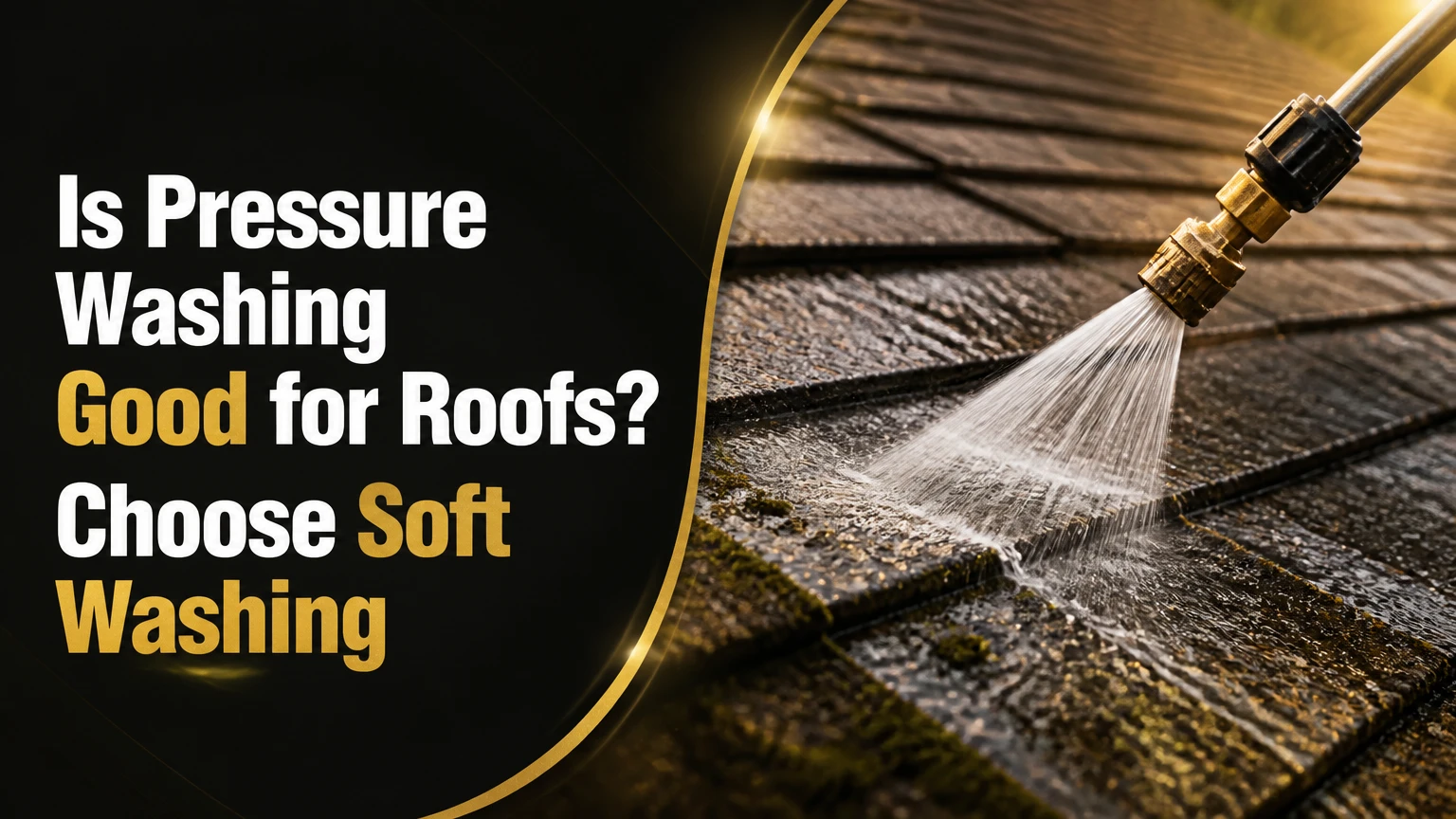
No, traditional high-pressure washing is not good for most residential roofs. High pressure can remove asphalt-shingle granules, damage tile finishes, strip metal coatings, and drive water beneath flashing or seams. Professional roof cleaning usually uses soft washing: a chemical treatment with water and low-pressure rinsing, generally below 500 PSI.
At a Glance
- High-pressure washing can permanently remove the mineral granules that protect asphalt shingles from ultraviolet radiation.
- Soft washing uses a controlled cleaning solution and low-pressure water, commonly below 500 PSI.
- Concrete, clay, and metal roofs have different risks, but no material makes careless pressure washing safe.
- Typical professional roof-cleaning prices range from $200-$1,500, depending on roof size, pitch, access, and growth.
- Moss requires more than cosmetic treatment because retained moisture can lift shingles and damage porous tiles.
- A contractor should identify the roof material, disclose the working pressure, explain chemical controls, and inspect for damage before cleaning.
Why Is High-Pressure Washing Harmful to Roofing?
High-pressure washing harms roofing by converting water into a mechanical cutting force that removes protective surfaces and pushes water into joints. Asphalt shingles are especially vulnerable because their mineral granules protect the asphalt mat from sun exposure, weathering, and impact.
The Asphalt Roofing Manufacturers Association, commonly called ARMA, advises against power washing asphalt shingles. ARMA’s homeowner guidance states, “Do not use a power washer on your roof,” because concentrated pressure can damage shingles and reduce service life. Manufacturer instructions should take priority over generic cleaning advice.
A standard pressure washer may produce 1,500-4,000 PSI. That force can loosen granules, expose asphalt, break brittle seal strips, and damage ridge caps. The visible result may be clean shingles, but the hidden result can be premature aging and leaks.
Pressure also travels beneath laps, flashing, and underlayment edges. A roof can remain dry during the first storm and leak later, after damaged sealant or lifted material allows repeated water entry.
What Is the Difference Between Pressure Washing and Soft Washing?
Pressure washing removes growth mainly through water force, while soft washing uses a cleaning solution to kill and loosen organic growth before a low-pressure rinse. Soft washing is usually the safer method for asphalt shingles and many painted or coated roof surfaces.
| Method | Typical pressure | Main cleaning action | Main roof risk |
|---|---|---|---|
| High-pressure washing | 1,500-4,000 PSI | Mechanical force | Granule loss, lifted shingles, forced water |
| Low-pressure rinsing | 100-500 PSI | Removal of loosened residue | Overspray, poor drainage, operator error |
| Soft washing | Under 500 PSI | Chemical treatment plus gentle rinse | Plant damage or staining if uncontrolled |
| Manual cleaning | 0 PSI | Scraping or brushing | Foot traffic, scraping, broken roofing |
Soft washing commonly combines water, sodium hypochlorite, and a surfactant. The surfactant helps the solution remain on sloped roofing instead of running off immediately. The chemical treatment breaks down algae, moss, and lichen at the surface and, in some cases, at the root structure.
Soft washing does not mean spraying an uncontrolled bleach mixture. A trained technician adjusts concentration, dwell time, weather conditions, runoff control, and rinsing procedures for the roof material.
Which Roof Materials Can Tolerate Pressure Washing?
No common roof material makes unrestricted pressure washing advisable. Asphalt shingles are the least tolerant, while concrete and clay tiles may withstand limited pressure under specific conditions. Metal roofing and commercial membranes have different failure modes that still make careless pressure dangerous.
| Roof material | Pressure tolerance | Common pressure damage | Preferred approach |
|---|---|---|---|
| Asphalt shingles | Low | Granule loss, seal failure, lifted tabs | Soft washing below 500 PSI |
| Concrete tile | Moderate physical strength | Finish loss, surface porosity, cracked tiles | Soft wash and manual removal |
| Clay tile | Moderate but brittle | Cracking, glaze damage, displaced tiles | Manufacturer-approved cleaning |
| Metal panels | Moderate surface strength | Dents, coating loss, seam intrusion | Low-pressure cleaning |
| EPDM membrane | Low at seams and edges | Punctures, seam damage, leaks | Manufacturer-approved low-pressure method |
| TPO membrane | Low at seams and welds | Cuts, tears, weld damage | Commercial roofing specialist |
Roof age changes the risk. Asphalt shingles become more brittle as asphalt dries and granules disappear, while older sealants and flashing can fail under water impact. A material inspection should come before a cleaning estimate.
How Much Pressure Is Safe for Roof Cleaning?
For asphalt shingles, the safest practical pressure is the lowest pressure that moves loosened residue, commonly below 500 PSI and often substantially lower. A garden-hose-level rinse may be adequate after chemical treatment because the solution, not the water force, performs most of the cleaning.
Pressure limits are not universal material standards. A stated PSI alone cannot prove that a roof-cleaning method is safe because nozzle angle, tip type, distance, flow rate, operator movement, and roof condition also determine impact.
| Situation | Typical working pressure | Practical qualification |
|---|---|---|
| Asphalt-shingle soft wash | 100-500 PSI | Use the lowest effective rinse |
| Loose debris on sound tile | 300-1,200 PSI | Confirm tile condition and manufacturer guidance |
| Metal roof cleaning | 100-500 PSI | Avoid seams, flashings, and painted damage |
| EPDM or TPO cleaning | 100-300 PSI | Follow membrane manufacturer instructions |
| Aggressive preparation before recoating | Project-specific | Use only when resurfacing requires it |
The 1,200-PSI figure sometimes cited for concrete or clay tile is an upper field limit for restricted debris removal, not a general recommendation. Wide fan tips, downward spray direction, safe footing, and a sound substrate are necessary conditions.
Can Pressure Washing Remove Black Stains, Moss, and Lichen?
Pressure washing can remove the visible layer of black stains, moss, and lichen, but force alone does not reliably eliminate the organisms or prevent regrowth. Soft washing is generally more effective for black algae, while thick rooted moss may require manual removal before chemical treatment.
Black streaks on asphalt shingles commonly involve the cyanobacterium Gloeocapsa magma. The streaks are often cosmetic at first, but aggressive blasting can create more damage than the algae itself. A properly applied sodium-hypochlorite solution can kill the growth, and rain can gradually remove the dead residue.
Moss behaves differently. Moss holds water against the roofing surface and can grow beneath shingle edges or between porous tiles. In freezing climates, retained water expands and contracts, increasing the risk of cracked tiles or lifted shingles.
Lichen attaches firmly and may leave a pale outline after treatment. Scraping too soon can remove granules or surface coating. A technician should allow the organism to die and weather away rather than treating a clean-looking surface as the only objective.
How Does Soft Washing Clean a Roof Without Pressure?
Soft washing cleans a roof by applying a controlled chemical solution, allowing dwell time, and using low-pressure water to remove loosened residue. The method relies on chemical action rather than a concentrated water jet.
A typical residential process follows these steps:
- Inspect the roof. The technician identifies the material, age, damage, pitch, drainage paths, and fragile areas.
- Protect nearby surfaces. Windows, siding, exterior fixtures, gutters, and sensitive landscaping receive covers or water protection.
- Pre-wet plants. Fresh water dilutes accidental overspray before the cleaning solution is applied.
- Apply the solution. Sodium hypochlorite, water, and a compatible surfactant are applied at a material-appropriate concentration.
- Allow dwell time. The solution remains active long enough to loosen algae, moss, or lichen without drying on the roof.
- Rinse gently. Low-pressure water carries away residue and prevents unnecessary surface impact.
- Rinse plants and inspect. Landscaping receives another fresh-water rinse, while the roof is checked for missed areas and damage.
The often-cited 1%-3% sodium-hypochlorite range is a typical practitioner range, not a universal recipe. Concentration should follow roof material, growth severity, temperature, wind, and product instructions.
Can Soft-Wash Chemicals Damage Plants or Gutters?
Yes, roof-cleaning chemicals can damage plants, painted surfaces, metals, and gutters when runoff or overspray is poorly controlled. Professional application reduces the risk through pre-wetting, shielding, runoff management, and thorough post-rinsing.
Sodium hypochlorite can bleach foliage and stress grass. Concentrated runoff can also discolor painted siding, corrode untreated metals, and affect fish or aquatic environments. Wind makes the risk higher because mist can travel beyond the roof edge.
A responsible contractor should explain the protection plan before starting. The plan should include downspout discharge control, plant pre-wetting, sensitive-plant coverage, controlled application, and post-treatment rinsing. Plants directly below a roof edge may need temporary relocation.
Gutters are not automatically protected by a soft wash. Chemical residue can remain inside clogged gutters, while strong runoff can affect aluminum finishes. Gutters should be checked for blockage before cleaning and flushed afterward when the roof-cleaning procedure requires it.
How Much Does Professional Roof Cleaning Cost?
Professional roof cleaning typically costs $200-$1,500 for a residential project. A small, accessible single-story roof with light algae may cost near the lower end, while a large, steep, tall, or heavily moss-covered roof can reach the upper end.
| Project condition | Typical price range | Main cost drivers |
|---|---|---|
| Small, low-slope roof | $200-$450 | Easy access, light algae |
| Average asphalt roof | $350-$800 | Roof size, pitch, treatment time |
| Large or steep roof | $700-$1,500 | Height, safety equipment, labor |
| Heavy moss or lichen | $600-$1,500 | Manual removal, repeat treatment |
| Commercial membrane roof | $1,000-$4,000+ | Surface area, access, membrane controls |
These are typical market ranges, not guaranteed prices. A contractor may price by roof square, square foot, labor hour, or project complexity. Roof squares measure 100 square feet, but estimates should also account for pitch and access.
A low bid may exclude plant protection, gutter rinsing, moss removal, or a second treatment. The written estimate should specify the method, pressure range, solution, included protection, cleanup, and damage exclusions.
How Long Does Roof Cleaning Take, and How Often Is It Needed?
Most residential roof cleaning takes 2-6 hours on site, while heavy moss, steep access, or large roofs can require a full day. Cleaning frequency commonly ranges from 2-5 years, but shade, humidity, tree cover, roof material, and local climate determine the interval.
| Condition | Typical on-site time | Likely maintenance interval |
|---|---|---|
| Light algae on a small roof | 2-3 hours | 3-5 years |
| Average asphalt roof | 3-5 hours | 2-4 years |
| Heavy moss or lichen | 5-8 hours | 1-3 years |
| Large tile roof | 5-10 hours | 3-5 years |
| Commercial membrane | Project-specific | Manufacturer schedule |
Dead algae may not disappear immediately. Black staining can fade over several weeks as weather removes treated residue, while moss can brown within days and detach gradually.
Homeowners should schedule cleaning before severe growth covers large roof areas. An annual visual inspection from the ground or attic can identify recurring shade, clogged gutters, lifted shingles, and new moss before cleaning becomes more complex.
Can Homeowners Clean a Roof Themselves?
Homeowners can clean limited roof areas from the ground or a properly positioned ladder, but climbing onto a wet or chemically treated roof creates a serious fall risk. Professional roof cleaning is safer for steep, tall, fragile, or heavily contaminated roofs.
A DIY approach should never involve a pressure washer on asphalt shingles. Homeowners should also avoid walking on brittle shingles, clay tiles, wet moss, and coated metal panels. A fall can occur before visible roof damage becomes the main problem.
Safer homeowner tasks include trimming branches, clearing ground-level debris, checking attic moisture, and photographing roof growth from the ground. A telescoping application tool may reduce climbing, but chemical exposure and runoff still require protective equipment and careful control.
If a homeowner uses a roof-cleaning product, the label must identify the compatible roof material and required dilution. Mixing bleach with acids, ammonia, or other cleaners can create dangerous gases. Electrical fixtures, pets, ponds, and neighboring property also require protection.
When Is Controlled Pressure Actually Appropriate?
Controlled pressure is appropriate in limited situations, including preparation for complete recoating or removal of deeply rooted moss from porous tile after manual loosening. Controlled pressure does not mean using a turbo nozzle or blasting an intact asphalt-shingle roof.
For interlocking moss on concrete tiles, technicians may first remove the bulk of the growth manually. A downward-angled, wide-fan rinse can then clear remaining roots from tile gaps before a chemical treatment. The technician must confirm that tiles are sound and that water cannot enter vulnerable joints.
Pressure can also be specified before repainting or resurfacing a metal or tile roof. The purpose is to remove failing paint, chalk, or old sealant so the new coating bonds to a prepared surface. That work is restoration preparation, not routine cleaning.
The roof owner should obtain the coating manufacturer’s preparation requirements in writing. A contractor who uses high pressure merely because it is faster is applying the wrong standard. The method must match the next roof system, not just the current appearance.
How Can You Tell Whether a Roof Needs Cleaning or Repair?
A roof needs repair rather than simple cleaning when it has missing or lifted shingles, exposed underlayment, cracked tiles, active leaks, widespread granule loss, rust-through, or damaged membrane seams. Cleaning cannot restore failed roofing components.
| Visible condition | Likely response | Reason |
|---|---|---|
| Uniform black streaks | Soft-wash assessment | Often algae without structural failure |
| Small moss patches | Moss treatment and inspection | Growth may hide lifted edges |
| Missing shingles | Roofing repair | Cleaning cannot replace roofing |
| Cracked or displaced tiles | Tile repair first | Water entry risk exists |
| Bare asphalt patches | Roof evaluation | Granule loss may be advanced |
| Rust holes in metal | Metal repair or replacement | Coating alone will not close holes |
| Membrane seam separation | Commercial roof repair | Washing may enlarge the leak |
An attic inspection can reveal active problems. Dark sheathing, damp insulation, daylight, or water trails justify repair investigation before any chemical application.
Cleaning contractors should photograph defects before starting. A clean roof can expose old damage, but cleaning should not be used to hide it from a buyer, insurer, or future roofer.
What Should You Ask a Roof-Cleaning Contractor?
Ask the contractor to identify the roof material, state the working PSI, name the cleaning solution, describe plant protection, and explain how the method affects the manufacturer warranty. A vague answer such as “we use safe pressure” is not enough.
Use this screening checklist:
- What exact roof material and condition do you see?
- What pressure will contact the roofing surface?
- Will you use a turbo nozzle or spinning tip?
- What sodium-hypochlorite concentration will you apply?
- How will you protect plants, siding, windows, and gutters?
- Who carries workers’ compensation and liability insurance?
- Will you provide before-and-after photographs?
- Does the estimate include moss removal and cleanup?
- What happens if rain arrives during treatment?
- Which manufacturer instructions support the proposed method?
A contractor who proposes 3,000 PSI on asphalt shingles should be rejected. The same concern applies to a contractor who cannot distinguish algae from moss or tile from an asphalt architectural shingle.
The estimate should separate cleaning from repairs. That separation prevents a pressure-washing crew from making unapproved roof alterations during the job.
What Happens If a Pressure Washer Damages the Roof?
Pressure-washer damage can appear as missing granules, cracked tiles, lifted shingle edges, stripped paint, exposed fasteners, dented panels, or leaks around seams and flashing. Some damage is immediately visible, while water intrusion may appear only after later storms.
Photograph the roof, gutters, ground debris, and affected areas as soon as possible. Granules collecting in gutters or downspout outlets may indicate excessive shingle abrasion, although normal aging can also produce granule loss.
Ask the contractor for an incident report and insurance information. A qualified roofer should inspect the roof independently, identify whether damage is new, and document the repair scope. Do not authorize a second cleaning or coating before the inspection.
Emergency steps depend on the defect. A temporary roof covering may limit water entry after a puncture, while cracked tiles or lifted shingles need prompt repair. Membrane seams and flashing require a commercial roofing specialist when the roof is EPDM or TPO.
Is Roof Cleaning Covered by a Warranty or Insurance?
Routine roof cleaning is usually treated as maintenance, while pressure damage may be excluded from a roofing warranty or covered by the contractor’s liability insurance. Exact coverage depends on the shingle or membrane manufacturer, policy language, and documented cause of damage.
Manufacturers commonly require owners to follow published maintenance instructions. ARMA recommends avoiding power washing on asphalt shingles, and individual manufacturers may specify approved cleaning agents, dilution limits, and application methods.
Homeowners should review the warranty before hiring a cleaner. The relevant documents include the roof product name, installation warranty, maintenance requirements, exclusions for algae or moss, and any requirement for an approved contractor.
Insurance generally does not pay for ordinary algae removal or preventable maintenance. A sudden covered event, such as storm damage, is a separate claim from deterioration caused by improper cleaning. Photographs, invoices, contractor insurance details, and inspection reports help establish the timeline if a dispute occurs.
The Bottom Line
Traditional high-pressure washing is not good for most residential roofs because it can remove granules, crack tiles, strip coatings, and force water beneath roofing joints. Soft washing below 500 PSI is usually the safer cleaning method for asphalt shingles and many other roof systems. Concrete and clay tiles may permit carefully controlled pressure after manual moss removal, while recoating preparation can require a specialized higher-pressure process. Roof material, condition, warranty requirements, and the contractor’s protection procedures should determine the method.