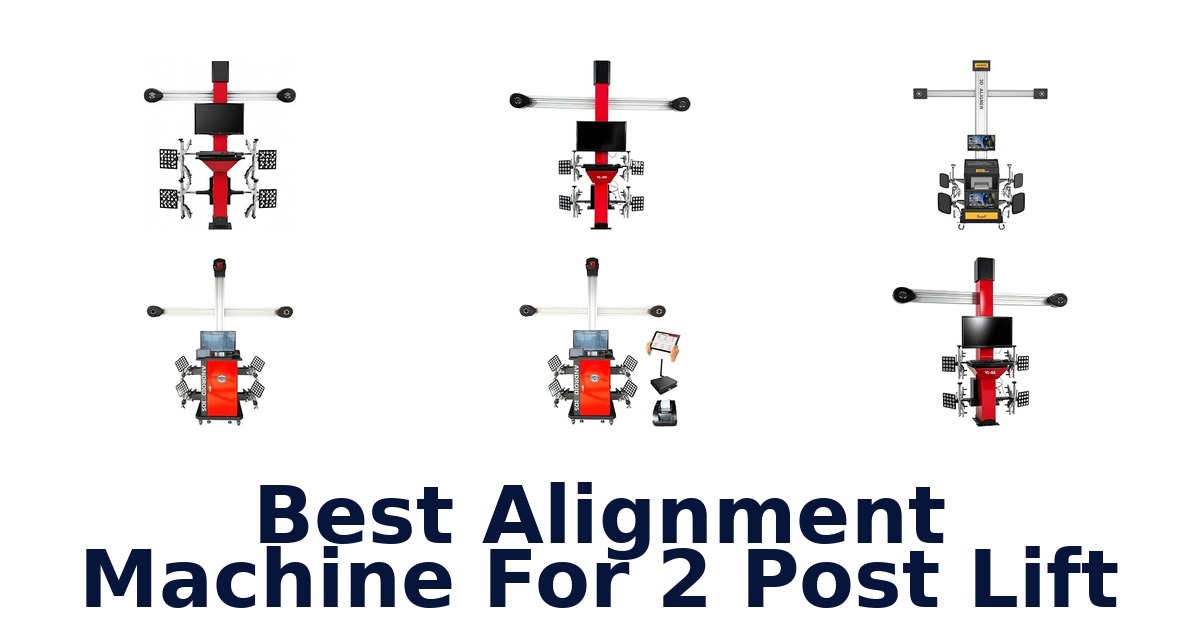
A strong choice for a two-post lift explicitly supports that lift type, provides a suitable working range, and gives technicians clear alignment readings; the CHERY INDUSTRIAL.COM AV9 Pro is the clearest match here. It is the only listed product whose supplied details specifically say it works with 2 post lifts, without additional modification. Other options add features such as 3D measurement, larger displays, printer integration, or stated measurement accuracy, but their listings do not establish two-post-lift compatibility.
Treat that distinction as essential: a detailed camera or screen specification does not confirm that a machine fits your lift setup. This roundup ranks the eight products by stated lift suitability first, then by the usefulness of their listed measurement specifications and included equipment.
Confirm the installation requirements with the seller before purchase.
The CHERY INDUSTRIAL.COM AV9 Pro leads because its product details explicitly state that it works with 2 post lifts without additional modification. It also offers 3D optical measurement, a stated 1500–3000 mm working distance, and an included tablet and 30-inch monitor. The other listed aligners describe measurement systems and screens, but the supplied information does not specifically confirm two-post-lift compatibility.
Verify the required lift geometry and installation details before choosing any system.
Our Top Picks
 Best Overall
Its listing explicitly confirms compatibility with 2 post lifts without modification, plus 3D cameras and a stated 1500–3000 mm working distance.
View on Amazon Mobile Display
The listing specifies iOS tablet and smartphone display support, 4-wheel optical positioning, and a 1500–3000 mm working distance, though lift fit is unconfirmed.
View on Amazon Large Display
It includes a 42-inch display and lift turntables, and states ±0.01° accuracy; its listing does not specify two-post-lift compatibility.
View on Amazon- Specified Accuracy EQCOTWEA 3D Aligner
- Dual-Screen Setup AUTOOL XC508
Compare the listed alignment systems and their stated features
| # | Product | Weight | Buy |
|---|---|---|---|
| 1 | 1. CHERY AV9 ProBest Overall | 52.9 lb | View on Amazon |
| 2 | 2. KATOOL KT-AV9 iOSMobile Display | — | View on Amazon |
| 3 |  3. KATOOL KT-AV9 AndroidAndroid-system alignment buyers | 256 lb | View on Amazon |
| 4 | 4. GIYI 3D Wheel AlignerLarge Display | 346 lb | View on Amazon |
| 5 |  5. EQCOTWEA 3D AlignerSpecified Accuracy | 350 lb | View on Amazon |
| 6 |  6. AUTOOL XC508Dual-Screen Setup | — | View on Amazon |
| 7 |  7. KATOOL KT-5DALive-imaging performance garages | 309 lb | View on Amazon |
| 8 |  8. HayWHNKN 3D AlignerReal-time camera measurement bays | 400 lb | View on Amazon |
Detailed Reviews: Best Alignment Machine For 2 Post Lift
#1 · Best Overall
1. CHERY AV9 Pro
- Weight: 52.9 lb
Best for: Flexible two-post lift shops.
Why it ranks #1: Its listing explicitly confirms compatibility with 2 post lifts without modification, plus 3D cameras and a stated 1500–3000 mm working distance.
Compatibility with both two-post and scissor lifts, without additional modification, is the AV9 Pro’s defining advantage. It lets a shop use its existing lift setup while adding automatic 3D, four-wheel alignment measurements, with Android and iOS tablet compatibility for viewing and operating the system.
The 3D optical cameras measure across a stated 1500–3000 mm working distance, giving the shop a defined range for positioning a vehicle. Four-wheel positioning supports a complete alignment workflow, while the included tablet, 30-inch monitor, mouse, keyboard, and printer provide display and input equipment with the machine. Because it works with two-post and scissor lifts without modification, it can suit garages using either lift type; check that the working distance fits the intended setup.
- Works with two-post and scissor lifts without additional modification
- Automatic 3D optical-camera measurement
- Four-wheel positioning
- Includes tablet, 30-inch monitor, mouse, keyboard, and printer
- The stated working distance is limited to 1500–3000 mm.
Skip it if you need measurements outside the stated 1500–3000 mm working distance; this system lists no range beyond it.
For garages using a two-post or scissor lift, the AV9 Pro combines lift flexibility with automatic four-wheel measurement and included display equipment. Choose it when the 1500–3000 mm working range suits your alignment bay.
Full product details
| Brand | CHERY INDUSTRIAL.COM |
|---|---|
| Color | red |
| Compatible with Vehicle Type | Car, Truck, SUV, Van, RV, Bus, UTV, ATV, Motorcycle, Trailer, Sport Utility Vehicle, Tractor |
| Included Components | AV9 Pro |
| Item Weight | 52.9 pounds |
| Manufacturer | CHERY INDUSTRIAL |
| Part Number | AV9 Pro |
| Manufacturer Warranty Description | One-year warranty |
| Material | steel |
| Model Number | AV9 |
Listed on Amazon as: AV9 Pro Wheel Alignment Machine Full Automatic 3D Mobile System Works with 2 Post and Scissor Lifts Android iOS Display Included
View on Amazon#2 · Mobile Display
2. KATOOL KT-AV9 iOS
Best for: Tablet-connected alignment bays.
Why it ranks #2: The listing specifies iOS tablet and smartphone display support, 4-wheel optical positioning, and a 1500–3000 mm working distance, though lift fit is unconfirmed.
The KATOOL KT-AV9 can display synchronized alignment readings on a PC, smartphone, or tablet, including Apple iOS-compatible devices. That flexibility lets a shop use mobile devices as display terminals while its Android-based 3D camera system measures four-wheel positioning within a stated 1500–3000 mm working distance.
KATOOL specifies a 5MP camera and four-wheel optical positioning, providing the imaging basis for the listed 3D measurement system. Synchronized readings across PC, smartphone, and tablet offer multiple display-terminal options, while iOS compatibility extends that choice to Apple devices. The effective working distance is 1500–3000 mm, and the usage tips specify keeping the machine within six feet of the target and maintaining a 5°–15° tilt angle. Those positioning requirements matter when setting up the alignment bay.
- Supports synchronized readings on PC, smartphone, and tablet
- Compatible with Apple iOS display devices
- Uses Android-based 3D camera measurement technology
- Four-wheel optical positioning system with a 5MP camera
- The machine must stay within six feet of the target and at a 5°–15° tilt angle.
Skip it if you cannot maintain the stated six-foot distance and 5°–15° tilt; the AV9 Pro listing instead specifies a 1500–3000 mm working range.
For shops that want tablet or smartphone display options, including iOS, the KT-AV9 pairs device flexibility with four-wheel optical positioning. Choose it only if the stated distance and tilt setup work for your bay.
Full product details
| Brand | KATOOL |
|---|---|
| Manufacturer | KATOOL |
| Part Number | AK-AV80 |
| Model | KT-AV9 |
Listed on Amazon as: KATOOL KT-AV9 3D Wheel Alignment Machine Android System, Automotive Tire Aligner with iOS Compatibility
View on Amazon#3
3. KATOOL KT-AV9 Android
- Weight: 256 lb
Best for: Android-system alignment buyers.
Why it ranks #3: This is a 3D Android-system aligner, but the supplied specifications give no lift-compatibility details or measurement range to confirm fit.
An Android system is the clearest stated feature of KATOOL’s KT-AV9 wheel alignment machine. For a buyer comparing 3D aligners specifically by platform and model, the product title identifies an automotive tire alignment tool, while its listed 256-pound weight gives a concrete consideration for shop placement.
The KT-AV9 is identified as an Android-system 3D wheel alignment machine, so its stated platform is central to evaluating whether it suits a shop’s preferred equipment workflow. Its 256-pound listed weight is relevant when planning where the machine will sit and how it will be handled during installation. The available product information does not provide measurement accuracy, display details, lift compatibility, or included accessories, so those capabilities cannot be assessed from the listed facts.
- Identified as a 3D wheel alignment machine
- Android system is specified in the title
- Listed for automotive tire alignment
- Product weight is specified as 256 pounds
- The supplied listing does not specify measurement accuracy or included accessories.
Skip it if you need documented measurement accuracy or a listed accessory package; this product information does not provide either.
The KATOOL KT-AV9 is for buyers seeking an Android-system 3D aligner and who can plan around its 256-pound listed weight. The supplied details leave accuracy, lift compatibility, and accessories unspecified.
Full product details
| Brand | KATOOL |
|---|---|
| Item Weight | 256 pounds |
| Item model number | KT-AV9 |
| Manufacturer | KATOOL |
| Part Number | no |
| Package Dimensions | 47 x 40 x 36 inches |
Listed on Amazon as: KATOOL KT-AV9 Android System 3D Wheel Alignment Machine Wheel Aligner Automotive Tire Alignment Tool
View on Amazon#4 · Large Display
4. GIYI 3D Wheel Aligner
- Weight: 346 lb
Best for: Push-through alignment workflow.
Why it ranks #4: It includes a 42-inch display and lift turntables, and states ±0.01° accuracy; its listing does not specify two-post-lift compatibility.
Automatic measurement after simply pushing the vehicle forward is the GIYI aligner’s key workflow feature. Its 3D system reports toe, camber, thrust angle, and setback, giving tire shops and repair bays a way to assess several alignment readings without manual calibration or a complex setup.
GIYI specifies ±0.01° accuracy for its 3D measurements, which cover total toe, camber, thrust angle, and setback; that range of readings helps technicians identify alignment issues associated with tire wear or vehicle pulling. The push-forward measurement process avoids manual calibration, simplifying the measurement step. Its package includes a 42-inch display, dedicated mouse and keyboard, brake pedal depressor, steering wheel holder, targets, cameras, turntables, and transition blocks for the listed alignment workflow.
- Measures total toe, camber, thrust angle, and setback
- Specified measurement accuracy of ±0.01°
- Measurement process requires pushing the vehicle forward, with no manual calibration
- Includes 42-inch display, cameras, targets, holders, and turntable equipment
- At 346 pounds, the listed machine is a substantial piece of shop equipment.
Skip it if you need a lighter listed machine; the KATOOL KT-AV9 weighs 256 pounds, compared with this unit’s 346 pounds.
For a tire shop or repair bay prioritizing push-forward measurement and a large 42-inch display, GIYI supplies a broad set of alignment equipment. Account for its 346-pound listed weight when planning placement.
Full product details
| Brand | GIYI |
|---|---|
| Item Weight | 346 pounds |
| Item model number | JZY-GIYI |
| Manufacturer | GIYI |
| Part Number | JZY001 |
| Model | GIYI-4 Wheel Alignment Machine |
| Package Dimensions | 114.25 x 13.7 x 11.8 inches |
Listed on Amazon as: 3D Wheel Alignment Machine with 42" Monitor, Dedicated Mouse and Keyboard, Wheel Aligner Automotive Tire Alignment Tool for Tire Shops & Auto Repair
View on Amazon#5 · Specified Accuracy
5. EQCOTWEA 3D Aligner
- Weight: 350 lb
Best for: Precision-focused 110V shops.
Why it ranks #5: Its listed 3D system measures toe, camber, caster, and kingpin to ±0.01°, but the supplied details do not confirm two-post-lift use.
Specified ±0.01° readings across toe, camber, caster, and kingpin set the EQCOTWEA aligner apart for shops seeking detailed 3D measurements. Its push-and-measure workflow also removes the need for calibration, linking those readings to a simpler measurement process for passenger-vehicle repair and tire service.
Industrial 3D cameras measure toe, camber, caster, and kingpin to the stated ±0.01° accuracy, giving technicians several alignment parameters to evaluate when investigating tire wear or steering pull. The push-forward process completes the measurement cycle without calibration, reducing setup steps in the listed workflow. The 24-inch screen provides a specified display size, and the included accessory kit and English manual provide equipment and documentation for getting started. The machine is listed as 350 pounds.
- Specified ±0.01° accuracy for toe, camber, caster, and kingpin
- Push-forward measurement requires no calibration
- 24-inch screen
- Includes an accessory kit and English manual
- The listed machine weighs 350 pounds.
Skip it if you need a lighter machine to place or reposition; the KATOOL KT-AV9 is listed at 256 pounds, versus this unit’s 350 pounds.
The EQCOTWEA suits passenger-vehicle repair shops and tire services that value four-parameter 3D readings and a no-calibration measurement process. Its 350-pound weight is a relevant consideration when planning placement.
Full product details
| Brand | EQCOTWEA |
|---|---|
| Included Components | Accessory Kit *1, English Manual |
| Dimensions | 108.2"L x 21.6"W x 100"H |
| Item Weight | 350 pounds |
| Manufacturer | EQCOTWEA |
| Part Number | T057070 |
| Model Number | T057070 |
| Screen Size | 24 inches |
Listed on Amazon as: 3D Wheel Alignment Machine Professional Wheel Aligner 110V
View on Amazon#6 · Dual-Screen Setup
6. AUTOOL XC508
Best for: Report-ready multi-screen shops.
Why it ranks #6: Two 20-inch screens and a built-in thermal printer support workflow and reporting, while the supplied facts do not establish lift compatibility.
Two interactive 20-inch screens, including a movable auxiliary display, let technicians view information and operate the AUTOOL system at the same time. That split-screen workflow is especially relevant in busy alignment bays, while the built-in thermal printer can produce reports directly after testing.
The fixed main screen and flexible auxiliary screen support simultaneous viewing and operation, which can keep alignment information visible while a technician works. AUTOOL also lists a built-in high-speed thermal printer for producing reports without separate printing equipment, useful for customer presentation and record keeping. Its mobile cabinet beam allows alignment work from different angles without a dedicated alignment station, offering more flexibility in how the machine is positioned within a workshop.
- Two 20-inch HD interactive screens, including a movable auxiliary screen
- Built-in thermal printer for alignment reports
- Mobile cabinet beam allows work from different angles
- Expert-mode software is described as time-saving to operate
- The listed system uses a 110V power supply.
Skip it if you require a machine specified for a different power supply; this AUTOOL listing specifies 110V.
AUTOOL suits workshops that want dual-screen operation, printed test reports, and a mobile cabinet beam rather than a dedicated alignment station. Its listed 110V supply is an important boundary for choosing a bay.
Full product details
| Brand | AUTOOL |
|---|---|
| Item model number | XC508 |
| Manufacturer | AUTOOL |
| Part Number | XC508 |
| Model | Wheel Alignment Machine |
Listed on Amazon as: AUTOOL 3D Wheel Aligner, Professional Automotive Wheel Alignment Machine with Dual 20" HD Screens,Built-in Printer, 80,000+ Vehicle Database,Voice Guidance,110V Garage Equipment
View on Amazon#7
7. KATOOL KT-5DA
- Weight: 309 lb
Best for: Live-imaging performance garages.
Why it ranks #7: Its listing describes five-axis real-time imaging for passenger vehicles and light trucks, but provides no stated lift fit or numeric accuracy.
KATOOL’s five-axis real-time imaging is the defining feature of the KT-5DA, with on-screen imaging that mirrors each turn of the wrench. That live feedback is intended to give technicians immediate visual information during adjustments, making this model relevant to performance garages and automotive shops.
The five-axis alignment system is presented for passenger vehicles and light trucks, establishing the vehicle scope stated for this model. Its real-time imaging mirrors wrench turns on screen, helping technicians see adjustment changes as they work instead of relying only on a later view. KATOOL also describes high-definition cameras and faster setup with clearer data, linking the imaging system to an adjustment workflow. The listed weight is 309 pounds, a practical placement consideration for a shop.
- Five-axis alignment system
- Real-time imaging mirrors wrench turns on screen
- High-definition cameras are specified
- Stated fit includes passenger vehicles and light trucks
- The stated vehicle scope is passenger vehicles and light trucks.
Skip it if you service vehicles beyond passenger vehicles and light trucks; the AUTOOL XC508 listing instead names cars, trucks, SUVs, vans, RVs, buses, and other vehicle types.
For automotive shops and performance garages working on passenger vehicles or light trucks, the KT-5DA offers live visual feedback during adjustments. Its stated vehicle scope and 309-pound weight should fit the shop’s needs.
Full product details
| Brand | KATOOL |
|---|---|
| Item Weight | 309 pounds |
| Item model number | KT-5DA |
| Manufacturer | KATOOL |
| Part Number | KT-5DA |
| Model | KT-5DA |
| Package Dimensions | 48 x 41 x 28 inches |
Listed on Amazon as: KATOOL KTOOL 3D Wheel Aligner – 5D Real-Time Imaging System, Tire Alignment Tool Heavy-Duty Wheel Alignment Machine for Automotive Shops and Performance Garages KT-5DA
View on Amazon#8
8. HayWHNKN 3D Aligner
- Weight: 400 lb
Best for: Real-time camera measurement bays.
Why it ranks #8: The 24-inch monitor and 3D measurement features are listed, but no supplied detail confirms two-post-lift compatibility or a working distance.
Automatic wheel-position recognition and real-time 3D imaging are the HayWHNKN aligner’s main workflow features. Its cameras, sensors, and software analyze camber, toe, and other alignment data, giving technicians an automated way to monitor measurements while working in a 110V shop.
High-precision cameras and sensors recognize wheel positions automatically, while software analyzes camber, toe, and other alignment data in real time. That pairing supports ongoing measurement and adjustment rather than requiring technicians to rely only on a static reading. The machine is listed with a 24-inch monitor and 110V power, which give buyers concrete display and electrical requirements to plan around. At 400 pounds, its listed weight also makes shop placement an important part of selecting a location.
- 3D imaging monitors alignment parameters in real time
- Automatic wheel-position recognition using cameras and sensors
- Software analyzes camber, toe, and other data
- Listed with a 24-inch monitor and 110V power
- The listed machine weighs 400 pounds.
Skip it if you need a lighter listed machine; the EQCOTWEA 3D Wheel Alignment Machine is listed at 350 pounds, compared with this unit’s 400 pounds.
This HayWHNKN model fits a 110V alignment bay seeking real-time imaging, automatic wheel recognition, and a 24-inch monitor. Its 400-pound listed weight makes a planned installation location especially relevant.
Full product details
| Brand | HayWHNKN |
|---|---|
| Item Weight | 400 pounds |
| Item model number | SFS057070 |
| Manufacturer | HayWHNKN |
| Part Number | SFS057070 |
| Dimensions | 108.2 x 21.6 x 100 inches |
Listed on Amazon as: 3D Wheel Alignment Machine with 24" Monitor 110V
View on AmazonCheck lift geometry before relying on compatibility claims
A stated lift-compatible label is not a substitute for checking the geometry of your actual lift and alignment bay. The AV9 Pro listing explicitly names two-post lifts, while the other products’ supplied details do not confirm that use; this does not prove they cannot work, but it leaves a crucial fit question unanswered. Before ordering, ask the seller which lift configurations are supported and whether the system needs a particular target position, vehicle height, or unobstructed camera line of sight.
Compare those answers with your lift’s arms, columns, and the vehicle positions used during alignment. The AV9 Pro’s listed 1500–3000 mm measurement distance is useful context, but it should not be treated as a complete installation drawing.
Obtain the required clearances and setup instructions for the exact model and lift combination. This avoids confusing general 3D alignment capability with verified suitability for a particular two-post installation.
No-calibration claims still need setup confirmation
A push-and-measure description does not establish that every shop setup can skip all preparation or checks. GIYI and EQCOTWEA describe measurement without manual calibration, and both list ±0.01° accuracy; those claims are specific to their products, not proof that mounting, target placement, or the surrounding installation needs no attention. Before buying, clarify what the no-calibration process includes, how the system handles a changed lift position, and whether targets or turntables must be positioned in a prescribed way.
This matters especially when adapting an aligner to a two-post lift, because the supplied product details do not give a shared lift-installation standard. The AV9 Pro provides the most direct compatibility statement, but its listed working range alone does not answer every setup question.
Ask the manufacturer or seller for model-specific operating instructions and confirm that the intended measurement workflow matches your lift and vehicle service process.
How to Choose an Aligner for a Two-Post Lift
Explicit lift compatibility
Look first for an explicit statement that the aligner works with your lift type, rather than assuming any 3D system will fit. The CHERY AV9 Pro is the only product here whose supplied details specifically confirm use with 2 post lifts without additional modification; it also names scissor lifts. The KATOOL AV9 listings describe optical systems and, for the iOS version, a 1500–3000 mm working distance, but do not state two-post compatibility.
The remaining listings likewise leave that question unanswered. Buyers who need a documented match should favour the AV9 Pro and still confirm their exact lift arrangement with the seller.
If considering another model, get written confirmation for the intended lift before purchase.
Measurement information and range
Choose measurement details that match the alignment work you plan to do, and distinguish stated accuracy from a general 3D feature claim. GIYI and EQCOTWEA each list ±0.01° accuracy; EQCOTWEA names toe, camber, caster, and kingpin, while GIYI names total toe, camber, thrust angle, and setback. The CHERY AV9 Pro specifies a 1500–3000 mm working distance but does not provide a numeric accuracy in the supplied details.
KATOOL’s iOS-compatible AV9 also states the 1500–3000 mm range. Buyers prioritizing a published accuracy figure may prefer GIYI or EQCOTWEA, whereas those prioritizing the clearest stated lift fit should start with the CHERY model and verify measurement needs.
Display and reporting workflow
Select a display and reporting setup that suits where technicians work and how your shop presents results. GIYI includes a 42-inch display, while EQCOTWEA lists a 24-inch screen; AUTOOL provides two 20-inch screens and a built-in thermal printer. The CHERY AV9 Pro lists a 30-inch monitor alongside a tablet, and the KATOOL iOS AV9 supports tablets and smartphones as display terminals.
These configurations serve different workflows: a larger fixed screen may help when viewing from a distance, while movable or mobile displays can offer placement flexibility. For printed reports, AUTOOL’s integrated printer is the clearest stated option.
Buyers should weigh those conveniences only after confirming the machine fits their lift and installation.
Which aligner should you choose for your lift?
Choose the CHERY AV9 Pro if explicit two-post-lift compatibility is the deciding requirement: it is the only listing that confirms that fit without additional modification. If you want iOS or smartphone display options and can independently verify lift suitability, consider the KATOOL KT-AV9 iOS, which lists a 1500–3000 mm working distance. For a stated ±0.01° measurement figure, compare the GIYI 3D Wheel Aligner and EQCOTWEA 3D Aligner, but ask each seller to confirm two-post installation.
Choose the AUTOOL XC508 if dual 20-inch screens and a built-in printer fit your reporting workflow. The KATOOL KT-AV9 Android, KT-5DA, and HayWHNKN listings provide less supplied evidence for this specific lift use; confirm compatibility before selecting them.
Related Buying Guides
Frequently Asked Questions
What measurements should I take on my lift before ordering a wheel aligner?
Measure the lift’s usable runway dimensions, spacing, height range, and available clearance around the vehicle and alignment equipment. Note whether it is a two-post or scissor lift, and record any adapters or obstructions. Give these details to the seller and ask them to confirm that the specific system can be installed and used safely.
Can a 3D alignment system be used on a two-post lift without dedicated alignment runways?
It depends on the system and lift setup; do not assume that every 3D aligner works without dedicated runways. The AV9 Pro listing explicitly says it works with two-post lifts without additional modification. For the other listed systems, ask the seller to confirm compatibility with your lift geometry and whether any runway or installation changes are needed.
What installation, calibration, and software support should I confirm with the seller?
Confirm who handles installation, what lift and site details are required, and whether calibration is included or must be arranged separately. Ask how software updates and technical support are provided, and whether the included display or operating system is supported. Get the answers for the exact model and your intended two-post-lift configuration before ordering.
How should I compare the measurement figures listed for different aligners?
Ask sellers to explain what each stated measurement figure represents, how it is obtained, and whether it applies to your setup. The GIYI 3D Wheel Aligner and EQCOTWEA 3D Aligner list a ±0.01° figure, but that alone does not confirm two-post compatibility. Verify both the measurement claim and installation suitability directly.
Which display or reporting features should I prioritize?
Choose features that fit your technicians’ workflow. The listed options include a tablet and 30-inch monitor, a 42-inch monitor, dual 20-inch screens with a built-in printer, and Android or iOS display compatibility. Confirm exactly what is included with the model you select, and check that its display setup suits your shop.
Final Words
If confirmed two-post compatibility is essential, the AV9 Pro is the clearest choice because its listing explicitly says it works with two-post lifts without additional modification. Otherwise, compare display and workflow features, such as iOS compatibility, dual screens, or a built-in printer, while treating lift fit as unconfirmed. Before ordering, give the seller your lift measurements and get installation and calibration requirements confirmed for the exact system.