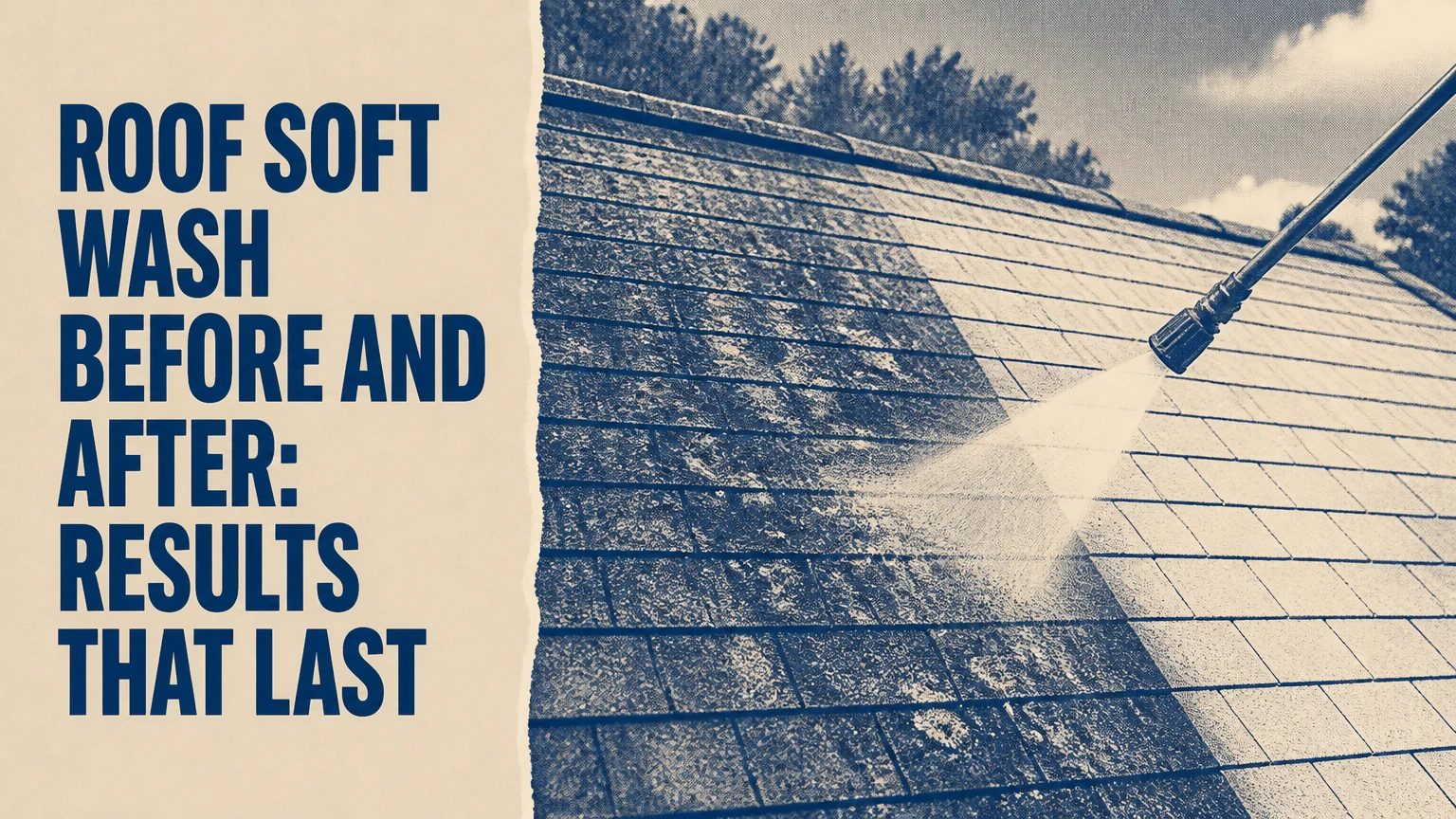
Roof soft wash before and after results usually show black algae streaks, moss, and lichen disappearing without the granule loss associated with high-pressure cleaning. Roof soft washing applies a roof-compatible biocidal solution at low delivery pressure, allowing chemistry and dwell time to remove biological growth. The roof may look better immediately, although some dead moss or lichen can take weeks to weather away.
Key Facts at a Glance
- Roof soft washing removes biological staining through chemical treatment rather than abrasive blasting.
- Typical residential roof cleaning costs about $300-$950, or approximately $0.20-$0.60 per square foot.
- A professional treatment commonly takes 2-5 hours, including setup, application, rinsing, and cleanup.
- Black algae often improves immediately, while thick moss and lichen may need gradual weathering or a second treatment.
- Asphalt shingle manufacturers generally prefer non-pressure cleaning, but warranty requirements vary by manufacturer and product.
- Plant protection, runoff control, weather conditions, and chemical selection determine safety more than the word “soft” alone.
What Roof Soft Washing Changes
Roof soft washing is a low-pressure cleaning method that uses a targeted chemical solution to kill or deactivate algae, moss, lichen, and other organic growth on roofing. The pump pressure is commonly comparable to a garden hose or kept below roughly 300 PSI, but the exact pressure depends on the equipment, nozzle, roof material, and contractor.
The important distinction is mechanism. Pressure washing relies primarily on force to dislodge contamination, while soft washing relies on a surfactant and biocide to break down or kill contamination with limited mechanical impact. “Low pressure” does not automatically mean safe if the chemical is misapplied, overspray is uncontrolled, or a worker walks on fragile shingles.
Why black streaks form
Black streaks on many asphalt shingles are commonly associated with the cyanobacterium Gloeocapsa magma. The organism can spread across shingle fields and create a dark, uneven appearance, especially on roof slopes that receive limited sunlight or remain damp beneath tree cover.
Moss and lichen behave differently. Moss holds moisture and can lift shingle edges, while lichen attaches more firmly and may leave pale or bare-looking patches after treatment. A chemical wash kills the organisms, but it cannot restore missing granules, repair cracked tiles, or reverse structural deterioration.
What soft washing cannot do
Soft washing is a cleaning and treatment service, not a roof restoration system. It cannot correct leaks, replace damaged flashing, repair rotten decking, restore eroded asphalt, or return a roof beyond its serviceable condition to a new-roof appearance.
A roof with severe granule loss may look cleaner after treatment but still require replacement. That distinction matters when a before-and-after photograph is used to judge the roof’s condition.
What Results Should You Expect?
A roof soft wash before and after comparison should evaluate color, biological growth, remaining material damage, and drainage rather than color alone. Black algae staining may fade during the application, but thick moss can remain visible as dead, brown material until rain and natural weathering remove it over several weeks.
The best immediate result occurs on lightly to moderately stained asphalt shingles, concrete tiles, and compatible metal roofing. Heavy lichen, embedded dirt, rust, efflorescence, and deteriorated coatings require separate expectations because a biocide does not dissolve every roof contaminant.
Before-and-after indicators
| Condition | Before treatment | Typical after treatment | Expected timing |
|---|---|---|---|
| Black algae | Dark vertical streaks | Gray or roof-colored surface | Immediate to several days |
| Light moss | Green, soft surface growth | Brown, inactive growth | Immediate death, 1-4 weeks to weather |
| Heavy moss | Thick mats lifting shingle edges | Dead clumps with exposed roof beneath | 2-8 weeks, sometimes staged removal |
| Lichen | White, gray, or yellow crusts | Inactive patches or faint attachment marks | Several weeks to months |
| Dirt and pollen | Brown or dusty film | Cleaner roof surface | Same day after rinsing or rainfall |
| Missing granules | Exposed asphalt or bald areas | Damage remains visible | Not repairable through washing |
A clean roof is not necessarily an undamaged roof. Before-and-after photographs should be taken from the same position, at a similar angle, and under comparable lighting because wet shingles can appear darker and dramatic sunlight can exaggerate color differences.
Does every stain disappear immediately?
No. Black algae often responds fastest, while mature lichen and moss may leave a temporary outline after the organisms die. Scraping or aggressive brushing to force an instant photograph can remove granules and create more damage than the original growth.
A useful professional checkpoint is biological inactivity, not perfect color uniformity. If the growth no longer feels alive, spreads, or remains green after appropriate dwell time, the treatment may be working even when residual marks remain.
How Professionals Perform the Work
Professional roof soft washing usually takes 2-5 hours for an average single-family home, although steep roofs, multiple roof levels, heavy moss, restricted access, and extensive landscaping can extend the appointment. The sequence below prioritizes roof inspection, controlled application, and property protection.
Step 1: Inspect the roof and property
The technician checks roof age, pitch, material, brittle areas, missing shingles, exposed underlayment, cracked tiles, corroded flashing, skylights, gutters, downspouts, and nearby electrical equipment. A roof with active leaks or unsafe decking should be repaired or replaced before cleaning.
Ground preparation includes moving furniture, covering sensitive objects, identifying ornamental plants, and locating storm drains, ponds, wells, and rainwater collection tanks.
Step 2: Protect plants, walls, and drainage
Plants should be thoroughly pre-wetted with clean water before chemical application. Professionals then control overspray, keep solution away from windows and painted surfaces, and rinse vegetation during the work and again after the roof is treated.
Downspouts require special attention. Chemical runoff can enter garden beds, ponds, storm drains, or rain barrels unless downspouts are temporarily redirected, disconnected where appropriate, or routed into a controlled collection area.
Step 3: Select and mix the treatment
The roof material and biological load determine the solution. Sodium hypochlorite is common for rapid algae and organic-growth treatment, while oxygen-based or proprietary biocides may suit properties where runoff sensitivity limits chlorine use.
There is no universal safe mixing ratio for every roof. Concentration depends on the product label, active ingredient, roof contamination, local regulation, application equipment, and manufacturer instructions. A contractor who quotes one fixed ratio for asphalt, slate, tile, and metal has skipped an important assessment.
Step 4: Apply with controlled pressure
The operator applies an even coat from a stable position, often using a ground-based or low-access method rather than walking across wet shingles. Delivery pressure should be sufficient to place the solution but not to scour granules, force water beneath laps, or damage tile surfaces.
Dwell time commonly falls around 10-30 minutes, but the product label and drying rate control the actual interval. The technician should prevent the solution from drying on windows, siding, metal trim, and sensitive vegetation.
Step 5: Rinse or allow controlled weathering
Some treatments are rinsed gently after the organic material is inactive. Other products are designed to remain and weather away through rainfall. The correct approach depends on the product label, roof material, runoff controls, and the amount of dead growth remaining.
High-pressure rinsing defeats the purpose of soft washing. Low-pressure rinsing should remove loose residue without driving water beneath shingles or stripping surface granules.
Step 6: Complete cleanup and document the result
The crew rinses plants, walls, windows, gutters, walkways, and equipment. They inspect for chemical residue, record any pre-existing damage, and photograph the completed roof from matching viewpoints.
A credible invoice identifies the roof material, treatment used, areas cleaned, exclusions, runoff precautions, and any recommended follow-up. A vague promise of a “lifetime clean roof” is not a substitute for documented work.
Which Roof Materials Can Be Soft Washed?
Asphalt shingles, concrete tiles, clay tiles, and many painted metal roofs can often receive a soft-wash treatment, but each material has different limits. Slate, wood shingles, aged coatings, and specialty membranes require manufacturer or specialist guidance because chemical compatibility and foot traffic risks vary.
| Roof material | Common contamination | Main risk | Practical approach |
|---|---|---|---|
| Asphalt shingle | Algae, moss, lichen | Granule loss, brittle tabs | Non-pressure chemical treatment |
| Concrete tile | Algae, moss, dirt | Cracked tiles, surface erosion | Low-pressure application and careful access |
| Clay tile | Algae, lichen, dust | Breakage from foot traffic | Treat from safe access points |
| Painted metal | Algae, pollen, oxidation | Coating damage, corrosion | Product-compatible cleaner and thorough rinse |
| Slate | Moss, lichen, organic debris | Splitting and slipped slates | Slate specialist assessment |
| Wood shingle | Moss, algae, mildew | Fiber damage and excessive wetting | Manufacturer-approved treatment only |
Are asphalt shingles safe to soft wash?
Asphalt shingles are often safer to clean with a non-pressure method than with high-pressure washing, provided the chemical, application, and runoff controls are appropriate. The Asphalt Roofing Manufacturers Association states that it “recommends the use of a non-pressure cleaning method” for algae stains on asphalt roofing.
That recommendation does not mean every chemical or contractor is automatically compliant. GAF, CertainTeed, Owens Corning, and other manufacturers publish product-specific care instructions, and warranty language can differ by shingle line. Obtain the roof manufacturer’s cleaning guidance before authorizing treatment, especially on a newer roof.
Which Cleaning Chemistry Fits the Roof?
Sodium hypochlorite usually produces the fastest visible change on black algae and organic growth, while sodium percarbonate and lower-impact biocides can reduce chlorine exposure but may act more slowly. The right chemistry is the least aggressive product that can achieve biological control without harming the roof, landscaping, or drainage system.
| Chemistry | Typical visible response | Main advantage | Main limitation |
|---|---|---|---|
| Sodium hypochlorite blend | Minutes to several hours | Fast algae and moss kill | Plant, metal, and runoff risk |
| Sodium percarbonate | Hours to days | Oxygen-based and lower odor | Slower on deep staining |
| Quaternary ammonium biocide | Days to weeks | Residual biological control | Slow cosmetic improvement |
| Manufacturer-approved cleaner | Product-specific | Compatibility documentation | May cost more or require specialist use |
Sodium hypochlorite can corrode untreated metals, discolor fabrics, injure plants, and damage nearby surfaces when concentration or exposure is excessive. Surfactants help the solution cling to a pitched roof, but more surfactant is not automatically better because residue and runoff can increase.
A safer specification asks for the product name, active ingredient, intended roof material, application method, dwell time, and disposal procedure. “Eco-friendly” is too vague to evaluate without an ingredient or safety data sheet.
Is Soft Washing Safer Than Pressure Washing?
Soft washing is generally safer for asphalt shingles and fragile roof surfaces because it reduces mechanical force, but pressure washing is not automatically dangerous for every roofing material or application. The decisive factors are pressure at the roof, nozzle distance, operator control, material condition, and manufacturer instructions.
| Decision factor | Soft washing | Pressure washing |
|---|---|---|
| Primary action | Chemical treatment | Mechanical impact |
| Typical roof delivery | Under 300 PSI, often lower | Commonly 1,500-4,000 PSI at equipment level |
| Asphalt shingle risk | Chemical and runoff damage | Granule loss and water intrusion |
| Moss removal | Kills growth, weathering may follow | Rapid physical removal, regrowth can persist |
| Suitable warranty position | Often aligns with non-pressure guidance | Frequently excluded for asphalt shingles |
| Best use case | Organic staining on compatible roofing | Hard-surface cleaning where the manufacturer permits it |
The claim that pressure washing voids every roof warranty is too broad. Many asphalt shingle manufacturers warn against pressure washing, but the governing document is the warranty and care instruction for the specific product.
Pressure can also make a roof look excellent for one afternoon while leaving biological material in pores and seams. Soft washing may look less complete at first when dead moss must weather naturally, but it usually applies less abrasive force.
How Much Does Roof Soft Washing Cost?
Typical residential roof soft washing costs $300-$950, with many contractors quoting approximately $0.20-$0.60 per square foot. The final price depends on roof area, pitch, stories, material, growth severity, access, landscaping, runoff handling, and whether gutters or minor debris removal are included.
| Project condition | Typical price range | Typical duration | Primary cost driver |
|---|---|---|---|
| Small, low-pitch roof | $300-$500 | 2-3 hours | Minimum service charge |
| Average one-story roof | $450-$750 | 2-4 hours | Area and access |
| Large or steep roof | $700-$1,200+ | 4-6 hours | Safety setup and labor |
| Heavy moss or lichen | Add $100-$400 | Add 1-3 hours | Staged treatment and debris |
| Sensitive landscaping | Add $100-$300 | Add 30-90 minutes | Protection and runoff control |
These are typical planning ranges, not a guaranteed local quote. A roof inspection can change the scope when the contractor finds brittle shingles, unsafe decking, difficult hose access, or extensive plant protection requirements.
Cleaning should not be priced in isolation from roof age. Spending $600 to clean a roof with active leaks and widespread granule loss may delay a necessary replacement without solving the underlying problem.
How Long Do Results Last?
A roof soft-wash treatment commonly remains visibly effective for about 2-5 years, although shaded, humid roofs beneath dense tree cover may need attention sooner. Sun exposure, rainfall, roof orientation, local spores, nearby vegetation, and the type of treatment determine the interval.
No responsible contractor can guarantee a fixed number of years for every property. A biocide may kill existing growth, but airborne spores, leaf debris, and persistent moisture can recolonize the surface.
Pruning branches, cleaning gutters, improving roof ventilation, and correcting recurring moisture sources can extend the clean appearance. Zinc or copper strips may reduce regrowth in some situations, but they are not a substitute for proper installation, compatible flashing, or treatment of existing colonies.
Weather, Runoff, and Timing
Soft washing should occur during a calm, dry weather window that allows the solution to remain on the roof for its specified dwell time and prevents overspray. Wind, extreme heat, freezing conditions, and immediate heavy rain can reduce treatment control or increase runoff.
| Weather condition | Operational concern | Better decision |
|---|---|---|
| Wind above roughly 10-15 mph | Chemical drift to plants and siding | Postpone or use a protected window |
| Rain within 1-2 hours | Dilution and uncontrolled runoff | Follow product label, usually postpone |
| High heat and direct sun | Rapid drying on shingles | Treat cooler shaded sections first |
| Freezing temperatures | Ice risk and poor chemical action | Reschedule |
| Calm, overcast conditions | More controlled dwell time | Often preferred |
Rain after treatment is not inherently harmful, but the first runoff can carry chemical residue and dead organic material. Properties with rain barrels, koi ponds, wells, or sensitive gardens require a written runoff plan before work begins.
What Can Go Wrong?
The most common roof soft-washing failures involve excessive chemical strength, uncontrolled runoff, inadequate inspection, and pressure that is too high for the roof. Corrective action depends on the failure, and some damage, such as granule loss or plant injury, cannot be reversed by another cleaning.
- Streaks remain after drying: The growth may be inactive but deeply stained, or the dwell time was inadequate. Request a documented spot treatment rather than an aggressive full-roof rinse.
- Moss remains green: The solution did not fully contact the growth, or rain diluted it too soon. Do not scrape wet shingles; arrange a controlled re-treatment.
- White residue appears: Salt or cleaner residue may remain on the surface. A gentle water rinse can remove it, but persistent residue should be evaluated against the product label.
- Plants turn yellow or brown: Chemical drift or runoff may have caused injury. Flush foliage and soil with clean water promptly, then consult a horticulturist for severe damage.
- Metal flashes or gutters corrode: Chemical exposure was excessive or surfaces were not rinsed. Photograph the condition and notify the contractor quickly.
- Shingles lose granules: Excessive pressure, foot traffic, age, or pre-existing deterioration may be responsible. Compare inspection photographs before assigning cause.
- Leaks appear afterward: Cleaning may have exposed an existing defect or displaced a fragile component. Stop interior water damage and obtain a roofer’s inspection.
One practitioner rule matters here: never judge a roof solely by the dramatic first rinse. A roof can be visually clean while retaining structural defects, and a roof can look incomplete while biological growth is already dead.
Should You Do It Yourself?
DIY roof soft washing is reasonable only for a low-risk, low-pitch property where the operator can work from the ground or a properly secured access system without walking on wet roofing. Steep roofs, two-story access, fragile materials, chemical exposure, overhead wires, and extensive landscaping make professional service the safer choice.
A DIY operator still needs chemical-resistant gloves, eye protection, protective clothing, a suitable low-pressure sprayer, clean-water hoses, runoff controls, and a product label that names the roof material. Never mix bleach products with acids, ammonia, or other cleaners because toxic gases can form.
Do not improvise from a ladder while leaning sideways, climb onto wet shingles, or use a pressure washer as a substitute for a soft-wash pump. Fall injuries and chemical burns are higher-consequence risks than a disappointing cosmetic result.
How to vet a contractor
Ask the contractor to provide:
- Roof-material-specific cleaning instructions.
- The active ingredient and safety data sheet.
- The planned pressure or application method.
- Plant, window, metal, and runoff protection procedures.
- Before-treatment photographs documenting existing damage.
- A written scope that separates cleaning from repairs.
- Proof of liability insurance and worker coverage.
- Warranty language that does not promise impossible results.
A contractor who refuses to identify the chemical or insists that high pressure is necessary for asphalt shingles should not receive the work without further verification.
FAQ
Will soft washing remove all black streaks from a roof?
Soft washing often removes or lightens black algae streaks, but permanent discoloration can remain after the organism dies. Weathering, roof age, embedded deposits, and previous granule loss affect the final appearance. A treatment that leaves faint marks can still succeed biologically, so color alone should not determine whether another application is needed.
Can roof soft washing damage gutters?
Roof soft washing can damage gutters, fasteners, downspouts, and flashing if concentrated chemical solution remains on metal surfaces. Professional crews protect or rinse those components during application. Aluminum, galvanized steel, copper, and painted metals have different tolerances, so the contractor should identify the metal and specify the rinse procedure.
Should moss be removed before or after treatment?
Moss should generally be chemically treated before any remaining dead material is removed. Pulling or scraping live moss from asphalt shingles can dislodge granules and lift shingle edges. After treatment, loose dead growth can weather away or be removed gently when the roof and manufacturer guidance permit it.
Can I soft wash a roof before selling my house?
A roof cleaning can improve curb appeal before listing a home, especially when black algae creates an uneven appearance. Cleaning does not replace a roof inspection, repair certification, or disclosure of leaks and damage. Schedule the work several days before photography so residual moss, runoff, and wet-surface color do not distort listing images.
Does soft washing lower energy bills?
A cleaner roof may absorb less heat than a roof covered in dark organic growth, but savings vary too widely to promise a specific reduction. Attic insulation, ventilation, roof color, climate, and air-conditioning efficiency usually have a larger effect. Treat energy improvement as a possible secondary benefit, not the main financial justification.
What should happen after a roof soft wash?
Keep gutters and downspouts clear, rinse or inspect nearby plants, prevent leaf accumulation, and watch for leaks during the next rainfall. Photograph the finished roof and retain the invoice, chemical information, and contractor instructions. If moss returns quickly, investigate shade, moisture, branches, and drainage before simply repeating the wash.
Conclusion
A roof soft wash before and after comparison is most useful when it shows more than a cleaner color. Evaluate whether algae, moss, and lichen are inactive, whether granules and tiles remain intact, and whether the contractor controlled chemicals around plants, metal, windows, and drainage. Typical costs run $300-$950, results often last 2-5 years, and the safest method is the one compatible with the roof manufacturer’s instructions.