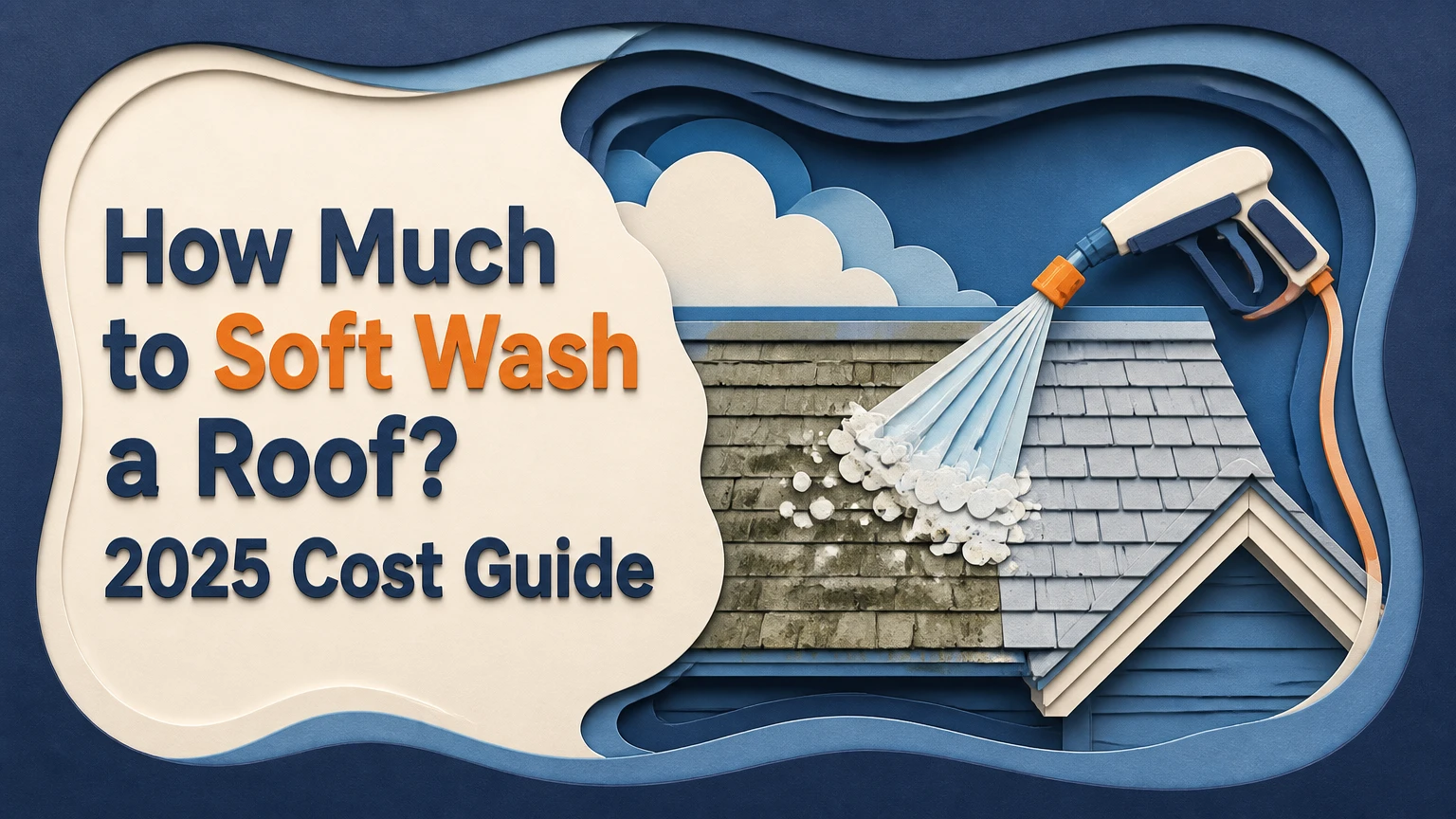
Roof soft washing typically costs $300-$800 for a residential roof, with a planning midpoint near $550 and common quoted rates of $0.20-$0.40 per square foot of roof area. Small, accessible asphalt-shingle roofs may cost $250-$400, while steep, moss-covered, multi-story, or heavily landscaped properties can exceed $1,000.
Key Facts at a Glance
- Residential roof soft washing commonly costs $300-$800, excluding unusual access, repairs, or extensive moss removal.
- Typical unit pricing is $0.20-$0.40 per square foot of actual roof area, not the home’s indoor floor area.
- A 2,000-square-foot roof commonly costs $400-$700 when access and growth are moderate.
- Professional work usually takes 2-4 hours, including preparation, application, dwell time, rinsing, and cleanup.
- Moss, steep slopes, multiple stories, solar panels, and delicate landscaping increase the quote.
- Soft washing uses low mechanical pressure plus a treatment solution; pressure washing and soft washing are not interchangeable.
How Much Does Roof Soft Washing Cost?
Roof soft washing costs about $300-$800 nationally for many homes, although local labor rates, roof size, growth severity, access, and material can move the final price below or above that range. A cleaner may also apply a minimum service charge, commonly $250-$400, even when the roof is small.
The most useful comparison is the price for the complete job, not the chemical rate alone. A $0.25-per-square-foot quote may exclude gutter cleaning, plant protection, extensive moss removal, travel, or a second treatment. A higher quote may include those controls and a written workmanship warranty.
Roof cleaners measure the sloped roof surface, including its pitches and attached sections. A 1,500-square-foot house can have a 1,900-square-foot roof after accounting for roof pitch, overhangs, dormers, and garages. That difference explains many apparently inconsistent estimates.
Typical Cost by Roof Area
| Actual roof area | Typical soft-wash price | Typical active job time | Common scenario |
|---|---|---|---|
| 1,000-1,500 sq. ft. | $250-$400 | 1.5-2.5 hours | One-story asphalt roof with light algae |
| 1,500-2,000 sq. ft. | $350-$600 | 2-3 hours | Average suburban roof with black streaks |
| 2,000-3,000 sq. ft. | $500-$900 | 3-4.5 hours | Larger roof with moderate algae and moss |
| 3,000-4,000 sq. ft. | $700-$1,200 | 4-6 hours | Multi-section roof or two-story home |
| More than 4,000 sq. ft. | $1,000-$1,500+ | 5-8+ hours | Large, steep, complex, or heavily contaminated roof |
These are typical planning figures rather than a regulated price schedule. Urban labor markets, high insurance costs, difficult roof access, and long travel distances can raise local quotes by 20%-50%. Rural markets may have lower labor rates but higher trip charges.
Does Roof Size Mean House Size?
Roof soft-washing prices should be based on the actual roof surface, not the home’s living area. Roof pitch, overhangs, attached garages, porches, valleys, and dormers all increase the area that must be treated.
A simple gable roof has less surface area than a similarly sized hip roof because a hip roof contains additional sloped sections. Steepness also changes labor time, even when two roofs have identical measured areas.
| Home floor area | Approximate roof area | Typical cleaning range | Main pricing risk |
|---|---|---|---|
| 1,000-1,500 sq. ft. | 1,200-1,800 sq. ft. | $250-$500 | Minimum charge or limited access |
| 1,500-2,500 sq. ft. | 1,800-2,800 sq. ft. | $400-$800 | Roof geometry and second story |
| 2,500-3,500 sq. ft. | 2,800-4,000 sq. ft. | $600-$1,200 | Dormers, valleys, and steep slopes |
| 3,500+ sq. ft. | 4,000+ sq. ft. | $900-$1,500+ | Multiple roof sections and equipment |
Aerial measuring software can estimate roof dimensions, but a physical inspection remains important. Satellite measurements cannot reliably identify fragile tiles, loose granules, blocked valleys, deteriorated flashing, or unsafe access.
What Makes Roof Soft Washing More Expensive?
Roof soft washing costs more when the crew must spend additional time on safety, biological growth removal, chemical control, or property protection. The largest price increases usually come from steep pitch, multiple stories, thick moss, difficult access, and fragile landscaping.
Major Cost Drivers
| Cost driver | Typical effect on price | Why it matters | Example |
|---|---|---|---|
| Steep roof pitch | +15%-30% | Requires slower movement and fall protection | 8:12 slope instead of 4:12 |
| Two or three stories | +10%-30% | Requires longer hoses, poles, lifts, or extra setup | Eaves 25-35 feet above grade |
| Heavy moss or lichen | +20%-60% | Requires controlled removal and repeat treatment | Thick growth across shaded north slope |
| Delicate landscaping | +$50-$200 typical | Requires pre-wetting, tarps, monitoring, and rinsing | Roses, ponds, vegetable beds |
| Solar panels or skylights | +$50-$200 typical | Requires masking, careful runoff control, and panel protection | Roof-mounted photovoltaic array |
| Long travel distance | $25-$150 typical | Covers fuel and crew time | Property outside the normal service area |
| Roof sections or dormers | +10%-25% | Increases hose movement and inspection time | Four-sided hip roof with dormers |
The percentage figures are typical practitioner adjustments, not universal rules. Some contractors build every factor into a flat quote, while others itemize labor, equipment, and treatment.
An important practitioner rule is that heavy moss is not priced like black algae staining. Algae can often be treated and left to weather away. Thick moss may conceal lifted shingles, retain water, and require careful hand removal, which changes both labor and roof-risk assessment.
What Biological Growth Is on the Roof?
Black streaks on asphalt shingles are commonly associated with cyanobacteria, including Gloeocapsa magma, while green moss and lichens create greater physical concerns. Mold and mildew usually indicate persistent moisture and shade, but visible growth does not prove that the roof deck has already rotted.
| Growth | Typical appearance | Primary risk | Usual treatment implication |
|---|---|---|---|
| Gloeocapsa magma | Black or blue-black streaks | Cosmetic staining and increased solar heat absorption | Chemical soft wash, often without scrubbing |
| Moss | Raised green cushions or mats | Moisture retention and possible shingle lifting | Treatment plus cautious removal |
| Lichen | Gray-green crust with anchored structures | Pitting or surface attachment | Slow biocide treatment; avoid forceful scraping |
| Mold or mildew | Dark patches in shaded areas | Moisture indicator and possible deck concern | Inspect ventilation and roof condition |
| Pollen and dirt | Yellow, brown, or gray film | Primarily cosmetic | Lower-strength cleaning may be sufficient |
Chemical treatment can kill biological growth without making every mark disappear immediately. Dead moss may remain attached for weeks or months while rainfall loosens it. A contractor promising instant removal of thick lichen without mechanical risk deserves careful questioning.
Is Soft Washing Safer Than Pressure Washing?
Soft washing is generally safer for asphalt shingles than high-pressure washing because the method relies on chemical treatment and low mechanical force rather than blasting granules from the shingle surface. Safety depends on the solution, application pressure, runoff control, roof condition, and operator technique.
The often-repeated “under 300 PSI” figure is not a universal safety standard. Some roof-cleaning equipment operates at substantially lower pressure, and pressure at the roof depends on the nozzle, distance, flow, and pump. Shingle manufacturers and the Asphalt Roofing Manufacturers Association generally favor non-abrasive cleaning practices and warn against aggressive pressure that can damage roofing components.
| Method | Typical mechanical pressure | Immediate visual result | Main roof risk |
|---|---|---|---|
| Chemical soft wash | Low pressure, often under 300 PSI | Moderate to fast, depending on solution | Chemical or runoff damage |
| Garden-hose rinse | Near household pressure | Limited on embedded growth | Low mechanical risk |
| Surface pressure washing | 1,000-2,500+ PSI | Fast surface removal | Granule loss and water intrusion |
| Manual moss removal | Minimal pressure but direct contact | Fast on loose growth | Shingle tearing or dislodging |
| Oxygen-bleach treatment | Low pressure | Slower cosmetic change | Incomplete control of severe growth |
The safer method is the one appropriate to the substrate and manufacturer guidance. Soft washing is not suitable for hiding cracked tiles, failed flashing, rotten decking, or an already exhausted roof.
Which Roof-Cleaning Solution Is Best?
No single roof-cleaning solution is best for every roof. Sodium hypochlorite-based treatments act quickly on algae, sodium percarbonate is slower and often more landscaping-friendly, and proprietary biocides may emphasize residual biological control over immediate cosmetic results.
| Treatment type | Typical result time | Strength | Limitation | Best use |
|---|---|---|---|---|
| Sodium hypochlorite blend | Minutes to hours | Rapid algae and stain reduction | Can damage plants, metals, and finishes if mishandled | Asphalt algae and moderate organic staining |
| Sodium percarbonate | Hours to days | Lower odor and oxygen-based chemistry | Slower on heavy moss and lichen | Light growth and sensitive properties |
| Proprietary biocide | Days to weeks | Residual or long-term biological control | Higher material cost and delayed appearance | Prevention and recurring growth |
| Water-only rinsing | Immediate surface change | No chemical runoff | Does not reliably kill embedded organisms | Loose dirt and light pollen |
| Manual removal | Immediate on loose material | Removes thick surface buildup | Can disturb shingles and tiles | Limited moss after chemical loosening |
A professional should identify the product by active ingredient, follow its label, and explain where runoff will go. “Eco-friendly” is not a sufficient technical description because toxicity depends on concentration, exposure, pH, aquatic impact, and the specific formulation.
Never mix sodium hypochlorite with ammonia, acids, or other incompatible cleaners. Toxic gases or dangerous reactions can result. Product labels and local stormwater rules control handling requirements.
How Does a Professional Soft Wash a Roof?
A professional roof soft wash usually takes 2-4 hours for an average roof, with the work divided into inspection, protection, application, dwell time, controlled rinsing, and cleanup. The most important success factor is runoff management, because a chemically effective treatment can still damage plants, metals, siding, or aquatic environments when poorly controlled.
Step 1: Inspect the Roof and Property
The crew should identify the roofing material, roof age, pitch, visible damage, growth type, gutters, downspouts, skylights, solar panels, windows, and nearby vegetation. Cleaning should pause when shingles are brittle, tiles are cracked, flashing is loose, or the roof is near replacement age.
The crew should photograph pre-existing damage. A treatment is not a repair.
Step 2: Protect Plants, Openings, and Drainage
Professionals typically pre-wet landscaping with clean water, cover sensitive plants briefly, protect exterior walls and openings, and control where concentrated runoff travels. Downspouts may be temporarily redirected, but blocking them without a safe collection or discharge plan can create overflow.
You know preparation is adequate when the crew can identify the runoff path before spraying. A common mistake is covering plants while leaving dry leaves or soil exposed to concentrated drips.
Step 3: Apply the Labeled Solution
The operator applies a roof-compatible treatment at low pressure, generally beginning at the lower roof edge and working upward to manage runoff. Exact concentration should follow the product label and substrate requirements, rather than a generic internet recipe.
A uniform application matters more than maximum chemical strength. Overly strong mixtures can bleach surfaces, corrode metals, injure foliage, and create unnecessary environmental exposure.
Step 4: Allow Correct Dwell Time
Typical dwell time is 15-30 minutes, but temperature, shade, growth thickness, product instructions, and drying rate change the correct interval. The solution should remain active without drying into a concentrated residue.
The success checkpoint is visible biological color change or loosening, not necessarily a perfectly bare roof. Scrubbing too early can remove granules or disturb shingle edges.
Step 5: Rinse, Neutralize, and Inspect
Some treatments are rinsed thoroughly, while certain biocides are designed to remain and break down growth gradually. The operator should rinse affected siding, gutters, metal fixtures, and landscaping as specified by the product label.
Afterward, the crew should inspect for residue, blocked gutters, remaining loose moss, plant stress, and runoff issues. A second visit may be appropriate for severe lichen, but repeated chemical applications should not substitute for a roof-repair decision.
How Long Does Roof Soft Washing Take?
Roof soft washing usually takes 1.5-2.5 hours for a small roof, 2-4 hours for an average roof, and 4-6 or more hours for a large or complex roof. Weather, access, plant protection, setup, and moss severity often determine the schedule more than spraying time.
Rain can affect the work in two different ways. Rain during application may dilute or move the solution, while later rainfall can help dead growth detach. Wind is often a larger immediate problem because overspray can reach windows, siding, neighboring property, and vegetation.
A contractor should also explain whether the quoted duration includes cleanup and whether the roof will look fully clear the same day. Algae stains may improve rapidly, while dead moss and lichen can remain visible for several weeks.
Is Soft Washing Safe for Every Roofing Material?
Soft washing is not automatically safe for every roof material. Asphalt shingles, concrete tile, clay tile, metal, and cedar shakes have different tolerances for chemicals, moisture, foot traffic, and mechanical contact.
| Roofing material | Typical cleaning approach | Main hazard | Essential precaution |
|---|---|---|---|
| Asphalt shingles | Low-pressure labeled treatment | Granule loss from pressure or abrasion | Follow manufacturer cleaning guidance |
| Concrete tile | Low-pressure chemical treatment | Slipping, cracking, and porous staining | Limit foot traffic and inspect broken tiles |
| Clay tile | Gentle treatment and controlled rinsing | Cracking and glaze damage | Avoid forceful spray and concentrated chemistry |
| Metal roofing | Compatible treatment with prompt rinsing | Etching, oxidation, or finish damage | Test an inconspicuous section first |
| Cedar shake | Specialized biological treatment | Fiber damage and moisture retention | Assess rot and follow wood-roof guidance |
Cedar roofs require particular caution. Killing fungi does not restore split shakes, failed underlayment, or wet decking. A roof contractor familiar with wood roofing may recommend treatment, limited cleaning, preservatives, or replacement instead.
Roof warranties also matter. Before cleaning, check the manufacturer’s maintenance instructions and ask for the proposed chemical and pressure range in writing.
Can You Soft Wash a Roof Yourself?
Homeowners can perform limited roof-cleaning work, but DIY soft washing carries chemical, fall, runoff, and roof-damage risks that make professional service preferable for steep, high, fragile, or heavily contaminated roofs. A ground-based pump sprayer may be reasonable for a small, low-slope structure only when the product label permits that application.
Typical DIY expenses include $40-$100 for treatment, $30-$80 for protective materials, and $50-$150 for a suitable sprayer or extension equipment. Those costs do not include fall protection, replacement plants, medical risk, or damage caused by a wrong mixture.
Do not walk a wet roof without appropriate training and fall protection. Never climb onto a roof to compensate for inadequate equipment, and never use a pressure washer on asphalt shingles simply because the stain remains.
Professional service is usually the better value when the roof is two stories, steeper than a comfortable walking slope, near electrical equipment, surrounded by delicate plants, or covered in thick moss.
What Should a Roof-Washing Quote Include?
A reliable quote identifies the roof area, material, growth type, treatment, access conditions, protection measures, cleanup, exclusions, and warranty terms. The lowest price is difficult to compare when one contractor includes only chemical application and another includes plant protection, gutter cleanup, and a return visit.
Ask these questions before accepting a quote:
- Is the price based on measured roof area or estimated house size?
- Which active ingredient will be used, and is it approved for this roof material?
- What pressure range and nozzle type will the crew use?
- Does the price include pre-wetting, tarps, rinsing, and plant neutralization?
- How will the crew control downspout and stormwater runoff?
- Are moss scraping, gutter cleaning, solar panels, and repairs excluded?
- What happens if dead lichen remains visible after treatment?
- Does the company carry liability insurance and workers’ compensation coverage?
- Is the warranty for stain appearance, biological regrowth, workmanship, or all three?
- Will the contractor document pre-existing granule loss, cracks, or leaks?
A two-year stain guarantee may sound valuable, but its terms require scrutiny. Some warranties cover only reapplication, while others exclude shade, tree cover, heavy moss, weather, or roof deterioration.
Common Soft-Washing Mistakes and Fixes
Using Excessive Pressure
High pressure can strip asphalt-shingle granules, force water under laps, damage flashing, and remove protective finishes. If granules appear in gutters after cleaning, stop further mechanical cleaning and have the roof inspected.
Spraying Dry Landscaping
Dry foliage and soil absorb concentrated runoff more readily than saturated surfaces. Pre-wet plants, keep exposure brief, rinse according to the chemical label, and watch for delayed leaf injury over the next several days.
Treating Directly Before Hot, Windy Weather
High heat can dry a solution before adequate dwell time, while wind increases overspray. Choose a calm period with moderate temperatures and enough time to complete rinsing and cleanup.
Scraping Anchored Lichen Aggressively
Lichen can bond tightly to shingle surfaces. Forceful scraping may remove granules along with the organism, so chemical loosening and gradual weathering are often safer than demanding an instant cosmetic result.
Ignoring Roof Age
A clean roof can still be a failing roof. If shingles are near the end of their expected service life, have widespread granule loss, or show exposed underlayment, compare cleaning cost with replacement cost first.
How Often Should a Roof Be Soft Washed?
Many roofs need cleaning every 2-5 years, but the interval depends on shade, humidity, tree canopy, roof orientation, ventilation, and the type of biological growth. A north-facing roof under dense trees may require attention sooner than a sunny, well-ventilated roof.
Preventive treatment can be cheaper than repeated heavy moss removal, but routine chemical application is not automatically beneficial. A contractor should confirm regrowth before recommending a fixed three-year schedule.
Improve the conditions that feed growth by trimming branches away from the roof, clearing gutters, correcting persistent moisture, and checking attic ventilation. These measures do not replace cleaning, but they can extend the interval between treatments.
When Should You Skip Cleaning and Repair the Roof?
Skip soft washing and obtain a roofing inspection when shingles are brittle, cracked, extensively lifted, missing, or losing large amounts of granule; when tiles are broken; or when leaks and rotten decking are present. Cleaning cannot restore structural integrity.
A roof near replacement age may not justify a $500 cleaning if the work will provide only a short cosmetic benefit. Conversely, removing algae from a roof with sound shingles can preserve appearance and help reveal defects before they become leaks.
The correct sequence is inspection first, cleaning second. A reputable cleaner should recommend against treatment when the roof condition makes the work unsafe or uneconomic.
Frequently Asked Questions
Does Roof Soft Washing Remove Black Streaks Permanently?
Roof soft washing can kill the organisms causing black streaks, but permanent prevention is not guaranteed. New growth depends on shade, moisture, tree cover, roof orientation, and local climate. A treatment may keep asphalt shingles clear for several years, while a heavily shaded roof can develop staining sooner.
Will Rain Wash Away the Cleaning Solution?
Rain can dilute or remove a treatment before it reaches the required dwell time, so cleaners usually need a suitable dry-weather window. Later rainfall may help dead moss and lichen detach gradually. The contractor should explain whether the product is intended for rinsing or post-treatment weathering.
Is Roof Soft Washing Covered by Homeowners Insurance?
Routine roof cleaning is generally maintenance, not an insured loss, so homeowners insurance usually does not pay for it. Policies may cover sudden damage from a named event, subject to exclusions and deductibles, but they normally do not cover algae, moss, neglect, or gradual deterioration.
Does Soft Washing Increase a Roof’s Life?
Soft washing can remove moisture-retaining biological growth and reduce cosmetic staining, but it does not guarantee a longer service life. The benefit is greatest when growth is moderate and shingles remain sound. Cleaning cannot reverse ultraviolet aging, granule loss, poor ventilation, failed flashing, or deck rot.
Should Gutters Be Cleaned at the Same Time?
Gutter cleaning is often efficient during the same visit because roof debris and treatment runoff can enter the drainage system. Some roof-soft-washing quotes include gutter rinsing, while others charge separately. Confirm whether the service includes debris removal, downspout testing, and cleanup.
What Is the Cheapest Safe Roof-Cleaning Option?
The cheapest safe option is usually a professionally applied treatment on a small, accessible roof with light algae and no difficult landscaping. DIY work may cost less in materials, but falls, chemical exposure, runoff, and shingle damage can erase the savings. Avoid choosing a low price that excludes property protection.
The Bottom Line
How much to soft wash a roof depends primarily on actual roof area, growth severity, pitch, access, material, and property protection. Plan on $300-$800 for a typical residential roof, $0.20-$0.40 per square foot, and 2-4 hours for an average job. Compare complete written scopes, verify the treatment and runoff plan, and have the roof condition assessed before paying for cosmetic cleaning.