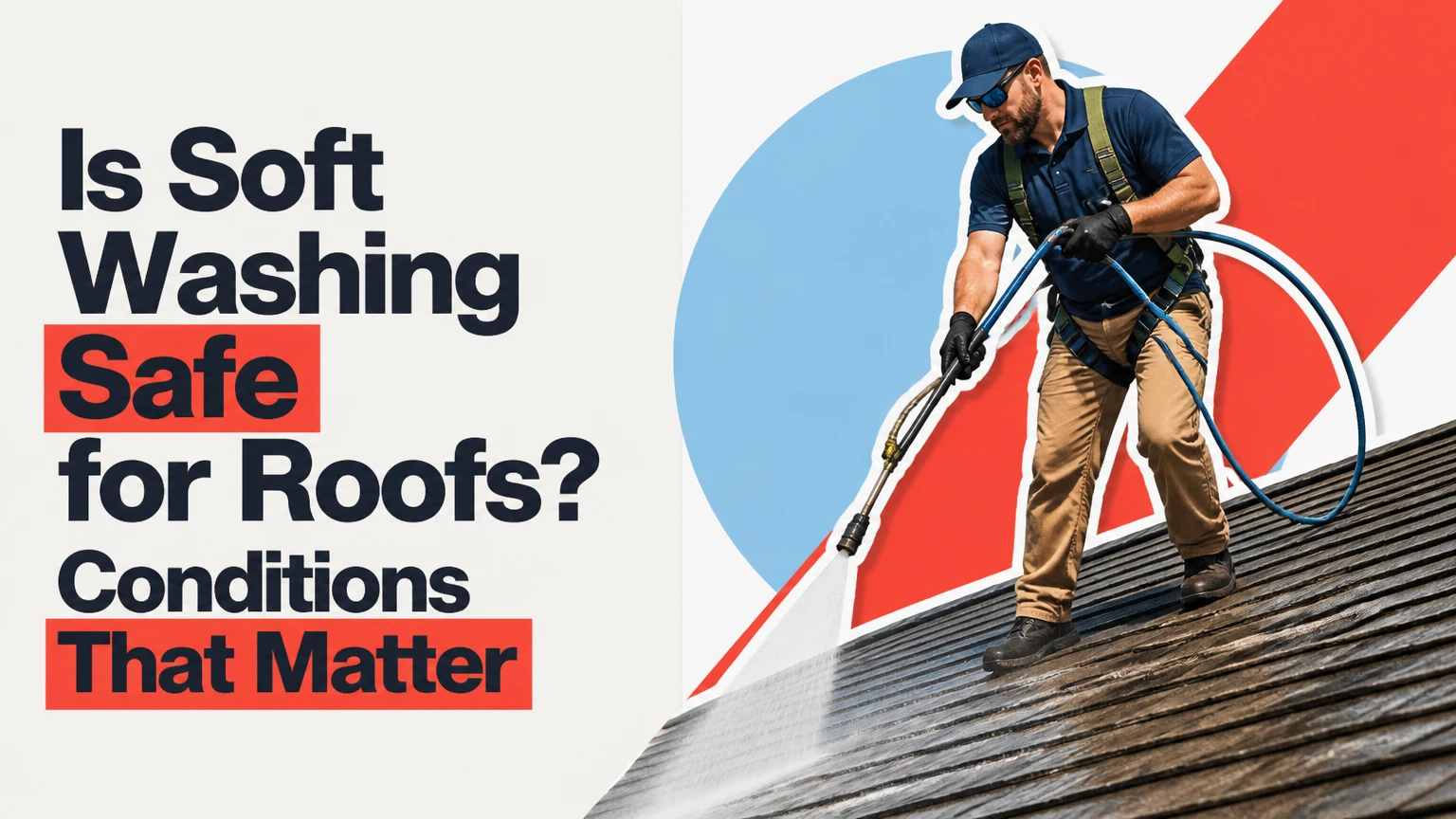
Soft washing is generally safe for roofs when a trained technician uses low pressure, a roof-compatible cleaning solution, controlled dwell time, and thorough plant protection. The method is safer than high-pressure washing for most asphalt shingle roofs, but it is not automatically safe for every roof, coating, chemical concentration, or application condition.
Key Facts at a Glance
- The Asphalt Roofing Manufacturers Association recommends non-abrasive, low-pressure cleaning rather than power washing asphalt shingles.
- Soft washing removes organic growth chemically, so it reduces the physical abrasion that can dislodge asphalt granules.
- A typical residential roof soft wash costs approximately $450-$900 and takes 2-5 hours, depending on pitch, access, and growth.
- Sodium hypochlorite can damage plants, metals, painted surfaces, and some roof coatings when technicians allow concentrated runoff or residue to dry.
- Moss, algae, and lichen may leave stains after treatment because dead growth weathers away gradually rather than disappearing immediately.
- A roof inspection must precede cleaning because soft washing cannot repair leaks, cracked tiles, failed flashing, or deteriorated shingles.
What Does Roof Soft Washing Actually Do?
Roof soft washing is a chemical cleaning method that uses low-pressure spray to treat algae, moss, lichen, dirt, and other organic deposits. The solution breaks down or kills biological growth, while gentle rinsing removes loosened residue without the impact force associated with pressure washing.
The dark streaks on many asphalt roofs commonly involve cyanobacteria, often identified as Gloeocapsa magma in roofing discussions. Moss and lichen behave differently because their structures attach more physically to the surface and may require longer dwell time, repeat treatment, or careful manual removal.
The term “soft wash” describes a method, not a universal formula. One contractor may use diluted sodium hypochlorite, while another may use a manufacturer-approved detergent, hydrogen-peroxide-based product, quaternary ammonium compound, or a low-pressure rinse with limited chemical treatment.
What makes soft washing safer than pressure washing?
Soft washing uses chemical action instead of high kinetic force, which reduces the chance of stripping granules, lifting shingle edges, forcing water beneath laps, or damaging fragile tile surfaces. The safety advantage applies only when the operator controls pressure, overspray, runoff, contact time, and walking access.
ARMA’s roof-care guidance recommends a “non-abrasive, low-pressure cleaning method” for asphalt shingles. That recommendation supports the cleaning approach, but it does not mean ARMA approves every bleach concentration or guarantees every soft-wash job will preserve a roof.
How Does the Soft-Washing Process Work?
A professional roof soft wash normally follows six stages: inspection, property protection, chemical application, dwell time, low-pressure rinsing, and final verification. A typical single-family project takes 2-5 hours, although steep roofs, heavy moss, restricted access, and extensive landscaping can increase the duration.
Step 1: Inspect the roof and property
The technician should document brittle or missing shingles, exposed underlayment, cracked tiles, loose ridge caps, failed sealant, damaged flashing, skylights, solar equipment, gutters, and active leaks. Cleaning a visibly failing roof can worsen existing damage and complicate responsibility for later leaks.
The inspection should also identify the growth type. Thin black staining requires a different approach from thick moss mats, lichen colonies, or tree-sap deposits.
Step 2: Protect plants, metal, and electrical equipment
Plants should be saturated with clean water before chemical application, shielded where practical, and rinsed again during and after the work. Downspout discharge should be directed away from delicate landscaping, ponds, storm drains, and neighboring property.
Technicians should protect or isolate air-conditioning equipment, outdoor lighting, painted siding, vehicles, copper items, and sensitive metal fixtures. Chemical overspray can create damage even when the roof itself remains unharmed.
Step 3: Apply a roof-compatible solution
Application equipment may include a low-pressure pump, proportioner, hose, dedicated sprayer, and calibrated nozzle. The operator should follow the product label, account for roof material, and avoid guessing concentration from an internet recipe.
A common commercial practice uses diluted sodium hypochlorite for algae and moss, but the correct strength varies with product concentration, biological load, temperature, roof material, and manufacturer instructions. “Stronger” is not a safety strategy.
Step 4: Allow controlled dwell time
The solution commonly remains on the roof for approximately 10-30 minutes, subject to the label and drying conditions. A technician should keep the surface wet enough for the treatment to work without allowing concentrated chemical residue to dry on shingles, metal, windows, or plants.
Strong sun, high temperatures, wind, and porous growth can change the required dwell time. The operator may work in smaller sections to maintain control.
Step 5: Rinse with low pressure
Rinsing should remove dead growth and chemical residue without blasting the roof. The exact pressure depends on the pump, nozzle, distance, flow rate, and roof condition, so a pressure number alone cannot prove that a job is safe.
Many contractors describe soft-wash output as roughly 100-500 PSI, while some roof-cleaning guidance uses lower figures. The practical rule is to use the lowest pressure that achieves the intended rinse, never a pressure selected to make the work appear faster.
Step 6: Verify the roof and surrounding property
The final check should include gutters, downspouts, valleys, flashing, plants, siding, windows, outdoor equipment, and areas where runoff collected. Photographs taken before and after treatment help distinguish pre-existing defects from cleaning-related damage.
A clean-looking roof is not the only success measure. The property should also be free of concentrated chemical residue and unmanaged runoff.
Which Chemicals Are Used on Roofs?
Sodium hypochlorite is widely used for organic roof growth because it acts quickly, but it can burn vegetation, corrode metals, fade finishes, and irritate skin or lungs if mishandled. Alternative products may reduce some hazards, yet “eco-friendly” does not mean harmless to every roof, plant, animal, or waterway.
| Cleaning approach | Typical target | Typical contact or rinse pattern | Main risk |
|---|---|---|---|
| Diluted sodium hypochlorite | Algae, moss, lichen | 10-30 minutes, controlled rinse | Plant injury, corrosion, runoff |
| Hydrogen-peroxide product | Algae, light organic staining | Product-label dwell, often rinse | Surface incompatibility, eye and skin irritation |
| Quaternary ammonium biocide | Algae and residual biological control | Product-specific, sometimes limited rinse | Aquatic toxicity and residue |
| Sodium percarbonate | Delicate organic deposits, some wood surfaces | Longer dwell, agitation or rinse | Incomplete heavy-growth removal |
| Mild detergent and brushing | Dirt, sap, light surface deposits | Short dwell, gentle rinse | Abrasion if brushing is aggressive |
Chemical performance depends on concentration and application. A low-pressure nozzle does not make an incompatible solution safe.
Is bleach safe for asphalt shingles?
Diluted bleach can be compatible with asphalt shingles when the roof manufacturer permits the method and the operator controls concentration, dwell time, runoff, and rinsing. Undiluted or excessively concentrated sodium hypochlorite can damage vegetation, metal components, sealants, painted surfaces, and possibly roofing materials.
Roofing manufacturers often publish care instructions that differ by shingle line and warranty. A homeowner should check the shingle manufacturer’s maintenance document before authorizing a chemical treatment, especially when the roof is under warranty or less than a few years old.
Is Soft Washing Safe for Every Roof Material?
Soft washing is not a universal approval for every substrate. Asphalt shingles usually tolerate low-pressure treatment better than high-pressure cleaning, while cedar, aged coatings, unsealed metal, and brittle tile require material-specific products and access methods.
| Roof material | Usual cleaning position | Key adjustment | Stop or refer condition |
|---|---|---|---|
| Asphalt shingles | Low-pressure chemical treatment commonly suitable | Avoid granule disturbance and foot traffic | Brittle, curling, thin, or failing shingles |
| Concrete tile | Low-pressure treatment often suitable | Avoid walking wet tiles; control runoff | Cracked, shifted, or fragile tiles |
| Clay tile | Possible with compatible chemistry | Use ladders or lift access rather than stepping | Powdering glaze, cracks, loose bedding |
| Painted metal | Possible with approved detergent or biocide | Rinse quickly and protect fasteners | Chalking, peeling coating, exposed corrosion |
| Galvanized or galvalume metal | Chemistry must match coating | Avoid unapproved bleach and trapped residue | Coating loss, white rust, active corrosion |
| Cedar shakes | Product and age determine suitability | Use a wood-safe method and limited pressure | Splitting, rot, or saturated wood |
| Synthetic or membrane roof | Follow membrane manufacturer | Protect seams, adhesives, and penetrations | Unknown membrane or adhesive condition |
Bare galvalume should not be treated with an assumed bleach recipe. The aluminum-zinc coating, fasteners, sealants, and adjacent painted components may react differently, so the roof manufacturer or coating supplier should determine acceptable chemistry.
Solar panels should be cleaned under the panel manufacturer’s instructions and isolated from roof chemicals. Soft washing the roof around photovoltaic equipment is a separate risk decision.
How Much Does Soft-Washing a Roof Cost?
Typical residential roof soft washing costs $450-$900, with common pricing around $0.30-$0.80 or more per square foot when pitch, access, and heavy growth increase labor. A small, low-pitch roof can cost less, while a steep or heavily moss-covered roof can exceed $1,000.
| Project condition | Typical price range | Typical time | Main cost driver |
|---|---|---|---|
| Small, low-pitch roof with light algae | $250-$450 | 1.5-3 hours | Minimum service charge |
| Average asphalt roof with moderate staining | $450-$900 | 2-5 hours | Roof size and landscaping |
| Steep roof with harness setup | $700-$1,400 | 4-7 hours | Fall protection and access |
| Heavy moss or lichen growth | $800-$1,600+ | 4-8 hours | Repeat treatment and manual work |
| Tile or complex metal roof | $600-$1,500+ | 3-8 hours | Fragile surfaces and material controls |
Prices vary by region, insurance requirements, roof geometry, and disposal or runoff controls. A quote should identify the roof area, chemical method, plant protection, rinse plan, warranty limitations, and whether gutter cleaning is included.
A low bid may exclude the work that protects the property. Ask whether the contractor carries liability insurance, workers’ compensation coverage, and roof-cleaning experience for the specific substrate.
Does Soft Washing Preserve the Roof Warranty?
Low-pressure cleaning generally aligns better with asphalt-shingle warranty guidance than high-pressure washing, but a contractor’s statement that soft washing is “warranty approved” is too broad. Warranty terms come from the individual roofing manufacturer, product line, installation conditions, and maintenance instructions.
High-pressure cleaning can remove protective granules and damage shingle surfaces. It may also void or complicate warranty claims when the manufacturer prohibits power washing, but warranty consequences cannot be determined from pressure alone.
Before cleaning, record the roof’s age, product name, visible condition, and existing defects. Keep the contractor’s invoice, chemical product information, photographs, and written process description.
Is Soft Washing Safer Than Pressure Washing?
Soft washing is usually the safer choice for asphalt shingles because it reduces abrasion and water intrusion risk. Pressure washing may remove surface dirt quickly, but high-pressure water can dislodge granules, lift shingle edges, damage flashing, and drive water beneath roofing components.
| Decision factor | Soft washing | High-pressure washing | Manual treatment |
|---|---|---|---|
| Typical roof pressure | Approximately 100-500 PSI | Commonly 1,500-3,000+ PSI | Low pressure plus hand tools |
| Algae control | Chemical treatment reaches growth | Surface removal may leave regrowth | Chemical control varies |
| Granule risk | Low when properly operated | Moderate to high | Moderate if scraping is forceful |
| Moss removal | Chemical kill plus gradual release | Fast visual removal, incomplete kill possible | High labor, controlled results |
| Plant exposure | Chemical runoff risk | Greater water and soil displacement | Lower chemical volume, more labor |
| Best common use | Asphalt shingle biological growth | Hard, non-roof exterior surfaces | Delicate or localized deposits |
Pressure washing is often appropriate for concrete, masonry, driveways, and some siding. A method that works on a driveway does not automatically belong on an asphalt roof.
When Is Soft Washing a Bad Choice?
Soft washing is a poor choice when the roof is structurally failing, the material is chemically incompatible, weather prevents runoff control, or the operator cannot work safely without walking on a hazardous surface. Cleaning cannot restore lost granules, repair flashing, stop an active leak, or reverse wood rot.
Do not proceed without specialist advice when:
- The roof has exposed underlayment, widespread curling, severe granule loss, or active leakage.
- Cedar shakes, coated metal, galvalume, or an unfamiliar membrane lack documented chemical instructions.
- Wind can carry spray onto neighboring property, ponds, HVAC equipment, or edible gardens.
- Rain is likely to create uncontrolled runoff during the treatment window.
- The roof requires unsafe walking, especially when wet, steep, mossy, or chemically coated.
- The contractor cannot state the product, dilution method, dwell time, and plant-protection plan.
What happens to dark streaks after treatment?
Dark streaks may remain for days or weeks after algae treatment because dead pigment and attached residue weather away gradually. Immediate reapplication can increase chemical exposure without improving the result, especially when the biological growth has already been neutralized.
A reasonable follow-up is to photograph the roof at the completion date and inspect it again after several rain cycles or approximately 30-90 days. Persistent active growth, rather than residual staining, justifies a professional reassessment.
Can a Homeowner Soft Wash a Roof?
A homeowner should limit DIY roof cleaning to ground-based or safely accessed, low-pitch work where the roof material and product label are known. Wet shingles, chemical residue, ladders, and roof edges create fall and exposure hazards that make professional work preferable for most multi-story or steep roofs.
For a DIY project, the minimum controls include:
- Read the roofing and chemical manufacturer instructions.
- Wear chemical-resistant gloves, eye protection, protective clothing, and suitable footwear.
- Pre-wet and continuously protect nearby plants.
- Keep people, pets, and children away from runoff.
- Never mix bleach with acids, ammonia, or other cleaners.
- Avoid spraying electrical equipment, windows, vehicles, and HVAC components.
- Use ground-based application where possible.
- Stop if wind, heat, rain, or runoff prevents control.
The most common DIY error is treating roof cleaning as a spray-and-rinse task. The chemical may be manageable, but fall prevention and runoff management determine whether the project is safe.
How Long Does a Soft-Washed Roof Stay Clean?
A professionally treated roof commonly remains visibly cleaner for 2-5 years, but shade, humidity, tree cover, roof orientation, and local rainfall can shorten or extend that period. A north-facing roof beneath dense trees may regrow faster than a sunny roof with strong airflow.
Preventive maintenance usually costs less than waiting for thick moss to develop. Keep gutters clear, trim branches that shade the roof, remove leaf accumulation, and correct persistent moisture sources such as overflowing valleys or blocked drainage.
Metal strips containing copper or zinc may help limit biological regrowth in some roof designs, but installation must avoid incompatible fasteners, staining, and warranty conflicts. Preventive devices cannot compensate for poor drainage or deep shade.
What Should You Ask a Roof-Cleaning Contractor?
A qualified contractor should answer process questions with material-specific details rather than promising that every roof is safe. Request the following before approving work:
- Which roofing material and manufacturer instructions are you following?
- What product will you apply, and what label governs its use?
- How will you protect plants, siding, HVAC equipment, windows, and water features?
- Where will downspout runoff go during treatment?
- Will anyone walk on the roof, and what fall-protection system will they use?
- How will you document pre-existing damage?
- What pressure range and nozzle type will you use?
- Will you rinse, and how will you verify residue removal?
- What happens if staining remains after the first treatment?
- Are liability insurance and workers’ compensation certificates available?
A credible answer includes limits. Contractors who promise complete removal of every stain, permanent prevention, or universal warranty protection are making claims the cleaning method cannot support.
Frequently Asked Questions
Can soft washing cause roof leaks?
Soft washing does not normally create leaks when low pressure, controlled spray, and proper roof access are used, but cleaning can expose or aggravate pre-existing defects. Water may enter through failed flashing, cracked tiles, open laps, damaged vents, or deteriorated underlayment. Inspection and photographs should precede treatment.
Will soft washing remove moss immediately?
Soft washing can kill or weaken moss during treatment, but thick moss may remain attached until rain, wind, or careful follow-up removal releases it. Aggressive scraping can damage shingles and tiles, so the contractor should explain whether the service includes delayed removal, repeat treatment, or manual work.
Is roof soft washing safe around pets?
Roof soft washing is safe around pets only when animals are kept away from spray, treated surfaces, chemical containers, and runoff until the area is thoroughly rinsed and the product label permits re-entry. Dogs and cats should remain indoors or in a clean, isolated area during application and cleanup.
Can rain damage a soft-washed roof?
Rain during or shortly after treatment can dilute the solution, shorten dwell time, and carry chemicals into landscaping or drains. A contractor should schedule work within the product label’s weather window and have a runoff plan. Light rain after adequate treatment may be harmless, but uncontrolled storms make the job unsuitable.
Does soft washing increase a roof’s life?
Soft washing can reduce biological growth that retains moisture and contributes to surface deterioration, but it does not guarantee a specific service-life extension. Roof age, ventilation, installation quality, weather exposure, and existing damage have greater influence than cleaning alone. Cleaning should support maintenance, not replace roof inspection.
The Bottom Line
Yes, soft washing is usually safe for roofs when the method matches the roofing material and the operator controls chemical strength, pressure, dwell time, runoff, and fall hazards. The approach is generally preferable to high-pressure washing for asphalt shingles, consistent with ARMA’s low-pressure, non-abrasive guidance.
Soft washing is not automatically safe for aged shingles, cedar, coated metal, galvalume, fragile tile, solar equipment, or poorly controlled landscaping. Verify the roof manufacturer’s instructions, require a written protection plan, and treat a $450-$900 typical price as a starting range rather than proof of quality. For the query “Is soft washing safe for roofs?”, the accurate answer is yes, conditionally, with material compatibility and operator control determining the outcome.