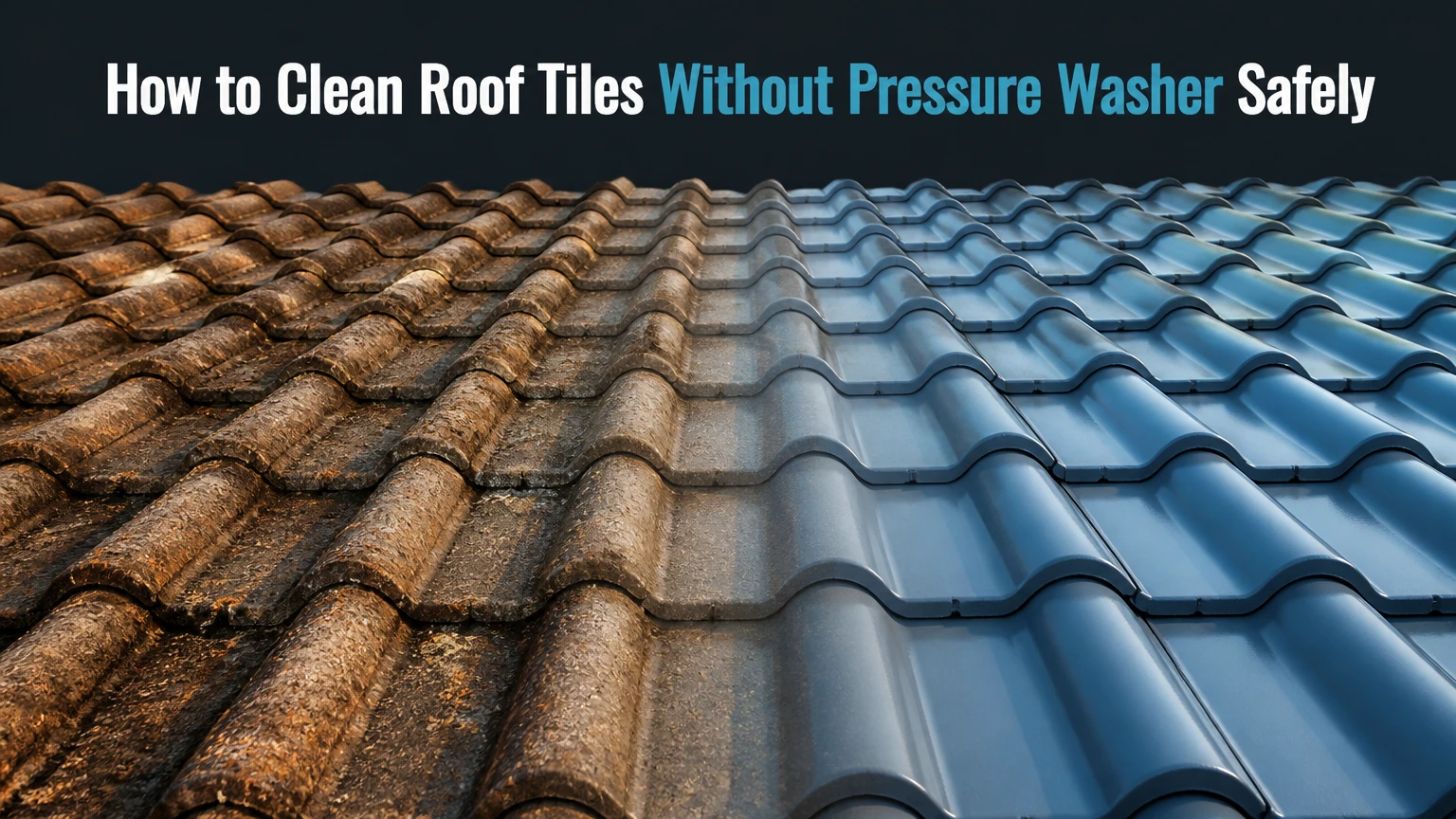
The safest way to clean roof tiles without a pressure washer is to remove thick growth gently, apply a roof-safe treatment exactly as its label directs, and let rain remove dead residue. Avoid forceful scraping, improvised chemical mixtures, and roof walking unless a qualified professional has confirmed safe access and fall protection.
Key Facts
- Pressure washing can drive water beneath tile laps, dislodge tiles, and damage surface coatings.
- A typical DIY treatment takes 4-8 hours of active work, while biocide results may take 2-6 months.
- Product labels, not internet ratios, determine the correct dilution for sodium hypochlorite, oxygen bleach, or quaternary ammonium compounds.
- Thick moss should be removed mechanically before chemical treatment, but fragile clay, slate, and historic tiles may require a no-contact method.
- Never mix bleach with ammonia, acids, vinegar, or another cleaner.
- The safest option for a steep, high, fragile, or inaccessible roof is a professional roof-cleaning service.
Why Avoid Pressure Washing Roof Tiles?
Pressure washing is usually unsuitable for tiled roofs because concentrated water can damage the tile surface and force water into joints, laps, underlay, and roof penetrations. A garden hose used at low pressure is different: it can rinse loosened debris without delivering the impact energy of a pressure washer.
Concrete tiles may lose their factory finish or expose more porous material after aggressive cleaning. Clay tiles can crack under impact or from foot traffic, while old mortar bedding, ridge caps, flashing, and sealants may fail before the tiles visibly break.
Roofing manufacturers often publish cleaning restrictions for their products, and warranty terms may exclude damage caused by unsuitable cleaning methods. Check the tile manufacturer’s maintenance instructions before applying bleach, a biocide, a brush, or any coating.
The United States Occupational Safety and Health Administration requires fall protection for many construction activities at elevations of 6 feet or more under 29 CFR 1926.501. That rule does not turn a homeowner into a qualified roof worker, but it illustrates the seriousness of roof access. A harness without a rated anchor, correct rope system, and rescue plan is not adequate protection.
What Should You Prepare Before Cleaning?
Prepare a compatible cleaner, a soft removal tool, runoff controls, and a safe access plan before touching the roof. Typical DIY materials cost $35-$150, excluding scaffolding, fall-protection equipment, repairs, or professional access equipment.
Before You Start
| Requirement | Typical specification | Why it matters |
|---|---|---|
| Active work time | 4-8 hours for 100-200 m² | Includes setup, scraping, spraying, and cleanup |
| Chemical dwell time | 10-60 minutes, label dependent | Prevents premature rinsing or product failure |
| Natural treatment time | 2-6 months | Common for slow-acting biocides |
| Pump sprayer | 5-15 litres, chemical-compatible seals | Delivers even coverage at low pressure |
| Soft brush | Nylon bristles, 150-300 mm head | Loosens residue without wire scratches |
| Scraper | Profile-matched plastic or soft metal blade | Reduces tile-edge damage |
| Hose | Standard garden hose with fan or shower setting | Rinses without pressure-washer impact |
| Gloves and eye protection | Chemical-resistant gloves and sealed goggles | Protects against splashes |
| Plant protection | Polyethylene sheets, water, collection buckets | Limits chemical contact and runoff |
| Roof access | Scaffold, roof ladder, or professional system | Prevents unsafe footholds on unsupported tiles |
Do not rely on a generic “roof cleaner” recipe. Sodium hypochlorite concentration, quaternary ammonium strength, surfactant content, tile compatibility, and required dwell time differ substantially between products. Read the safety data sheet and label, then test the product on two or three inconspicuous tiles.
Choose a cool, dry, low-wind period. Direct sun can dry a treatment before it has worked, while heavy rain can dilute it and move it into drains or planting beds. A practical target is an overcast day with at least 6 hours of forecast dry weather, unless the product label states otherwise.
How Do You Clean Roof Tiles Without Pressure Washer?
To clean roof tiles without pressure washer equipment, protect the ground, clear gutters, remove loose moss carefully, apply a labeled treatment, and rinse only when the product instructions require it. Work in small sections from the ridge toward the eaves, and never create a path that requires standing on wet, chemically treated tiles.
Step 1: Inspect the Roof From the Ground
Inspect the roof from windows, binoculars, a scaffold platform, or the eaves before planning access. Look for cracked or missing tiles, sagging areas, exposed underlay, loose ridge caps, damaged flashing, blocked valleys, and heavy moss lifting tile edges.
Do not clean a roof that shows active leaks, structural movement, widespread broken tiles, or decayed battens. Arrange a roofing inspection first. Cleaning can remove the visual evidence of a problem without repairing the cause.
Success checkpoint: You can identify the tile material, contamination type, drainage route, and damaged areas without stepping on the roof.
Common mistake: Treating moss-covered tiles as a cleaning problem when roots have already lifted or fractured them.
Step 2: Protect Plants, Walls, and Drainage
Pre-wet nearby plants and masonry with clean water, then cover sensitive vegetation with breathable protective sheets during application. Do not leave plastic over plants in strong sun, because trapped heat can cause more damage than the cleaner.
Clear gutters before treatment so dead moss does not form a blockage. If the product label permits collection or diversion, disconnect or extend downspouts into containers or a suitable non-sensitive discharge area. Never discharge concentrated chemical runoff into ponds, vegetable beds, storm drains, or a neighboring property.
The Centers for Disease Control and Prevention gives a direct rule: “Never mix bleach with ammonia or any other cleaner.” Acids, vinegar, toilet cleaner, and some rust removers can release dangerous gases when combined with hypochlorite.
Success checkpoint: Plants are wet and covered, gutters are open, and runoff has a controlled route.
Common mistake: Protecting plants but ignoring aluminum gutters, painted walls, solar panels, rainwater tanks, or pets.
Step 3: Remove Thick Moss Gently
Remove only loose, bulky growth that can be reached safely. Use a profile-matched roof scraper or soft nylon brush, moving downward so loosened material travels toward the gutter rather than beneath tile overlaps.
Avoid wire brushes, angle grinders, screwdrivers, and aggressive scraping. These tools can scratch protective coatings, enlarge hairline cracks, and leave rough surfaces that retain moisture. Do not pull moss upward against the tile overlap.
For fragile clay, slate, handmade, glazed, or historic tiles, do not assume manual scraping is safe. A ground-based telescoping sprayer or a specialist conservation roofer is preferable to creating breakage while trying to achieve a cleaner appearance.
Success checkpoint: Large clumps are gone, but the tile face remains intact and the overlaps remain seated.
Common mistake: Chasing every stain mechanically. Dead lichen may remain attached for weeks after treatment and does not need forceful removal.
Step 4: Choose and Mix One Treatment
Select one method according to tile condition, contamination, runoff risk, and the time available. Mix only the amount needed for the working session, using the label’s dilution, application rate, and protective-equipment requirements.
| Treatment | Typical visible result | Main limitation | Suitable situation |
|---|---|---|---|
| Manual removal only | Same day for loose debris | Spores and stains remain | Small patches or sensitive tiles |
| Sodium hypochlorite | 20-60 minutes | Plant, metal, and coating damage risk | Stubborn organic staining with controlled runoff |
| Sodium percarbonate | 30-60 minutes plus scrubbing | Usually needs agitation and rinsing | Light to moderate dirt and algae |
| Quaternary ammonium biocide | 2-6 months | Slow visual improvement | Preventive or low-contact treatment |
| Professional low-pressure soft wash | Same day to several weeks | Service cost and chemical selection | High, steep, extensive, or fragile roofs |
A frequently quoted 3%-5% hypochlorite concentration is not a universal roof-cleaning instruction. The relevant figure is the product’s active concentration at the tile surface, and household bleach, commercial sodium hypochlorite, and premixed roof products are not interchangeable.
Oxygen bleach usually refers to sodium percarbonate, which releases hydrogen peroxide and sodium carbonate in water. It is not automatically harmless: concentrated solution can irritate skin, affect plants, and damage some finishes. “Biodegradable” describes breakdown, not permission to release untreated runoff.
Success checkpoint: The label confirms compatibility with the tile, required dilution, dwell time, rinse instructions, and environmental precautions.
Common mistake: Adding dish soap, vinegar, pool chemicals, or a second cleaner to “make it stronger.”
Step 5: Apply From the Ridge Toward the Eaves
Apply the prepared solution evenly with a low-pressure pump sprayer, beginning at the highest reachable section and working toward the gutter. Saturate the contaminated surface without flooding ridge vents, roof penetrations, solar equipment, or wall cavities.
Keep the spray pattern controlled. Wind can carry droplets onto windows, vehicles, painted surfaces, and neighboring plants. Stop if the wind increases enough to create visible drift.
For a contact cleaner such as a hypochlorite or percarbonate product, maintain the label’s dwell time and prevent premature drying only if the label permits light misting. For a leave-on biocide, do not rinse unless its instructions require rinsing.
Success checkpoint: Coverage is uniform, growth changes color or loosens, and no uncontrolled stream is entering the building or garden.
Common mistake: Applying a heavy coat in direct sun, allowing it to dry into patches, then compensating with an even stronger mixture.
Step 6: Agitate and Rinse According to the Label
Use a soft nylon brush on remaining stains only after the treatment has had its specified contact time. Rinse with a garden hose using a fan or shower pattern, not a concentrated jet, when the product requires rinsing.
Rinse from the ridge downward and keep water away from tile laps, vents, flashing joints, and roof edges where possible. Collect or dilute runoff according to the product label and local wastewater rules.
Leave-on biocides are different. Their purpose is to remain on the tile and let weather remove dead growth gradually. Rinsing them immediately can eliminate the active ingredient before it reaches the established growth.
Success checkpoint: Rinsed tiles have no slippery chemical film, visible residue, or loose debris remaining in the gutters.
Common mistake: Rinsing every product automatically. A leave-on treatment can fail when removed before it acts.
Step 7: Clean Gutters and Inspect the Roofline
Remove moss, sediment, and chemical-contaminated debris from gutters after rinsing. Check downspout outlets, valleys, eaves, flashing, ridge caps, and roof-to-wall junctions for blockages or movement.
Inspect the ground for dead leaves, discolored plants, white residue, or chemical pooling. Rinse affected hard surfaces with clean water while following the product instructions for neutralization and disposal.
Success checkpoint: Water flows through each downspout, no moss remains across drainage outlets, and no tile is visibly displaced.
Common mistake: Completing the roof surface but leaving the first heavy rain to flush a gutter full of moss into a blocked downspout.
Step 8: Allow Natural Weathering and Record the Treatment
Photograph representative areas after cleaning and again after 30, 90, and 180 days. Slow biocides may leave dead brown or pale growth attached for several weeks, so immediate visual comparison can misclassify a successful treatment as a failure.
Record the product name, batch or dilution details, date, weather, tile type, and areas treated. That information prevents incompatible repeat applications and helps a roofer diagnose future problems.
Success checkpoint: New growth is declining, drainage remains clear, and the roof surface has no new cracks or coating loss.
Common mistake: Reapplying chemicals after two weeks because dead lichen has not detached.
Which Roof-Cleaning Method Should You Choose?
The best method depends on tile fragility, contamination depth, runoff control, and the required visual timeframe. Manual removal is the lowest-chemical option, a labeled biocide is usually the lowest-contact option, and hypochlorite is the fastest visual treatment but carries the highest environmental and material-management burden.
| Decision factor | Manual only | Sodium hypochlorite | Sodium percarbonate | Leave-on biocide |
|---|---|---|---|---|
| Active chemical cost | $0-$30 | $10-$50 | $20-$60 | $30-$100 |
| Visible improvement | 1 day | 20-60 minutes | 30-90 minutes | 2-6 months |
| Physical scrubbing | High | Low to medium | Medium to high | Low |
| Plant protection burden | Low | High | Medium | Product dependent |
| Metal-corrosion concern | Low | High | Medium | Product dependent |
| Best roof condition | Fragile, lightly soiled | Robust, heavily stained | Light to moderate growth | Fragile or inaccessible |
| Rinse requirement | Hose or none | Usually label required | Usually required | Often no rinse |
When Is Manual Cleaning Enough?
Manual cleaning is enough when growth is limited to a few loose patches and the tile surface is sound. A telescoping scraper from a scaffold or eaves position can remove visible moss without exposing the roof to chemical runoff.
Manual removal does not reliably kill microscopic growth in porous concrete, shaded clay joints, or lichen roots. Expect faster regrowth when the roof remains damp and shaded. Use a labeled follow-up treatment only if the tile manufacturer and product label allow it.
When Is a Biocide Better?
A leave-on biocide is better when preserving the tile surface matters more than obtaining an immediate cosmetic result. Quaternary ammonium products can suppress organic growth over time, but dilution and residual claims vary by formulation, so a universal 1:4 or 1:10 ratio is unsafe advice.
Biocides are not a repair for lifted tiles, blocked drainage, or persistent moisture. Their performance declines when overhanging branches, poor ventilation, or leaking gutters keep the roof wet.
When Is Hypochlorite Justified?
Hypochlorite may be justified for severe algae or lichen staining on compatible, robust tiles when the operator can control overspray, protect plants, and manage metal and wastewater risks. It is a poor choice beside a rainwater harvesting tank, fish pond, sensitive landscaping, or corrodible fixtures unless the label and local rules provide a safe plan.
Fast color change is not proof that the roof is fully clean. Hypochlorite can bleach the stain while roots, surface damage, and drainage defects remain.
How Do Tile Materials Change the Method?
Tile material changes the acceptable level of abrasion, roof access, and chemical exposure. Concrete tiles generally tolerate more gentle brushing than old clay or slate, but every material requires a manufacturer or product-label compatibility check.
| Tile material | Main vulnerability | Preferred approach | Avoid |
|---|---|---|---|
| Concrete | Porous surface and coating loss | Gentle scraper, labeled treatment, low-pressure rinse | High-pressure jet and wire brush |
| Modern clay | Cracking and glaze damage | Ground-based or scaffold application | Repeated foot traffic |
| Historic clay | Brittle edges and irregular glaze | Conservation roofer assessment | Unapproved chemicals and scraping |
| Slate | Delamination and nail failure | Specialist inspection and minimal contact | Walking, pressure washing, harsh abrasion |
| Painted or coated tile | Finish loss and discoloration | Manufacturer-approved cleaner | Strong oxidizer without test patch |
| Interlocking tile | Water entry at laps | Downward application and controlled rinse | Upward spray into joints |
Concrete and clay are not interchangeable. A solution safe for an uncoated concrete tile can discolor a glazed clay tile or strip a painted finish. Slate requires particular caution because cleaning can expose failures that are better addressed by a roofing specialist.
How Much Time and Money Does Cleaning Take?
A typical homeowner spends $35-$150 on consumables and 4-8 active hours for a 100-200 m² roof, while professional cleaning commonly costs about $500-$2,500 depending on access, height, tile condition, and regional labor rates. The total calendar time can extend to 2-6 months when a leave-on biocide is selected.
| Project variable | DIY typical range | Professional typical range |
|---|---|---|
| Small 50-100 m² roof | $35-$100 | $400-$1,000 |
| Medium 100-200 m² roof | $60-$150 | $700-$1,800 |
| Large 200-300 m² roof | $100-$250 | $1,200-$2,500 |
| Scaffold or specialist access | $300-$1,500 extra | Often included or itemized |
| Immediate chemical treatment | 1 working day | 1-2 working days |
| Slow biocide completion | 2-6 months | 2-6 months |
These are planning ranges, not quotations. A steep roof, multi-story elevation, fragile tiles, blocked valleys, solar panels, or extensive repairs can change the price more than roof area does.
What Commonly Goes Wrong?
Most failed roof-cleaning jobs result from unsafe access, incorrect chemical handling, premature rinsing, or excessive abrasion. The recovery depends on the failure, and some damage requires a roofer rather than another cleaning pass.
| Failure | Likely cause | Immediate response | Further action |
|---|---|---|---|
| Treatment dries in streaks | Sun, low humidity, or thin application | Stop and follow label reapplication advice | Use cooler, calmer weather |
| Plants turn yellow | Overspray or concentrated runoff | Flood with clean water if label permits | Remove covers and monitor several days |
| White residue remains | Incomplete rinsing or mineral deposit | Rinse gently with clean water | Test a hidden tile before any remover |
| Moss returns in weeks | Shade, moisture, or missed roots | Inspect gutters and branches | Correct moisture source before retreating |
| Tiles crack | Foot traffic or hard tools | Stop access immediately | Arrange roof inspection |
| Downspout blocks | Loose moss entered drainage | Clear from ground safely | Fit a temporary debris screen where suitable |
Do not neutralize or mix chemicals by intuition. Follow the label or contact the manufacturer, because acids, reducing agents, and oxidizers can react unpredictably.
How Can You Prevent Moss From Returning?
Preventing regrowth requires reducing moisture and debris, not repeatedly increasing chemical strength. Clean gutters at least twice yearly where trees overhang the roof, trim branches that shade the roof, and repair leaks or overflowing valleys.
Inspect the roof after major storms and after the wet season. Remove small deposits early from a safe ground or scaffold position. Keep gutters, valleys, and downspout outlets clear so water does not remain against tile edges.
Copper or zinc strips are sometimes installed near ridges to release metal ions during rainfall, but effectiveness depends on rainfall, roof geometry, existing contamination, and local environmental restrictions. Do not install metal strips as a substitute for repairing shade, leaks, or blocked drainage.
A recurring moss problem often signals a wet microclimate. Cleaning treats the symptom; ventilation, sunlight, drainage, and roof repairs determine the recurrence rate.
When Should You Hire a Professional?
Hire a professional when the roof is steep, more than one story high, fragile, visibly damaged, inaccessible from safe scaffolding, or contaminated across a large area. Professional help is also appropriate when chemical runoff could enter a rainwater tank, pond, sensitive garden, or public drainage system.
Do not climb simply because a roof ladder or harness is available. A harness requires a rated anchor, compatible equipment, correct setup, and a rescue plan, while a roof ladder does not protect against every side slip or fall at the eaves.
A roofer should inspect tiles before cleaning when moss is lifting edges, mortar is crumbling, valleys are blocked, or leaks have appeared. Cleaning broken tiles can worsen water entry and make later diagnosis harder.
FAQ
Can I Use Vinegar to Clean Roof Tiles?
Vinegar is not a dependable general roof treatment. Acetic acid may affect some coatings, metals, plants, and surrounding masonry, while its moss-killing performance is inconsistent on established growth. Never combine vinegar with hypochlorite bleach, because acidic cleaners can release chlorine gas. Use a labeled roof product instead.
Can Rain Wash Moss Off After Treatment?
Rain can gradually remove dead moss after a leave-on biocide, but the process commonly takes 2-6 months. Heavy rain immediately after application may dilute or carry away a contact treatment before it works. Check the product label’s rainfall window before deciding whether an application failed.
Is It Safe to Walk on Roof Tiles?
Walking on roof tiles is unsafe unless a qualified person has established suitable access and fall protection. Clay, slate, old concrete, and interlocking tiles can crack or move under concentrated foot loads. Use scaffolding, a correctly installed roof ladder, or a professional service rather than treating the tile surface as a walkway.
How Often Should Roof Tiles Be Cleaned?
Inspect roof tiles annually and clean only when growth, staining, or blocked drainage justifies it. Many roofs need attention every 2-5 years, but shaded, damp roofs may require earlier maintenance. Repeated chemical cleaning without correcting shade, leaks, or gutter overflow can accelerate surface wear without solving regrowth.
Should Moss Be Removed Before Applying Biocide?
Thick, loose moss should usually be reduced before biocide application so the treatment can reach the tile surface. Fragile or historic roofs are an exception because scraping may cause more damage than the moss. For those roofs, obtain a specialist assessment and consider a ground-applied, low-contact treatment.
Should You Replace Tiles Instead of Cleaning Them?
Replace tiles when they are cracked, delaminated, badly displaced, or no longer shed water. Cleaning is appropriate for sound tiles with surface contamination, not for structural defects. A roof inspection can separate removable moss and algae from damage that requires repair before any treatment.
The Bottom Line
How to clean roof tiles without pressure washer equipment safely depends on gentle debris removal, label-directed treatment, controlled runoff, and safe access. Use manual cleaning for small patches, a compatible slow biocide when low contact matters, and faster oxidizing products only when tile compatibility and environmental controls are certain. Inspect, protect, treat, rinse as directed, and fix the moisture conditions that cause regrowth.