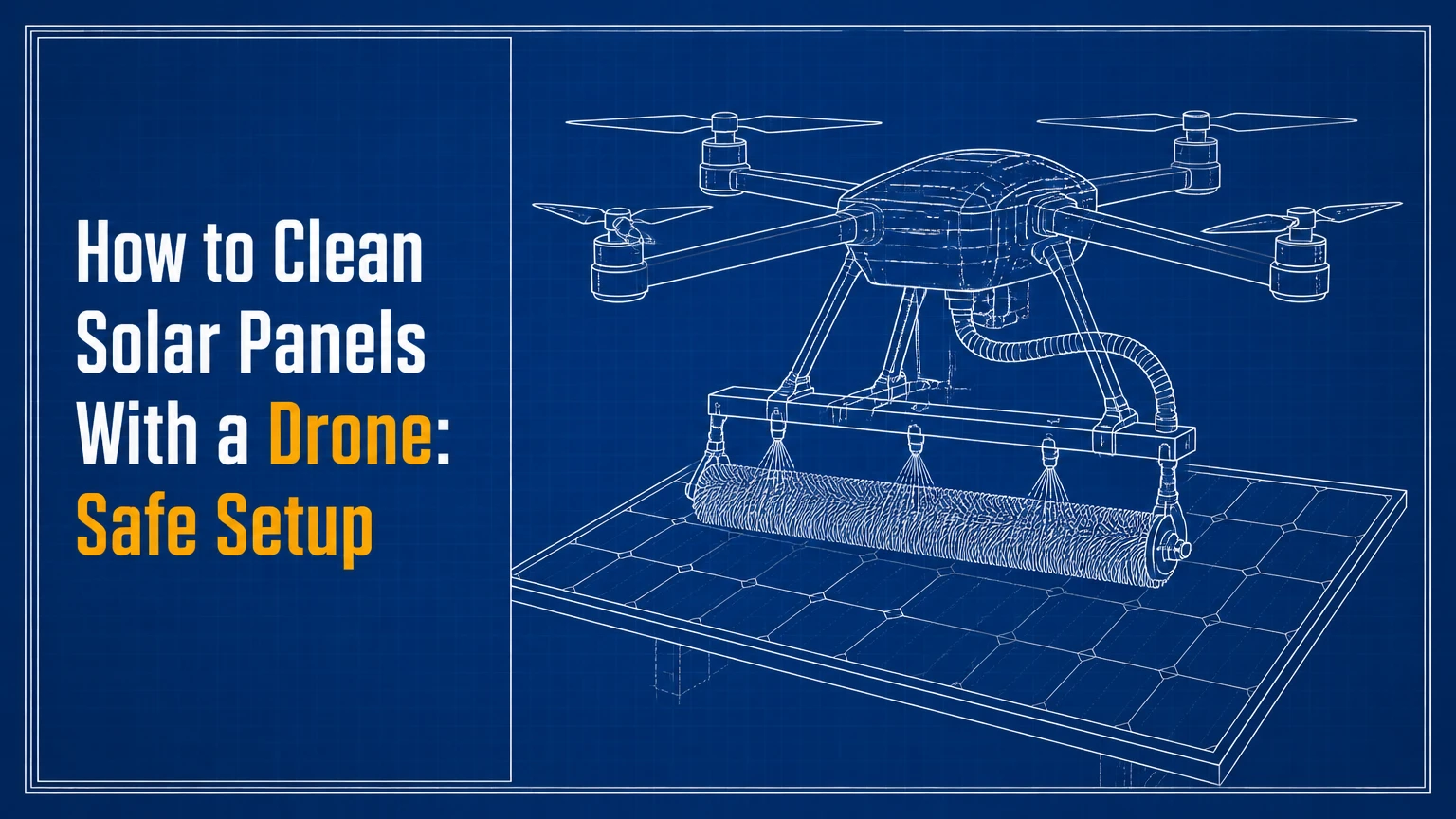
A solar-panel cleaning drone uses a purpose-built UAV, controlled spray system, and ground crew to remove dust, pollen, bird droppings, and residue without sending workers onto the array. The safe process requires site permission, electrical and aviation controls, treated water, a mapped flight path, low-impact cleaning settings, and post-cleaning inspection.
Key Facts at a Glance
- A cleaning drone should use soft spray or manufacturer-approved brushes, not abrasive bristles or uncontrolled pressure-washing heads.
- Reverse-osmosis or deionized water reduces mineral spotting; the required water quality depends on local water chemistry and module guidance.
- RTK positioning improves repeatability, but visual line of sight, obstacle detection, and a trained pilot remain necessary.
- Solar modules can still produce DC voltage in daylight after an inverter shutdown, so cleaning is not automatically an electrically safe task.
- A typical loaded multirotor flight lasts about 8-20 minutes, while tethered systems trade hose management for longer fluid availability.
- Residential arrays usually have better economics with an insured ground-based cleaning crew than with dedicated drone ownership.
What Is a Solar-Panel Cleaning Drone?
A solar-panel cleaning drone is an industrial multirotor fitted with a spray boom, hose connection, tank, brush, or combination cleaning tool. The aircraft carries the cleaning system over photovoltaic modules while a pilot or automated route keeps the tool at a controlled distance from the glass.
Cleaning drones are not ordinary camera drones with a garden sprayer attached. A commercial system must manage payload weight, fluid movement, pump pressure, hose drag, rotor downwash, battery heating, and the consequences of losing position over glass or electrical equipment.
The target contamination determines the tool. Loose desert dust may need a low-pressure pure-water rinse, while dried bird droppings may require soaking and a second pass. Cement dust, salt film, oily industrial residue, and pollen can require a compatible detergent followed by a thorough rinse.
How does the cleaning process work?
A pilot first surveys the array, identifies hazards, and creates a controlled route. The drone then moves parallel to the module rows while a spray system wets and rinses the surface, or a soft approved roller makes contact under carefully limited pressure.
RTK GPS can improve lane repeatability when the base station, satellite view, and correction link remain reliable. RTK does not detect every wire, crane, antenna, parapet, tree, bird, or unexpected person. A pilot must retain authority to stop the operation.
Rotor downwash can dislodge dry dust, but downwash alone does not remove bonded grime. In some layouts, downwash also redistributes dust onto adjacent modules or blows contaminated water toward inverters and roof edges. Operators should treat aerodynamic cleaning as a secondary effect rather than the primary method.
What Equipment and Controls Are Needed?
A professional operation needs more than an aircraft and water tank. The minimum setup includes a suitable UAV, approved cleaning attachment, batteries or tether power, treated water, filtration, exclusion barriers, communications, and documented emergency procedures.
Before You Start
| Requirement | Typical specification | Verification point |
|---|---|---|
| Aircraft | Heavy-lift multirotor rated above working payload | Confirm payload at the intended altitude and temperature |
| Water supply | 30-60 L onboard tank or ground pump and hose | Check flow, hose length, and refill method |
| Water quality | RO or deionized supply, often below 30-50 ppm TDS | Test at the nozzle, not only at the source |
| Positioning | RTK GNSS plus visual piloting | Confirm correction lock and return-to-home behavior |
| Cleaning tool | Low-pressure nozzle or soft approved roller | Follow module and attachment manufacturer limits |
| Crew | Pilot plus ground operator for commercial work | Assign one person to watch hazards and hose movement |
| Safety zone | Cones, barriers, signs, and roof access control | Keep people outside the flight and runoff areas |
| Records | Site map, weather log, route file, inspection photos | Store before-and-after evidence |
The water figure is a practical starting range, not a universal pass-fail rule. Module glass, local minerals, detergent chemistry, and the final rinse determine whether spotting occurs. Conductivity and a dried-glass test are more informative than TDS alone.
How Do You Clean Solar Panels With a Drone?
The operating sequence has eight steps. A small rooftop survey may take 30-60 minutes to prepare, while a commercial array requires a documented site plan, water logistics, weather checks, and an emergency briefing before launch.
Step 1: Confirm the Site Is Suitable
Inspect the array from the ground and review the module layout, roof access, nearby buildings, power lines, antennas, HVAC units, trees, fences, public roads, and pedestrian routes. Identify whether the aircraft must cross over people, property outside the operator’s control, or energized equipment.
Measure the array’s row spacing, module tilt, highest point, lowest clearance, and distance from the launch area. Photograph damaged glass, loose frames, exposed conductors, cracked junction boxes, and existing stains before cleaning.
You will know it worked when: the crew can identify every planned flight boundary, emergency landing zone, and no-fly area without guessing.
Common mistake: treating a clear satellite image as a current site survey. Construction equipment and temporary obstacles change quickly.
Step 2: Check Aviation, Property, and Electrical Permissions
Verify the aviation rules that apply where the drone will operate. In the United States, commercial drone work generally falls under Federal Aviation Administration Part 107, including remote-pilot certification, operating limitations, airspace compliance, and registration requirements. Controlled airspace may require FAA authorization through the applicable process.
Obtain written permission from the property owner and coordinate with the facility manager. For a rooftop, confirm roof-load limits, fall-protection requirements, access restrictions, and the building’s water-disposal rules.
Use the site’s electrical safety procedure before approaching modules. Turning off the inverter may stop AC export, but illuminated PV modules and DC conductors can remain energized. Only qualified personnel should isolate, lock out, verify, or work near electrical components.
You will know it worked when: the operator has written site authorization, current airspace approval where required, and a signed electrical and roof-safety plan.
Common mistake: assuming a drone eliminates all worker hazards. The ground crew still faces vehicles, roofs, hoses, electricity, slips, and falling objects.
Step 3: Map the Array and Build the Flight Route
Create a route that follows module rows with consistent stand-off distance and overlap. Use RTK corrections when the aircraft supports them, but retain a manual route or safe landing plan if the correction link fails.
Set geofences around roof edges, inverters, skylights, antennas, neighboring property, and overhead lines. Use conservative row spacing and speed during the first pass. Manufacturer values such as 1 m/s and a 45-degree spray angle may be useful test settings, but neither value applies to every nozzle, module tilt, pump, or aircraft.
You will know it worked when: a dry rehearsal or low-risk hover confirms the aircraft maintains clearance, the spray reaches the intended glass, and the route does not send runoff toward sensitive equipment.
Common mistake: optimizing the route for maximum area before confirming spray coverage. A fast pass that misses the lower module edge creates rework.
Step 4: Prepare Treated Water and Cleaning Solution
Use water filtered through reverse osmosis, deionization, or another validated treatment system. Test TDS or conductivity at the operating point, inspect filters, and perform a small dry-down test on a representative module.
Use a module-compatible, neutral or manufacturer-approved cleaner only when water alone cannot remove the contamination. Never mix chemicals casually, and never discharge detergent or dirty rinse water into storm drains without checking local requirements.
You will know it worked when: the test area dries without visible mineral rings, greasy film, or detergent residue.
Common mistake: using untreated tap water because the panels appear clean while wet. Dissolved calcium and silica become visible after evaporation.
Step 5: Inspect and Configure the Drone
Install the tank, hose, pump, nozzle, brush, guards, batteries, and payload connections according to the aircraft instructions. Confirm that the loaded aircraft remains within its center-of-gravity and maximum-payload limits.
For a tethered aircraft, inspect the hose for kinks, abrasion, leaks, and excessive drag. Secure the ground pump and keep the hose operator away from the aircraft’s flight path. For an onboard tank, account for changing mass as the fluid is consumed, because handling can change during the route.
Check propellers, motors, landing gear, battery condition, GNSS status, compass warnings, obstacle sensors, return-to-home altitude, and emergency-stop behavior.
You will know it worked when: the aircraft passes its preflight checklist with the actual payload installed, not an empty-tank substitute.
Common mistake: testing an empty aircraft and assuming its loaded flight characteristics will be identical.
Step 6: Perform a Low-Impact Test Pass
Start with a short section containing representative dust, bird residue, and module tilt. Use the lowest pressure and slowest practical speed that deliver coverage. Keep the nozzle or roller at the manufacturer’s specified stand-off distance.
Avoid spraying directly into module edges, junction boxes, connectors, cable penetrations, inverter vents, or roof-mounted electrical equipment. Do not use a 3,000-psi setting merely because a pump can produce it. High pressure can force water into seals, damage coatings, loosen labels, and increase glass or frame risk.
You will know it worked when: the glass is uniformly wet, contamination releases without visible abrasion, no water reaches prohibited equipment, and the dry surface has no streaks.
Common mistake: judging cleaning quality while the glass is wet. Mineral spotting and detergent film appear during drying.
Step 7: Clean the Array in Controlled Passes
Clean one mapped block at a time, maintaining a stable speed, stand-off, and overlap. Use a pre-soak for dried bird droppings or sticky residue rather than increasing pressure. A second low-pressure rinse usually produces a better result than one aggressive pass.
A typical loaded drone may operate for 8-20 minutes per battery cycle, but payload, wind, temperature, hose drag, and repeated acceleration can reduce endurance. Land before the battery reaches the manufacturer’s reserve threshold, and exchange batteries in a designated safe area.
You will know it worked when: every module edge receives coverage, the surface dries evenly, and the route log identifies any missed or repeated lanes.
Common mistake: allowing the pilot to manage flight, water, pedestrians, hose position, and battery status alone. Divided attention increases operational risk.
Step 8: Inspect, Document, and Restore the Site
Photograph cleaned blocks after drying. Compare output data only after allowing for irradiance, cloud cover, inverter clipping, temperature, and normal system variation. A thermal camera can identify suspicious hot cells or bypass-diode behavior, but thermal anomalies require qualified diagnostic follow-up.
Inspect roof drains, gutters, cable routes, inverter enclosures, and the ground for runoff or loosened debris. Remove barriers only after the aircraft, hose, chemicals, and tools are accounted for.
You will know it worked when: the array is visually clean, no equipment has received prohibited water, all anomalies are logged, and the site manager accepts the closeout record.
Common mistake: promising a fixed energy increase. Soiling recovery depends on the starting condition, irradiance, module technology, cleaning quality, and whether dirt was actually the performance constraint.
Which Drone Type Fits the Site?
The best system depends on water logistics, roof geometry, production scale, and whether the aircraft must carry fluid. Onboard tanks simplify hose management, while tethered systems support longer cleaning runs but add drag, trip hazards, and ground coordination.
| System type | Typical capacity or reach | Best-fit site | Main limitation |
|---|---|---|---|
| Onboard liquid tank | 30-60 L, 8-20 minute loaded flights | Small commercial roofs, carports, fragmented arrays | Payload reduces endurance and handling margin |
| Ground-tethered hose | Continuous ground supply, hose lengths commonly 30-100 m | Large arrays, tall facades, repeated low-pressure rinses | Hose drag, snagging, and runoff management |
| Spray-only attachment | Low-pressure or controlled-flow nozzle | Loose dust, pollen, light salt film | Weak against baked-on contamination |
| Soft brush attachment | Contact roller or approved microfiber tool | Dried residue and bonded industrial dust | Contact force and debris can scratch glass |
| Inspection and cleaning payload | RGB or thermal camera plus cleaning tool | Sites needing condition records during maintenance | Thermal findings need qualified interpretation |
A tethered drone is not automatically better for a utility-scale field. Long hose runs can cross roads, drainage channels, trackers, and neighboring rows, so a wheeled ground system or robotic cleaner may be safer and more productive in some layouts.
How Much Does Drone Cleaning Cost?
A professional drone cleaning service commonly prices work by panel, square meter, mobilization, or contract scope. Typical service pricing of about $0.30-$0.40 per panel can be competitive with manual crews, but travel, access, water treatment, inspection, and regulatory overhead may dominate small jobs.
| Cost item | Typical range | Main cost driver |
|---|---|---|
| Professional drone cleaning service | $0.30-$0.40 per panel | Array size, contamination, access, travel |
| Manual or pole-based service | $0.45-$0.55 per panel | Labor, roof access, water handling |
| Professional equipment package | $4,000-$10,000 | Aircraft, batteries, pump, attachment |
| Specialized custom system | $25,000 or more | Payload, tether, automation, inspection hardware |
| Treated water and consumables | $0.02-$0.15 per panel | Local water chemistry and rinse volume |
| Mobilization for a small site | $250-$1,000 typical | Distance, permits, setup, and crew time |
These figures are planning ranges, not universal market prices. Ask providers whether the quote includes water, batteries, pilot time, roof access, thermal inspection, wastewater control, insurance, and a return visit for missed or streaked modules.
How long does a drone cleaning job take?
A two-person crew may clean roughly 200-240 square meters per loaded flight under favorable conditions, while daily output around 800-1,000 panels is possible for a well-organized large site. Actual production falls when rows are narrow, wind rises, contamination needs soaking, or the aircraft must repeatedly reposition.
| Operating condition | Flight or work range | Planning consequence |
|---|---|---|
| Loaded onboard-tank flight | 8-20 minutes | Schedule battery swaps and refills |
| Tethered cleaning cycle | Battery-limited, fluid supply continuous | Allocate hose handlers and pump checks |
| Small rooftop survey | 30-60 minutes preparation | Complete permissions before arrival |
| Typical production pass | About 1 m/s starting speed | Validate coverage before increasing speed |
| Favorable daily output | 800-1,000 panels | Requires efficient access and ground support |
| Wind operating threshold | Verify aircraft-specific limit, often below 10 m/s for precision work | Stop earlier when spray drift or control margin worsens |
Wind resistance ratings are not cleaning-quality ratings. A drone may remain airborne in stronger wind while spray misses the glass, hose drag increases, and downwash spreads contaminated water.
Drone Cleaning Compared With Alternatives
Drone cleaning removes the need for workers to climb across an array, but it does not eliminate all labor or all damage risk. Manual pole systems remain practical for small, accessible arrays, while robotic cleaners can outperform aircraft on repetitive utility-scale rows.
| Method | Typical cost basis | Best operating height or layout | Main risk or weakness |
|---|---|---|---|
| Cleaning drone | $0.30-$0.40 per panel | Steep roofs, fragmented commercial sites | Aviation compliance and weather dependence |
| Ground-based telescopic pole | $0.45-$0.55 per panel | Residential and low-rise arrays | Slow access and limited reach |
| Roof-access manual crew | Site-specific labor quote | Complex stains and detailed inspection | Fall, glass, and electrical exposure |
| Solar cleaning robot | Equipment or contract pricing | Long, regular utility rows | Trackers, gaps, and transport logistics |
| Fixed brush or truck system | Contract-specific | Large ground arrays with vehicle access | Requires row clearance and road access |
For a homeowner with 10-30 modules, drone ownership rarely produces a sensible payback. A qualified, insured ground crew can usually mobilize more cheaply and avoid aviation administration.
For a utility operator, compare drone output with robotic cleaning by total cost per megawatt-hour, not cost per flight. Include water use, transport, battery replacement, row changeover, downtime, and the value of thermal inspection.
What Are the Common Failure Modes?
Most poor results come from unsuitable water, excessive pressure, weak route control, or cleaning under the wrong weather conditions. The recovery method should address the cause rather than sending the drone over the same glass repeatedly.
| Failure | Likely cause | Corrective action |
|---|---|---|
| White spots after drying | High-mineral water or exhausted filters | Replace media, retest source water, perform a pure-water rinse |
| Streaks or oily film | Excess detergent, poor overlap, or incomplete rinse | Reduce chemical concentration and add a final rinse |
| Route drift | RTK correction loss, magnetic interference, or poor calibration | Stop, relocate the base, recalibrate, and rerun a short test |
| Missed lower edges | Excessive speed, wrong stand-off, or poor spray angle | Slow the pass and adjust coverage using manufacturer limits |
| Dust returns to cleaned modules | Rotor downwash or crosswind | Change approach direction, reduce agitation, and clean smaller blocks |
| Glass or coating damage | Abrasive brush, grit trapped in contact tool, or excessive pressure | Stop operation, document damage, and use an approved noncontact method |
Solar modules should generally be cleaned when glass temperatures and contamination conditions permit. Early morning can reduce thermal stress, but dew can dilute detergent and create uneven runoff. Follow module-maker guidance and avoid spraying a hot surface with markedly colder liquid.
When Should You Not Use a Cleaning Drone?
Do not use a cleaning drone when the operator cannot maintain legal flight control, safe separation, or a reliable emergency landing option. High wind, lightning, heavy rain, poor visibility, nearby power lines, unstable RTK, unauthorized airspace, and uncontrolled public access are valid stop conditions.
A drone is also a poor choice when the array has severe bonded contamination that requires controlled hand treatment, when the roof cannot support the ground crew safely, or when runoff would enter sensitive equipment or a regulated drain. A low-cost pole system may produce a safer result.
Solar-panel cleaning is not a substitute for electrical maintenance. Cracked modules, burned connectors, insulation faults, loose frames, and hot spots belong in a qualified inspection and repair workflow.
How Do You Measure Whether Cleaning Paid Off?
Measure soiling loss before and after cleaning rather than assuming a fixed recovery percentage. Compare irradiance-normalized energy from a cleaned block with an equivalent uncleaned reference, or use a soiling station, clear-sky model, and inverter data over a defined period.
A practical measurement plan records module temperature, irradiance, inverter output, cleaning time, water volume, weather, and contamination type. A single sunny afternoon cannot prove a 10% or 25% gain because irradiance, clipping, temperature, and cloud movement can overwhelm the cleaning effect.
Calculate payback as:
Cleaning benefit = recovered kilowatt-hours × electricity value minus cleaning cost
Schedule more frequent cleaning where dust deposition, agricultural pollen, bird activity, or salt exposure creates measurable losses. Cleaning less often may be rational where rainfall removes loose soil and energy recovery remains below the service cost.
FAQ
Can a normal camera drone clean solar panels?
A normal camera drone should not be adapted for cleaning. Consumer aircraft are not designed for liquid payloads, hose drag, spray recoil, contaminated runoff, or operation near energized photovoltaic equipment. Use a commercial airframe and attachment rated for the actual payload, or hire an insured specialist.
Does drone cleaning damage solar panels?
Drone cleaning can damage modules if operators use abrasive brushes, excessive pressure, contaminated water, or uncontrolled contact. Low-impact methods reduce risk, but no aircraft-based process is risk-free. A test section, module-compatible tools, treated water, and documented stand-off settings should precede full-array cleaning.
Can a drone clean floating solar panels?
A drone can reach some floating solar arrays, but the operation requires special planning for wind over water, emergency recovery, corrosion, boat traffic, hose management, and electrical isolation. A tethered aircraft may create unacceptable drag or entanglement risk, so a boat-based or robotic method can be preferable.
How often should solar panels be cleaned?
Cleaning frequency should follow measured soiling rather than a universal calendar. A dusty agricultural site may need monthly or quarterly service during deposition seasons, while a rainy residential site may need only occasional cleaning. Compare energy recovery with service cost before setting the interval.
Is pure water better than solar-panel detergent?
Pure water is usually the simplest final-rinse medium when its mineral content is low enough to dry without spotting. Detergent can help with oily or bonded contamination, but the product must be module-compatible and completely rinsed. More chemical does not compensate for poor water quality or incorrect pressure.
Can drone cleaning increase solar output by 25%?
Drone cleaning can restore output lost to soiling, but a 25% increase is site-specific and should not be promised in advance. The result depends on accumulated dirt, rainfall, irradiance, module temperature, shading, inverter limits, and the quality of the cleaning. Measure before and after to establish the actual gain.
Conclusion: Is Drone Cleaning Right for Your Array?
To clean solar panels with a drone, use a purpose-built commercial UAV, obtain aviation and site permissions, control electrical and roof hazards, map the array, use treated water, test low-impact settings, clean in short controlled passes, and document the dry result. Drones fit steep, hazardous, fragmented, or large commercial sites best; small residential arrays usually favor an insured ground-based alternative.