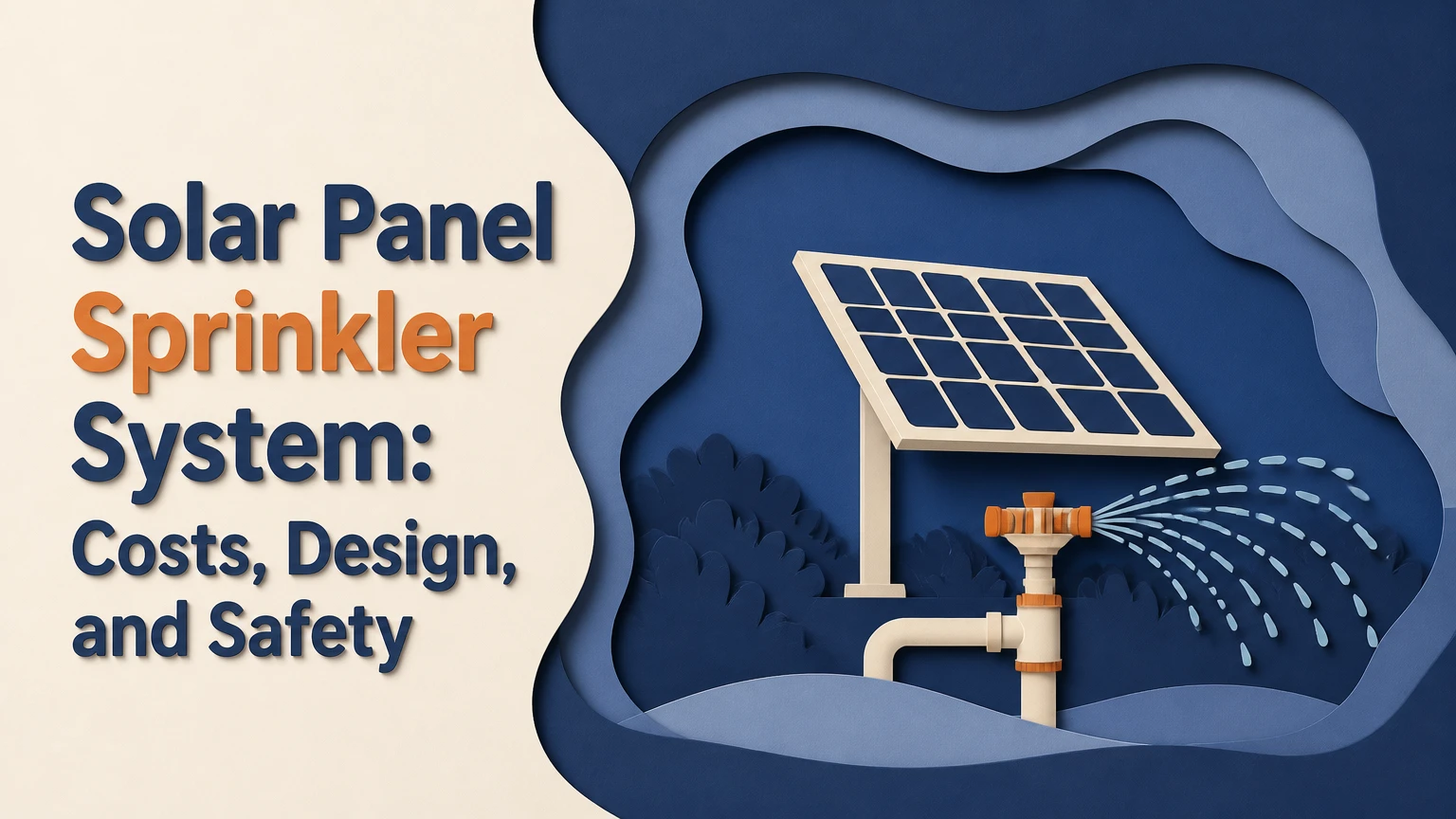
A solar panel sprinkler system is an automated panel-cleaning assembly that distributes water across photovoltaic modules through fixed spray nozzles, pipes, valves, a controller, and sometimes a pump powered by a solar-charged battery. The system reduces loose dust and bird residue, but its value depends on soiling severity, water quality, roof safety, drainage, and the cost of installation.
Key Facts at a Glance
- A panel-cleaning sprinkler system normally uses a timer or sensor, pump, filter, valves, distribution tubing, and low-profile nozzles.
- Soiling losses vary widely; a 10%-30% production reduction is possible in severe conditions, but many sites experience substantially less.
- Clean, low-mineral water matters more than maximum spray pressure because dissolved minerals can leave permanent-looking scale on glass.
- Solar modules should not be sprayed when their glass is very hot or when freezing conditions can trap water in plumbing.
- Plumbing must attach to the independent racking structure, not by drilling into photovoltaic module frames.
- A cleaning system usually makes financial sense first on dusty commercial arrays, agricultural sites, and difficult-to-access roofs.
What Is a Solar Panel Sprinkler System?
A solar panel sprinkler system is a fixed or semi-fixed water-rinsing network installed above or alongside a photovoltaic array. Its purpose is to move water over the module glass so gravity carries away loose dust, pollen, salt, and surface debris. The system is different from a lawn irrigation sprinkler because its nozzle pattern, water chemistry, mounting method, and drainage requirements must suit photovoltaic equipment.
The phrase can also describe a sprinkler installation powered by a solar pump. That meaning concerns irrigation, not panel maintenance. For solar cleaning, the most accurate terms are automated solar panel cleaning system, photovoltaic module rinsing system, and solar array wash system.
Cleaning does not repair shading, failed bypass diodes, delamination, inverter faults, or cracked glass. It only addresses contamination on the front surface. That distinction prevents an owner from spending on plumbing when the production loss comes from an electrical or mechanical fault.
How Does an Automated Panel Rinsing System Work?
An automated panel rinsing system opens a water valve on a schedule or after a sensor trigger, then sends filtered water through nozzles positioned at the upper edge of each module row. Water flows downward across the glass, carrying loose contamination toward a designed gutter, roof edge, drain, or ground infiltration area.
A typical arrangement is:
Water source → shutoff valve → backflow protection → sediment filter → pump → pressure regulator → solenoid valves → distribution pipe → spray nozzles
The controller can run a 12V or 24V pump directly through a relay, or it can operate a mains-powered pump through a properly rated outdoor control enclosure. A solar-charged battery is useful where grid power is unavailable, but the cleaning array still needs safe wiring, fusing, weatherproof connectors, and a service disconnect.
What Each Component Does
| Component | Typical specification | Design purpose | Common failure |
|---|---|---|---|
| Storage tank | 25-250 gallons | Holds rainwater or treated supply | Algae, sediment, empty tank |
| Sediment filter | 50-100 micron prefilter | Protects pump and nozzles | Rapid clogging |
| Booster pump | 1-5 GPM, 30-70 PSI | Supplies pressure and flow | Dry running or undersizing |
| Controller | 12V or 24V, 1-6 zones | Schedules wash cycles | Water ingress or fuse failure |
| Solenoid valve | 1/2-inch or 3/4-inch | Separates array zones | Sticking from grit or scale |
| Distribution pipe | 1/2-inch or 3/4-inch UV-rated tubing | Carries water to nozzles | Sagging, cracking, freezing |
| Spray nozzle | 0.2-1.0 GPM each | Creates the wash pattern | Mineral blockage or overspray |
Pressure is not a universal target. A nozzle rated for 25 PSI may produce a satisfactory sheet, while a misting nozzle may require a higher pressure to produce its published pattern. Select the pump from the nozzle datasheet, total simultaneous flow, vertical lift, pipe friction, and filter loss rather than choosing a generic “high-pressure” pump.
Does Cleaning Increase Solar Panel Output?
Cleaning can increase photovoltaic output when dirt blocks light, but the gain is site-specific rather than guaranteed. The National Renewable Energy Laboratory identifies soiling as a measurable operating loss and has developed the widely used PV Performance Modeling Collaborative soiling model; field results vary with rainfall, tilt, particle type, wind, and cleaning frequency.
A 10%-30% loss is plausible in dry, dusty, agricultural, or bird-heavy environments. It is not a reliable default for every home. A steep roof in a rainy climate may gain little from automated rinsing, while a low-tilt array beside an unpaved road can accumulate enough dust to justify frequent cleaning.
Measure before automating. Compare inverter energy data on similarly sunny days, inspect module glass, and record output before and after a controlled wash. A temporary production monitor or utility-grade irradiance comparison gives a better investment decision than assuming a percentage loss.
A Simple Payback Calculation
Use:
Annual recovered value = array capacity × annual sunlight hours equivalent × expected recovered fraction × electricity rate
For example, a 6-kilowatt array producing 7,200 kWh annually, with a measured 12% soiling loss and electricity value of $0.22 per kWh, has an estimated recoverable value of:
7,200 × 0.12 × $0.22 = $190 per year
A $2,000 installation would not repay through energy recovery alone in that example. A system that prevents dangerous roof access or reduces commercial cleaning labor may still be justified, but those benefits should be counted separately.
Which System Type Fits the Array?
Fixed overhead nozzles are usually the simplest option for small residential arrays, while robotic spray bars are more appropriate for large commercial rows where labor and access dominate costs. Sensor-driven operation can reduce unnecessary washes, but optical sensors need calibration and may not detect every form of contamination.
| System type | Typical scale | Water use | Best operating condition |
|---|---|---|---|
| Fixed spray nozzles | 6-40 modules | 0.5-1.5 gallons per module per cycle | Accessible racking with reliable drainage |
| Zoned spray bars | 40-500 modules | 0.3-1.0 gallon per module | Long commercial rows |
| Robotic cleaning rail | 500+ modules | 0.1-0.5 gallon per module, or dry cleaning | High labor cost and repetitive geometry |
| Gravity-fed rinse | 2-20 modules | 0.5-2.0 gallons per module | Elevated tank and low-pressure nozzles |
| Manual purified-water cleaning | 1-100 modules | 0.1-0.5 gallon per module | Occasional contamination and low capital budget |
Fixed Sprinklers
Fixed nozzles have low mechanical complexity and can wash a row without moving parts. Their weaknesses are permanent exposure to weather, uneven pressure across long runs, and the possibility that a clogged nozzle creates a dry strip.
Robotic Cleaning Equipment
Robotic brushes, wipers, or spray bars reduce water use on very large arrays. They cost more, require compatible module spacing, and introduce motors, rails, wheels, and control electronics that need their own maintenance.
Gravity-Fed and Rainwater Systems
Rainwater can reduce mineral spotting, but a rain barrel does not automatically provide enough pressure. Pressure from elevation is approximately 0.433 PSI per vertical foot, so a tank only 10 feet above the nozzle supplies about 4.3 PSI before pipe losses. Many commercial spray nozzles will not perform at that pressure.
How Do You Design the Plumbing?
Design the array as hydraulic zones rather than placing every nozzle on one long pipe. Each zone should have a known nozzle count, a calculated flow rate, and enough pressure at the farthest nozzle to maintain the required spray pattern.
Use this basic calculation:
Zone flow in GPM = number of active nozzles × nozzle flow in GPM
A zone with eight nozzles rated at 0.35 GPM requires 2.8 GPM before adding filter and pipe losses. The pump must deliver that flow at the pressure specified by the nozzle manufacturer, plus the vertical lift from the tank or supply line.
| Array layout | Nozzle arrangement | Typical zones | Design check |
|---|---|---|---|
| 10 modules in one row | 5 top-edge nozzles at 0.35 GPM | 1 | 1.75 GPM plus losses |
| 20 modules, two rows | 5 nozzles per row at 0.35 GPM | 2 | 1.75 GPM per zone |
| 36 modules, three rows | 6 nozzles per row at 0.40 GPM | 3 | 2.40 GPM per zone |
| 60 modules, five rows | 6 nozzles per row at 0.40 GPM | 5 | 2.40 GPM per zone |
Install a sediment filter before small nozzle orifices. Add a pressure regulator when the supply can exceed the nozzle rating. Place a manual drain at low points, especially where freezing is possible.
How Do You Install a Panel-Cleaning Sprinkler Network?
A small ground-mounted system may be suitable for competent DIY work, but roof-mounted plumbing creates fall, electrical, and water-intrusion risks. A licensed electrician or solar contractor should review wiring, module access, roof penetrations, and local plumbing requirements before commissioning a permanent installation.
Before You Start
| Requirement | Typical residential value | Practical note |
|---|---|---|
| Materials budget | $250-$600 DIY | Excludes roof-safety equipment |
| Professional installation | $1,200-$3,500 | Varies with roof pitch and access |
| Design and installation time | 4-8 labor hours DIY | Longer for multiple zones |
| Nozzle water demand | 0.2-0.8 GPM each | Confirm the product datasheet |
| Required tools | 5-8 basic tools | Include a pressure gauge and multimeter |
| Safety equipment | Harness, anchors, ladder stabilizer | Use only equipment rated for the task |
Step 1: Map the Array
Record each row’s length, slope, module orientation, gutter location, and drainage path. Mark obstructions such as vents, skylights, clamps, optimizers, and cable runs.
You will know the layout is usable when every module has overlapping wetting coverage and runoff cannot enter an electrical enclosure. The common mistake is designing for nozzle spacing without studying where dirty water will exit.
Step 2: Divide the Array Into Zones
Group modules by row length and elevation. Keep zone flow within the pump’s operating range, and use separate solenoid valves when a single run would create a significant pressure drop.
You will know the zoning is adequate when the first and last nozzles produce comparable patterns during a pressure test. Avoid running all nozzles simultaneously until the hydraulic calculation confirms sufficient flow.
Step 3: Mount the Distribution Pipe
Attach tubing to independent racking members with manufacturer-approved clamps or UV-resistant clips. Do not drill into module frames, laminate surfaces, rails containing wiring, or roof membranes.
You will know the pipe is secure when it cannot rub against glass, sharp aluminum, or exposed cable insulation under wind movement. Loose tubing is a mechanical hazard because it can abrade wiring over time.
Step 4: Install and Aim the Nozzles
Position low-profile nozzles near the upper edge of each row and angle them so water travels down the module face rather than outward. A 180-degree nozzle may suit an edge row, while a 360-degree nozzle may waste water through overspray.
You will know the pattern works when the lower portion of every module becomes wet without spray reaching electrical connectors, neighboring property, or pedestrian areas. A nozzle that produces a fine mist may drift in wind instead of rinsing the glass.
Step 5: Connect Filtration, Valves, and Controls
Install a shutoff valve, backflow prevention appropriate to the local plumbing code, sediment filtration, pump protection, and a fused controller circuit. A rainwater tank connected to a household potable line requires physical separation and compliant backflow protection.
You will know the control system is safe when each zone can be isolated manually, the pump cannot run dry, and electrical enclosures remain closed during operation. Do not place low-voltage equipment where roof runoff can collect.
Step 6: Flush, Test, and Commission
Flush the pipe before installing final nozzle tips, then test one zone at a time for 2-5 minutes. Measure inlet pressure and inspect for leaks, dry areas, excessive mist, and runoff problems.
You will know commissioning is complete when the farthest nozzle maintains its intended pattern and the array drains without ponding. Photograph the working spray pattern for future troubleshooting.
What Water and Timing Are Safe?
Filtered rainwater or properly treated low-mineral water is usually safer for glass than hard tap or untreated well water. Water hardness creates calcium and magnesium deposits, and iron-rich well water can leave rust-colored stains that become harder to remove after repeated drying.
The best timing rule is based on module temperature, not a universal clock. Early morning, late evening, or an overcast cool period reduces thermal stress and evaporation. Spraying cold water onto very hot glass can impose a temperature difference, but claims that any daytime rinse will automatically shatter tempered solar glass are overstated. Follow the module manufacturer’s cleaning instructions and avoid extreme temperature changes.
A wash cycle should also be skipped when freezing is expected, strong wind will cause overspray, or rain will provide an equivalent rinse shortly afterward. Weather automation can reduce waste, but a forecast is not a substitute for inspecting actual contamination.
What Does a Solar Panel Sprinkler System Cost?
A typical DIY residential installation costs $250-$600 for tubing, fittings, nozzles, filtration, a timer, and a small pump. Professional residential projects commonly cost $1,200-$3,500, while commercial systems with multiple zones, tanks, controls, and access equipment can exceed $5,000.
| Project scale | Equipment cost | Installed cost | Typical duration |
|---|---|---|---|
| 6-12 ground-mounted modules | $150-$350 | $400-$1,000 | 2-4 hours |
| 10-20 roof modules | $250-$600 | $1,200-$3,500 | 4-8 hours |
| 30-100 commercial modules | $1,000-$4,000 | $5,000-$12,000 | 1-3 days |
| 100+ commercial modules | $3,000-$12,000 | $10,000-$25,000+ | 2-7 days |
These are typical planning ranges, not universal quotes. Roof access, fall protection, water storage, electrical work, permits, freeze protection, and the need for purified water can change the total substantially.
Compare annual recovered electricity value with equipment, water, filter replacements, winterization, repairs, and controller electricity. A $500 system that recovers $150 annually has a simple energy-only payback of about 3.3 years, before maintenance and financing.
What Are the Main Risks and Failure Modes?
The most serious risks are unsafe roof access, mineral deposits, uncontrolled runoff, freezing, and poorly protected electrical connections. Automated water delivery does not remove the need for inspection because a system can distribute contaminated water consistently and efficiently.
| Symptom | Likely cause | Corrective action |
|---|---|---|
| Dry strip on one module | Clogged or misaligned nozzle | Clean the tip, inspect overlap, adjust angle |
| Weak spray at row end | Excessive zone length or undersized pipe | Split the zone, increase pipe diameter, verify pump curve |
| White film on glass | Hard-water mineral scale | Use deionized or low-mineral water; remove deposits safely |
| Pump runs but no water moves | Empty tank, air lock, blocked filter | Prime pump, clean filter, verify intake level |
| Controller operates intermittently | Low battery, blown fuse, water ingress | Test battery voltage, replace fuse, reseal enclosure |
| Pipe ruptures in winter | Trapped freezing water | Drain low points and remove or insulate vulnerable sections |
| Runoff reaches wall or walkway | Poor drainage planning | Add gutters, deflectors, or a controlled discharge route |
Expert Rules That Prevent Expensive Problems
Do not optimize for mist. Fine mist sounds water-efficient, but wind can carry droplets away and leave dissolved minerals on the panel. A coherent low-volume sheet or fan pattern often cleans more reliably than a drifting fog.
Treat bird droppings separately. A short rinse may soften fresh droppings, but baked-on deposits can remain. Repeated spraying does not guarantee removal, and concentrated droppings can create localized shading until manually treated with approved soft tools.
Keep plumbing independent from photovoltaic hardware. A pipe supported by a module frame can transmit vibration and load into a component that was never designed to carry plumbing. Racking clamps preserve the module manufacturer’s mounting arrangement.
Measure production before buying automation. If a home array loses only 2%-4% from soiling, a recurring cleaning system may cost more energy and water than it recovers. The same system can be rational at a dusty livestock facility with frequent manual-cleaning labor.
Sprinklers Versus Other Cleaning Methods
A fixed water system is not automatically the best cleaning method. Manual purified-water cleaning uses less capital, robotic systems reduce access labor at scale, and dry brushing can be preferable where water is scarce, provided the brush and technique are approved for the module surface.
| Method | Initial cost | Water demand | Access and maintenance | Best fit |
|---|---|---|---|---|
| Fixed sprinkler rinse | $250-$3,500 residential | 0.5-1.5 gal/module | Permanent plumbing service | Frequent dust and difficult access |
| Manual soft brush | $20-$300 equipment | 0.1-1.0 gal/module | Labor and roof risk | Occasional residential cleaning |
| Purified-water pole | $300-$1,500 | 0.1-0.5 gal/module | Filter replacement | Hard-water locations |
| Robotic cleaner | $1,000-$20,000+ | 0-0.5 gal/module | Motors and tracks | Large commercial arrays |
| Dry microfiber cleaning | $20-$150 | 0 gallons | Scratch and static-control risk | Light, loose dust only |
The fixed sprinkler wins when cleaning frequency is high and access is difficult. Manual cleaning wins when contamination is infrequent and the array is safely reachable from the ground. Robotic equipment wins when a large site has repetitive rows and labor costs exceed mechanical maintenance.
When Should You Avoid Automation?
Avoid a permanent sprinkler installation when the array is small, rainfall is frequent, water is expensive, or the panels can be safely cleaned from the ground once or twice per year. Avoid it when drainage cannot be controlled, the supply contains significant minerals, or the roof structure cannot accept additional attachments without warranty or code concerns.
Solar panel cleaning automation is also a poor substitute for an operations plan. Commercial owners still need visual inspections, inverter checks, thermal imaging where appropriate, vegetation control, and electrical testing. Water only addresses surface contamination.
How Often Should Panels Be Washed?
Cleaning frequency should follow measured soiling, not a fixed calendar. A typical residential array may need one or two cleanings annually, while dusty desert or agricultural sites may require cycles every few days during severe conditions.
| Site condition | Starting interval | Trigger for more frequent cleaning |
|---|---|---|
| Rainy suburban roof | 6-12 months | Visible film or measurable output decline |
| Dry urban location | 2-4 months | Construction dust or pollen |
| Desert or unpaved-road site | 3-14 days | Output decline above 5%-10% |
| Agricultural or livestock site | 3-30 days | Dust, ammonia residue, or bird contamination |
| Coastal salt exposure | 1-3 months | Salt film after windy weather |
Rain does not always clean panels. Light rain can turn dust into a muddy film, and rainfall may not remove bird droppings or salt residue. Inspect after storms rather than assuming precipitation completed the maintenance cycle.
FAQ
Can I connect a panel-cleaning sprinkler to a garden hose?
A hose connection can work for a small temporary rinse if the water is low in minerals and the hose pressure matches the nozzle requirements. Permanent systems should include shutoff protection, filtration, compliant backflow prevention, controlled drainage, and a method to prevent stagnant water from entering potable plumbing.
Will sprinkler water damage solar panels?
Clean water used under the module manufacturer’s instructions normally does not damage panel glass. Damage risk increases when water reaches electrical connectors, when mineral deposits accumulate, when fittings abrade cables, or when very cold water contacts extremely hot glass. Never use abrasive powders, aggressive pressure washing, or unapproved chemicals.
Do solar panels need distilled or deionized water?
Solar panels do not universally require distilled or deionized water, but low-mineral water reduces spotting and scale. A reverse-osmosis or deionization system may be worthwhile in hard-water regions, although the filter’s water waste and replacement cost should be included in the operating budget.
Can a solar panel sprinkler system run without grid electricity?
A cleaning system can run without grid electricity using a rainwater tank, 12V or 24V pump, solar charge controller, battery, fuse, and timer. The tank must sit high enough for gravity pressure or the battery must power a pump that meets the nozzle flow and pressure requirements.
Do I need a sensor or is a timer enough?
A timer is enough for a simple, predictable site, but a sensor can prevent unnecessary washes after rain or during low-soiling periods. Optical soiling sensors add cost and require calibration, so production monitoring and visual inspection may provide better value for a small residential array.
Is a sprinkler system better than hiring a panel cleaner?
A sprinkler system is better when recurring access labor is expensive and the array regularly accumulates removable dust. Hiring a cleaner is usually better for small arrays, infrequent contamination, complex stains, or sites where plumbing, water treatment, and drainage would cost more than periodic service.
The Bottom Line
A solar panel sprinkler system can reduce soiling losses with scheduled, low-contact rinsing, but the design must prioritize water quality, drainage, pressure balance, freeze protection, and safe attachment to the racking. Measure actual production loss first. For many homes, occasional purified-water cleaning costs less; for dusty, inaccessible, or commercial arrays, zoned automation can provide a defensible operational benefit.