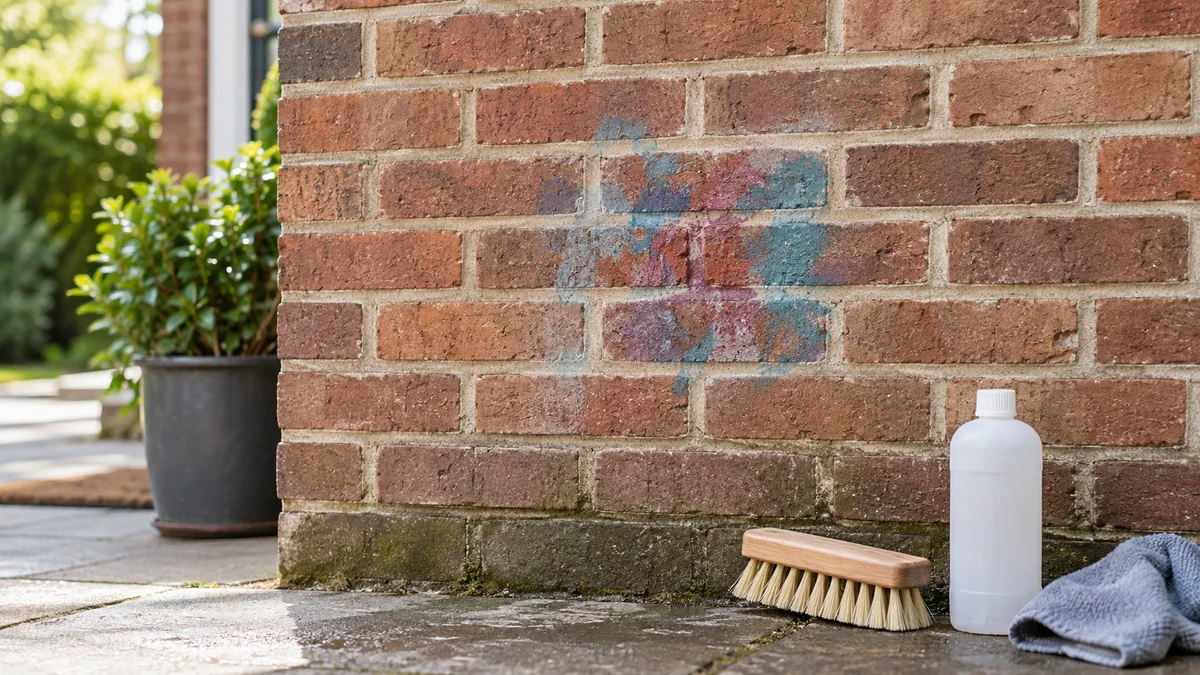
To remove spray paint graffiti from exterior brick walls, soften the paint with a masonry-compatible gel, agitate with a nylon brush, and rinse at the lowest effective pressure. Test first, prevent chemical runoff, and avoid wire brushes, abrasive blasting, acids, and high-pressure jets because porous brick and mortar can be permanently scarred.
Key facts at a glance
Fresh graffiti usually needs less dwell time and fewer applications than weathered paint.
Gel removers stay on vertical brick longer than thin liquids and reduce uncontrolled runoff.
A wide fan nozzle and low pressure are safer than a narrow jet, but the correct setting depends on brick hardness and mortar condition.
Ghosting is residual pigment inside the brick, not proof that more aggressive pressure is needed.
Historic brick, soft handmade brick, lime mortar, and painted masonry warrant a specialist assessment.
A breathable sacrificial anti-graffiti coating can make later removal faster without sealing moisture inside the wall.
What Makes Spray Paint Difficult to Remove From Brick?
Spray paint is difficult to remove from brick because aerosol binders harden across an uneven, absorbent surface while pigment travels into capillaries below the fired face. A masonry graffiti remover must soften the binder without dissolving the brick surface, enlarging pores, weakening mortar, or spreading pigment into clean areas.
Brick is not a flat tile. Its surface includes pits, voids, silica-rich inclusions, and open pores. Spray paint bridges the high points first, then settles into those depressions. Weather, ultraviolet exposure, and repeated wetting can further harden or embed the coating.
Most aerosol paints contain acrylic, alkyd, enamel, or polyurethane-type binders. The label rarely identifies the exact formulation, so a test patch is more useful than guessing from color alone. Older glossy paint often needs longer chemical contact than fresh matte paint.
The fired outer face is the brick’s primary weather-resistant layer. Removing that face exposes softer clay beneath it, which can absorb more water and deteriorate during freeze-thaw cycles. Mortar can fail sooner than brick because old lime mortar is softer and more chemically sensitive.
Why chemical softening is safer than force
Chemical softening reduces the mechanical force needed to detach paint. Solvent blends, alkaline ingredients, or biodegradable ester systems attack the paint binder; the rinse then carries away loosened pigment and residue.
A chemical remover is not automatically safe. Strong alkaline products can burn skin, damage plants, stain some masonry, or discolor adjacent coatings. Product instructions, a test panel, runoff containment, and thorough rinsing control those risks.
What Should You Check Before Removing Graffiti?
Before removing graffiti, identify the brick condition, mortar condition, adjacent materials, paint age, drainage path, and local wastewater requirements. Photograph the wall, measure the affected area, and perform a controlled test patch before buying equipment or treating the full surface.
Before-you-start checklist
| Item | Typical requirement | Why it matters |
|---|---|---|
| Test patch | 30 x 30 cm | Reveals color change and dwell response |
| Work area | 1-2 m beyond tag | Captures splatter and rinse water |
| Product quantity | 0.5-1 L per 2-5 m² | Varies with gel thickness and porosity |
| Initial dwell | 5-15 minutes | Suitable starting point for fresh paint |
| Older paint dwell | 20-60 minutes | Allows hardened binder to soften |
| PPE | Chemical gloves, goggles, boots | Limits skin and eye exposure |
| Weather window | 10-30°C, no strong wind | Controls evaporation and runoff |
Do not begin if rain is likely to wash chemicals into a drain, strong wind can carry spray toward people or plants, or temperatures are low enough to prevent rinsing and drying. Cover windows, metal fittings, painted trim, soil, drains, and nearby vegetation with compatible sheeting.
A respirator is not a substitute for ventilation or label instructions. If the product safety data sheet specifies organic-vapor protection, use a properly fitted respirator with the listed cartridge, and do not work in an enclosed space without professional controls.
How Do You Remove Spray Paint Graffiti From Exterior Brick Walls?
Use a masonry-safe gel remover, keep the surface wet during dwell, agitate with nylon, and rinse gently in controlled passes. A small tag usually takes 30-90 minutes of active work, while layered graffiti can require several cycles or professional equipment.
Step 1: Document and isolate the wall
Photograph the graffiti in daylight and mark the treatment boundary with removable tape. Check whether the wall is bare brick, painted brick, sealed masonry, concrete block, or a mixed facade.
Remove loose dirt with a dry soft brush. Do not pre-soak the entire wall if doing so would carry pigment downward before the remover has softened it. Protect drains and collect runoff whenever the product label requires containment.
Success checkpoint: The tag, substrate, nearby finishes, and runoff path are clearly identified.
Common mistake: Treating a painted or sealed wall as bare brick.
Step 2: Select a masonry-compatible remover
Choose a product explicitly labeled for brick, masonry, or porous mineral surfaces. Gelled alkaline, solvent, ester, or specialty graffiti-removal products can work, but the label must specify the substrate and required rinse or neutralization method.
Avoid selecting a product solely because it removes paint from metal or glass. A solvent that works on a smooth surface can drive pigment deeper into brick or soften an adjacent coating.
Success checkpoint: The product label identifies masonry compatibility, dwell time, PPE, and disposal instructions.
Common mistake: Mixing two removers to increase strength. Chemical mixtures can release heat or toxic vapors.
Step 3: Perform a representative test patch
Apply the remover to a hidden or low-visibility 30 x 30 cm area that includes brick face and, if possible, a mortar joint. Use the same brush, thickness, dwell time, and rinse method planned for the full wall.
Inspect the patch after it dries. Look for lightening, darkening, a glossy change, mortar erosion, pigment spreading, or a visible clean halo. Some discoloration appears only after several hours as moisture leaves the brick.
Success checkpoint: Paint softens without visible loss of the brick face or mortar.
Common mistake: Testing only a clean brick area and not the actual paint and mortar combination.
Step 4: Apply a thick, even gel coat
Apply enough remover to keep the tag visibly wet. A synthetic-bristled brush is suitable for small areas; a low-pressure chemical sprayer can cover larger walls if the product label permits it.
Work from the outer edge toward the center when possible. This reduces the chance of dragging softened pigment across clean brick. Avoid brushing vigorously during the first application because friction can smear softened paint into pores.
Success checkpoint: The entire paint film is covered, including pits and mortar-side edges.
Common mistake: Applying a thin coat that dries before the binder softens.
Step 5: Control the dwell time
Begin with 5-15 minutes for fresh or thin paint and 20-60 minutes for older, layered, or glossy paint. Follow the product label rather than treating these ranges as universal instructions.
Keep the gel wet. If the surface begins to dry, add fresh product instead of adding water unless the label allows dilution. Direct sun, wind, porous brick, and high temperature shorten the working time.
Success checkpoint: The paint wrinkles, dulls, softens, or lifts under light brush pressure.
Common mistake: Leaving the product until it dries hard, which can create residue and extend cleanup.
Step 6: Agitate with nylon
Use a stiff nylon masonry brush for the brick face and a softer nylon brush near fragile mortar. Scrub in short overlapping strokes rather than pressing hard in one location.
For deep joints, a narrow nylon detail brush can reach the recesses without scraping the brick arrises. Replace a brush if it becomes loaded with softened paint, because a saturated brush can redeposit pigment.
Success checkpoint: Loosened paint forms a slurry or flakes away without brick-colored grit entering the runoff.
Common mistake: Using a steel wire brush, which can leave gray scratches and remove the fired surface.
Step 7: Rinse with controlled pressure
Rinse with a garden hose for a small residential tag or a pressure washer with a wide fan nozzle for larger work. Start at the lowest setting that moves the softened residue, commonly about 500-800 PSI on sound modern brick, and increase cautiously only when the test patch supports it.
A 25-40 degree fan nozzle is safer than a zero-degree tip. Keep the nozzle moving and begin at least 30 cm from the wall, then adjust distance before increasing pressure. Hot water around 50-80°C can improve removal, but heat is unnecessary for every product and may damage adjacent coatings.
Rinse in manageable sections. Direct dirty water toward collection points rather than allowing it to dry on lower brick.
Success checkpoint: The surface is free of slippery residue, and the mortar profile remains unchanged.
Common mistake: Using a high-pressure pencil jet close to the wall.
Step 8: Inspect after drying
Allow the brick to dry before judging the result. Wet masonry can look darker, cleaner, or more uneven than it will appear after 24 hours.
If paint remains, repeat the chemical cycle rather than immediately increasing pressure. Two mild applications are generally safer than one aggressive blast, especially on older brick.
Success checkpoint: Remaining marks are identified as paint, pigment shadow, dampness, or substrate discoloration.
Common mistake: Treating every dark area as removable paint.
Which Graffiti Removal Method Is Safest?
A masonry gel is usually the best first choice for sound, unpainted modern brick because it combines targeted chemical action with low mechanical stress. Steam is preferable for some fragile or historic surfaces, while abrasive blasting is a specialist last resort rather than a normal homeowner method.
| Method | Suitable substrate | Typical cost | Typical time | Main risk |
|---|---|---|---|---|
| Masonry gel remover | Sound bare brick, concrete, stone | $25-$60 per gallon | 30-180 minutes | Chemical staining or runoff |
| Biodegradable ester or soy formula | Small tags, sensitive residential areas | $20-$45 per container | 45-240 minutes | Multiple applications |
| Hot-water pressure rinse | Pre-softened paint on sound brick | $75-$250 equipment hire | 1-4 hours | Mortar erosion or face loss |
| Low-pressure steam | Fragile, historic, weathered masonry | $140-$235 per professional visit | 1-3 hours | Heat-sensitive adjacent finishes |
| Soda or abrasive blasting | Heavy buildup under specialist control | $300-$900 professional work | 2 hours to several days | Irreversible brick damage |
The cheapest product is not always the cheapest method. If a $35 chemical product requires four applications and runoff controls, a professional steam or gel treatment may cost less than replacing damaged brick or repointing eroded mortar.
Abrasive blasting can remove paint quickly, but it also removes the surface that protects the brick. Soda is less aggressive than some mineral abrasives, yet it still requires containment, dust control, substrate testing, and a skilled operator.
What Pressure Washer Settings Work on Brick?
Pressure washing brick requires an adjustable machine, a wide fan nozzle, continuous movement, and a test patch. Start near 500-800 PSI on sound modern brick, avoid exceeding the lowest effective setting, and never use a zero-degree nozzle against the wall.
The AI Overview range of 700-1,000 PSI can be reasonable for some sound masonry, but it is not a universal safe limit. Soft handmade brick, old mortar, damaged brick faces, and previously cleaned walls may fail at lower pressure.
| Wall condition | Starting pressure | Nozzle | Working distance |
|---|---|---|---|
| Sound modern brick | 500-800 PSI | 25-40 degree fan | 30-45 cm |
| Hard dense brick | 700-1,000 PSI | 25-40 degree fan | 30 cm minimum |
| Soft or weathered brick | 300-500 PSI | 40 degree fan | 45-60 cm |
| Historic lime-mortar wall | Specialist assessment | Steam or controlled low pressure | Set by specialist |
The best operational rule is to increase cleaning effectiveness through dwell time, heat, and repeated passes before increasing pressure. Pressure removes softened residue; it should not be the primary tool for breaking intact paint.
How Do You Remove Graffiti Ghosting or Shadowing?
Remove graffiti ghosting with a dedicated masonry shadow remover after the visible paint has been removed and the wall has dried. Apply the product only to the affected area, use the label dwell time, and stop if the shadow does not improve after a controlled second treatment.
Ghosting usually means pigment remains in pores, although a damp patch, mortar staining, efflorescence, or a paint shadow under a former coating can look similar. Stronger pressure often enlarges the cleaned area without removing the embedded color.
Hydrogen peroxide, alkaline gels, and specialist fade-out products vary significantly in concentration and compatibility. Do not improvise a peroxide and bleach mixture, and do not apply acid to “brighten” the wall. Acids can react with mortar and alter the appearance of mineral surfaces.
A shadow can be less visible after the brick fully dries. Compare the treated area with an untreated section under the same light before deciding whether further work is justified.
What Should You Never Use on Exterior Brick?
Never use a zero-degree pressure tip, steel wire brush, untested acid, solvent mixture, or abrasive blast as a first response to spray paint on brick. These methods can remove the fired face, scar the surface, weaken mortar, spread pigment, or create hazardous dust and runoff.
Common mistakes and recovery actions
| Mistake | What happens | Recovery |
|---|---|---|
| Wire brushing | Gray scratches and face loss | Stop, rinse residue, consult a mason if deep |
| High-pressure blasting | Eroded brick and mortar | Stop immediately; document damage |
| Acid washing | Mortar attack or color change | Flush only as label directs; obtain assessment |
| Painting over graffiti | Bleed-through and trapped moisture | Strip or prime with a compatible masonry system |
| Letting gel dry | Crusted residue and uneven cleaning | Re-soften with the labeled product |
| Ignoring runoff | Plant, drain, or surface-water contamination | Contain, collect, and follow local disposal rules |
Can household vinegar, acetone, or bleach remove graffiti?
Household vinegar, acetone, and chlorine bleach are poor default choices for exterior brick. Vinegar can attack cement-based mortar, acetone evaporates quickly and may spread softened paint, and bleach may lighten organic staining without dissolving the graffiti binder.
These products also create misleading results. A wall may look lighter immediately after wetting or bleaching, then darken again when dry. A masonry-formulated remover gives more predictable dwell behavior and substrate instructions.
How Does the Situation Change for Different Walls?
The safest method changes according to brick hardness, mortar composition, paint layers, temperature, and adjacent finishes. A modern utility wall can tolerate more controlled rinsing than a nineteenth-century facade with soft brick and lime mortar.
Fresh graffiti under 48 hours old
Act quickly, but still test first. Fresh paint often responds to a short gel dwell and nylon agitation, followed by a garden-hose rinse or low-pressure wash. Do not assume fresh paint is harmless because the binder may already have entered open pores.
Painted or sealed brick
Identify the underlying finish before applying remover. A graffiti product may strip the wall coating along with the tag, creating a larger repair area. A coating manufacturer or professional cleaner should approve the test method.
Historic brick and lime mortar
Use a heritage masonry professional for handmade brick, listed buildings, soft mortar, decorative facades, or walls with previous erosion. Steam, nebulous water cleaning, or a carefully selected poultice may be preferable to alkaline gel and pressure washing.
Cold or wet weather
Cold weather slows chemical reactions and drying, while rain spreads residue. Postpone treatment when the wall cannot dry safely, or use a professional system designed for the conditions. Do not cover a damp wall with impermeable plastic for extended periods.
How Much Does Brick Graffiti Removal Cost?
Small DIY graffiti removal commonly costs $25-$100 for product and disposable protection, while professional treatment often costs $150-$500 for a small visit and $300-$900 or more for extensive or difficult work. Historic restoration, access equipment, runoff recovery, and masonry repairs increase the total.
| Project type | Materials or service | Typical total cost | Typical duration |
|---|---|---|---|
| Small DIY tag, 1-2 m² | Gel, gloves, nylon brush | $25-$100 | 30-90 minutes |
| Several tags, 5-15 m² | Multiple gel applications | $75-$250 | 2-6 hours |
| Professional modern wall | Chemical or hot-water cleaning | $150-$500 | 1-4 hours |
| Heavy layered graffiti | Specialist cleaning and containment | $300-$900+ | 2 hours to 2 days |
| Historic facade | Heritage assessment and treatment | $500-$2,000+ | 1-5 days |
Prices vary by region, access, travel, water recovery, and whether repointing or brick replacement is needed. A quote should state the proposed pressure, chemical system, test-patch process, runoff handling, and whether coating is included.
How Can You Prevent Graffiti From Returning?
Prevent repeat graffiti by removing all residue, allowing the masonry to dry, repairing defects, and applying a breathable sacrificial or permanent anti-graffiti coating approved for that brick. Coating damp or contaminated masonry can trap moisture and cause peeling, whitening, or adhesion failure.
Sacrificial coatings form a removable layer that can be stripped or washed away with later graffiti. Permanent systems resist repeated cleaning but require accurate application and may change gloss or color. Neither coating guarantees protection from every paint type.
Use a coating only after the wall is clean and fully dry. Ask the manufacturer for coverage rate, vapor permeability, temperature limits, recoat time, and compatibility with the existing masonry.
When Should You Hire a Professional?
Hire a professional when the wall is historic, higher than a safe ladder, heavily layered, adjacent to delicate finishes, close to a storm drain, or already showing face loss and mortar failure. Professional cleaning is also appropriate when the test patch leaves discoloration or when the product requires hazardous neutralization.
A competent contractor should explain the test area, chemical safety data, rinse pressure, nozzle, runoff controls, expected shadowing, and post-cleaning inspection. Avoid contractors who promise “zero damage” without testing or who propose maximum pressure as the main solution.
What if paint reaches the mortar joints?
Treat mortar more gently than the brick face because mortar is usually softer and more absorbent. Use shorter dwell times, a softer nylon brush, and lower rinse pressure; if pigment is deeply embedded, accept some remaining shadow rather than eroding the joint.
Repointing may be necessary when mortar has already lost depth or cohesion. Cleaning cannot restore mortar that has been physically removed.
FAQ
Will a garden hose remove spray paint from brick?
A garden hose can remove loose residue after a chemical gel has softened the spray paint, but it rarely removes aged, bonded paint by itself. Use a controlled nozzle, direct runoff away from clean masonry, and avoid forcing water into damaged joints or wall openings.
How long can graffiti remover stay on brick?
The safe dwell time depends on the product, paint, temperature, and brick porosity. Fresh paint may need 5-15 minutes, while old layers may need 20-60 minutes. Keep the product wet and follow the label rather than leaving it overnight by default.
Can pressure washing damage brick?
Pressure washing can damage brick when the pressure is excessive, the nozzle is too narrow, or the operator holds the jet close to one location. Start around 500-800 PSI on sound modern brick, use a wide fan, and test soft or historic masonry at much lower force.
Will painting over graffiti stop the stain?
Painting directly over graffiti often fails because dark pigments can bleed through and the new coating may trap moisture. If repainting is appropriate, remove loose contamination first, use a compatible masonry primer designed to block stains, and confirm that the wall is dry.
Is steam cleaning better than chemical removal?
Steam cleaning is often better for fragile or historic masonry because it reduces chemical exposure and mechanical abrasion, but steam may struggle with thick polyurethane or layered industrial coatings. A test panel determines whether heat alone can soften the specific paint.
How soon can an anti-graffiti coating be applied?
Apply an anti-graffiti coating only after the wall is clean, residue-free, and dry according to the coating manufacturer’s moisture and temperature requirements. Many systems need at least 24-72 hours of suitable drying, although porous or damp walls may require longer.
The Bottom Line
To remove spray paint graffiti from exterior brick walls safely, test a masonry-compatible gel, keep it wet for the specified dwell period, agitate with nylon, and rinse using the lowest effective pressure and a wide fan nozzle. Repeat gentle treatment instead of escalating force, and use a heritage or masonry specialist when brick or mortar is fragile.