Wait at least 28 days before sealing new concrete under standard conditions, because 28 days is the conventional curing benchmark for Portland-cement concrete. Concrete can look dry within hours while still releasing moisture and developing strength, so the final decision must also satisfy the sealer manufacturer’s moisture limit, surface condition, temperature, and humidity requirements.
Key Facts at a Glance
- New concrete normally needs 28 days of curing before a conventional topical sealer is applied.
- Concrete curing is hydration, a chemical reaction between cement and water; drying is the loss of free moisture.
- Seven-day concrete commonly reaches about 65-75% of its specified 28-day compressive strength, depending on the mix and curing conditions.
- Epoxy and polyurethane coatings often require in-situ relative humidity testing, commonly at or below 75-80% RH.
- A plastic sheet test can screen for surface moisture, but it cannot replace ASTM F2170 or ASTM F1869 testing when a coating warranty or specification requires formal results.
- A sealer applied too early can blister, whiten, peel, bubble, or lose adhesion, especially when the product forms a dense surface film.
How Long Should Concrete Cure Before Sealing?
Concrete should cure for 28 days before sealing when the slab uses a conventional Portland-cement mix and the sealer manufacturer gives no shorter interval. The 28-day period is a standard reference point, not a universal guarantee that every slab is dry enough for every coating.
A driveway, patio, sidewalk, or garage floor may need longer than 28 days when the slab is thick, the weather is cool, the relative humidity is high, the subgrade is wet, or the concrete has low permeability. A thin water-repellent silane may tolerate conditions that would be unacceptable for a non-breathable epoxy, but the product’s technical data sheet controls the installation.
Concrete Cure Timeline
| Concrete age | Typical condition | Practical meaning | Sealing guidance |
|---|---|---|---|
| 24-48 hours | Surface is hard but immature | Light foot traffic may be possible; strength and abrasion resistance remain low | Do not apply a conventional sealer |
| 7 days | Approximately 65-75% of 28-day strength in many mixes | Slab can be substantially stronger but may retain significant moisture | Seal only with an approved early-age system and documented moisture compliance |
| 14 days | Intermediate maturity | Some proprietary acrylic systems may permit application | Confirm product approval, moisture limit, and curing compound compatibility |
| 28 days | Conventional design-strength benchmark | Standard point for many sealers and coating specifications | Test moisture and prepare the surface before application |
| 30-60 days | Additional drying opportunity | Useful for thick slabs, damp weather, basements, and dense mixes | Often safer for epoxy or polyurethane when RH remains elevated |
The American Concrete Institute’s ACI 308 guidance treats curing as maintaining moisture and temperature conditions that allow cement hydration. That guidance does not mean every slab reaches a coating manufacturer’s moisture threshold on day 28. Strength maturity and coating readiness are related, but they are different measurements.
What Is the Difference Between Drying and Curing?
Curing is the hydration of cement, while drying is the movement and evaporation of water that is not chemically bound in cement products. Concrete needs water to cure, but a coating installation usually requires enough excess moisture to leave the slab before a dense film is placed on top.
During hydration, cement compounds react with water and form products that bind sand and aggregate. The process begins soon after mixing and continues for months, although the first 28 days are the conventional period used for design-strength reporting.
Drying is controlled by vapor movement. Moisture can leave through the top surface, but it can also move upward from damp soil or a wet base beneath the slab. A polyethylene vapor retarder, high indoor humidity, poor drainage, or a thick slab can slow that movement.
A topical sealer does not automatically stop all hydration inside concrete. The more immediate risk is that a low-permeability coating traps vapor at the bond line, where pressure, condensation, or alkalinity can damage the film.
Can You Seal Concrete After Seven Days?
You can seal seven-day concrete only when the specific product is approved for early-age application and the slab meets its moisture, temperature, and surface requirements. Seven days is not a generally safe substitute for the conventional 28-day curing period.
Some curing-and-sealing compounds are designed for fresh concrete and must be applied at a defined time after finishing, often while the surface is hard enough to resist marking. Those products are different from a later-applied decorative acrylic, epoxy, or polyurethane coating.
An early-age product may use a breathable formulation or a curing membrane that accommodates continued moisture movement. Applying an ordinary sealer over seven-day concrete creates a different risk profile, particularly on a garage slab or enclosed basement floor.
Before using an early-sealing system, verify four items:
- The product data sheet permits the concrete’s age.
- The concrete has reached the required compressive strength or maturity.
- Moisture readings meet the stated RH or MVER limit.
- The surface is free of curing compounds, laitance, oil, dust, and weak material.
A project deadline does not justify ignoring those requirements. It calls for a different approved system.
Which Moisture Test Should You Use?
Use the test named by the coating manufacturer, with ASTM F2170 in-situ relative humidity testing preferred for many resilient-floor and resin-coating decisions. The plastic sheet test is useful for screening, while calcium chloride testing under ASTM F1869 measures vapor emission and has limitations when moisture originates below the test surface.
| Test method | What it measures | Typical use | Important limitation |
|---|---|---|---|
| Plastic sheet, ASTM D4263 screening method | Visible condensation or darkening under plastic | DIY screening on patios and small slabs | Does not quantify internal RH or vapor rate |
| In-situ RH, ASTM F2170 | Internal concrete relative humidity at probe depth | Epoxy, polyurethane, commercial flooring | Requires calibrated probes and correct placement |
| Calcium chloride, ASTM F1869 | Moisture vapor emission rate in pounds per 1,000 square feet per 24 hours | Some coating specifications | Results can be distorted by ambient conditions and surface treatments |
| Concrete moisture meter | Electrical indication near the surface | Comparative spot checks | Readings vary with mix, aggregate, salts, and calibration |
| Carbide or oven testing | Gravimetric moisture content | Laboratory or specialist evaluation | Not always the acceptance method for coatings |
Many epoxy systems specify a maximum internal RH of 75-80%, while some products require a lower value. A common MVER limit is 3 pounds per 1,000 square feet per 24 hours, but the manufacturer may specify 5 pounds, 8 pounds, or no calcium chloride test at all. Treat those values as product requirements, not universal concrete laws.
How Do You Perform the Plastic Sheet Test?
Tape a clear 2-foot by 2-foot polyethylene sheet tightly to clean concrete for 24 hours, then inspect the underside and the concrete for condensation or darkening. Moisture under the sheet indicates that the surface is releasing vapor or that the test area is affected by temperature differences.
Use duct tape or a purpose-made vapor test tape on all four edges. Choose a representative area, not the driest corner of the slab. Perform additional tests near exterior walls, plumbing penetrations, floor drains, and areas that receive less airflow.
The plastic sheet test can produce a false negative when the room is dry, the slab surface is warm, or vapor movement is intermittent. It can also produce a false positive from condensation caused by a cold slab and humid room air. Use it as a screening tool, not as proof that an expensive resin coating is ready.
Which Concrete Sealer Is Best for Each Project?
The best concrete sealer depends on whether the slab needs vapor permeability, color enhancement, chemical resistance, abrasion resistance, or UV stability. Penetrating silane and siloxane products suit exterior water protection, acrylics suit decorative appearance, and epoxy or polyurethane systems suit controlled indoor environments with verified moisture.
| Sealer type | Typical location | Appearance and life | Moisture tolerance and cost |
|---|---|---|---|
| Silane or siloxane | Driveway, sidewalk, patio, masonry | Natural appearance; commonly 3-10 years depending on exposure | Vapor-permeable; typical material cost $0.20-$0.75 per square foot |
| Water-based acrylic | Stamped patio, colored walkway, pool deck | Matte to satin; commonly 1-3 years | More breathable than dense resin; typical cost $0.15-$0.50 per square foot |
| Solvent-based acrylic | Decorative exterior concrete | Wet look to gloss; commonly 1-3 years | Fast solvent evaporation; typical cost $0.20-$0.70 per square foot |
| Epoxy | Interior garage, workshop, industrial floor | Glossy film; commonly 3-10 years with maintenance | Low vapor tolerance; typical material cost $1.00-$3.00 per square foot |
| Polyurethane | Interior or protected commercial floor | Satin to gloss; commonly 4-10 years | Better abrasion and UV resistance than epoxy; $1.50-$4.00 per square foot |
| Polyaspartic | Garage and commercial floor systems | Satin to gloss; commonly 5-10 years | Fast cure and strong chemical resistance; $2.00-$5.00 per square foot |
Penetrating Sealers for Outdoor Slabs
Silane and siloxane sealers penetrate capillaries and reduce water absorption without creating a thick surface film. They are usually the safest choice for driveways and sidewalks that need freeze-thaw protection while retaining traction and a natural appearance.
Penetrating sealers are not good at creating a wet look, hiding stains, resisting deep oil contamination, or protecting the surface from scratches. They also cannot correct dusting concrete, structural cracks, or poor drainage.
Acrylic Sealers for Decorative Concrete
Acrylic sealers enhance the color of stamped or integrally colored concrete and are easier to renew than thick resin coatings. Water-based acrylics generally produce less odor, while solvent-based acrylics often deepen color more strongly and may re-dissolve during maintenance.
Acrylic film is comparatively soft. Hot tires, deicing salts, standing water, abrasion, and repeated cleaning can shorten its service life. Apply only the coverage rate listed by the manufacturer because excess acrylic can remain tacky or turn white.
Epoxy, Polyurethane, and Polyaspartic Coatings
Epoxy creates a hard, chemically resistant film but is sensitive to moisture vapor and ultraviolet exposure. Polyurethane generally provides better scratch and UV resistance, while polyaspartic systems cure rapidly and can be installed in a wider temperature range when the system is designed for those conditions.
These coatings are not forgiving of damp concrete. A beautiful garage floor can fail at the bond line even when the coating itself is high quality. Moisture testing, mechanical preparation, and control of the slab temperature matter more than choosing the most expensive resin.
How Should You Prepare Concrete Before Sealing?
Prepare concrete by removing contaminants, exposing sound pores, repairing unsuitable defects, and allowing the final cleaning water to evaporate. New concrete may still contain a curing compound, laitance, release agent, or finishing residue that prevents a sealer from bonding.
Use this sequence:
- Inspect the slab. Remove weak, chalky, flaking, or friable concrete. Do not coat over active leaks, hydrostatic pressure, or structural movement.
- Identify the existing surface treatment. A curing compound, wax, acrylic residue, oil film, or previous sealer may require a specific remover or mechanical method.
- Clean the concrete. Remove oil with an alkaline degreaser, then rinse until no detergent remains. Collect wastewater where local rules require it.
- Profile dense concrete. Use diamond grinding, shot blasting, or an approved etching method. Resin coatings commonly need a concrete surface profile similar to CSP 2-3, while product instructions control.
- Repair compatible defects. Fill cracks and pinholes with materials approved for the sealer system. Do not bridge moving joints with rigid filler.
- Dry the slab. After wet cleaning, allow at least 24-48 hours under favorable ventilation, then repeat the required moisture test.
- Confirm conditions. Check slab temperature, air temperature, humidity, and dew point. The slab must remain above the product’s minimum temperature throughout application and initial cure.
Acid etching is not a universal preparation method. It may fail to remove oil or curing compounds, and residual acid can interfere with adhesion if rinsing and neutralization are incomplete. Mechanical profiling gives more predictable results for epoxy and polyurethane.
What Weather Conditions Affect Concrete Sealing?
Temperature, humidity, rain, wind, shade, and slab temperature affect both moisture evaporation and sealer film formation. Most products require a clean, dry surface and an application temperature commonly between 50 and 90 degrees Fahrenheit, although the data sheet may set a narrower range.
Avoid sealing when rain is expected during the product’s specified protection period. Exterior concrete can remain visually dry while moisture rises from the ground, and a sudden temperature drop can create condensation before the sealer cures.
Direct midday sunlight can heat the slab well above the surrounding air. Solvent may evaporate too quickly, causing bubbles, lap marks, or poor penetration. Early morning can also be unsuitable if dew remains on the surface. A shaded late-morning or afternoon window is often better, provided the slab is dry and temperatures remain within range.
The dew point matters on dense coatings. Keep the concrete surface above the dew point by the manufacturer’s stated margin, commonly 5 degrees Fahrenheit or more, to reduce condensation risk.
What Happens If You Seal Concrete Too Early?
Early sealing can cause whitening, blistering, peeling, bubbles, soft spots, and loss of adhesion because vapor and alkaline moisture remain beneath the film. The failure may appear immediately or after temperature changes force moisture toward the surface.
| Failure | Typical cause | Visible symptom | Possible remedy |
|---|---|---|---|
| Blushing | Moisture trapped in acrylic or resin film | Milky white or cloudy appearance | Allow drying; qualified acrylic systems may respond to controlled xylene re-solvation |
| Blistering | Vapor pressure or poor adhesion | Raised bubbles or domes | Remove loose coating, dry slab, mechanically prepare, and recoat |
| Peeling | Contamination, weak surface, or moisture | Sheets detach from concrete | Grind to sound concrete and correct the moisture source |
| Sticky film | Over-application, cold conditions, or incorrect mix | Tacky surface collects dirt | Follow product-specific recoat or removal procedure |
| Pinholes and bubbles | Outgassing from warming slab | Small craters or foamy spots | Apply during stable temperatures and use a suitable primer |
| Dark patches | Uneven absorption or retained moisture | Irregular color or sheen | Allow drying, then apply compatible maintenance coat if adhesion is sound |
Xylene is not a universal repair. It can re-liquefy some solvent-based acrylics, but it will not reliably repair failed epoxy, polyurethane, or a coating detached by hydrostatic pressure. Test a small area, provide ventilation, follow the safety data sheet, and remove failed resin mechanically when necessary.
How Much Does Sealing Concrete Cost?
Typical sealer material costs range from $0.15 per square foot for basic acrylic to $5.00 per square foot for premium polyaspartic systems, excluding preparation and labor. Grinding, repairs, moisture mitigation, and multiple coats can exceed the cost of the coating itself.
| Project type | Typical material cost | Typical preparation | Typical total installed range |
|---|---|---|---|
| Exterior silane or siloxane | $0.20-$0.75 per sq. ft. | Cleaning and spot repair | $0.75-$2.50 per sq. ft. |
| Decorative acrylic patio | $0.15-$0.70 per sq. ft. | Cleaning and light profiling | $1.00-$3.00 per sq. ft. |
| Single-car garage epoxy | $1.00-$3.00 per sq. ft. | Grinding, crack repair, primer | $3.00-$8.00 per sq. ft. |
| Polyurethane or polyaspartic garage | $2.00-$5.00 per sq. ft. | Grinding and system primer | $4.00-$12.00 per sq. ft. |
| Commercial moisture-mitigation system | $3.00-$8.00 per sq. ft. | RH testing and vapor-control primer | $8.00-$20.00 per sq. ft. |
These are typical planning ranges, not bids. Small areas often cost more per square foot because mobilization, masking, and equipment setup remain nearly fixed.
Should You Seal a Basement, Garage, or Driveway Differently?
A driveway usually needs a breathable water repellent, a garage needs verified moisture control before a resin coating, and a basement requires investigation of water pressure before any sealer is selected. The location changes the failure mechanism more than the calendar does.
Basement Floors
Test for dampness, wall seepage, plumbing leaks, and vapor movement from the slab. A film-forming sealer cannot solve hydrostatic pressure, and coating over a wet basement floor can redirect moisture into the walls or cause widespread delamination.
Garage Floors
Wait 28 days or longer, grind rather than merely acid-etch when using resin, and test RH in several locations. Hot tires, oil, road salt, and abrasion favor epoxy with a compatible polyurethane or polyaspartic topcoat, but only after the slab passes the system’s moisture limit.
Driveways and Patios
Choose a breathable silane, siloxane, or suitable acrylic after the concrete has cured and the surface is dry. Preserve texture on slopes and pool decks because a glossy film can become slippery when wet unless the product system includes an appropriate traction additive.
Cold-Weather Concrete
Cold conditions slow hydration and drying. A slab that reaches 28 calendar days during near-freezing weather may not behave like a slab cured at 70 degrees Fahrenheit with adequate moisture retention. Follow the product’s minimum temperature and use maturity or moisture data when the schedule is tight.
Stamped or Colored Concrete
Confirm whether a curing compound and release powder remain on the surface. Decorative acrylic must bond to a clean, sound surface, and aggressive grinding can alter the pattern, so use the least aggressive preparation that meets the product’s adhesion requirement.
What Is the Safest Decision Rule?
Use 28 days as the minimum planning interval, then approve sealing only when the concrete passes the product-specific moisture, surface, temperature, and weather requirements. The calendar establishes a reasonable starting point; test results and the technical data sheet determine readiness.
For a typical outdoor DIY slab, wait 28 days, clean it, confirm that no curing compound blocks absorption, perform the plastic sheet screen, and apply a breathable sealer during stable dry weather. For epoxy, polyurethane, or polyaspartic flooring, use formal RH testing when required and treat any failed reading as a moisture-control problem rather than a product-selection problem.
The most common practitioner mistake is confusing a hard surface with a dry substrate. The second is applying extra sealer to compensate for poor absorption. Dense concrete, excess product, and trapped moisture produce failures that a thicker coat cannot fix.
Frequently Asked Questions
Can rain damage concrete before it is sealed?
Rain can damage immature concrete when it erodes the surface paste, leaves standing water, or disrupts finishing, but ordinary rain does not automatically ruin a properly placed slab. Protect fresh concrete during the first hours, then allow the surface to dry fully before sealing. Do not use sealer to protect wet concrete from an approaching storm.
How long should you wait after pressure washing concrete?
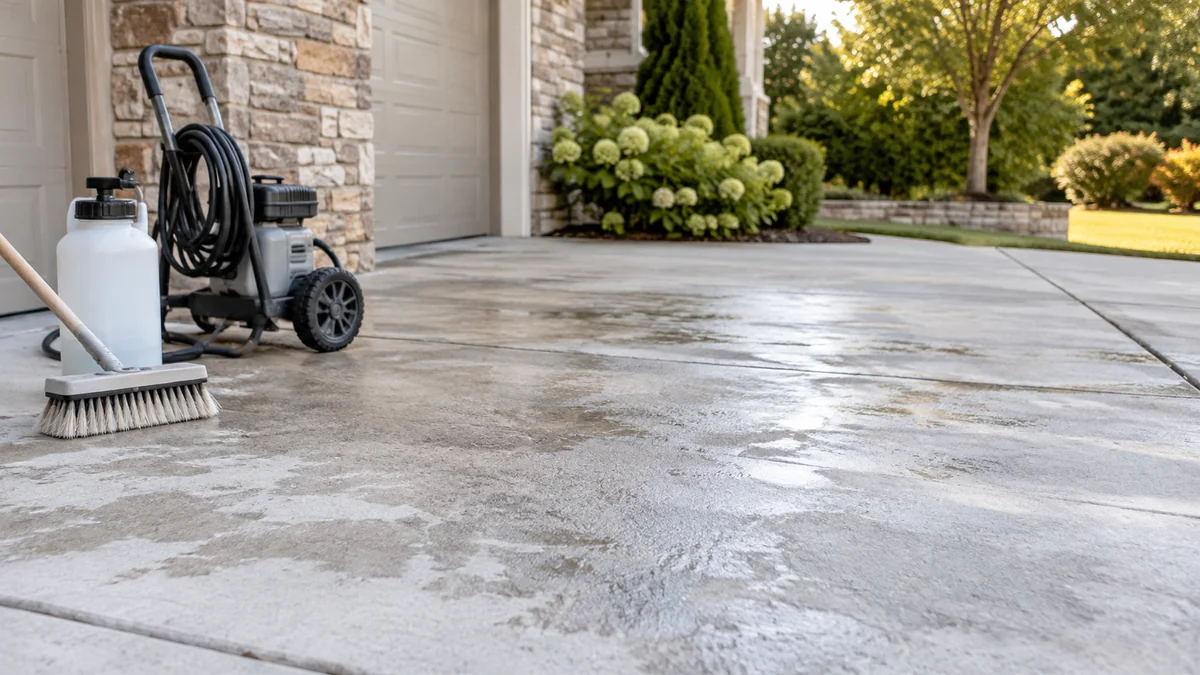
Wait at least 24-48 hours after pressure washing under warm, dry, ventilated conditions, then verify dryness rather than relying only on elapsed time. Thick slabs, shaded areas, high humidity, and porous joints can require longer. A plastic sheet screen or the coating manufacturer’s moisture test provides a better decision than a fixed recoat interval.
Can you seal old concrete immediately after cleaning?
Old concrete can sometimes be sealed after cleaning once the surface is dry, sound, contaminant-free, and within the product’s moisture limits. Age alone does not guarantee readiness. Oil, salts, old acrylic, curing compounds, and vapor from the subgrade can still prevent adhesion on a decades-old slab.
Does sealing concrete make it waterproof?
Sealing concrete reduces water absorption or forms a protective film, but most sealers do not make a slab waterproof against hydrostatic pressure. Cracks, joints, porous edges, and water beneath the slab remain potential entry paths. Drainage, crack repair, and vapor control must address those conditions before coating.
Is a concrete sealer required after 28 days?
Concrete does not require sealer solely because it reached 28 days. A driveway may benefit from reduced water and salt absorption, while an interior utility slab may need no coating. Select a sealer when its protection or appearance justifies the maintenance, cost, and preparation requirements.
What should you do if concrete is still wet after 28 days?
Find the moisture source before applying a dense sealer. Check drainage, plumbing, vapor transmission, indoor humidity, and slab temperature, then retest after correcting the condition. If the project cannot wait, use a manufacturer-approved moisture-mitigation primer or breathable system, not an ordinary topical sealer applied over a failed moisture test.
The Bottom Line
For how long to wait for concrete to dry before sealing, use 28 days as the standard minimum curing period for new concrete, but do not treat day 28 as automatic approval. Distinguish curing from drying, test moisture, prepare the surface, and match the product to the slab’s location and vapor conditions. A breathable exterior sealer may tolerate more moisture than epoxy, while a garage coating demands documented substrate readiness.