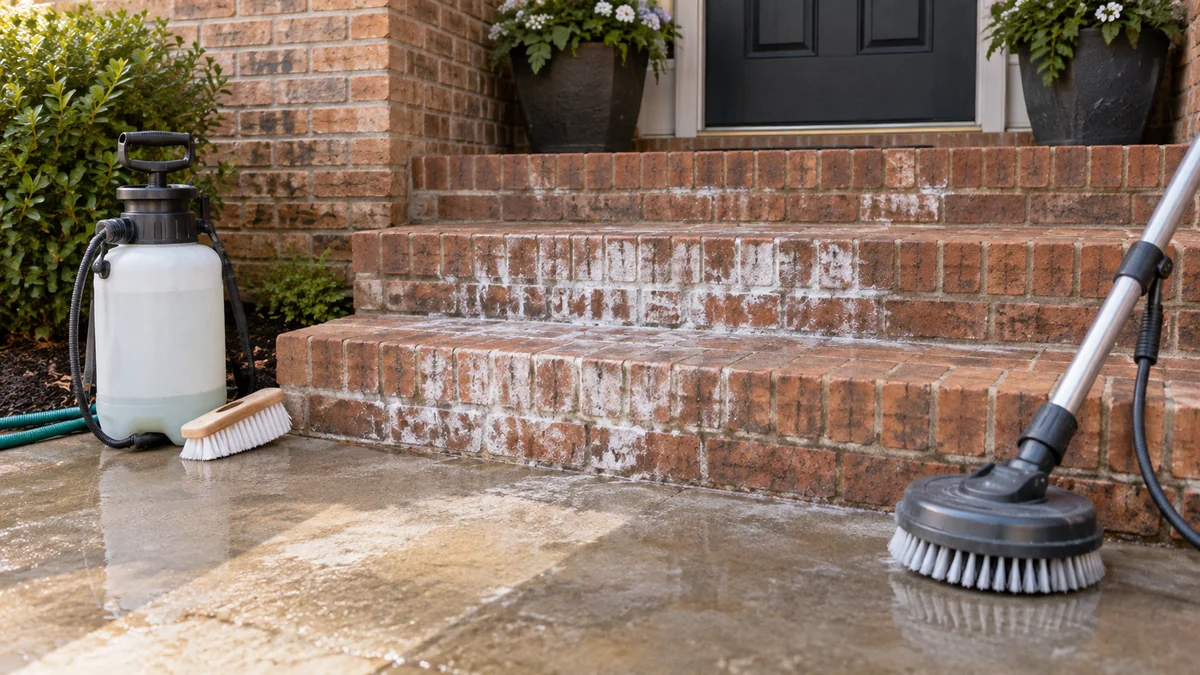
To remove efflorescence, dry-brush the loose white crystals from clean, dry brick or concrete, correct the moisture source, and use the mildest suitable cleaner for any bonded residue. Presoak masonry before a wet cleaner, scrub with nylon, rinse thoroughly, and wait for complete drying before deciding whether a second treatment or breathable sealer is appropriate.
Key Facts
Efflorescence is a surface deposit of crystallized, water-soluble salts carried through porous masonry by moisture.
Dry brushing is the safest first treatment because it removes loose salts without adding water to the pores.
Cleaning cannot permanently stop efflorescence while leaking gutters, poor drainage, rising damp, or cracked joints continue supplying moisture.
Vinegar may help with light deposits, but hardened calcium carbonate often needs a purpose-made masonry cleaner.
Muriatic acid can etch concrete, weaken mortar, corrode metal, and damage colored or historic masonry.
Spalling, flaking, hollow-sounding brick, or recurring heavy deposits require moisture diagnosis and often professional masonry repair.
What Is Efflorescence and Why Does It Form?
Efflorescence is a chalky white or pale-gray salt deposit left on brick, concrete, mortar, stone, or masonry block after moisture evaporates at the surface. The process requires soluble salts, water to dissolve them, and connected pores or cracks that allow the salt solution to migrate outward.
Rainwater, groundwater, construction moisture, and plumbing leaks can all transport salts. Common sources include cement compounds, mortar, brick ingredients, concrete admixtures, deicing salts, fill soil, and contaminated water.
Efflorescence is usually cosmetic rather than toxic or structural. The exception is subsurface crystallization, sometimes called cryptoflorescence, which can create pressure inside pores and contribute to face loss, flaking, or spalling.
Is the White Powder Efflorescence or Something Else?
A dry, non-greasy powder that wipes away from porous masonry is likely efflorescence, but appearance alone cannot confirm the diagnosis. Mold usually has a fuzzy or blotchy appearance and grows where organic residue and persistent dampness exist; efflorescence forms angular or dusty crystals.
| Deposit | Appearance | Simple test | Main response |
|---|---|---|---|
| Primary efflorescence | Loose, bright white powder | Dry brush removes most residue | Brush, collect, monitor moisture |
| Calcium carbonate deposit | Hard white or gray crust | Water does little; surface feels bonded | Test mild masonry cleaner |
| Mold or algae | Green, black, brown, or fuzzy growth | Organic cleaner affects color or odor | Address dampness and use suitable biocide |
| Paint, mortar, or lime residue | Thick smear or irregular hardened spots | Deposit may resist brushing and water | Identify coating or construction residue |
| Cryptoflorescence damage | Flaking face, cracks, spalling | Brick sounds hollow or sheds pieces | Stop moisture and obtain masonry assessment |
A useful field test is to collect a small dry sample and place it in a glass of warm water. Efflorescence commonly dissolves partly or completely, although hardened carbonate deposits may not. The test does not replace a professional analysis when masonry is deteriorating.
Which Type of Efflorescence Do You Have?
Primary efflorescence is usually loose and water-soluble, while secondary deposits are harder and often contain calcium carbonate. Subsurface salt damage is the most serious form because the visible surface may be only the endpoint of internal deterioration.
| Type | Typical timing | Hardness and solubility | Typical treatment |
|---|---|---|---|
| Primary salts | Days to months after construction | Soft, powdery, often water-soluble | Dry brushing and moisture control |
| Secondary carbonate crust | Months or years later | Hard, bonded, poorly soluble in plain water | Mild or buffered masonry cleaner |
| Subsurface crystallization | Any age with persistent dampness | Internal pressure damages pores | Moisture repair and masonry assessment |
| Deicing-salt residue | Winter or spring exposure | Powder or streaks near paving | Dry removal, controlled rinsing, drainage repair |
New concrete, mortar, and brickwork may release construction moisture for months. A small amount of early efflorescence can decline as the assembly dries, but repeated deposits after rain indicate an active water route rather than a one-time curing event.
Before You Start: Time, Tools, and Safety
A small outdoor area usually takes 2-4 hours of active work and 24-48 hours of drying time. Typical DIY material cost is $10-$75, depending on whether dry brushing, vinegar, or a specialty cleaner is needed.
| Requirement | Typical specification | Why it matters |
|---|---|---|
| Stiff brush | Nylon or natural fiber, 6-10 inches wide | Removes salts without metal staining |
| Sprayer | Plastic pump sprayer or watering can | Distributes cleaner evenly |
| Water supply | Garden hose with adjustable nozzle | Provides controlled rinsing |
| PPE | Chemical-resistant gloves, goggles, long sleeves | Protects skin and eyes |
| Cleaner | White vinegar or labeled masonry cleaner | Matches deposit severity |
| Protection | Plastic sheeting and painter’s tape | Shields glass, plants, and metal |
Wear eye protection whenever brushing or spraying. Keep children and pets away from the work area, and never mix acids with bleach, ammonia, or other cleaners. Protect aluminum, galvanized steel, natural stone, painted surfaces, plants, and nearby soil from runoff.
Test every cleaner on an inconspicuous area first. Wait until the test patch dries because color change and etching may become more visible after evaporation.
How to Remove Efflorescence From Brick and Concrete
The safest procedure has six stages: identify moisture, dry-brush loose salts, prepare the surface, apply the least aggressive cleaner, rinse without damaging masonry, and recheck after drying. Cleaning succeeds only when the masonry surface is treated without driving additional contaminated water into the substrate.
Step 1: Find and Correct the Moisture Source
Inspect gutters, downspouts, flashing, roof edges, hose bibs, irrigation, window joints, foundation drainage, and cracked mortar before wet cleaning. Look for deposits below a downspout, along a slab edge, beneath a window, or in a horizontal band that corresponds to rising damp.
Common corrective actions include extending downspouts at least several feet from the foundation, repairing failed caulk and flashing, repointing open joints with compatible mortar, correcting soil slope, and repairing plumbing leaks. Do not seal over an actively damp wall.
Moisture clues and likely causes
| Pattern | Likely water route | First inspection |
|---|---|---|
| Vertical streak below roofline | Gutter or flashing failure | Gutter joints and roof drainage |
| White band near floor or foundation | Rising damp or poor grading | Soil level, drainage, vapor conditions |
| Deposit around window | Failed sill, flashing, or sealant | Window perimeter and sill slope |
| Repeated patch on interior wall | Plumbing or condensation | Pipes, humidity, exterior wall temperature |
| Powder on pavers after winter | Deicing salt or poor drainage | Joint sand, runoff path, slab slope |
A cleaner removes residue, not the cause. If deposits return after one or two dry weather cycles, treat recurrence as diagnostic evidence.
Step 2: Dry-Brush and Collect Loose Crystals
Brush the completely dry surface with firm, overlapping strokes, working from the top downward. Collect the powder in a dustpan or disposable cloth instead of rinsing it into adjacent soil, joints, or floor drains.
Dry brushing is effective for primary efflorescence because loose crystals are mechanically detached before water dissolves them. Use a nylon brush on brick and concrete; avoid steel or wire brushes, which can scratch faces, remove mortar fines, and leave iron particles that later rust.
You will know this step worked when the loose haze is gone and only bonded streaks or crust remain. A common mistake is hosing the wall immediately, which can redissolve salts and transport them deeper into pores.
Step 3: Protect Surrounding Materials and Presoak
Cover nearby plants, glass, aluminum, painted trim, and sensitive flooring. If a wet cleaner is necessary, saturate the masonry with clean water from the bottom upward until the surface is uniformly damp but not producing heavy runoff.
Presoaking fills some pore space with clean water, reducing the amount of cleaner absorbed into the brick or concrete. Use low pressure. A pressure washer set too aggressively can erode mortar joints and open pathways for later water entry.
Do not presume that one pressure setting suits every wall. Weak historic brick and soft mortar can be damaged below settings that appear safe on modern concrete.
Step 4: Choose the Mildest Effective Cleaner
Select the cleaner according to deposit hardness, substrate, color, and age. Apply a small test patch first, follow the product label, and never assume that a stronger acid produces a better result.
| Method | Best use | Typical dwell | Main limitation |
|---|---|---|---|
| Dry nylon brushing | Loose primary salts | No dwell | Does not remove hard crust |
| White vinegar, 5% acetic acid | Light bonded residue | About 5-15 minutes | Slow on thick carbonate deposits |
| Buffered masonry cleaner | Moderate deposits and colored concrete | About 5-15 minutes | Costs more than household vinegar |
| Muriatic acid | Severe deposits on compatible uncolored masonry | About 3-5 minutes maximum | High risk of etching and corrosion |
For a light deposit, use white distilled vinegar diluted 1:1 with water, unless the product or substrate manufacturer gives different instructions. Apply with a plastic sprayer, keep the surface wet during the short dwell period, scrub with nylon, and rinse completely.
Vinegar is not a universal masonry cleaner. It may fail against thick calcium carbonate, and repeated acid exposure can affect cementitious surfaces. A buffered, non-muriatic efflorescence cleaner is generally easier to control on colored concrete, pavers, and visible brick façades.
Step 5: Apply, Agitate, and Rinse
Apply the cleaner from the bottom upward so dirty solution does not run across a dry, untreated surface. Work in small sections, keep the product from drying, and scrub stubborn deposits with a nylon brush after the label-specified dwell time.
Rinse from the top downward with a garden hose or controlled low-pressure rinse. Use enough water to remove cleaner and dissolved salts, but avoid forcing runoff into wall cavities, cracks, or the foundation.
Neutralization depends on the product. Follow the label rather than automatically applying baking soda, because some proprietary cleaners specify a particular neutralizer or require only thorough rinsing. Never neutralize an unknown chemical with another product.
You will know the section is adequately rinsed when no foam, slickness, odor, or visible cleaner remains. A common mistake is allowing acid to dry on the surface, which can leave streaks and increase etching.
Step 6: Dry and Recheck the Masonry
Allow the cleaned surface to dry naturally for 24-48 hours before judging the result. Avoid applying a sealer for at least three days after heavy washing, and extend the drying period when weather is cool, shaded, humid, or rainy.
New white powder after drying does not automatically mean the cleaner failed. It may show that moisture is still carrying salts from the wall interior. Brush the renewed deposit dry, document its location, and compare it with the suspected water route.
If the same area blooms repeatedly, inspect drainage and joints before repeating chemical treatment. Repeated acid applications can progressively remove cement paste and change the surface texture.
Which Removal Method Is Safest?
Dry brushing is safest for loose powder, diluted vinegar is reasonable for light bonded residue, and buffered specialty cleaners provide better control for moderate deposits. Muriatic acid belongs near the end of the decision tree and is unsuitable for many colored, historic, weak, or metal-adjacent surfaces.
Brick
Modern, sound brick can often tolerate dry brushing and a carefully tested mild cleaner. Avoid aggressive pressure and strong acid on soft brick, deteriorated joints, handmade historic brick, or masonry with lime mortar.
Concrete
Plain gray concrete generally tolerates more cleaning than colored or decorative concrete, but acid can change texture and shade. Acid-sensitive finishes, exposed aggregate, integral color, stamped patterns, and sealers require a test patch and manufacturer guidance.
Pavers
Concrete pavers may show both efflorescence and joint-sand residue. Use a paver-compatible product, control runoff, and avoid leaving acid in joints where it can affect sand, polymeric binders, or nearby vegetation.
Historic masonry
Historic brick and lime mortar need conservation treatment rather than routine acid washing. Start with dry brushing and low-pressure water only when appropriate, and consult a mason experienced with historic buildings before using any acid.
Why Muriatic Acid Is Usually a Last Resort
Muriatic acid can dissolve stubborn mineral crusts quickly, but it can also etch concrete, bleach colored surfaces, corrode metal, burn skin, create hazardous fumes, and weaken mortar. The chemical is not a default upgrade from vinegar or a specialty cleaner.
If a qualified professional specifies hydrochloric acid for compatible, uncolored masonry, the professional should control dilution, ventilation, runoff, PPE, dwell time, and neutralization. Never pour concentrated acid onto dry masonry, mix acid with bleach, or use it near enclosed spaces, metal fixtures, or sensitive landscaping.
A failed acid treatment may leave permanent pale patches or a rougher surface even after the white residue disappears. Removing the stain is not a success if the masonry face or joint has been damaged.
Can You Pressure-Wash Efflorescence?
Pressure washing can rinse cleaned masonry, but close-range high pressure is a poor first treatment for efflorescence. The spray can drive water and dissolved salts into pores, erode mortar, remove the face of soft brick, and create new water-entry paths.
Use a garden hose or low-pressure rinse for most residential work. If professional pressure washing is necessary, the operator should adjust pressure, nozzle distance, spray pattern, and flow to the substrate, then test an inconspicuous area.
Pressure washing also cannot correct rising damp, failed flashing, leaking gutters, or poor grading. It may make the wall look clean for a short period while increasing future moisture entry.
Should You Seal Brick or Concrete After Cleaning?
Seal masonry only after the moisture source is corrected, the surface is clean, and the substrate has dried completely. A breathable, penetrating silane or siloxane water repellent is generally more appropriate than a film-forming acrylic on exterior brick and concrete.
| Sealer type | Typical behavior | Appropriate use | Main risk |
|---|---|---|---|
| Silane penetrant | Repels liquid water while allowing vapor movement | Sound exterior brick and concrete | Limited benefit on cracked joints |
| Siloxane penetrant | Water repellent with deeper pore treatment | Porous masonry exposed to rain | Requires clean, dry substrate |
| Acrylic film | Forms a surface coating | Selected decorative concrete systems | Can trap moisture and alter gloss |
| Epoxy coating | Dense surface barrier | Specialized dry concrete applications | Poor choice for damp masonry |
A sealer cannot stop efflorescence caused by groundwater pressure or interior leaks. Applying a dense film over damp salts can trap moisture and increase blistering, peeling, or subsurface damage.
Common Mistakes and How to Fix Them
Hosing loose powder immediately
Problem: Water dissolves surface salts and carries them back into pores.
Recovery: Allow the masonry to dry, dry-brush again, collect the residue, then address the moisture route.
Using a wire brush
Problem: Steel bristles can scratch masonry, remove joint material, and leave rust-producing fragments.
Recovery: Stop brushing, vacuum loose metal particles, and use nylon for remaining deposits.
Applying cleaner to dry masonry
Problem: Dry pores absorb cleaner unevenly, increasing staining and chemical attack.
Recovery: Rinse thoroughly, allow the surface to dry, then perform a controlled test with proper presoak.
Letting acid dry
Problem: Dried chemical residue can streak or etch the surface.
Recovery: Follow the product’s emergency rinse directions and assess the test area after drying.
Sealing active efflorescence
Problem: A film-forming sealer can trap water and salts.
Recovery: Remove failing coating where appropriate, correct moisture, clean, and allow extended drying before resealing.
Ignoring spalling
Problem: Flaking faces and crumbling brick may indicate internal crystallization or freeze-thaw damage.
Recovery: Stop aggressive cleaning and obtain a masonry inspection before more water or chemical treatment is applied.
Cost, Time, and Professional Help
Typical DIY cleaning costs range from $10-$20 for brushes and vinegar to $30-$75 for a specialty cleaner, protective materials, and PPE. Professional masonry cleaning commonly costs about $0.30-$1.60 per square foot, with small jobs often subject to minimum charges of approximately $150-$250.
| Project type | Typical active time | Typical material or service cost | Difficulty |
|---|---|---|---|
| Small loose deposit | 30-90 minutes | $10-$20 | Low |
| Light vinegar treatment | 2-4 hours | $15-$30 | Moderate |
| Specialty cleaner, 200 square feet | 3-6 hours | $30-$75 | Moderate |
| Professional exterior cleaning | 1-2 days scheduling | $0.30-$1.60 per square foot | Professional |
| Moisture and masonry repair | Several days to weeks | Site-dependent | Professional assessment |
Hire a qualified professional when brick is historic, mortar is soft or lime-based, the wall is interior and damp, the area is extensive, deposits return repeatedly, or masonry is cracking and spalling. Cleaning is not a substitute for structural repair.
Situational Variations
Indoor brick or concrete
Do not saturate an interior wall until you understand the water source and have a plan for drying. Ventilation, dehumidification, plumbing inspection, and controlled spot cleaning are more important indoors because trapped moisture can damage finishes and framing.
Newly built masonry
Small deposits during the first months may decline as construction moisture leaves the assembly. Dry-brush first, monitor after dry weather, and ask the builder or masonry contractor to investigate if deposits become extensive or recur after every rain.
Colored or decorative concrete
Avoid untested acid because it can create lighter patches, alter aggregate exposure, or damage an existing sealer. Use a compatible cleaner and test in a hidden location until the surface dries.
Masonry beside metal
Protect aluminum, steel, galvanized flashing, and painted trim from acidic runoff. Even a short exposure can stain or corrode metal, especially where residue remains in seams.
FAQ
Is efflorescence harmful to people?
Ordinary exterior efflorescence is usually a mineral deposit rather than a biological hazard. Loose powder can irritate eyes or airways during brushing, so wear goggles and avoid creating airborne dust. Health concerns increase when the deposit accompanies mold, sewage contamination, chemical spills, or persistent indoor dampness.
Can baking soda remove efflorescence?
Baking soda is not a primary efflorescence remover. It is commonly used as a neutralizing material for certain acidic residues, but it will not reliably dissolve hardened calcium carbonate or solve moisture migration. Follow the cleaner label because neutralization requirements differ among products.
How long does efflorescence take to disappear naturally?
Light primary efflorescence may decline over several weeks or months as masonry dries and weather removes surface salts. Natural weathering does not solve active leaks, rising damp, or poor drainage. Recurrence after rain indicates that moisture control remains necessary.
Can efflorescence be painted over?
Painting over active efflorescence is usually premature. Salts and moisture can cause blistering, peeling, and discoloration beneath the coating. Clean the surface, repair water entry, verify dryness, and use a masonry-compatible breathable coating only when the manufacturer permits it.
Does efflorescence mean concrete or brick is failing?
Efflorescence alone does not prove structural failure. It does indicate that moisture is moving through porous material. Failure becomes more likely when deposits accompany spalling, face loss, open cracks, hollow-sounding brick, deteriorated mortar, or repeated saturation and freezing.
What is the permanent solution for recurring efflorescence?
The permanent solution is to stop the moisture pathway, not repeatedly remove the residue. Repair drainage, flashing, gutters, plumbing, grading, or joints as appropriate, then clean the surface with the least aggressive effective method and monitor it through subsequent wet weather.
The Bottom Line
Remove efflorescence by dry-brushing first, diagnosing the moisture source, and escalating from diluted vinegar to a buffered masonry cleaner only when the residue remains bonded. Reserve muriatic acid for professionally controlled, compatible applications. The lasting solution to how to remove efflorescence (white powder) from brick and concrete is moisture control, careful cleaning, complete drying, and breathable protection when the substrate is suitable.