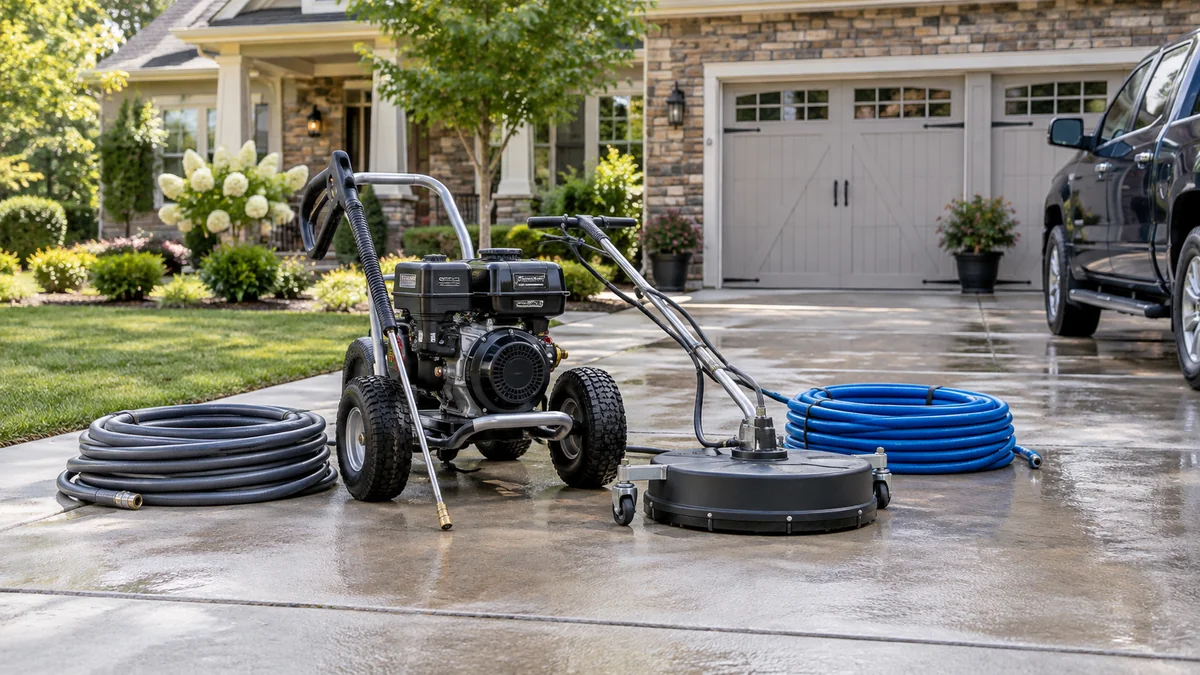
Cheap pressure washing and professional soft washing services differ mainly in how they remove contamination. Cheap pressure washing uses high mechanical force that can damage siding, roofs, paint, and concrete, while professional soft washing uses surface-appropriate chemistry and controlled low-pressure rinsing. For most homes, soft washing costs more initially but reduces damage and biological regrowth risk.
Key Facts at a Glance
- Typical residential pressure-washing quotes range from $99 to $250 for a basic house wash, while professional soft washing commonly costs $400-$900.
- Professional soft washing uses cleaning chemistry, dwell time, and low-pressure rinsing rather than relying on high PSI alone.
- Asphalt shingles, vinyl siding, stucco, EIFS, painted wood, and window screens can suffer permanent damage from excessive pressure.
- Soft washing does not guarantee a fixed two-to-five-year result because climate, shade, roof moisture, and nearby trees control regrowth.
- A responsible contractor protects plants, pets, ponds, windows, electrical equipment, and storm drains before applying chemicals.
- Concrete can tolerate more pressure than siding or roofing, but colored, stamped, cracked, or weak concrete still requires controlled cleaning.
What Is the Difference Between the Two Services?
Cheap pressure washing is a low-price cleaning service that usually depends on water pressure to dislodge dirt and growth. Professional soft washing is a controlled exterior-cleaning process that combines a purpose-selected detergent or biocide with low-pressure application and a thorough rinse.
The word “cheap” describes the business model, not a particular machine. A reputable contractor may use a pressure washer for concrete and still soft wash siding. Conversely, an inexperienced operator may advertise “soft washing” while applying excessive pressure through a narrow nozzle. The equipment label matters less than the pressure at the surface, chemical control, operator training, and protection procedures.
How the Two Methods Work
Pressure washing transfers kinetic energy from a narrow water stream into the surface. That force can remove mud, loose paint, tire marks, and some surface algae, but it may leave viable biological material in pores and joints.
Soft washing allows chemistry to break down organic contamination during a controlled dwell period. The operator then rinses dead material away with lower-pressure, higher-volume water. Sodium hypochlorite is common for organic growth, while surfactants improve cling and detergents help with oils or general soil. The correct product and concentration depend on the surface, contamination, temperature, and runoff constraints.
Master Comparison: Price, Risk, and Results
| Decision factor | Cheap pressure washing | Professional soft washing |
|---|---|---|
| Typical whole-house price | $99-$250 | $400-$900 |
| Common surface pressure | 2,000-4,000 PSI advertised | Approximately 40-300 PSI at surface |
| Typical commercial water flow | 1.5-2.5 GPM consumer equipment | 4-10 GPM dedicated equipment |
| Main cleaning mechanism | Mechanical impact | Chemistry, dwell time, controlled rinse |
| Roof suitability | Unsafe for asphalt shingles | Usually appropriate when properly performed |
| Biological regrowth control | Variable, often limited | Better when chemistry reaches the growth |
| Damage exposure | High on fragile materials | Lower, but chemical and runoff risks remain |
| Typical house-wash duration | 4-8 hours | 1.5-3 hours, depending on access and size |
These ranges are typical U.S. residential figures, not universal prices or technical standards. A quote can change substantially with roof pitch, access, regional labor costs, oxidation, heavy moss, detached structures, and required plant protection.
How Do PSI and GPM Affect Risk?
PSI measures pressure, while GPM measures water volume. PSI influences impact force, but GPM determines how quickly contamination and residue move away. A high-GPM system can clean efficiently at lower pressure, whereas a low-GPM consumer machine may encourage an operator to hold a narrow nozzle close to the surface.
Surface pressure is more important than the machine’s maximum rating. Nozzle type, distance, angle, flow, and dwell time change the force delivered to siding or concrete. A machine labeled 4,000 PSI does not automatically apply 4,000 PSI at the wall, but a close-range zero-degree or fifteen-degree nozzle can still cause severe damage.
How Do Professional Soft Washing Services Work?
Professional soft washing typically follows six stages: inspection, protection, solution selection, low-pressure application, dwell, and controlled rinsing. A competent technician adjusts the process for the material instead of applying one “hot mix” to every surface.
First, the technician identifies paint condition, oxidation, loose caulk, failed window seals, roof damage, outdoor outlets, vents, landscape beds, ponds, and storm drains. Plants are pre-wet with fresh water, and vulnerable items are covered or moved.
Next, the technician selects a cleaning solution. Sodium hypochlorite may kill algae, mold, mildew, moss, and lichen, but the concentration must be appropriate for the material and contamination. Surfactants help the solution cling to vertical siding. Stronger is not automatically better.
The solution remains on the surface for a controlled dwell period, often about 5-20 minutes. The operator prevents drying, watches runoff, and applies additional solution only where needed. A low-pressure rinse removes dead growth and residue, followed by another plant rinse. Fish ponds, delicate plants, and storm drains require additional controls.
What Professional Soft Washing Is Not Good For
Soft washing is not a universal stain remover. It may kill organic growth without removing rust, oil, artillery fungus, tannin stains, hard-water deposits, efflorescence, or deeply embedded tire marks. Those contaminants require separate chemistry or mechanical methods.
Soft washing also cannot repair rotten wood, failed paint adhesion, broken shingles, cracked mortar, leaking flashing, or deteriorated sealant. Cleaning a damaged surface can make the defect more visible. A responsible contractor records those conditions before starting.
What Does Each Service Cost?
A typical professional soft-washing quote for a 2,000-square-foot home falls around $400-$900, while roof cleaning often costs $500-$1,200. A low-price pressure-washing quote may begin near $99 but can exclude gutters, detached buildings, heavy growth, chemical treatment, plant protection, or difficult access.
| Project type | Cheap pressure-washing quote | Professional soft-washing range | Major price variables |
|---|---|---|---|
| Small vinyl house wash | $99-$175 | $250-$500 | Story count, oxidation, access |
| 2,000-square-foot house | $150-$250 | $400-$900 | Siding type, growth, landscaping |
| Asphalt-shingle roof | $250-$600 | $500-$1,200 | Pitch, moss, height, runoff |
| Concrete driveway | $100-$250 | $150-$400 | Square footage, oil, surface condition |
| Stucco or EIFS | $200-$400 | $400-$900 | Cracks, coatings, low-pressure access |
| Detached garage or patio | $75-$200 | $150-$350 | Size, drainage, staining |
An unusually cheap price may reflect efficient routing, a small service area, or a legitimate introductory offer. It may also indicate no insurance, no chemical treatment, minimal preparation, or a rushed operator. Price alone cannot establish quality, but an itemized scope can reveal what the price excludes.
When Does the Higher Price Pay Off?
The higher price usually pays off when the surface is fragile, elevated, expensive to replace, or heavily affected by biological growth. Roofs, painted siding, stucco, EIFS, wood, and older windows carry more downside risk than a plain concrete slab.
A $150 shortcut can become a $1,000-plus repair if pressure strips roof granules, forces water behind siding, damages paint, or breaks a window seal. Soft washing is not automatically damage-proof, because harsh chemistry, poor rinsing, and careless overspray can injure plants or discolor materials. The value comes from controlled technique, not the marketing term.
Which Surfaces Need Soft Washing?
Roofing and wall cladding generally need low-pressure cleaning, while sound uncoated concrete can often tolerate pressure washing. Surface condition changes the recommendation, so contractors should inspect before choosing a method.
| Surface | Preferred approach | Typical pressure guidance | Main warning |
|---|---|---|---|
| Asphalt shingles | Chemical treatment, low-pressure rinse | Under approximately 100 PSI at surface | Granule loss and warranty concerns |
| Vinyl siding | Soft wash and low-pressure rinse | Approximately 40-150 PSI | Water behind laps and oxidation |
| Stucco | Low-pressure wash with suitable chemistry | Approximately 50-150 PSI | Cracks and water intrusion |
| EIFS or Dryvit | Very gentle soft wash | Approximately 40-100 PSI | Delamination and trapped moisture |
| Painted wood | Low-pressure cleaning | Approximately 50-150 PSI | Paint stripping and fiber damage |
| Sound plain concrete | Controlled pressure washing | Often 2,000-3,500 PSI | Etching and striping |
| Colored or stamped concrete | Low pressure plus testing | Often below plain-concrete settings | Color loss and sealer damage |
Can Pressure Washing Damage an Asphalt Roof?
High-pressure washing can remove protective granules from asphalt shingles, shorten roof life, and invalidate manufacturer warranty coverage. Asphalt roofs should generally receive a manufacturer-compatible low-pressure chemical treatment, with moss physically removed only through methods that do not scrape or lift shingles.
The Asphalt Roofing Manufacturers Association has long warned against power-washing asphalt shingles because aggressive force can damage the roofing surface. Contractors should follow the shingle manufacturer’s care instructions rather than relying on a generic PSI number.
Why Does Concrete Show Swirl Marks?
Concrete shows swirl marks when a handheld wand creates uneven impact across the cement paste. The circular pattern becomes especially visible on large driveways after the surface dries.
A professional surface cleaner distributes water through rotating nozzles at a consistent height. Even that tool requires correct pressure, overlapping passes, and post-treatment rinsing. Existing etching cannot usually be erased by more pressure. Additional blasting often enlarges the damaged area.
What Damage Can Cheap Pressure Washing Cause?
Cheap pressure washing can cause visible surface damage and hidden water intrusion when the operator uses excessive pressure, a narrow nozzle, poor spray angles, or inadequate inspection. The most serious failures occur when a technician treats fragile siding or roofing like a concrete driveway.
Common failure modes include:
- Siding intrusion: Spraying upward beneath vinyl laps can push water behind the cladding, where it may wet sheathing or insulation.
- Paint stripping: Close-range pressure can remove failing paint and gouge soft wood fibers.
- Window damage: High impact can tear screens, disturb glazing, or expose weak seals.
- Roof granule loss: Pressure can remove the mineral surface from asphalt shingles.
- Concrete etching: Uneven wand movement can permanently scar the cement cream.
- Plant injury: Soft-wash chemicals that dry on leaves can cause browning or defoliation.
An experienced operator tests an inconspicuous area first. That small test can reveal oxidation, loose paint, dye instability, weak mortar, or incompatible coatings before the entire elevation is treated.
How Long Will the Cleaning Result Last?
A professionally cleaned exterior may remain visibly cleaner for one to five years, but no contractor can guarantee a universal lifespan. Shade, humidity, tree cover, roof orientation, rainfall, pollution, and surface porosity determine how quickly algae and mildew return.
| Condition | Typical visible-clean interval | Why it changes |
|---|---|---|
| Sunny vinyl siding with limited trees | 2-4 years | Faster drying and less spore retention |
| Shaded north-facing siding | 1-2 years | Persistent moisture supports regrowth |
| Asphalt roof with heavy tree cover | 1-3 years | Organic debris and shade remain |
| Exposed concrete driveway | 1-3 years | Traffic, soil, and weather add contamination |
| Coastal or humid property | 1-2 years | Higher moisture and airborne growth pressure |
Soft washing improves biological control because it treats contamination rather than only scraping its visible layer. It does not create a permanent antimicrobial surface. Gutter cleaning, branch pruning, drainage correction, and roof ventilation may extend the result more effectively than simply increasing chemical strength.
How Can You Compare Contractors Fairly?
Compare contractors by scope, surface method, safeguards, insurance, and documentation rather than by headline price. A legitimate quote should identify the areas being cleaned, excluded repairs, expected process, protection measures, and final price.
Ask each contractor these questions:
- What pressure will reach each surface?
- Will the roof receive pressure, and if so, why?
- What products will be used on siding, roof, concrete, or stucco?
- How will plants, pets, ponds, windows, and outdoor furniture be protected?
- Who controls runoff near storm drains?
- Does the company carry general liability and workers’ compensation insurance?
- Are repairs, oxidation, rust, oil, and permanent stains excluded?
- Will the contractor provide before-and-after photographs?
- What happens if a previously hidden defect becomes visible?
- Is the price fixed, itemized, and inclusive of setup and cleanup?
The contractor’s answers should match the material. A person who recommends one high-pressure setting for roof shingles, vinyl siding, stucco, and concrete has not performed a meaningful surface assessment.
Warning Signs in a $99 Quote
A $99 house-wash offer deserves careful review because the advertised price may cover only a small frontage or a limited rinse. Warning signs include no written scope, no proof of insurance, refusal to identify chemicals, pressure-washing roof shingles, no plant-protection plan, and payment demanded before inspection.
Low price is less concerning when the job is genuinely small, such as a short concrete walkway. It is more concerning when the quote covers a large two-story home, roof, gutters, detached structures, and heavy growth without measurements or exclusions.
What Can a Homeowner Safely Do?
A homeowner can handle light dirt on a small, accessible concrete area with a garden hose, mild detergent, eye protection, and a suitable surface-cleaning tool. Roofs, ladders, electrical equipment, fragile cladding, and chemical mixing create substantially higher risk.
For a low-cost house-wash alternative, use a labeled exterior-cleaning product exactly as directed, test a hidden area, protect plants with pre-wetting, keep windows closed, and rinse thoroughly. Never mix sodium hypochlorite with acids, ammonia, or other cleaners. Chemical labels and local discharge rules control safe handling.
Do not climb a roof with a pressure washer. Do not use a ladder while managing a reactive spray wand. If the roof has moss, damaged shingles, steep pitch, or nearby power lines, hire an insured contractor.
Which Method Should You Choose?
Choose Soft Washing for Roofs and Fragile Cladding
Choose professional soft washing when the project includes asphalt shingles, vinyl siding, stucco, EIFS, painted wood, or heavy organic growth. The method minimizes mechanical force and gives the contractor a way to treat the biological source.
Choose Controlled Pressure Washing for Sound Concrete
Choose pressure washing for plain, structurally sound concrete when the goal is removing mud, tire marks, loose dirt, or surface deposits. Require a surface cleaner, test area, and reasonable pressure rather than accepting maximum machine PSI.
Choose Repair Before Cleaning for Failed Surfaces
Choose repair or replacement before cleaning when wood is rotten, shingles are brittle, paint is peeling extensively, mortar is missing, or stucco is cracked. Cleaning cannot restore structural integrity, and water or chemicals can make an existing failure worse.
Choose a Qualified Professional for High-Value Properties
Choose an insured, experienced contractor when the property has expensive landscaping, multiple stories, difficult drainage, fragile materials, or a roof warranty. The extra cost buys process control and a clearer remedy if something goes wrong.
The Bottom Line
Cheap pressure washing and professional soft washing services are not equivalent purchases. High-pressure cleaning may be appropriate for sound concrete, but it is a poor default for roofs, siding, stucco, EIFS, painted wood, and other vulnerable surfaces. Professional soft washing normally costs more, yet its low-pressure process, biological treatment, plant protection, and surface-specific decisions reduce the risk of expensive damage.
The best choice depends on the material, contamination, access, and contractor competence. Compare written scopes rather than slogans, and treat a $99 whole-house quote as an invitation to inspect exclusions, insurance, and technique before accepting the apparent bargain.
Frequently Asked Questions
Is Soft Washing Better Than Pressure Washing for Mold?
Soft washing is generally better for mold and mildew on building exteriors because appropriate chemistry can kill biological growth while low-pressure water removes the residue. Pressure alone may remove the visible film without treating growth in pores or seams. Moisture problems, shade, and poor drainage can still cause mold to return.
Can Soft Washing Remove Black Streaks From Roof Shingles?
Soft washing can usually remove black streaks caused by roof algae when the solution is compatible with the shingles and applied without damaging granules. Black streaks can also reflect aged materials or embedded staining, so results vary. Contractors should avoid aggressive brushing, scraping, and high-pressure rinsing on asphalt roofing.
Does Soft Washing Damage Plants?
Soft washing can damage plants when chemical solution dries on leaves, enters soil at high concentration, or reaches sensitive species. Professional protection includes pre-wetting, shielding, controlled application, runoff management, and post-rinsing. Homeowners should identify delicate plants, fish ponds, edible gardens, and irrigation systems before work begins.
Should I Pressure Wash a Vinyl Siding House?
You should not automatically pressure wash vinyl siding with high pressure. Low-pressure application and rinsing are safer because force directed beneath siding laps can cause water intrusion, while close-range spray can damage oxidation and seals. A contractor should spray downward or across the surface at a controlled pressure after testing.
Does Professional Soft Washing Void a Roof Warranty?
Soft washing does not automatically void a roof warranty, but improper chemicals, pressure, physical abrasion, or unauthorized procedures may conflict with manufacturer instructions. Ask for the shingle manufacturer’s cleaning guidance and use a contractor who documents the method. Warranty terms vary by product and installation date.
How Often Should a House Be Soft Washed?
Many homes need exterior cleaning every one to four years, depending on shade, humidity, tree cover, orientation, and contamination. A sunny property may remain clean longer than a north-facing wall beneath dense trees. Correcting gutter overflow, trimming branches, and improving drainage can extend the interval between cleanings.